
Latest Insights On
GenAI, Tech, and Digital Transformation
Stay updated with expert insights, success stories, and real-world applications of cutting-edge technology.
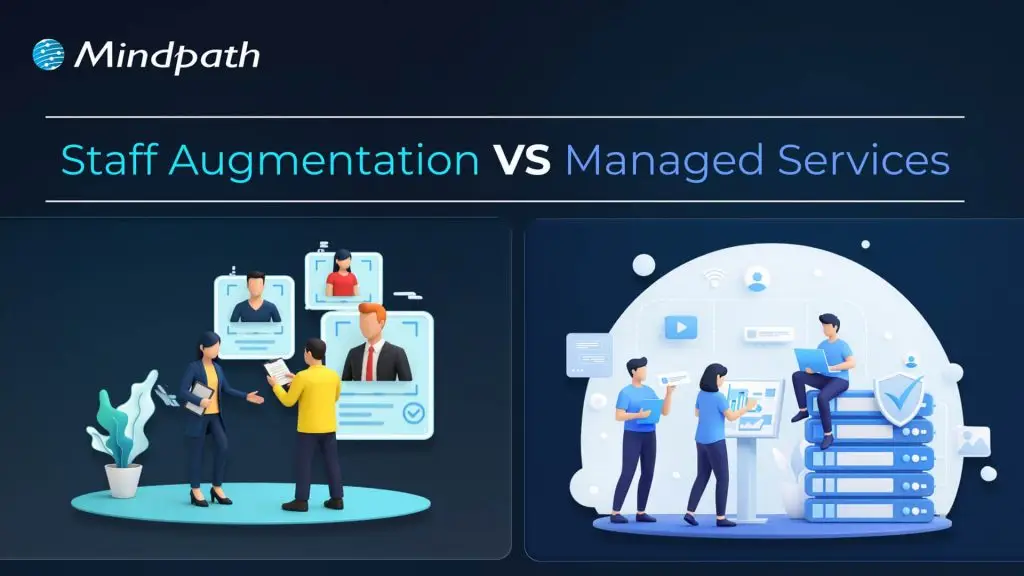
The employees of a company are no doubt the most essential assets. In the recent scenario, businesses have plenty of choices to keep their team more robust and result-oriented. With the rise of remote work and technology, you don’t need to limit your team to a certain geographic location. Further, you can leverage the excellence of the worldwide talent pool.
A number of companies are choosing to outsource their tasks and project development. In fact, the global outsourcing market size is USD 1.02 trillion, and it is going to double by 2031 (Source). In this blog, let us compare two of the most essential outsourcing approaches: staff augmentation vs managed services. This can help you pick the right service that goes well with your company’s structure.
Want a team that can help you to stay competitive with evolving project demands? At Mindpath, we offer staff augmentation services that enable you to scale your workforce efficiently and cost-effectively.
What is Staff Augmentation?
Staff augmentation is a flexible outsourcing strategy where businesses temporarily hire external professionals to fill skill gaps, meet project demands, or scale operations, without the overhead of permanent, full-time hires. The process is quick, and you can augment capacity as per your current team’s needs. You can leverage near-shore, onshore, and offshore talent and scale the team as per the demands.
- When it comes to the IT industry, businesses can use staff augmentation for multiple stages of the development process. Additionally, this includes workflow optimisation, programming, quality assurance, etc.
- This can help you overcome specific challenges while hiring key skills that your internal team may be missing.
- Talking about staff augmentation vs managed services, staff augmentation is cost-effective and offers flexibility.
- It is a temporary solution that accesses your existing team and resources, and gets the benefits of outside talent while reducing the operational charges.
What are Managed Services?
Managed services are an integral approach to software development that allows you to outsource your IT functions to a provider from another region. Moreover, your business can outsource the work virtually to managed IT services. This can include anything from data migration to cybersecurity, and much more.
- Managed service providers don’t integrate with your internal team but operate on their own.
- They can offer you a reliable quote and project timelines. After you approve them, they will start working on the designated task while maintaining continuous communication.
- The managed services model is cost-efficient as it lessens the requirement for overhead and resource management.
- Your company can prioritize other business tasks and can check on the progress instead of assessing the work on a daily basis.
Looking to stay ahead in your hiring strategy with evolving workforce models? Check out the latest staff augmentation trends to learn what’s shaping the future of talent.
What are Some Key Differences between Managed Services vs Staff Augmentation?
To get a detailed knowledge of managed services vs staff augmentation, let us go through some of its key aspects. Here is a table that highlights all the essential features that these models consist of.
| Important Features | Staff Augmentation | Managed Services |
| Benefits | Cost efficiency is one major staff augmentation benefits. | This model leverages a fixed rate and can be your long-term partner. |
| You can have access to a wide range of talented professionals. | Prevents you from the risk of managing in-house teams. | |
| It enables you to scale the team as per project demands. | Provides access to a team with expertise across multiple elements. | |
| Bridges temporary skills gaps. | Allows the internal team to prioritize core operations. | |
| Disadvantages | It is a bit risky to integrate a new team to your existing operations. | Integrating external resources might require extreme knowledge. |
| Risk of dependency on external providers for critical works. | You need to depend on the provider to drive process success. | |
| It needs a strong internal management capacity to handle the external professionals. | No control over your project, team, or the development process. | |
| Flexibility | Your teams can be scaled quickly as per the existing skills gaps. | Flexibility remains limited, and changes might give rise to additional payments. |
| Expertise | It offers access to specific skills or expertise for a required timeframe. | Offers a wide range of expertise and a supportive environment. |
| Responsibility | The client is responsible for your project’s success and workflows. | This model provider owns the project and offers a product as per the agreed requirements. |
| Focus Area | It is task-specific and viable for short-term projects. | It leveraged end-to-end solutions. |
| Customization | This model is fully customizable as per your team dynamics. | Follows the terms that is written on the agreement. |
| Best For | Quick scaling where your workload is heavy. | Suitable for long-term project commitments. |
When Should You Prefer Staff Augmentation Services?
After assessing the staff augmentation benefits and other critical factors, let us understand when you should leverage this outsourcing model.
1. Your Need is Project-Specific
If your requirement is temporary, staff augmentation can help you bring in the specialized talent for a specific time period. Further, you can easily access the services as per your project demands without seeking any long-term commitments.
2. You Need Direct Assessment
When your company has a strong team, staff augmentation allows the external team to work under your supervision. So, this ensures your priorities are fulfilled with quality. Additionally, your existing team’s capabilities will also increase with better insights.
3. You are Handling a Strict Deadline
If your project’s timeline is critical and hiring full-time employees would take too long, staff augmentation provides rapid onboarding of skilled professionals. Further, this can help you maintain your project speed.
Want to avoid common onboarding challenges with external talent? Learn through our augmented staff onboarding guide for a smoother transition.
When Should You Prefer Hiring Managed Services?
Here are the instances where managed IT services can be your utmost preference.
1. You Desire Strategic IT Management
If your organization doesn’t have the leadership to manage all its internal IT operations, managed services can access the experts to take complete responsibility. Moreover, this ensures professional oversight for better performance management. Your team gets the freedom to focus on core functionalities.
2. You Need Predictable Solutions
When your company depends on consistent system performance and reliability, managed services can deliver structured processes. So, it keeps your team balanced while lessening the operational charges. Moreover, your plans will have that strategic influence on your audience.
3. Your Company Needs Long-Term Commitments
Managed services can offer continuous expertise when it comes to fulfilling your ongoing requirements. Instead of hiring an internal team, you can get dedicated support that can encourage your overall functions.
Curious about hiring the right talent for short-term and long-term projects? Check out our staff augmentation hiring guide to learn practical hiring insights.
Cost Considerations of Both IT Outsourcing Models
It is important for you to understand that saving money is not always the primary goal. You also need to value precise creation. Here, go through the cost approaches of both the IT outsourcing models.
1. Staff Augmentation Costs
In this model, you need to pay only for the expertise you need. You can control the resource allocation, and there is no overhead of benefits, training, and recruitment. However, the charges might increase if you demand some change in the middle of your project.
2. Managed Services Costs
This model can assure you of predictable or fixed charges. It sometimes includes service level agreements for performance. The essential providers can handle multiple clients effectively. But managed services sometimes come with longer contractual commitments.
Looking to improve project delivery with the right technical expertise? Check out our IT staff augmentation guide to learn how to bring in skilled professionals.
Final Words
Staff augmentation and managed services can assist your business in completing the development projects more efficiently. However, when it comes to staff augmentation vs managed services, you need to assess their elements prior. Staff augmentation can be a great solution for businesses that need flexibility and short-term goals. On the other hand, managed services are best suited for long-term assistance.
Our experts at Mindpath can help you with both aspects. Partnering with us can offer you the support that you desire while filling the gap needed for your IT foundation.

Business and technology leaders have to deal with one of the biggest challenges that come with rapid growth, which is scalability. You have to think how to expand technical teams, accelerate product development and obtain new funding as your business grows. This is where CTOs are under pressure to rely on scalable software architecture to accommodate the new demands emerging as the business grows bigger. Do you think that scalability in 2026 is all about managing a holiday season spike in demand for your products and services?
Technology leaders have to think beyond adopting specific solutions and build architectures that can survive amidst the chaos of emerging technologies. Gartner predicted that almost 90% of organizations worldwide will have adopted hybrid cloud architectures by 2027 (Source). Do you notice that buying more servers or adopting cloud architecture will only pile up costs on a business? CTOs should think of ideal solutions that help them in scaling technology without increasing the cost burden.
Ready to scale your technology without increasing operational costs or complexity? Mindpath offers managed IT services to help you optimize infrastructure, reduce expenses, and support sustainable business growth.
Unraveling the Need to Choose an Ideal Approach for Scaling Technology
Many business leaders are worried about the ‘how’ of scaling technology and miss the ‘what’ of scaling. It is important to understand that cost-efficient tech scaling is possible only when CTOs know scaling as something more than handling an increasing amount of work. You have to focus on the difference between horizontal and vertical scaling to figure out how to achieve scaling at lower costs.
Vertical scaling is similar to buying a bigger and faster grill for your burger shop when you get more customers. Even though the new grill will work for some time, you will eventually have to need another grill to meet growing demand. On the other hand, horizontal scaling is like building ten more shops with a small machine, which offers limitless capability to deal with increasing demand.
You can consider vertical scaling as something like trying to make cars drive faster on a highway. Horizontal scaling is like adding more lanes to the highway, thereby making driving safer while reducing traffic on the highway. It definitely sounds like a recipe for long-term growth in the context of software architecture.
Defining the Mental Approach to Scaling Technology
CTOs should also think about the type of approach they want to follow for scaling technology. Most of the companies choose cloud optimization or other scalability techniques as a reactive measure. It means that organizations respond to increasing traffic or system downtime by pressurizing CTOs to bring more power. However, the reactive approach does not rely on planning and ultimately leads to a pile of unorganized resources, which increase costs.
How would a CTO think of an innovative solution to this problem? The ideal answer will come with a predictive approach to scaling technology. CTOs should assume that their software architecture will grow in future and they will focus on building architectures that can accommodate the growth naturally. It is just like building a Lego set with the help of clear instructions rather than throwing them in a pile.
The high level of planning and organization of resources in the predictive approach to scaling ensures easier management alongside reducing costs.
Planning to scale your technology infrastructure without inflating your cloud expenses? Explore our guide on cloud cost optimization to discover strategies for reducing costs while maintaining performance and scalability.
Solving the Technology Scaling Problem with Architecture
Every CTO must know that the decisions made for designing the architecture of software will have the largest impact on costs of scaling in future. Fixing the problems in a faulty architecture will be more expensive than building the right one in the first place. Which software architectures do you think will improve engineering efficiency and provide room for scaling technology at lower costs?
1. Explore the Potential of Serverless Computing
The traditional approaches to software architecture revolved primarily around renting a server and keeping it operational even when no one is using the app. Serverless computing offers a promising solution to build your software architecture in a way that delivers specific functions as services.
With serverless architecture in cloud computing, you will only have to pay when someone actually uses your app or clicks a button. If your app does not have any users, then you don’t have to pay anything, thereby saving your from costs you pay for idle time.
2. Building Smaller Components with Microservices
One of the biggest trends in software architecture that has gained traction in recent times is the use of microservices. You don’t have to build a huge and resource-intensive application with microservices. On the contrary, you build small and independent pieces for your app, which will work in unison with each other.
If one of your components is busy and experiencing more traffic, then you can focus on scaling that component alone. As a result, you will save a lot of money by avoiding the need to scale the whole application.
Looking to break down your monolithic applications for greater flexibility and scalability? Discover our guide on transitioning from monolith to microservices to explore how this approach reduces complexity and optimizes costs.
How Will Data Management Help in Scalable Software Architecture?
Databases form a huge portion of the tech stack in your software architecture. The ideal solution to achieve efficient architecture scaling with reduced costs will obviously involve choosing smarter approaches for database management. You can end up with a huge budget to achieve scalable systems design when you fail in database management. CTOs should opt for innovative approaches to manage databases to design software architecture for enhanced scalability.
1. Caching
Your app adds more to your budget every time it requests the database for information. Caching involves maintaining a ‘cheat sheet’ of the most frequently provided answers. It ensures that your app will not recalculate a complex request and ask the database for information. On the contrary, your app will look towards the cache and help you manage most of the traffic to your app.
2. Storage Tiers
Data storage takes up a lot of your budget and choosing one monolithic approach to data storage is not cost-efficient during scaling. Therefore, you should choose a mix of hot and cold storage for your data to reduce data storage fees. Hot storage is the ideal option for data required in everyday uses of your app while cold storage stores data that is required only for audits or history. You can move old data to cold storage and reduce your monthly storage fees during scaling initiatives.
Looking to build scalable and resilient applications that fully leverage the cloud? Discover our guide on cloud-native development to explore how this approach enhances performance, flexibility, and cost-efficiency.
Scaling Technology without Bankruptcy with Spot Instances
The CTO will also have to think about the financial aspects of scaling solely for performance. You can build scalable software architecture with AI resources that eat up a huge share of your scaling budget. Will it prove feasible in the long run? No. It is important to look for modern orchestration tools that consider budget as a huge constraint. For instance, configuration of Kubernetes clusters to scale up with spot instances for non-critical workloads will offer cheaper cloud capacity.
Final Thoughts
The burden of the responsibility of scaling technology has a huge impact on the decisions taken by CTOs. It is important to know that building scalable architectures from scratch is the ideal approach to scale with high costs. You can choose microservices and serverless computing to facilitate easier scalability with lower costs. Most important of all, CTOs have to choose resources that are cost-aware and provide the benefits of scaling.
Mindpath is a leading IT service provider, specializing in technology scaling solutions. We have built software architectures for diverse use cases for different organizations across industries. Our primary focus on quality alongside helping clients achieve resource efficiency makes us a reliable choice for technology scaling initiatives. Reach out to our experts and discover the ideal approach to scale technology without excessive scaling costs now.
The adoption of artificial intelligence in business functions would have sounded like a myth almost a decade ago. You will come across many organizations leading the charge by adopting AI in business functions in 2026. The curiosity to learn about AI use cases for business will also lead to thoughts about the ways in which AI brings value to business operations. According to a 2025 survey by McKinsey, almost 88% of participating organizations claimed that they used AI in one business function (Source).
The McKinsey Global Tech Agenda 2026 report also showcases that 54% of companies treat AI as their top investment (Source). The statistics for AI adoption clearly suggest that businesses see huge potential for ROI in AI use cases. According to Deloitte’s 2026 AI report, almost 42% of companies believe that they are strategically prepared for AI adoption (Source). Every business owner should know the business use cases of AI that deliver tangible improvements in their ROI.
Looking for smarter ways to enhance productivity and deliver better customer outcomes? Mindpath offers end-to-end artificial intelligence development services tailored to optimize performance and drive success.
Unravelling the Top AI Use Cases for Business with Measurable ROI
The growing use of AI in business creates big questions about the value that artificial intelligence brings to the table. Many enterprise AI examples have showcased measurable ROI albeit with modest outcomes, such as growth in capacity, productivity and efficiency. Do you want to adopt AI in business use cases that deliver measurable ROI? It is more important than ever for every business owner to identify AI use cases that improve ROI by enhancing productivity and expanding revenue opportunities.
1. Using AI for Content Generation
One of the most common use cases of AI that you will come across, even in public use, is content generation. Businesses can leverage Generative AI tools for content generation in various ways that empower content and marketing teams with significant time savings. Marketing teams can use AI tools to reduce the time required to generate marketing materials by streamlining the content creation process. On top of it, AI writing assistants serve valuable support in localizing content and creating nuanced translations.
The best example of AI success stories in streamlining marketing content creation workflows is Currys. The UK-based electronics retailer incorporated Adobe Firefly in its creative workflow for faster idea generation, iteration on campaign visuals and producing on-brand asset variants. With the help of AI, the creative team of Currys reduced content production time by almost 50%. AI also helped the marketing team of the organization reduce dependency on third-party agency costs.
2. Predictive Maintenance and Quality Control
For many years, businesses had to rely on vendor recommendations for predictive maintenance. However, vendors with years of industry experience failed to achieve precision and accuracy in predicting malfunctions. Artificial intelligence plays a major role in enhancing predictive analytics to achieve better accuracy in monitoring equipment health. AI-powered predictive maintenance systems can use sensor data, field reports, ERP logs and production records to draw precise estimates of equipment lifetime and probability of failure.
The best example of using AI to enhance predictive maintenance and quality control is Rolls-Royce. It uses a combination of AI-powered predictive analytics and digital twin technology to monitor the performance of aircraft engines and critical systems. Sensors embedded in aircraft engines send real-time data to machine learning models, which can identify subtle patterns that indicate possibility of failure. Rolls-Royce has used AI-driven predictive analytics to extend the time required between maintenance schedules by around 48%. AI has helped in reducing unplanned service events and longer engine runtimes between scheduled maintenance.
Curious how automated machine learning can simplify model building and accelerate your AI initiatives? Discover our guide on automated machine learning to explore how it helps deliver faster insights with minimal manual effort.
3. Personalizing the Customer Experience
Businesses can use AI-powered customer experiences to achieve significant improvement in sales and reducing cost to serve each customer. Personalization is no longer a luxury that brands offer to few selected customers and every customer expects it by default. One of the best examples of applied AI solutions is visible in the applications of highly personalized recommendation engines. You can utilize large language models and AI agents to facilitate real-time interactions with customers while capturing their preferences and understanding the context.
Many successful case studies of AI-powered personalization showcase positive ROI and Starbucks is one of the leading examples. Starbucks introduced Deep Brew, a machine learning platform to integrate AI in the customer experience journey. Deep Brew analyzes transaction and loyalty data to come up with personalized recommendation and offers for customers. The system takes data from the Starbucks mobile app, purchase history of customers and contextual signals to create personalized promotions and digital interactions. Starbucks has achieved a 30% ROI for AI-powered personalization and offers with Deep Brew.
4. Fraud Detection
Almost every industry that you will come across has to experience problems with fraud detection. As a matter of fact, fraud detection is not limited only to the domains of finance and banking. The list of AI use cases for business also emphasizes how artificial intelligence has become a powerful tool for fraud detection. Businesses can use generative AI platforms to detect fraud patterns in user activity and call logs with more accuracy. On top of it, AI agents can facilitate end-to-end management of fraud detection workflows and complement the work of human reviewers.
HSBC is the biggest example of companies leverage AI and machine learning systems to improve fraud detection. The leading global bank has integrated AI and machine learning in its financial crime and fraud detection operations with significant improvement over the traditional rules-based monitoring. The AI platforms of HSBC detect two to four times more suspicious activity as compared to traditional methods. At the same time, the AI systems also helped HSBC in reducing false positives by almost 60%, thereby improving focus on genuine threats.
5. Enhancing Knowledge Management
Knowledge management is probably one of the biggest concerns in everyday operations of a business in 2026. The ability to leverage AI in operations that require knowledge sharing will empower businesses to improve their ROI by significant margins. The combination of conversational AI and autonomous agents can help teams in supporting new employees with personalized assistance. New hires don’t have to rely on managers and team leaders for basic questions, thereby empowering senior employees to focus on high-priority tasks.
Morgan Stanley has implemented Morgan Stanley Assistant, an internal knowledge copilot to help financial advisors gain access to institutional knowledge. The assistant helps advisors in searching, retrieving and understanding content from the large internal database of the organization. The interesting part is that advisors can do all of these tasks directly in their workflow without manually searching through policy materials and research. Morgan Stanley has successfully expanded the scale of its assistant to help more than 16,000 financial advisors.
Looking to enhance your customer service experience with faster responses and smarter support solutions? Explore the benefits of AI for customer service to discover how it improves efficiency, personalization, and customer satisfaction.
Final Thoughts
The ability to leverage AI for transformation can be one of the biggest strengths for any business in 2026. If you are a business owner, then it is high time to think about AI as a strategic investment and not as a fancy experiment. The AI use cases for business clearly showcase the power of artificial intelligence to deliver measurable ROI. You should choose a reliable technology partner to help you embrace the power of AI for your business.
Mindpath is one of the leading platforms for AI development services with years of experience in the industry. Our team of experts specializes in creating custom AI solutions for businesses in every industry with unwavering focus on client requirements. We are committed to bring your vision to life with our distinct capabilities and industry expertise in AI. Consult with our experts to find the ideal roadmap for AI adoption now.

The digital landscape has gone beyond normal trends. 8 out of 10 users are willing to pay more for a detailed user experience. Further, research shows that around USD 1 invested in UX is supposed to bring USD 100 in return. So, any usability defect on your website is way more than just a design flaw. Your users are not just directly comparing you with your competitors. But they are comparing you to the seamless and effective digital experience they have ever experienced.
This is where the relevance of a UX audit comes into the picture. So, this process doesn’t just verify visual inconsistencies or defective navigation. In fact, it unveils hidden frictions that can make your users frustrated and abandon the site.
Ready to enhance your user experience and uncover opportunities for improvement? Contact us today to get expert guidance and start optimizing your website for better engagement and conversions.
What is a UX Audit?
A UX audit is generally known as a user experience audit. It is a systematic evaluation of digital interfaces like mobile applications, websites, or any software platforms. Further, this approach is used to identify usability issues that can affect your users’ ability to reach their goals. According to the research by the Nielsen Norman Group, an average website loses around 67% of its visitors before they reach a certain conversion point.
So, a website UX audit can help you understand what is working well and what is not. Everything is decided based on the research, data, and industry-standard UX regulations.
How is a UX Audit Different from a UI Audit?
A UI UX audit majorly prioritizes the visual design of the interface. So, it mainly includes color contrast, visual hierarchy, spacing, and all. On the other hand, a UX audit targets the entire journey of the users that includes certain factors as given below.
- Interaction flows.
- User behavior and interest.
- Clarity of the content.
- Conversion barriers.
Most of the audits combine both UX and UI elements to offer a detailed analysis of the performance of your digital product. This is why a UX and user interface audit is necessary for maximum results.
Looking to design experiences that captivate and retain users? Discover our guide on UI/UX design trends to explore approaches that boost usability and appeal.
Why You Should Conduct a User Experience Audit for Robust Digital Performance?
Investing in UX audit services offers strategic benefits to your digital product. Additionally, here are some effective UX audit benefits listed below.
1. Better Conversion Rate
It eliminates friction in major user flows like purchases, sign-ups, and form submissions. Further, it can directly boost your goal completions.
2. Encourages User Satisfaction
If your navigation remains intuitive along with clear content, your users will feel more connected to your products, and the engagement rate will increase.
3. Strong Brand Perception
A well-maintained and consistent user interface can build credibility while boosting your trustworthiness in the marketplace.
4. Data-Rich Redesigns
Insightful data from the website UX audit can value UX improvements while eliminating the guesswork. Further, it can prevent you from costly redesign mistakes.
5. Keeps You Ahead
Even a small usability improvement can keep you unique in this competitive edge. So, users are more likely to trust you over your competitors.
Looking to enhance your UX audit process with scalable and efficient tools? Discover the benefits of SaaS to explore how cloud-based solutions can streamline workflows and improve collaboration.
Who Can Benefit from a UX Audit?
No doubt, UX audits can be beneficial for anyone who is developing a SaaS product or complicated web apps. However, they are more reliable for a certain type of business, as given below.
- Organizations that are aware of their product requirements but are confused about where and how to begin.
- Businesses without any research of UX design teams and a desire to refine their UI/UX values in the digital space.
- Companies that are willing to do Agile product development want to be assured that their UC enhancements are aligned with the users’ expectations.
What are Some Efficient Types of UX Audit Techniques?
There is no one-size-fits-all approach. So, UX audits have been divided into many significant types that developers should be aware of.
1. Usability Audit
This approach goes deeper into your users’ journey to discover if they have been facing any usability issues. So, usability testing can be incorporated to analyze essential factors like interaction design, navigation flow, and overall functionality. This ensures that your users are seamlessly navigating your product without any frustration.
2. Information Architecture Audit
This type assesses the structure of your content labelled along with the product. Further, it also verifies if users can effectively locate what they require. Further, such an audit type easily reveals your content gaps along with confusing structures that can hinder the users’ journey.
3. Accessibility Audit
An accessibility audit can assure you of your product’s usability to everyone, including people who are differently abled. Additionally, this audit proves compliance with WCAG by valuing the color schemes, keyword navigation, and screen reading metrics.
4. Design Audit
This kind of UI UX audit takes care of the design components. This includes the product’s color schemes along with your brand consistency. This ensures the design aligns with your brand identity while keeping your visual experience intact. By effectively assessing each of your design references, the visual audit ensures that the visuals support usability.
5. Content Audit
Content audit includes evaluating the relevance, quality, and tone of your product content. Moreover, it ensures that the content matches the requirements of users while sticking to your brand values. By refining the content, your business can easily strengthen users’ trust while bringing clarity and engagement.
Planning to create a website that combines stunning design with seamless functionality? Discover our guide on web design and development services to explore how professional solutions can elevate your digital presence.
How to Initiate a UX Audit Thoroughly for the Best Results?
Here, you can go through the structured process to make sure your audit UX UI is efficient and result-driven. Apart from this, when you desire to carry out a UX audit, you need to consider whether it is viable for your in-house team or if you should hire an external agency.
1. Be Assured of Your Objectives
It is important to conduct a meeting with all your stakeholders. This approach can streamline your objectives while increasing conversions. You can easily enhance your user experience while addressing suitable goals. This effective alignment can help your team plan the tasks.
2. Gather Product Insights and UX Metrics
Before initiating the assignment, it is important to assess the documents, such as the goals of the product, the user journey, and the user behavior. Additionally, this can help you understand the intent behind the project.
After this phase, you need to gather all necessary performance analytics that include your users’ time spent on certain pages, clicks, and frequency. So, these relevant data can help you assess how the users are engaging with your product.
3. Perform UX Design Audit
After verifying the defective areas in your user experience, you need to apply Usability Heuristics and design principles to assess multiple design mishaps. Such a step in the UX Audit website can be used to evaluate the interface with consistent design, error prevention, flexibility, etc.
4. Run User Testing Sessions
Invite your representative users to complete the real necessary tasks. This includes observing the points of confusion and navigation errors. User testing can offer you authentic details about how your users think and behave in a real scenario.
5. Get a UX Report
Once you are done with gathering all the crucial data, it’s time for you to effectively document your findings into a structured UX audit report. The report generally includes severity rating, issues verified, evidence, expected impact, etc.
A strong report ensures your stakeholders can understand and act as per the requirements.
Planning to work with a web design firm but unsure which questions will reveal their expertise? Check out our guide on questions to ask a website design company to learn how to evaluate potential partners.
A Completely Free UX Audit Checklist
Here is a detailed UX audit checklist you can thoroughly apply to any of your interfaces.
1. Navigation and Structure
- Logical menu structure.
- Streamlined menu labels.
- Effective search functionality.
- Breadcrumbs, if necessary.
2. Visual Design and UI Elements
- Precise contrast level for readability.
- Consistent color schemes and typography.
- Clickable and attractive buttons and links.
- Intuitive and meaningful icons.
3. Content and Messaging
- CTAs are available above the fold.
- Headlines are clear and to the point.
- Body content is aligned with proper subheadings.
- No fluff and jargon.
4. Form and Crucial Inputs
- Labels are specific and goal-oriented.
- Errors are displayed clearly.
- Submit buttons should communicate actions.
5. Interaction and Feedback
- Loading times are bearable.
- User actions have confirmation.
- Interactive elements.
- No unnecessary or broken links.
6. Mobile and Responsiveness
- Buttons are spaced effectively.
- Layouts can be adjusted to all screen sizes.
- Content fits without needing any horizontal scroll.
- Navigation suits mobile devices.
7. Conversion Management
- Secondary CTAs are effective and non-intrusive.
- Primary call to action remains unique.
- Trust indicators like feedback and reviews are present.
- Funnels have minimal friction.
Wondering how much it really costs to build a professional and effective website? Discover our guide on website development cost to explore factors that impact pricing and plan your budget wisely.
Real-World UX Audit Examples
There are certain real-world UX audit examples that can deepen your understanding. Further, it can encourage you to go through the checklist for being authentic.
1. E-commerce Checkout
Many e-commerce sites abandon their purchases at the payment step. So, a UX audit checklist can help you discover unexpected shipping charges and complicated multi-step checkout. You can address this by simplifying the form while adding the progress bar.
2. SaaS Onboarding Flow
When a SaaS company discovers through session recordings and heatmaps that users drop off mid-onboarding, the audit can make you aware of a lack of a progress indicator and an inefficient CTA. You can simplify the features to improve your product’s CTA.
When Should You Conduct a UX Audit?
A UX audit can easily fix what is broken and can accelerate the experience of your users. While you can leverage a UX audit at any stage, there are some critical moments that are essential to consider.
1. Pre-launch and Redesigning
Before you go live with your product, verifying the usability issues in the early phase can minimize the risks while preventing you from costly mishaps. Further, a UX audit report can assess the current experience of your consumers while helping you track the elements that are desirable.
2. As a Critical Part of Your Ongoing Improvement
Doing UX audits twice a year might help you maintain your quality, as your users’ expectations might change with the evolving trends. Moreover, adding new functionalities and features can disturb your existing workflows. An audit can keep the user experience intact.
3. To Battle Performance Issues
Fewer session times and minimal return visits can highlight that there are some issues with your UX. So, to back up your engagement, you need to value the UX audit as very critical. If your users are not completing their key actions, an audit can help you address the real issue behind the drop-off.
4. For Strategic Insights
Comparing your user experience with your competitors can reveal gaps and opportunities. So, demonstrating a strong and effective experience can boost your business value.
How to Prioritize UX Audit Findings?
A UX audit template unveils a series of opportunities. So, value the issues as per these standards.
| Priority | Level of Impact | Implementation Effect |
| Major Fixes | High | High |
| Quick Wins | High | Low |
| Minor Improvements | Low | Low |
Challenges You Might Expect in UX Audit
Apart from a series of UX audit benefits, the process might leverage certain challenges, especially when your team depends on assumptions instead of real user data. Limited access to users and biased internal opinions can lead you towards misleading conclusions. You might face a problem in balancing business goals with your user requirements.
Looking for an UX Audit Service Provider for your Website?
A UX audit checklist can be noted as a practical tool that offers structure to your evaluation process. Further, it can help you identify areas that need improvement and help enterprise products become more user-friendly. It also aligns the user experience with your business motive and enhances the overall customer satisfaction.
If you are also ready to leverage the best of UX audit services from the professionals, Mindpath can be your reliable partner. The experts here can help you elevate your user experience and product performance to another level.
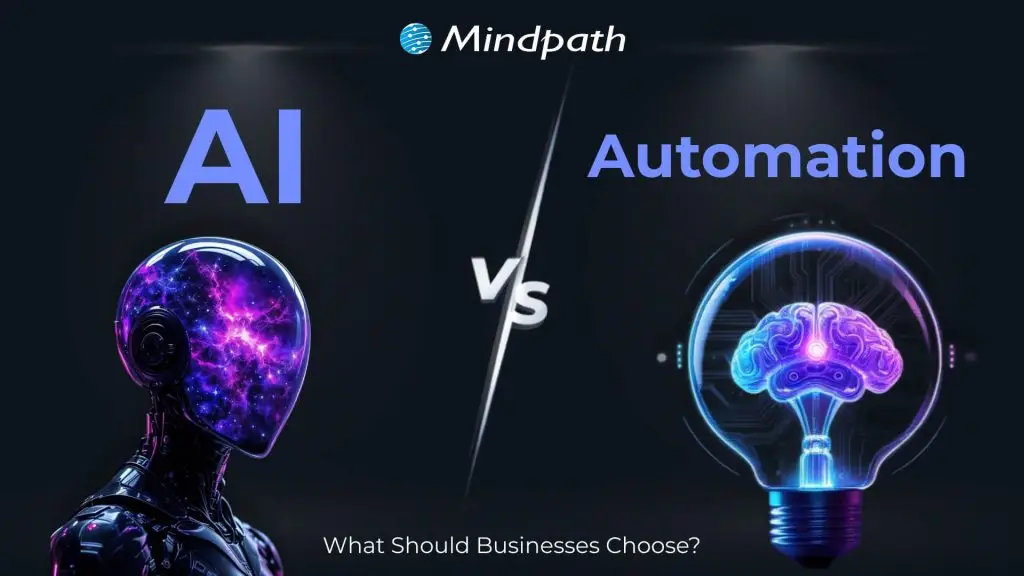
The significant impact of artificial intelligence on every industry has made every business leader think about embracing it in their enterprise strategy. CEOs want to stay updated with new trends and reduce costs by reducing dependence on manual processes. However, the AI vs automation debate has emerged as a crucial concern for business leaders. It is important to find out whether AI will deliver the benefits you want as a standalone technology or it needs seamless automation.
Is AI delivering the value that business leaders want from it? According to IDC, global spending on AI will increase by 1.7 times in the next three years. At the same time, the 2026 AI Report by Deloitte revealed that only 42% of companies believed that they have the right strategy for AI adoption (Source). Even with the growing inclination towards adopting AI technologies, only a few companies can scale beyond pilot stages. Business leaders should understand the difference between automation and AI to make the ideal decision for digital transformation.
Struggling to keep up with rapidly evolving technology and data-driven demands? At Mindpath, we offer scalable artificial intelligence development services that streamline operations and unlock new business opportunities.
Understanding Automation and Why Businesses Need It
Automation has been around for quite some time, probably before the AI revolution gained momentum. Business leaders have been investing in automation for many years and with everyone talking about AI, they want to know whether they picked the wrong technology. The fact is that a well-planned business automation strategy will trump random AI adoption any day. Automation is all about executing predefined rules with accuracy, consistency and most important of all, without fatigue.
When you implement automation in the right way, it brings discipline to all business processes at scale. All you have to do is define the workflow and automation sees that the workflow runs exactly in the same way every time. It does not falter in the event of changing volumes, operational pressure or time of the day. Business leaders embrace automation to achieve benefits like,
- Reduction in operational costs
- Significantly fewer human errors
- Predictability of outcomes
- Faster cycle times
Defining the Right Time for Business Process Automation
Automation delivers promising benefits but only when you have clear understanding of the process that you want to automate. The term ‘intelligent automation’ fits perfectly in scenarios where,
- You have a repetitive and stable process.
- The inputs for the process align with a specific format.
- The decision logic of the process is always consistent.
- You have possibility of predictable errors in the post.
If your business has to spend a lot of time in doing the same tasks repetitively, then you need automation.
Planning to implement AI in your organization but unsure how to structure a clear and effective path forward? Discover our guide on AI roadmap to explore the key steps for successful planning and execution.
Where Can You Apply Automation in Real Business Use Cases?
Business leaders wondering about the ideal use cases of automation should look for applications that deliver maximum ROI. You can leverage automation in use cases like,
1. Data Entry and Synchronization
Automation can play a vital role in enhancing tasks that require entering data and transferring data between internal systems without manual efforts.
2. File Handling and Document Management
Automation can help in reducing time required for renaming files, organizing documents and sending them to the relevant teams or systems.
3. Invoice Processing and Reconciliation
Business leaders can rely on automation for automatic extraction of standard fields, reporting mismatches and matching invoices with purchase orders.
4. Rule-based Approval Workflows
The power of automation can introduce new efficiencies that require approval for requests on the basis of value, policy rules and roles.
All the use cases of automation in business revolve around operational improvements with little to no innovation. The primary outcomes of embracing automation in business focus on reducing costs, enhancing efficiency and saving the time of teams.
Planning to implement AI in your business but unsure about the potential hurdles you might face? Discover the challenges of AI adoption to explore how to overcome barriers and ensure a successful implementation.
Artificial Intelligence and Moving Away from Rules
The role of artificial intelligence begins where you need to move beyond the ‘if-this-then-that’ logic in real business scenarios. When you have many variables, exceptions and ambiguity in the equation, it is inevitable to think how AI can add value. Businesses should integrate AI in their digital transformation roadmap to transition from following rules to thinking of possible solutions.
Automation works by following fixed instructions while AI learns from data and identifies patterns before making decisions. On top of it, AI uses the data it learns from to improve its capabilities with new interactions.
Choosing the Right Time for AI Adoption
Artificial intelligence might seem like just another trend that businesses have been pursuing for digital transformation. On the contrary, it is important to know that AI is a valuable resource to resolve bottlenecks in decision making. AI adoption is a reasonable decision in situations where,
- The decision making process depends on multiple variables.
- You don’t have static or predictable patterns in decision making.
- The system can provide more accurate outcomes as it learns and processes more data.
- The business has to make decisions at scale and in real time.
You have to understand that AI is the ideal technology to complement decision-making in scenarios where humans struggle.
Looking to reduce guesswork and make more confident business decisions? Discover our guide on AI in decision making to explore how it enables data-driven success.
Where is AI Useful in Real Business Use Cases?
Artificial intelligence has become one of the priorities of almost every business in 2026, with global spending expected to increase by huge margins. At the same time, it is reasonable to think how the AI vs automation debate turns in favor of AI in certain use cases. You will find the best business use cases of AI in the following areas,
1. Demand Forecasting
Businesses can leverage AI to predict future demand with the help of historical data, external signals and seasonality. As a result, businesses can ensure efficient inventory management and expand revenue opportunities.
2. Fraud Detection and Risk Management
AI tools can analyze transaction patterns of customers at different locations and time while evaluating behavior. It can serve as a valuable resource for flagging and prioritizing risks for the business.
3. Customer Sentiment Analysis
One of the biggest and most prolific use cases of AI in business right now is the ability to evaluate customer sentiment. Businesses can find out what their customers think about them by analyzing unstructured data from chats, emails and reviews.
4. Personalizing Customer Experiences
You will also find the ideal example of benefits of AI decision making in use cases for personalizing customer experiences. Businesses can use AI to suggest relevant products and content to their customers on the basis of use behavior insights.
5. Predictive Maintenance
Businesses should rely on AI for predictive maintenance to anticipate failures before they happen. AI tools can analyze usage and performance patterns through real-time data sourced from equipment to predict failures in advance.
The use cases of AI in business clearly show that it is the ideal option when predefined rules will fail to achieve the desired results. Business leaders can adopt AI in use cases where decision-making at scale in real-time is the biggest challenge.
Wondering how startups can benefit from AI-driven tools and automation? Explore our guide on AI solutions for small businesses and startups to discover growth-focused use cases.
Final Thoughts
Many business leaders want to find the ideal choice between AI and automation in the race for digital transformation for businesses. However, it is important to understand the differences in an AI vs automation debate to figure out that both of them complement each other. You cannot create a strong foundation for AI adoption without automation as it helps in cleaning and standardizing data and creating predictable pipelines for AI inputs.
Mindpath is a trusted AI development service provider, known for delivering solutions tailored to the vision and business goals of clients. We have created automation workflows for businesses in multiple industries and continue to grow our specialization in AI development. Consult with our experts to discover the ideal choice between AI and automation for your business now.
In the year 2025, Artificial Intelligence has certainly emerged as one of the most promising technologies. As AI continues to power everything, from generative design tools to real-time decision tools, the stakes for AI safety and security have never been higher.
The high reliance on AI in recent times has undoubtedly given rise to a number of concerns relating to AI safety. You need to bear in mind that in order to leverage AI in an optimum manner, you need to know the answer to – What is the safety and security of AI? It is high time to explore the topics relating to AI Safety, Alignment, and Model Robustness.
With the rise of AI in business operations, it is necessary to build systems that operate safely and remain robust under real-world conditions. Mindpath offers AI development services that provide safe and reliable solutions.
What is AI Safety?
AI safety is the interdisciplinary field focused on preventing accidents, misuse, and unintended harmful consequences from artificial intelligence systems. It encompasses AI alignment, robustness, and ongoing monitoring to ensure AI systems behave reliably and as intended, without causing harm.
AI safety involves the practices, research, and safeguards that help ensure AI technologies remain beneficial, predictable, and aligned with human values rather than causing harm. As AI systems become more capable and widely deployed, understanding AI safety is essential to minimizing risks and unintended consequences.
Why AI Security Matters Today?
With the passage of time, the AI systems that are being developed are highlighting high sophistication. In fact, they are becoming deeply integrated into the lives of people. One must remember that such novel technologies have the potential to give rise to both positive and negative impacts on people and organizations.
In recent times, the concerns relating to the negative impact of AI are growing like never before. People are growing concerned about the increasing dependence on AI. It has automatically given rise to questions such as – What is the safety and security of AI?
In the societal context, AI security measures must be adopted so that AI can be put to use in a safe and secure way. These measures are critical for ensuring the safety of the public. The role of AI security is indispensable when it comes to safeguarding the privacy as well as the fundamental rights of individuals. In order to learn about AI safety and security at an in-depth level, you need to familiarize yourself with the underlying concepts.
Want to understand which AI advancements are redefining responsible development and deployment? Discover the top AI trends driving transformation across industries in this in-depth article.
An Insight into AI Alignment
AI Alignment refers to the process that involves the encoding of human goals and values into Artificial Intelligence models. The purpose is to make these models safer and more reliable for use. As society is heavily reliant on AI technologies, the role of AI safety and alignment is of key importance.
AI alignment can serve as a catalyst and help to tackle certain side effects relating to bias and inaccurate outputs. It can make sure that AI systems can behave as they are expected to behave and that they align with human values. Alignment generally takes place as a phase relating to model fine-tuning.
AI safety and alignment may involve red teaming and synthetic data approaches. However, you need to bear in mind that as AI models become more complex in nature, it may become more challenging to control and anticipate their outcomes. This is commonly referred to as the AI alignment problem. It is essential to tackle the AI alignment problem so that AI safety can be improved.
Looking to future-proof your AI strategy with cutting-edge generative technologies? Read our in-depth overview of the top GenAI tools leading the next wave of innovation.
Risks Relating to AI Misalignment
In case there exists an issue relating to AI misalignment, it is imperative to address the same. This is because AI misalignment has the potential to give rise to a diverse range of risks and threats.
1. Bias As Well As Discrimination
The issue relating to AI bias may arise because of human bias. It may arise in the original training dataset of an AI system or its algorithms. Without proper AI safety and alignment, an AI system may not be able to avoid biased outcomes that are discriminatory or unfair.
2. Reward Hacking
When it comes to reinforcement learning, AI systems learn from punishments and rewards in order to take actions within an environment. The issue relating to reward hacking may take place when AI systems locate loopholes for triggering the reward function. This happens without actually meeting the intended goals of the developers.
3. Misinformation
You need to bear in mind that AI misalignment may lead to misinformation. Additionally, the issue relating to political polarization may also arise due to AI misalignment. The outcome may not be aligned with the best interests of people or society. This is because truthfulness may be compromised in this case.
4. Existential risk
When it comes to artificial superintelligence, the role of proper AI safety and alignment is of critical importance. In the absence of AI alignment with human values, there may be a risk for all forms of life on this planet. Although it may seem far-fetched right now, one cannot totally negate the risk.
If you wish to address these risks effectively, it is essential to understand the importance of AI alignment. Through AI prioritization, you can avert these risks.
Curious about how emerging trends will shape the next generation of safe, aligned, and robust AI systems? Explore our detailed insights in the future of AI to understand where innovation, governance, and responsible development are headed next.
AI Safety and Model Robustness
While discussing the topic relating to AI safety, one cannot ignore the importance of model robustness. In the context of AI safety, model robustness is key since it can ensure that AI systems perform in a reliable and accurate manner under diverse conditions.
AI safety and robustness are highly interrelated concepts. Model robustness can prevent issues relating to errors as well as unexpected inputs. Robustness is considered to be a core technical component that can ensure that harm from AI can be prevented. The significance of AI safety and robustness can be understood from the fact that it can protect AI models against malicious attacks, and it can also enable AI systems to operate in a fair manner.
The Need for AI Governance
AI Governance refers to the standards and processes that help make sure that AI systems are ethical and safe to use. Organizations can use AI governance to develop and operate AI systems in a responsible and accountable manner. You need to understand that the role of AI governance is catalytic to ensure AI safety. Business entities need to prioritize the development of AI governance frameworks.
These frameworks can ensure that they can leverage the artificial intelligence technology in a responsible and ethical manner. The growing importance of AI safety is automatically increasing the reliance on AI governance models. Practices like automated monitoring and performance alerts can empower organizations to ensure that their AI tools function ethically and responsibly. The role of AI governance is indispensable to promoting safety and security in the dynamic AI landscape.
Are you prepared for the next wave of generative AI innovations that may challenge current safety and alignment frameworks? Read our comprehensive generative AI predictions blog to stay ahead of emerging trends.
Final Words
The popularity of AI technology has certainly reached unimaginable heights in recent years. It has automatically increased the overall dependence on AI technology in diverse spheres. This trend has given rise to an important question relating to AI safety and security. The importance of AI safety has been reaching new heights today. If you wish to leverage AI optimally, it is necessary to understand the significance of AI safety.
Mindpath’s top-notch AI development services can ensure perfect safety and security for businesses. The experts can ensure that the best practices are in place that can promote AI security. Businesses can rest assured by relying on competent professionals while capitalizing on AI tools to reach their organizational goals.
Artificial Intelligence is no longer a futuristic concept for massive tech giants. Recently, businesses of all sizes have been adopting AI to automate processes and enhance customer experience while gaining a good reputation in the competitive markets. AI is rigorously fueling its values and is going to reach USD 3,497.26 billion by 2033. However, off-the-shelf AI tools might fall short if your business follows unique workflows and has strict data requirements. This is where custom AI development becomes necessary.
Creating AI solutions that fit your business perfectly is now essential for achieving efficiency and growth. So, this detailed guide consists of everything you need to know about custom AI development, starting from its benefits to a complete AI roadmap. Further, learn how a custom AI development company can help you with long-term success.
Planning to integrate custom AI into your business strategy? Mindpath offers AI development services to help you innovate and scale faster with personalized solutions tailored to your business needs.
What Does Custom AI Development Define?
Custom AI development is significantly designed to optimize as per the unique requirements of your company. This is how it remains valuable and more exclusive compared to generic or pre-made tools and apps. Such development uses AI models to automate the procedure and assess data in such a manner that can satisfy the specific concerns of the business while pushing them ahead in the competitive landscape.
1. The major benefits of custom AI development services are that it completely matches the unique goals of a business while ensuring reliability for the objectives and workflows of your company.
2. Off-the-shelf tools mainly deliver generalized features. But, custom AI development is uniquely made to automate and optimize the procedures that are necessary for your business’s success.
3. By valuing such specific challenges, a custom AI development company can help you improve your performance while driving innovation.
4. In companies where quality insight is necessary, like healthcare, finance, and manufacturing, custom development can deliver undeniable value.
What are Some Essential Benefits of Developing Custom AI Solutions?
Making an investment in custom AI comes with a series of benefits of AI. This is how the following investment becomes your long-term benefit. With the help of professional custom AI development services, you gain the capability to tailor solutions while addressing specific needs, which is not possible with generic AI tools. Here, you can go through some of the incredible benefits of custom AI development.
1. Competitive Benefits
By adopting AI models that are initiated specifically for your operations, you can gain a significant competitive advantage. Custom AI development can help you streamline your operations and improve customer experiences. Further, it encourages data-driven decision making. Custom solutions can help you gather new opportunities and can help your business stay ahead in the competition.
2. Tailored Solutions for Unique Requirements
No matter if you want to improve your customer service through AI chatbots or want to automate your data analysis, custom development offers you that flexibility. You can develop solutions that align with your business demands. Further, the result will be more effective & efficient.
3. Effective Integration
Custom AI development ensures seamless integration with the existing systems and infrastructure of your business. Unlike pre-built features, which might need serious adjustments, custom development allows your business to create AI app development solutions. By following a clear AI app development playbook, businesses can easily plan, build, and launch intelligent applications in a more efficient and structured way.
Such applications can fit well into your existing databases and software. So, you can be assured of faster development and easy integration.
4. Better Customer Satisfaction
AI-efficient systems like voice assistants and chatbots can amplify your customer experience. An expert custom AI development company helps your company personalize the services to increase the satisfaction rate of your customers. This approach can enhance your customer satisfaction rate while increasing loyalty.
Such valuable systems can analyze your user interactions, preferences, and behaviors. This can make your customers get custom content as per their interests.
Want to improve customer support efficiency and satisfaction with AI? Discover AI for customer services to learn how intelligent solutions streamline interactions and resolve queries faster.
Custom AI Development Process
Understanding the detailed procedure of custom AI development can help you channelize your investments properly. Further, you can be aware of the risks while being assured of the final solution and business values. With an efficient process, you can let your AI initiatives fulfil your strategic insights instead of straining your pockets randomly.
1. Business Problem Identification
A successful AI project always starts with clarity. So, the first step starts with identifying the exact business issue AI needs to resolve. Whether it’s reducing operational charges or improving your decision-making, clear objectives can make you win. Further, proper planning of custom AI development services can offer you measurable ROI in no time.
2. Data Assessment and Strategizing
Data always stands as the foremost foundation of any AI system. In this phase, your team needs to evaluate the data sources along with the data structure and quality. Additionally, you can be aware of specific inconsistencies & biases. A suitable data preparation strategy includes governance planning & precise labeling.
3. Designing the Solution
It’s time for you to be authentic about the AI structure right after refining your data strategy. In this, you need to regard valuable algorithms and integration approaches for the best results. Moreover, the design matches the security and performance needs to adopt long-term values.
4. Model Development and Training
Custom AI development services can help you build machine learning models with curated datasets during the development phase. Developers will fine-tune the system to keep it aligned with your needs while maintaining its accuracy. This is how you can turn your raw data into meaningful & actionable data.
5. Testing Period
Before you incorporate the deployment step, the following models should be tested in real-world use cases. This is how you can assess the performance and fairness level of the model. Further, it assures that the AI system is behaving as per the changing conditions while meeting the needed regulations.
6. Integration and Deployment
In this step, the AI solution is transformed into production and integrated with existing systems like CRM or other internal platforms. This is how your whole business can adopt the system seamlessly without any interruptions.
7. Precise Monitoring and Continuous Improvement
After the deployment process, the AI models are rigorously monitored to detect performance issues. Further, it is important to assess if they are following the changing data patterns. With effective updates, you can be assured of the results being accurate while meeting your business requirements.
Planning to implement custom AI but concerned about integration and workforce readiness issues? Learn about AI adoption challenges to discover how to overcome them and ensure long-term success.
How Multiple Industries are Seeking the Values of Custom AI Development?
Custom AI solutions have already proved their essentiality for multiple industries. Around 65% of companies value the essentiality of generative AI tools for effortless operations. Custom AI solutions can help your business solve unique challenges while driving growth. Here are some of its top applications.
1. Retail
AI is used in retail to offer personalized product recommendations, demand forecasting, and inventory management. By assessing customer data, AI can easily predict trends while suggesting products that customers are more likely to buy. Moreover, this approach can improve customer and sales satisfaction rates.
2. Healthcare
In the healthcare sector, AI in healthcare solutions are being used to verify patients’ data and analyze medical conditions efficiently Further, it can help in diagnostics while automating the administrative workloads. Custom AI development services can enhance patient outcomes and improve operational efficiency.
3. Manufacturing
You can be assured of proper supply chain management in manufacturing through AI. Moreover, it can improve your predictive maintenance and automate production lines. A custom AI Development Company can help you streamline operations while reducing downtime. Most importantly, it can enhance your product quality.
4. Finance
In this sector, AI can help you analyze fraud detection and risk assessment. It can also initiate algorithm trading along with customer service automation. Moreover, custom AI solutions can manage huge amounts of financial records frequently. This enables your business to leverage data-rich decisions and stay ahead in the financial sector.
Ready to leverage AI to improve customer satisfaction in banking? Discover AI in personalized banking experiences to understand how intelligent tools make financial services more adaptive and personalized.
Common Areas that Demand Custom AI Development
AI is almost shifting the trends to another level. Almost every business is using AI tools to optimize their performance and serve their customers satisfactory solutions. But, do you know where custom AI shines the best? Let’s highlight some of the most essential areas where tailor-made solutions can take your business to new heights.
1. Conversational AI
Everyone must have used a bot that sounds completely robotic. This is where the relevance of conversational AI comes into the picture. It transforms basic chatbots into dynamic problem solvers.
Every business has its brand voice and customer requirements. So, a custom chatbot can assess the brand tone while offering unforgettable interactions that work.
2. Computer Vision
An AI solution that never misses a chance to scan images or videos can effectively target the defect that you might miss. This is where computer vision works as a critical initiation. This technology can power custom solutions for tasks that require precision.
As your business might have unique quality assurance regulations, custom solutions ensure that AI reflects what is most important to you.
3. Predictive Analytics
How efficient will it be if you could predict market shifts, customer demand, and operational changes before they happen? Predictive analytics is here to push you into the future. It transforms data into foresight. Custom AI development can offer you precise insights while helping you act confidently.
Want to maximize the impact of your AI initiatives? Discover the benefits of AI consulting to check out how specialized expertise strengthens implementation and performance.
What are Some Challenges of Custom AI Development?
No doubt custom AI solutions come with a series of benefits. But there are many challenges you might expect in the process. Here are some of the most common hurdles your business might face.
1. Complexities of the Models
AI development in fields like ML and deep learning can be extremely complicated. Picking the right tuning parameters and algorithms requires proper expertise in data science and AI. Further, AI models need to be continuously improved, which is possible with the assistance of a custom AI development company.
2. Quality and Availability of the Data
To make the AI models work efficiently, they need to attend to high-quality and important data. So, gathering and preparing such data can be time-consuming for you. Additionally, your business might face the challenge of gaining enough and accurate data.
3. Integration with Prominent Legacy Systems
Multiple businesses depend on legacy systems that might not be compatible with modern AI tech. So, integrating the custom models with existing infrastructure might be risky. It requires significant changes as per the existing workflows. Further, you need to have proper planning, and your team must coordinate with the experts to achieve the best results.
Looking to connect custom AI with outdated systems efficiently? Discover modernizing legacy systems to learn how upgrades enable smoother AI integration.
Ready to Transform Your Business with Custom AI?
Custom AI development is not just a technical advancement to adopt randomly. It is one of the most essential strategic approaches that can help your business solve specific challenges while satisfying potential customers. Further, you can discover better data while aligning your operations to be more goal-oriented. This can help your customers be familiar with your business while getting the desirable results they want.
If you are ready to adopt the effective solutions through the best custom AI development, sticking to the right professionals is necessary. Mindpath is extremely professional in developing tailored solutions that leverage the perfect combination of innovation and precision. With a deep understanding of different business requirements and expertise across diverse AI development services, we are committed to generating user-friendly solutions that can give you a competitive edge. Further, we ensure that your AI project aligns with your vision while offering you the measurable results you desire.
Staff augmentation has turned out to be a popular strategy for businesses that want to access specialised skills. As per the recent statistics, the IT staff augmentation market size is going to reach USD 857.2 billion by 2032 (Source). This approach can help you scale your workforce while remaining ahead in the competitive landscape.
If you are also thinking of staff augmentation hiring, there are several key factors that should be carefully considered. This ensures a seamless and effective integration of external experts into your organisation. In this blog, we will further explore what you should take into account when your staffing solution demands quality staff augmentation.
Looking for a faster way to strengthen your workforce without compromising on quality? At Mindpath, we offer staff augmentation services that help you scale your team with highly qualified professionals.
What Does Staff Augmentation Hiring Actually Mean?
Staff augmentation is a flexible outsourcing strategy where you temporarily add external professionals to your existing workforce to fill skill gaps or scale capacity. Further, 65% of recruiters are including AI tools in staff augmentation to support talent acquisition (Source). Unlike traditional outsourcing, augmented staff work directly under your management, integrating into your daily workflows. These experts bring specialised skills and new perspectives while understanding your team’s dynamics.
So, whether you demand a professional developer or a financial analyst, hire talent through staff augmentation if you want a solution without any permanent hiring commitment.
Must Read: Staff Augmentation Trends
Staff Augmentation Best Practices that Let Your Company Perform Exceptionally
It is necessary for your business to meet the changing technology requirements of the digital world. Further, you need to keep your resources intact while keeping the project on track. The staff augmentation model accesses organisations to effectively fill in the skills gaps and maintains flexibility that is not possible in traditional hiring.
However, successful staff augmentation hiring needs careful planning and the right approaches, as given in this section.
1. Be Clear About Your Needs
Before you initiate the process of hiring through staff augmentation, it is important to have clarity about your business’s specific requirements. Understand what skills or expertise you are lacking internally? What are your goals, and why do you intend to outsource a new team?
Accurately defining your requirements can help you find the right talent. One of the most essential staff augmentation best practices is having clarity. The more precise your expectations are, the better the results will be.
2. Pick the Right Staff Augmentation Model
Not every project needs the same level of external support. There are some common types of staff augmentation models that are listed here.
- Long-Term Augmentation
This is effective for your ongoing projects that need to be completed within a given timeframe.
- Short-Term Augmentation
This approach is suitable for urgent or temporary requirements.
- Skill-Based Augmentation
It is necessary when you require specific skills for your project.
3. Partner with a Reputable and Experienced Provider
Selecting the right IT staff augmentation services is a critical step in the whole process. So, you must research and pick a reputable company with a good track record of success. Further, the provider should have a well-established talent pool and a history of offering top-rated professionals. The team should also align with your business requirements.
4. Verify their Collaborative Features
Instead of just valuing the technical skills of the experts, you should also assess their collaborative standards. They should match your team’s communication approaches while showing compatibility with the workflow. You can also assess their language proficiency and ability to work in collaborative environments.
Poor or ineffective communication can delay your projects while increasing the misunderstanding rate. A good cultural fit ensures a seamless integration while developing your productivity aspects.
5. Be Assured of Data Security
When you hire talent through staff augmentation, the team might have access to your data. So, before you make a deal with them, sign NDAs and agreements. Ask about the security policies and restrict access as per the required roles. You shouldn’t ignore the security aspects at all. A single breach can tarnish your market reputation within minutes.
Planning to scale your workforce without overspending on full-time hires? Discover our cost-effective IT staff augmentation blog to learn practical cost-saving approaches while enhancing your workforce.
6. Go through the Pricing Structure
Average IT staff augmentation costs between USD 50,000 and USD 199,999. However, the pricing differs as per the requirements of your business. So, be assured of the providers’ monthly and hourly costs. Also assess their administrative fees or if they have any hidden costs. Ask about their overtime policies and replacement guarantees.
7. Verify their Flexibility
Your project requirements might change anytime. A reliable staff augmentation model should allow you to scale your resources as needed. It should also allow you to replace underperforming talent quickly and add new skill sets when required.
Flexibility ensures your team can adapt to any changes without any delays.
8. valuate their Performance
Establish clear performance metrics and KPIs to verify the effectiveness of your augmented staff. Verifying the team on a daily basis can make the external team understand your project values while helping your project get completed on time.
9. Plan a Seamless Onboarding Process
Even experienced professionals seek clarity when it comes to keeping their project aligned with the business. So, your structured staff augmentation hiring process should remain clear about your needs. The external team should have precise access to tools and documentation. You should introduce them to your internal teams and define the workflows.
10. Exit Strategy
Understand what you are going to do when the specific project is completed. Make a plan for your transition and assess when you should end the services of your outsourced team.
Looking to streamline your team integration process for faster results? Check out our augmented staff onboarding guide to learn proven strategies for seamless execution.
Why Staff Augmentation Hiring is a Strategic Approach for Your Company?
The staff augmentation model can offer you a series of benefits if you implement it correctly.
- It can help you hire faster as compared to traditional recruitment processes.
- It offers access to global talent pools.
- You can enjoy greater project flexibility and reduced operational charges.
- Further, your project delivery will be completed within the given timeline.
Common Mistakes to Avoid in Staff Augmentation Hiring
While the model is very effective, organisations still make such mistakes that need to be avoided.
- Selecting vendors based only on cost.
- Hiring with clear project objectives.
- Ignoring cultural fit.
- Lack of onboarding and performance assessment.
Avoiding or preventing such mistakes can help your staff augmentation hiring be more result-oriented and convenient as per the market needs.
Looking to choose the right outsourcing model for your business needs? Check out our staff augmentation vs managed services comparison to learn the key differences and benefits.
When You Should Hire Talent through Staff Augmentation?
Consider this valuable approach if you need to quickly scale your development team or you want to bridge the skill gap. An outsourced team can easily support a new product launch while helping you with digital transformation. Most importantly, it can reduce the hiring overhead. IT augmentation services offer flexibility, speed, and long-term employment commitments that encourage your business productivity.
Bottom Line
Hiring talent through staff augmentation can be a strategic approach that can help your organisation with the right skills and expertise. Moreover, it can help you stand strongly in today’s competitive business environment. By following the staff augmentation best practices, you can easily build high-performing teams quickly.
If your company is looking forward to hiring talent through staff augmentation, benefit from working with professional providers who understand your project dynamics. They also understand your technical requirements and team integration. With Mindpath, staff augmentation services, your business can easily access knowledgeable industry experts. Further, we can assure you of achieving all your technology goals without any risks and delays.
Frequently Asked Questions
Out-dated systems retard development and cause wastage. Most of the teams are struggling with increasing maintenance expenses and unseen threats. That is where the legacy modernization services come in. They assist business reduce technical debt and to enable real value. You want one that is faster and more powerful, do you? Now is time to reconsider the way your core systems will serve your objectives.
Modernization, however, does not just concern the upgrade of technology. It is a question of maximizing ROI with a well thought out strategy and intelligent choices. The less simple you make something, the more budget and innovation you liberate. Consequently, teams are developmental rather than rehabilitating past problems. This blog will cover the topic of how modernization leads to a decrease in technical debt and bring about quantifiable returns.
Looking to simplify operations and lower technical debt? Mindpath offers legacy modernization services make it easier to upgrade and optimize systems without disrupting your business.
Understanding Technical Debt in Legacy Systems
Technical debt in legacy systems is the accumulating cost of outdated technologies, past architectural compromises, and quick fixes applied in place of long-term solutions. As companies postpone upgrades, this burden compounds much like financial interest, making legacy modernisation services increasingly essential to restore system health.
Like financial debt, technical debt generates compounding interest; every shortcut taken today inflates tomorrow’s maintenance costs, complicates integrations, and introduces critical security vulnerabilities. What begins as minor inefficiencies gradually accumulates into significant operational barriers.
The following are some of the effects of not taking technical debt into consideration:
- Old and unprotected systems enhance security risks and vulnerability of sensitive data to cyber threats.
- The high maintenance costs leave the IT budgets with minimal scope of growth and innovation.
- Hard systems are barriers to cloud, AI, and modern technology installation.
- Without legacy modernization services, systems become too complex to manage and require costly full replacement.
Looking to improve system performance and reduce long-term operational costs by upgrading outdated technology? Discover the benefits of modernizing legacy systems to explore how it enhances scalability, security, and overall ROI.
How Legacy Modernization Services Reduce Technical Debt?
Technical debt delays the development and adds expenses. Legacy modernization services help reduce this burden and create a stronger, more efficient technology foundation.
1. Smart Code Refinement
The teams are used to clean and refactor available code in order to enhance clarity and stability. They eliminate repetitions and complicated reasoning. This makes optimizing legacy applications easier and reduces future maintenance effort.
2. Cloud Enablement Strategy
Organizations transfer the workloads to the cloud or container environments to enhance scalability. This measure eliminates the reliance on old hardware. Legacy modernization services help teams control infrastructure costs and improve performance.
Also Read: Legacy Application Modernization in 2026
3. Microservices Transformation
Professionals subdivide monolithic systems into smaller and modular services. All the components are independent and promote quicker updates. This approach reduces risk and improves flexibility in evolving legacy applications.
4. API Driven Integration
Teams eliminate the stiff interfaces with protective and adaptable APIs. This enhances the connection of the systems to new platforms and tools. Consequently, companies make integrations easier and less technical.
Planning to modernize your legacy systems but unsure about the right approach and sequence to follow? Explore our guide on legacy modernization roadmap to explore the key steps for a smooth and successful transformation.
5. Automated Testing and CI/CD
The modern pipelines encourage automated testing at development stages. The teams identify problems at an early stage and publish updates without any hesitation. Legacy modernization services strengthen delivery speed and improve software reliability.
6. Application Portfolio Cleanup
Organizations check through applications and eliminate unutilized or duplicated systems. This reduces the cost of maintenance and operational clutter. Strong legacy application modernization services create a leaner and more focused IT landscape.
7. Documentation and Knowledge Alignment
Modernization teams revise system documentations and develop knowledge bases. This minimizes reliance on the individual professionals. Clear documentation facilitates the process of upgrading and being stable in the long term.
8. AI-Driven Code Intelligence
The sophisticated tools are used to analyze the dependencies and identify performance gaps in a short time. Teams use AI to accelerate code improvements and support data modernization initiatives. This will enhance precision and accelerate the process of transformation.
Want to ensure your legacy system upgrades align with long-term business goals and deliver maximum value? Explore our guide on legacy modernization strategy to discover the best approaches for a successful and future-ready transformation.
Ready to Reduce Technical Debt and Improve ROI?
Technical debt is a source of slow growth and risk. Legacy modernization services help businesses regain control and improve long term ROI. By updating systems to have a clear strategy, teams reduce costs in maintenance and increase agility. Therefore, organizations become more innovative, secure, and develop technology that will support future objectives with assurance.
At Mindpath, our legacy modernization services are based on alignment of technology with business vision. Our performance, scalability, and quantifiable returns also serve as the basis of our legacy system modernization services. We evaluate holes, update buildings and enhance integration. With the appropriate approach, companies become simpler and establish resilient online platforms to build sustainable growth.
SaaS tools have changed the way businesses handle everyday work. Instead of installing and maintaining software on individual devices, teams can access cloud-based applications whenever they need them. From communication and project management to CRM, marketing, security, HR, and analytics, there is now a SaaS tool for almost every business function.
Key Takeaways
- 01
SaaS tools provide cloud-based software that businesses can access without managing traditional software infrastructure. - 02
The right SaaS tools can improve communication, productivity, customer management, sales, security, analytics, and HR operations. - 03
Businesses should evaluate SaaS tools based on functionality, integrations, scalability, pricing, security, and ease of adoption. - 04
A smaller set of well-integrated SaaS tools can be more effective than subscribing to too many disconnected platforms. - 05
AI, automation, stronger integrations, security, and industry-specific solutions are shaping the future of SaaS platforms.
The challenge is not finding a SaaS tool. It is finding the right one. A tool that works well for a startup may not be the best fit for an enterprise, while a platform designed for sales teams may add little value to an HR or development team.
To make the choice easier, we have selected 30 SaaS tools across key business functions. The list includes platforms for collaboration, CRM, project management, sales, security, productivity, analytics, and HR. We have also highlighted what each tool is best suited for so you can compare options based on your actual business needs.
Looking to build a SaaS product tailored to your business requirements? Explore Mindpath’s SaaS development services for scalable, secure, and business-focused software solutions.
What are SaaS Tools?
SaaS tools are software applications delivered over the internet rather than installed and managed entirely on a local computer. SaaS stands for Software as a Service. Users typically access these applications through a web browser or mobile app and pay through a subscription or usage-based model.
Common examples include CRM platforms, project management software, communication applications, accounting systems, marketing platforms, design tools, and HR software. Because the software is hosted by the provider, businesses generally do not have to manage the underlying infrastructure themselves.
This model makes SaaS tools particularly useful for businesses that need to scale quickly, support distributed teams, connect multiple applications, or introduce new software without a lengthy installation process.
Why Do Businesses Use SaaS Tools?
The value of a SaaS tool depends on how well it solves a specific business problem. When selected carefully, SaaS platforms can simplify routine work and give teams better visibility into their operations.
1. Lower Upfront Costs
Most SaaS products use subscription-based pricing, so businesses can avoid a large upfront investment in software infrastructure. Plans can often be adjusted as the team grows.
2. Faster Implementation
Cloud-based tools can generally be introduced faster than traditional software that requires extensive local installation and configuration. This allows teams to start using new workflows without waiting for lengthy deployment cycles.
3. Easier Collaboration
Since SaaS applications are accessed online, employees can work with the same information from different locations and devices. This is particularly useful for remote and hybrid teams.
4. Scalable Business Operations
As a company adds employees, customers, projects, or workflows, SaaS platforms can often scale through additional users, features, storage, or usage capacity.
5. Integration With Other Tools
Many SaaS platforms provide integrations and APIs that allow businesses to connect different parts of their technology stack. This can reduce repetitive data entry and create more connected workflows.
6. Regular Product Updates
SaaS providers manage product updates, bug fixes, and infrastructure maintenance on the service side. Businesses therefore do not have to handle every software update manually.
Interested in the technology behind SaaS products? Explore the latest SaaS trends shaping cloud software and digital business operations.
How We Selected These SaaS Tools
There is no single SaaS platform that is best for every business. The right choice depends on the size of your organization, team structure, budget, existing technology stack, and the problem you are trying to solve.
For this list, we considered factors such as ease of use, core functionality, integrations, scalability, collaboration capabilities, automation, and suitability for different business environments. The goal is not to rank every platform universally, but to help you understand where each tool can be useful.
30 Best SaaS Tools for Businesses
The following SaaS tools cover some of the most common requirements across modern organizations. We have grouped them by their primary business function to make comparison easier.
Quick Comparison of the Best SaaS Tools
| Tool | Category | Best For |
|---|---|---|
| Slack | Communication | Team communication and collaboration |
| Microsoft Teams | Communication | Meetings, messaging, and Microsoft 365 users |
| Notion | Productivity | Knowledge management and flexible workflows |
| Google Workspace | Productivity | Cloud-based office collaboration |
| Loom | Communication | Video messages and screen recording |
| SugarCRM | CRM | CRM automation and customer management |
| HubSpot CRM | CRM | Sales, marketing, and customer management |
| Salesforce | CRM | Enterprise CRM operations |
| Close | CRM | Sales communication and pipeline management |
| Wrike | Project Management | Complex project and resource management |
| Trello | Project Management | Visual task management |
| Celoxis | Project Management | Project, resource, and financial management |
| Asana | Project Management | Project planning and team workflows |
| Monday.com | Work Management | Customizable team workflows |
| Pipedrive | Sales | Sales pipeline management |
| ActiveCampaign | Marketing | Marketing automation |
| Freshsales | Sales CRM | Lead management and sales outreach |
| Mailchimp | Email Marketing | Email campaigns and audience management |
| Coupler.io | Reporting | Automated data reporting |
| 1Password | Security | Password and access management |
| LastPass | Security | Password management |
| Astra Security | Cybersecurity | Security monitoring and testing |
| Cloudflare | Security | Web security and performance |
| Vicarius | Security | Vulnerability remediation |
| Google Analytics | Analytics | Website and user behavior analysis |
| Canva | Design | Marketing and visual content creation |
| Grammarly Business | Productivity | Business writing and communication |
| BambooHR | HR | HR management for growing companies |
| HiBob | HR | People operations for growing organizations |
| ADP Workforce Now | HR | Payroll and workforce management |
Category 1: Communication and Collaboration SaaS Tools
Communication tools sit at the center of day-to-day business operations. They help teams exchange information, share files, document decisions, and collaborate without relying entirely on meetings or email.
1. Slack
Best for: Team communication and distributed collaboration.
Slack organizes conversations into channels, direct messages, and dedicated project spaces. Teams can share files, connect third-party applications, and keep discussions around specific projects or departments. It can be particularly useful when a company needs a central place for quick conversations without filling every discussion into email threads.
2. Microsoft Teams
Best for: Organizations already using Microsoft 365.
Microsoft Teams brings chat, meetings, calls, file sharing, and collaboration into one platform. Its close connection with Microsoft 365 makes it a practical choice for organizations that already rely on tools such as Word, Excel, PowerPoint, and SharePoint.
3. Notion
Best for: Knowledge management, documentation, and flexible team workflows.
Notion combines documents, databases, notes, task management, and internal knowledge in one workspace. Teams can use it for project documentation, meeting notes, content calendars, onboarding material, and company knowledge bases. Its flexible structure makes it useful for teams that want to build workflows around their own processes.
4. Google Workspace
Best for: Everyday cloud-based productivity and collaboration.
Google Workspace combines applications such as Gmail, Docs, Sheets, Slides, Drive, and Meet. Multiple users can work on documents and spreadsheets at the same time, making the suite useful for startups, agencies, educational organizations, and established businesses.
5. Loom
Best for: Asynchronous communication and screen recording.
Loom allows users to record their screen, camera, or both and share the recording through a link. Teams can use it for product walkthroughs, quick updates, training, feedback, and explanations that would otherwise require a meeting.
Category 2: CRM SaaS Tools
CRM platforms help businesses organize customer information, manage leads, track sales activities, and understand relationships throughout the customer journey.
6. SugarCRM
Best for: Customer relationship management and sales automation.
SugarCRM provides tools for managing customer relationships, sales activities, marketing processes, and service workflows. Its automation and customization capabilities make it suitable for organizations that need more control over their CRM processes.
7. HubSpot CRM
Best for: Businesses that want CRM, marketing, sales, and service capabilities in one ecosystem.
HubSpot CRM helps teams manage contacts, deals, sales activities, marketing campaigns, and customer interactions. Its broad product ecosystem can be useful for growing companies that want multiple customer-facing functions connected through one platform.
8. Salesforce
Best for: Large organizations with complex CRM requirements.
Salesforce provides a broad CRM ecosystem covering sales, marketing, customer service, analytics, and other business functions. Its extensive customization and integration capabilities make it a strong option for organizations with complex customer-management workflows.
9. Close
Best for: Sales teams that want communication and pipeline management in one place.
Close combines CRM functionality with calling, email, SMS, task management, and sales reporting. It is designed around sales workflows, making it useful for teams that spend much of their day communicating with prospects.
Category 3: Project and Task Management SaaS Tools
Project management tools help teams plan work, assign responsibilities, monitor deadlines, and understand project progress. The right choice depends on whether your team prefers simple task boards or more structured project and resource management.
10. Wrike
Best for: Complex projects and resource planning.
Wrike provides project planning, task management, dashboards, reporting, collaboration, and resource management features. Its range of views and workflow capabilities makes it suitable for teams managing multiple projects at the same time.
11. Trello
Best for: Simple visual task management.
Trello uses boards, lists, and cards to organize tasks and workflows visually. It is easy to understand and can work particularly well for content planning, marketing activities, small projects, and teams that prefer a lightweight project management approach.
12. Celoxis
Best for: Project, resource, and financial management.
Celoxis combines project planning with resource allocation, timesheets, dashboards, Gantt charts, risk management, and financial tracking. It can be useful for organizations that need more detailed control over project delivery and resource utilization.
13. Asana
Best for: Structured project planning and team workflows.
Asana helps teams organize tasks, projects, deadlines, dependencies, and responsibilities. Teams can use different views and automation features to create workflows around product development, marketing, operations, and other recurring business processes.
14. Monday.com
Best for: Customizable work management.
Monday.com provides customizable boards and workflows for project management, sales, marketing, operations, and other business functions. Teams can configure views, templates, automations, and integrations around their preferred way of working.
Category 4: Sales and Marketing SaaS Tools
Sales and marketing teams use SaaS platforms to manage leads, automate communication, run campaigns, measure performance, and keep customer information organized.
15. Pipedrive
Best for: Sales pipeline management.
Pipedrive focuses on visual sales pipelines. Sales teams can organize deals, schedule follow-ups, automate routine tasks, and monitor opportunities as they move through different stages of the sales process.
16. ActiveCampaign
Best for: Marketing automation and customer journeys.
ActiveCampaign provides tools for email marketing, automation, segmentation, customer journeys, and campaign analytics. It can help marketing teams create more targeted communication based on customer behavior and engagement.
17. Freshsales
Best for: Lead management and sales outreach.
Freshsales combines CRM capabilities with email, phone, lead scoring, and sales tracking. It gives sales teams a centralized place to manage prospects and monitor interactions throughout the sales process.
18. Mailchimp
Best for: Email marketing and audience management.
Mailchimp provides tools for creating email campaigns, managing audiences, automating communication, and analyzing campaign performance. It can be useful for businesses that want to manage email marketing without building their own campaign infrastructure.
19. Coupler.io
Best for: Automated reporting and data consolidation.
Coupler.io connects data from different applications and makes it available through spreadsheets, dashboards, and reporting workflows. Marketing and sales teams can use it to bring campaign, traffic, and performance data together for analysis.
Category 5: IT and Security SaaS Tools
Security should be considered when selecting any business software. Password management, vulnerability monitoring, application security, and network protection can all become part of a company’s SaaS stack.
20. 1Password
Best for: Business password and credential management.
1Password helps teams securely manage passwords, credentials, and sensitive information. Centralized access management can make it easier for organizations to control who has access to specific accounts and resources.
21. LastPass
Best for: Password management and controlled access.
LastPass provides password management features designed to help users securely store and access credentials across devices. Businesses can use centralized controls to manage employee access to accounts and applications.
22. Astra Security
Best for: Website security testing and vulnerability management.
Astra Security focuses on identifying and addressing website and application security issues. Its offerings include vulnerability monitoring, security testing, compliance support, and integrations that can fit into development workflows.
23. Cloudflare
Best for: Web security, traffic protection, and performance.
Cloudflare provides services that sit between users and web applications, helping organizations manage traffic, protect applications, and improve delivery performance. Its security capabilities include DDoS protection and web application security.
24. Vicarius
Best for: Vulnerability remediation and software security.
Vicarius focuses on vulnerability management and remediation. Security teams can use it to identify vulnerable assets, prioritize threats, and integrate remediation activities into existing workflows.
Category 6: Design, Productivity, and Analytics SaaS Tools
Not every SaaS tool is built for a single department. Some platforms support everyday productivity, visual content creation, communication quality, or business analytics across multiple teams.
25. Google Analytics
Best for: Website traffic and user behavior analysis.
Google Analytics helps businesses understand how users interact with their websites and digital properties. Teams can examine traffic sources, user behavior, engagement, and other performance data to support marketing and product decisions.
26. Canva
Best for: Fast creation of marketing and visual content.
Canva provides templates and design tools for presentations, social media graphics, documents, videos, and other visual assets. Its simple interface allows marketing and business teams to create professional-looking content without relying on a full-time designer for every small asset.
27. Grammarly Business
Best for: Business writing and communication quality.
Grammarly helps teams improve grammar, clarity, tone, and consistency across business communication. It can be useful for teams that regularly create emails, documents, marketing copy, reports, and other written content.
Category 7: HR SaaS Tools
HR platforms help organizations manage employee information and recurring people-related processes. As companies grow, these systems can reduce manual administration and provide a central source of workforce information.
28. BambooHR
Best for: HR management in small and growing organizations.
BambooHR provides tools for employee records, hiring, onboarding, performance management, time tracking, and other HR activities. Its focus on core HR workflows makes it a practical option for growing teams.
29. HiBob
Best for: People operations in fast-growing companies.
HiBob is designed around modern HR and people-management workflows. Organizations can use it to manage employee information, HR processes, reporting, and other activities as their workforce grows.
30. ADP Workforce Now
Best for: Payroll and workforce management.
ADP Workforce Now combines payroll, benefits, talent management, workforce administration, and related HR functions. It is particularly relevant for organizations that need a broader workforce management platform rather than a standalone HR application.
Which SaaS Tools are Best for Small Businesses?
Small businesses usually need tools that are easy to adopt, affordable, and capable of growing with the team. Instead of subscribing to dozens of applications, it is often better to start with the functions that have the biggest operational impact.
- Communication: Slack or Microsoft Teams
- Productivity: Google Workspace or Notion
- CRM: HubSpot CRM
- Project management: Trello or Asana
- Sales: Pipedrive or Freshsales
- Marketing: Mailchimp or ActiveCampaign
- Design: Canva
- Analytics: Google Analytics
- HR: BambooHR
The best combination will depend on your team’s workflow. A five-person company does not necessarily need the same technology stack as a 500-person organization.
How to Choose the Right SaaS Tool for Your Business?
Choosing a SaaS tool based only on popularity can lead to unnecessary subscriptions and complicated workflows. Before adopting a platform, consider the following questions.
1. What problem are you trying to solve?
Start with the business problem rather than the software. For example, if your team is losing track of leads, look for a CRM instead of simply searching for the most popular business software.
2. Does it fit your existing workflow?
A powerful platform is not useful if employees find it difficult to adopt. Look at the user experience, learning curve, automation options, and day-to-day workflow before making a decision.
3. Can it integrate with your existing stack?
Check whether the platform connects with the applications your team already uses. Strong integrations can prevent duplicate work and reduce manual data transfer.
4. Will it scale with your business?
Consider what happens when your company adds users, customers, locations, or more complex workflows. A tool that works today should not become a major limitation six months later.
5. How does the pricing model work?
Compare the total cost rather than just the advertised starting price. Consider user-based charges, premium features, storage, integrations, implementation costs, and any additional usage fees.
6. What security and compliance controls are available?
Businesses should understand how a SaaS provider handles authentication, data protection, access control, backups, and compliance requirements before storing sensitive business information on the platform.
How Many SaaS Tools Does a Business Actually Need?
There is no ideal number of SaaS tools for every organization. The right number depends on the company’s size, processes, industry, and technology requirements.
The goal should not be to collect as many tools as possible. A smaller technology stack with well-integrated applications can be more effective than dozens of disconnected subscriptions. Before adding another SaaS platform, check whether an existing application already provides the required functionality.
SaaS Tools vs. Traditional Software
| Factor | SaaS Tools | Traditional Software |
|---|---|---|
| Access | Usually available through the internet | Often installed on specific devices or infrastructure |
| Updates | Generally managed by the provider | May require manual updates |
| Scalability | Users and plans can often be adjusted | May require additional infrastructure or licenses |
| Collaboration | Designed for online and distributed access | Can require additional collaboration systems |
| Pricing | Commonly subscription or usage based | Often license or upfront purchase based |
What is the Future of SaaS?
SaaS platforms are continuing to evolve beyond basic cloud-based software. Businesses increasingly expect their applications to automate routine work, connect with other systems, and provide useful insights without creating additional complexity.
1. AI-Native SaaS
Artificial intelligence is becoming part of many SaaS products, from writing and customer support to analytics, search, workflow automation, and sales assistance.
2. Greater Automation
Businesses are looking for tools that can handle repetitive tasks automatically. Workflow automation can reduce manual handoffs and allow employees to focus on higher-value work.
3. Stronger Integrations
Modern businesses rarely operate through a single application. APIs, connectors, and integration platforms will remain important as companies connect CRM, marketing, finance, HR, project management, and analytics systems.
4. More Attention to Security
As businesses move more processes to cloud applications, security, identity management, data protection, and compliance will continue to influence SaaS purchasing decisions.
5. Industry-Specific SaaS
Instead of offering the same generic workflow to every customer, more SaaS products are being designed around specific industries and use cases. This can help businesses adopt software that matches their operational requirements more closely.
Before investing in a SaaS product, it is important to understand the potential implementation and adoption challenges. Read about SaaS challenges for businesses and the factors that can affect successful adoption.
Final Thoughts
The best SaaS tools are not necessarily the platforms with the longest feature lists. The right tool is the one that solves a genuine business problem, fits naturally into your team’s workflow, integrates with the systems you already use, and can support your future requirements.
For some businesses, that may mean starting with communication and project management. Others may need a stronger CRM, marketing automation, analytics, HR, or security platform. The important thing is to build a SaaS stack around your business processes rather than adding software simply because it is popular.
If an off-the-shelf SaaS product does not provide the functionality, integrations, or scalability your organization needs, a custom solution may be a better option. Mindpath provides SaaS development services to help businesses design, develop, integrate, and scale cloud-based software around their specific requirements.

Do you want to create web applications for your business, but are unsure about which framework to choose? Choosing the correct framework for your next project can be challenging because it must be perfect in terms of speed, performance and creating attractive UIs. When we discuss ideal frameworks; React, Angular and Vue are the most popular ones that come to our minds. But the main question is – which one should you choose from these three, i.e., Angular vs React vs Vue?
Confused, right? Well, we got you covered! This blog will walk you through the difference between Angular vs React vs Vue which will give you a clear idea about which one to choose for your next project. So, let us find out!
Confused about whether Angular, React, or Vue is the right framework for your next project? Mindpath offers expert ReactJS development services to help you choose and build scalable, high-performing web applications.e
Overview of Angular, React, and Vue
When you’re setting out to develop a website or web application, one of the initial choices is selecting an appropriate front-end framework. Angular, React, and Vue are three of the leading choices today. All three work differently, and the choice of the best one is based on your project requirements, your team’s expertise, and your long-term objectives. Let us try to understand their fundamentals:
What is Angular?
Angular is a popular, open-source front-end framework maintained by Google, designed to build dynamic, single-page web applications (SPAs). Built with TypeScript, a type-safe variant of JavaScript, it gives developers a complete toolkit to handle UI rendering, routing, forms, and client-server communication without relying on third-party libraries. This makes it particularly well-suited for large and complex applications.
One of the greatest things about Angular is that it only gets better with periodic updates, every six months. Such updates tend to introduce new features, enhancements, and bug fixes, which make your app up-to-date and secure.
Here are the important features of Angular:
1. Dependency Injection
Angular makes it easy to share data and logic between parts of your app using services. These services are “injected” where needed, helping keep your code clean and testable.
2. Angular CLI
Angular comes with a command-line tool that helps you quickly create, test, and build apps. It saves time by automating common tasks like generating files or setting up projects.
3. Cross-Platform Development
With Angular, you can use the same code to build web, mobile, or even desktop apps. This means faster development and less work for different platforms.
4. MVC Architecture
Angular organizes your code into three parts: data (model), display (view), and logic (controller). This structure keeps things neat and easy to manage.
5. Reactive Programming
Angular handles real-time updates smoothly using reactive programming. It helps your app respond to user actions instantly without waiting on the server.
Want to know how React skills can help you build portfolio-ready applications? Explore our detailed ReactJS web development guide to understand its real-world potential.
What is React?
React is a free, open-source JavaScript library used for building interactive user interfaces (UIs). Maintained by Meta (formerly Facebook) and a large open-source community, it is designed primarily for creating web and mobile applications.
One of the reasons developers adore React is that it’s so flexible. You can use the tools and features you require, without being locked into a rigid structure. This allows you to have greater control over how your app is constructed. React also makes development quicker by enabling you to reuse snippets of code in various portions of your application.
Here are the important features of React:
1. Virtual DOM
React uses a virtual copy of the real DOM to check for changes before updating the screen. This avoids reloading everything and makes the app faster.
2. One-Way Data Binding
In React, data flows in just one direction, data transferred from top to bottom. This makes it easier to control how data moves in the app.
3. JSX (JavaScript + HTML)
JSX lets you write HTML inside JavaScript, which makes the code cleaner and easier to understand. It helps developers work faster without switching between languages.
4. High Performance
Due to virtual DOM and reusable components, React apps run very smoothly. Only the parts that change are updated, which saves time.
5. Component-Based Structure
React breaks the app into small pieces called components. Each one handles its own look and logic, and you can reuse them anywhere.
Wondering how to keep your React app fast as it becomes more complex? Explore our detailed guide on optimizing React performance for large applications to learn easy ways to keep your app fast and smooth.
What is Vue?
Vue (pronounced “view”) is an open-source, progressive JavaScript framework for building interactive user interfaces and web applications. It focuses on front-end development and is flexible enough to scale from a simple script on a single page to a full-scale single-page application (SPA), all while staying fast and lightweight.
What distinguishes Vue is that it brings together useful aspects of React and Angular. It’s easy to learn and suits well for developing apps that must be fast to market without compromising on performance or quality. Due to its clean structure and simple syntax, developers can start using Vue easily and develop apps that are easy to maintain.
Here are the important features of Vue:
1. Lightweight and Fast
Vue is a small framework (just 21KB), allowing for quick load times and faster development. It enables developers to write clean, concise code and speed up the process.
2. Excellent Performance
With its virtual DOM lighter than React, Vue updates only what’s needed, making apps faster and more efficient. It delivers impressive performance, even with large data sets or complex tasks.
3. Easy Debugging
Vue provides live feedback on how the UI looks as you write code, making debugging quick and straightforward. This helps developers catch errors early, even if they’re new to coding.
4. Built-in Tools
Vue includes Vue Router for easy navigation and Vuex for efficient state management. These built-in features save time by providing everything needed to build a full application.
5. Flexibility and Reactivity
Vue can be used for both small and large apps, giving developers flexibility. Its reactive system ensures real-time updates when data changes, keeping the app fast and responsive.
Now that we have understood the fundamentals of Angular, React and Vue, let us learn about the difference between Angular vs Vue vs React.
Planning to build your next project with React but not sure what expertise to prioritize? Discover the key ReactJS developer skills you should look for by reading this comprehensive breakdown.
Angular vs React vs Vue – A Quick Comparison
Here’s a quick comparison of React, Angular, and Vue to help you understand their strengths in terms of popularity, ecosystem, learning curve, performance, and architecture. This will give you a clear view of what each offers:
1. Popularity
React is extremely popular in web development with most big players using it to support their front-end requirements. Angular is robust in features, commonly used by big applications and top companies like Google and Upwork. Vue is becoming more popular as a light, adaptive framework, a favorite among both businesses and developers.
2. Ecosystem
In the debate of React vs Vue vs Angular, React has a robust ecosystem with state management in React using tools like Redux, and the ability to create mobile apps with React Native. Angular also supports state management and mobile development with NativeScript while providing a structured framework for building apps. Vue offers useful libraries, state management with Vuex, and smooth integration with Laravel for full-stack development.
3. Learning Curve
In Angular vs React vs Vue comparison, Angular comes with a steeper learning curve due to its complex project structure and TypeScript requirement while React is easier to start with, due to its simpler, component-based approach and Vue, though a bit more complex than React, is still beginner-friendly and has a syntax similar to HTML, making it accessible for most developers.
4. Performance and Memory
For performance in Vue vs React vs Angular, Angular uses real DOM, which can slow down larger applications, while React and Vue leverage virtual DOM for faster rendering and better memory management. This makes React and Vue more efficient in handling dynamic web apps and scaling performance effectively.
5. Architecture
React, when compared with Vue vs Angular architecture, is flexible without having a set design pattern and emphasizes components as building blocks. Angular has the MVC pattern but is component-based and gives a clean structure. Vue uses the MVVM pattern but is flexible enough to use different patterns and can integrate smoothly with third-party tools.
Need a clear path to build React expertise across your team? Discover a strategic React roadmap that helps teams build scalable, high-quality applications faster.
ReactJS vs Angular vs Vue Comparison Table
Here’s a quick comparison of Angular, React, and Vue across key factors. This table highlights their unique strengths to help you choose the right framework for your project:
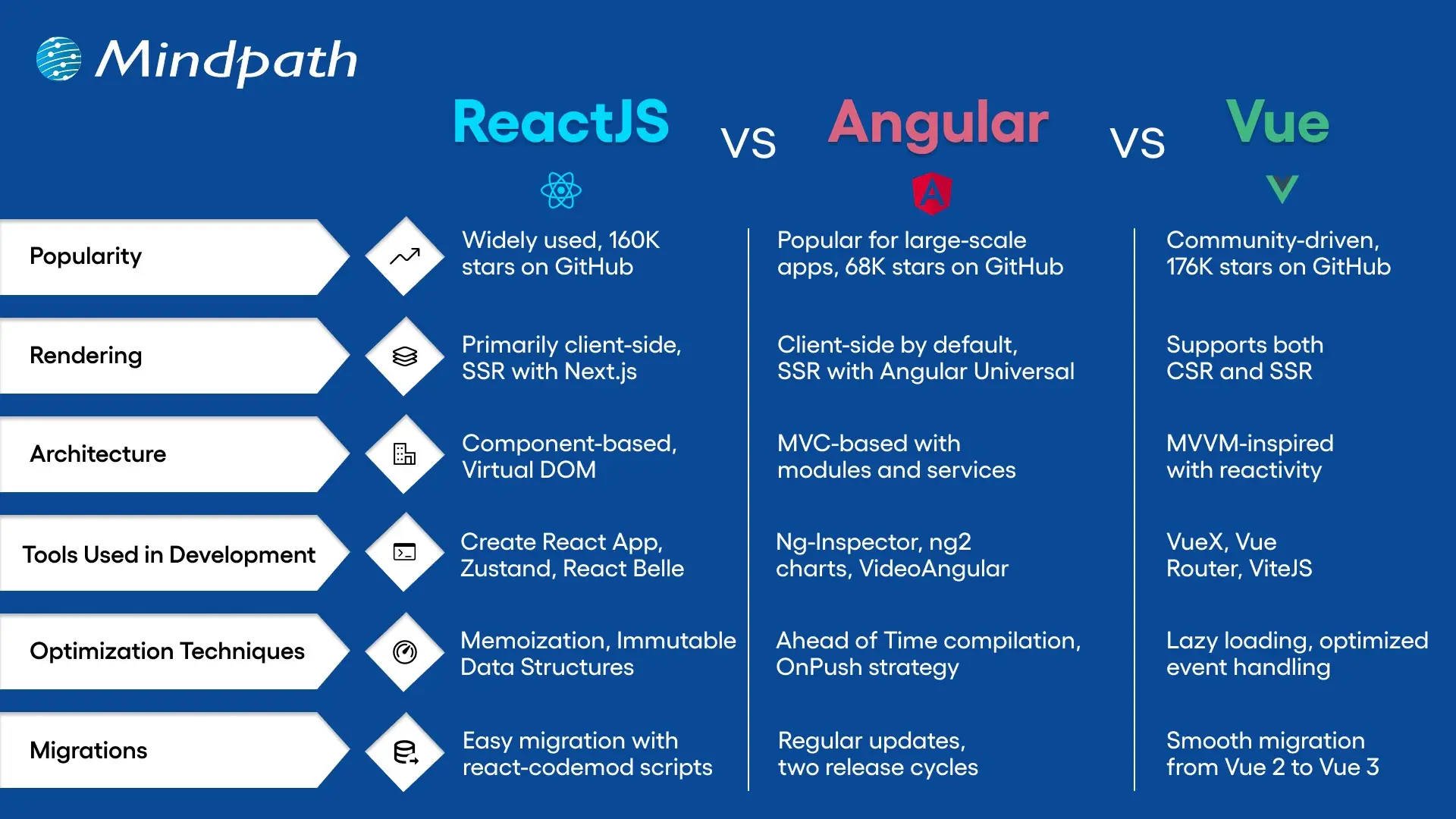
Choose the Right Framework for your Web Applications
Selecting between Angular vs React vs Vue is based on your project and team expertise. Each offers distinct advantages for web applications today. Angular is best for big-scale, enterprise-oriented applications with a full toolkit. React provides flexibility, reusability, and an enormous ecosystem and is best for dynamic and quick-loading UI. Vue is small in size, simple to learn, and ideal for small to medium-sized applications with a nice balance of simplicity and performance.
At Mindpath, we specialize in delivering high-performance web solutions with our ReactJS development services. Our experienced developers build scalable, responsive, and feature-rich applications tailored to your business needs. No matter if you’re upgrading an existing product or starting from scratch, our team ensures seamless development and fast delivery, backed by modern tools and proven practices.
The emergence of Retrieval Augmented Generation, or RAG, has certainly expanded the boundaries of Artificial Intelligence. If you’re wondering what is RAG in AI, the RAG refers to an advanced AI technique that can significantly improve generative models. This is possible since RAG enables them to access as well as integrate external and up-to-date information.
Within a short span of time, the concept of RAG has gained massive popularity. Its popularity was magnified after 2020 when the approach was formalized by Meta AI. The current interest in RAG comes from its capability to address the major challenges associated with large language models. It is time to explore the RAG concept in detail.
Looking to build a RAG solution tailored to your business? Explore Mindpath’s RAG Development Services to create AI applications that deliver accurate, context-aware responses using your enterprise data.
What is RAG?
Before diving into the realm of Retrieval Augmented Generation, you should be able to define RAG. RAG refers to the process of optimization of the output of a large language model so that it can reference an authoritative knowledge base beyond its training data sources while giving a response.
Understanding RAG in AI is essential because it expands the capabilities of LLMs beyond their static training data. RAG enables large language models to be applicable to specific domains or an organization’s internal knowledge base, keeping responses accurate and current. A common RAG example is in healthcare, where physicians use AI systems powered by RAG to access relevant, up-to-date clinical information for more accurate medical decisions.
Features of RAG
Now that you can define RAG properly, you need to familiarize yourself with its key features. Some of the main features of Retrieval Augmented Generation are:
1. Retrieval Augmented Generation involves retrieval, augmentation, and generation of responses.
2. RAG has the potential to significantly curtail GenAI hallucinations and outdated knowledge to improve the factual accuracy of the responses.
3. Instead of solely relying on pre-existing training data, RAG enables AI models to retrieve relevant and authoritative information from external knowledge bases or databases to generate accurate and contextually rich responses.
4. The RAG process can enhance the quality of answers on the basis of the retrieved information.
Want to understand how models like RAG focus on the most relevant parts of data for accurate responses? Check out our guide on attention mechanism explained to explore how this core concept powers modern AI systems.
Importance of RAG
After knowing what is RAG in AI, it is essential to look at its significance. RAG is extremely important because it is capable of resolving the limitations of conventional large language models. In order to know RAG in AI meaning and its importance, you need to be aware of the challenges associated with traditional LLMs. The key challenges are:
1. Generating false information when there is no accurate response.
2. Generating generic or out-of-date information when users expect a specific or the latest response.
3. Creating responses from non-authoritative sources.
4. Creating inaccurate responses because of terminology confusion.
Now that you know what is RAG in AI, you can say that this process can solve some of the challenges associated with LLMs. This is because RAG redirects large language models to retrieve relevant information from authoritative and pre-determined knowledge sources. Individual users or organizations can have a greater degree of control over the generated response or output. An RAG example involves a customer chat support bot that can retrieve relevant documents to answer customer queries about a product or service.
Looking to truly understand how AI can transform everyday business operations and improve smarter decision-making? Check out the key benefits of AI to see how it drives real innovation and long-term efficiency.
Mechanism of RAG
Let’s move ahead and understand how RAG works. Knowing the underlying process relating to the RAG process is cardinal to understanding the concept thoroughly.
In the case of RAG, an information retrieval component comes into the picture, which uses user input to pull information from a new data source. Both the user query or input and the relevant information are provided to the LLM. The LLM then uses the new knowledge along with the training data for the purpose of creating better responses.
1. Steps Involved in the RAG Process
After knowing what is RAG in AI, you can understand the key steps that are involved in the RAG process. Understanding these aspects is crucial to knowing the value of RAG for enterprises as well as individual users.
2. Creating External Data
The data that is outside the original training dataset of the LLM is the external data. It may come from different data sources, such as databases or document repositories. Moreover, the external data may exist in diverse formats, such as long-form text or files. An AI technique known as embedding language models is responsible for converting data into numerical representations and storing them in a vector database.
3. Retrieval of Relevant Information
This step involves a relevancy search. It basically involves the conversion of the user’s query into a vector representation. It is then matched with the vector databases. The documents relevant to the input of the user will be returned. Mathematical vector calculations and representations help in computing as well as establishing the relevance.
4. Augmenting the LLM Prompt
At this stage, the RAG model is responsible for augmenting the user input by adding relevant retrieved data in the context. This particular step involves the use of prompt engineering techniques for communicating effectively with the LLM. The augmented prompt plays a key role since it allows LLMs to produce an accurate response to the queries made by users.
5. Updating External Data
At this point, you may wonder – What if the data becomes old or stale? In order to maintain current information for retrieval purposes, the document has to be asynchronously updated, and the embedding representation of the document has to be updated. The user can do this through automated real-time processes. It can also be done through periodic batch processing. It is a common challenge in the context of data analytics that can be solved by adopting different data-science approaches.
Wondering how modern data practices actually make AI outputs smarter and more reliable in everyday use? Explore the latest data analytics trends shaping faster and more informed decision-making.
Use Cases of RAG
In the prevailing times, the relevance of RAG for enterprises has magnified exponentially. You need to be aware of some of the real-life RAG use cases, such as:
1. Customer Support Chatbots
One of the practical use cases of RAG involves chatbots or virtual assistants. RAG can play a key role in powering chatbots so that they can provide accurate and relevant information to customers.
2. Employee Training
While talking about RAG use cases, organizations must bear in mind that they can leverage RAG in order to create systems for training assessments. The role of RAG is also crucial to offer training and education resources during the onboarding process.
3. Document Assistance
RAG’s use is immense when it comes to drafting reports and generating content summaries. Its utility is also high in the context of populating documents with up-to-date and relevant information from diverse sources.
4. Software Development
RAG can act as a useful tool for developers who develop software applications. This process can help them generate codes. It can even provide them with suitable function suggestions. They can also rely on Retrieval Augmented Generation to fix bugs by retrieving information from diverse sources like libraries.
Want to build intelligent applications that integrate RAG for enhanced performance and scalability? Explore our insights on custom software development to create AI-powered solutions tailored to your business needs.
Final Words
The emergence of Retrieval Augmented Generation has been nothing less than revolutionary in the realm of Artificial Intelligence. RAG extends the utility of LLMs with external, specific knowledge. The RAG process depends on external knowledge sources for producing accurate and context-specific responses.
One must realize the importance of Rag. The insight can help you leverage the novel concept in an optimal manner and overcome the challenges associated with LLMs. With Mindpath’s expertise in providing AI development services, your company can derive optimum value from RAG and stay ahead of its competitors at every level.
Join our Newsletter!
categories
Join the world's largest training library and unlock new opportunities!
Featured Posts



Turn Insights Into
Real Business Solutions
Exploring trends is only the beginning. Whether you’re planning AI adoption, modernizing legacy systems, or building scalable software, our experts help transform ideas into practical business outcomes.