Agentic AI vs Generative AI – Understanding Key Differences

Join our Newsletter!

Featured Posts

Support Is One Click Away

Home

Agentic AI vs Generative AI – Understanding Key Differences

Agentic ai vs generative ai

Agentic AI vs Generative AI – Understanding Key Differences

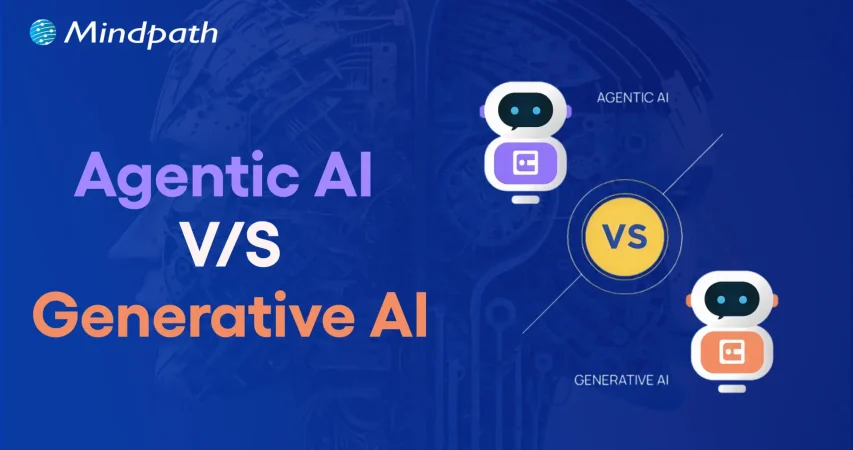
Artificial intelligence created the biggest ripples in the domain of technology in the last decade. Following the adoption of generative AI tools, there is a new type of AI that showcases how artificial intelligence continues evolving. The agentic AI vs generative AI comparison has become a hot topic of discussion for businesses worldwide. Which one do you think delivers the best of AI for your business?

Since the public release of ChatGPT, many businesses have gradually incorporated generative AI in their workflows. However, agentic AI emerged as a practical solution to address the unrealistic expectations users had from generative AI. Is agentic AI better than generative AI? You should know that each one of them has distinct strengths for optimizing professional business practices.

If you are looking to build innovative AI solutions that help enhance your business performance. Explore Mindpath AI development services to see how you can leverage the best through our expertise in agentic and generative AI.

Understanding the Definition of Generative AI

Many people would think of ChatGPT and other tools like Midjourney upon hearing generative AI. How can you define generative AI in the present context? You can assume that generative AI refers to the variant of artificial intelligence that focuses only on creation. Take a generative AI tool and imagine something that you want to create, such as an image or a letter to your friend. All you have to do is offer instructions and it can create your image or letter. 

How does generative AI create something new from your instructions? The core design of generative AI or gen AI revolves around models learning from existing data. Generative AI models use the knowledge gained from their training to create new output that features some elements of human creativity. 

You must have searched for ‘what is gen AI’ after learning about the mainstream adoption of ChatGPT, DALL-E and other generative AI tools. The effectiveness of these tools revolves around advanced machine learning models or neural networks to understand and recreate the patterns from their training dataset.

Even with the widespread adoption, generative AI does not come without limitations. The outputs by generative AI systems are as accurate and relevant as the data used for their training. On top of it, generative AI is not capable of making decisions on its own and just creates from the patterns it has learned.

Wondering how your business can leverage AI to stay competitive? Discover generative AI for business to learn how intelligent systems drive innovation, efficiency, and growth.

Emergence of Agentic AI

The quest to solve the limitations associated with gen AI led to the creation of agentic AI. With the use of smart agents, AI switched to proactive functionality from its traditional reactive nature. You can define agent AI as a new variant of artificial intelligence that focuses on specific tasks and autonomous operation. Smart AI agents will not only generate outputs based on your instructions but also learn in real time, make decisions, and implement actions required to achieve your goals. 

One of the most distinctive highlights of agentic AI, which makes it capable of autonomous decision-making, is adaptability. The best example of agentic AI is evident in agents used for customer support or in the infrastructure of autonomous vehicles. AI agents use sensors and algorithms to understand the environment and process information, followed by executing actions with different degrees of human oversight.

You can understand the answers to “what does agentic AI mean” in the fast-paced digital landscape by identifying how it acts with a purpose. Agentic AI is not only about responding to input like generative AI. On the contrary, AI agents understand the objectives and make informed choices to achieve the specific goals.     

Curious how Agentic AI and Generative AI fit into the broader AI landscape? Explore types of Artificial Intelligence to discover how ANI, AGI, and ASI provide the foundation for advanced AI systems.

Unraveling Key Differences in the Agentic AI vs Generative AI Debate

The arrival of agentic AI represents a major paradigm shift in the domain of artificial intelligence after generative AI. At the same time, you cannot ignore how generative AI is the most effective option for content creation. Therefore, an overview of the differences between agentic and generative AI is essential to pick the right option for your requirements.

1. Core Objectives

The foremost point in any generative AI vs agent AI comparison shall focus on the core purpose of the two types of artificial intelligence. Generative AI emphasizes creation and its core purpose is to create original content from user instructions. You can create images, draft emails or generate marketing materials with generative AI. The primary value proposition offered by generative AI revolves around augmenting the creativity of humans. Generative AI aims to achieve its purpose with the help of pattern matching and linguistic fluency.

Agentic AI works with the core purpose to achieve the goals assigned to it. The primary goal of agentic AI exceeds beyond content creation and aims to achieve a broader set of specific goals. The role of AI agents is to work autonomously without waiting for your prompts, which empowers them to identify opportunities and make relevant decisions. You can find answers to ‘what is agent AI vs generative AI’ in the fact that agentic AI can come up with different strategies and pick the right one to achieve the defined goals. For example, agentic AI use cases in software testing not only focus on writing test cases but also adopt a proactive approach to ensure software quality.

2. Dependence on Prompts

You wouldn’t get any prizes for guessing that generative AI is highly dependent on prompts. Generative AI has been designed to be reactive, which means that it responds only to user queries or prompts. You can have the most sophisticated LLMs in your generative AI systems and they won’t do a thing without human inputs. It clearly shows that generative AI is not capable of identifying problems or initiating conversations on its own. The reliance on prompts creates a significant roadblock for expanding the utility of generative AI. As a result, the most sophisticated generative AI models also need human oversight for every decision.

The difference between generative AI and agentic AI is evident in the fact that agentic AI has been designed for autonomy. AI agents operate within specific constraints to achieve defined goals albeit with complete autonomy. Agentic AI knows exactly when it must execute an action and determines the ideal strategy that can help in achieve the desired goal. You can notice the autonomy of agentic AI in how they leverage adaptive behavior and sophisticate decision trees in their architecture. Upon encountering problems, AI agents know how to solve them independently without human intervention.      

3. Use Cases in Real World

Another point of comparison between agentic AI and generative AI draws attention towards their utility. Generative AI has become the preferred choice for creative and analytical tasks that require human oversight. You can notice most of the use cases of generative AI in content creation and code generation. In addition, it also serves as a promising tool for design and visual creation by translating your ideas into real art. Businesses have also adopted generative AI as a promising solution for complex data analysis tasks to generate valuable insights.

The agentic AI vs generative AI comparison shall also showcase the growing use of AI agents in business functions. Agentic AI can streamline autonomous software testing with its capability to adapt to changes in the software application. Similarly, you can find successful examples of agentic AI applications in supply chain optimization. The other prominent use cases of agentic AI include algorithmic trading and robotic process automation.  

4. Workflow of Agentic and Generative AI

Most of the discussions on differences between agentic and generative AI also emphasize how the two variants of AI work. Generative AI works by providing unidirectional responses according to your input. For example, you provide instructions to generate an image and generative AI will create the image for you. Generative AI does not retain persistent memory or understand the objective you are pursuing as it focuses solely on the immediate instruction. It is one of the reasons for which using generative AI in multi-step processes involves human intervention at every stage.

Agentic AI stands out as the solution where generative AI poses problems. You can understand the difference between generative AI and agentic AI clearly in the various applications of agentic AI. Smart AI agents are capable of handling complex tasks that involve multiple steps and require memory retention. Agentic AI can maintain state across different interactions and track the progress made towards the defined objectives. Subsequently, it can adapt strategies on the basis of results in the intermediate steps to achieve the final goal.  

Looking to leverage the power of both autonomous and creative AI systems? Learn the benefits of AI to explore how Agentic and Generative AI together can transform strategy, operations, and customer engagement.

The following table showcases the notable differences between generative AI and agentic AI.

Criteria Generative AI Agentic AI
Core Objectives Generative AI aims to augment the creativity of humans by facilitating faster content creation. Agentic AI aims to achieve the defined goals with autonomous action.
Dependence on Prompts Generative AI is highly dependent on prompts. Agentic AI can take autonomous decisions without prompts.
Use Cases Generative AI is useful for content creation and data analysis tasks. Agentic AI is useful for autonomous software testing, algorithmic trading and robotic process automation.
Workflow Generative AI works by offering single-shot response to user instructions or queries. Agentic AI works with complex and multi-step workflows by adjusting strategies to achieve defined goals. 

Final Thoughts

The differences between generative and agentic AI reveal how artificial intelligence offers two distinct solutions to achieve different business goals. If you want to create content, generative AI is your best pick. On the other hand, you should choose agentic AI when you need your AI systems to work independently on specific tasks. The overview of the generative AI vs agent AI comparison can help you pick the ideal AI for your business.  

Mindpath is a leading platform to provide AI development services tailored to your business requirements. We also specialize in developing generative AI models to help you achieve promising improvements in productivity. Our ability to identify the pain points of the client and understand their vision helps us create the most relevant solutions. Reach out to us and give your business an additional edge in the AI revolution now.
Related Post

Discover the ultimate guide to hiring Node.js developers in London. Learn about the skills, benefits, and cost factors involved in finding the right talent for your project.
How much does hiring a ReactJS developer cost? Learn about factors affecting rates, and how to find the best talent within your budget.
Discover AI 2024 trends shaping our world—from multimodal models to optimized solutions. Explore how AI can revolutionize your business with Mindpath’s cutting-edge services.

Related Post

Hiring aNode.js developer in New York take more than simply technical skills. The ideal applicant should have a solid understanding of JavaScript foundations, backend frameworks, database administration, and API development. They should also be able to construct scalable, high-performance applications using asynchronous programming, debugging, and version control. Furthermore, soft skills like communication and cooperation are essential for effective collaboration. Here are the important technical qualities to look for when hiring a qualified Node.js developer in New York.

1. JavaScript Fundamentals

A solid knowledge of JavaScript fundamentals is required for any Node.js developer. Developers who understand functions, objects, closures, and asynchronous programming may build code that is both efficient and scalable. Since Node.js is based on JavaScript, understanding ES6+ features such as arrow functions, promises, and async/await is essential. A developer with strong JavaScript skills can produce cleaner, more maintainable code and adapt fast to new tools and frameworks in the Node.js ecosystem.

2. Node.js frameworks

Experience with popular Node.js frameworks such as Express.js is required for backend development. Express.js makes server-side programming easier with capabilities like routing, middleware integration, and request processing. Developers that are familiar with NestJS or Koa.js may create scalable and maintainable apps. A thorough grasp of how frameworks simplify backend procedures allows faster development, improved security, and better API management, making them essential for any Node.js developer in New York.

3. Database Management

A professional Node.js developer should be familiar with both SQL and NoSQL databases. Knowledge of PostgreSQL, MySQL, and MongoDB is essential for effective data management. The ability to develop optimized queries, manage transactions, and organize databases efficiently ensures that applications run smoothly. An experienced developer should also be conversant with ORM technologies such as Sequelize or Mongoose, which assist manage database interactions and accelerate development.

4. Testing and Debugging

Ensuring code reliability requires strong testing and debugging skills. A good Node.js developer should have experience with unit testing frameworks like Jest, Mocha, or Chai to identify and fix errors before deployment. Debugging skills, including the ability to analyze logs, use Node.js debugging tools, and resolve performance bottlenecks, help maintain a stable and efficient application. Effective testing reduces bugs, enhances security, and ensures a seamless user experience.

At Mindpath, we connect you with top-tier developers who specialize in JavaScript, Node.js frameworks, database management, API development, and more. Whether you need a developer for a startup, enterprise, or e-commerce project, we have the right talent to bring your vision to life.

Ready to build your dream team? Contact Mindpath today and let’s create something exceptional! Get in touch now!

Discover the ultimate guide to hiring Node.js developers in London. Learn about the skills, benefits, and cost factors involved in finding the right talent for your project.
Remote development team
Globalization has been a phenomenon that blurred boundaries and helped many businesses expand internationally. While the world is reaching toward realizing the idea of a “Global Village”, reservations and misconceptions about hiring remote employees and teams prevail.   COVID-19 showed business leaders the endless potential of remote working. While the world remained locked up, remote working allowed businesses to keep going, especially the ones dependent heavily on IT services  With rapid digitization, IT services have become more crucial than ever for businesses belonging to all categories and industries. According to Statista, the revenue of the IT services market is projected to reach USD 1,420 billion by 2024. Out of the total revenue, the IT Outsourcing segment is dominating the market with a projected volume of USD 541.10 billion in 2024.   Hiring a remote development team is a sound business decision with multiple benefits. In this blog, we will cover all the information essential if you are considering hiring remote developers or development teams for your business.  

Remote IT Development Teams: An Overview

Remote development teams consist of developers and tech professionals working from different geographical locations. These teams collaborate with businesses virtually, understanding their requirements, creating various wireframes, creating delivery plans, working on development, and delivering, deploying, and testing the final product. When hiring talent via staff augmentation, it’s essential to ensure that these remote teams are well-integrated into your project, enabling seamless collaboration and meeting your business goals efficiently.  Businesses are inclined towards hiring remote developers to access a wide talent pool within budget. Especially mid-sized and small businesses that cannot accommodate a full-fledged IT team to develop and maintain their website, apps, and other digital platforms can hugely benefit from hiring an offshore team.  

Benefits of Hiring a Remote Development Team

1. Access to a Global Talent Pool

One of the primary benefits of hiring a remote development team is the ability to access a diverse range of skills and expertise. Casting a wider net can help businesses recruit the top talents in the technology fields such as development, design, implementation, etc.   Emerging technologies like AI, ML, data science, DevOps, Blockchain, Cloud Computing are taking over the world. By looking beyond geographical boundaries, you can find developers with specific technical capabilities that may not be available locally.

2. Cost Efficiency

Hiring remote developers can be more cost-effective than maintaining an in-house team. A report by Deloitte suggests that 63% of companies outsource their development tasks to reduce costs.   You can reduce expenses related to office space, equipment, and other overhead costs. Moreover, the ability to hire from regions with lower living costs can further reduce payroll expenses without compromising on talent quality. 

3. Flexibility and Scalability

Remote teams offer greater flexibility. You can scale your team up or down based on project requirements without the logistical challenges associated with in-house teams. According to studies, 53% of businesses have dealt with capacity issues, and 38% improved the service quality by hiring a remote development team.   This flexibility allows you to manage resources more efficiently and respond quickly to changing project needs. 

4. Increased Productivity

Remote developers often experience fewer distractions than traditional office environments, increasing productivity. There is also no time for commuting to a physical workplace, saving time for more strategic actions.   With a properly managed remote team, you can leverage different time zones to maintain a near-continuous workflow, ensuring that your project progresses even outside typical working hours. 

5. Environmental Benefits

Hiring a remote development team not only saves your costs and improves productivity but can also contribute to reducing your company’s carbon footprint. With fewer employees commuting to a central office, there are fewer greenhouse gas emissions, aligning your business with environmentally sustainable practices.

Challenges to Consider

1. Communication Barriers

Effective communication is crucial for the success of any development project. When working with a remote team, time zone differences and language barriers can pose significant challenges. It is essential to establish clear communication protocols and utilize collaboration tools to ensure everyone is on the same page.

2. Managing Productivity

Tracking productivity can be more challenging with a remote team. Setting clear expectations, establishing measurable goals, and using project management tools are vital for keeping remote developers on track. Regular check-ins and progress updates can also help in maintaining accountability. 

3. Cultural Differences

Cultural differences can impact team dynamics and workflow. Understanding and respecting these differences is important for fostering a collaborative environment. Encouraging an inclusive culture where all team members feel valued can help mitigate potential conflicts and improve overall productivity. 

Best Practices for Working with Remote Developers

1. Define Clear Objectives

Before hiring a remote development team, define your project goals, timelines, and deliverables. Clear objectives provide a roadmap for the team and help in aligning their efforts with your business objectives. 

2. Invest in the Right Tools

Leverage technology to bridge the gap between remote team members. Tools like Slack/MS Teams for communication, Jira/Azure DevOps for project management, and GitHub for version control can enhance collaboration and streamline workflows. 

3. Build a Strong Onboarding Process

A well-structured onboarding process ensures that remote developers understand your company culture, project expectations, and their specific roles. Providing comprehensive training and resources can help new team members integrate smoothly and start contributing quickly. 

4. Foster Team Engagements

Regular team-building activities, virtual meetups, and open communication channels can help in building a cohesive team. Encouraging social interaction and recognizing individual contributions can boost morale and foster a sense of belonging among remote developers. When comparing IT staff augmentation vs. traditional hiring, these practices are essential in maintaining a strong, engaged team, regardless of the hiring model, while benefiting from the flexibility and scalability that staff augmentation offers.

Wrapping Up

Hiring a remote development team can offer numerous benefits, from access to a global talent pool to cost savings and scalability. However, it also requires careful planning and management to overcome challenges such as communication barriers, productivity tracking, and cultural differences.  If you’re considering hiring a remote development team, Mindpath’s Team Augmentation services can be an invaluable resource. Our experienced professionals can seamlessly integrate with your existing team, bringing specialized skills and expertise to help you achieve your project goals. With Mindpath, you get the flexibility and scalability of remote development without the common pitfalls. Partner with us to unlock the full potential of your development projects.  Feel free to reach out to us with any questions or to discuss your specific requirements. Together, we can build something great! 
Hiring a remote development team is a sound business decision with multiple benefits. Read things to keep in mind while hiring a remote team.
application security best practices

In this modern tech world, keeping your app safe and secure isn’t just a minor task anymore, but rather it has become a business priority. Whether you have built a mobile app or a web platform, the users trust you with their personal information every time they log in or make any transaction. Isn’t it true? This is the reason for which you should follow application security best practices because it can help you in protecting your app from hackers, data leaks and even costly breaches.

Strong security starts when you understand the correct strategy, starting from secure coding to regular updates and data protection. Do you want to know what is the best practice for application security for your web and mobile apps? Don’t worry, we will cover essential techniques for securing your applications in this blog, which can help you in staying one step ahead of threats and building trustworthy digital experience.

According to MarketsandMarkets Analysis, The mobile apps and web analytics market is expected to grow from 9.4 billion in 2022 to USD 20.2 billion by 2027, at a CAGR of 16.4%.

What is Application Security?

Application security refers to the practice of protecting your apps from threats that could steal all the data and even harm the system. It involves adding security features during the development stage and continuing to protect your app even after it is launched. This can ensure that both your app as well as the information it handles, are safe from hackers and other risks.

This protection can include hardware tools, software settings and regular security settings. For instance, a powerful router that obscures a device’s IP address provides hardware protections, while an application firewall embedded in the software frames actions. Security protocols, such as routine testing and upgrades, help to ensure risks are identified and rectified quickly so that the app continues to secure itself for years to come.

Want to transform your ideas into seamless applications?  Our Web and Mobile Application Development Services offer end-to-end development to create scalable and high performing apps which are designed accoridng to the business needs.

What are the 3 Pillars of Application Security?

To build a strong foundation for protecting any app, it’s important to focus on the core elements of security. These three pillars work together to keep applications safe and trustworthy.

1. Process:

This pillar includes the policies, procedures, and workflows that help manage and secure applications. These processes are designed to reduce risk and protect the app throughout its entire lifecycle.

2. Technology

Technology covers the tools and security controls used to keep applications safe. While new solutions keep emerging, it’s important to focus on the core security needs that protect the application effectively.

3. People

People are often the most overlooked part of application security, even though they play a key role. This pillar focuses on managing human risk, which includes the behaviors and actions of employees, contractors, and partners who have access to the system.

Also Read: Custom Web Development Services

Web Application Security Best Practices

In today’s digital world, keeping your application and security strong is more important than ever. A single loophole can lead to serious trouble. That’s why it’s essential to follow a smart plan to protect your app from threats. Here are some best practices you can follow:

1. Spot and Understand the Weak Points in Your App

After setting up your app security plan, it’s time to check for weak spots. You are likely to find many issues, but not all are serious. Focus on the most dangerous ones first. Use a custom threat model or OWASP risk scores to help you sort and fix them smartly

2. Use Quick Fixes Like Virtual Patching and WAF

Waiting months to fix app issues is risky. Virtual patching and a Web Application Firewall (WAF) can protect your app right away. They block attacks, even before a complete fix is ready. Also, limit app features and keep watching traffic to catch problems early and stay safe.

3. Start with Fixing the Most Important Issues

Fixing every issue at once can feel overwhelming. Focus first on the critical and high risks that could hurt your business or brand the most. Once those are handled, move on to the lower-risk ones. This smart step-by-step plan helps save time and protects what matters most.

4. Group Your Apps by Risk Level

When you have many apps, it helps to sort them by priority. Put them in buckets like critical, serious, and normal based on how sensitive the data is. Fix the most important ones first. Retire unused apps, and keep your list updated to stay organized and reduce risk.

5. Build a Clear Map of Your App Security

When apps grow fast, it’s easy to lose track. Start by making a full list of all your apps, their purpose, and update status. Add details like how they’re used and update security steps. This clear picture helps you fix issues quickly and build stronger web application security.

6. Monitor Your Application Every Time

Virtual patching through a WAF helps you fix issues faster and keeps your app under watch. It shows which attacks are blocked and where they come from. This ongoing monitoring builds useful security insights and also helps stop app-layer DDoS attacks before they cause trouble.

Curious about the next step in mobile innovation? Explore Progressive Web Apps (PWA): The Future of Mobile-First Development to see how PWAs combine the best of web and mobile apps for faster, engaging experiences.

Mobile Application Security Best Practices

Mobile apps are a big part of our daily lives and keeping them secure is a must. Whether you’re building an app or managing one, these simple practices can help you protect your users and data from unwanted threats.

1. Be Careful with Third-Party Libraries

Third-party libraries can save time but might bring security risks if not handled right. Always keep them updated and patched. Take time to check their safety before using them to avoid accidentally opening doors for hackers.

2. Make Login Stronger with Better Authentication

Use strong login methods to keep your app safe. Combine passwords with extra checks like one-time codes or fingerprint scans. Multi-factor authentication (MFA) makes sure only the right users can get in by asking for two or more ways to prove who they are.

3. Monitor and React to Threats Instantly

Use tools that keep an eye on your app and spot threats right away. When something suspicious happens, act quickly to protect your app. Having a clear plan for responding helps your team fix issues fast and keeps your app secure, following the best mobile security practices.

Also Read – Top Mobile App Development Trends in 2025

4. Set Clear Access Controls

Control what users can see and do in your app to keep data safe. By limiting access, you prevent unauthorized people from reaching sensitive information. This simple step is key to strong mobile app security and helps protect your app and users effectively.

5. Keep Your App Secure with Regular Updates

Regularly update your app and fix any security issues quickly. Patching helps close gaps that hackers could exploit. Setting up a routine for updates ensures your app stays protected and reduces the chance of breaches, keeping both your app and users safe.

6. Protect Your App with Tamper Detection

Use tamper detection to spot if your app’s code has been changed. Tools like checksums or digital signatures check the app’s integrity. If something is off, the app can stop running, alert your team, or even erase sensitive data to keep everything secure.

Wondering how a mobile app can boost your business? Explore the Benefits of Mobile App Development to discover how apps improve engagement, sales, and customer loyalty.

Are You Protecting Your App in the Right Way?

Application security best practices matter for everyone, not just tech teams. They help build trust, prevent data leaks, and keep users safe. Simple actions like checking your code, controlling access, and updating often can make a big difference. Staying secure today means staying ahead of threats.

At Mindpath, building secure digital experiences is our priority. Our web and mobile application development services follow proven application security best practices to ensure safety, performance, and reliability at every step. Partner with us to deliver robust and secure solutions you can trust.