Generative AI for Business: Your Key to Success

Join our Newsletter!

Featured Posts

Support Is One Click Away

Home

Generative AI for Business: Your Key to Success

generative ai for business

Generative AI for Business: Your Key to Success

Ever imagined a machine that could produce articles, logos, and new content to power your business? Sounds intriguing, isn’t it? Well, that is what generative AI can do for your business. This new-generation artificial intelligence is transforming future of businesses by generating new content, images, product designs and even strategy concepts from patterns it has acquired by analyzing the existing data. In this blog, we are going to discuss how generative AI for business can create innovation and give a competitive advantage.

So, before we learn about how generative AI can transform businesses, let’s understand what is generative AI.

Looking for ideas to reshape your business with generative AI? Unlock smarter growth, faster innovation, and personalized customer experiences with Mindpath’s AI-powered solutions

What is Generative AI?  

In simple terms, generative AI is an artificial intelligence that takes huge datasets and algorithms to learn the pattern and then generates new outputs based on its understanding. While AI is all about recognizing data, classifying it, or predicting, generative AI takes it a step further—it produces new content. For instance, it can author customer emails, create social media posts, produce product descriptions, and even assist in designing user experiences. 

Generative AI has the ability to provide enterprises with numerous benefits like enhancing innovation and creativity, enhancing productivity and reducing expenses. Generative AI also facilitates original idea creation, speed in product development, and custom-built customer experiences. In addition, it has the potential to enable workers to focus on more critical activities and reinforce security and raise the satisfaction levels of customers. 

Also Read: Generative AI Revolution

Let’s dive in how generative AI can drive business innovation and creativity for businesses. But before that have a quick look at the Google Trends for Generative AI for Business.

generative ai for business trends

How does Generative AI Drive Innovation for Businesses? 

In today’s fast-moving digital world, innovation is the key to staying ahead. Generative AI in business is assisting companies in igniting new ideas, enhancing content, and accelerating processes. Let us see how generative AI for innovation is changing the way companies think and create. 

1. Personalization Fuels Innovation 

Building a strong customer connection helps in driving business growth and personalization plays a major role in it. Companies can deliver tailored content and better user experiences with the help of smart tools that can understand customer behavior. This is precisely where generative AI for innovation can make a huge difference by helping businesses personalize at a scale which is much faster and more accurate than manual efforts.  

2. AI Creativity and Human Creativity: A New Partnership 

There is much discussion circulating about AI creativity vs. human creativity. It shouldn’t be about who is superior, but how they can both contribute to success. Humans can provide emotion, context and novel ideas to which AI can provide structure and new insights based on data. Merging the two can assist businesses to work more smartly. For example, how generative AI can augment human creativity is seen when it rapidly produces ideas or content, and humans are able to edit and make them work for the brand’s voice and objectives. This also ties into how AI is redefining job roles in tech, showing the evolving collaboration between human expertise and AI capabilities.

3. Unlocking Potential through Data-Driven Creativity 

Generative AI for business enables companies to convert information into intelligent ideas through analysis of customer behaviors, market patterns, and performance outcomes to develop valuable content, product layouts, or advertising campaigns. Humans contribute creativity, passion, and profound meaning, while AI contributes pace, logic, and the capacity to process vast volumes of data rapidly. When combined both, companies are able to develop meaningful experiences that connect with people and result in improved outcomes. aligning with the latest Gen AI trends in business intelligence.

4. Streamlining Operations 

When used properly, Generative AI in business enables companies to save time by automating routine work and processing large sets of data. This allows teams more time to come up with new ideas and more efficient ways of working. When businesses apply this type of thinking, they can grow more quickly, plan more smartly, and stay ahead of market change. That’s how generative thinking helps businesses innovate smarter because it provides them with the space, tools, and insights to grow more smartly. 

5. Securing Financial Transactions 

Generative AI is becoming a necessity for securing financial systems and mitigating risks. It enables companies to identify potential financial risks by processing vast amounts of data efficiently and accurately. The technology also helps in forecasting market trends, enhancing decision-making. Additionally, generative AI is improving fraud and suspicious activity detection in real-time. It’s transforming trading by offering insights from enormous data sets, ensuring smarter and safer transactions. 

Wondering how generative AI is influencing content creation and design strategies? Check out our blog generative AI changing creative industries  to see how AI-driven creativity is shaping the future of industries.

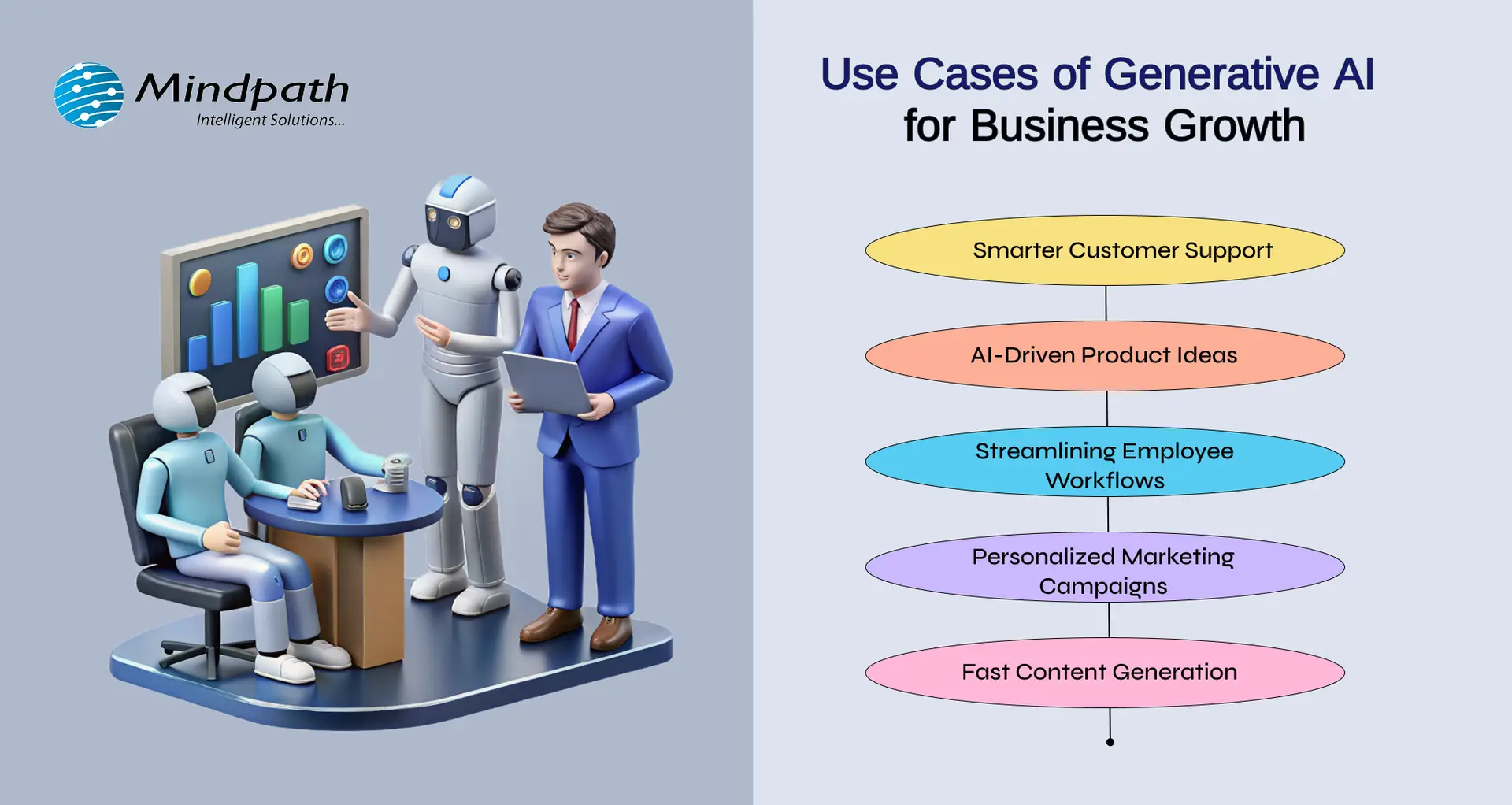
Use Cases of Generative AI for Business Growth 

Generative AI for business is revolutionizing the way companies develop by enhancing customer experience, increasing productivity of employees, and accelerating innovation. From conversational tools like ChatGPT, Bard, and Midjourney to live business applications, the effects are tangible. Here are some simple yet impactful generative AI use cases that fuel business growth today:
Use Cases of Generative AI for Business Growth 

1. AI-Driven Product Ideas

With tools such as Midjourney, businesses are able to create product ideas, packaging, and graphics. It illustrates how AI can be applied in innovation, by assisting teams to come up with creative ideas quicker and validate what is effective with actual audiences.

2. Smarter Customer Support

Tools like ChatGPT help companies create AI-powered chatbots that answer customer questions instantly. This improves response time and frees up human agents to focus on complex issues. It’s a simple way to offer 24/7 support and boost customer satisfaction.

3. Streamlining Employee Workflows

According to the McKinsey Generative AI Report, generative AI can automate tasks that take up 60–70% of employees’ time today. This includes writing emails, summarizing reports, and generating presentations—especially helpful for knowledge workers and high-skill roles.

4. Personalized Marketing Campaigns

Generative AI technology assists companies in crafting customized ads and suggestions based on user data. This renders marketing more precise and efficient, enabling more engagement and sales while saving time for marketers.

5. Fast Content Generation

With platforms like Bard, teams can quickly write blogs, product descriptions, and emails. This saves time and allows employees to focus on strategy. It’s one of the most practical generative AI examples used daily across industries. 

Looking to leverage generative AI for smarter, more adaptive app solutions? Explore our blog on Generative AI in App Development highlights practical applications, transformative benefits, and strategies to stay ahead in the digital landscape.

Ready to Make Your Business AI-Ready? 

Generative AI is changing the way businesses work, think, and grow. It’s not just about automation, it’s about helping teams be more creative, make faster decisions, and offer better experiences to customers. Be it creating content, improving support, or building new ideas, generative AI for business is making every day work smarter and more efficient. 

At Mindpath, we specialize in delivering cutting-edge AI development services tailored to meet the unique needs of modern businesses. Our expertise in generative AI enables companies to streamline operations, boost productivity, and create intelligent solutions that drive real value. Whether you’re looking to implement AI-powered automation, enhance customer engagement, or accelerate innovation, Mindpath is your trusted technology partner for consistent business growth! 
Related Post

Discover AI 2024 trends shaping our world—from multimodal models to optimized solutions. Explore how AI can revolutionize your business with Mindpath’s cutting-edge services.

Related Post

ui ux design trends 2025

At present, the UI and UX aspects of web app development are undergoing a paradigm shift. It is an understatement to say that the year 2025 has been a groundbreaking year when it comes to web app development. This is because an array of new UI/UX design trends has emerged. In fact, as per recent UX statistics, if you invest USD 1 in UX, you are likely to get a return of USD 100. It highlights the rising popularity of top-notch UI UX designs.

If you wish your business to stand out in the crowded digital space, it is essential to familiarize yourself with the latest UI UX best practices. By incorporating the top UI UX trends into your website, you can have a lasting impression on your target audience. Let us take a look at some of the most unique UX UI design trends that are set to rule in the year 2025 and beyond.

If you want to modernize your next project with UI/UX trends, our web development services can help you design and develop applications that would deliver engaging digital experience.

Top UI/UX Trends of Today

Gone are the days when websites used to be boring. Thanks to rising emphasis on UI UX, learning businesses have started realizing the strategic relevance of user experience and user interface. In the fast-paced business world, it is a must for businesses across diverse industries to incorporate captivating UX UI elements that can captivate online users.

If you wish to use your business website as a strategic tool, it is essential to review UI UX design elements that are ruling the web app development arena at present. It will certainly create an opportunity for you to develop a world-class website that can boost the overall experience of your users. Some of the major UX UI trends that are likely to rule the current as well as future web app development arena are:

1. AI-Driven Personalization

Today, businesses are relying on artificial intelligence technology to redefine their UI UX efforts. By leveraging AI, it has become possible to take personalization to the next level. Many businesses across diverse sectors and industries are incorporating AI to tailor the digital experiences of their users. By capitalizing on AI capabilities, it has become possible to create highly engaging as well as relevant interactions for the target audience.

Such a development in the web app development arena has undoubtedly revolutionized the experiences of users. Moreover, by focusing on AI-driven personalization, businesses are able to understand the behavior and preferences of their users in a better way. The insights are equipping businesses to promptly respond to the needs of their users and strengthen their association with them. Today, businesses have even started taking AI-driven personalization to the next level by creating dynamic layouts for their websites and developing adaptive designs.

Curious to learn how AI can transform web development? Take a deep dive into our Comprehensive Guide to AI in Web Development to get more insights!

2. Integration of Immersive Elements

One of the most popular UX UI trends that is dominating the web app development space revolves around the use of immersive elements. It has become common to add 3D elements to websites so that users can have a highly engaging experience. Some of the other common UX UI design examples that are gradually gaining popularity include virtual reality (VR) and augmented reality (AR) elements.

By incorporating such components into web app development, new possibilities have opened up for businesses. In fact, businesses have become capable of blurring the lines between the virtual world and the physical world. It has also been reshaping how online users interact with businesses in the modern era. In the future, this specific UX UI design trend is likely to gain further momentum due to its rising popularity among businesses and users alike.

3. Focus on Interactive Design

At present, businesses have shifted their attention towards interactive design in the context of web app development. By incorporating such elements, businesses can improve engagement and interaction with online users. It has become quite common to incorporate elements in the form of subtle animations and feedback to guide the users. Similarly, businesses have started incorporating dynamic animations that are capable of responding to the inputs of users.

Interactive design is considered to be an indispensable part of UX UI. Such design components can serve as catalysts and influence how online users interact within a website. This trend is here to stay since it can impact the experience of online users at diverse levels. If you wish your web application to have a lasting impact on your target audience, you must certainly start incorporating impactful interactive design features and components.

4. Introduction of Dark Mode

The dark mode is not exactly a new trend in the web app development space, but it has undoubtedly gained immense popularity in recent times. This mode has become immensely popular among online users owing to its sleek and captivating look. Moreover, the dark mode ensures the comfort of users, especially when they navigate websites and applications in low-light settings.

By including the dark mode element, it is possible for you to keep up with the amazing UX UI trend. This visual setting can create value for your web app by improving its overall aesthetics. Moreover, it can certainly enhance the overall experience of online users by improving their readability and reducing their eye strain. It is undoubtedly one of the top trends that businesses cannot afford to ignore today.

5. Sustainability in Designing

Today, immense focus is being laid on sustainability aspects. This trend has also been observed in the context of web application development. Currently, businesses are fusing sustainable and environmentally friendly design elements into their websites and applications. You must also start including elements that enhance the digital experiences of your users while minimizing their environmental impact. One of the top trends that is gaining momentum focuses on minimalism and efficiency. Similarly, another popular trend involves the use of recyclable resources.

It has become fairly common to prioritize efficiency in coding practices. By focusing on this aspect, it is possible for businesses to curb their footprint on the environment. This UX/UI trend is surely catching up in recent years, and it is expected to stay for a long time. It is the perfect time for modern businesses to incorporate this specific UX UI trend by locating unique ways to reduce waste and optimize the use of resources in web app design.

The top UX UI trends that have been identified are redefining the future of web app development today. Furthermore, these top trends are most likely to gain further momentum and influence how businesses create their websites as well as applications to shape user experience.

Final Words

The future of UI/UX design is full of new possibilities today. You can give your business an edge by choosing the best UX/UI design elements. Some of the major trends that you must look out for today include AI-driven personalization, integration of immersive elements, interactive design, dark mode, and many more.

You must undoubtedly consider joining hands with Mindpath since we offer comprehensive UI UX designs to modern businesses today. We aim to help you to keep up with the latest UI/UX design trends in 2025 and enjoy a competitive advantage. By choosing Mindpath’s top-notch app development services, businesses can create amazing applications that boost their performance and contribute to business growth.

full stack vs traditional web development

The dynamic digital landscape calls for new approaches to traditional tasks such as web development. Is full-stack development the ideal alternative to traditional web development? Interestingly, the answers to such questions will paint full-stack development as the right choice. However, it is important to know that a full-stack vs traditional web development comparison also highlights their individual strengths.

Experts have pointed out that web development will not rely on one specific approach replacing the other. The full-stack approach has gained popularity for its efficiency and versatility, while traditional web development is useful for specific projects. Let us learn more about the differences between full-stack and traditional web development.

Curious about how full-stack development can elevate your projects? Explore our full stack development services to get guidance and support across every layer of the application development.

Fundamental Difference between Full Stack and Traditional Development

The best way to draw predictions about the future of web development starts with an understanding of the two predominant approaches. Traditional web development has been the fortress of specialists and focuses on two distinct domains, frontend and backend development.

1. Frontend Development

The primary focus of frontend development for a web application is the visual appeal of the application. Frontend developers create aesthetically appealing designs and responsive layouts for the web application interface. The skills required to become a frontend developer include knowledge of HTML, CSS, and JavaScript. Each tool serves a distinct functionality in the web development process. For instance, HTML helps in structuring web content while CSS is useful for styling. Frontend developers must also know how to use frameworks like React and Vue.js for creating functional interfaces from design ideas.

2. Backend Development

The traditional web development process is incomplete without backend development, which deals with the server-side operations. Backend developers create the foundation for the frontend of the web applications with the help of logic and database management. Developers can write backend logic with languages like Java, Ruby, Python, PHP, and Node.js. The notable tools for database management include MongoDB, MySQL, and PostgreSQL. Some of the other notable responsibilities of backend developers include API creation, data storage, and security of web applications.

3. Full Stack Software Development

The full-stack approach to web development follows a holistic approach that combines frontend and backend development. Every full-stack development specialist can manage the complete web development process, starting from ideation to creating the server logic and deploying the application. Full-stack developers use their comprehensive set of skills to contribute value in projects that demand resource optimization. The most noticeable advantage of full-stack development is the ability to bridge the gap between functionality and design.

Also Read: Full-stack development with Node.js

Why is the Full Stack Approach Becoming Popular?

The review of differences between full-stack and traditional development can start with an impression of the advantages of full-stack development. The full-stack vs traditional development debate emphasizes how full-stack enhances efficiency, speed, versatility, and cost-efficiency. Businesses can complete full-stack projects with a single developer managing different aspects of the project. Full-stack developers can use their broad skill set to adapt to different project requirements and add value in different stages of the development process.

Another prominent highlight of the full-stack approach to web development is the holistic understanding of the project. Full-stack developers don’t view a project from distinct client-side and server-side perspectives. On the contrary, they know how the client-side and server-side work, which helps them make better architectural decisions. The holistic understanding of the project also helps full-stack developers achieve seamless integration and troubleshoot issues with ease.

The growing popularity of full-stack development in 2025 also depends on the benefit of cost-efficiency. Full-stack developers are a more economical choice than hiring different professionals for frontend and backend development. Smaller projects or startups can capitalize on this advantage and deliver desired results within a limited budget.

Is Traditional Web Development Still Relevant?

The advantages of the full-stack approach to web development may have you thinking that traditional development is not relevant. However, traditional web development is still useful in various scenarios for its distinct benefits. For instance, the full-stack vs traditional web development debate draws attention towards the effectiveness of traditional development in projects that demand deep specialization. In traditional development, developers can focus on specializing in a specific area, thereby earning the skills required to deliver high-quality output in their tasks.

Traditional web development is more suitable for use cases that involve highly complex architectures, niche performance requirements, and microservices. Larger organizations prefer to have different professionals for frontend and backend development, as it helps in establishing clear responsibilities. It is extremely helpful in situations when the organization has to scale up larger projects. Traditional web development puts multiple specialists to work on different parts of an application, thereby enabling efficient scaling.

Planning to validate your product idea quickly? Learn how hiring a full-stack developer for MVP accelerates development and increases success rates.

Unraveling the Negative Aspects of Frontend and Backend Development

Almost every discussion on the differences between full-stack and traditional web development emphasizes their advantages. However, the frontend vs backend vs full stack debate must also focus on the negative aspects to draw a balanced comparison. The following sections describe the prominent setbacks of full-stack and traditional web development.

1. Full Stack Development

The foremost setback of the full-stack approach to web development is the lack of specialized expertise in a specific area, such as complex database optimization. As a result, full-stack developers might struggle to manage different elements of a project simultaneously. The complex coding processes in the full-stack approach might require a high level of expertise for effective coordination between different stacks. Most important of all, juggling between frontend and backend development responsibilities can be a significantly challenging task.

2. Traditional Development

The disadvantages of the conventional web development approach include slower development cycles and higher costs. Businesses that choose traditional approaches to build web applications will have to hire multiple specialists, which can be expensive. The development speed also decreases in traditional web development due to the need for handoffs between teams and multiple dependencies. Furthermore, the need for seamless coordination also creates more communication overhead that may ultimately lead to potential misunderstandings and bottlenecks.

Looking for a cost-effective way to build your next web project? Explore how hiring a freelance full-stack developer benefits your business and enhances your digital presence.

Will the Future Rely on Full Stack or Traditional Web Development?

The full-stack and traditional web development comparison reveals that each approach has distinct strengths and setbacks. Many people think that full-stack will ultimately replace traditional web development for good. On the contrary, the future of web and software development is more likely to embrace a hybrid model. The hybrid model will blend the best of full-stack and traditional web development to make web development more efficient.

The web development industry will look for full-stack developers to manage end-to-end solutions, streamline development processes, and reduce overheads. On the other hand, specialization from dedicated frontend and backend developers will remain crucial for highly complex applications.

Trends in the Future of Web Application Development

The future of web application development will also embrace many other trends that will shape new avenues for developing applications. One of the most prominent additions among modern web development trends is the potential for including AI and machine learning in web development workflows. The two technologies can help in generating code automatically, integrating smart features in applications, and enhancing the UI/UX designs.

Low-code or no-code platforms can be the ideal alternative to full-stack or traditional development for simpler projects. These platforms can help professional developers reduce the need for extensive manual coding and emphasize strategic tasks such as API integration or creating custom features.

Ready to modernize your development approach for competitive advantage? Discover how full-stack development for web projects accelerates delivery and improves performance.

Final Thoughts

The insights on the differences between full-stack web development and traditional development reveal that both of them are essential for web development. Contrary to common assumptions, the future of web application development will not prefer a full-stack approach over traditional web development. As a matter of fact, businesses will choose the hybrid approach that offers the best of both web development approaches.

At Mindpath, our expertise in full-stack development has helped us serve multiple clients. We can claim to serve our clients with excellence in every stage of the web development process. Our vision to serve end-to-end IT solutions with complete transparency helps us earn the trust of our clients. Reach out to our consultants and discover the ideal solution to develop your next web project.

Remote Development Teams

Managing a remote development team can feel like a unique challenge, right? With team members spread across different locations, how can you ensure everyone stays connected, motivated, and productive? What strategies can you implement to keep your team engaged and aligned with project goals? In this blog, we’ll explore practical tips to help you navigate the complexities of remote team management.  

Managing a remote development team is essential because it allows everyone to collaborate effectively even when they are separated by a long distance. Good management ensures that everyone understands their responsibilities and feels connected to the team. When developers are well-managed, they are more productive and satisfied with their job, which leads to better project outcomes. Furthermore, excellent management facilitates issue resolution and keeps the team focused on their objectives. In today’s environment, when many individuals work from several places, qualified management is essential for success. 

So, let’s dive into the tips for managing a remote development team! 

Tips For Managing Remote Development Team

1. Hire Trusted Developers

The first and most significant recommendation is to hire folks that you can trust. Remote work can assist teams become more productive, decrease stress, and save money for the business. However, hiring the wrong individuals might cause serious consequences. When working remotely, it is impossible to manage the team in person. Trust is crucial; team members must be dependable and provide outstanding outcomes. If someone doesn’t appear capable, they can check in regularly via Slack, Zoom, or other methods, which might cause tension and pressure for them. Constant inspection can have an adverse effect on team performance. Establishing a robust recruiting process is crucial for identifying people with the necessary abilities. 

2. Use Agile Methods

One of the most effective approaches is to use the Agile Methodology. This strategy improves communication, cooperation, and project delivery by incorporating market input. Agile works by establishing a flat team structure, eliminating needless hierarchies. It focusses on identifying key aspects of the program to be built based on real-world scenarios. Agile also promotes brief daily meetings known as stand-ups, in which all team members can offer their ideas and updates. Furthermore, the team examines each project update collectively to determine what could be improved, added, or eliminated. Teams that plan and work together can launch a Minimal Viable Product (MVP) as soon as feasible. This ensures that the final product properly fits the demands of the users. 

3. Enhance Communication Tools

An important principle for good communication is to never assume; instead, ask questions and speak out when in doubt. This idea can assist in avoiding misunderstandings within a remote collaboration. Misunderstandings are common while working remotely, so it’s essential to resolve them early with the correct tools and procedures. For example, a team can use Zoom for meetings and special events, Slack for fast reminders and announcements, and Google Drive or Coda for document sharing. These technologies can significantly enhance communication and eliminate misunderstanding. Regular video conferencing is vital for interacting with teammates and fostering collaboration. They let you discuss project progress, identify areas for improvement, and check in on personal problems. These discussions serve to foster trust and transparency in communication. 

4. Hold Regular Performance Reviews

It is essential to schedule frequent performance evaluations to assess both individual and group performance. These appraisals give helpful feedback and assist in identifying areas for development. Setting a constant timetable, whether biweekly or monthly, enables developers to expect comments and focus on improving their performance. These sessions also provide a fantastic chance to acknowledge and appreciate their accomplishments. Encouraging 360-degree input is another great method. This entails getting feedback not only from managers, but also from colleagues and stakeholders. This technique provides a more comprehensive understanding of a developer’s strengths and opportunities for improvement. Developing future action plans is a key component of performance evaluations. Work with each developer to create customized development plans based on the input obtained.  

5. Build Team Spirit

Developing a strong business culture in a remote workplace can be difficult, especially when many people imagine coworkers celebrating birthdays with cake or enjoying themselves after work. However, the essence of workplace culture lies not only in the activities themselves but also in the relationships that they build among team members. It takes purposeful effort to foster a team spirit that boosts everyone’s spirits. Consider organizing virtual team-building events, celebrating accomplishments, or simply checking in with team members. These actions can assist in establishing relationships and foster a positive remote work environment. 

6. Let Them Work Freely

It’s essential to provide engineers with enough room to complete their work. Clients frequently express their worry about how to closely monitor their developers’ work, which can lead to ambiguity regarding progress. The remedy is straightforward: avoid micromanaging. The results speak louder than words. 

While it is essential to analyze performance data, one of the most common mistakes that drive great engineers to quit is attempting to regulate their every move. Developers don’t spend their whole day coding; they frequently require time to think about answers and devise new solutions to challenges. 

The easiest method to evaluate their work is to focus on the results they produce, rather than continually watching their everyday actions. Trusting them to work autonomously leads to a more productive and motivated team. 

7. Know Your Team’s Dynamics

Different teams have distinct meeting and communication requirements. Some teams may benefit from regular meetings to keep focused on project specifics, particularly if their job requires a lot of cooperation. Others might thrive better with fewer, less frequent encounters. To properly manage a development team, you must first learn how each person works best. Recognizing the team’s speed, choosing the most effective tools, and calculating the appropriate number of meetings may all assist to minimize burnout and undue stress. By identifying and respecting individual work preferences, you may foster a productive and peaceful workplace that benefits the whole team’s performance. 

Hire Remote Developer at Mindpath

At Mindpath, we understand that hiring remote developers is a crucial step in bringing your project to life. Our streamlined process is designed to ensure you find the right talent while receiving the support you need throughout the development journey. Whether you’re building a new application or enhancing an existing one, we’re here to help you achieve your goals efficiently. Here’s how our process works: 

1. Gather Your Requirements

Start by reaching out to Mindpath to discuss your project goals and needs. We will review all details and create a comprehensive plan that outlines our approach, timeline, and estimated costs. 

2. Select the Right Talent

We’ll identify remote developers who are the best fit for your project. You will have the opportunity to interview candidates and choose developers who meet your specific requirements. 

3. Kick Off the Project

Once your development team is assembled, we’ll kick off the project with a clear plan and timeline. Our team will maintain regular communication, providing updates to ensure everything aligns with your vision. 

4. Receive Ongoing Support

Mindpath is committed to supporting you throughout the development process and even after project completion. Our goal is to ensure that all your objectives are met and that the project runs smoothly. 

Final Thought!

A remote development team has to be managed effectively using a combination of communication, trust, and culture-building techniques. By prioritizing these characteristics, you can create an environment in which developers feel respected and encouraged to do their best work. Remember that hiring the proper developers is only the beginning. Maintaining an open channel of communication, holding frequent performance evaluations, and cultivating team spirit are essential for keeping your team on track with project objectives. At Mindpath, we streamline the recruiting process to ensure you locate the perfect people for your unique need. We are here to help you throughout your development journey, ensuring that your goals are met and that your projects run smoothly. 

Ready to elevate your project with top-notch remote developers?

Partner with Mindpath for seamless collaboration and expert support.

Discover effective strategies for managing remote development teams, from hiring trusted developers to enhancing communication.