Latest Insights On

GenAI, Tech, and Digital Transformation 

Stay updated with expert insights, success stories, and real-world applications of cutting-edge technology.

professional web development

Professional website development is not just an option for businesses. It has become a strategic necessity without which businesses may struggle in the prevailing digital age. It is a must for business entities that wish to grow and thrive in the online space. A website that has been developed by professionals acts as the cornerstone of the digital presence of businesses in the highly competitive business world.

Such a website can unlock diverse, varying growth opportunities in the form of better market reach and improved customer engagement. It is high time to select the top professional web development services since these solutions can increase the credibility and accessibility of your brand significantly.

Struggling to turn your website into a powerful tool for business growth? Mindpath’s professional web development services can help you build a high-performing, user-friendly website that drives results.

An Insight into Professional Web Development Solutions

Professional web development services can provide businesses with cutting-edge and customized website solutions that are designed to enhance user experience and security. They even contribute to enhanced search engine optimization. Such services prioritize mobile compatibility along with intuitive navigation to meet the needs of current-day users. The demand for professional web development solutions has been scaling to unimaginable heights lately.

Top Benefits of Using Professional Web Development Solutions

Modern business undertakings can derive a plethora of benefits by relying on professional website development services. You need to be aware of these benefits so that you can leverage these solutions in order to unlock business growth.

1. Expanded Market Reach and Visibility

Businesses need to bear in mind that professional web development incorporates technical SEO best practices as part of a well-defined web development roadmap. These practices can ensure that your website ranks higher on search engines and becomes easily discoverable by potential customers. A reliable professional web developer knows how to break geographical barriers by creating a mobile-optimized and responsive design that caters to a major part of the web traffic. So you must surely consider seeking professional help so that the reach of your website can be extended across different platforms and device types. Furthermore, multi-platform integration can allow seamless presence across various digital touchpoints. It will help your business widen its audience base in an effective manner.

2. Better Customer Engagement

It is advisable for businesses to choose professionals who have expertise as well as experience in website development. This is because they know that user engagement and experience matter a lot for businesses. They focus on elements that can impact the level of engagement for online visitors, like intuitive navigation. These elements can serve as a catalyst and boost the level of engagement for online visitors.

Moreover, they can even motivate them in order to spend additional time on the site while exploring the offerings of the business. Professional web designers know that strategically placed call-to-action buttons can guide visitors toward desired actions, which can help boost leads as well as create new sales opportunities.​ An experienced and qualified professional website designer can certainly help your business gain an edge in the market by developing a well-functioning and highly engaging website.

Want to accelerate business growth with a more efficient development process? Discover web development tools that empower professional teams to build secure, scalable, and high performing websites.

3. Boosted SEO and Higher Conversion Rates

Professional developers and designers are capable of writing SEO-friendly code. They can implement the design practices that are aligned with the latest search engine algorithms. These steps can serve as a catalyst and enhance the visibility of your website in the online setting.

Businesses must remember that it leads to more qualified traffic directed to their site. It can thus increase the likelihood of converting visitors into customers of your business. The optimization of site speed, as well as mobile experience, can further support better search rankings. They can help reduce bounce rates, which directly impact the bottom line of business entities.

4. Scalability and Customization

A website that has been professionally developed is built with scalability in mind. This mindset allows the website to grow alongside your business. With the help of custom website development services, your website can incorporate tailored features that meet your specific needs and clearly differentiate your business from competitors.

A business must make use of top website development services, as they provide advanced functionalities in diverse areas such as e-commerce and content management. Such adaptability is key, as it can help save costs and time in the long run through the prevention of the need for frequent migrations or redesigns.

5. Enhanced Security

Today is the age of cyber threats. In such times, businesses need to develop websites that are safe and secure in nature. This is when professional web development comes into the picture, with a strong focus on web application security. These experts can make sure that the security dimension of your business website is non-negotiable.

These service providers are capable of implementing robust security protocols and tools such as HTTP encryption so that cybercriminals and online attackers will have no chance to target your business website. You need to choose professional web designing and development services as they can safeguard your business as well as customer data in an effective manner. This feature can play a key role in driving business growth.

Looking to unlock sustainable growth with a stronger digital foundation? Discover how partnering with a professional web development company can help you build scalable and high performing solutions.

6. Higher Trust and Credibility

The website of a business entity often forms the first impression in the mind of potential customers. A sleek and modern design, combined with clear security features like SSL certificates, signals to visitors that your business is trustworthy as well as professional in nature. This credibility has the potential to encourage customers to engage more confidently with your brand.

This feature can ultimately support sustained growth for your business. Businesses from diverse industries and sectors need to remember that trust is critical while developing the business website. Customers will be encouraged to visit and revisit a website if they think that it is trustworthy.

7. 24/7 Online Presence and Competitive Edge

Physical stores are bounded by working hours. However, that is not the case when it comes to a business website. A professional website has to operate around the clock so that visitors will be able to navigate the site in a seamless manner and make inquiries and sales at any time. For every business, web development is a must in the prevailing times, as most businesses now have a web presence. The ongoing availability is crucial in order to maintain competitiveness in the dynamic and volatile business arena.

In the case of smaller or newer businesses, being accessible online is extremely important in the strategic sense. This is because it can enable them to compete on a larger scale and operate in an efficient manner in the competitive space.​ If you want your business to gain a competitive edge in the volatile market setting, it is very important to choose a credible and professional web development service provider.

Curious how emerging technologies are reshaping professional websites? Check out the latest web development trends and discover what drives performance, security, and scalability.

Want a Website That Drives Growth and Outperforms Competitors?

In the highly competitive market scenario, top professional web designing solutions are the ultimate need for businesses. These services can act as a source of competitive advantage for your business. Some of the main advantages of top professional web development solutions are better market reach and visibility, along with enhanced customer engagement.

At Mindpath, we provide professional web development services that can definitely give a competitive edge to your business instantly. Our professionals know how to deliver tailored and advanced websites that are aligned with the vision of brands. If you wish your business to gain an edge over your competitors, you certainly need to strengthen your business website immediately. Step ahead and partner with a credible professional web development service provider like Mindpath to have a robust business website.

GenAI tools for teachers

The year is 2026 and AI isn’t just knocking at the doors of the education industry as it has become an integral part of the classroom, research lab and faculty room. Educators have been burdened with expectations and exhaustion due to changing curriculum designs in different parts of the world. The arrival of GenAI tools in education sector has marked the introduction of many new opportunities for educators.

Generative AI is gradually becoming an indispensable companion of teachers worldwide for many reasons. Most important of all, gen AI tools are not replacing the human element in the teaching experience. On the contrary, generative AI empowers teachers and helps them provide personalized learning experiences to every student. Let us find out the top generative AI tools that can help teachers.

Want to stay ahead in the education sector by offering smarter, more efficient solutions? Mindpath offers generative AI development services to help education businesses build custom, scalable AI tools tailored to their needs.

Understanding the Significance of Generative AI for Teachers

The biggest problem for teacher in the modern education industry is the burden of tedious and repetitive administrative tasks. Imagine the stress on teachers who have to evaluate the test papers of each student and prepare lesson plans for the next day. The use of GenAI tools for teachers can help in reducing the burden of administrative tasks, especially with automated grading and generation of personalized learning materials. Generative AI tools can allow teachers to invest their efforts in interacting with students, fostering creativity and nurturing critical thinking skills.

Teachers should understand that generative AI is not just another technological trend that will fade away with time. As a matter of fact, generative AI signifies a major paradigm shift in the domain of education. You can notice the broader impact of generative AI in education sector in different solutions like personalized learning at scale, automated content generation and better student engagement. Generative AI can help learners by creating adaptive learning systems that align with the learning style, strengths and weaknesses of each learner.

The reduced administrative burden on educators helps them interact directly with students and craft innovative teaching strategies. GenAI tools also help educators provide instant feedback on student assignments thereby allowing students to learn quickly from their mistakes. Teachers can rely on generative AI to improve student engagement by creating interactive content and personalized assessments. As a result, generative AI helps educators transform learners into active participants in the learning journey.

Looking for ways to integrate cutting-edge AI into your teaching strategy? Read this blog on generative AI trends to stay ahead with the newest AI innovations.

What are the Top Generative AI Tools for Teachers?

The blend of artificial intelligence and education brings promising results for learners as well as educators. You might be wondering about the top generative AI tools preferred by teachers and their special features. The following list of generative AI tools can help you understand the significance of gen AI in the education sector.

1. ChatGPT

The biggest generative AI tool that attracts the attention of educators worldwide is ChatGPT. It is still one of the basic tools that transformed how we interacted with artificial intelligence. Educators can trust ChatGPT for its versatility and use it as an assistant for different types of tasks. ChatGPT is one of the top 10 AI tools in education for drafting lesson plans, summarizing research papers or providing answers to difficult student questions. Educators can trust ChatGPT for brainstorming, content creation and delivering responsive student support.

2. Sendsteps

Sendsteps AI is a unique platform that makes the process of creating assignments a lot easier for learners. It relies on the power of natural language processing to understand the teacher’s instructions with accuracy. The AI tool uses teacher instructions to craft content personalized to specific needs and learning objectives of students. Educators can also use Sendsteps for creating interactive quizzes with the facility of automatic grading.

3. Google Gemini

Another big name among the best AI tools for students and teachers is Google Gemini. It stands out with multimodal capabilities that make it better than text-only models. Google Gemini can not only generate text but also images and audio content, thereby enhancing its versatility for classroom applications. Teachers can rely on Gemini to create lesson materials, interactive quizzes with audio prompts and explanation of scientific concepts with diagrams.

4. Canva Magic Studio

You cannot think about AI tools in the field of education without focusing on Canva and its ‘Magic Studio’ AI features. Canva is a distinct AI tool in education that allows you to create visually stunning presentations effortlessly. Teacher can also use it to craft compelling educational videos, infographics and interactive worksheets. The ‘Magic Studio’ feature of Canva also provides personalized recommendations for content generation while creating teaching aids.

Also Read:  Generative AI Predictions

5. Quizizz

Quizizz is another generative AI platform that helps teachers in creating interactive quizzes. It can help teachers in crafting engaging quizzes, interactive lessons and polls from different source materials. The AI tool can also help in generating different types of questions, such as open-ended or multiple-choice questions. Educators can transform quizzes and assessments into fun experiences for students with Quizizz while obtaining an accurate impression of student performance.

6. Socrative

The list of top generative AI tools that can help teachers also includes Socrative, an AI-powered student response system. Socrative is the best example of using generative AI for educators to enhance their capabilities for evaluating student assignments. Teachers can use Socrative to create open-ended questions and quizzes to collect formative assessment data. The data obtained from such tests can help teachers recognize the weaknesses and students and modify their teaching approaches.

7. Nearpod

Nearpod is also a useful generative AI tool for embedded open-ended questions, quizzes and polls in presentations. Teachers can use Nearpod as one of the top education AI tools to create engaging lessons for students. The tool also provides valuable data on student performance along with creative tools for educators. The creative tools can help in creating interactive learning experiences that boost critical thinking and creativity of learners.

8. Flipboard

One of the most interesting AI tools that teachers can use in 2025 is Flipboard. It is the best AI for education delivery in a completely new and innovative format. Flipboard helps educators in combining articles, videos and other web content on a specific topic in the format of a digital magazine. Educators can share the digital magazines with students through links that can enhance the learning experience.

9. Magic School AI

Magic School AI is a comprehensive collection of AI tools for educators, focused on automation of common classroom tasks. It is one of the best generative AI tools to create subject-specific lesson plans, worksheets and rubrics. Teachers can find more than 60 tools in Magic School AI for different aspects of the teaching experience.

10. Curipod

The collection of GenAI tools for education must also include Curipod for its capabilities as a lesson planning assistant. It helps in making classroom learning more engaging with interactive activities. Curipod can create presentations with interactive elements to encourage student participation. Teachers can use Curipod as a trusted solution for real-time understanding of student performance and fostering active learning.

Could understanding AI applications in other industries help you choose the best tools for your classroom? Discover how generative AI in market research, providing insights that can spark innovation in teaching.

11. Eduaide.AI

Eduaide.AI is one of the few generative AI tools created specifically for educators. It helps in streamlining lesson planning and creation of learning resources. The AI tool can help in generating lessons plans aligned with popular standards. The intuitive interface of the platform combined with emphasis on pedagogical support makes it an invaluable tool for educators.

12. Otter.AI

Otter.AI is also another notable example of education AI tool with distinctive features. The AI-powered transcription service leverages generative AI for real-time transcription of spoken language in class lectures or parent-teacher conferences. The tool plays a crucial role in enhancing accessibility of education and efficiency of taking notes.

13. Evernote

Evernote is a comprehensive organizational tool for an educator, which utilizes generative AI for content curation. Teachers can use Evernote to save videos, articles and other web content to create educational content. The AI tool helps in effective collection and organization of research materials, creation of lesson plans and sharing personalized learning resources with students.

14. Gradescope

Gradescope also showcases another example of using generative AI tools for learning improvement through the use of AI for simpler and faster grading process. Teachers can use Gradescope for automated assessment of complex assignments like essays, code submissions or problem sets. The AI-powered features of the platform not only save the time of teachers but also ensure grading consistency and offers accurate analytics for student performance.

15. Raindrop.io

Raindrop.io is another promising addition to the list of top gen AI tools in the domain of education. It is a bookmarking tool that helps teachers in saving and organizing web content alongside creating collections of bookmarks. Teachers can share the bookmarks with learners, which may be videos, articles or any relevant web content for future reference.

Curious about the most impactful ways generative AI is being applied across different industries and classrooms? Explore detailed generative AI use cases in our comprehensive guide to see how these tools are transforming education and beyond.

Ready to Transform Education with Generative AI?

Generative AI tools are revolutionizing education by reducing administrative burden, enabling personalized learning, and boosting student engagement. Educators can focus on creativity, critical thinking, and meaningful interactions while students enjoy adaptive and interactive learning experiences in the classroom.

At Mindpath, AI development services help education businesses build custom, scalable generative AI solutions. From automating lesson plans and grading to creating personalized learning platforms, our expert team designs tailored AI tools that empower teachers and enhance student engagement.

Custom mobile application development

Businesses today, in a fast-moving digital world, are always trying to innovate so they can stay ahead. Custom mobile application development helps drive the change in how companies interact with their customers and improve internal operations. Try to imagine having a solution that is just for your business and will improve efficiency, engagement, and accelerate growth. Developing an app with a solution for the goals of your business has become a strategic need for any business wanting to be an industry leader.

As technology develops, the demand for personalized digital experiences grows, and the expectations of customers rise. If organizations want to provide authentic value, they can no longer select a generic approach. With custom mobile application development services, organizations gain the ability to adjust quickly, have deep functionality, and create seamless experiences that genuinely resonate. In this blog, we will discuss how those applications form the basis of digital transformation and change the way businesses are operating in a connected world.

Unlock new ways of connecting with users that help your business reach greater heights with Mindpath’s mobile app development services, which provide solutions according to the individual business demands.

Overview of Custom Mobile Application Development

Custom mobile app development means developing customized mobile applications that align with the company’s unique goals and workflow. A custom mobile app development company constructs your app from the ground up, giving you total control of features, design, and experience, while they supply the solutions to maximize efficiency and growth.

The process enables organizations to provide seamless integration of the app with their current systems with full confidence in security and scalability. Throughout the process, from planning and designing to developing and supporting, every phase of the app is managed to achieve business requirements and provide a smooth, entertaining experience for users.

How Does Custom Mobile Application Development Drive Digital Transformation?

Custom mobile app development is changing the way businesses think about tech and growth. It allows organizations to embrace newer solutions to replace their technologies that serve the company’s individual goals and strategies in this digital age.
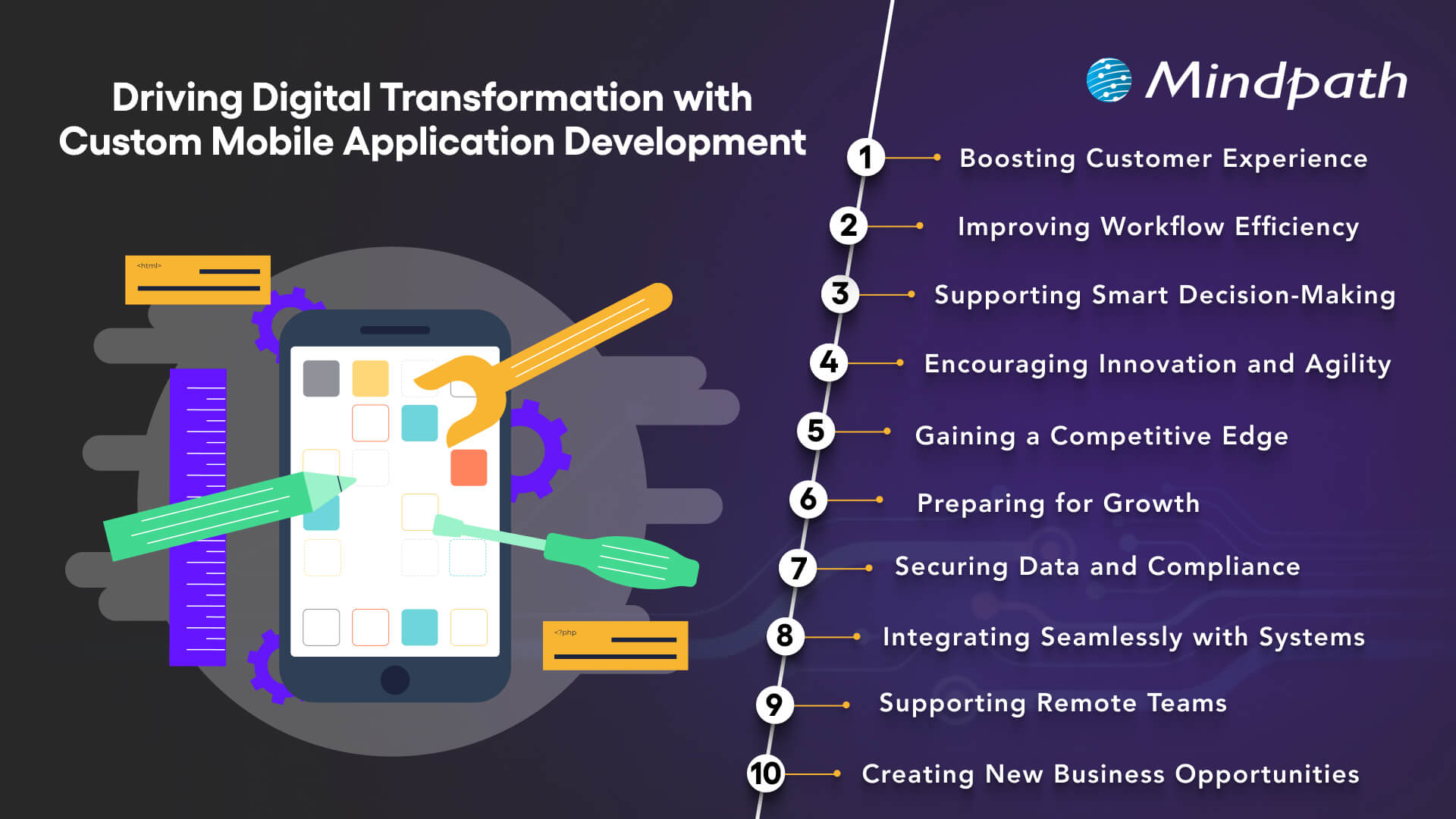
Driving Digital Transformation with Custom Mobile Application Development

1. Boosting Customer Experience

By using custom mobile application development, a company can have an app that is unique and offers a different experience for the users. These applications are the most convenient way for the customers to interact with the company, get a response, and receive the service. If a business adopts a user-centric design, it is only a matter of time before they will see their customers being more loyal and having a stronger bond with them.

2. Improving Workflow Efficiency

Personalized applications simplify core business operations through the automation of monotonous tasks and the minimization of errors. As a result, the company productivity is elevated and operational expenses are lowered. Enterprises thus become winners of facilitated work processes and a better structured system.

3. Supporting Smart Decision-Making

Custom app development enables real-time data collection and analysis. Companies have the ability to monitor consumer behavior, industry trends, and their own performance in an easy way. Such a data-driven strategy is a great source of power for decision-makers, as it enables them to take correct and prompt decisions.

Want to understand which tools and frameworks power successful mobile apps and accelerate digital transformation? Explore our detailed guide on mobile app development technologies to discover the platforms and tech stacks driving innovation.

4. Encouraging Innovation and Agility

By using tailored solutions, businesses have the possibility to create exclusive features that tackle issues directly. Such freedom from constraints promotes creativity and makes it possible for the company to adjust to the changes in the market swiftly. In other words, companies have the opportunity to be ahead of their competitors in the sense that they can try out new things and make their moves faster.

5. Gaining a Competitive Edge

Custom applications are a great way for companies to be different from the rest of the businesses by giving them exclusive features and a better user experience. Such differentiation leads to a powerful market presence. A good app is the company’s strongest weapon in the battle for customers against competitors.

6. Preparing for Growth

Custom mobile application development is a wise decision when considering business growth because it guarantees that the app will be scalable. It is very easy to add new features or make a service available to more users. The company can grow with no problem of performance or user experience being compromised.

Must Read: AI in Mobile Apps

7. Securing Data and Compliance

Custom apps may have the most sophisticated security features that are specifically tailored to meet the needs of different industries. Such features not only secure sensitive information but also help in maintaining compliance with the set regulations. Companies can go about their operations without any worries that their data is secure.

8. Integrating Seamlessly with Systems

Custom apps built using the right mobile app development tools can be linked to existing corporate software and platforms without any problems. As a result, this leads to the creation of a single digital ecosystem that spans across different tools. Information exchange between various systems becomes very easy. Hence, the mistake rate is reduced, and the speed of work is increased.

9. Supporting Remote Teams

With the help of mobile application development platforms, employees get access to tools and information from anywhere. This provision of remote access is a great boost to collaboration, which can now happen across different locations. It also allows work arrangements to be flexible. Teams are thus not being unproductive as they are not bound to a single office.

10. Creating New Business Opportunities

The creation of custom apps may result in a business gaining revenue streams through subscription fees, in-app purchases, or new digital models. Companies can now dig into newer ways of monetizing their services. By means of website and mobile app development, the business can ensure that these opportunities are indeed going in line with their overall strategy.

Looking to future-proof your mobile app strategy? Discover the latest insights in our blog on mobile app development trends to see how emerging technologies are redefining digital experiences.

Want to Drive Growth with Custom Mobile Apps?

Custom mobile application development is a powerful tool for businesses looking to innovate and stay competitive. Tailored apps improve efficiency, enhance customer experience, and provide data-driven insights that guide smarter decisions. By adopting custom solutions, organizations can drive growth, strengthen their market presence, and create seamless digital experiences that truly align with their goals.

At Mindpath, we offer professional custom mobile application development services to help businesses achieve these results. Our team builds scalable, secure, and feature-rich mobile applications that integrate smoothly with existing systems. We focus on delivering solutions that match your business needs and foster innovation. We provide a superior user experience across all platforms.
Legacy application modernization

There is need to make radical decisions in order to grow in 2026. Legacy application modernization now sits at the center of every CEO agenda. You are witnessing increasing prices, delayed launches, and systems to block innovation. So, what will you change first? Technology influences the degree, pace and consumer confidence. Consequently, leaders need to think radically about fundamental systems with expediency and conviction.

Nonetheless, the process of modernization is not a fast upgrade. It involves vision, alignment and good implementation. You would need to relate business objectives with contemporary architecture and cloud preparedness. Delay decreases the benefits as competition increases. Clearly, smart CEOs are early adopters and change agents. This blog discusses real-life tactics that help organizations grow in a scalable manner. So, keep reading further!

Want to turn legacy applications into a driver of growth and innovation? Mindpath provides legacy modernization services that help organizations modernize systems and unlock new business opportunities.

Why is Understanding Legacy Application Modernization Strategies Important?

Leaders must understand the right approach before investing in legacy application modernization. An effective plan will minimize risk, cost management, and adjust the technology to business objectives. It makes more intelligent choices, prevents interference, and long-term value. Modernization attempts to accelerate growth but lack guidelines; they tend to slack growth rather than improve it.

The world of business today is a busy environment where it is the speed and flexibility that determine the success of a business. Knowing the strategy behind legacy app modernization helps teams prioritize upgrades, strengthen security, and support innovation. It develops a blueprint to scalable systems, improved customer experience and a sustainable digital growth in competitive markets.

Must Read: AI-driven legacy system modernization

Key Strategies for Legacy Application Modernization

Powerful growth requires a definite course of action. Legacy application modernization strategies help businesses upgrade systems with less risk and better results. A narrow strategy makes the technology work in line with long-term objectives and innovation.

1. Refactor or Rearchitect

This is a method that re-architectures an application. Teams subdivide large systems into small and flexible services. It enhances scalability and is available with AI and real-time data tools. Many legacy modernization strategies recommend this for business-critical platforms. It drives true Legacy system transformation.

2. Rehost

Rehosting relocated applications in the cloud without altering code. It lowers data center expenditure within a short time. Companies achieve improved infrastructure and scalability. Although it does not fix deep design issues, it supports early legacy application modernization goals. It puts the systems into readiness to be improved in the future.

3. Retire

Retiring eliminates non-value-adding applications. Most organizations continue to incur the expense of unused or duplicated systems. Their closure saves on licensing and maintenance. This simple step strengthens application modernization plans. It liberates funds on high impact innovation projects.

4. Replatform

Replatforming transfers applications to the cloud with minor enhancements. Managed cloud services could replace self-managed databases in teams. This enhances performance and saves on operation. It balances cost and benefit during modernization of legacy applications. It eliminates chances of complete reconstructions.

5. Repurchase

Repurchasing involves substituting custom systems with cloud based SaaS products. Companies shift to subscription services run by reliable suppliers. This eliminates internal pressure of maintenance. It guarantees the availability of frequent updates and security patches. It supports faster legacy modernization decisions.

6. Relocate

Relocation takes virtual machines into the cloud without adjustment. It is efficient when implementing data centers of a large scale. Businesses are consistent and fast during migration. This method supports infrastructure goals in legacy application modernization programs. It keeps disruption low.

7. Retain

Retaining is maintaining the application in the existing environment. This is selected when systems continue to provide high returns to companies. It enables IT teams to work on more important upgrades. Not all systems are in need of urgent transformation. Smart legacy application modernization planning includes selective retention.

Want to ensure your modernization efforts follow a clear and structured path? Explore the legacy modernization roadmap to guide every step of your transformation journey.

Steps to Build an Effective Legacy Application Modernization Roadmap

A roadmap makes complicated upgrades into systematic improvement. The correct plan will help make sure legacy app modernization initiatives remain business-focused, budget-wise, and long-term.

Steps to Build an Effective Legacy Application Modernization Roadmap 

1. Evaluate Your Current Applications

Begin by taking a thorough analysis of your current systems. Quality of check codes, performance problems, integrations and infrastructure to identify the latent risks and areas of improvement.

2. Define Clear Business Objectives

Connect the leadership and stakeholders to the importance of modernization. Establish quantifiable objectives to ensure teams know priorities, expected results and schedules prior to technical change.

3. Select the Right Modernization Approach

Select a strategy that suits the business, e.g. rehosting, refactoring or rebuilding. The right choice reduces risk and supports long term legacy application modernization success.

4. Prioritize and Test with a Pilot

Divide the plan into achievable stages. Begin with high impact modules and put a proof of concept to confirm performance, security and scalability enhancements.

5. Execute in Controlled Phases

Move changes in steps so that there is no disruption. A structured rollout ensures stable operations and measurable value throughout the legacy application modernization journey.

Want to understand how updating legacy systems can boost business performance? Discover the benefits of modernizing legacy systems to achieve efficiency and scalable growth.

Ready to Lead Growth with a Clear Modernization Strategy?

Legacy application modernization offers CEOs the freedom to scale comfortably. It lowers the risk, enhances security and optimizes performance of the system. More significantly, it makes technology consistent with long term business objectives. The first mover companies are faster, more nimble and more trusted by their customers. An obvious guide transforms complicated systems into development drivers.

Mindpath is a reputed legacy modernization company who provide legacy modernization services that assists businesses in modernizing key systems in a clear and accurate manner. Our professionals evaluate, develop, and implement policies that facilitate creativity and business prowess. We put emphasis on quantifiable outcomes and value creation. Through Mindpath Legacy modernization services, companies create safe and scalable platforms that can support future developments.

FAQs

1. Why should CEOs prioritize Legacy application modernization in 2026?

Legacy application modernization helps CEOs reduce operational risk and unlock faster innovation. Modern systems support better decision making, improved security, and stronger customer experiences. In competitive markets, outdated platforms slow growth. A clear modernization strategy ensures technology actively drives revenue, efficiency, and long term business stability.

2. How long does a modernization initiative typically take?

Timelines depend on system complexity, business goals, and chosen strategy. Some upgrades take a few months, while large transformations may extend longer. A phased roadmap reduces disruption and delivers value early. Clear planning, executive alignment, and expert guidance help maintain speed and control.

3. What risks should businesses consider before modernization?

Companies should evaluate integration gaps, data migration challenges, security exposure, and internal skill readiness. Poor planning may lead to cost overruns or operational delays. Strong governance, stakeholder alignment, and measurable milestones reduce uncertainty. A structured roadmap ensures smoother execution and predictable outcomes.

4. How do microservices improve scalability in modernization projects?

Microservices break large systems into smaller, independent components. Teams can scale each service based on demand without affecting the entire platform. This structure improves deployment speed, fault isolation, and performance optimization. It also supports cloud environments and advanced integrations such as AI driven analytics tools.

5. How can Mindpath’s legacy modernization services support technical transformation?

Mindpath’s legacy modernization services provide structured assessments, architecture redesign, and cloud migration expertise. Their team builds scalable systems aligned with business objectives. As a trusted technology partner, Mindpath ensures secure execution, phased rollouts, and measurable performance gains across complex enterprise environments.

AI use cases 

Currently, cloud computing, data analytics, and machine learning are influencing the way companies are innovating. Do companies have the capability to leverage AI use cases to remain competitive in the market? All industries are under pressure to become efficient and customer-focused and make better decisions. Investigating these technologies stimulates novelties and challenges leaders with the need to reconsider the old methods.

With smarter systems embraced in organizations, the actual question is what AI applications are the most valuable. Is it possible to have teams that open up and simultaneously cut down on mistakes and costs? Numerous leaders are creating, trying and revising solutions every day. In this blog, we are going to examine the most successful AI business use cases that are going to transform business in 2026. So, keep reading further!

Planning to adopt AI but unsure how to turn emerging use cases into measurable business outcomes? Mindpath offers end-to-end AI development services that guide you from strategy to implementation.

Why are Businesses Turning to Artificial Intelligence?

Businesses embrace the use of artificial intelligence to operate more quickly, cheaply, and make better decisions. Numerous businesses using AI automate routine work and enhance day-to-day operations. Data insights help the leaders to influence strategy and planning. McKinsey reports that about two thirds of organizations continue to test or pilot AI with careful adoption across industries.

Careful consideration of real value AI use cases has become a priority among companies. Teams make the experiences of customers personal and their supply chains efficient through intelligent systems. According to McKinsey, 64 percent of the respondents claim that AI helps support innovation goals. Companies that pair AI with their expansion policies tend to achieve greater productivity and quicker innovations and improved competitive placements.

Not sure how to move from AI ideas to real business impact? Discover the AI roadmap to check out how structured planning turns AI use cases into scalable results.

Practical AI Use Cases Driving Business Transformation

Businesses do not consider AI as an experiment anymore, they use it to solve daily problems. The current trends of many businesses utilizing artificial intelligence are based on measurable results and quicker outcomes. AI helps make smarter decisions, smoother operations and makes industry growth scalable. Below are the use cases that demonstrate how companies can transform AI strategies into a real business impact.

1. Personalized Customer Journeys

AI assists brands to know customer preferences and behavior patterns in real time. The AI use cases in teams are used to customize recommendations and interactions. This will enhance interactivity and customer retention. The experiences offered by many companies using AI make them appear relevant and timely.

2. Predictive Equipment Monitoring

AI monitors the machine information by sensors and performance history. Such AI applications detect problems prior to failure. There is a decrease in downtime and maintenance costs incurred in business. Repairs are scheduled ahead of time and unexpected breakdowns prevented.

3. Intelligent Customer Support

AI chatbots respond to queries in real-time in digital mediums. These applications of AI decrease response time and workload. Customers are provided with regular assistance all the time. Support teams are responsive to complicated customer demands.

Looking for practical inspiration beyond theoretical AI use cases? Discover AI chatbot examples to check out how businesses are automating support, sales, and workflows.

4. Smart Workforce Planning

AI forecasts the staffing requirement based on the previous demand. AI use cases provide managers with the ability to manage workloads. Staffs are given timetables that are based on availability and capabilities. Teams do not experience staffing problems during peak times.

5. Content and Campaign Creation

AI examines trends with the purpose of recommending topical content. GenAI use cases assist teams to write articles and social posts more quickly. Marketers minimize tasks used up in repetitive work. Creative teams dwell on message and strategy.

Must Read: Generative AI Tools for Content & Code Creation

6. Advanced User Security

AI makes authentication based on biometrics and behavioral monitoring. These AI use cases minimize fraud and unauthorized entry. Real-time systems identify the abnormal activity. The users enjoy secure and easier logins.

7. Quality Testing Automation

During development cycles, AI tests applications are tested continuously. Enterprise AI use cases enable teams to identify defects in the beginning. Products are developed to fix bugs prior to release. Enterprises provide quality software with a reduced amount of errors.

Want to know what makes AI applications smarter behind the scenes? Check out the role of vector databases in AI applications and discover how they improve relevance and decision-making.

8. Operational Intelligence Management

AI is used to keep track of systems in order to detect problems in performance. AI use cases help teams to avoid service outages. Issues are resolved faster with the use of automated alerts. Operations continue to be stable and efficient.

9. Safety and Risk Monitoring

AI examines the surroundings based on camera and live data. There are the AI use cases that detect risks in advance of events. Companies enhance the safety conformity in operations. Simultaneously, the teams react quicker to threats.

10. Conversational Product Assistance

Artificial intelligence assistants help customers in choosing products. AI agents use cases provide real-time questions and recommendations. Customers get the correct answers immediately. Brands enhance interactivity and buying assurance.

Ready to understand what powers self-learning and action-oriented AI applications? Discover the role of AI agents to learn how they manage tasks, decisions, and execution end to end.

Real-World AI Use Cases Examples

Companies have outgrown strategy and are concerned with real achievement in their daily activities. These AI use cases demonstrate how companies use intelligence to address real-world problems in various sectors. The following are illustrative of the ways AI is providing quantifiable value to real businesses.

1. Amazon suggests products about browsing and buying history, enhancing cross-selling and upselling using the AI use cases in action.

2. Netflix applies AI to recommend films and movies according to viewing history to keep the users active and decrease churn.

3. Tesla enhances car security through the Autopilot that helps them monitor the road and drivers to avoid collisions.

3. Apple makes iPhones secure using Face ID which offers quick and smooth authentication but ensures sensitive user data remains intact.

4. Walmart trains new workers with AI, which guarantees consistency in training and leaves managers to do valuable work.

5. Coca-Cola manages logistics and inventory through AI to enhance the efficiency of the supply chain and minimize operational expenses.

6. IBM uses Robotic Process Automation on routine work, enhancing precision and allowing workers to undertake high-value tasks.

7. L’Oréal applies conversational AI to provide individual beauty tips and recommendations, which enhances engagement and purchases.

Wondering what separates traditional automation from true AI-driven transformation? Learn about AI models to check out how they power modern enterprise use cases.

Ready to Transform Your Business with AI?

AI is reshaping how companies operate, improve efficiency, and engage customers. Practical AI use cases help businesses automate tasks, enhance decision-making, and boost innovation. From personalized experiences to predictive maintenance, AI is driving measurable value. Companies adopting these technologies can grow faster, reduce costs, and stay ahead in competitive markets while building smarter and scalable operations.

At Mindpath, we offer expert AI development services to help businesses implement these solutions. Our team builds custom AI systems, chatbots, and predictive tools that fit your operations. With Mindpath, companies using artificial intelligence can automate workflows, personalize customer experiences, and improve efficiency. We guide businesses to apply AI effectively and achieve real growth through smart technology.

FAQs

1. What are common AI use cases in business?

Artificial intelligence is used to automate work, assess information, and create better customer experiences. There are numerous applications of AI use cases in many businesses aimed at efficiency. Predictive analytics, chatbots, and recommendation engines are commonly used.

2. How do businesses identify the right AI use cases?

Begin with redundant operations or data-intensive processes that reduce the speed of teams. Analyze the areas that businesses using artificial intelligence achieve the best outcomes. Focus on the high-value areas in accordance to the goals.

3. Will AI replace human jobs in companies?

AI does the routine work and human beings concentrate on strategy and creativity. AI in real life is not a substitute, but a partner. Reskilling will be fundamental due to its increasing adoption.

4. What industries lead in adopting AI technologies?

AI is applied in finance, healthcare and retail to make predictions, analyze and recommend. Enterprise AI use cases are effective in boosting efficiency and customer experience. Every industry implements AI to address certain issues.

5. How can small businesses benefit from AI adoption?

AI schedules, reports and supports small teams automatically. Companies using AI are able to conserve time and minimize errors. Smart tools allow small businesses to compete better.

outsourcing web development

In the present world, maintaining a strong online presence has become a necessity for any business. That’s where outsourcing web development can help you. As a matter of fact, this can be your most strategic growth accelerator. It is currently being used by organizations of both large and small scale to get access to global talent and unlock innovation, which keeps them on the competitive edge.

If you want to update your current website or introduce a new one, outsourcing can help you facilitate smooth management of this process, giving you time to work on other crucial issues. This post will help you know what outsourcing web development truly means and explore the 10 amazing benefits of the same.

Struggling to keep up with rising development costs, talent shortages, and faster digital demands in 2026? Mindpath’s web development services help you outsource with confidence, delivering scalable solutions that accelerate business growth.

Web Development Outsourcing- A Short Brief

In simple words, outsourcing web development is a practice of hiring an external team of professionals to handle a development project. Instead of investing in creating an in-house team, some businesses prefer to opt for outsourced web development services. The major factors that have caused this are minimized costs, shorter project durations, and the availability of specialized skills.

This will enable the businesses to concentrate on the major operations without the need to worry about web development and maintenance. It has become a norm amongst companies. Over 76 percent of the enterprises outsource their IT functions (Source: Deloitte). This is useful for startups and enterprises. 

Should You Outsource Web Development?

Still not sure if you should outsource web development? Here are some questions that can help you make a decision: 

1. Do you require any specialized skills not available in-house? 

2. Is scalability important to your business growth?

3. Do you want to speed up time-to-market and lower costs? 

If your answer is yes, you can prefer to outsource web development projects. This will offer you a perfect combination of expertise, innovation, as well as efficiency. If you are looking for some more reasons, check out the selections below, where we have covered some impressive benefits of outsourcing web development. 

Want to build a tailored digital solution that perfectly aligns with your business goals and user needs? Check out our guide on custom web development services to discover how personalized solutions can give you a competitive edge.

10 Key Advantages of Outsourcing Your Web Development

Outsourcing web development is not just about reducing costs; it’s also about working smarter without compromising quality. Read on to know the major advantages of outsourcing web development and the reasons why several businesses are drawn towards it. 

1. Access to Global and Top Talent

Outsourcing opens the door to highly experienced and skilled UX/UI designers, programmers, creative experts, project managers, and more. You are not limited by location anymore. The outsourced companies use advanced technologies such as blockchain and AI, and have skilled experts in frontend and backend development.

Based on your budget and requirements, you can outsource projects to regions well known for their tech expertise, such as Poland, Europe, or the United States. It allows you to leverage top-tier talent at competitive hourly rates.  

2. Reduced Development Cost

The most obvious advantage of outsourcing is lower web development costs. When you hire an in-house team, you will have to deal with multiple expenses. For instance, salaries, office space, software, benefits, employee training, and more.

You don’t have to worry about full-time salaries when you outsource. You only have to pay for the services you need. Besides, most outsource web development companies follow a flexible pricing structure. That can help startups and SMEs scale quickly. 

3. Fast Development Time

An experienced outsourced development team can start working on your project instantly. They have access to all web development tools and web development technologies to complete the task on time. 

Besides, they always follow streamlined workflows and agile methodologies to ensure faster prototyping and deployment. This gives you a chance to launch your website or web app faster to stay ahead of your competitors. 

4. Scale Up or Down Conveniently

The fact is, your web development needs are not constant. When you need to launch a new product, you may need a large team. And for maintenance, a few developers will be enough. Outsourcing lets you adjust your team as per your needs. 

Furthermore, scaling will be more predictable. You can plan ahead, understanding your requirements and adjusting team skills and size quickly. This is useful for seasonal companies and startups moving through a rapid growth stage. 

5. Access to The Latest Tech

Everyone is aware that technology is dynamic. It may not be easy to keep abreast with new security measures, web development trends, web development frameworks and web programming languages. However, outsourcing companies usually invest in the state-of-the-art tools and platforms.

They also assure you of working with best practices and current security features in developing your web apps. With chatbots, AI, and other high-level cybersecurity solutions, they transform your site into a masterpiece.

Curious how AI is transforming the way modern websites are built and optimized for better performance? Discover our in-depth guide on AI in web development to learn how it can enhance efficiency, personalization, and scalability.

6. Risk Mitigation

Creating a website comes with various risks, including security issues, non-compliance, and unexpected costs. These factors can easily derail your project. If you don’t want to deal with all these risks, partnering with an outsourcing company would be an ideal option. 

Trusted web development outsourcing companies practice the best security, compliance, and coding standards. In addition, their special QA teams constantly ensure your new website complies with the accessibility guidelines and performance. In addition, their SLAs or service-level agreements can be of benefit to you.

7. 24/7 Technical Support and Maintenance

A website needs to be updated as well as optimized regularly after it is developed. The majority of businesses fail to maintain their websites through their in-house team. Outsourcing provides continuous maintenance and technical support.

They keep an eye on your website, fixing things and making sure your site is equipped with the most recent laments to run without any hassle.

8. Reduced Burn Rate

You may find developing an in-house team appealing. However, it comes with major overhead. For instance, recruitment expenses, equipment leases, back-office operations, team onboarding, and more. 

For early-stage businesses or startups without consistent revenue, these expenses can inflate the burn rate. Well, outsourcing web development provides you with a leaner alternative. Pay only when you opt for their services, and you can stay financially agile. 

9. More Time for Core Operations

Web development is a process that should be carefully monitored, and it needs much of your attention. That means when done in-house, you may not get enough time for core business operations. 

By handing over the task to an external team, you can dedicate your time to other crucial things, such as sales, marketing, customer acquisition, strategic partnerships, etc. As a result, when your web app is fully developed, you will be in a good position to execute a successful launch. 

10. Enhanced Transparency and Project Management

Reputed outsourcing companies utilize modern project tracking tools, agile methodologies, and focus on transparent communication. They ensure you get regular updates and reports about your project. 

Furthermore, they ensure a smooth collaboration between you, designers, developers, and the project manager. With such facilities, you can ensure your web development aligns with the company’s vision. 

Looking to improve collaboration and speed up your web development process with a more flexible approach? Explore our detailed guide on agile methodology in web development to discover how it helps deliver faster and more efficient results.

Common Web Development Services to Outsource

You can assign the entire project or specific parts to your outsourced web development company. Here are some of the common services that are usually outsourced:

1. UI/UX Design

To develop interesting and user-friendly interfaces.

2. Web Consulting

Assists in idea validation and making web development easy.

3. Tailored Web Development

This includes both backend and frontend coding.

Must Read: Frontend Development Trends

4. E-Commerce Development

Creating a superior online store. 

5. API Development and Integration

To create custom APIs for enhanced user experience and functionality.

6. Database Management

To design as well as manage databases in a secure manner. 

To achieve desired outcomes, outsourcing web development to an experienced and reliable company is important. 

Planning to build a successful digital product but unsure about the right steps and timeline to follow? Discover our complete web development roadmap to understand each phase and make smarter outsourcing decisions.

Ready to Kick Start Your Business Growth by Outsourcing Web Development?

Outsourcing web development is more than a cost-saving strategy. It allows businesses to access global talent, adopt the latest technologies, scale efficiently, and focus on core operations. Smart outsourcing ensures faster project delivery, improved quality, and long-term business growth.

At Mindpath, we offer end-to-end web development services tailored to your unique needs. From UI/UX design and web apps to maintenance and support, our expert team ensures seamless execution, timely delivery, and innovative solutions that help your business scale confidently and achieve measurable results.

Benefits of saas

Are you still relying on on-premise software to manage your business operations? In today’s evolving world, traditional software models are considered costly, outdated, and also challenging to maintain. The shift towards SaaS (Software as a Service) is redefining how organizations function. Besides, the benefits of SaaS are truly impressive compared to traditional models. 

As cost-efficiency, rapid deployment, and remote work become top priorities for businesses, SaaS has emerged as a crucial element of modern IT strategy. In this blog, we will discover more about it and understand what are the benefits of SaaS. Furthermore, you will understand how these tools support business operations. So, let’s dive deep into it. 

Planning to move your business to a cloud-based software model for better flexibility and cost efficiency? Mindpath’s SaaS Development Services deliver tailored solutions that improve performance, scalability, and user experience.

What is SaaS? – A Simple Explanation

Software as a Service, or SaaS, is a cloud-based software model where tools are hosted by third-party providers. The service providers offer the tools to organizations on a pay-as-you-go basis. As a result, businesses can access SaaS applications anytime they want with an internet connection. 

Some common examples of SaaS platforms are Zoom, Salesforce, Google Workspace, Mailchimp, and Shopify. Speaking about some common benefits of SaaS, these are continuous innovation, seamless collaboration, and faster deployment. 

Some key characteristics of SaaS are: 

1. Accessible from anywhere and anytime 

2. Subscription-based pricing models

3. Automatic and hassle-free updates 

4. Flexibility and scalability 

Looking to match your business needs with a skilled SaaS development provider? Check out how to choose the right SaaS development services to ensure perfect alignment.

Key Benefits of Software as a Service

Now that we have an understanding of SaaS, it’s time to explore the values SaaS platforms bring to the table. From small startups to large organizations, SaaS tools offer powerful solutions to enhance productivity and streamline multiple operations. 

Here are some impressive software as a service benefits that make these tools a crucial element of every business’s success. 

1. Cost-Efficiency

We would say this is one of the most compelling Benefits of SaaS. Opting for traditional software means you will have to invest in IT personnel, hardware, and licenses. However, SaaS tools eliminate these expenses by providing you  with: 

  • Lower initial investment

There is no need to buy expensive software licenses and hardware. 

  • Transparent billing

With different subscription models, you can plan your budget easily. 

  • Low Maintenance Costs

The service providers will handle regular patches, updates, and service maintenance. 

These things make SaaS attractive for small businesses and startups with a restricted budget.

2. Scalability- It Grows with Your Business

As your organization grows, so do your software requirements. All trusted SaaS service providers have powerful and massive IT infrastructure. This makes it highly scalable and flexible. When your business grows, you can just change your subscription plan, and you are ready to go. 

Using SaaS platforms, organizations can: 

1. Upgrade and downgrade their plats based on requirements. 

2. Add or remove users with a few simple clicks 

3. Access modern features without making any changes to the tool. 

Organizations just need to pay for the services they use, making it an adaptable solution. 

Looking to understand how different development approaches impact SaaS performance? Check out the types of software development to gain insights for building high-quality SaaS solutions.

3. Mobility and Accessibility

In this world, where global teams and remote work are the latest trends, accessibility is vital. It can be achieved through SaaS solutions. These tools are easily accessible through any device with an internet connection.  

SaaS allows employees to effortlessly collaborate from any location. Besides, the software can be accessed from smartphones, laptops, tablets, and desktops. What’s more? Multiple teams can smoothly work on the same projects simultaneously. 

This high level of accessibility enhances overall productivity while supporting an agile workforce. 

4. Reliable Data Storage and Automated Backups

As SaaS is powered by cloud technology, your data will be regularly stored and backed up. Businesses can customize their storage options based on their needs. Furthermore, they can increase or decrease the features. 

On the other hand, with SaaS tools, you don’t need to worry about running out of space. No matter what your storage requirements are, you can easily find an ideal plan that will work for your business. 

Must Read: Cloud Security Tools

5. Hassle-Free Maintenance and Automatic Updates

Users of traditional software are well aware of the disruptive and time-intensive manual update process. One of the significant advantages of software as a service is that updates are handled by the service provider. 

Furthermore, there are other benefits to consider, such as: 

  • Continuous Improvement

Service providers regularly roll out new, advanced features along with security patches. 

  • No Manual Setup

Updates are delivered and installed by the SaaS service provider. Users don’t need to perform any action. 

  • High Uptime

All updates are deployed during off-peak hours to avoid disruption. 

It ensures that your organization has access to the latest security enhancements and features. 

6. Compatibility- Effortless Integration

Most SaaS tools utilize Application Programming Interface or API for data transfer. It makes these tools highly compatible, and they can be integrated with almost all technologies. 

Modern SaaS platforms easily connect with ERP, accounting, marketing tools, and CRM. As a result, it will be easier for you to manage and streamline repetitive tasks. The interconnected ecosystem boosts data visibility and supports informed decision-making.

7. Enhanced Security

Undoubtedly, security is a major concern for every business. And trusted SaaS providers always prioritize cybersecurity. With the best SaaS tool, you will enjoy the following security benefits: 

  • Regular Backup

Most SaaS tools support automated data backup, ensuring quick data recovery in the event of system failure. 

  • Data Encryption

SaaS providers use advanced security features to keep sensitive information protected. 

  • Compliance

These tools adhere to the major industry standards such as HIPAA, GDPR, and more. 

With the help of a SaaS provider’s expertise, your organization can attain the maximum level of security. 

Planning to create a SaaS application that perfectly fits your business needs? Discover the custom software development process to ensure your SaaS is designed for success.

8. Faster and Hassle-Free Deployment

One of the key advantages of SaaS is how quickly you can get started with it. These tools can be deployed within a few hours or days. There is no need to wait for months. You just need to sign up with the tool and start taking advantage of the features.

On the other hand, SaaS tools’ intuitive interfaces and easy-to-understand tutorials can help your team get started quickly. If deployed properly, you will be able to witness the changes within a few days. This rapid deployment supports your business’s quick digital transformation. 

9. Business Intelligence and Data Analytics

Many SaaS tools provide users with built-in analytics features. These features allow businesses to track multiple key performance indicators, evaluate operational efficiency, and monitor user behaviour. 

Moreover, these tools simplify reporting by offering actionable insights and visual dashboards. As you will have access to the latest, accurate data, making informed decisions will be easier. Whether you are refining your strategy or scaling it,  SaaS tools empower faster and smarter business moves. 

Curious about the common pitfalls businesses face with SaaS solutions? Check out the challenges of SaaS to safeguard your adoption strategy.

When to Opt for SaaS Instead of Traditional Software?

Although SaaS is not the right option for every scenario, some do. Let’s explore the key situations where SaaS may shine, with a focus on the software as a service advantages.

1. You are a Startup and Scaling Fast

SaaS allows you to launch a product faster, pay monthly, and it will scale seamlessly as you grow. It helps your team to stay lean. You don’t have to worry about lock-in or hardware investments. Just enjoy the agility. 

2. You Need Quick Deployment with Lower Upfront Costs

Ask yourself the following questions: 

  • Do you have a limited budget?
  • Do you need software that can work instantly for your business? 
  • Are you worried about costly  IT infrastructure?

If yes, SaaS is the right option for you. With this, you will get instant access along with a predictable monthly fee. The best thing is that most SaaS tools come with free trials and offer basic features for free. 

3. Your Team Needs Remote Access and Flexibility

If you are managing remote or hybrid teams, a SaaS platform can ensure smooth collaboration and access. In fact, these platforms are designed for accessibility and can keep your crucial data synchronized across devices safely. 

SaaS Readiness Checklist: Know If Your Business is Prepared

Transitioning to a cloud infrastructure doesn’t mean your organization can implement SaaS models. In fact, it has been seen that some organizations found SaaS tools unsuitable as their workflows and systems were not aligned with the cloud-based facility. 

However, if you have a robust software product, a trusted recurring payment system, and a huge customer base, then you are well-positioned to experience the Benefits of SaaS.  

When implemented properly with the help of an expert, a SaaS tool can benefit both service providers and users. It provides customers with user-friendly and seamless experiences. On the other hand, it enables your business to enhance its products and services. For a successful deployment, ensure that: 

1. Your software or product is market-ready.

2. A robust recurring payment system is in place.

3. Your existing infrastructure is compatible with the new cloud solution.

4. You have a scalable and responsive support team. 

5. Your compliance and data security protocols are robust. 

6. Your team can continuously measure as well as optimize product performance. 

If your organization aligns with these statements, then you can successfully embrace SaaS platforms and enjoy all the Benefits of SaaS. When you have a solid foundation, SaaS models can drive long-term success, customer satisfaction, and sustainable growth. 

Future Trends in SaaS

SaaS is evolving, driven by smarter cost control, industry-specific solutions, and AI. Talking about the future trends, we may expect to see a shift toward scalable, secure, and intelligent software ecosystems. 

Some major future Saas trends to consider are: 

1. AI-powered SaaS tools offering more Benefits of SaaS, including automated financial forecasting and AI-powered customer support. 

2. More sophisticated SaaS tools offering deeper compliance support, workflow alignment, and customization. 

3. No-code or low-code enablement to empower non-technical users.

4. Compliance-driven and privacy-first SaaS solutions. 

5. Increasing adoption of API-first and module SaaS tools that can help create custom stacks. 

Ready to Unlock the Full Potential of SaaS for Your Business?

SaaS is transforming the way organizations operate, offering scalability, enhanced collaboration, cost-efficiency, and robust security. By adopting SaaS solutions, businesses can streamline operations, improve productivity, and stay agile in today’s fast-evolving digital landscape.

At Mindpath, we deliver custom SaaS solutions tailored to your business needs. Our expertise ensures seamless integration, optimized workflows, and future-ready systems. Partner with us to harness the power of SaaS, maximize efficiency, and achieve measurable results while minimizing investment.

educational chatbots

The radical transformation of the education sector is clearly visible in how classrooms have changed along with the approaches for teaching. With the arrival of solutions like educational chatbots, the education landscape is shifting gradually towards innovative approaches. You can rely on the conversational AI tools to get a completely new perspective on education. Learners can get personalized and engaging experiences, while educators can use AI chatbots to reduce their administrative burden.

In addition, chatbots can assist in providing instant feedback, guiding students through complex concepts, and supporting collaborative learning even outside the classroom. They also help institutions manage routine queries and streamline processes, giving teachers more time to focus on teaching. Let us learn more about the impact of AI chatbots on the learning experience. Let us learn more about the impact of AI chatbots on the learning experience.

Looking to enhance customer engagement with a personalized AI solution? At Mindpath, we offer custom chatbot development services that combine advanced AI with seamless system integration.

Significance of Chatbots in Education

The primary design of chatbots in the domain of education focuses on conversational AI that can interact with students, educators and administrators. The most important highlight of such chatbots is that they learn from interactions with students and understand context better to provide relevant responses. Chatbots work as a learning bot which can answer your simple queries as well as complex questions from subjects in your curriculum. The integration of chatbots in different use cases in education has showcased proof of their transformative potential.

You can understand the importance of chatbots in education from the list of benefits they have to offer. The true capabilities of chatbots focus on personalizing the learning experience by providing personalized content and recommended resources for each student. Educators can also achieve better student engagement with chatbots alongside addressing the challenges in administrative processes. It is important to note that almost 75% of educators acknowledge the potential of AI to transform learning through chatbots and other solutions.

Unraveling the Utility of Chatbots for Education

The education industry faces multiple challenges ranging from overcrowded classrooms to shortages of teaching staff and changes in learning preferences. The combination of artificial intelligence and education can serve the most effective solutions to these challenges. Chatbots powered by artificial intelligence are the best examples of using AI to revolutionize education. You must know that chatbots are no longer the traditional bots that used a predefined set of rules to provide answers.

Chatbots have become sophisticated AI partners who can adapt to diverse learning styles, offer instant feedback, and stoke the curiosity of learners. The following sections can help you understand how chatbots are the next big thing for the education industry.

Wondering how chatbots create measurable value beyond just answering student queries? Discover the powerful advantages outlined in our guide on the benefits of chatbots and see how they drive engagement and efficiency.

1. No More One-Size-Fits-All Learning

The most noticeable advantage of any educational chatbot app or platform is the assurance of personalized learning. Traditional classrooms had to face the biggest problem in catering to the learning needs of each student. Teacher could not create lessons that could align with the learning style, pace and knowledge of all students. AI chatbots can serve as your personalized tutor and offer multiple benefits that build a new perspective on the learning experience of students.

Chatbots can adapt to every learner and make changes in the depth, difficulty and description of concepts in lesson content. If students experience troubles in understanding specific topics, then chatbots can provide additional explanations. Chatbots will ensure that no one in the classroom is left behind in the learning journey. AI chatbots analyze their interactions with learners to discover their strengths and weaknesses.

Another distinctive reason to trust the use of AI in education through chatbots is the ability to cater to diverse learning styles. For instance, some learners may learn better from diagrams and videos while others may benefit from speech synthesis or interactive simulations. Multilingual students can rely on chatbots with NLP capabilities to break down language barriers in education.

2. Learning outside the Classroom

The conventional viewpoint on education paints the classroom as the place where you do all the learning. Interestingly, no one ever bothered to emphasize the fact that most of the learning in the life of a person happens outside the classroom. Teachers have their limits and educational institutions cannot function beyond a specific time. The applications of AI in education make learning outside the classroom a more exciting experience.

Let us assume that a learner comes across an important question at midnight while studying for an exam. Chatbots can help in finding the most relevant answer to the question with detailed explanations. As a result, learners in different time zones or with other responsibilities can learn whenever they want. Learners can also rely on chatbots as smart assistants for help with their homework.

AI chatbot can not only help students with their homework but also streamline administrative processes. It plays a crucial role in empowering the administrative staff to focus on more complex issues. The impact of chatbots outside the classroom can open more prospects to improve the learning experience of every student.

Must Read: Conversational AI Chatbots

3. Fostering Student Engagement

The next prominent aspect that proves the utility of edbot AI solutions is their ability to encourage student engagement. Imagine the level of frustration students have to go through as they sit for endless hours through boring lectures. How far could a student go with the habit of rote memorization? Chatbots in the field of education can solve this problem by ensuring interactive and dynamic learning experiences.

You should know that most of the chatbots use gamification elements such as interactive quizzes, points, leaderboards and badges. It will ensure that learning will become an adventure for every student and encourage them to participate actively in the lessons. The interactive dialogue with chatbots will also encourage student to ask questions and think differently rather than just receiving information.

The impact of AI chatbots on student engagement is also visible in the advantages of simulations. Chatbots can create immersive simulations that boost student engagement in different disciplines. For instance, medicine students can practice diagnosis of virtual patients while engineering students can repair virtual machines. The risk-free environment not only fosters skill development but also promotes student engagement.

4. Serving as Teammates of Teachers

Educators have the biggest responsibility in the world as they nurture young minds who would build the world’s future. The consistent evolution of education trends has created significant challenges for educators in different educational contexts. Whether it is a school or a college, teachers have been experiencing various limitations that affect their efficiency and productivity. Chatbots can solve most of the challenges for educators through automation of routine tasks such as grading assignments.

Teachers can use AI chatbots for creating personalized lesson plans and content for learning materials. The most notable education chatbots examples such as Duolingo or Gradescope indicate how chatbots make the work of teachers a lot easier. As a matter of fact, educators can bookmark specific content on the internet with chatbots and save the valuable time of learners.

Educators can also use chatbots to obtain detailed insights on student performance through data on engagement patterns and difficulty. Teachers can rely on the insights to find out individual student needs and customize their teaching approaches accordingly.

Want to ensure your AI-powered learning tools also contribute directly to student acquisition? Explore the benefits of implementing a lead generation chatbot for better conversion results.

Ready to Transform Learning with AI Chatbots?

The adoption of a chatbot in education institutions can bring a wide range of benefits for students, educators and the institution itself. Chatbots are the most innovative solutions to the biggest challenges in education, such as lack of teaching staff, administrative overheads and student disengagement. While most people believe that chatbots could work only as an AI teaching assistant, they have diverse functionalities. You must know how AI chatbots personalize the learning experience of student and enable automated grading of student assignments.

At Mindpath, we provide AI development services to help institutions design and implement intelligent chatbots tailored to their unique educational needs. Our chatbot solution enable students to learn anytime, anywhere, with personalized support that adapts to each learner’s pace and style. They also help educators reduce administrative tasks, engage students more effectively, and focus on teaching. So, partner with Mindpath today to transform the learning experience for both students and teachers.

AI Tech Stack Guide

A solid and consistent AI tech stack is crucial to building powerful AI applications that actually operate. It merges the right data tools, machine learning frameworks, cloud environments, and deployment platforms to ensure your app absorbs data, learns from it, and improves over time. Smart decisions made at each layer will create a smoother development cycle, giving you a more powerful and scalable final product.

Every component of an AI tech stack combines to enable your application to be precise, quick, and able to handle real-world obstacles. Understanding how each piece is put together will enable you to sidestep potential obstacles and build smarter solutions. In this blog, you will see how to combine all of these pieces to build AI-powered applications that pass the real-world test.

Want to enhance your product with intelligent features? From recommendation engines to predictive analytics, Mindpath’s AI development services bring advanced capabilities to your applications.

What is a Tech Stack?

A tech stack is the group of tools and technologies used to build and run a software application. It includes everything from the AI programming languages and frameworks to the databases, servers, and APIs that help different parts work together. Every choice you make for your tech stack shapes how your product works, how easily it can grow, and what skills your team will need to keep it running smoothly.

A good tech stack also makes it easier to track how people use your product and see where you can improve. For any company building software, investing in the right tech stack is an important step. It gives your team what they need to create, maintain, and improve your product, so it keeps meeting customer needs as you grow.

What Does AI Tech Stack Mean?

An AI tech stack encompasses all of the required tools, frameworks, libraries, and systems for the full development, deployment, and management of an AI-powered application. It covers the whole journey of an AI application from when you find and clean data, to training your model, to getting it in action. Whether it is a chatbot, image analysis, or a predictor, the right tech stack will seamlessly work in the background to optimize the performance of your solution while it learns.

Finding the right combination of tools can keep your team organized and the project prepared to scale. Having a clear tech stack allows you to spend less time fixing a glitch and more time creating a smart feature that provides value. Preparing a clear tech stack can also provide you with a solid foundation to better manage more users, test new ideas and iterate on the AI solution, while adapting to the changing requirements of the technology.

Looking to align your AI tech stack with the most impactful advancements in the industry? Discover the top AI trends shaping the next generation of intelligent solutions.

Types of AI Tech Stack

There are different types of Artificial Intelligence tech stacks, each designed to handle specific tasks and goals. Understanding these categories helps you choose the right tools for your project’s needs.

Types of AI Tech Stack

1. Generative AI

The GenAI tech stack provides the means to build intelligent systems that can produce new products like text, images, or audio. It blends together the powerful models available, the right data, and the handiest tools to streamline and improve development.

2. Domain-Specific AI

Some sectors require targeted stacks to accommodate specialized needs and regulations, such as healthcare, finance, and retail, that engage with trusted AI outcomes.

3. Enterprise AI

This works with large organizations and allows them to develop their own AI capabilities with respect to their internal processes and suitability for their growth. It integrates bespoke development, optimal operations, and seamless integration, providing an organized approach to their more complex requirements.

4. Consumer AI

It focuses on delivering users top-level, helpful, simple, and fast AI experiences they can engage with every day. Consumer AI taps into models, smart apps, and solid cloud or edge connections to produce a seamless experience for users.

Curious about where AI is headed? Head to our blog The Future of AI: How AI is Transforming the World to learn more!

Layers of an AI Tech Stack

Building an effective AI system means understanding how each layer supports the next. These layers work together to turn raw data into smart, reliable applications.

layer of an AI tech stack

1. Infrastructure Layer

This layer forms the base of a modern AI stack, giving you the hardware and software needed to build and run AI systems. It covers everything from powerful processors to storage and operating systems that keep everything running smoothly. Without a strong foundation here, AI development would be slow and unreliable.

2. Data Layer

Good data is the heart of AI application development. This layer handles how data is collected, stored, cleaned, and prepared for use. Clean, well-organized data helps models learn accurately and perform better.

3. Model Layer

This layer is where you build and train the brains of your AI. It includes frameworks and tools that make it easier to design, test, and deploy models. A well-managed model layer speeds up AI app development and boosts results.

Must Read: AI for Customer Service

4. Application Layer

Here, all your hard work connects directly with users. This AI tech stack layer includes the user interface, APIs, and logic that bring your AI features to life. A clear application layer ensures people get real value from your AI.

5. Observability and Governance Layers

These layers help you keep an eye on how well your AI works and that it stays secure and fair. They cover monitoring, performance checks, and rules for data protection. Together, they build trust and long-term success.

6. Orchestration Layer

This part keeps every piece of your AI system working together smoothly. It manages workflows and automates tasks to save time. Proper orchestration means you spend less effort fixing things and more time improving them.

7. Generative Model Layer

This layer focuses on models that can create new content like text or images. It uses strong foundation models and customizes them for what your project needs. A good setup here drives innovation for creative AI solutions.

Struggling to choose the right AI model to power your AI-driven application? Explore our detailed guide on the top AI models to understand their capabilities, strengths, and real-world applications

Best Practices for Building an AI Technology Stack

Building an effective AI tech stack takes careful planning and the right approach for your goals. Following best practices helps you make smart choices and get the most out of your AI development tools and resources.

1. Define Your AI Goals Clearly

Start by knowing exactly what you want your AI tech stack to do. Clear goals help you choose the right tools and avoid wasting time on things you don’t need. It could be improving customer service, automating tasks, or predicting trends. When everyone understands the goal, the project runs smoother and stays focused.

2. Prioritize Good Data Early

Good AI starts with good data that’s clean, organized, and reliable. Make sure you have a strong system to collect and manage your data from day one. Accurate data helps your models learn better and make smarter decisions. Invest time in setting up clear data processes to get the best results.

3. Keep It Flexible and Automated

A flexible setup makes it easier to update or add new tools as your needs change. Modular systems let you swap parts without starting over, saving time and money. Use automation to handle boring, repetitive tasks, so your team can focus on important work. This approach helps you scale and stay ready for growth.

Wondering which generative AI tools are transforming modern AI application development? Learn more about the top GenAI tools for the future of AI development to strengthen your AI tech stack.

4. Ensure Security and Teamwork 

Keeping your AI secure should always be a top priority, especially when handling private data. Follow all rules and regulations to stay compliant and avoid risks. Make sure your team works well together by setting clear roles and sharing information. Strong teamwork and security build trust in your AI system.

5. Keep Improving Your Models

Your AI models should never stand still. Create a process to check how they perform and update them with fresh data. This helps your system stay smart and relevant as things change. Regular updates mean better results and a competitive edge.

6. Plan for Easy Growth

Think ahead so your system can handle more users, bigger data, and new features as you grow. A scalable setup saves you from costly rebuilds later. Make sure your tools and infrastructure can expand without any problems. This way, your AI stays strong no matter how much your business grows.

Not sure how to strategically implement AI beyond just the technical stack? Explore our detailed guide on AI in business strategy to understand how to turn AI capabilities into measurable business value.

Looking to Power Your Business with Smart AI Tech Stack?

A clear and well-structured AI tech stack makes it easier to turn complex ideas into reliable AI applications. By choosing the right tools and following smart practices, you can handle data better, keep your systems secure, and scale with confidence. A good foundation now means your solutions will adapt smoothly as your needs and goals grow.

At Mindpath, we offer trusted AI development services to help you build and maintain AI solutions that work in real business scenarios. Our team combines the best tools and strategies to design applications that learn, perform, and deliver results. Let us help you leverage AI to achieve your goals and maximize the value of your investment.

AI integration in business

Artificial intelligence is one of the most powerful technologies for business transformation in 2026. As more examples of AI integration in business come to the limelight, business owners and managers want to discover effective ways to embrace AI. Businesses have been adopting AI not only to automate tasks but also to find new solutions to foster innovation, enhance process efficiency, and drive customer engagement.

Organizations have been using AI in different capacities for over a decade, and the success of their AI initiatives paved the path for broader adoption. You can come across different use cases of AI in the domain of business, ranging from predicting market trends to developing marketing content. Let us find out how AI use cases deliver results for businesses in the real world. 

Watching the use case of AI is not enough; want to adopt AI for your business? Mindapth, an AI development service provider, has expertise in providing intelligent solutions that help businesses move towards real-world success.

Is AI Important for Businesses?

The biggest concern for any business in the existing technological landscape is about AI adoption. While AI use cases in business have been delivering promising results, business owners want to find out whether AI is necessary for their business. How will a business embrace AI? Artificial intelligence is still an elusive concept for many business owners owing to a lack of awareness. As a matter of fact, many people believe that the use of AI in business is only about automation. On the contrary, the utility of AI in business revolves around leveraging machine learning, natural language processing, and other AI technologies to streamline operations. 

You can discover numerous use cases of artificial intelligence for business that help in resolving challenges in different departments. For example, AI can enhance customer satisfaction levels, enable intelligent workflows, and reduce the time invested in repetitive tasks. The applications of AI in almost every department of an organization, such as sales, customer service, and operations, lead to results that add more value to the business.  

Must Read: Challenges in AI Adoption and How to Overcome Them

Unraveling the Top Use Cases of AI for Business

The advantages of AI for business in different real-world use cases encourage more companies to integrate AI into their operations. Artificial intelligence not only powers personalized ads and consumer-facing technologies like Alexa but also revolutionizes how businesses work, compete, and innovate. According to a survey by EY, almost 72% of executives have reported that employees use AI every day in the workplace for tasks like communication, software development, and data analysis (Source). The following real-world AI use cases will offer the best insights into the utility of artificial intelligence in the business landscape.

1. Enhancing Process Efficiency

Artificial intelligence helps in achieving significant improvements in the operational efficiency of businesses. AI plays a crucial role in automation repetitive tasks and optimizing resource allocation, thereby reducing waste. Artificial intelligence tools help in cutting costs and also contribute to the bottom line of a business. For instance, supply chain optimization tools can leverage AI to draw accurate predictions for demand and optimize the inventory.

Business leaders can also utilize AI business applications for the automation of document processing tasks, which are generally repetitive in nature. Automation of invoice processing and data entry offers an easy solution to enhance operational efficiency. On top of it, businesses can also enhance process efficiency through the use of AI in energy management. AI-powered solutions can analyze patterns of energy usage and automate processes like lighting, heating, and cooling according to usage trends.    

2. Improved Workplace Productivity

The automation capabilities of artificial intelligence can also serve a crucial role in enhancing workplace productivity. Employees can use AI for automation of repetitive tasks that consume a lot of time, thereby finding the time to focus on strategic tasks. At the same time, the benefits of AI in business point to how employees can make more informed decisions with AI. Virtual meeting assistants are the most promising example of embracing artificial intelligence to make informed decisions. 

AI tools can not only provide meeting transcriptions but also a summary of key points in the meetings. As a result, employees can focus on activities that bring more value to their organization. Artificial intelligence tools for task automation also serve as useful choices for the automation of project management workflows. For instance, Google Smart Compose allows employees to use AI for writing emails faster with better accuracy. Therefore, employees don’t have to waste a lot of time getting their emails right without compromising the quality of communication.

Curious about the different AI approaches companies are using today? Check out the types of AI and discover how they power automation, analytics, and customer engagement.

3. Predictive Analytics

The next most popular use case of artificial intelligence in the modern business landscape is predictive analytics. Companies can use AI for business growth by analysing historical data, identifying patterns, and predicting future outcomes. Businesses have been adopting AI to make smarter decisions, whether it is about identifying customer needs, reducing risk, or optimizing inventory. Artificial intelligence can tap into the power of advanced algorithms and real-time data streams to empower businesses with insights that help them make proactive decisions.

The utility of AI in predictive analytics not only helps in making informed decisions but also improves efficiency and empowers businesses to deliver better customer experiences. The value of AI for decision makers is visible in examples across retail, finance, and healthcare sectors. AI-powered predictive analytics can help businesses in the retail sector forecast demand and optimize their inventory to avoid running out of stock. Similarly, healthcare companies can use AI predictive analytics to evaluate patient history and determine the risk of diseases.       

4. Content and Product Development

Artificial intelligence gained significant popularity owing to the arrival of generative AI tools. One of the most notable use cases of generative AI is content development, which can help businesses in many ways. The curiosity to learn how businesses use AI will also point to how artificial intelligence can help in generating content, product designs, and functional prototypes for product development. As a matter of fact, many businesses already use generative AI in marketing, product innovation, and software development. 

The use cases of AI in marketing content generation involve creating blog posts, personalized emails, ad copies, and product descriptions. Businesses can also create custom training content and simulations with the help of generative AI. Artificial intelligence also provides a new direction for approaches to creating e-commerce product content based on customer behavior trends. On top of it, generative AI can offer product ideas, creative concepts, and UI mockups according to user instructions.

Want to accelerate content production and streamline coding tasks in your business? Discover generative AI tools for content creation and code creation to learn how they boost efficiency and creativity.

5. New Benchmarks of Security

The biggest impact of artificial intelligence in business is visible in the domain of cybersecurity. The advantages of AI integration in business can help in fighting against emerging security threats. Artificial intelligence can serve as a protective layer for businesses by improving threat detection capabilities with seamless analysis of datasets to recognize potential anomalies and risks of breaches. The proactive approach to cybersecurity with AI empowers businesses to respond quickly and address risks before they inflict damage. 

Artificial intelligence can not only enhance detection but also facilitate automation of incident response and alerting mechanisms. As a result, businesses can reduce the burden on security teams by initiating countermeasures instantly. AI-powered simulations can also help businesses strengthen cybersecurity training and enhance their overall resilience. For instance, AI tools can detect fraudulent transactions and anomalies in user behavior for better security in finance. 

6. Talent Acquisition and Management

Managing talent is one of the formidable challenges for business owners. Starting from the process of attracting talent to retention, businesses can use AI to empower their workforce with skilled resources. The different examples of AI implementation in companies showcase the automation capabilities of AI. Businesses can use AI-powered automation in different steps of the talent management cycle. 

The use cases of AI for talent acquisition point to the use of AI tools for resume and portfolio analysis. In addition, recruiters can also use AI to review video interviews of candidates. The comprehensive assessment with AI helps in identifying the right talent for a company. Artificial intelligence also helps in boosting employee retention, as evident in the example of LinkedIn Talent Insights. It uses AI to offer accurate predictions for employee attrition rates and also offers recommendations to enhance employee retention.

Planning to integrate AI into your business strategy but unsure where to start? Discover AI solutions for small businesses and startups to learn how tailored technologies can deliver measurable results.

Want to Harness AI to Drive Real Business Growth?

The applications of artificial intelligence in the business landscape have helped business owners discover new perspectives on efficiency and innovation. As the demand for digital transformation with AI continues to gain momentum, more businesses will join the bandwagon. However, professional assistance can help a business identify the ideal strategic approach to leverage AI for its operations.

We at Mindpath have helped thousands of clients with AI adoption in different business departments. Our experts specialize in end-to-end AI solutions, and the experience of serving a wide range of clients enhances our strengths. We are committed to understanding the client’s requirements and vision to help them achieve the best outcomes for their business with AI. Consult with our experts and find the ideal use cases to embrace AI in your business right now.

ecommerce software development  

E-commerce is rapidly changing, and brands have to cope with it on a daily basis. Customer journeys need fast loading, effective information display, and dependable performance across all the devices. This compulsion makes e-commerce software development a fundamental business priority and not a peripheral activity. It influences product loading processes, payment processing, and growth of systems. We, as technology experts, are well aware of this change. It calls on teams to rebuild platforms in a purposeful, precise, and long-term growth perspective.

Based on this fact, attention turns to the planning and reinforcement of platforms. Intelligent e-commerce systems bridge the gap between business objectives and reality. They permit change and maintain performance. They also enhance brand confidence in an increasingly competitive environment. The connection between technology and strategy results in smarter decision-making. It initiates necessary debates in emerging businesses. So, this blog focuses on analyzing this field in detail and discussing what really makes e-commerce sites successful. Let’s dive in to know more!

Ready to transform your online store with a reliable and feature-rich platform? Mindpath’s software development services help businesses build innovative and scalable e-commerce solutions.

What Does E-commerce Software Development Mean?

To put it simply, e-commerce software development implies the development of digital systems that can assist businesses in selling online without any issues. These systems handle products, prices, orders, and activities of customers centrally. They assist e-stores in loading quickly and operating without failure. They are created by developers to suit the needs of customers and business objectives. Due to increasing online demand, powerful software assists brands to remain organized, responsive and engage in daily sales activity.

The process also facilitates growth and flexibility as business goes online. Through e-commerce development services, teams create a platform to facilitate payments, track orders, and manage users conveniently. Quality software links all the store’s functions intelligently. It makes teamwork easy and customers’ shopping straightforward. Such transparency enables businesses to win trust and provide a uniform online experience.

Also Read: Types of Software Development

Key Benefits of E-commerce Software Development

In the contemporary world, online selling requires more than a simple web site. Brands seek speed, control and growing demand platforms. The e-commerce software development services facilitate this transition with smarter digital basics. The following are some of the main advantages which make this method worth considering.

1. Built for Your Business Needs

Each business operates in its unique way, and software must be aware of that fact. E-commerce software development assists teams to mould features in accordance with actual workflow and objectives.

2. Ready to Grow with Demand

E-commerce stores evolve with the growth of products, customers, and purchase orders. E-commerce software development helps it grow without slowing down systems and disrupting normal operations.

3. Better Control Over Design and Experience

Brands desire stores that are appealing and feel right to the customers. This method offers complete ownership over layout and flow as well as shopping experience.

Must Read: Web Development vs Software Development

4. Smooth Connection with Existing Tools

Several companies are already utilizing accounting, inventory, or CRM software. All these systems are linked through a well-planned software that maintains smooth operations of the system.

5. Faster Performance for Shoppers

Speed is important when the customers are browsing or paying over the internet. Powerful development pays attention to a rapid load and seamless action in each step.

6. Stronger Protection for Customer Data

E-commerce sites deal with personal customer information on daily basis. Dedicated systems implement protection rules which secure data and establish enduring customer confidence.

Curious how businesses build platforms aligned with their exact workflows? Check out custom software development and discover how it ensures better control and security.

Features of an E-commerce Software Development

The demand of e-commerce software will keep increasing as the online firms continue to grow all over the world. Grand View Research estimated the market of e-commerce software in the world to be USD 7.12 billion in 2022. The market has the potential of reaching USD 20.90 billion in 2030 with a CAGR of 15.3 percent. This expansion is an indication that it requires functionality to handle inventory, taxation, and day-to-day operations.

1. Simple Navigation Flow

Good layouts enable the user to navigate through easily without wasting time. E-commerce software development makes categories and checkout user-friendly.

2. Smart Product Control

The stores update and sort listings effectively. This will enable customers to find products easier and also make shopping more enjoyable.

3. Secure Payment Handling

There are various payment methods, which enhances customer confidence. E-commerce software solution development assures that all dealings remain secure and intact.

4. Order Tracking System

Teams have a chance to track orders between placement and delivery. This enhances coordination, as well as minimizes errors in shipping.

5. Mobile-Ready Experience

Mobile users anticipate hassle-free browsing and purchase. Responsive design will ensure an easy experience across all gadgets.

Want to keep your online store competitive in a rapidly evolving market? Discover software development trends to learn how modern innovations are transforming e commerce platforms.

Emerging Trends in E-commerce Software Development

E-commerce environment continues to evolve along with technology and consumer demands. The trends in e-commerce software development are currently geared towards enhancing growth and user satisfaction.

1. Mobile-First Shopping

Smartphones are now taking over the online purchases. E-commerce software development achieves seamless and quick experiences across all mobile devices.

2. Smarter Recommendations

AI and ML can assist platforms in recommending the products that the users desire. This enhances interaction and marketing prospects successfully.

3. Virtual Product Experience

AR allows customers to have a virtual experience on the use of products and then purchase. It enhances confidence and decreases returns in online shopping.

4. Voice-Activated Buying

Voice commerce enables purchases by commands. It accelerates and simplifies the process of shopping among the tech-savvy customers.

5. Subscription Models

Subscription-based services provide customers with products at regular intervals. Recurring orders and automated billing are efficiently supported on platforms.

Want to plan your e commerce project without unexpected expenses? Discover software development cost to learn what factors influence budgeting and long term investment.

What to Consider While Choosing the Right E-commerce Software Development Company?

Choosing the appropriate partner determines the success of your online shop. E-commerce software development requires skills, trustworthiness and business insight.

1. Find a company that has high competence in e-commerce software development and a track record. Check on their previous works so that they could be able to cope with their business requirements.

2. Ensure that the technology stack that they are based on is reliable and up to date. Ensure that they are adept at such popular platforms such as Shopify, Magento or WooCommerce.

3. Check out their capabilities regarding the capacity to customize solutions to your business needs. A dynamic strategy assists in developing a platform that actually suits your operations.

4. Make sure that the firm is capable of developing scaled systems that increase with your business. With time, your platform is supposed to support increased traffic, products, and transactions.

5. Pay attention to effective communication and cooperation during the project. The development process is smooth and predictable due to regular updates and open discussions.

6. Consider their after-launch services such as support and maintenance. Constant support makes your online store efficient and modern.

Planning to upgrade your existing e commerce system for better performance? Discover how a skilled software development agency can modernize your platform with advanced technologies.

Ready to Take Your E-commerce to the Next Level?

E-commerce is changing at an alarming rate, and good software is one of the major factors to remain competitive. E-commerce software development assists companies to handle merchandise, finances and customer experiences effectively. It helps in growth, enhances performance, and establishes trust. Selecting suitable software and features is a guarantee of ease of operation, ease of use, and success over time. With intelligent planning and development, online stores become viable and scalable business platforms.

At Mindpath, we provide professional software development services that are specific to your business objectives. Our team is highly skilled in e-commerce software development and incorporates modern technologies in speed, security, and efficiency. They provide platforms that grow with your business, are easy to manage, and improve user experiences. Ongoing support and development means your online store will be competitive, receptive, and available to future possibilities.

outsourcing software development

The modern world requires rapidity, precision, and intelligent choices in the construction of excellent software. Teams tend to take breaks and reconsider the scaling of their work without the loss of control or quality. That is where the outsourcing software development comes into the discussion and alters the speed. It generates interest, brings up practical issues and encourages open-minded judgment. Consequently, making the appropriate development decision becomes a business decision, rather than a band-aid solution.

Additionally, this method leads to knowledge, adaptability and quicker advances when managed with caution. It helps leaders to think more incisively questions and demand more definitive results. Simultaneously, it requires planning, trust and effective communication. Then the question is how do you take a step in confidence and purpose? In this blog, we walk through the complete picture, helping businesses understand the path, mindset, and decisions involved.

Planning to outsource software development to accelerate growth and reduce operational costs? Mindpath’s software development services offer reliable and customized solutions that ensure timely delivery and excellent performance.

Outsourcing Software Development – An Overview

Software development outsourcing refers to the process of collaborating with a third party to create, manage, or enhance software programs. Firms implement this strategy rather than relying on internal teams alone. It includes the development of applications, system upgrades, testing, and optimization. Companies remain focused, and specialists work effectively on technical matters.

Nowadays, outsource software development is not only about saving money. They are able to reach efficient engineers and new technologies more quickly. This model minimizes pressure on hiring and day-to-day management. Teams are easily scaled according to the requirements of the project. Consequently, companies become more rapid and provide high-quality digital products.

The three types of outsourcing software development are as follows:

1. Offshore Outsourcing

Offshore outsourcing is associated with teams located in distant countries with distinct time zones. In outsourcing software development, businesses prefer this model to save money and grow more quickly with global talent.

2. Nearshore Outsourcing

Nearshore outsourcing collaborates with teams in local countries with close time zones. This model fosters outsourcing software development through enhanced communication and faster cooperation.

3. Onshore Outsourcing

Onshore outsourcing employs developers in the same country. This model of outsourcing software development is highly favored by companies due to its high compliance, security, and real-time coordination.

Looking to access specialized talent beyond your local market? Check out offshore software development and discover how it improves efficiency and project flexibility.

Key Benefits of Outsourcing Software Development

The current businesses desire quicker outcomes and greater technological skills. Software outsourcing enables businesses to remain focused and expand effectively, and below are the main advantages that businesses enjoy.

1. Lower Development Costs

By outsourcing software development, businesses save on the cost of hiring, training and infrastructure costs. Teams handle budgets more efficiently and have a stable project development.

2. Access to Skilled Talent

The companies network with seasoned developers in various technologies. This access enhances the quality of projects and sustains technical-specific requirements.

3. Flexible Team Scaling

Businesses can easily change the size of teams according to project needs. This flexibility ensures business continues uninterrupted when the business grows or slows down.

Also Read: Software Development Cost

4. Faster Hiring Process

External partners provide ready developers without long recruitment delays. Projects continue without interruptions caused by staffing gaps.

5. Specialized Technical Skills

Teams gain direct access to experts in advanced technologies. This approach saves time and avoids heavy internal training efforts.

6. Quicker Product Launch

Development moves faster through parallel work and clear coordination. Companies release products sooner and stay competitive in dynamic markets.

Want to choose the right approach before outsourcing your next tech project? Discover types of software development to learn which model best fits your business goals and budget.

Key Factors to Consider Before Outsourcing Software Development

Selecting the appropriate partner must be well planned and with good business alignment. Outsourcing software development services is most effective when the companies consider the needs, risks, and long term objectives.

1. Clear Project Requirements

First, define goals, features, and budget limits clearly. Outsourcing software development succeeds when teams share the same understanding early.

2. Transparent Pricing Structure

Next, review pricing models and payment terms carefully. This move prevents unnoticed expenses and contributes to assured financial decisions.

3. Proven Expertise and Portfolio

Then, study previous projects and industry experience closely. Outsourcing software development works best when partners show strong, relevant results.

Also Read: Software Development Trends 

4. Reliable Delivery Timelines

After that, confirm the company meets deadlines consistently. Proper planning and skilled teams keep progress steady.

5. Company Reputation and Reviews

Also, read genuine client feedback on trusted platforms. These reviews show how the company handles challenges and commitments.

6. Strong Security and Communication

Finally, check data protection practices and communication tools. Regular updates and secure systems build trust throughout the project.

Curious how successful companies manage development from planning to deployment? Check out Software Development Life Cycle and discover how it improves transparency, control, and scalability.

Common Pitfalls to Avoid When Outsourcing Software Development

There are numerous companies that make haste decisions, and regret it subsequently. When teams are aware of likely risks and take action, outsourcing software development can result in success.

1. Most teams do not consider post-launch support and regret later. In the process of outsourcing software development, maintenance scope must always be verified to prevent security and performance problems.

2. There are companies that do not thoroughly investigate their partners and use Internet feedback as the only source. This shortcut tends to create low fit and project expectation failure.

3. Time zone issues and cultural differences are quick to decimate progress. These problems become severe in situations where projects require intense teamwork and expedited decision making.

4. Even in competent teams, weak communication leads to misunderstandings. Constant updates and discussions make the development stay on track with business objectives.

5. Most companies never pay attention to terms of NDA when signing contracts. This is an error that transfers the risk and restricts services even when fully paid.

Want to hire the right talent for your outsourced development projects? Discover the qualities of a good software engineer to learn what skills and traits ensure project success.

Ready to Make Smarter Software Decisions?

Outsourcing of software development assists businesses to operate at quicker speed without compromising on quality and control. It introduces talent and certain expertise, focus, and malleable development within a single strategy. This method is beneficial when organized effectively and helps to achieve improved outcomes and reduce risks. By making the right partner and goal alignment at an early stage, companies build confidence when selecting partners. Long-term success is defined by good communication and expectations.

At Mindpath, we support businesses with reliable teams and proven delivery experience. As a trusted software development outsource company, Mindpath focuses on clarity, speed, and quality. Our custom software development outsourcing services help you scale confidently while staying aligned with business goals. We value transparency, security, and strong collaboration at every step.

Join our Newsletter!

categories

Join the world's largest training library and unlock new opportunities!

Featured Posts

Ready to Leverage GenAI for
Software Development?

Form automation to innovation, let’s turn your ideas into intelligent, AI-driven solution.