Top Benefits of Mobile App Development for Your Business 

Join our Newsletter!

Featured Posts

Support Is One Click Away

Home

Top Benefits of Mobile App Development for Your Business 

Mobile app development 

Top Benefits of Mobile App Development for Your Business 

In this fast-paced digital world, mobile app development has become a key channel for businesses to help grow and support their customers. Every tap, click and swipe is part of the user’s experience and lasting commitment to the brand. As customers rely more on their smartphones for shopping, entertainment, and other services, those companies that develop an intuitive e-commerce mobile app will have a better competitive advantage and will have their customers engaged with them.

As technology progresses every day, businesses can no longer rely solely on traditional platforms. Mobile apps now offer convenience, personalization, and live interaction that websites often cannot provide. Mobile apps help brands deliver seamless experiences and help build awareness and growth. This blog post will provide key advantages of mobile app development and help take your business to new heights.

Want to fully experience the benefits of mobile app development in your business? Mindpath offers mobile app development services, which help your business unlock new opportunities through innovative design and seamless functionality.

What is Mobile App Development?

Mobile app development refers to building software applications that are operated on mobile devices such as smartphones and tablets. Mobile app development is simply the process of designing the app’s interface and coding the app itself. These apps are designed to serve particular functions, which means they will facilitate the ability for a user to use services, shop online, or stay connected to others.

Mobile applications are capable of making use of the integrated functionality offered by a device, such as GPS, camera, bluetooth, and microphone, which sets them apart from traditional software. Developers today create the majority of applications for the Android or iOS platforms because these two dominate the worldwide market. Developers may use various frameworks & tools to construct applications that function smoothly, are visually attractive, and work seamlessly across devices.

Must Read: Mobile App Development Trends 

What is the Process of Mobile App Development?

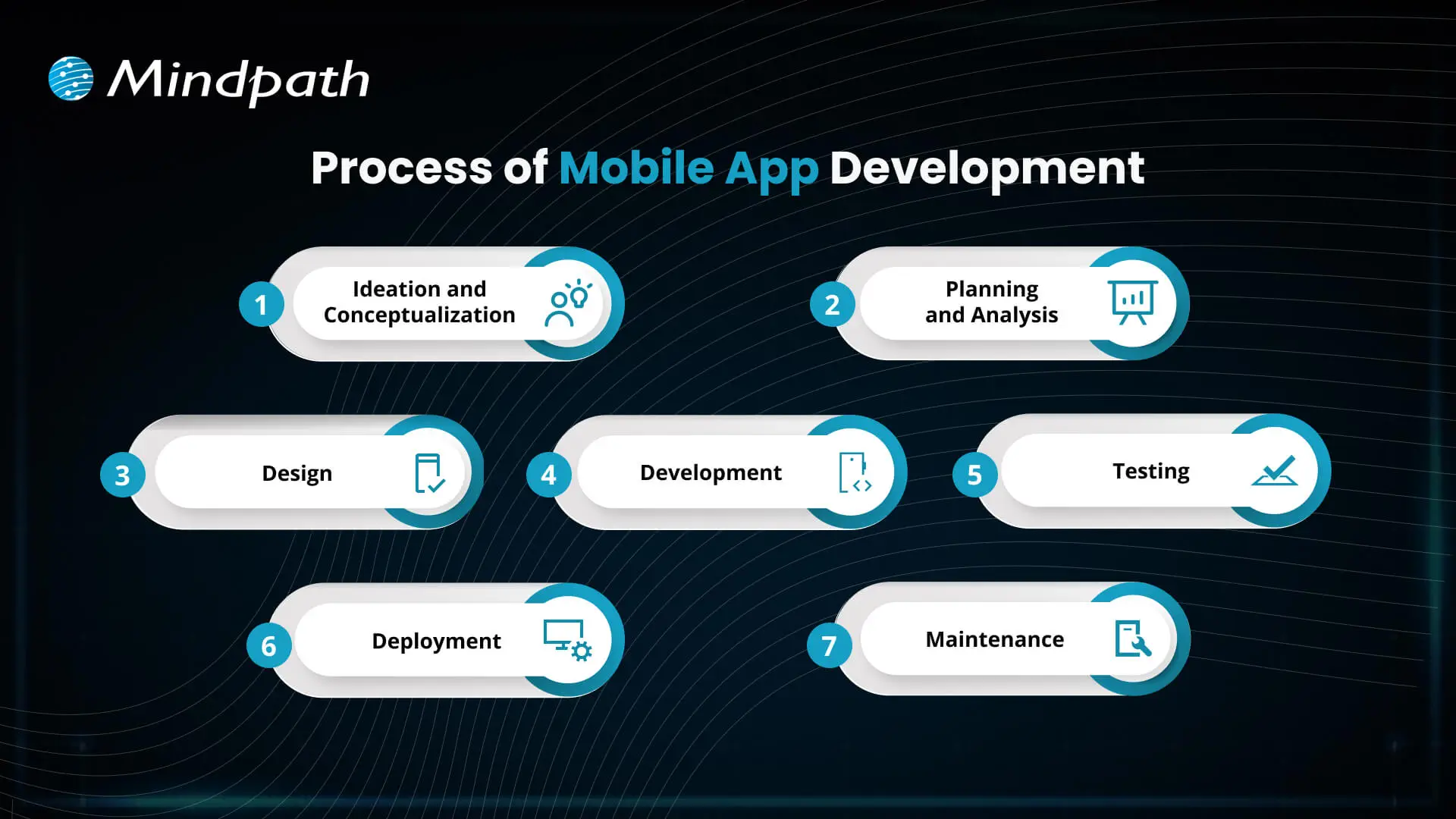
Developing a mobile application involves several necessary steps to take your idea to a working app. Each step plays a role in enabling usability, reliability, and scalability of the mobile app that is aligned with the business goals.
Process of Mobile App Development

1. Ideation and Conceptualization

The first step in the mobile app development process is coming up with a concept for your app. The teams think of an exciting mobile app development idea, find a way to solve problems for users, depict their target audiences, and identify key features.

2. Planning and Analysis

During this step, the teams conduct market research, determine app features, and establish goals. A proper framework documents timelines, budgets, and resources that will enable mobile app development startups and teams to stay on track.

3. Design

Designers create the aesthetic design and layout of the app to ensure it looks pleasing and is easy to use. Designing with simplicity and enjoyment in mind will allow users to navigate the app easily and have a positive experience while working.

4. Development

This is where developers start coding and building both the front and back ends of the app. The mobile app development process at this stage focuses on creating functional features that bring the design to life.

5. Testing

Before an app is launched, several tests are conducted to identify any malfunctions, like bugs or performance problems. This is a necessary step in order to ensure that the app is performing normally and responding correctly for the users.

6. Deployment

After the application has successfully gone through the testing stage, the app is published on the app stores, i.e., Google Play or Apple App Store. Companies that provide mobile app development will also develop a listing and promotional materials to be prepared for the launch.

7. Maintenance

Once the app has launched, it should be updated on a regular basis to fix bugs and continue to work with new devices or software versions. Maintaining the app will give users satisfaction, and enjoying the app for an extended period of time will keep users active.

Is your business app prepared to handle today’s security challenges? Discover how application security best practices for web and mobile apps keep user data safe while supporting sustainable growth.

Benefits of Mobile App Development

The advantages of mobile app development support businesses in more easily reaching customers and accelerating growth. By utilizing a mobile app development service, businesses can build simple and effective mobile apps that enhance user experience and increase engagement.

1. Enhance Customer Engagement

Mobile apps enable users to engage with your brand more often, keeping your business top of mind and relevant. Mobile app development allows businesses to develop features such as favorites, shopping lists, and review capabilities, all of which act as tools to enhance engagement.

2. Build Strong Brand Identity

An app that is well-designed becomes a permanent ambassador for your brand. Mobile app developers can collect relevant user data through the app, which can help improve your brand and continue to deliver value to your audience.

3. Increase Customer Loyalty

Mobile applications can host loyalty programs that encourage customers to revisit and repeat purchases. By giving discounts or rewards instantly, the app creates a sense of engagement with the app and helps build longer-term positive relationships.

4. Improve Customer Interaction

Mobile applications provide a convenient way for customers to purchase products because the app saves payment details and even previously favorite products. This all allows for an easier customer experience, which leads to convenience, improves customer satisfaction, and increases future conversions.

5. Personalize Marketing Efforts

Businesses can provide targeted offers and recommendations based on how users interact with their app. Personalized communication helps make users feel appreciated and encourages engagement.

Looking to build apps faster and smarter? Explore how mobile app development tools streamline development and boost productivity.

6. Boost Profits

Mobile apps typically drive sales and reduce marketing expenses by improving engagement, loyalty, and the overall user experience. Investing in the app is worthwhile because it is an efficient means of maximizing return.

7. Leverage Social Media Integration

Mobile applications can seamlessly connect to their social media channels, allowing individuals to easily share products or submit reviews. This advertising practice provides brands with exposure and social proof.

8. Provide Unique Value to Customers

Apps can offer features that are not available anywhere else, such as augmented reality try-ons, AI in mobile app development for intelligent chat support, and app-exclusive discounts. This adds convenience and encourages individuals to visit again.

9. Target Your Niche Market

Mobile apps provide a competitive advantage over other markets with specialized features and experiences. Businesses can effectively target and engage a broader segment of their target market.

10. Strengthen Communication

Push notifications ability and geotargeting gives businesses the ability to communicate with users in real time. Apps allow businesses to send relevant and time-sensitive messages without interruption from other communication channels.

Want to stay ahead in app innovation? Discover how mobile app development technologies power scalable, future-ready applications.

Ready to Elevate Your Business with Mobile Apps?

Mobile app development offers businesses a powerful way to engage customers, build loyalty, and boost growth. By leveraging AI in mobile apps, companies can deliver smarter personalization, real-time support, and data-driven user experiences that stand out in competitive markets.. Leveraging the benefits of mobile apps helps businesses strengthen their brand, improve customer experience, and maximize sales in today’s digital world.

Mindpath provides professional mobile app development services to help businesses turn ideas into functional, user-friendly apps. Our team of experts focuses on designing apps that engage users, integrate key features, and deliver measurable results. With Mindpath, companies can launch high-quality apps that drive growth, enhance customer experience, and ensure long-term success.
Related Post

Discover key DevOps challenges and effective solutions to streamline development and operations, and boost deployment efficiency.
Learn how to implement DevSecOps in the cloud to enhance security. Discover the key steps to safeguard your cloud infrastructure.

Related Post

chatbots in education

The education industry is evolving and the dominance of AI in the sector will serve as a primary reason for inducing transformation on a large scale. One of the notable applications of AI in education that often goes unnoticed is the use of chatbots. The blend of artificial intelligence and education aims to make learning more productive and chatbots are the perfect example of the same. Students, educators and institutions can rely on modern educational chatbots for their adaptive nature and intelligent capabilities. Let us learn about the top ten real-world examples of chatbots that have been revolutionizing education.

Planning to transform student experiences with intelligent chatbots? With Mindpath’s AI development services, you can design and implement tailored tools that make learning smarter and more personalized.

Impact of Chatbots on Education

Conversational AI is responsible for changing the viewpoint of many people about accessibility of AI technologies. Imagine talking to an AI tool and finding solutions to a problem in your mathematics textbook. Conversational AI chatbots are the best example of tools which can interact with users in natural language. The use of chatbots in education involves the combination of machine learning and natural language processing to understand student queries and provide relevant answers. The core strength of chatbots revolves around offering instant assistance personalized at scale for each user.

Chatbots offer better results than human support, primarily due to their round-the-clock availability. Student can get support and relevant information whenever required from chatbots, thereby reducing delays. Chatbots analyze the data of individual students and adapt their content recommendations in a way that helps students with personalized learning. Educators can use chatbots to craft interactive quizzes and provide instant feedback to learners. At the same time, chatbots also reduce the administrative burden on teachers and allow them to focus on more complex tasks.

Want to understand how chatbots can improve learning experiences? Check out the benefits of chatbots to learn how they enhance engagement and efficiency.

Discovering the Top Ten AI Chatbots for the Education Sector

AI chatbots are the most innovative tools in the domain of education with a wide range of benefits. Chatbots can not only provide instant support and personalized learning experiences to students but also empowers teachers with resources to become more productive. The rising popularity of educational chatbot applications has drawn the limelight towards their transformative impact on classroom and online learning. The following AI chatbot examples being used in education will showcase their significance for the long-term growth of the industry.

1. Socratic

One of the most notable additions among AI chatbots used in the field of education is Socratic. Created by Google, Socratic is a chatbot that helps in breaking down complex academic questions and offers easily comprehensible explanations. The core strength of Socratic as an education chatbot is in the step-by-step solutions offered for problems in different subjects like mathematics, literature and science. It also adds visual aids and diagrams in its answers to provide easier explanation for abstract concepts alongside recommending online resources, articles and videos for better understanding of learners.

2. Zendesk Chat

Zendesk Chat is also a popular AI chatbot solution for higher education institutions. It is useful for managing queries, enhancing student engagement and providing responsive support. Zendesk Chat is one of the best examples of chatbots for higher educational institutions with its distinctive features. For instance, Zendesk Chat supports seamless integration with different CRM systems, thereby empowering educators to monitor conversations and evaluate engagement data. As a multilingual chatbot, Zendesk Chat can enhance student engagement even with presence of diverse groups.

3. IBM Watson

The IBM Watson Assistant is another example of using an AI chatbot for education, especially in higher education. The chatbot by one of the leading tech giants offers highly customizable tools to enhance student engagement and streamline communication. It also supports CRM integration to ensure cohesive support across different platforms. IBM Watson uses advanced natural language processing to provide nuanced answers to complex student queries. Furthermore, IBM Watson also uses an adaptive learning model that helps it evolve with student interactions.

4. Microsoft Copilot

The list of chatbots used in the field of education will be incomplete without including Microsoft Copilot. Learners and educators can access the functionalities of this intelligent assistant in the complete Microsoft suite of products. Copilot is one of the best chatbot examples that can help students in creating compelling presentations and essays alongside refining the content with insightful recommendations. Another notable application of Copilot in education focuses on quick summaries of web pages or documents.

5. Pounce

Another example of innovative chatbots in the domain of education is Pounce. It has been created by the Georgia State University to address the problems of declining enrollment. The chatbot helps in sending timely reminders and notifications about important deadlines, orientation details and steps to obtain financial aid. Pounce also offers personalized outreach by interacting with every student to ensure that they complete the enrolment process.

Want to understand how AI can enhance workflows and decision-making? Check out AI consulting to learn how expert guidance helps implement AI solutions effectively.

6. MATHiaU

Carnegie Learning has come up with MATHiaU, as a dedicated AI chatbot to teach mathematics. It leverages AI to create personalized learning paths for university students while adjusting the difficulty of content according to real-time student performance. MATHiaU serves step-by-step guidance that can help students overcome their doubts without feeling overwhelmed. Most important of all, the chatbot can recognize specific learning gaps and offer suggestions to address the setbacks.

7. Ivy.ai

Ivy.ai also deserves a place in this list of AI chatbots, especially for its emphasis on higher education institutions. As a matter of fact, it is one of the top education chatbot examples that have achieved promising results in enhancing student engagement. The chatbot can handle different types of queries, ranging from admission to the financial aid processes. Students can also rely on Ivy.ai for access to campus information, such as details about events and facilities.

8. Cara

Cara is another example of AI chatbots developed by educational institutions to address longstanding problems. It is a chatbot tailored for offering administrative support to the students of the University of Galway. Cara helps in addressing a wide range of administrative questions with quick and relevant answers. Cara reduces the administrative burden on the university staff by handling routine questions effectively. The introduction of Cara has led to enhancements in student satisfaction and engagement while allowing educators to focus on more complex tasks.

9. Duolingo

Duolingo is one of the top examples of “how are chatbots used in education” for its ability to help students gain fluency in new languages. It will serve as a huge catalyst for breaking down the language barriers in education. Duolingo offers a safe environment for students to learn how to speak and write in a new language with confidence. The instant feedback on pronunciation, vocabulary and grammar offers ideal prospects for immediate correction of mistakes.

10. Querium

The final addition among the top AI chatbots for enhancing education is Querium. It is an AI-powered platform created for promoting STEM education through comprehensive, step-by-step guidance to solve problems. The strength of Querium revolves around helping students find solutions to complex STEM problems with detailed explanations. Another special feature of Querium is concept reinforcement, in which it connects problems to the underlying theoretical concepts for better understanding.

Curious how AI-powered chatbots help generate more qualified leads? Discover lead generation chatbot to check out strategies for increasing conversions.

Final Thoughts

The advantages of chatbot in education can provide a completely new direction to the experience of students, educators and institutions. You can notice how each chatbot in this list offers diverse benefits such as personalized content creation, automated administration or student performance monitoring. As the AI landscape expands, you can expect more chatbots to make an impact on the education sector. Mindpath helps you leverage AI development services to create custom chatbots and intelligent learning tools tailored to your educational needs.

Business Benefits of Chatbots

Suppose a customer is browsing your website during the weekend, and then asks a question related to your product, and your chatbot answers that without any delay. Won’t that benefit your business and satisfy your customers? Well, that is precisely one of the key benefits of chatbots. Yes, you heard that right. Chatbots can help businesses respond faster, guide customers smoothly, and improve the overall customer experience. Now-a-days business leaders are starting to see how chatbots can make everyday tasks easier and more efficient.

An interesting report from Tidio reveals that around 60% of B2B companies and 42% of B2C companies already use chatbot software. By 2025, this number is expected to grow by 34%. With better tools, smarter features, and clear business value, AI chatbots are turning into a must-have. If you are curious to know what are the typical benefits of AI chatbot for business, then this blog can guide you perfectly. So, what are you waiting for? Let’s dive in!

At Mindpath Tech, we specialize in custom chatbot development tailored to your unique business needs. Our GenAI-powered chatbot solutions help automate engagement, enhance customer experience, and drive efficiency across industries.

What is a Chatbot?

A chatbot is a software application that enables a user to engage in a conversation that imitates a human. In many cases, a chatbot can engage either through text or vocal conversation. By doing this, chatbots enable customers to answer questions, resolve problems, or complete tasks much quicker. Some chatbots adhere to a pre-set script. However, many modern chatbots rely heavily on artificial intelligence (AI) and natural language processing (NLP), to understand what the user is asking, and provide a thoughtful and natural response.

To put this in perspective, let’s assume you arrive at a bank’s website and begin typing your question (example: “How can I open a savings account?”). The chatbot will not only understand that you are asking about a savings account, but also guide you through the steps to take, without the help of any human agent.

The chatbot market is growing fast. According to a study by Grand View Research, the global chatbot market size was valued at USD 7.76 billion in 2024 and is projected to reach USD 27.29 billion by 2030, growing at a CAGR of 23.3% from 2025 to 2030. This rapid growth is driven by advancements in artificial intelligence and machine learning, making chatbots smarter, faster, and more valuable for businesses across industries.

What exactly is a chatbot, and why is everyone talking about them? Explore our in-depth guide: What is a Chatbot – Everything You Need to Know.

What are the Benefits of Chatbots?

If you are wondering what are the benefits of using AI chatbot, here is the answer. AI chatbots are becoming an essential part of modern business operations. Designed to assist in day-to-day tasks, they offer practical support across various business functions.

Here are some benefits of chatbots for businesses:

1. Smart Routing for Better Support

AI chatbots can handle simple questions and tasks on their own. When the issue needs a human touch, the chatbot collects key details from the customer at the beginning. It then sends the conversation to the right agent based on who is available and best suited to help. This smooth handover saves time and makes the support experience faster and more efficient.

2. Improves with Every Interaction

AI chatbots learn from each interaction to improve their responses over time. They collect data, understand patterns, and offer more accurate and personalized replies. They also recognize when to involve a human agent. By picking up on customer emotions, they provide better and more thoughtful support.

3. Enhance Sales

One of major benefits of chatbots is its ability to support sales teams by handling routine tasks. Chatbots can collect lead details, schedule demos, and guide visitors through your website. They also help move potential customers through the sales funnel by answering questions and sharing product information. This leads to higher conversions, fewer drop-offs, and better cross-sell and upsell opportunities.

4. Cost Effective Solution

Managing costs is important for any growing business. While chatbots need some setup at first, they help save money in the long run by handling common tasks and reducing the need for extra staff. They can quickly direct conversations to the right place, making support more efficient. With easy-to-use tools like no-code builders, businesses can launch chatbots faster and start seeing results sooner.

5. Generate Leads

AI chatbots can start natural conversations that feel more personal than standard forms. Instead of sending users to fill out long details, bots gather useful customer data while answering questions in real time. They use conversational AI to understand voice or text and guide the chat smoothly. This helps capture valuable information like visited pages, cart activity, location, and user preferences, making lead generation more effective.

Benefits of Chatbot For Customers

Let us also learn about the benefits of chatbots for customers:

1. Offers Omnichannel Support

Today’s customers use many platforms to reach out; like email, social media, websites, and messaging apps. They expect smooth conversations no matter which channel they choose. AI chatbots can help by answering common questions across all platforms and keeping the conversation connected. This creates a faster, more consistent experience that meets customers where they are.

2. Provides Multilingual Support

As businesses reach global audiences, language should not be a barrier to great service. AI chatbots can offer multilingual support by asking for the customer’s language or detecting it through the conversation. They can chat naturally in multiple languages through text, voice, or messaging. This helps provide clear and friendly support to every customer, no matter where they are.

3. Delivers 24/7 Customer Service

Customers expect fast and reliable service at any time of the day. AI chatbots make this possible by offering 24/7 support without delays, even during peak hours. They handle the first interaction instantly, reducing wait times and helping customers find answers quickly. This ensures a smooth and responsive experience, no matter when the customer reaches out.

4. Create More Personalized Customer Experiences

AI chatbots can offer tailored support by using customer data from tools like CRM or marketing software. They adjust messages based on where a customer is in their journey and suggest products that match their interests. Bots can also answer questions about orders or shopping carts without asking for extra details. When used thoughtfully, this creates a smooth, human-like experience that feels personal and helpful.

5. Ensure Proactive Customer Support

AI chatbots can take the first step by reaching out to customers based on their activity on your website. They can answer common questions, guide users through tricky pages, or remind them about unfinished tasks like a full cart or pending form. This kind of timely support helps reduce drop-offs and improves customer experience. When needed, chatbots can also suggest connecting with a human agent to move things forward smoothly.

Curious about the role of conversational AI in modern business strategy? Dive into Conversational AI Chatbots for Business Growth to see how companies are using them to gain a competitive edge.

Disadvantages of AI Chatbots

While AI chatbots offer many benefits, they also come with a few limitations that businesses should be aware of. Understanding these challenges can help you use chatbots more effectively and plan for the right balance between automation and human support.

1. Struggles with Complex Questions: AI chatbots may not understand sarcasm, unclear grammar, or complicated queries, leading to wrong answers.

2. Lacks Human Emotion: Chatbots can’t show empathy or handle emotional conversations the way a human can.

3. Takes Time to Set Up: Building a chatbot with the right questions, answers, and flow can take time and effort.

4. Can Risk Data Security: If not properly protected, chatbots may expose sensitive customer information to security threats.

5. Bias Responses: If trained on biased data, chatbots can unknowingly give unfair or inappropriate responses.

6. Hallucination: Chatbots can make up answers or provide incorrect details, which can confuse or mislead users.

Ready to Experience the Real Benefits of Chatbots?

Chatbots are helping businesses respond faster, cut costs, and improve customer service. From lead generation to 24/7 support, they make things easier and quicker. While they can’t replace humans fully, they’re a smart way to enhance service and give customers a better overall experience.

At Mindpath, we offer chatbot development services built to match your needs. We create smart, easy-to-use AI bots that improve support, boost engagement, and connect smoothly across platforms. Let us help you deliver faster, better service with a solution designed just for you.

Frequently Asked Questions

1. How do businesses measure the success of chatbot implementation?

Businesses usually track metrics like response time, customer satisfaction, resolution rate, and lead conversions. These insights help understand how well the chatbot is performing. Regular monitoring and improvements ensure the chatbot continues to deliver value and supports overall business goals effectively.

2. What are the benefits of chatbots for businesses beyond customer support?

The benefits of chatbots go beyond answering queries. They help automate repetitive tasks, qualify leads, assist in marketing campaigns, and improve internal workflows. By handling multiple roles, chatbots increase efficiency and allow teams to focus on more strategic and high-value activities.

3. Can chatbots be customized based on different business needs?

Yes, chatbots can be fully customized to match specific business requirements. From conversation style to features and integrations, they can be tailored to suit different goals. This flexibility ensures that businesses can create a chatbot experience aligned with their brand and customer expectations.

4. How secure are chatbots when handling customer information?

Chatbots can be secure if built with proper data protection measures. Encryption, secure APIs, and compliance with data privacy standards help safeguard user information. Regular updates and monitoring also play an important role in ensuring that customer data remains protected during interactions.

5. What are the benefits of chatbots for improving customer engagement?

The benefits of chatbots include keeping customers engaged through quick replies, proactive messages, and personalized interactions. They help maintain continuous communication, reduce waiting time, and guide users smoothly, creating a more interactive and satisfying experience that encourages users to stay connected longer.

Recruit Computer Programmers in 2024

Looking to hire a computer programmer in 2024 but feeling overwhelmed by the process? Wondering how to find the perfect fit for your team amidst the sea of talent? Don’t worry! In this blog we will learn about the simple steps to recruit a computer programmer in 2024. 

A computer programmer writes and fixes code for software and apps. They utilize specialized programming languages to write instructions that computers follow to do things. This means they create the applications and programs we use every day, ranging from social networking apps to corporate tools. Programmers frequently work alone or in collaboration with other technical specialists, such as software developers and engineers. Their job includes not only developing code, but also identifying and resolving any issues that may arise, ensuring that everything functions well. 

As technology grows more integrated into our daily lives, talented programmers are in high demand in many sectors. Hiring a computer programmer is vital because they help in developing and updating the software that keeps our digital world working smoothly. Without them, many of the tools and apps we use would not exist or function correctly. 

So, let’s dig in to explore the simple steps to recruit a computer programmer! 

Steps to Recruit Computer Programmers

1. Define Your Requirements

Before you start looking for a computer programmer, you should know exactly what you’re looking for. Determine which programming languages the programmer should be familiar with, such as Java, Python, or JavaScript, based on the requirements of your project. Consider what technologies and tools they should be familiar with, especially if you’re creating anything specific such as a website. Decide if you need someone with extensive knowledge to take on leadership responsibilities or someone with a few years of experience to undertake routine tasks. Consider the personal abilities you value, such as being an effective communicator or team player. Knowing these details can assist you in finding the ideal programmer for your requirements. 

2. Estimate Your Cost

Before you begin looking for a computer programmer, you must first determine your budget. The cost of employing a programmer varies greatly depending on their degree of expertise, location, and the unique abilities they bring to the table. For example, a highly experienced programmer or one with specialized abilities may command a greater wage than someone with less experience or more generic skills. Setting a budget ahead of time not only helps you identify a programmer that fits inside your budget, but it also ensures that you are realistic about your financial situation. 

3. Clear Job Description

When recruiting a computer programmer, it’s essential to have a clear job description. This allows potential applicants to understand exactly what you’re looking for, ensuring that you recruit the right kind of individuals. Begin by using plain and straightforward language. Avoid using technical terms or sophisticated terminology that may mislead candidates. Clearly outline the position, including the activities and responsibilities that the programmer will be handling. Be precise about the technologies and programming languages they’ll be using. 

Include a list of the required qualifications and skills, such as years of experience and any specific background needs. Do not forget to add the soft skills essential to you, such as teamwork or communication. This manner, you’ll attract individuals that not only have the necessary technical talents but also fit in with your company’s culture. 

4. Conduct Interview

Conducting interviews helps you get to know the individuals and assess their abilities. Enquire about their programming background, problem-solving skills, and communication style. You might also assign them a coding challenge to put their abilities to the test.  

Interviews can be conducted via video, phone, or in person, and should include both technical and behavioral topics. The technical section evaluates coding abilities, whereas the behavioral section examines communication and team fit. Involve other team members in the selection process to verify the candidate is a good fit for the team. 

5. Evaluate Skills

A computer programmer’s communication abilities are critical to the success of any project. They must properly communicate their ideas and work successfully with team members. During the employment process, these soft skills should be assessed. To assess a candidate’s ability to break down technical nuances, ask them to describe a complicated programming concept in easy words. Additionally, assess their responsiveness and clarity in responding to your enquiries. 

Good communication skills include the ability to listen and deliver constructive feedback. Pay attention to how they connect with others; this might provide insight into their teamwork and problem-solving ability. Ensuring that a programmer can explain their ideas and collaborate well with your team will considerably improve the overall success of your projects. 

6. Propose an Offer

Once you’ve identified the best computer programmers for your project, make an official offer. To minimize misunderstandings, clearly state the project scope, timing, and budget. Be precise about what to expect and how the project will be managed. Discuss your communication expectations properly. This covers preferred modes of communication, frequency of updates, and response time frames. If your staff are in separate time zones, make rules to manage possible obstacles, such as overlapping working hours or dealing with urgent concerns. Include any additional terms or conditions, such as confidentiality agreements or specific targets. This guarantees that both parties are on the same page and contributes to a strong basis for a successful working relationship. 

7. Onboarding the hire

To ensure a seamless start to your collaboration, you must efficiently onboard your new hire. Once the hiring procedure is complete, it’s time to put your new computer programmer’s skills into action. Begin by giving them full access to systems and tools. Introduce them to the immediate staff and make sure they understand their roles and duties. Begin the project by outlining the initial tasks and setting expectations for delivery. This will allow your new team member to integrate fast and contribute to the project’s success from the beginning. 

Ready to hire top computer programmers? 

Connect with Mindpath to find the perfect fit for your project and start achieving your goals today! 

Hire Computer Programmers at Mindpath

At Mindpath, recruiting computer programmers is a simple and advantageous procedure that ensures your project’s success. We start by knowing your specific needs and goals to connect you with the right personnel. Our objective is to make the hiring process as simple and efficient as possible, offering ongoing help from beginning to end.  Here’s how we make hiring easier: 

1. Discuss Your Needs

Reach out to us to discuss your project requirements. We’ll work with you to create a detailed plan that outlines the project scope, timeline, and budget. 

2. Find the Right Programmer

Based on your needs, we’ll recommend skilled programmers who are well-suited for your project. You’ll have the opportunity to interview and select the ones who fit best with your vision. 

3. Start the Project

Once you’ve chosen your programmer, we’ll kick off the project with a clear plan and timeline. We’ll keep you informed with regular updates and seek your feedback to ensure everything is on track. 

4. Get Ongoing Support

We’ll continue to assist you throughout the process and beyond, addressing any issues promptly and ensuring your goals are met. 

Wrapping Note!

Recruiting an appropriate computer programmer is an essential stage in achieving your project’s objectives and assuring success. By following the simple but effective steps outlined—defining your requirements, estimating costs, creating a clear job description, conducting thorough interviews, evaluating skills, proposing a well-defined offer, and effectively onboarding—you can streamline the hiring process and find a programmer who perfectly fits your needs. 

Mindpath simplifies the process by providing specialized help at every stage. We offer a seamless and productive recruiting process by knowing your project needs and finding and integrating the perfect programmer. Our aim is to give continuing support and resolve any concerns, ensuring that your project not only meets, but exceeds, your expectations. 

Looking for dedicated programmers?

Mindpath makes hiring easy and efficient. Contact us now to get started and elevate your project with the best!