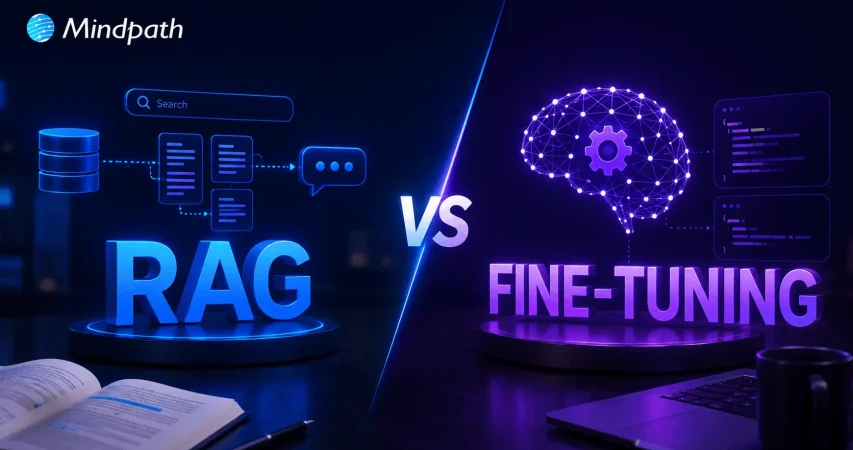
Large language models are transforming how businesses automate decisions, customer support, and daily operations. As organizations compare RAG vs fine-tuning, choosing the right approach becomes a critical business decision. Both methods improve AI performance, yet they solve different challenges and deliver very different outcomes. Understanding these differences helps businesses build smarter, more reliable AI applications.
Key Takeaways
- 01
RAG delivers current knowledge through external data without modifying the underlying language model. - 02
Fine-tuning improves specialized performance, consistency, and domain-specific AI behavior for businesses. - 03
Each approach addresses different business challenges rather than competing with each other. - 04
Cost depends on implementation complexity, maintenance, infrastructure, and long-term business objectives. - 05
Choosing the right approach improves AI accuracy, scalability, and overall business value.
The right strategy depends on your goals, data, budget, and long-term AI roadmap. Selecting the wrong method can increase costs while limiting your model’s accuracy and flexibility. In this blog, you’ll learn the difference between RAG and fine-tuning, when to use each approach, their costs, key benefits, and how to choose the right solution for your business. So, let’s keep reading!
Want to improve your AI with reliable, real-time business knowledge? At Mindpath, we offer RAG Development Services that enhance AI accuracy with intelligent data retrieval.
What is RAG in Large Language Models?
Retrieval Augmented Generation (RAG) is an AI framework that connects large language models (LLMs) with external knowledge sources. Instead of relying only on training data, it retrieves relevant information from business documents or databases to generate accurate, context-aware, and up-to-date responses.
RAG works by retrieving relevant information from connected knowledge sources before the LLM generates a response. It searches indexed content, adds the retrieved context to the user’s query, and produces accurate answers using current business information without retraining the underlying model.
Key Benefits of RAG
- Reduces Hallucinations: Grounds responses using verified business information.
- Uses Current Data: Retrieves updated knowledge without retraining the model.
- Source Transparency: Links responses to trusted documents for verification.
- Lower Costs: Avoids expensive model retraining for knowledge updates.
- Protects Data: Keeps sensitive business information within secure systems.
- Easy Scalability: Expands knowledge by indexing new business documents.
Drawbacks at a Glance
- Depends on Data Quality: Poor knowledge sources reduce response accuracy.
- Retrieval Errors: Incorrect document retrieval leads to inaccurate responses.
- Misses Complex Context: Struggles to connect information across multiple documents.
- Higher Response Time: Retrieval processes can slow answer generation.
- Infrastructure Costs: Storage, indexing, and maintenance increase implementation expenses.
What is Fine-Tuning?
Fine-tuning adapts a pre-trained large language model using a smaller, task-specific dataset. In discussions around RAG vs fine-tuning, this approach improves the model’s knowledge, response style, and performance for specialized business tasks without building an entirely new model.
Fine-tuning works by training an existing LLM on carefully prepared examples that reflect specific business requirements. It is commonly used to improve domain expertise, maintain consistent response quality, follow brand guidelines, and perform specialized tasks with greater accuracy.
Key Benefits of Fine Tuning
- Improves Accuracy: Delivers better performance for specialized business tasks.
- Maintains Brand Voice: Produces responses with consistent tone and style.
- Faster Responses: Requires shorter prompts for efficient output generation.
- Reduces Token Costs: Uses fewer tokens during each interaction.
- Supports Compliance: Follows defined rules and business requirements.
- Enhances Privacy: Minimizes sensitive information in user prompts.
Drawbacks at a Glance
- Higher Training Costs: Requires significant computing resources and investment.
- Needs Regular Retraining: New data requires repeated model updates.
- Reduced Flexibility: Performs best only for specialized tasks.
- Risk of Bias: Poor training data affects response quality.
- Can Forget Knowledge: New training may reduce existing capabilities.
RAG vs Fine-Tuning LLM: Key Differences
Understanding the difference between RAG and fine-tuning helps businesses choose the right AI strategy. While both improve LLM performance, they differ in how they access knowledge, learn information, and solve business challenges.
| Feature | RAG | Fine-Tuning |
| Primary Purpose | Retrieves external knowledge | Improves model behavior and expertise |
| Knowledge Source | External documents and databases | Learned during model training |
| Information Updates | Instant through knowledge base updates | Requires retraining with new data |
| Response Style | Uses the base model’s default style | Customizes tone, format, and behavior |
| Source Transparency | Can cite retrieved sources | Cannot reference learned sources |
| Implementation Cost | Lower initial training costs | Higher training and maintenance costs |
| Best Use Cases | Enterprise search, chatbots, knowledge assistants | Industry-specific tasks, brand voice, structured outputs |
| Maintenance | Update documents only | Retrain the model as data evolves |
Is RAG better than Fine-Tuning?
Choosing between RAG and fine-tuning depends on your business needs and AI objectives. Understanding where each approach fits helps you make a more informed decision. Let us have a look at when to use RAG vs fine-tuning:
1. When to Use RAG?
- Frequently Updated Data: Ideal when business information changes regularly.
- Large Knowledge Bases: Best for searching extensive documents and databases.
- Source Verification: Use when responses must include reliable document references.
- Private Business Data: Suitable for securely accessing internal company knowledge.
- Faster AI Deployment: Choose RAG for quicker implementation without retraining.
2. When to Use Fine-Tuning?
- Custom AI Behavior: Ideal for consistent tone, style, and responses.
- Structured Outputs: Best for fixed formats like JSON or templates.
- Stable Knowledge: Suitable when business information rarely changes.
- Faster Responses: Generates answers without retrieving external information.
- Specialized Tasks: Improves performance for domain-specific business applications.
Cost of Fine-Tuning vs RAG
The cost of fine-tuning vs RAG depends on your implementation goals and long-term AI strategy. Understanding the major cost factors helps businesses plan budgets more effectively before investing.
| Cost Factor | RAG | Fine-Tuning |
| Initial Implementation | $15,000 – $80,000 | $20,000 – $150,000+ |
| Monthly Operating Cost | $300 – $5,000/month | $500 – $10,000+/month |
| Knowledge Updates | Low cost, update documents | High cost, retrain model |
| Infrastructure | Vector database, embeddings, APIs | GPUs, model hosting, storage |
| Deployment Time | 2–8 weeks | 4–12+ weeks |
| Best for Budget | Frequently changing business data | Stable, specialized AI tasks |
Verdict: There is no one-size-fits-all answer because the right investment depends on your business goals, data complexity, update frequency, and long-term AI strategy.
Ready to Choose the Right AI Approach for Your Business?
Choosing between RAG vs fine-tuning depends on your business objectives, data requirements, and desired AI outcomes. While RAG helps access external knowledge, fine-tuning enables businesses to customize AI models for specific tasks, improve accuracy, and deliver consistent responses. Selecting the right approach helps organizations create reliable and scalable AI applications.
At Mindpath, we help businesses develop customized AI solutions with advanced fine-tuning capabilities. Our AI development services help organizations optimize LLM performance, build domain-specific applications, and create intelligent solutions that align with their unique business requirements and growth goals.