Choosing the Right React Development Company for Your Business

Home

Choosing the Right React Development Company for Your Business

Choosing the Right React Development Company for Your Business

Discover how to choose the right ReactJS development company with our step-by-step guide and learn about Mindpath’s expert services.

Join our Newsletter!

react development company

Have you ever pondered why most of the businesses are in search of React development company? Are you curious to know why choosing the right development partner is important? If yes, you’ve reached the right place!

React, a JavaScript library that was developed by Facebook, is very popular for the development of fast and interactive user interfaces. It has a component-based structure and offers flexibility for developers to put out smooth, scalable and high performing web applications. It focuses on creating interactive elements for web applications, particularly single-page applications (SPAs), where content updates dynamically without reloading the page. Due to these benefits, many businesses are relying on React to enhance their digital experience.

But selecting an appropriate React development company is as crucial as the technology itself. The right team can guarantee that your business objectives are met with precision and efficiency. This blog will guide you through the advantages of choosing the right partner for your React needs as well as the factors to look for in a ReactJS development firm. So, let’s explore!

Looking for a reliable ReactJS development company? Mindpath is leading provider of ReactJS development services aimed at creating impactful and scalable applications that deliver concrete business outcomes.

Advantages of Partnering with a React Development Company

Partnering with an appropriate ReactJS development company can offer many benefits and it is very important to know what they bring to the table and how they work. Here are a few benefits you should know before making your choice: 

1. Customized ReactJS Solutions

A dependable ReactJS development company understands that every business has requirements. By offering customized solutions, they guarantee that the final product aligns with your goals. They can adjust features, improve functionality, and design a user-friendly interface to match your business requirements. With customizable ReactJS development services, the company guarantees your web application is not just practical but optimized to support your growth and success. This personalized attention can help in building a product that meets your exact requirements, fostering competence and improving user experience.

2. Faster and Smarter Development

Utilizing ReactJS services can help to speed up the whole development process, so, an expert team follows a clear and organized method that improves how quickly and smoothly the work gets done. With automation and collaboration support tools, they can create your project faster without sacrificing quality. They usually follow agile practices, which include breaking the work into smaller pieces, getting feedback, and adjusting accordingly. This way, your application is delivered in a short time, with fewer bugs, and better results.

Also Read: React Roadmap for 2025

3. Ongoing Support after Development

Reliable ReactJS development companies do not consider their work finished once a project goes live; a good company provides continued assistance and support to ensure the website or application runs smoothly. This means troubleshooting and resolving bugs, implementing minor changes, and providing ongoing maintenance. With good ReactJS services, you receive regular maintenance to ensure your application is performing well and updated. If anything goes wrong, the team will be able to fix it with ease. This type of support fosters trust and ensures that your business remains stable in the long term by keeping your digital solution up to date and trouble-free.

4. Strong Emphasis on Quality

Quality remains a top priority for businesses when building web applications. A React development company with expert teams adheres to strong testing methods to make sure everything works as expected. They check the code, design, and features at every stage of the project. This identifies errors early, corrects them prior to the final delivery and makes the final product smooth, dependable, and ready for actual users. By focusing on quality, ReactJS development agencies ensure that applications delivered are of high standards and work effectively.

Are you missing out on the potential efficiency ReactJS offers for modern web apps? Discover the essential benefits of ReactJS development services to maximize your investment.

Key Factors While Choosing a ReactJS Development Company

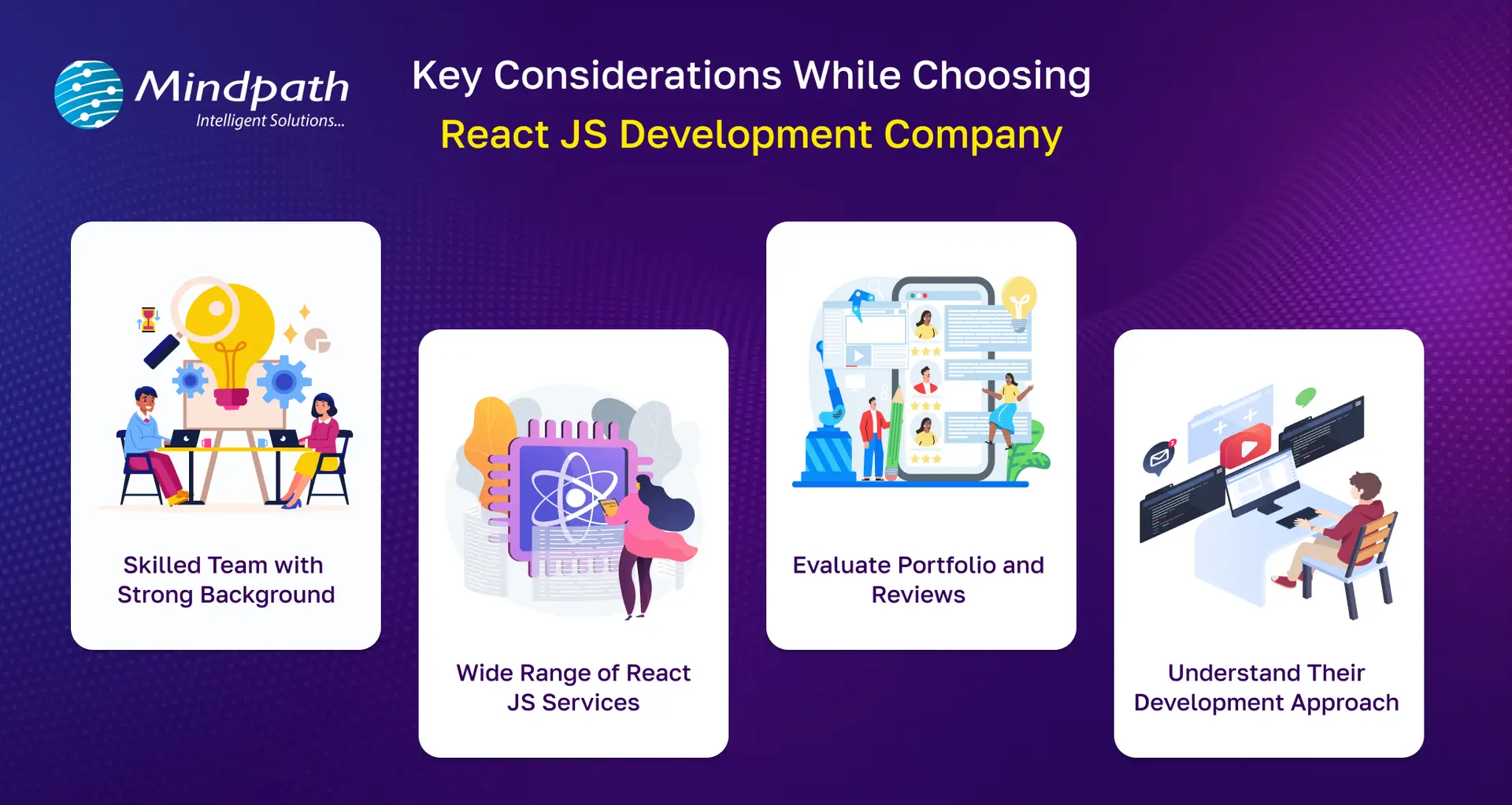
While choosing a ReactJS development agency, you must pay attention to a few things. Each company has its own way of working and it’s crucial to know what makes one stand out from the rest. The following are some of the important considerations you must look for: 
Key Factors While Choosing ReactJS Development Company

1. Skilled Team with Strong Background

When selecting a team for your ReactJS application development, it is essential to look at their previous records. A team with good experience and expertise will easily be able to deal with complex tasks. They must have developed various types of web or mobile applications for different companies which indicates that they know what fits best in a situation. Experienced teams can identify and fix problems in less time and develop better apps suitable for your needs.

2. Wide Range of ReactJS Services

It is crucial to select a team that provides a complete spectrum of ReactJS development services. This includes custom ReactJS application development, UI/UX design, and React Native mobile app development. The team should also be able to take care of API integration, backend development, and performance optimization. Also look for those who provide migration services to bring your current system up to date and offer ongoing maintenance and support to make sure your app is running smoothly in the long run.

Must Read: Top ReactJS Trends 

3. Evaluate Portfolio and Reviews

Looking at previous projects and client reviews of a React development company helps you understand their skills and how satisfied their clients are. You can search for reviews on websites like Clutch, GoodFirms, and Trustpilot. These reviews show how well the team communicates, fix issues, and delivers results. A strong portfolio with positive feedback indicates that the team has experience and a good reputation, which gives you confidence in their ability to handle your project successfully.

4. Understand Their Development Approach

One should always know the development process of the team to ensure it suits your business needs. Most developers employ agile practices, which enable them to implement changes easily and remain flexible throughout the project. This implies they can adjust to any issue that comes up. An organized process ensures that the end product is according to your objectives and matches your expectations, especially in the case of ReactJS development, where flexibility and productivity are the key to providing high-quality output on time.

Want to understand how much your business should invest in skilled ReactJS talent? Learn the real cost of hiring ReactJS developers to make informed financial decisions.

Looking for ReactJS Development Services?

Selecting the appropriate React development firm can literally make all the difference in the performance of your application and the success it brings to your business. From customization and speed to quality and maintenance support, every aspect is a crucial consideration for ensuring your success. Investing time to consider experience, services, and working methodologies will guide you to the best team.

At Mindpath, we provide professional ReactJS development services with years of experience and innovation underpinning our work. If you need to hire ReactJS developers who know your needs inside out and can provide you with efficient and scalable solutions, we’re here to assist you in growing. 
Frequently Asked Questions

1. Why should one hire a React development company instead of freelancers?

Hiring a React development company ensures access to a full team of designers, developers, and testers working together. This structured approach improves quality, scalability, and timely delivery. Unlike freelancers, agencies usually offer long-term support, better accountability, and organized project management for complex business applications. 

2. How to measure the expertise of a ReactJS development partner?

You can assess expertise by reviewing technical certifications, case studies, GitHub contributions, and industry experience. Conducting technical interviews and discussing architecture strategies also helps. A strong React development company will confidently explain their approach, performance optimization methods, and scalability planning. 

3. What industries benefit most from ReactJS development services?

Industries such as e-commerce, fintech, healthcare, education, and SaaS benefit greatly from ReactJS development services. React’s flexibility and component-based structure make it ideal for building dynamic dashboards, interactive portals, and scalable single-page applications tailored to diverse business needs. 

4. How important is scalability when choosing a React development company?

Scalability is critical for long-term growth. Your application should handle increasing users, new features, and higher traffic without performance issues. An experienced team designs clean architecture, reusable components, and efficient state management to ensure smooth scaling as your business expands. 

5. What questions should I ask before finalizing a React development company?

Ask about their development methodology, communication process, security practices, post-launch support, and experience with similar projects. Clarify timelines, pricing structure, and technology stack. Clear discussions at the start reduce risks and help build a transparent, productive partnership. 

Related Post

What is serverless architecture 

Currently, companies are striving to create applications capable of scaling at a moment’s notice while requiring very little overhead. In this major transition, digital leaders need to grasp the concept of what is serverless architecture. It suggests a move towards fast development, less concern with the technical infrastructure, and a focus on generating real business ‍value.

While seeking agility and innovation, organizations will probably come across serverless computing since it is often praised for its great benefits. However, any architectural decision brings along some critical considerations that impact control and performance. So, in this blog, we will explore the fundamentals of serverless architecture to help you consider how it fits into the bigger picture. So, keep reading further!

Ready to build a scalable and efficient serverless ecosystem for your business? Explore Mindpath cloud infrastructure services to design, deploy, and manage high-performance cloud environments tailored to your needs.

What is Serverless Architecture?

Serverless architecture is a cloud computing model in which the cloud provider automatically manages the infrastructure. It eliminates server management, scaling, and maintenance. This means developers can concentrate on code to fulfil business needs. This enhances the speed, agility, and efficiency of application development.

Cloud providers automatically run application code in stateless, event-driven environments. They manage deployment, scaling, and availability automatically. So, developers avoid operational complexity and focus on innovation. This approach enables rapid deployment, optimal resource allocation, and performance under variable load.

Also Read: Serverless Architecture in Cloud Computing

Why are Businesses Choosing Serverless Architecture in 2026?

The serverless architecture market was worth USD 9.42 billion in 2023 and continues to grow at a robust pace, according to Grand View Research reports. It’s projected to grow at a CAGR 28.2% from 2024 to 2030. This is why serverless is gaining traction in various sectors. In 2026, companies will use serverless to address application development challenges more effectively.

Serverless helps deliver responsive and scalable applications in growing demand. It is easier to build and has a faster development cycle. Organizations are now embracing it to keep up with the digital shift. Let’s take a look at the components of serverless architecture that make it so powerful.

1. Event Sources

Invoke serverless functions via APIs, database operations, or storage events.

2. Data Services

Offer scalable data storage for access and management.

3. Compute Layer (FaaS)

Runs code based on events without server management.

4. Observability Layer

Monitors logs, metrics and performance for visibility.

5. API Gateway Layer

Controls access and routes traffic to serverless functions.

6. Orchestration

Manages the execution of multiple functions for complex tasks.

What are the Key Advantages of Serverless Architecture?

Knowing what is serverless architecture helps to explain its increasing popularity with businesses. Companies are looking for ways to ease development and increase efficiency. The benefits below demonstrate how it addresses the needs of applications.

1. Faster Application Delivery

Without the need to build infrastructure, teams are able to roll out features at a faster pace. Hence, it mitigates the occurrence of delays and enhances release cycles.

2. No Server Management Required

Developers are not responsible for the management of servers and operating systems. That makes development quite straightforward and that greatly contributes to the reduction of technical burden.

3. Flexible Event-Based Execution

Applications that recognize and react to events such as a change in data or a new file being uploaded. This feature unleashes the power of modern and customized workflows.

4. Better Cost Efficiency

Companies only get billed for the times they actually run their code, so there is no cost for unused resources. This approach leads to more effective financial management and better use of money.

5. High Availability by Design

Applications are deployed across multiple zones to improve their reliability. With this, they can maintain their performance even in cases of failures or when there is high demand.

6. Easy and Automatic Scaling

Applications automatically increase their capacity based on the traffic demand. There is no need for manual intervention during traffic spikes.

7. Improved Developer Focus

Development teams fully dedicate their efforts to enhance application logic and including new features. This is a direct indication of the major serverless benefits for contemporary software development.

8. Reduced Operational Effort

It significantly reduces the requirement for near-constant supervision and the upkeep of infrastructure. Consequently, it diminishes the level of operational work and dependence on resources.

Key Challenges of Serverless Architecture

While we are discussing the benefits of serverless computing, we should also consider its challenges. It may enhance development, but there are some constraints that impact control and performance. Here are some of the challenges that businesses need to consider.

1. Limited Control Over Performance

Serverless systems can have different response times depending on whether there are sudden changes in traffic or periods of inactivity.

2. Dependency on Cloud Providers

Functional applications are highly dependent on specific provider services, making migration difficult.

3. Complex Debugging Process

It is hard to debug errors across multiple distributed functions, as there is no central point of control. 

4. Stateless Architecture Limitations

Functions do not maintain internal state and rely on external systems for state management. 

5. Security Management Challenges

A web of interconnected services expands the attack surface and needs security attention.

6. Constraints in Application Design

Serverless may not be suitable for long-running applications or memory-intensive tasks.

7. Difficult Local Testing

Local testing of applications becomes complex because of service integration. 

8. Cold Start Delays

Time is required to start inactive functions so this is a problem for applications with a rapid response requirement. 

Trends Shaping the Future of Serverless Architecture

Just knowing the concept of what is serverless architecture is not sufficient in the ever-changing technology landscape. Companies must also know how it is evolving. These trends are just a glimpse of how serverless architecture is going to transform the way apps are built and used in future.

1. AI and Machine Learning Growth

Serverless frameworks enable quicker AI model deployment and scaling. This facilitates real-time intelligent applications.

2. Edge Computing Expansion

Applications are executed near end-users. This enhances performance and lowers latency.

3. Support for Complex Applications

Serverless can run complex and high-performance applications. This extends its application in modern apps.

4. Multi Cloud Adoption

Companies adopt serverless on multiple cloud providers. This lowers risk of vendor lock-in.

5. Stateful Serverless Evolution

Enhancements enable improved function state management. This simplifies workflow and eliminates external state.

Ready to Embrace the Future with Serverless Architecture?

Knowing what is serverless architecture enables better tech choices. It enables rapid development, scalable resource management, and easy maintenance. In the digital age, keeping up with the times is crucial. The rise of serverless architecture is transforming the development and deployment of applications in the competitive landscape.

At Mindpath, we provide cloud computing services tailored to modern business needs. We assist in creating scalable and efficient serverless solutions. Our goal is to deliver speed, agility and value for your digital transformation.

Frequently Asked Questions

1. When does serverless architecture make the most sense for a project?

Serverless works best for applications with variable traffic, event-driven workflows, or rapid release needs. It suits projects that require quick scaling and minimal infrastructure management while maintaining flexibility in development and deployment.

2. How does serverless architecture help control development costs?

Costs depend on actual usage rather than fixed infrastructure. This makes it suitable for businesses with unpredictable traffic, as there is no need to pay for idle resources, helping optimize overall spending and resource planning.

3. Can serverless architecture handle high-traffic applications effectively?

Serverless platforms automatically scale based on demand, making them suitable for handling sudden traffic spikes. This ensures applications remain responsive without requiring manual intervention or additional infrastructure setup during peak usage.

4. What challenges should teams prepare for before adopting serverless?

Teams should plan for areas like debugging complexity, vendor dependency, and performance variability. Proper architecture design and monitoring strategies help manage these challenges effectively and ensure smooth application performance over time.

5. How does serverless architecture support faster product releases?

By removing infrastructure setup and maintenance tasks, development teams can focus entirely on coding and deployment. This speeds up release cycles and helps businesses introduce new features or updates more efficiently.

AI-driven legacy system modernization

AI-driven legacy system modernization is transforming how businesses approach aging technology. Firms are under increasing pressure to remain competitive and deal with complicated and old systems. Is it possible to make this process smarter with the help of technology? The dilemma is how to balance innovation and stability, and how several are looking at the active reformation of legacy workflow by AI and automation.

The adoption of smart solutions enables organizations to be agile and fast in integrating main systems. They are able to detect bottlenecks, minimize mistakes and streamline processes to a much greater accuracy. This solution triggers the debate of efficiency and future-proofing. In this blog, we will explore how AI and automation can bring the legacy systems up to date. Keep reading further!

Looking to future-proof your legacy applications with AI-driven solutions? Mindpath’s legacy modernization services help organizations upgrade systems efficiently and stay ahead in the digital landscape.

What is AI-Driven Legacy System Modernization?

AI-driven legacy system modernization is the use of artificial intelligence and machine learning to update, translate, and migrate outdated enterprise software into modern, cloud-native environments. It automates key activities such as code refactoring, documentation, and testing while identifying system dependencies and preserving core business logic without requiring high-risk “rip and replace” overhauls. This approach accelerates modernization, reduces errors, and lowers costs, helping organizations transition ageing systems into agile and cloud-ready infrastructure.

The adoption of AI in legacy modernization will allow decisions to be made more intelligently when upgrading the system. Machine learning suggests trends, risks forecasts and provides best optimized solutions. Generative AI can help generate proper code and documentation and minimal disruption. Through AI, organizations can modernize in a shorter time, continue working with the existing systems, and optimize them to grow in the future.

Must Read: Benefits of Modernizing Legacy Systems

Why AI-Driven Legacy Modernization Matters?

Old systems have been known to slack innovation and amplify risks in operation. These are the advantages of AI and automation in legacy system modernization.

1. Faster Modernization Cycles

AI-driven legacy system modernization speeds up system upgrades by automating repetitive tasks. Organizations accomplish projects in lesser time, downtime is minimized and efficiency enhanced.

2. Cost Reduction

AI maximizes the investment of the resources and reduces errors that reduce the expenses of the modernization. The process of legacy application modernization is predictable and more cost-effective.

3. Improved Accuracy

AI is very accurate in analyzing code and data which minimizes human errors. This makes sure that the updates do not affect business logic and system stability.

Must Read: Monolith to Microservices

4. Enhanced Security

Artificial intelligence-based devices identify threats immediately and indicate vulnerabilities. Companies enhance protection and comply successfully.

5. Scalability and Flexibility

AI allows legacy systems to manage increasing data and traffic. They are unified with modernization based on cloud, IoT, and advanced platforms.

6. Future-Proofing Operations

AI-driven legacy system modernization supports incremental upgrades, extending system lifespan while adapting to evolving technologies. This makes systems up to date and capable of future expansion.

Wondering how to balance AI innovation with a strong modernization plan? Discover the legacy modernization strategy to achieve a more effective transformation.

Role of AI in Legacy System Modernization

AI-driven legacy system modernization is reshaping how organizations update and optimize outdated systems. Here are the roles of AI-driven legacy system modernization in transforming legacy operations efficiently.

role of ai in legacy system modernization

1. Strategic Business Logic Analysis

AI-driven legacy system modernization starts by uncovering hidden business logic. It plots dependencies and decision rules. Modernization becomes smarter and data-driven, and teams are given a clear understanding.

2. Automated Code Refactoring and Optimization

AI rewrites the old code to new cloud-ready codes. Refactoring is faster, fewer errors in the system, and the system itself is much better with generative AI.

3. Intelligent System Mapping with NLP

Natural language processing transforms the complex old code into canned knowledge. Inefficiencies and bottlenecks are promptly found and assist in accelerating modernization.

4. Seamless Legacy-to-Cloud Migration

AI-driven legacy system modernization enables smooth cloud transitions. It also re-architectures code to reflect the current architectures and best practices.

Must Read: Benefits of Cloud Migration

5. Advanced Data Integration and Predictive Maintenance

AI integrates multiple sources of data to allow a smooth integration. Predictive analytics will identify possible problems before they happen and minimize downtime and operational problems.

6. AI-Powered User Experience Enhancement

AI interprets the user behavior in order to streamline interfaces. Chatbots and virtual assistants automate the repetitive field of work making it more engaging and efficient.

7. Real-Time Project Oversight with GenAI

AI offers invaluable real-time insight into the state of modernization. Predictive analytics and automated documentation keep the stakeholders updated and project on schedule.

8. Proactive Risk Mitigation and Quality Assurance

AI reduces the human factor and promotes uniformity. Modernization with structures and low risk can have safety nets that are provided through automated testing and monitoring.

Looking to create a clear path for modernization powered by AI and automation? Check out the legacy modernization roadmap to organize your approach effectively.

Ready to Transform Your Legacy Systems?

AI-driven legacy system modernization empowers businesses to update old systems quickly and accurately. It reduces errors, lowers costs, and improves performance. Companies gain clear insights into business logic and system dependencies, enabling smarter decisions. Modernization also ensures systems stay scalable, secure, and ready to support future growth efficiently.

Mindpath legacy modernization services help organizations implement AI-driven solutions smoothly. Our team analyzes existing systems, refactors code, and enables cloud integration. We provide predictive analytics, risk mitigation, and real-time monitoring. With our services, companies can modernize legacy systems efficiently while preserving core business logic and maintaining operational continuity.

FAQs

1. How does AI-driven legacy system modernization support business growth?

AI-driven legacy system modernization helps companies scale systems to handle more data and traffic. It ensures faster decision-making, improves performance, and keeps core business logic intact. Mindpath’s services guide businesses in adopting AI to modernize efficiently and support long-term growth.

2. Can my existing legacy system work with new technologies after modernization?

Yes. AI-driven legacy system modernization enables integration with cloud platforms, IoT, and modern applications. Mindpath’s legacy modernization services ensure your system becomes compatible with emerging technologies while maintaining stability and operational continuity.

3. How does modernization impact overall operational efficiency?

Modernization reduces manual work, shortens upgrade timelines, and minimizes errors. By applying AI-driven legacy system modernization, companies achieve faster operations, lower costs, and higher system reliability. Mindpath helps organizations implement these efficiency improvements effectively.

4. What technical steps are involved in AI-driven legacy system modernization?

AI maps business logic, automates code refactoring, analyzes dependencies, and predicts potential failures. Tools like generative AI and NLP convert complex legacy code into modern, cloud-ready formats. Mindpath applies these techniques to ensure smooth, accurate modernization.

5. How does AI help in risk reduction during modernization?

AI identifies vulnerabilities, monitors system performance, and flags potential failures early. AI-driven legacy system modernization reduces errors and ensures consistent updates. Mindpath’s services integrate these safeguards, creating structured, low-risk modernization projects.

Support Is One Click Away

Featured Posts

Related Post

Discover the ultimate guide to hiring Node.js developers in London. Learn about the skills, benefits, and cost factors involved in finding the right talent for your project.