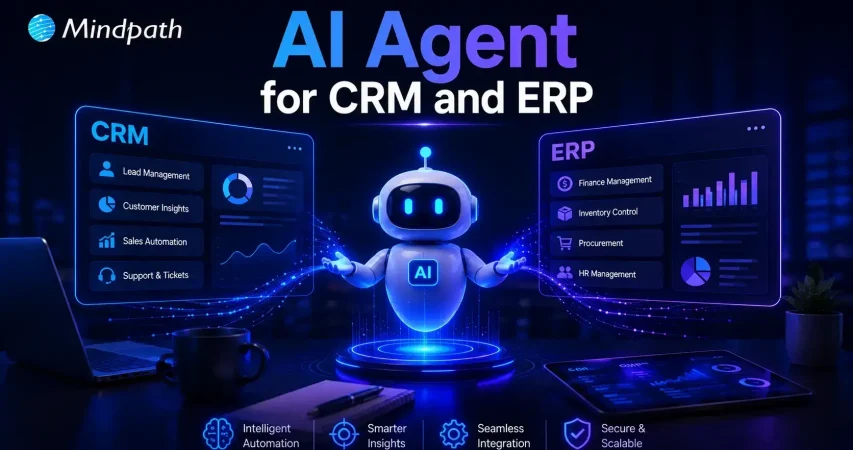
Artificial intelligence is changing how organizations manage everyday operations. AI agents for CRM and ERP help businesses connect systems, automate workflows, and reduce manual effort. They improve data accuracy, support faster decisions, and keep teams working with consistent information across departments.
Key Takeaways
- 01
AI agents connect CRM, ERP, and enterprise systems to create a unified business ecosystem. - 02
They automate repetitive workflows while improving speed, efficiency, and accuracy. - 03
Real-time synchronization enables faster business decisions and better collaboration. - 04
Businesses can automate sales, inventory, invoicing, forecasting, and customer service. - 05
A phased implementation ensures secure integration, scalability, and long-term value.
Yet many organizations still struggle with disconnected software, scattered data, and inefficient processes. What makes AI agents different from traditional automation, and why are enterprises adopting them rapidly? In this blog, we’ll explore how AI agents connect CRM, ERP, and business systems to improve efficiency and drive smarter operations.
Ready to build AI agents that seamlessly connect your CRM, ERP, and business systems? At Mindpath, we offer AI Agent Development Services to create intelligent, scalable AI agents tailored to your business needs.
Why Do Businesses Need AI Agents Across CRM, ERP, and Enterprise Systems?
In today’s enterprises, connected systems are essential for efficient operations. AI agents eliminate disconnected workflows, automate routine tasks, and enable intelligent decision-making across departments.
1. Eliminating Data Silos
AI agents connect CRM, ERP, and other enterprise applications into a single source of truth. This removes duplicate records and ensures every department works with accurate, real-time information.
2. Synchronizing Cross-System Data
Customer records, inventory updates, purchase orders, and financial transactions remain synchronized across multiple platforms. Employees no longer need to manually transfer information, reducing delays and human errors.
3. Automating End-to-End Workflows
AI agents execute complete business processes automatically from processing customer requests to validating invoices and updating ERP records—reducing repetitive work and accelerating operations.
4. Managing Exceptions Proactively
Instead of waiting for employees to identify issues, AI agents monitor workflows continuously. They detect shipment delays, invoice mismatches, approval bottlenecks, and vendor issues before they impact operations.
5. Improving Predictive Decision-Making
By analyzing historical and real-time business data, AI agents forecast customer demand, optimize inventory, improve cash flow planning, and reduce operational risks.
6. Supporting Faster Business Decisions
Business leaders receive real-time insights gathered from multiple enterprise systems in one place, enabling quicker responses to customer needs, financial performance, and supply chain changes.
How Do AI Agents Connect CRM, ERP, and Other Business Applications?
Modern organizations rely on enterprise software integration to keep information flowing seamlessly. AI agents act as intelligent connectors that automate data exchange and coordinate workflows.
1. Connecting Through APIs
AI agents securely exchange data between CRM, ERP, and other business applications using APIs, eliminating manual transfers.
2. Synchronizing Business Data
Customer information, inventory records, financial data, and sales information stay consistent across all connected systems.
3. Automating Cross-System Workflows
AI agents coordinate tasks involving multiple business applications from start to finish, reducing manual work and improving operational speed.
4. Triggering Intelligent Actions
When predefined business events occur, AI agents automatically create tasks, update records, notify teams, or initiate the next workflow.
5. Providing Real-Time Insights
AI agents collect data from different platforms and present a unified business view, helping decision-makers access actionable insights quickly.
6. Maintaining Secure Data Exchange
AI agents follow enterprise security policies and access controls while transferring business information, ensuring secure and reliable integration.
Real Business Use Cases of AI Agents for CRM and ERP Integration
Understanding how AI agents connect CRM and ERP becomes easier by looking at real-world business applications. These intelligent agents streamline operations, improve data accuracy, and automate workflows across multiple departments with minimal human intervention.
1. Sales Order Processing
AI agents capture customer orders directly from the CRM and instantly update the ERP system. This reduces manual data entry, speeds up order fulfillment, and minimizes processing errors.
2. Inventory Management
By combining real-time ERP inventory data with CRM sales information, AI agents monitor stock levels, predict demand, and help businesses avoid stock shortages or overstocking.
3. Customer Service Automation
Support teams gain instant access to complete customer histories by combining CRM and ERP data. This enables faster issue resolution and delivers a more personalized customer experience.
4. Invoice and Payment Management
AI agents automatically generate invoices after verifying completed orders and delivery status. They also synchronize payment updates with financial records to improve accounting accuracy.
5. Sales Forecasting and Planning
AI agents analyze CRM sales pipelines together with ERP financial and operational data to generate more accurate forecasts for budgeting, resource planning, and business growth.
6. Procurement and Vendor Coordination
AI agents monitor inventory thresholds and automatically initiate procurement workflows. They update vendor records, track purchase orders, and ensure timely replenishment of inventory.
Key Benefits of AI Agents for Enterprise Workflow Automation
AI agents help organizations automate complex business processes while improving operational efficiency, reducing manual work, and enabling intelligent decision-making.
1. Autonomous Task Execution
AI agents execute multi-step workflows without continuous human intervention. From order processing to invoice approvals, they complete tasks consistently and accurately.
2. Seamless Cross-System Integration
AI agents connect CRM, ERP, finance, HR, and other enterprise applications, eliminating information silos and enabling smooth data flow across departments.
3. Greater Accuracy and Fewer Errors
Before updating enterprise systems, AI agents validate information automatically, reducing manual errors and ensuring high-quality business data.
4. Improved Scalability
As business operations grow, AI agents handle increasing workloads without requiring additional employees, allowing organizations to scale efficiently.
5. Faster Business Operations
By automating repetitive administrative work, AI agents reduce processing times from hours to minutes, helping businesses respond faster to customer and market demands.
6. Intelligent Decision Support
AI agents analyze enterprise data from multiple systems and generate real-time insights, enabling business leaders to make informed strategic decisions.
7. Adaptive Problem Resolution
When workflow exceptions occur, AI agents identify issues automatically, recommend corrective actions, and keep business operations running with minimal disruption.
8. Higher Workforce Productivity
By taking over repetitive operational tasks, AI agents allow employees to focus on innovation, strategic planning, customer relationships, and higher-value business activities.
How to Successfully Implement AI Agents Across Your Business Systems
A structured implementation strategy helps businesses maximize the value of AI agents while minimizing deployment risks. By focusing on the right processes, systems, and governance, organizations can achieve long-term success.
1. Identify High-Impact Workflows
Start by identifying repetitive, time-consuming business processes that provide the greatest opportunity for automation. Prioritize workflows that deliver measurable business value.
2. Connect Enterprise Systems
Integrate AI agents with CRM, ERP, HR, finance, and other core business applications using secure APIs. Seamless connectivity ensures consistent data across every system.
3. Establish Data Governance
Ensure high-quality data, strong security policies, role-based access controls, and compliance standards before deploying AI agents across enterprise systems.
4. Monitor and Optimize Performance
Continuously track workflow accuracy, automation efficiency, business KPIs, and user adoption. Regular optimization helps AI agents deliver greater long-term value.
5. Scale Gradually
Begin with a pilot project, validate business results, and expand AI agents to additional departments and workflows as confidence grows.
Ready to Implement AI Agents for CRM and ERP?
AI agents are transforming enterprise operations by connecting systems, automating workflows, and enabling smarter business decisions. Organizations that embrace AI-powered automation can eliminate manual processes, improve operational efficiency, and create a connected digital ecosystem that supports sustainable growth.
If you’re looking for reliable AI agents for business automation, Mindpath delivers multi-agent development services and enterprise integration solutions. Our experts design, develop, and optimize AI agents that seamlessly connect CRM, ERP, and enterprise applications to accelerate digital transformation and drive measurable business outcomes.