Cloud Cost Optimization Guide for Modern Businesses 

Join our Newsletter!

Featured Posts

Support Is One Click Away

Home

Cloud Cost Optimization Guide for Modern Businesses 

Cloud cost optimization

Cloud Cost Optimization Guide for Modern Businesses 

Cloud expenses continue to grow with the expansion of apps, new services, and bolt-on speedy releases. Cloud cost optimization is now the core of every intelligent IT plan. You spend on flexibility and speed, but at the end of the month, you are surprised by the costs, which often exceed your budget due to unforeseen usage spikes and the complexity of managing multiple cloud services. So, what drives this gap? More importantly, how can you gain control without hindering innovation?

Contemporary companies require performance, safety, and swiftness simultaneously. Uncontrolled resources, idle work loads and lack of visibility, however, consume budgets very fast. Hence, leaders should reconcile finance and engineering using well-defined cost objectives. Intelligent budgeting turns cloud expenditure into quantifiable value. This blog will show a practical way of gaining control of cloud investments.

Ready to take control of your cloud costs and get more from your investment? Mindpath offers cloud infrastructure services to help businesses optimize cloud usage, reduce waste, and scale efficiently.

What is Cloud Cost Optimization?

Cloud cost optimization refers to the utilization of cloud resources in a smartest manner to prevent wastage and manage costs. Companies check the usage, eliminate unnecessary services, and select appropriate pricing frameworks. This will enhance performance and minimize the unwarranted expenditure as well as keep cloud investment in line with the business objectives.

Cloud cost management helps in this endeavor to track, analyze, and plan cloud expenditure. Teams create the budgets, keep track of their usage, and reallocate the resources according to the demand. A combination of these practices aids companies in becoming financially clear, enhancing efficiency, and making superior decisions in long-term growth.

Must Read: Cloud Computing Trends 2026

Why is Cloud Cost Optimization Important?

Cloud services enable businesses to invest heavily in order to achieve growth, speed, and innovation. The reasons why cloud cost management is of critical importance in safeguarding budgets and enhancing financial control are as follows.
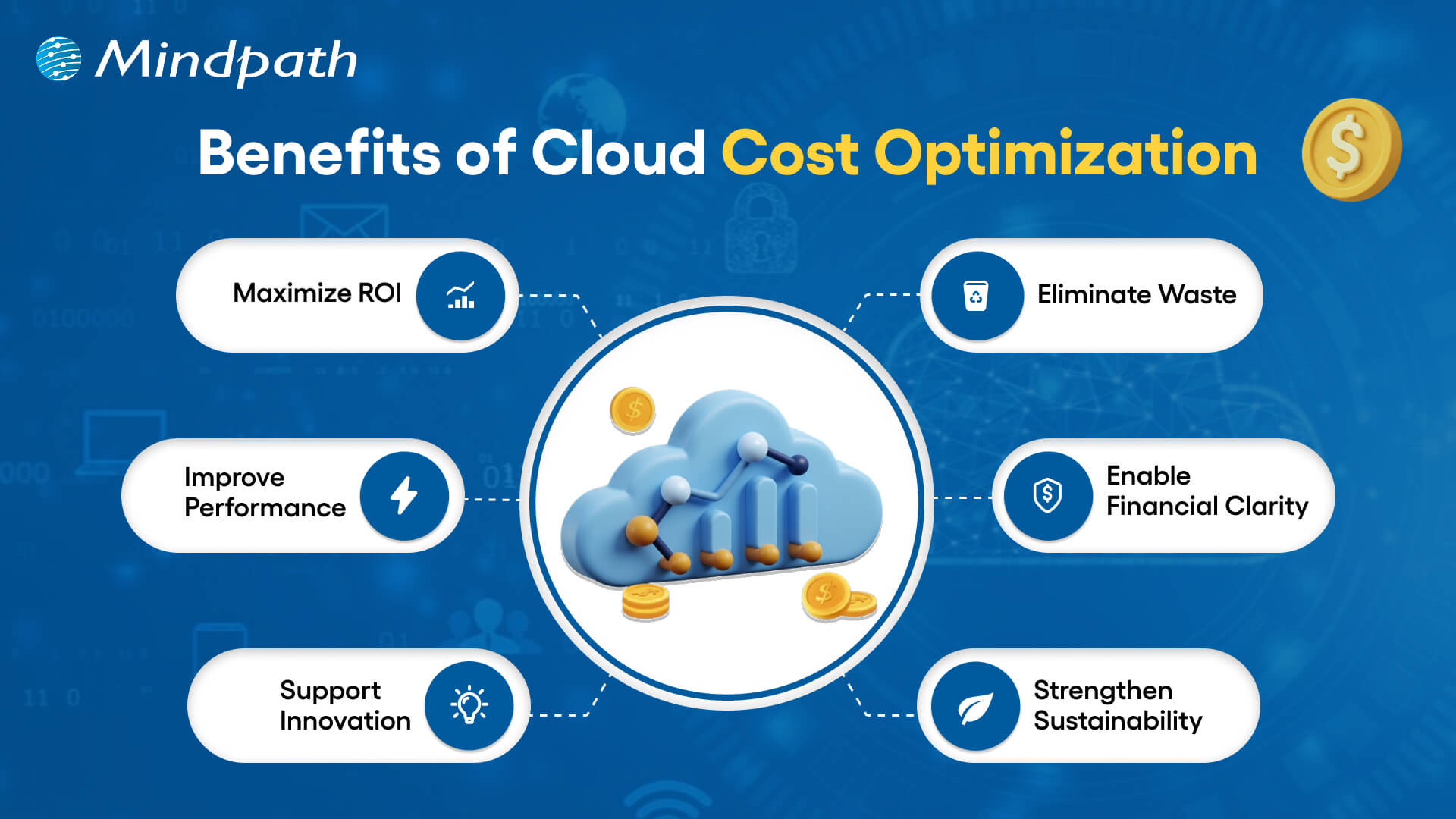
benefits of cloud cost optimization

1. Maximize ROI

Cloud expense optimization enables businesses to match expenditures with objective goals. They make sure that each dollar helps in growth, performance, and quantifiable business worth.

2. Eliminate Waste

Teams eliminate wastage of resources and storage before their expenses increase. Cloud cost optimization assists businesses in ceasing spending on services that are unnecessary.

3. Improve Performance

Organizations right-size the workloads on the basis of actual demand. This balance is also fast and reliable, as it keeps the costs down, which ultimately supports the organization’s ability to invest in new projects and innovations.

4. Enable Financial Clarity

Leaders follow usage real-time and make budgets confidentially. Being visible will avert the presence of surprise bills and enable smarter forecasting, which allows leaders to make informed financial decisions and allocate resources more effectively.

5. Support Innovation

Firms invest saved amounts in product development and online expansion. Expenditures that are managed efficiently leave opportunity for new ideas and expediency.

6. Strengthen Sustainability

Economic utilization of resources minimizes energy wastage and decreases carbon influence. Clear governance also develops team and departmental accountability.

Want to reduce cloud costs while also making your infrastructure more eco-friendly? Explore sustainable technology to build efficient and environmentally responsible systems.

Cloud Cost Optimization Strategies for Modern Businesses

Contemporary companies require effective means to regulate cloud expenses without compromising performance and scalability. Some major strategies that help companies achieve effective cloud cost optimization include the following.
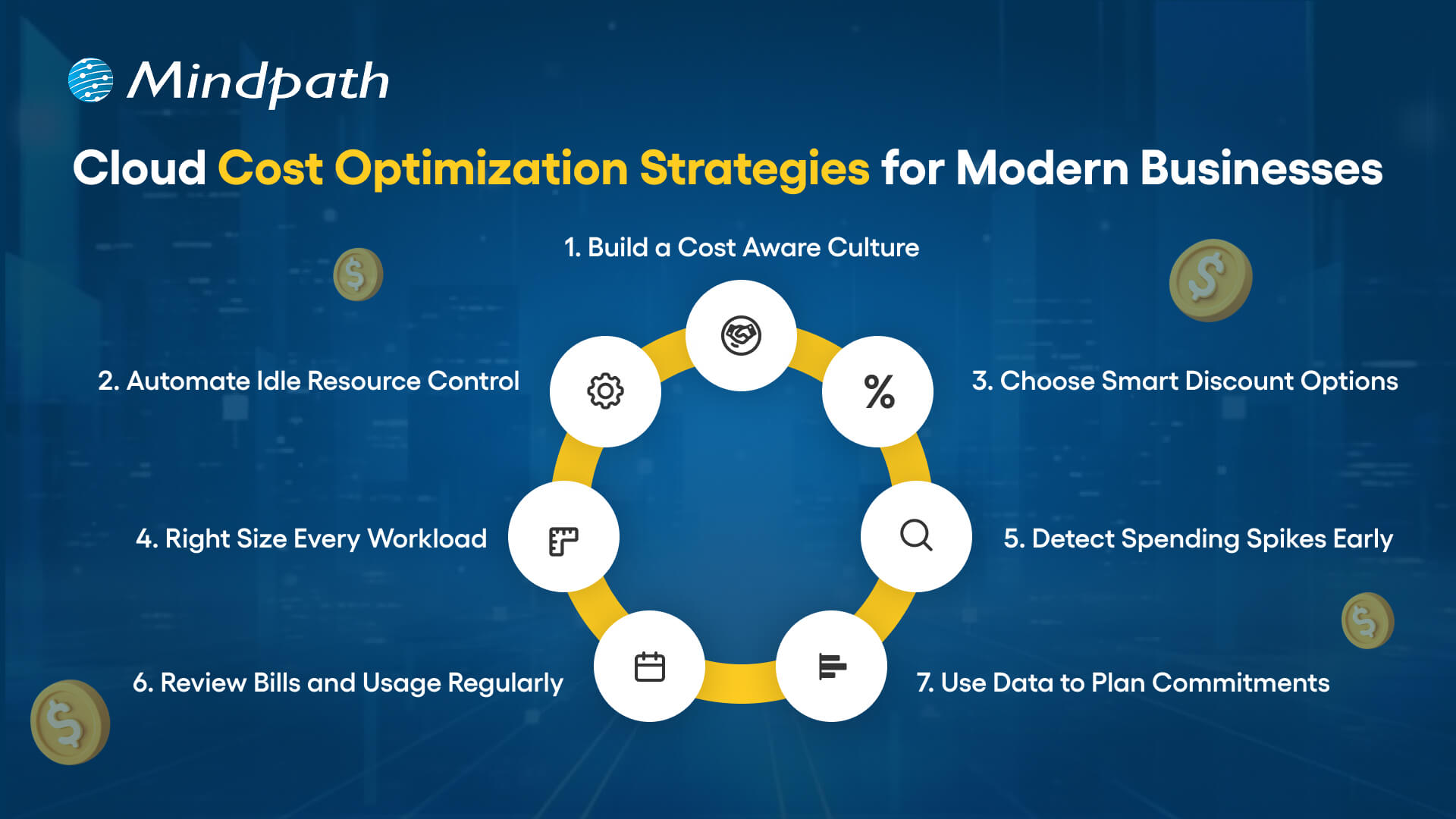
cloud cost optimization for modern businesses

1. Build a Cost Aware Culture

Clear ownership and shared responsibility are the beginning of strong cloud cost optimization. Leaders establish FinOps team and establish explicit spending policies. Teams go through regular reviews on usage and align the decisions with the business goals.

2. Automate Idle Resource Control

Unutilized servers and storage add up to high bills. Teams automate the scheduling of shutdowns and the removal of unused assets. Automation enhances the ability to optimize cost in the cloud because it avoids silent waste, which refers to the ongoing costs associated with unused resources that are not actively managed or monitored.

3. Choose Smart Discount Options

Cloud service providers also have savings plans and spot instances regarding flexibility in workloads. Workload stability is examined by teams, and then discount models are chosen. Smart commitments minimize the long-term expenses without jeopardizing performance.

Want to protect your cloud environment while optimizing costs? Explore cloud security to safeguard your systems and data effectively.

4. Right Size Every Workload

Excessively provisioned resources cost money and minimize efficiency. The teams keep tracking the CPU, memory, and storage usage. They align types of instances to actual workload requirements to facilitate cost optimization of clouds.

5. Detect Spending Spikes Early

Unplanned cost surges are hurtful to budgets and slow down planning. Real time alerts are used by teams to spot unusual usage in a short time. Timely behavior safeguards the financial control and enhances the cloud cost optimization.

6. Review Bills and Usage Regularly

The frequent examination of bills discloses outliers of costs and inefficiencies. The teams compare the present usage and the trends to identify gaps. This is followed up by constant monitoring of expenditure to ensure its congruence with approved budgets.

7. Use Data to Plan Commitments

Long-term contracts demand proper forecasting and clarity. Before commitment plans are locked teams analyze performance metrics. Data based decisions minimize risk and lead to a higher cost-efficiency.

Curious about how cloud migration supports cost optimization strategies? Check out the benefits of cloud migration to maximize your ROI.

Key Cloud Cost Optimization Tools

Businesses today need the appropriate tools to manage their expenditure and enhance visibility in the cloud setting. These are some of the important tools that can enable successful cloud cost optimization and smarter financial decisions.

1. Azure Cost Management + Billing assists teams to monitor their spending, budget and optimize Azure resources with visibility.

2. CloudZero relates cloud costs to products, features, and teams to make decisions related to the business.

3. AWS Cost Explorer and Trusted Advisor share cost-related information, usage data, and can offer recommendations applicable to make the process efficient.

4. Finout provides in-depth cost allocation analysis between various cloud and SaaS providers.

5. Google Cloud Cost Management helps to track spending and optimize usage in the GCP setups.

6. ProsperOps automates Savings Plans and Reserved Instances in order to make the maximum savings in the long term.

7. CloudHealth Victor by VMware provides business-level management, visibility and cost control in the environment.

8. Vantage provides visualized current multi cloud cost with straightforward and accurate reporting.

9. nOps applies AI based recommendations on the most economical AWS resources.

Wondering which cloud model can help you control costs and improve performance? Explore multi cloud vs. hybrid cloud to gain the clear insights.

Ready to Take Control of Your Cloud Spending?

Cloud cost optimization is beneficial to the modern business to perform cost control and enhance the performance and visibility. Businesses that audit usage, optimize resources, and automate the process of waste elimination obtain better financial control. Definite plans transform the investments in clouds into quantifiable value. By having teams focus on finance as well as engineering, teams eliminate surprise and develop long term and sustainable growth.

Mindpath is a leading provider of cloud infrastructure services, according to your business objectives. Our team is an analysis of how we use, and how we could use to waste less and be smarter with automation. We assist in the process of visibility enhancement, enhanced governance and increased returns on cloud investments. Collaborate with Mindpath to turn cloud spending into a competitive edge.
FAQs

1. What are the best practices for long term cloud cost optimization?

The following are the most appropriate practices towards long term cloud cost optimization:

  • Establish effective team ownership and accountability.
  • Set quantifiable cost targets and performance review monthly.
  • Automation is used to implement policies and avoid cost drift.
  • Use technical metrics with financial data to make smarter decisions.
  • Focus on permanent betterment to keep pace with the changing business priorities.

2. How often should businesses review their cloud cost strategy?

The teams need to observe the expenditure weekly and perform more thorough reviews every month. The regular tracking will enable the identification of trends before they turn into issues. Companies that view optimization as a continuous study make financial stability strong and give better predictions with time.

3. How can leadership teams support cloud cost management efforts?

The leadership needs to encourage transparency and foster common responsibility in spending. Effective communication between the engineering and finance enhances decision-making. Deliberate cloud cost management processes plus executive backing allow teams to remain efficiency-centered, accountable, and result-oriented.

4. What technical metrics should the team track for better cost control?

Teams need to keep track of the use of CPU resources, memory, the expansion of storage, and the pattern of data transfer. They should also monitor costs per workload and per user. These indicators assist engineers to fine-tune resources beforehand and uphold good performance without wasting resources.

5. How can Mindpath strengthen cloud cost optimization initiatives?

Mindpath provides intelligent cost control through its cloud services which offer strategic planning, automation and advanced analytics. Our professionals develop a scalable system of governance and introduce performance-driven optimization models. We assist the companies to develop sustainable cloud cost optimization that aids in growth and financial clarity.

Related Post

Explore the top ReactJS trends for 2025, including AI integration, performance optimization, and React Native growth.
Discover how to choose the right ReactJS development company with our step-by-step guide and learn about Mindpath’s expert services.

Related Post

Node.js Developers in Canada

Are you looking for a skilled Node.js developer in Canada to bring your project to life? Do you need a reliable expert who can build fast, scalable, and high-performing applications? Finding the right developer can be challenging, but with the right approach, you can hire a top Node.js professional who fits your needs perfectly.  

Hiring a skilled Node.js developer in Canada is essential for businesses looking to build fast, scalable, and efficient applications. With its non-blocking architecture and real-time capabilities, Node.js is a powerful choice for web and software development. Whether you’re developing a dynamic website, an API-driven platform, or a complex enterprise solution, finding the right developer ensures seamless performance and long-term success. Understanding the key factors in hiring a Node.js expert will help you make an informed decision and achieve the best results for your project. 

Let’s explore how you can make the best choice! 

Steps to Hire Node.js Developers in Canada

1. Define Your Project Requirements

To hire the right Node.js developer, you must first define your project’s technical and business needs. Outline the core functionalities, expected performance, and scalability requirements of your application. Identify the frameworks and tools you want to use, such as Express.js, Nest.js, or MongoDB, and specify whether the role requires front-end expertise alongside back-end development. Additionally, determine the level of experience required—junior developers handle basic tasks, mid-level developers work on feature-rich applications, while senior developers manage architecture and complex integrations. Having a well-documented project scope ensures that candidates understand your expectations from the start. A detailed job description outlining skills, responsibilities, and project goals will help attract the right talent. Without clarity, the hiring process can become inefficient, leading to mismatches in skills and expectations. A structured approach helps filter candidates early and ensures that only those with relevant expertise apply.

2. Source Qualified Candidates

Finding skilled Node.js developers in Canada requires using multiple recruitment channels. Start by posting job listings on platforms like LinkedIn, Indeed, and Glassdoor, which are popular among Canadian job seekers. Consider using tech-specific job boards such as Stack Overflow Jobs or GitHub Jobs to target professionals with strong development experience. Additionally, networking within Canada’s growing tech community can help you connect with skilled developers—attend industry conferences, local meetups, and online forums to discover potential candidates. If you prefer a more streamlined approach, working with tech recruitment agencies can save time by providing pre-screened candidates. Another option is hiring freelancers through platforms like Toptal or Upwork but ensure that remote hiring aligns with your business needs and legal considerations. A strong sourcing strategy increases the likelihood of finding a developer who meets both your technical and cultural requirements, ensuring a smoother hiring process. 

3. Conduct Technical Screening

After gathering applications, the next step is to assess candidates based on their technical skills and experience. Start with a resume review, focusing on past projects, relevant experience, and familiarity with the required Node.js frameworks. Candidates should demonstrate hands-on experience in building scalable applications, working with APIs, and optimizing back-end performance. To ensure technical proficiency, conduct coding assessments through platforms like HackerRank or Codility. These tests evaluate problem-solving abilities, efficiency in writing clean code, and understanding of Node.js fundamentals. Additionally, assess candidates’ experience with database management, security best practices, and cloud-based deployments. An effective screening process filters out underqualified applicants early, allowing only the most capable developers to move forward. By implementing structured assessments, you can streamline hiring and ensure that your chosen developer has the technical expertise necessary to contribute effectively to your project. 

4. Assess Technical and Problem-Solving Skills

Once candidates pass the initial screening, conduct in-depth technical interviews to evaluate their problem-solving abilities. Ask questions about key Node.js concepts such as asynchronous programming, event-driven architecture, API development, and database management. Provide real-world scenarios related to your project and assess how they would approach challenges. A practical coding exercise or take-home assignment can help evaluate their thought process and coding efficiency. In addition to technical expertise, consider their ability to design scalable solutions and optimize application performance. Discuss their experience with DevOps practices, cloud computing, and microservices architecture if relevant to your project. Soft skills are equally important—effective communication, adaptability, and teamwork play a significant role in long-term success. The goal is to hire a developer who not only writes efficient code but also collaborates well with your team and adapts to evolving project needs. 

5. Make the Right Hiring Decision

After evaluating technical skills, problem-solving abilities, and soft skills, the final step is making an informed hiring decision. Compare candidates based on performance in technical interviews, problem-solving assessments, and cultural fit. Strong communication and teamwork are crucial, as developers often collaborate with designers, project managers, and other team members. Additionally, check references to validate past work experience and reliability. When making an offer, consider industry-standard salaries in Canada and ensure compliance with local labor laws. Offering a competitive package, including professional development opportunities and flexible work arrangements, can help attract top talent. If hiring full-time isn’t feasible, explore freelance or contract-based options. A well-structured hiring process ensures you bring in a skilled Node.js developer who aligns with your technical needs and business goals, setting your project up for long-term success. 

Looking to hire top Node.js developers in Canada? At Mindpath, we provide skilled developers who specialize in building high-performance, scalable applications tailored to your business needs. Whether you need full-time developers or project-based support, our experts ensure seamless development with industry-leading technologies. 

Let’s bring your vision to life! Contact Mindpath today to hire the best Node.js talent for your next project. 

Read our next blog: Factors to Consider While Hiring NodeJS Developers in Canada 


Hire skilled Node.js developers in Canada with our step-by-step guide. Learn how to source, screen, and hire top talent for your project.
Multimodal Generative AI

Have you ever wondered how AI can generate text, images, and even music? What if a single AI model could understand and create across multiple formats? This is where Multimodal Generative AI steps in. In this blog, we’ll dive into the fascinating world of Multimodal Generative AI and explore how it’s shaping the future of AI. 

What is Multimodal Generative AI?

Multimodal generative AI is an advanced form of AI that can comprehend and generate several types of data, including text, images, audio, and video. These systems can combine and analyze several types of input to process data from multiple sources and produce new content. Multimodal AI combines various sources of data to accomplish more complicated tasks and call for a greater understanding of the data. Although there is a lot of potential for this technology in fields like accessibility, education, and content creation, there are also issues to be resolved, like preserving accuracy and relevance and handling ethical concerns about privacy and authenticity. 

Benefits of Multimodal Generative AI

1. Improves Accessibility

Through the creation of various kinds of content, these systems improve accessibility and facilitate information access for all. By ensuring that people with different abilities can interact with content in ways that best meet their requirements, they contribute to promoting inclusion and understanding on various platforms. By offering substitute formats, these systems seek to remove obstacles and make the user experience more inclusive for all users.  

2. Creates High-Quality Content

Multimodal generative AI can lead to more complex and intelligent content by mixing several forms of data. It can include text, graphics, audio, and other components to provide interesting content. This skill enables the creation of a wide range of instructional materials or media that deepen comprehension and spark users’ interests. For everyone, it makes for a more engaging and educational experience by combining different forms. This method not only grabs the interest of individuals but also accommodates various learning styles, which makes it simpler for people to understand difficult ideas and concepts. This results in more effective and richer content that appeals to a larger audience.  

3. Boosts User Experience

Multimodal generative AI can adapt content in user interfaces to the context and the demands of the user. When voice isn’t possible, it can provide visual explanations to make sure customers receive information most conveniently. It also improves interactive experiences, like video games, by producing lifelike people and language that react differently to human input. 

Because of its versatility, technology becomes more user-friendly and accessible and creates a more engaging experience. Multimodal generative AI can offer tailored suggestions by comprehending the context, which raises customer satisfaction and facilitates more seamless, pleasurable interactions with digital material. 

4. Combines Data Effectively

These systems are capable of smoothly fusing data from many sources to deliver a more thorough and coherent knowledge of intricate circumstances. Their ability to integrate text, audio, and visual data improves analysis and decision-making. This capacity is especially useful for security, since it can improve threat identification and monitoring by combining textual, auditory, and visual analysis. 

These algorithms can find patterns and relationships by combining several kinds of data that would not be apparent when looking at a single source. By using a holistic strategy, organizations can improve their ability to respond to possible hazards and improve operational safety and efficiency.  

5. Improves Understanding and Insights

These models can get a better knowledge of both content and context than single-mode AI systems by combining many sources of data, such as text, pictures, and sound. With the capacity to understand both verbal and non-verbal aspects of a user’s question, this feature makes replies in applications such as virtual assistants more accurate and relevant. 

These systems improve communication and engagement by considering several factors, giving users a more efficient and natural experience. This enhanced comprehension leads to deeper interaction and more significant conversations, which eventually boosts the efficiency of AI applications as a whole. 

6. Drives Creative Marketing and Advertising

By combining consumer data from several sources to create personalized advertising material, multimodal generative AI can enhance marketing initiatives. These technologies can offer customized advertising materials that engage consumers on several sensory levels by analyzing interactions across various forms. Using this strategy, companies can generate ads that are more relevant and engaging for their target demographic, which improves consumer engagement and boosts the efficiency of marketing efforts.  

Use - Cases of Multimodal Generative AI

1. Human-Computer Interaction

Multimodal AI enables more natural and intuitive human-computer interactions by processing inputs from several sources, including voice, gestures, and facial expressions. This feature facilitates more seamless communication and allows customers to interact with technology in a more comfortable and familiar way. Multimodal AI improves user experiences and opens technology to a larger audience by comprehending various input formats. 

2. Healthcare

Multimodal models are essential for medical image analysis in the healthcare sector because they integrate data from several sources, including written reports, medical scans, and patient records. The capacity of medical professionals to diagnose patients accurately and create efficient treatment programs is improved by this integration. These technologies eventually enhance patient care and results by offering a greater understanding of a patient’s state. 

3. Multimedia Content Creation

Multimodal AI can generate multimedia material by mixing data from a variety of sources, such as text descriptions, audio recordings, and visual references. This feature makes the process of creating content more efficient and enables the automatic production of interesting and rich content. These systems improve efficiency and creativity by combining several modalities, which makes it simpler to create varied content that meets the tastes of various audiences.  

4. Sensory Integration Devices

Multimodal artificial intelligence (AI) improves augmented reality, virtual reality, and assistive technology user experiences by combining touch, visual, and audio inputs into one device. These gadgets build settings that are more interactive and immersive by merging many sensory inputs. This integration allows for a more thorough and pleasurable experience across a variety of apps while also improving user engagement and accessibility to technology. 

Multimodal artificial intelligence (AI) Services at Mindpath

Our AI development services help organizations better understand their requirements and make decisions by utilizing text, photos, audio, and other inputs. Our ability to integrate data from several sources gives us a full understanding of your initiatives and objectives. Our AI models make interactions more relevant and engaging by producing personalized information and responses based on your unique needs. By utilizing a variety of input methods, technology is made easier to use and more pleasurable for the user overall.  

Our services also provide valuable insights that assist businesses in making better decisions, leading to more effective strategies. At Mindpath, our aim is to harness the power of multimodal AI to empower your business and improve outcomes through innovative solutions. 

Final Thoughts

Multimodal generative AI is transforming the way humans engage with technology and consume content. It improves user experiences across a range of industries, increases accessibility, and fosters creativity by mixing diverse sources of data effortlessly. This technology has enormous potential to change industries and improve our daily lives as it develops further. At Mindpath, we’re thrilled to take the lead in applying multimodal AI to develop cutting-edge solutions that enable companies and improve user engagement. Unlock countless opportunities for development and innovation by embracing the AI of the future with us. 

Ready to unlock the potential of your projects?

At Mindpath, we harness the power of advanced AI solutions to elevate your business.

Discover how Multimodal Generative AI enhance creativity, accessibility, and user experiences across industries.
freelance full stack developer

In the current business landscape, business entities are engaging in a wide range of projects. Due to the high diversity coupled with the complexity of projects, many companies are hiring the best freelance full-stack developers for their projects. According to the reports, full-stack developer jobs are one of the most in-demand jobs since their year-over-year postings are rising by more than 35 %.

As the reliance of companies across industries on digital technologies rises, the demand for full-stack development freelance services is likely to surge. Businesses that prioritise their digital transformation journey have been considering freelance full-stack developers. If you wish to excel in your tech projects, you must definitely consider the best freelance full-stack developer for hire.

If you’re looking to hire full-stack developers who see beyond code and focus on your future transformation, Full Stack Development Services will provide you with forward-thinking professionals who deliver innovative solutions that drive business growth.

Who is a Freelance Full-Stack Developer?

Before deciding whether a freelance full-stack developer is an ideal choice for your project or not, you must familiarise yourself with the particular role. A Freelance Full-Stack Developer is a professional who is proficient in the front-end and backend components of a web application. These developers have solid expertise in a broad range of technologies such as CSS, HTML, React, JavaScript, and many more. As in recent years, a greater number of businesses are integrating digital technologies into their processes, and the reliance on capable freelance full-stack developers has skyrocketed. 

The high versatility of these professionals while building entire web apps from scratch gives rise to benefits for businesses. Apart from their prowess to create apps, these professionals are capable of managing databases and deploying and maintaining software in a cloud environment. Thus, businesses that decide to hire a freelance full-stack developer can succeed in their technology-driven projects. 

Looking for the best way to scale? Explore how full-stack development for web projects improves flexibility and long-term growth. 

Skills of a Freelance Full-Stack Developer

Businesses need to familiarise themselves with the top skills and expertise of a Freelance and remote full-stack developer. The insight in this specific area can certainly help you understand the true potential of these professionals. The top skills that these professionals leverage in order to help business firms excel in their web development projects are:

1. High proficiency in front-end technologies

A capable Freelance Full-Stack Developer is proficient in popular front-end languages such as Angular, React, and CSS. 

2. Expertise in backend aspects

A highly skilled Freelance Full-Stack Developer has immense knowledge relating to database management, along with popular languages Python and Node.js. The professional also has expertise in API development, which equips them to handle backend operations flawlessly.

Also Read: Full-stack Development with Node.js

3. Solid foundation in cloud technologies

Talented Freelance Full-Stack Developers possess solid insight into cloud technologies. The rich insight empowers them to design highly scalable and secure applications for businesses. 

4. Testing and debugging skills

The skills relating to testing and debugging processes enable these professionals to develop robust and well-functioning applications. By conducting rigorous testing, they are able to locate flaws or vulnerabilities in web apps and adopt appropriate remedial measures in a prompt manner. 

5. Robust version control

Freelance Full-Stack Developers are capable of tracking changes to code. The skill pertaining to version control ensures that the quality of code can be maintained throughout the app development process. Furthermore, these developers focus on collaborating with others to ensure the success of projects. 

Want to gain deeper insight into which development role best suits your business needs? Explore our blog – Front-End vs Back-End vs Full-Stack Developer.

How Can a Freelance Full-Stack Developer Add Value to Your Project?

In the digitalised business realm, it is a necessity for businesses to consider partnering with the best freelance full-stack developers. Businesses can derive immense value if they decide to partner with a top Freelance Full-Stack Developer or hire a remote full-stack developer.

1. Expertise to handle end-to-end projects

By hiring the best Freelance Full-Stack Developers, you can rest assured about the entire web development lifecycle. These professionals will capitalise on their skills and expertise to handle a diverse range of projects efficiently. As they can work on the entire project lifecycle in an independent manner, you do not have to rely on other teams or professionals. 

2. Cost-effective solutions

Hiring the best Freelance Full-Stack Developers is undoubtedly a highly cost-effective solution for businesses. By choosing freelance full-stack developers, you can eliminate unnecessary costs relating to employee benefits or long-term contracts. Additionally, you do not have to hire entire project management teams to work on your web development projects. Moreover, by leveraging the expertise of these professionals, you can surely excel in your project in an efficient manner. 

3. High agility

Generally, Freelance Full-Stack Developers are highly agile as well as adaptable when it comes to handling web app development projects. As a result, they can deliver results for businesses with shorter delivery timelines. Furthermore, their ability to work in an independent manner can decrease the overall time taken to work on projects for businesses. Businesses can certainly derive immense value from their ability to launch their web apps in the market successfully. 

4. Flexible way of handling projects

By joining hands with Freelance Full-Stack Developers, businesses can handle their projects in a flexible manner. As these professionals work as freelancers, they offer flexible options for their business clients. Based on your exact project needs, these web developers can deliver tailored solutions to meet your specific project objectives. 

5. Capitalising on transferable abilities

Freelance Full-Stack Developers have highly transferable abilities thanks to their comprehensive knowledge of web development. As a result, business entities can take advantage of full-stack developers to take care of their varying needs relating to web design and web app development. The transferable abilities of these professionals undoubtedly empower businesses to reduce the overall complexity of their projects. 

Planning to validate your product idea quickly? Discover how hiring a full-stack developer for MVP accelerates product validation.

Promising Future of Freelance Full-Stack Developers

The future of Freelance Full-Stack Developers is full of possibilities in the current times. This is mainly because of the rising demand for these professionals in the contemporary business world. The skills that Freelance Full-Stack Developers possess make them highly dependable professionals. Furthermore, their proficiency makes them capable of tech agility and working on complete projects independently. 

The future-proof skills and prowess of full-stack developers increase their worth for companies. In the future, as more businesses engage in web development projects, the dependence on these developers may further increase. Such a trend is likely to increase the full-stack developer’s salary significantly in the long run.

Some of the chief reasons for the bright and prosperous future of freelance full-stack developers include:

  1. The growing demand for flexible web app development solutions in the business world.
  2. The ability of these professionals to offer end-to-end web app development solutions to businesses. 
  3. The flexible nature of solutions that are offered by full-stack developers in the evolving business climate.
  4. The updated knowledge of these developers about the latest industry trends, as well as the latest technology tools. 
  5. The ability to solve diverse web app projects with varying levels of complexity.     

Also Read: Full-stack Development Trends

Final Words

The emergence of the role of freelance full-stack developers has been a boon for modern business entities. In order to thrive in the tech-driven business landscape, a majority of businesses are hiring full-stack developers who can handle their web development projects efficiently. These professionals are undoubtedly playing a catalytic role in helping firms excel in their development projects. 

If you wish to capitalise on the skills of the best freelance full-stack developers, you must consider partnering with Mindpath. By leveraging its staff augmentation services, you can hire full-stack developers who can drive your projects towards success. Therefore, by integrating highly skilled professionals, your business can boost its project management capabilities.  

Discover why hiring a freelance full-stack developer in 2024 can boost your project’s efficiency, quality, and cost-effectiveness. Learn more with Mindpath!