The Ultimate Guide to Node js Libraries for AI Integrations

Join our Newsletter!

Featured Posts

Support Is One Click Away

Home

The Ultimate Guide to Node js Libraries for AI Integrations

Node js libraries for AI

The Ultimate Guide to Node js Libraries for AI Integrations

 As we know, with Node.js libraries, adding AI to your projects is becoming easier. These Node.js libraries for AI can offer you the ability to develop apps that can think, respond, and learn over time. If you enjoy working in JavaScript and you are curious about the new AI features like chatbots, smart predictive features (like those in Google Assistant), and apps that recognize voice input, then now is your chance. You don’t need to begin from scratch. If you use the right libraries, you can build smarter apps at less cost and more value.

These Node.js AI libraries come with beginner-friendly options that are powerful enough for advanced applications. You can add new features such as understanding language, detecting images, or performing machine learning without deep knowledge of AI. They are built to seamlessly integrate into your existing Node.js stack, enabling you to save time and effort in your development workflows. In this blog post, we’ll discuss some of the best libraries to quickly get started with AI in Node.js applications.

Are you looking to elevate your business’s web development with the use of Node.js? At Mindpath, we offer Node.js development services that aim to grow your business by providing reliable and AI-powered web solutions tailored to your unique needs.

Importance of Integrating AI into Node.js Applications

Node.js is increasingly becoming a leading option for creating smart, dynamic applications because it is lightweight and driven by events. Thus, can Node.js be used for AI? Yes, it can! Developers are already using Node.js as an API or tool for AI with tools like TensorFlow.js and Natural. In the 2024 Developer Survey by Stack Overflow, JavaScript continued to be the most popular programming language, which means that Node.js is a great starting ground for AI initiatives.

Integrating Node.js with AI applications allows developers to make applications that change and adapt in real-time. The asynchronous nature of Node.js allows developers to execute several operations simultaneously, making it a good platform for artificial intelligence features like chatbots and live prediction tools. More and more AI libraries support Node.js, as development can happen more quickly. As demand for AI using more efficient and adaptable models rises, Node.js is a new practical, scalable programming option for any developer who wants to create smart digital experiences.

Let us have a quick look at the benefits of integrating AI in Node.js applications:
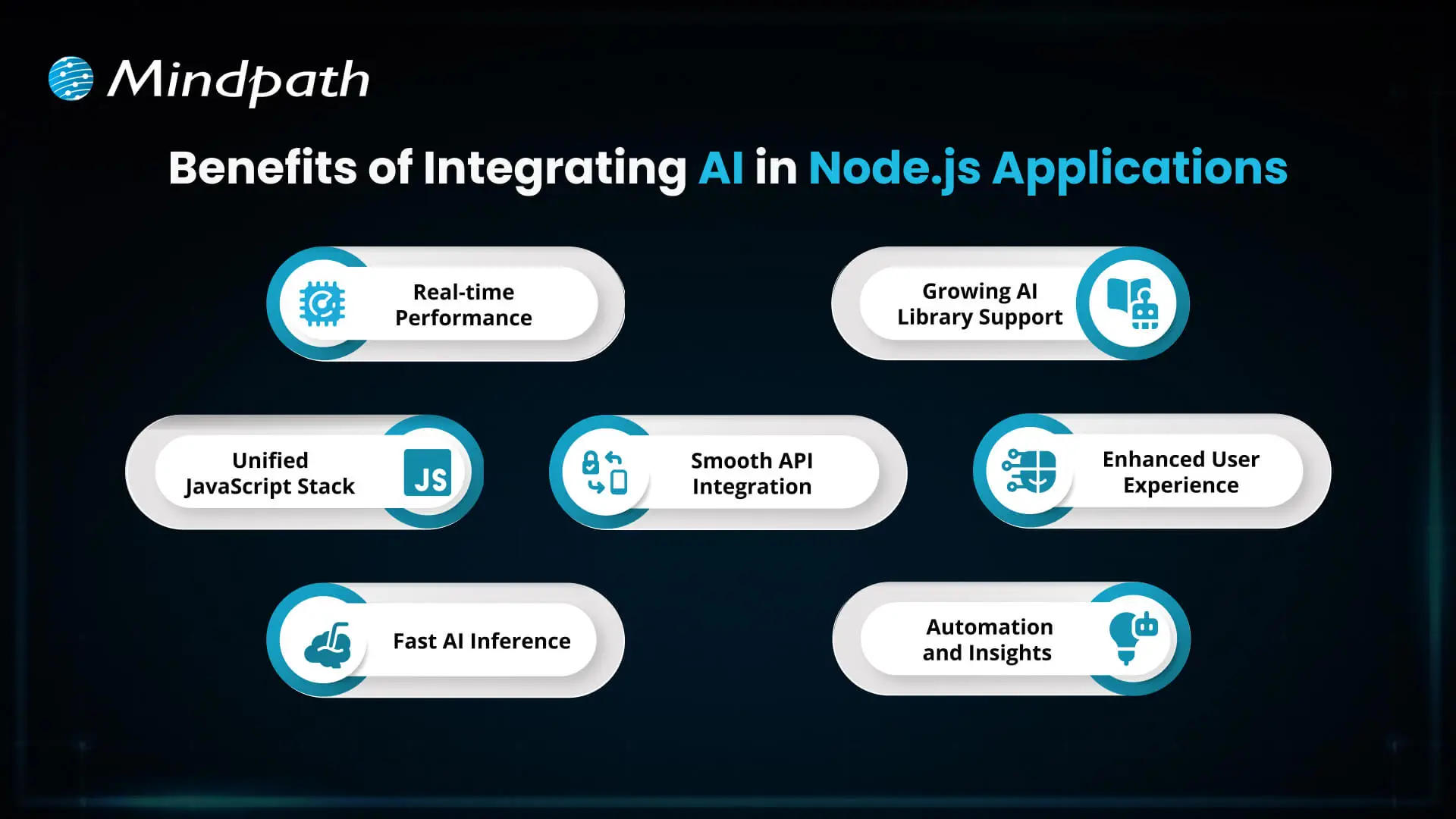
Benefits of Integrating AI in Node.js Applications

1. Real-time Performance

AI integration with Node.js handles real-time tasks like chatbots and fraud detection efficiently with its non-blocking, event-driven architecture. It supports thousands of concurrent requests, delivering quick and responsive AI features.

2. Unified JavaScript Stack

With Node.js AI integration, developers can use JavaScript for both frontend and backend, including AI features. This reduces context switching and makes the development process faster and more efficient.

3. Fast AI Inference

Node.js runs on the V8 engine, which ensures high-speed execution for AI models. This is perfect for real-time predictions like dynamic pricing or personalized recommendations.

4. Smooth API Integration

Node.js makes it easy to connect with external AI services and pre-trained models through APIs. It works well with AI built in other languages like Python, enabling flexibility in integration.

6. Growing AI Library Support

The Node.js ecosystem offers a wide range of AI libraries via npm, such as TensorFlow.js and ONNX.js. These tools allow developers to implement machine learning directly in JavaScript.

7. Enhanced User Experience

AI features like intelligent chat, personalization, and predictions improve how users interact with your app. Node.js helps deliver these features in a fast and seamless way.

8. Automation and Insights

AI in Node.js apps can automate repetitive tasks and analyze data in real-time. This leads to smarter applications that save time and improve performance.

Looking to streamline your web development in 2025? Check out our blog on Top 25 NodeJS Libraries in 2025 to find the best tools that will help you build powerful and efficient applications.

What are the Top Node.js Libraries for AI Integration?

Building intelligent apps is now simpler with the rise of Node.js artificial intelligence libraries that support machine learning, NLP, and smart automation. These powerful AI Node.js libraries help developers create responsive and data-driven features without complex setups. Here are some of the best Node.js libraries for AI integration:
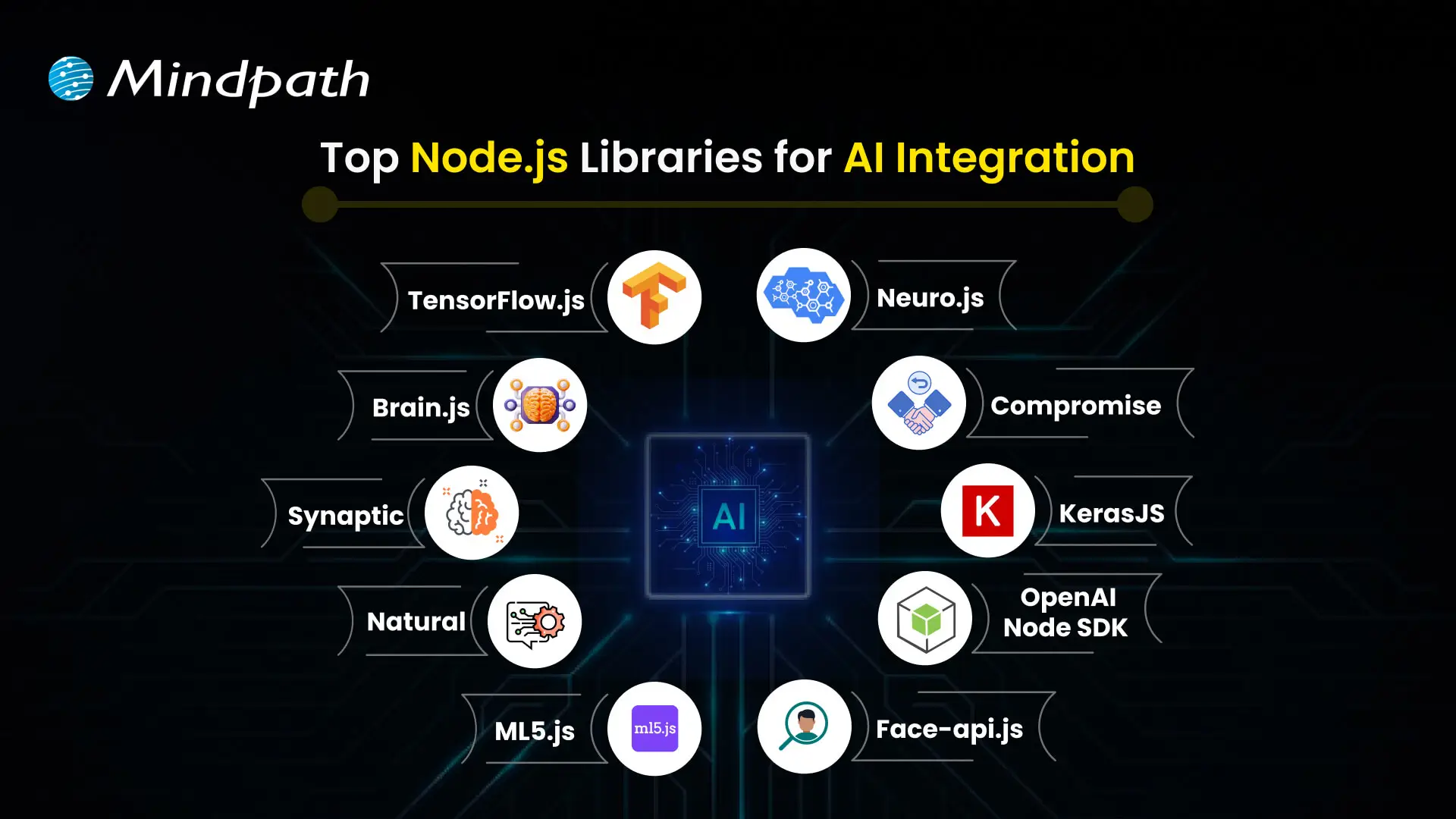
Top Node.js Libraries for AI Integration

1. TensorFlow.js

TensorFlow.js is one of the top Node.js libraries for machine learning, allowing developers to build, train, and run models entirely in JavaScript. It works both in the browser and with Node.js, making it versatile for a wide range of projects. The library is a good example of how Node.js libraries for AI can power real-world communication tools.

2. Brain.js

Brain.js is a simple neural network library that’s ideal for beginners working on small AI projects. It uses JavaScript to make machine learning accessible without complex configuration. Found in the list of useful npm libraries, it helps developers get started quickly with AI-powered features.

3. Synaptic

Synaptic offers a flexible system for creating different types of neural networks, including feedforward and recurrent ones. It supports supervised and unsupervised learning, giving developers options based on their use case. As one of the advanced Node.js libraries for AI, it works well for experimental and custom AI models.

4. Natural

Natural is a powerful Node.js natural language processing library that provides tools like stemming, classification, tokenization, and sentiment analysis. It’s great for applications that need to work with text data in real-time. This is one of the most complete Node.js libraries for AI when it comes to language-based features.

5. ML5.js

ML5.js is built on TensorFlow.js but focuses on simplicity and creative use, making it perfect for artists, designers, and beginners. It lets you easily create interactive AI experiences on the web. As part of the growing set of npm AI tools, it balances power with ease of use.

6. Neuro.js

Neuro.js focuses on building intelligent features for chatbots and virtual assistants using JavaScript. It’s tailored for tasks in NLP and conversational AI. The library is a good example of Node.js support for AI development in real-world communication tools.

7. Compromise

Compromise is a fast and lightweight library for real-time text processing. It’s designed for performance and currently supports only English, making it efficient for many use cases. As part of the JavaScript libraries used in NLP, it’s a useful choice for developers needing quick language insights.

8. KerasJS

KerasJS is a browser-based library that allows you to run deep learning models built with Keras using JavaScript. It supports several pre-trained models like Inception v3 and ResNet, useful for tasks such as image recognition and sentiment analysis. As one of the top Node.js libraries for machine learning, it offers flexibility for deploying models in web environments, with Node.js support in CPU mode.

9. OpenAI Node SDK

The OpenAI Node SDK helps developers connect easily with models like GPT and Codex for generating text, images, and code. It simplifies integration with OpenAI services using Node.js. Available among advanced npm libraries, it enables powerful generative AI in modern apps.

10. Face-api.js

Built on TensorFlow.js, face-api.js provides tools for face recognition, detection, and expression tracking. It runs on both browsers and Node.js, making it suitable for cross-platform apps. As part of modern Node.js libraries for AI, it brings computer vision capabilities to JavaScript projects.

Choosing the right libraries is just the start; you can also enhance Web Performance with Node.js Development Services, which are built to support advanced AI workflows.

Looking to Enhance Your App with Node.js and AI?

The growth of powerful Node.js libraries for AI integration is making it easier to build applications that think, learn, and adapt. AI libraries will help a developer create smarter, faster, and more sensible digital experiences, from real-time predictions, natural language processing, to so much more. With JavaScript at the core, the path to intelligent development is now more accessible.

At Mindpath, we provide professional Node.js development services for current and future applications that are powered by AI. We build intelligent backend systems, provide seamless API integrations, and build scalable features with Node.js, and when combined with AI, we are empowered to deliver increasingly smarter solutions. If you are looking to build an application soon, then we are ready to provide fast, reliable, and intelligent solutions focused on performance and innovation.

Related Post

Conversational AI, a byproduct of AI is already popular in the form of voice assistants like Siri and Alexa, customer assistant chatbots, messenger bots, and more such solutions.  
Discover the essential factors for hiring a top WordPress developer. Learn about expertise, communication, experience, cost, and finding the right platform.

Related Post

In the Illustrator image, a person is checking new technologies for her business on a laptop.
The world is changing rapidly and so is the technology spectrum across the globe. We are stepping into a digitally advanced world with new technologies like Generative AI, Web3, Blockchain, etc. Today’s businesses constantly seek innovative technologies to gain a competitive edge and drive strategic decision-making.   With the flood of technologies coming every year, some of them remain truly essential for modern-day businesses to thrive. Therefore, in this blog, we’ll explore ten upcoming technologies poised to transform business decision-making in the near future.  So let’s get started!  

8 Upcoming Technologies To Drive Business Decision

1. GenAI

GenAI or generative AI is already making strides with popular tools like ChatGPT, Dall-E, Midjourney, etc. Generative AI, as the name suggests, is able to generate content like text, images, codes, designs, etc., based on “prompts” given by the users.   ChatGPT, a hot example of GenAI took the world by storm as soon as it was introduced. Many software have been launched since. In the coming years, GenAI is expected to play a crucial role in helping business leaders with decision making. GenAI empowers businesses to automate creative processes and deliver hyper-personalized experiences at scale, from creating personalized marketing content to designing custom products. 

2. GenAIPowered Chatbots 

The next notable technology is Gen-AI-powered virtual assistants or chatbots which are becoming increasingly popular amongst users. GenAI-powered virtual assistants leverage natural language processing and machine learning algorithms to understand and respond to user queries and requests intelligently.  Virtual assistants include chatbots, voice assistants like Alexa & Siri, language-based assistants like ChatGPT & Bard, etc. GenAI and conversational AI are taking the customer experience to the next level. By harnessing the power of conversational AI, businesses can provide personalized customer support, streamline internal processes, and enhance productivity. 

3. Digital Twins 

Another trailblazing technology that’s going to assist businesses in making the best of their resources in the coming time is Digital Twins. Digital Twins are digital copies or replicas of real-world physical assets, systems, machines, tools, processes, etc.   To put simply, imagine you have a toy car that you want to understand better. You create an exact digital copy of this toy car on your computer, including all its parts and how they work together. This digital copy is called a digital twin. Now, whenever you want to experiment with or understand how the toy car behaves in different conditions, you can use the digital twin instead of the actual toy. For example, you could test how it moves on different surfaces, how it performs with various modifications, or how it reacts to changes in speed.  By creating a digital twin of products, equipment, or infrastructure, businesses can gain valuable insights into performance, predict maintenance needs, and enhance operational efficiency.

4. Multimodal User Interfaces (UIs)  

User Interfaces (UIs) play a key role in delivering optimal customer experience. But most UIs till now have confined users to interact with machines in a monotonous way like typing on keyboard. That’s not the case with Multimodal User Interfaces (UIs). Multimodal UIs combine various interaction modalities such as voice, gesture, touch, and gaze to provide more intuitive and immersive user experiences.  To put it simply, multimodal user interfaces are like having multiple ways to talk to your computer or device. It’s not just typing on a keyboard anymore. You can use your voice, touch the screen, wave your hand, or even look at something to interact with it. By accommodating diverse user preferences and accessibility needs, multimodal UIs enhance engagement and usability across different devices and platforms. 

5. Intelligent Applications  

Intelligent applications support advanced analytics, machine learning, and automation capabilities to deliver context-aware insights and recommendations in real time. Think of intelligent applications as smart helpers. These apps use AI/ML along with advanced analytics to understand what you need and help you out.  These intelligent apps can serve as a golden opportunity for businesses to better predict customer behavior, optimize supply chain operations, as well as automate decision making process.  

6. Tokenization  

Have you heard of digital tokens? Tokenization allows the conversion of physical assets and contracts into digital tokens. Wondering how? Here’s an example! When you make a purchase online, you might use your credit card. Instead of giving the website your actual credit card number, which could be risky if the site gets hacked, tokenization replaces your card number with a unique token. This token acts as a placeholder, representing your card securely without exposing your real information.   Tokenization is all set to enable secure and transparent payments without any third-party intermediaries.  

7. Quantum Processors  

Quantum processors, as complex as they sound, are actually going to simplify the complex procedures and provide fast results. These are superfast computer processors aimed at delivering faster results for any problem. For example, quantum processors can handle the complex calculations needed to understand how molecules behave and interact with each other, which is crucial for developing new medicines.  While still in the early stages of development, quantum processors have the potential to revolutionize fields such as cryptography, optimization, and drug discovery, enabling businesses to tackle previously intractable problems with unprecedented speed and efficiency. 

8. Web3 

Lastly, let’s talk about Web3. It represents the next generation of the internet. Web3 is all about creating an immersive user experience and creating a decentralized platform. Technologies like blockchain, decentralized finance (DeFi), and decentralized apps (DApps), are at the core of Web3.   It will give more control to users over their data and provide transparency in transactions. With Web3, instead of going through a centralized payment processor like PayPal, you can use a decentralized cryptocurrency like Bitcoin or Ethereum to make the purchase directly, without any intermediaries.  Business leaders need to adapt themselves to provide a customer experience that is democratize and free from intermediaries.   These were the 8 new technologies 2024 that will become crucial for business owners for making business decisions.  

Wrapping Up

In today’s digital world, businesses need to use new technologies to stay competitive and grow. These technologies, like GenAI, digital twins, smart virtual assistants, Web3, etc., can help them make better decisions and be more innovative. By keeping up with these changes and being open to trying new things, businesses can succeed in the digital age.  As a leader in upcoming technologies, Mindpath Tech is well-positioned to guide businesses through this journey of adaptation and innovation. With our expertise and commitment to staying ahead of the curve, we can help businesses harness the power of transformative technologies and thrive in the digital landscape.  So are you ready to become future-ready? Get in touch!  
Discover the top 8 emerging technologies set to revolutionize business decision-making in the near future, including Generative AI, Web3, Blockchain, and more.
Stability AI guide

In this generative AI revolution, one name that stands out as a leader of open-source AI models is Stability AI. The company has introduced many powerful AI models that have completely changed the way of generating digital content. In this comprehensive Stability AI guide, we will discuss more about this platform.

If you are looking to explore the most powerful, flexible, and accessible toolkit to create audio, videos, images, and more, this Stability AI guide is for you. Read on to find out what it is and the various models offered by Stability AI. Besides, here you will find the answer to an important question: “How can I use Stability AI?”

Want to explore Stability AI but need guidance on turning its capabilities into real business value? Mindpath provides end-to-end AI development services that bring your AI ideas to life with reliable, future-ready solutions.

What is Stability AI?

Let’s start this Stability AI guide by understanding the basics – what Stability AI is. Stability AI is a renowned company that was established in 2019. It strives to provide powerful and open-source AI models to perform different tasks. The brand is known for its Stable Diffusion model, a powerful image generation model.

Different from other platforms, Stability AI releases the source code and the weights of their models, as it emphasizes openness. This has made it a top choice among startups, hobbyists, and artists. Developers can easily fine-tune and build upon various models offered by Stability AI. The product portfolio of Stability AI expands beyond just image creation. The ecosystem includes multiple models for all types of digital content.

Must Read: Generative AI Tools for Content Creation

Now that you learn about Stability AI, it’s time to move into an important question in this Stability AI guide, i.e., how does it work?

How Does Stability AI Work?

In general, Stability AI creates as well as trains various foundational models, or we can say large neural networks. These models can generate content based on the patterns they have learned from different datasets. All these models are trained utilizing diffusion techniques, and the most popular of these is Stable Diffusion.

It basically starts with random noise. Next, by reversing the diffusion process, it eliminates the noise for generating realistic images that are based on the prompts of the user. For language-related tasks, Stability AI has advanced models such as StableVicuna and Stable LM. Stability AI wants to make modern AI technologies easier to access by making AI models open-source and offering comprehensive documentation.

Want to know what makes generative AI models so powerful? Discover the attention mechanism to learn how neural networks focus on important information during generation.

Understanding Various Stability AI Models

In order to maximize the use of Stability AI, it is essential to learn about its fundamental models. After all, these models are the basis of the incredible functionality of this platform. Continue reading this Stability AI guide and explore the key models. This will assist you in choosing the right one for your needs.

1. Stable Diffusion 3.5

This represents the ability of Stability AI to create an image based on text. This model produces high-quality and detailed images based on the user’s prompt. It is available in different sizes, like Medium, Turbo, and Large. It demonstrates a perfect combination of speed and quality. Whether you need an AI model for concept design, artwork, social media posts and product mockups, you can count on it.

2. Stable Diffusion XL

Even though it is an old model, it can still produce high-resolution and large images without compromising detail. It balances between quality and performance. This is the reason why this model is still being used by many workflows and community UIs.

3. Stable LM 2 12B

It is one of the popular Stability AI models, well-known for various types of natural language processing tasks. It supports 12 billion parameters and performs efficiently for tasks like question answering and text generation, as well as summarization.

4. Stable Point Aware 3D

We can say that it is a groundbreaking AI model for quick yet efficient 3D content generation. It can convert 2D images into detailed 3D models. It has made 3D modelling more accessible and easier than before. This model is valuable for industrial design, VR/ AR and gaming industries.

5. Stable Audio Open 1.0

This particular model lets users to create sound effects, instrumental tracks and music using text prompts. Using this, you can produce original audio content without worrying about royalty constraints. As the model is open-source, you can also fine-tune it for different projects.

You don’t need to learn about all these models at once. Just begin with Stable Diffusion as it is simple to learn.

Curious how generative AI models like Stability AI actually work? Read the Large Language Model (LLM) guide to gain clear insights into how these models process data and generate intelligent outputs.

How Can I Use Stability AI?

If you are wondering, “How can I use Stability AI?” then you are not alone. Well, the good news is that there is no specific answer to this question. You can get started with this platform through different methods. Check out the below sections to explore the methods.

1. Utilizing a Hosted Platform

This is the most convenient and quickest method of using Stability AI. You don’t have to deal with configuring the tools or downloads. All you have to do is use platforms such as DreamStudio or others using Stability AI models.

You can sign up for an account with platforms like Sinkin AI, Playground AI, DreamStudio, Childdrop or Invoke AI. Then, type your text prompt and click on the Generate button to view the result.

It is an ideal method if you want to learn the potential of Stability AI without developing any technical skills.

2. Online UI Built on Stable Diffusion

Do you want to have better control without dealing with code? There are many third-party websites offering easy-to-use interfaces developed on Stable Diffusion. These sites provide you with advanced features such as upscaling, guidance scale, negative prompts and more.

The best part is that you still don’t have to worry about local installation and spending money on high-end GPUs.

3. Run Stability AI Models Locally

This approach should be used when a user has a strong GPU and decent technical abilities. With this method, you can run AI models on your own system. It gives you maximum control, and you can switch between various models as per your needs.

Furthermore, you can even find-tune models and add LoRA. What’s more? Once configured, you can use features like outpainting, inpainting and more.

Local installation can be challenging and has a steeper learning curve. But in the long run, you will find it more secure, fast as well as highly customizable.

In short, as a beginner, you can prefer to follow the first two methods. After developing the required skills and knowledge, you can install the models locally and enjoy more creative possibilities.

Looking to customize AI models for your projects? Read OpenAI’s Fine-Tuning API tutorial to discover techniques for fine-tuning AI models and improving performance.

Real-World Stability AI Examples

Let’s end this Stability AI guide with some Stability AI examples that show the ways businesses and individuals are utilizing Stability AI.

1. For Creators

Using Stability AI image generator, creators can generate album covers, concept arts, book illustrations and more. The media tools make it easy to create unique visuals for digital campaigns and branding.

2. For Businesses

Organizations can use Stability AI to automate various tasks and save resources as well as time. Stability AI enables the creation of quality digital content, whether it is a video or a prototype design of a new product. These examples clearly show that you don’t need to be a technically skilled individual to leverage the power of Stability AI. It is one of the most effective AI solutions for small businesses, helping them streamline operations and create professional content without heavy technical expertise.

Want to understand how AI agents improve the performance of Stability AI? Explore the role of AI Agents to see how they guide generative processes and expand what Stability AI can achieve.

Unlock Your Creative Potential with Stability AI

Undoubtedly, Stability AI has made it easier to get access to stunning generative art as well as visual content. It offers a vibrant ecosystem of communities, tools, and tutorials along with powerful models. If you are using it for the first time, this Stability AI guide will help you learn more about it.

A clear answer to “How can I use Stability AI?” is quite simple, i.e., keep prompting. And if you need more help with this, Mindpath is here to guide you through our AI development services. The expert team at Mindpath can help you with model selection, deployment strategies, and prompt engineering. We ensure your creative journey is future-ready and efficient.

Big Data

Have you noticed how businesses are making more precise and data-driven decisions lately? That’s because big data is playing a huge role in shaping their strategies. But how does big data actually influence decision-making? And why is it so important in today’s digital age? In this blog, we’ll explore how big data is transforming the way decisions are made. So, let’s dive in! 

What is Big Data?

Big data is the term used to describe the vast volumes of data that are constantly being produced from a variety of sources, including social media, online transactions, sensors, and more. Big data is unique not just because of its size but also because of its rapid production and diverse variety of data types, which include text, figures, images, and videos. These vast, rapidly rising data sets, often known as the “Three V’s” (volume, velocity, and variety), are too complex for standard data tools to handle. Businesses can use big data to find patterns, trends, and insightful information that can help them make more informed decisions and plans of action. 

How Does Big Data Work?

Big data is made up of several kinds of information that are often categorized as semi-structured, unstructured, or structured. Structured data is simple to organize and typically comprises numbers in spreadsheets or databases. Unstructured data, on the other hand, is more difficult to organize as it is more complicated and includes information from sensors, text messages, and social media posts. Semi-structured data is in the middle; it has a certain amount of structure, but it still needs to be more structured than structured data. 

Numerous methods exist for gathering this data, including surveys, online transactions, in-store check-ins, and data from applications and personal gadgets. After being gathered, the data is electronically kept in large systems called data lakes or warehouses.

Role of Big Data in Modern Business Decision Making

1. Discover New Opportunities

Regardless of how much information you currently possess, there is always more to learn. Big data and analytics are essential tools in today’s fast-paced corporate climate for helping organizations evaluate their existing performance and create development strategies. 

Big data and business analytics allow organizations to improve their marketing efforts and identify possible growth prospects. With this method, companies can discover areas where their strategies are lacking and potentially profitable undiscovered markets. Additionally, by using data-driven insights, organizations can maximize their resources, make well-informed decisions, and eventually obtain a competitive advantage in their respective sectors. Adopting big data’s potential encourages creativity and adaptation in a market that is always changing, in addition to helping in the discovery of new customers. 

2. Gather Customer Feedback

Big data tools and analytics are important for collecting and evaluating client input, helping you to make informed decisions. For instance, you manage an online clothes business, and your products consistently earn positive reviews. But a lot of customers complain about the shipment timeframes and say they might not buy from you again because of the delays. 

Using big data to analyze this feedback allows you to uncover common themes and highlight particular issues influencing customer satisfaction. This research can show that the issue is more prevalent in areas or at particular times of the year, such as during the holiday shopping season. Armed with this information, you can take steps to optimize your shipping procedures, improve customer relations by informing them of arrival schedules, and ultimately improve their entire experience. You can boost repeated business and foster client loyalty by aggressively resolving these issues.

3. Spot Trends

The capacity to find patterns that improve decision-making is a key benefit of big data and business analytics. Businesses can find patterns and reoccurring problems in their operations or consumer behavior by analyzing massive data sets. This knowledge enables businesses to ensure that decisions are data-driven by providing strong evidence to support their solutions. 

It is advantageous for organizations to identify issues and provide data to support solutions since it allows them to monitor the success of their efforts over time. Organizations can determine if their tactics are having little to no effect, managing problems successfully, or enhancing overall performance by keeping an eye on these trends. In the end, identifying and acting upon these patterns enables companies to make wise decisions that result in improved performance and more prosperous operations. 

4. Evaluate Product Suitability

The key to assuring the success of an organization or product is to understand current market trends, analyze competitors, and know where a product is in its entire lifespan. By employing big data analytics, companies can analyze enormous volumes of data and forecast customer behavior, market swings, and price patterns. 

Organizations can make well-informed judgements about their services and more effectively adjust to shifting competitive circumstances by utilizing this information. To achieve the ideal product-market fit, which enables companies to successfully customize their goods and strategies to match client wants, predictive analysis is essential. Big data and business analytics, in the long run, are essential for improving decision-making and assisting businesses in remaining relevant and competitive in ever-changing markets. 

5. Measure for Better Management

In marketing, using business analytics and real-time data is essential for making informed decisions on the effectiveness of ongoing programs. Marketers can quickly optimize their plans when they have instant access to information on which efforts are successfully raising brand awareness, producing quality leads, and closing deals. 

Businesses can more effectively manage their marketing dollars by concentrating on the channels and strategies that yield the best results by examining these data. This strategy maximizes revenue effect while improving total return on investment (ROI). Marketing teams wouldn’t be able to see how their efforts affect the bottom line of the company if big data and business analytics hadn’t given them the insights they needed to work alone.  

Leveraging Big Data at Mindpath

At Mindpath, we use Big data to enhance our offerings and help us make wiser choices. We can gain a better understanding of our clients’ needs and preferences by gathering and evaluating a lot of data. This enables us to properly modify our solutions to meet their needs.  Big data helps us identify patterns and trends in the industry, which keeps us one step ahead of the competition. It also enables us to evaluate the success of our plans and alter them as necessary. Mindpath can offer top-notch services, improve client satisfaction, and produce superior outcomes for our clients due to the utilization of big data. 

Wrapping Up!

In today’s digital world, big data is transforming the way organizations make choices. Organizations can discover new possibilities, get insightful customer input, see trends, evaluate the applicability of their products, and measure performance more accurately by using large volumes of data. In a competitive environment, this data-driven strategy fosters creativity and adaptation in addition to improving decision-making. 

At Mindpath, we are aware of the enormous potential that big data has for enhancing our services and guiding our strategy. We can optimize our products, gain a deeper understanding of our clients’ demands, and ultimately raise customer satisfaction through data analysis. As we continue to harness the potential of big data, we are dedicated to exceeding client expectations and setting the standard for the industry. 

Is your business ready to harness the power of big data?

At Mindpath, we specialize in leveraging data-driven insights to elevate your decision-making and drive success.

Discover how big data transforms business decision-making, uncovering opportunities, enhancing customer feedback, and driving strategic growth.