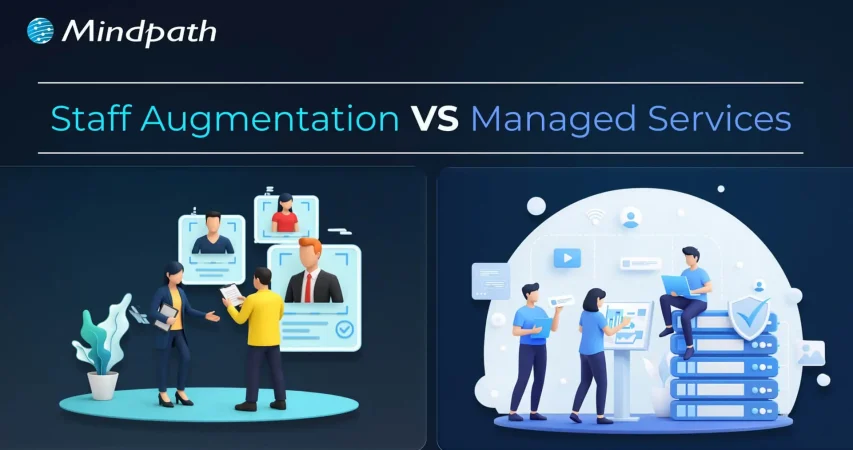
Staff Augmentation vs Managed Services: Which Model is Right for Your Business?

Join our Newsletter!

Featured Posts

Support Is One Click Away

Home

Staff Augmentation vs Managed Services: Which Model is Right for Your Business?

Staff Augmentation vs Managed Services

Staff Augmentation vs Managed Services: Which Model is Right for Your Business?

The employees of a company are no doubt the most essential assets. In the recent scenario, businesses have plenty of choices to keep their team more robust and result-oriented. With the rise of remote work and technology, you don’t need to limit your team to a certain geographic location. Further, you can leverage the excellence of the worldwide talent pool.

A number of companies are choosing to outsource their tasks and project development. In fact, the global outsourcing market size is USD 1.02 trillion, and it is going to double by 2031 (Source). In this blog, let us compare two of the most essential outsourcing approaches: staff augmentation vs managed services. This can help you pick the right service that goes well with your company’s structure.

Want a team that can help you to stay competitive with evolving project demands? At Mindpath, we offer staff augmentation services that enable you to scale your workforce efficiently and cost-effectively.

What is Staff Augmentation?

Staff augmentation is considered to be an outsourcing business model in which your company will hire outside professionals temporarily. Further, the process remains quick, and you can augment the capacity as per your current team’s needs. You can leverage near-shore, onshore, and offshore talent and can scale the team as per the demands.

  • When it comes to the IT industry, businesses can use staff augmentation for multiple stages of the development process. Additionally, this includes workflow optimisation, programming, quality assurance, etc.
  • This can help you overcome specific challenges while hiring key skills that your internal team may be missing.
  • Talking about staff augmentation vs managed services, staff augmentation is cost-effective and offers flexibility.
  • It is a temporary solution that accesses your existing team and resources, and gets the benefits of outside talent while reducing the operational charges.

What are Managed Services?

Managed services are an integral approach to software development that allows you to outsource your IT functions to a provider from another region. Moreover, your business can outsource the work virtually to managed IT services. This can include anything from data migration to cybersecurity, and much more.

  • Managed service providers don’t integrate with your internal team but operate on their own.
  • They can offer you a reliable quote and project timelines. After you approve them, they will start working on the designated task while maintaining continuous communication.
  • The managed services model is cost-efficient as it lessens the requirement for overhead and resource management.
  • Your company can prioritize other business tasks and can check on the progress instead of assessing the work on a daily basis.

Looking to stay ahead in your hiring strategy with evolving workforce models? Check out the latest staff augmentation trends to learn what’s shaping the future of talent.

What are Some Key Differences between Managed Services vs Staff Augmentation?

To get a detailed knowledge of managed services vs staff augmentation, let us go through some of its key aspects. Here is a table that highlights all the essential features that these models consist of.

Important Features Staff Augmentation Managed Services
Benefits Cost efficiency is one major staff augmentation benefits. This model leverages a fixed rate and can be your long-term partner.
You can have access to a wide range of talented professionals. Prevents you from the risk of managing in-house teams.
It enables you to scale the team as per project demands. Provides access to a team with expertise across multiple elements.
Bridges temporary skills gaps. Allows the internal team to prioritize core operations.
Disadvantages It is a bit risky to integrate a new team to your existing operations. Integrating external resources might require extreme knowledge.
Risk of dependency on external providers for critical works. You need to depend on the provider to drive process success.
It needs a strong internal management capacity to handle the external professionals. No control over your project, team, or the development process.
Flexibility Your teams can be scaled quickly as per the existing skills gaps. Flexibility remains limited, and changes might give rise to additional payments.
Expertise It offers access to specific skills or expertise for a required timeframe. Offers a wide range of expertise and a supportive environment.
Responsibility The client is responsible for your project’s success and workflows. This model provider owns the project and offers a product as per the agreed requirements.
Focus Area It is task-specific and viable for short-term projects. It leveraged end-to-end solutions.
Customization This model is fully customizable as per your team dynamics. Follows the terms that is written on the agreement.
Best For Quick scaling where your workload is heavy. Suitable for long-term project commitments.

When Should You Prefer Staff Augmentation Services?

After assessing the staff augmentation benefits and other critical factors, let us understand when you should leverage this outsourcing model.

1. Your Need is Project-Specific

If your requirement is temporary, staff augmentation can help you bring in the specialized talent for a specific time period. Further, you can easily access the services as per your project demands without seeking any long-term commitments.

2. You Need Direct Assessment

When your company has a strong team, staff augmentation allows the external team to work under your supervision. So, this ensures your priorities are fulfilled with quality. Additionally, your existing team’s capabilities will also increase with better insights.

3. You are Handling a Strict Deadline

If your project’s timeline is critical and hiring full-time employees would take too long, staff augmentation provides rapid onboarding of skilled professionals. Further, this can help you maintain your project speed.

Want to avoid common onboarding challenges with external talent? Learn through our augmented staff onboarding guide for a smoother transition.

When Should You Prefer Hiring Managed Services?

Here are the instances where managed IT services can be your utmost preference.

1. You Desire Strategic IT Management

If your organization doesn’t have the leadership to manage all its internal IT operations, managed services can access the experts to take complete responsibility. Moreover, this ensures professional oversight for better performance management. Your team gets the freedom to focus on core functionalities.

2. You Need Predictable Solutions

When your company depends on consistent system performance and reliability, managed services can deliver structured processes. So, it keeps your team balanced while lessening the operational charges. Moreover, your plans will have that strategic influence on your audience.

3. Your Company Needs Long-Term Commitments

Managed services can offer continuous expertise when it comes to fulfilling your ongoing requirements.  Instead of hiring an internal team, you can get dedicated support that can encourage your overall functions.

Curious about hiring the right talent for short-term and long-term projects? Check out our staff augmentation hiring guide to learn practical hiring insights.

Cost Considerations of Both IT Outsourcing Models

It is important for you to understand that saving money is not always the primary goal. You also need to value precise creation. Here, go through the cost approaches of both the IT outsourcing models.

1. Staff Augmentation Costs

In this model, you need to pay only for the expertise you need. You can control the resource allocation, and there is no overhead of benefits, training, and recruitment. However, the charges might increase if you demand some change in the middle of your project.

2. Managed Services Costs

This model can assure you of predictable or fixed charges. It sometimes includes service level agreements for performance. The essential providers can handle multiple clients effectively. But managed services sometimes come with longer contractual commitments.

Looking to improve project delivery with the right technical expertise? Check out our IT staff augmentation guide to learn how to bring in skilled professionals.

Final Words

Staff augmentation and managed services can assist your business in completing the development projects more efficiently. However, when it comes to staff augmentation vs managed services, you need to assess their elements prior. Staff augmentation can be a great solution for businesses that need flexibility and short-term goals. On the other hand, managed services are best suited for long-term assistance.

Our experts at Mindpath can help you with both aspects. Partnering with us can offer you the support that you desire while filling the gap needed for your IT foundation.
Related Post

Get insights on React developer hiring costs, including experience, location, and hiring models. Plan your budget effectively with our comprehensive guide.

Related Post

Image showing a person working on a laptop.

Want to know about the potential conversational AI use cases? You have reached the right place; let’s dive deep and understand the top use cases of conversational AI.

The advancement of the human race seen in recent times is mindboggling. At the spearhead of the pioneering force of development are the advances in technology made by man. With the rapid pace of development, humans realize the need to create artificial intelligence at par with human intelligence.

Especially after the massive disruption caused by the pandemic, we search for artificial intelligence applications capable enough to take up a significant chunk of manually completed tasks. The pandemic and subsequent social distancing have made us trust machines to complete specific tasks that can be hazardous to our health. Artificial intelligence is an important factor in machines replacing manual labor at most places.

With the rise in artificial intelligence applications, the AI-human relationship is evolving to make it more interactive and fruitful. One core technology that lies at making the use of AI more satisfying for humans is conversational AI. Conversational AI is a set of technologies that help a computer register, process and understand human language. Conversational AI renders a more human touch to AI applications by giving human-AI interactions a more conversational flow.

In this way, conversational AI makes it convenient for people to use complex machines. Conversational AI increases machines’ efficiency by helping them understand the user’s needs in a better way.

Understanding Conversational AI Use Cases

Conversational AI is one of the most promising sectors of Artificial intelligence, with its market share growing from $4.2 billion in 2019 to $15.7 billion by 2024. It is only natural for conversational AI use cases to increase in the next few years. As the accessibility of computers and intelligent devices increases, conversational AI use cases also improve. Conversational AI is used in both the commercial and domestic sectors today. Here are the few conversational AI use cases that highlight the revolution that conversational AI truly is.

IT and Data Security Services

One of the primary conversational AI use cases is found in the IT sector and data security. IT companies are using chatbots as the primary interface of customer support services. The chatbots help customers in accessing support services at any time. These chatbots are programmed to address the fundamental issues faced by a customer and offer troubleshooting solutions. If the customer’s type of concern is of higher complexity, it gets forwarded to the IT support executive. Having a chatbot in the IT services helps filter out the customer requests according to the complexity and priority of the concerns.

–  Using a chatbot in the customer support chain helps resolve issues, increase the staff’s productivity, and better incident management.

–  The chatbots also provide more data security to the customers as they are not exposed to a third party.

–  Chatbots are used in the IT service support sector, troubleshooting, and customer information sector.

Sales Management

Conversational AI platforms like chatbots and virtual assistants are used to handle the different processes involved in sales. In this way, chatbots and virtual assistants help in improving the sales management of an organization. Chatbots can be integrated into warehouse systems, databases, and CRM systems to simplify and streamline. Large-scale manufacturing companies use virtual assistants to schedule despatch of product shipments. Chatbots also help in maintaining sales databases. Chatbots can also assist lead management. Moreover, chatbots help in checking the lead status and fill in the lead details for sales executives.

Marketing and Promotions

Use cases for AI in conversational marketing are in every industry if appropriately observed. Every successful company takes its marketing strategy seriously. Companies are now using technology to support their marketing goals. One of these technologies is conversational AI. Companies are using different online platforms like websites and social media for marketing. The chatbots integrated into these platforms are excellent examples of conversational AI use cases. Chatbots help in gathering customer insights and potential leads from online platforms. Demographics and data insights lay the foundation of the marketing strategy for companies. Conversational AI applications provide crucial data to the marketing teams so that they can create efficient strategies.

Chatbots interact with potential customers to gather good leads. For highly interested potential customers, chatbots help in scheduling demos and meetings. Chatbots observe a visitor’s website activity to recommend products that can be relevant to them. There are many more ways in which conversational AI supports marketing activity and customer acquisition.

Internal Virtual Assistant

Apart from helping a company interact with its customers, a chatbot can also help an organization establish channels of internal communication. This helps in improving the coordination between the different teams of an organization. Internal virtual assistants and intranet chatbots can help set up meetings with the staff, sending out reminders to everyone involved, and improving internal communication in general.

Employees can do small tasks like applying for leaves, approving leaves, and staying informed on internal updates with intranet chatbots’ help. Chatbots can also help in the organization of documents and making them accessible to employees when needed. This decreases the hassle of working and allows an employee to become self-reliant in the workflow.

Furthermore, chatbots can keep the employees in the loop for recent developments, perform simple tasks for them and improve the company’s workflow in general.

Retail Industry Operations

In 2020, the retail industry was in for a revamp to embrace the new normal. As retail became tech-empowered, it also served as a strong example of conversational AI use cases.  The use of chatbots and other conversational AI forms act as virtual shopping assistants for people who want to shop from home. Even inside a store, chatbots help the customers in exploring the inventory for their chosen product. Intelligent chatbots help customers find suitable product recommendations according to their preferences and needs. In e-commerce websites, chatbots help in adding products to the cart and checking out with them. Even in offline stores, conversational AI helps customers make payments and checkout without human interactions.

Bottom Line

Conversational AI plays a vital role in carrying out operations in almost all sectors. The above-mentioned are a few of the use cases of Conversational AI in today’s era. If a user wants to learn more about conversational AI under a conversational AI tutorial, he/she cannot forego the use cases of conversational AI in different fields. With the adoption of conversational AI chatbots for your business, you can take your business to the next level of growth.

Want to know more about conversational AI? Reach our experts at eBotify and they will explain to you the concepts of conversational AI and chatbots.

Want to know about the potential conversational AI use cases? You have reached the right place;
generative AI trends

The technology world is growing at a quicker pace and 2026 is already proving to be a big year for innovation. Among the most discussed advancements, there are some exciting generative AI trends that are transforming how we produce content, design products and engage with digital tools. From smart video production to sophisticated code composition, generative AI is no longer a notion but is actually transforming the way things are reshaping in the real world.

Generative AI is applied across majority of industries today to facilitate work, enhance individual experiences, and assist individuals in generating more innovative ideas. In 2026, we are seeing a quick surge in adoption in healthcare, marketing, education and entertainment fields. Businesses are also embracing these tools to lead in innovation and customer experience. Intriguing, isn’t it?

Are you interested to know about some generative AI trends for 2026? Well, we have got you covered. This blog will walk you through top gen AI trends shaping 2026 and how they’re influencing the future of technology.

Want to integrate generative AI into your workflows for competitive advantage? At Mindpath, our AI Development Services deliver tailored, scalable AI solutions for your business.

Demystifying Generative AI: The Next-Gen Innovation

Generative AI is an intelligent technology that has the ability to assist in the development of new contents, images, videos or even computer code. It learns from what already exists and then applies what it has learned to create something new. For companies, this means they can utilize AI to create content, create products, or even assist with customers’ questions. It’s similar to having a super useful assistant who always learns and becomes proficient at various tasks. 

Generative AI is assisting companies in so many easy and intelligent ways. It saves time by performing daily tasks such as writing, designing, or responding to messages. So, teams can concentrate on more important things. It also assists organizations in making quicker decisions by getting data interpreted quickly. Customers receive better and more personalized service, which makes them satisfied. Additionally, it helps in creating new ideas and saving costs by doing work faster. Since the market is expanding very quickly, a Statista study approximates that generative AI will reach approximately $66.89 billion in 2026 and increase to $442.07 billion by 2031, demonstrating the growing importance of GenAI for business in driving efficiency, innovation, and customer engagement.

Also Read: Top AI Trends 

Now let us have a look at the generative AI trends for 2026:

Top Generative AI Trends to Look for in 2026

GenAI trends are progressing rapidly in 2026, revolutionizing the way we work and innovate. These trends are enhancing tools to be smarter, quicker, and more useful. Here are the leading GenAI trends that are shaping the future this year: 

1. Hyper-Personalization with GenAI

One of the key current trends in artificial intelligence is hyper-personalization. GenAI helps create content and messages that match each person’s unique needs and interests. It looks at large amounts of data to understand what someone likes, then gives them a more personal and meaningful experience. This makes communication more effective and helps build stronger connections. Hyper-personalization is becoming more important for better results, improved engagement, and customer satisfaction across many different industries. 

2. Multimodal Generative AI

AI is now getting better at understanding many types of information at once, like pictures, text, speech, and even video. This is called multimodal AI. For example, some tools can turn spoken words into text or show pictures based on what you write. New models like GPT-4V and LLaVa are making this possible. They help people talk to AI in smarter ways, using both words and visuals. This makes AI more useful and helpful in many different tasks. 

3. Conversational AI

Conversational AI is getting much better at having real conversations with people. Thanks to new tools like GPT, it can understand what you say, remember past chats, and reply in a way that feels natural. It’s like talking to someone who really listens and gives helpful answers. In 2026, this kind of AI can handle longer and more detailed chats, making it great for customer support, virtual helpers, and more. It feels less like a robot and more like a real helper. 

4. AI-Powered Apps and Services

One of the top ai industry trends is how apps and services are becoming much smarter by adding AI features. These AI-powered tools help people do their work faster and in a more personalized way. For example, writing apps learn your unique style to suggest better words and ideas, while health apps can offer treatment advice based on your personal health data. Shopping apps can recommend products you might like. In 2026, many industries use AI inside their software to make experiences easier, smarter, and more helpful for users every day. 

If you’re planning to integrate generative AI into your business strategy. Check out generative AI use cases to learn how companies are leveraging this technology to boost innovation and gain a competitive edge.

5. AI Boosting Creativity

AI is making creativity easier and more exciting for everyone. Tools like Dall-E can turn simple ideas into pictures, music, animations, and sounds, helping artists and creators bring their visions to life quickly. These AI tools keep getting better, allowing people to explore new ways to create art and express themselves. This technology is changing how creative work happens, giving both professionals and hobbyists fresh opportunities to make unique and interesting content in many different fields. 

6. AI Helping in Scientific Research

Generative AI predictions show that AI is making big changes in scientific research. It helps by quickly summarizing long and complex research papers, especially in medicine and pharma. This means researchers can understand important information faster without reading everything. These AI tools save time and make it easier to find key facts, helping scientists work better and faster. This leads to smarter decisions and faster progress in creating new treatments and improving healthcare for patients. 

7. Open Source and Generative AI

Open source is playing a big role in the growth of generative AI. It lets many people from different places work together to improve AI tools and make them better. This teamwork helps find and fix problems faster while making sure AI is fair and trustworthy. Open-source projects also share knowledge and resources, making AI development more open and honest. According to the McKinsey generative AI report, companies that see AI as key to their success are over 40% more likely to use open-source AI tools. In the tech industry, 72% of companies use open-source AI models, showing how important this approach is for advancing AI. 

8. Human in the Generative AI Loop

In 2026, a growing trend is people working closely with AI, called Human-in-the-Loop. This means humans help guide and check AI to make sure it follows rules and fits real-life needs. This teamwork makes AI results more accurate and reliable. By combining human skills with AI’s power, companies can get smart and creative results while keeping control over what the AI produces. This helps AI work better for many different uses. 

Looking to leverage generative AI for smarter, more adaptive app solutions? Explore our blog on Generative AI in App Development highlights practical applications, transformative benefits, and strategies to stay ahead in the digital landscape.

Ready to Embrace GenAI Trends for 2026?

The generative AI trends of 2026 are already changing how we create, communicate, and solve problems. From boosting creativity to transforming research and business services, these trends are making technology smarter and more helpful than ever. As industries keep exploring AI’s possibilities, it’s clear that generative AI will keep shaping the future in exciting and meaningful ways. 

If you’re looking to stay ahead in this fast-changing landscape, Mindpath’s GenAI solutions are here to help. Our expert team builds powerful and easy-to-use AI development services tailored to your business needs. Whether it’s integrating generative AI tools or developing custom applications, Mindpath ensures you get innovative, ethical, and result-driven AI experiences that truly make a difference. 

Frequently Asked Questions

1. How can businesses start adopting generative AI trends in 2026?

Businesses can begin by identifying repetitive or creative tasks that can benefit from automation. Adopting tools aligned with current generative AI trends such as content creation, analytics, or personalization is a good first step. A pilot project helps measure ROI before scaling across departments.

2. Will generative AI replace creative professionals?

No, generative AI is designed to assist, not replace, creative professionals. It speeds up brainstorming, drafting, and design processes, but human creativity, emotional understanding, and strategic thinking remain essential for producing meaningful and high-quality work.

3. Is generative AI expensive to implement?

The cost depends on the scale and complexity of implementation. Many cloud-based AI tools offer flexible pricing models, making them accessible even for small businesses. Starting small and scaling gradually can help manage costs effectively while still benefiting from innovation.

4. How do generative AI trends impact data privacy and security?

As generative AI trends grow, businesses must prioritize strong data governance. Secure APIs, encrypted storage, and compliance with regulations are essential. Organizations should also ensure transparency in how AI models use data to maintain customer trust and avoid legal risks.

5. What skills are important for working with generative AI tools?

Key skills include data literacy, prompt engineering, critical thinking, and understanding AI ethics. While technical knowledge is helpful, many modern tools are user-friendly. Professionals who can combine domain expertise with AI capabilities will have a strong advantage in 2026 and beyond.

trends in education

The transformative changes in the world of education have been fuelled by a wave of technological innovation. Just like other big sectors like finance, technology has had a formidable impact on the education industry. The emphasis on trends in education technology is gradually increasing as education has moved beyond the boundaries of classrooms. Education is becoming more personalized and dynamic with the help of different technologies, thereby establishing the foundations of EdTech. It is important to understand that EdTech is no longer another emerging trend. Educational technology, or EdTech, is now an integral element in the basic approach for acquiring knowledge. Let us find out the most notable trends that will dominate educational technology in 2026 and beyond.

Not sure how to move forward with education technology for your business? Contact us, we support organisations in building reliable and future-ready solutions.

Existing State of Education Technology

Before you learn more about the emerging education trends, you must understand the existing state of education technology or EdTech. The future of educational technology can revolutionize education on a global scale and create opportunities for students and educators. The EdTech industry is expected to become a $400 billion market by 2026 with new technologies redefining leaning experiences. Educational technology has the potential to address long-standing challenges in education alongside introducing the benefits of inclusivity, adaptability and accessibility.

As education gears up to become a $10 trillion industry by 2030, it is important to understand the scope of education technology. The integration of EdTech solutions has helped in creating ecosystems where learners can access knowledge anytime, anywhere. According to the World Economic Forum, the EdTech industry will serve more than 350 million post-secondary graduates and 800 million K-12 graduates worldwide in 2026. With such impressive numbers expected from the EdTech industry, you have strong reasons to believe that the industry will foster new trends.

Want to explore how AI can enhance teaching and learning experiences? Check out chatbots in education to discover how intelligent assistants provide real-time guidance and improve knowledge retention.

Unraveling the Big Trends for EdTech in 2026 and Beyond

The digital transformation of education with EdTech has been nothing short of a revolutionary experience for educators, learners and management. If you take a look at current educational trends, you will discover the significance of EdTech in transforming classrooms. Innovative technologies like artificial intelligence, virtual reality and other adaptive technologies have served as powerful tools for learners. The following sections will introduce you to some of the emerging trends in EdTech for 2026 and beyond.

1. Hyper-personalized Learning

The future of learning will rely a lot on artificial intelligence and there is no doubt in it. With the rising use of generative AI in education, learners and educators can capitalize on multiple advantages for better learning. Artificial intelligence plays a major role in adapting the learning experience to unique strengths, weaknesses and learning styles. Generative AI is shaping a new reality of education where personalized learning systems will ensure efficient learning experiences for every learner.

AI-powered learning systems can review the performance of learners, identify their knowledge gaps and also understand their individual learning styles. The systems can use the data to generate customized lessons, learning paths or adjust the difficulty of lessons. As a result, no student will be left behind in the learning journey and everyone will find equal opportunity to grow further.

2. New Role of Blockchain

Blockchain technology has been associated frequently with transformation of the education sector for its distinctive traits like cryptography or immutability. Blockchain is one of the biggest tech trends in education that can provide a completely new and efficient solution to verification of academic achievements. The concerns of fake certificates create troubles for deserving candidates who miss out on opportunities due to lack of verifiable credentials.

Blockchain can help in secure storage and verification of academic credentials like diplomas, degrees and certifications. As a result, learners will have more control over their academic records while enjoying the flexibility of distributing their credentials without the fear of copyright infringement. Blockchain can provide tamper-proof or immutable digital identities on a public ledger, thereby reducing the possibilities of fraud.

3. Adaptive Learning

Most of the discussions about the use of artificial intelligence in the education sector revolve around personalized learning. You can find many applications of AI in the field of education such as education chatbot apps that can solve learner queries at different stages. Adaptive learning through chatbot apps will emerge as one of the biggest trends in EdTech in 2026 and beyond. The primary goal of adaptive learning will focus on dynamic modification of lessons and content difficulty according to real-time assessment of student performance and engagement.

Adaptive learning systems will measure the progress of learners, identify their weaknesses and prepare learning paths that can guarantee success. The emphasis on lifelong learning along with growth of the online learning market creates more opportunities for adoption of adaptive learning systems. With the combination of predictive analytics, educators can use adaptive learning systems to create refined learning paths for truly personalized experiences.

4. Mix of Virtual and Augmented Reality

The list of top EdTech trends for 2026 and beyond will be incomplete without mentioning virtual and augmented reality. VR and AR have been implemented as solutions to create immersive learning experiences by transforming learners to places and situations that were previously unimaginable. For instance, VR can help learners visit historical sites in the classroom while AR displays overlay of digital information on the real-world objects.

The growing demand for immersive learning is one of the notable indicators of the rise of VR in education. At the same time, you must know that AR and VR encourage motivation, foster collaboration and improve comprehension. Virtual lessons have proved useful in enhancing the understanding of abstract concepts. Most important of all, VR and AR also present new opportunities for encouraging collaboration between learners and educators.

5. Bridging the Accessibility Gaps

As the world ushers in a new era of education, the primary use of IT in education will become more about making education accessible to everyone. The innovative use of technology in education with new EdTech solutions helps in achieving digital equity and accessibility. Learners can rely on EdTech to access education irrespective of their socio-economic background, physical abilities or geographic location.

Big organizations such as UNESCO recommend that local solutions will play a crucial role in transforming digital learning. One of the prominent emerging trends in educational technology will focus on creating infrastructure for digital literacy training, especially in low availability of resources. The only goal behind reducing the accessibility gaps will be about ensuring that every learner gets the opportunity to achieve their dreams.

Final Thoughts

The most noticeable trends for the domain of EdTech in 2026 and beyond include AI, blockchain and adaptive learning. VR and AR will also be the most prominent technology trends in education in future. You should know that these technologies will define future trends in education in 2026 and beyond with their transformative potential. For instance, AI can not only provide the foundation for hyper-personalized learning experiences but also create adaptive learning systems. You should also remember that data privacy and security will be prominent areas of concern in the future of EdTech. The challenges of potential biases in algorithms and the cost of implementing EdTech solutions will also create obstacles in future.

One of the crucial highlights that you should know about the higher education industry trends and EdTech focuses on opportunities. Educational technology will provide more productive and engaging learning experiences to every learner without any boundaries. At the same time, EdTech will also empower educators with resources that make them focus more on meaningful interactions. At Mindpath, we help organizations adapt to these evolving trends by building scalable and future-ready EdTech solutions.