Things to Consider Before Hiring a Full Stack Developer

Join our Newsletter!

Featured Posts

Support Is One Click Away

Home

Things to Consider Before Hiring a Full Stack Developer

Hiring a full stack developer

Things to Consider Before Hiring a Full Stack Developer

Have you thought about how hiring a full-stack developer could impact the success of your digital initiative? In a fast-paced world like technology, companies seek the ability to manage both front-end and back-end development.  What characteristics will define the best developer for your business requirements?

That’s where careful thought comes into play. Every business has its own specific objectives. If you choose a full-stack developer without careful consideration and evaluation can lead to gaps in performance. Avoid making a rushed decision without thinking it through, and taking the time to know what is important will help you move in the right direction. So, while you start planning your next steps, let’s discuss the key things you keep in mind, so that your hiring choice actively supports growth and innovation.

Hiring full-stack developers brings end-to-end technical support to scale your business faster. Mindpath can help you get the best talent that fits your requirements.

Who is a Full-Stack Developer?

A full-stack developer is a person who can work on both the front end and back end of a website or application. The front end comprises everything that the user sees and interacts with, and the back end is part of the app that runs on the server in addition to managing the database and application logic. The combination of this front-end and back-end skill set helps to make full-stack developers more flexible and valuable in creating all types of digital experiences.

Hiring a full-stack developer means hiring a person who knows how to link the design of a site, functionality, and performance. Full-stack developers understand programming languages, frameworks, and server environments. They make sure the design runs smoothly during the entire development process. By being aware of multiple layers of development, full-stack development saves time and money while allowing businesses to deliver a more efficient product.

Responsibilities of a Full-Stack Developer

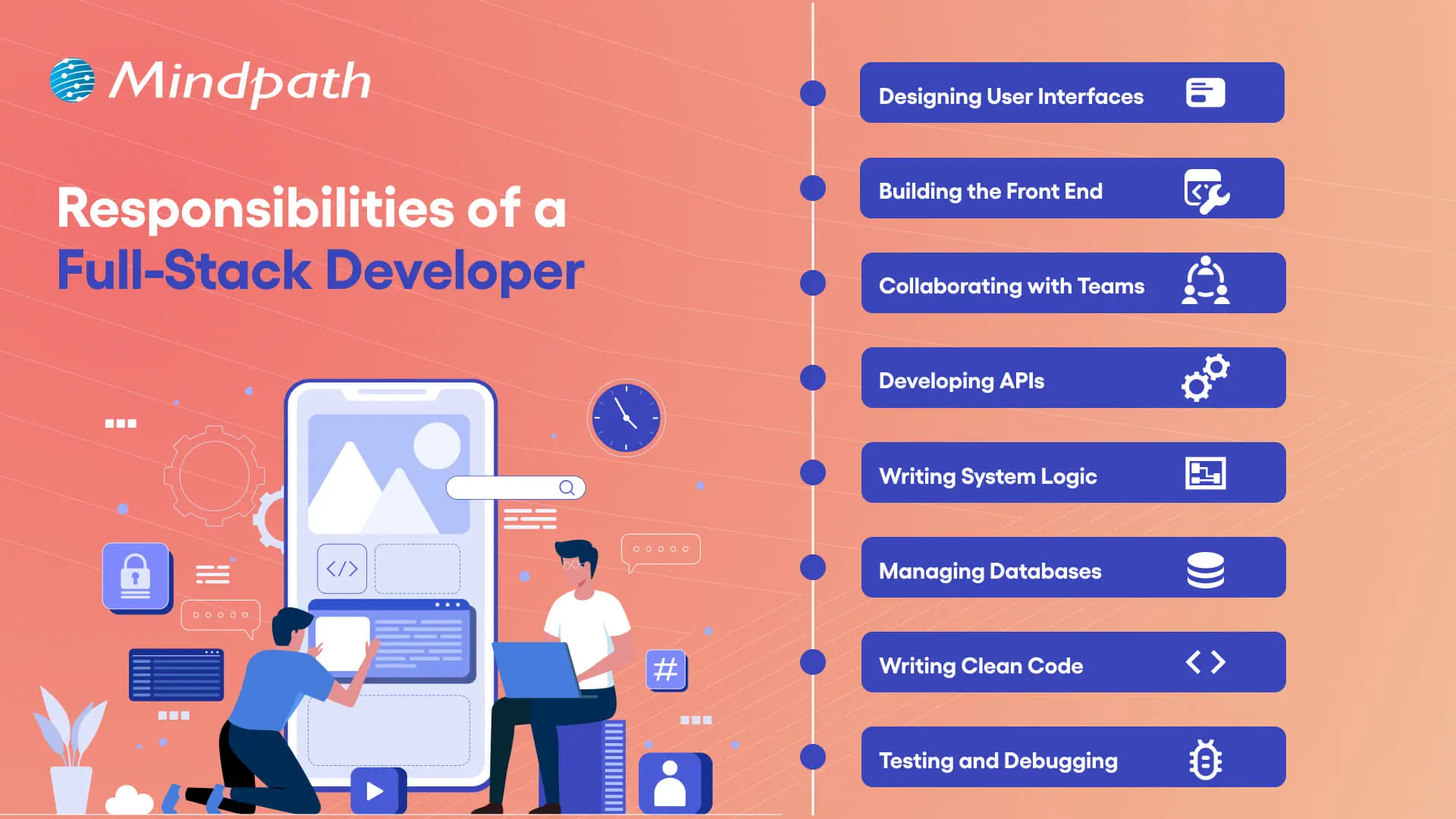
It’s important to recognize the broad spectrum of responsibility that comes with hiring a full-stack developer. The following responsibilities communicate how they join the layers of development into a smooth-flowing digital solution.
Responsibilities of a Full-Stack Developer

1. Designing User Interfaces

A freelance full-stack developer builds interfaces that have visual appeal and work on any device. They ensure that the website is responsive and works well for the user.

2. Building the Front End

Using HTML, CSS, and JavaScript, they build the experience that the user interacts with and engages with the visual. This allows for seamless movement through the site visually.

3. Collaborating with Teams

They collaborate with designers, managers, and stakeholders to achieve project outcomes. The benefits of collaboration can be easily seen, as it assures the application is built correctly.

4. Developing APIs

Full-stack developers are responsible for the build of APIs to interconnect systems and services. This allows the same data to move between the front end and back end.

5. Writing System Logic

They create a logic that drives the functions within an application. It responds to requests, processes data, and provides accurate results.

6. Managing Databases

A freelance full-stack developer sets up, maintains, and stores data in databases for user information. They secure data management, and they optimize the strategies for saving data.

7. Writing Clean Code

They write code that is maintainable and structured with performance in mind. Clean coding practices support a reduction in error and an increase in ease of modification.

8. Testing and Debugging

A full-stack developer tests an application to look for bugs. They debug the bugs to make sure it runs smoothly and reliably.

If you are planning to hire a full-stack developer, it is essential to understand the impact they can have on your product’s success. Explore our blog on Full Stack Developer Is Key to MVP Success to have a deeper understaning on how a full-stack developer can accelerate your MVP and give your product a competitive edge.

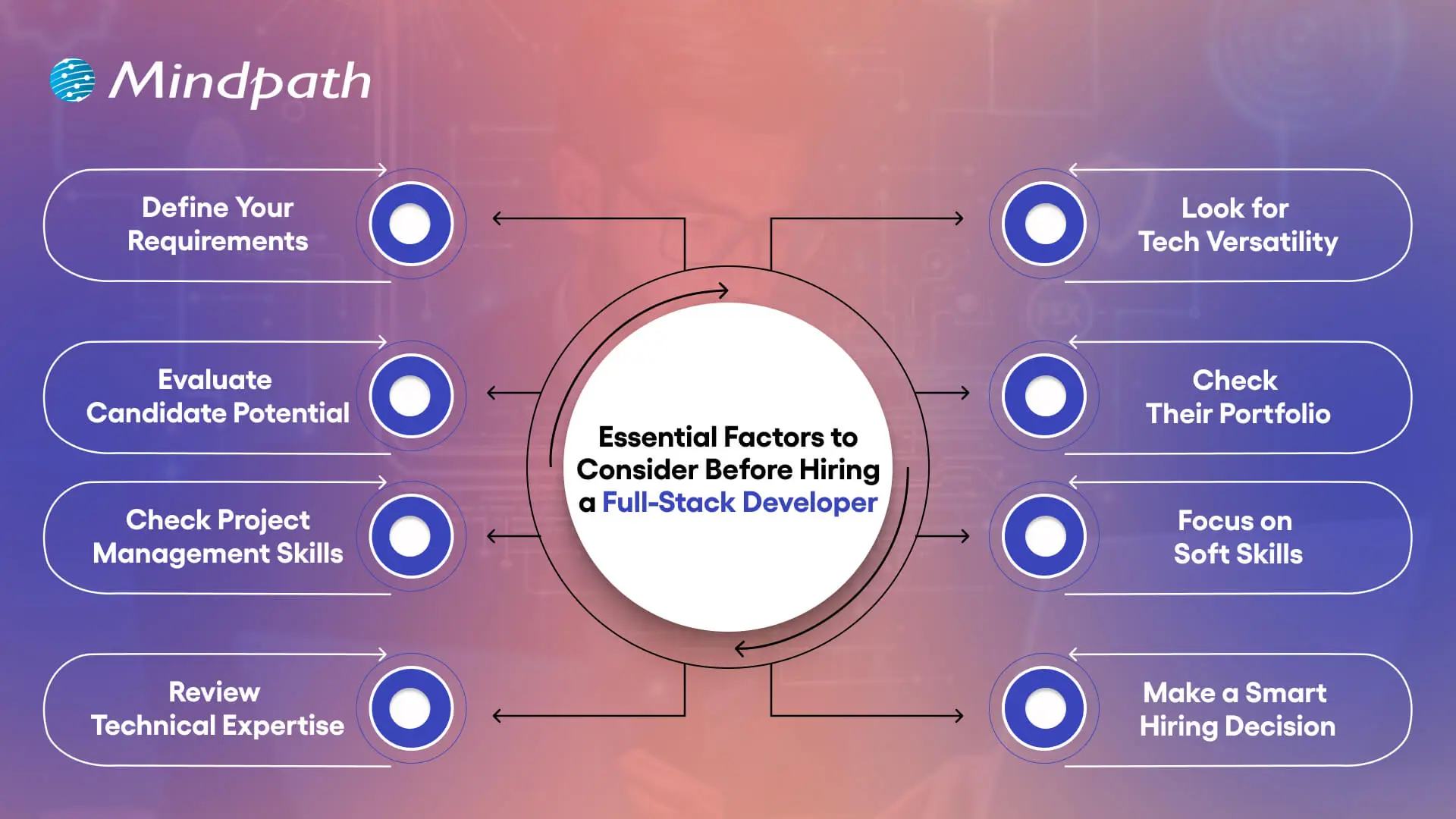
Essential Factors to Consider Before Hiring a Full-Stack Developer

Recruiting a full-stack developer isn’t just about evaluating technical skills. The following is a list of critical factors that will help you recruit a developer who aligns with your project needs and business objectives.
Essential Factors to Consider Before Hiring a Full-Stack Developer

1. Define Your Requirements

It’s important to create a clear document outlining your project needs prior to hiring a full-stack developer. This ensures the full-stack developer understands the features you need and the level of design you are expecting. Clarified requirements can aid in a quicker delivery to you and avoid any confusion.

2. Evaluate Candidate Potential

An experienced full-stack web developer has industry knowledge and experience. They can quickly adapt and move between projects as needed. Their ability to jump between projects can prove valuable when a deadline is around the corner.

3. Check Project Management Skills

When you hire a full-stack developer, you’re also getting a project manager with skills that go beyond simply coding. They have the ability to plan resources, lead teams, and manage the stages of development. Because of these proficiencies, they’re often the ones leading projects.

4. Review Technical Expertise

A good developer will know the languages behind building interfaces, HTML, CSS, and JavaScript. They will also know some back-end language, such as Python, PHP, or Ruby, and database experience with something like MySQL. It is a strong combination for full-stack development.

5. Look for Tech Versatility

Ensure that when hiring a full-stack developer, you validate their experience with multiple technologies. They should have knowledge of front-end frameworks, backend frameworks, and databases. You want real project experience that demonstrates their skills.

6. Check Their Portfolio

Request past work to evaluate their capabilities. A solid portfolio can illustrate how they overcome obstacles and provide solutions. Even newbies will be able to display some ability through sample work.

7. Focus on Soft Skills

A developer should recognize business requirements as well as perform technical tasks. A developer must be able to communicate without barriers to clients and teams. Good soft skills make it easy to comply with authority.

8. Make a Smart Hiring Decision

Finding the appropriate talent for full-stack web developer jobs can be a time-consuming process. Hiring a full-stack developer through a talent agency can help alleviate risk and guarantee that developers know what they are doing.

Want to transform your business inside out? Full-stack development makes it possible by optimizing operations and speeding up product launches. Explore the Benefits of Full-Stack Development every business needs to succeed.

How to Hire a Full-Stack Developer

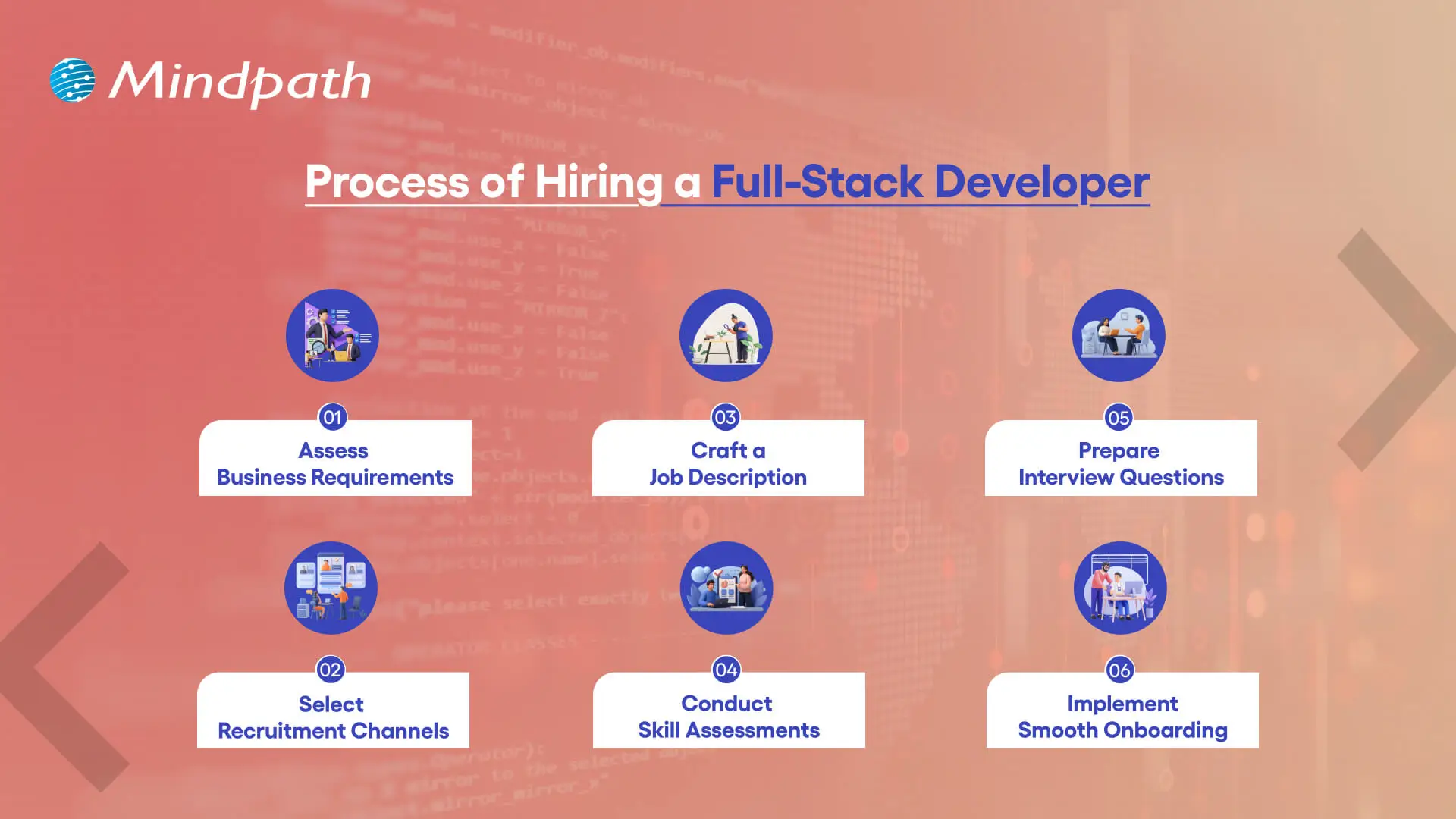
Selecting a full-stack developer involves an intentional process based on the right talent and your desired project specifications. The following steps will help you make a careful and confident hiring decision.
Process of Hiring a Full-Stack Developer

1. Assess Business Requirements

Prior to hiring a full-stack developer, make sure to define the project’s scope, budget, and timeline. Decide whether you need to hire someone full-time or if your project would require a freelance expert.

2. Select Recruitment Channels

Source candidates from networking sites, freelance platforms, and job boards. You can also connect with a full-stack development company to get the right talent.

3. Craft a Job Description

A good full-stack developer job description is a detailed description of the hard skills and tools, and the responsibilities for the job. A good job description helps you find the right candidates at a much quicker pace.

4. Conduct Skill Assessments

You can assess coding and problem-solving by utilizing structured coding tests or tasks. This method is a better hiring practice for a full-stack developer.

5. Prepare Interview Questions

Assess their familiarity with frontend, backend, and databases. A good candidate will often follow the best full-stack developer practices through good full-stack developer courses.

6. Implement Smooth Onboarding

After hiring a full-stack developer, tell them about their roles and responsibilities, the tools they will use, and the culture of the company. Successful onboarding ensures we’re setting them up for success and justifies their full-stack developer salary.

If you’re unsure whether to hire a full-time developer or a freelancer. Explore our blog on Freelance Full-Stack Developer to determine the best fit for your project’s needs. 

Ready to Hire a Full-Stack Developer for Your Next Project?

Hiring a full-stack developer is a smart decision for businesses aiming to build strong digital solutions. By focusing on skills, experience, and project needs, companies can find the right professional who delivers efficient results. The right choice not only saves time and costs but also ensures long-term success in competitive markets.

At Mindpath, you can hire full-stack developers who combine technical expertise with business understanding. Our developers work on both frontend and backend with precision, helping you achieve faster and smoother project delivery. With a proven track record across industries, Mindpath offers reliable talent that aligns perfectly with your goals and drives real value.
Related Post

Want to know about the potential conversational AI use cases? You have reached the right place;
Discover the benefits of serverless architecture, from cost savings to faster development, and learn how Mindpath can help your business thrive.

Related Post

React web application development

React has appeared as one of the most efficient libraries for creating dynamic and exceptionally performance-oriented web applications. As per the sources, around 20 million websites are using React at the moment. Giant companies, starting from Facebook, Airbnb, Netflix, Walmart, and Wix, all use React for undeniable engagement and a user-friendly interface.

Its incredible state management, component-based architecture, and effective ecosystem have made React a premier choice for building scalable applications. So, in this guide, we will cover everything related to React web application development. Further, we will learn how it can assist you in making your app solely for your audience base.

Planning to upgrade your existing web app with a faster and more interactive interface? Mindpath offers ReactJS development services that help businesses create seamless and user-friendly digital experiences.

Why Do Modern Businesses Demand React Web Application Development?

React is a JavaScript library and is extremely viable for creating dynamic and interactive user interfaces. The element that keeps it unique in the recent digital era is its component-based architecture. This allows you to break complicated UIs into reusable and manageable pieces.

Unlike traditional approaches, where UI updates can be inefficient and slow, React uses a virtual DOM to update only the sections of the interface that actually need changes. This is how you give rise to React web applications. It ensures faster rendering and a smooth user experience. So, if your business wants to achieve long-term growth, the flexibility of React can make it easier for you to add trendy features without rewriting the whole application.

Wondering how to improve rendering speed in large-scale React applications? Discover our ReactJS performance blog to learn advanced optimization techniques for better efficiency.

What are Some Undeniable Fundamentals of React?

React initiates scalable web applications with certain rooted fundamentals as given below.

1. Components

Components are generally the building blocks of an application. They can be class-based or functional. Further, they summarize both the presentation and the logic.

2. Virtual DOM

A virtual DOM is used by React to effectively upgrade and render the useful components. So, instead of re-rendering the whole UI, React initiates the minimum level of changes required. This approach enhances your app’s performance without hampering its existing features.

3. JSX

React uses JSX, and it is an extension of syntax. This allows developers to write code in JavaScript only. So, it becomes seamless for you to visualize and structure the components effectively.

4. Unidirectional Data Flow

This makes the application’s state predictable and easier to debug. So, you can be assured of getting scalable web applications, no matter how many features you want to include in them.

These are some valuable fundamentals or core principles that enable you to manage complexities with your growing application. In order to do this, you can create a strong foundation to get high-performance web applications.

Looking to improve productivity in your React projects? Check out our benefits of ReactJS for web developers blog to learn the core benefits that make development smoother and more scalable.

How to Set Up Your React Web Application Development the Right Way?

Your setup should be extremely precise if you want to leverage long-term values. To create a React app, there are some essential steps you need to follow.

1. Prefer a Reliable Development Environment

To initiate your React web applications, start by choosing a stable code editor and development tools that support modern JavaScript and React workflows. Further, features like debugging support, intelligent code completion, and integrated terminal access can improve your productivity while decreasing the development errors.

2. Get a Clear Project Structure

Streamlining the folders of your project in the early phase can prevent you from getting confused with your codebase’s growth. So, it is necessary to group your files by features and modules instead of the file type. Keep the components and utilities different to maintain their readability.

3. Leverage Modern JavaScript Assistance

React mainly prioritizes the modern JavaScript features. So, it is necessary to ensure support for JSX, ES6+ syntax, and module imports. This will allow you to write cleaner and more manageable code while keeping compatibility with modern browsers.

4. Set up Version Control from the Beginning

With the usage of version control systems, your team can track changes and manage collaboration. Further, you can maintain the stability of the code. With a consistent branching strategy, you can easily scale the development process. For a more valuable approach, you can discover the assistance of professional developers.

5. Integrate Code Quality

Code quality tools help maintain consistent coding rules throughout your team. On the other hand, better formatting can encourage readability while decreasing bugs.

6. Initiate Testing and Debugging

Prioritizing testing rules and debugging rules can help you assess the mistakes from the beginning, before they become massive. So, unit tests and standard debugging rules can help you be assured of your application’s stability with the addition of new features.

Looking to accelerate your React project with the right technical expertise from day one? Read our hire ReactJS developer blog to discover how experienced developers can drive scalable results.

How to Structure Your Scalable Web Applications with React?

If you want to gain scalability for your web application, it is not just about adopting more users. Instead, it includes managing an expanding codebase without piling up more complexities. You can hire ReactJS developers to add features smoothly while restricting confusion and technical errors.

1. Maintain Your Files as Per Their Features

Maintaining your files as per their features can safely segment your styles and components. Accordingly, this element enhances clarity while making the development process easier.

2. Centralize Shared Features

You should store common functions and API services in a single location. So, this decreases the rate of duplication while ensuring consistent behavior across multiple applications.

3. Separate UI Elements from Business Logic

Keeping presentation logic separated from business rules can improve your code readability and reuse. Further, it makes the testing process simple, allowing changes without challenging the interface.

4. Keep Precise Naming Conventions

Consistent naming conventions can make you aware of the codebase instantly. So, it becomes seamless for the growing team, and it also assists the new team members who are assisting with the following project. 

This valuable structure improves the efficiency of React web application development to be more result-driven.

Looking to align your business goals with a strong React development plan? Explore React roadmap to deeply understand the roadmap that supports sustainable growth and innovation.

What are Some State Management Strategies to Adopt?

State management becomes very important with the development of your React application, along with its complexities. So, with poor strategies, your development might suffer from inconsistencies and performance risks.

1. Context API

The context API is important for handling data that needs to be accessed by multiple components. It involves user preferences and authenticity. Further, it allows you to prevent risks while keeping the app highly manageable. 

2. Local Component State

Local state is highly convenient for handling UI-centric features like form inputs and interface visibility. So, adopting the state closer to your components that use it can encourage readability while restricting inefficient data sharing through the app. 

3. External Management of the State

Massive applications with complicated data flows require external state management.  It helps maintain consistency throughout the system. Such tools are made to manage asynchronous data.

So, these are valuable state management strategies that can help you build scalable web applications with React effortlessly.

Curious which React advancements can give your business a competitive edge? Dive into ReactJS trends to explore the technologies driving performance and growth.

How to Optimize the Performance of Your Scalable Web Applications?

Being assured of high-performance web applications is necessary to evolve with the changing demands of the users. So, here are some strategies to follow.

1. Memoisation

Wrap all the functional components with React. Memo to safeguard it from irrelevant re-renders when the proper ones have not changed. Further, the inclusion of useMemo and Callback allows you to leverage the potential of handling major calculations. This ensures your app is recomputing when you desire it. 

2. Minimize Load Times

You can be assured that only the necessary code is getting loaded when you open the app due to code splitting. This valuable approach also reduces the browser’s extreme JavaScript requirements.  Further, it incorporates faster page rendering while keeping the React web application development user-oriented.

3. Enhance User Experience

Lazy loading allows non-essential components to be loaded when you require them. This helps in preventing delays while keeping the scalable web applications intact and performance-driven.

Want expert support to build scalable and high-performance React applications for your business? Discover our React Development Company blog to learn how the right team can turn your vision into reality.

Conclusion

Building a React web application development requires many efficient strategies to keep the app truly serving your business aspects. You need to adopt valuable architecture and the trendiest development practices. React offers a strong foundation due to its component-based design and efficient rendering.

If you implement precisely, React allows your team to create applications that grow seamlessly and perform consistently while meeting the changing business requirements. So, consider Mindpath as your convenient approach, as this company offers an undeniable React development services combined with future-rich web solutions. 

Discover how ReactJS powers scalable, high-performance web apps. Learn key features, optimization tips, and how Mindpath can help.
AI in Hyperpersonalization

Have you ever noticed how some brands seem to know exactly what you need, sometimes before you do? Imagine opening a shopping app and seeing recommendations that feel almost handpicked just for you. This level of personalization is no coincidence—it’s powered by AI and is known as hyperpersonalization. But how exactly does AI make this happen? And what does it mean for the future of customer experiences? Let’s dive into how AI is redefining what it means to truly know your customer.  

What is Hyperpersonalization?

Hyper-personalization leverages Artificial Intelligence and real-time data to provide highly personalized experiences, showcasing items and information that are specific to each customer’s tastes. By analyzing individual purchasing behaviors, prior purchases, and browsing habits, AI allows companies to give suggestions that are tailored to each customer’s distinct interests and preferences. 

This high degree of personalization enables organizations to go beyond generic ideas, resulting in a more seamless and engaging client experience. It’s an effective strategy that improves convenience and strengthens brand loyalty by making each customer feel understood and cherished. Hyper-personalization allows marketers to constantly offer relevant, customized information that engages with each client on a personal level. 

The Role of AI in Hyperpersonalization

1. Smarter Product Recommendations

AI’s ability to comprehend user preferences and behaviors is crucial in revolutionizing the way product suggestions are generated. AI can forecast what you will be interested in next based on data such as previous purchases, browsing history, and even time spent on certain things. This goes beyond mere ideas; it tailors each recommendation to your own preferences and needs. 

For example, if you’ve been looking for shoes, AI can recommend a pair that matches your style or even forecast the type of shoes you’d like based on recent searches or seasonal patterns. These recommendations sometimes appear to be “reading your mind,” displaying goods you never considered, but once you see them, they feel like a great fit. This degree of personalization improves the whole buying experience. You spend less time looking for what you want because the AI finds it for you, making each interaction seem more relevant and easier. With hyperpersonalization, AI guarantees that the goods you view are constantly relevant to your tastes, improving your entire shopping experience. 

2. Friendlier Chatbots

AI-powered chatbots have gone a long way towards providing more lifelike, human-like conversations. Instead of robotic, one-size-fits-all replies, these chatbots can now tailor their tone, vocabulary, and behavior to the context of the interaction and the user’s specific demands. They employ powerful AI algorithms to comprehend not just what you’re saying, but also the emotions and meaning behind it. 

These AI chatbots can also personalize replies by recalling prior encounters, recognizing your preferences, and offering relevant solutions. Whether you need help with a product, troubleshooting, or completing a purchase, the chatbot customizes its replies to your individual needs, exactly like a real agent would. AI chatbots boost customer service by making conversations feel more personal and human, resulting in a more engaging and fulfilling experience for customers, allowing businesses to provide 24/7 help without losing quality or empathy.    

3. Better Campaign Strategies

AI-powered solutions have transformed the way businesses approach marketing campaigns, allowing them to analyze massive volumes of data and forecast campaign outcomes more accurately. These technologies look at customer behavior, market trends, and previous campaign performance to spot patterns that might not be visible. Understanding these trends allows AI to assist businesses fine-tune their strategy, ensuring they are targeting the appropriate audience with the right message at the right time. 

Furthermore, AI can enhance processes by automating repetitive operations like segmenting audiences, providing personalized content, and managing digital marketing. This automation minimizes human work and improves marketing teams’ efficiency, allowing them to focus on higher-level strategy and creativity.  AI analyzing data in real time makes marketing campaigns more fluid and responsive. Brands can swiftly alter campaigns based on performance analytics, increasing their ability to remain relevant and adapt to changing client requirements. This increased efficiency not only enhances campaign efficiency, but also enables a more personalized marketing strategy, offering bespoke content and experiences that engage with specific customers. 

4. Tailored Marketing Materials

AI allows organizations to go beyond basic marketing messages by providing highly personalized content that addresses individual tastes and behaviors. AI can generate marketing materials that are specifically tailored to you by analyzing data such as your previous purchases, browsing habits, social media activity, and even real-time elements such as location or current trends. 

Furthermore, AI can adapt the tone, structure, and timing of the material to the individual’s preferences. It can provide a product recommendation at the ideal time, such as when you’re planning a trip or getting ready for a vacation, ensuring that the offer feels timely and relevant. By combining various data points and external variables, AI enables companies to generate targeted, relevant marketing that improves the customer experience and drives stronger connections with their audience.  

Also Read: Top 10 Benefits of Artificial Intelligence in 2024 

AI Development Services at Mindpath

Mindpath specializes in AI development services that help organizations grow and prosper by leveraging smart technologies. Our AI solutions are intended to increase efficiency, improve customer experiences, and make more informed business decisions. We develop specialized AI systems that can analyze vast volumes of data, forecast future trends, and automate repetitive operations, allowing your processes to run quicker and more accurately.  Our AI services may be customized to meet your specific company needs, from creating pleasant chatbots to providing personalized product suggestions. Whether you want to optimize operations or engage customers with intelligent, automated solutions, Mindpath has the AI technologies you need. Our team collaborates closely with you to guarantee that the AI technology we build helps you succeed and stay ahead. 

Final Thoughts!

AI is truly transforming the way businesses connect with their customers, creating a future where experiences are not only personalized but also highly intuitive. Through smarter product recommendations, friendlier chatbots, optimized campaign strategies, and tailored marketing materials, AI is helping brands build stronger, more meaningful relationships with their audiences. At Mindpath, we are dedicated to bringing these advancements to life with our custom AI development services, ensuring that your business stays ahead of the curve and delivers exceptional, personalized experiences. By harnessing the power of AI, you can enhance customer engagement, streamline operations, and create more impactful marketing strategies that drive long-term success. 

Ready to elevate your customer experiences with AI?

Partner with Mindpath today to explore our custom AI development solutions and stay ahead in your industry!

AI drives hyperpersonalization with smarter recommendations, chatbots, and tailored marketing to boost customer experience and growth.
Agentic ai vs generative ai

Artificial intelligence created the biggest ripples in the domain of technology in the last decade. Following the adoption of generative AI tools, there is a new type of AI that showcases how artificial intelligence continues evolving. The agentic AI vs generative AI comparison has become a hot topic of discussion for businesses worldwide. Which one do you think delivers the best of AI for your business?

Since the public release of ChatGPT, many businesses have gradually incorporated generative AI in their workflows. However, agentic AI emerged as a practical solution to address the unrealistic expectations users had from generative AI. Is agentic AI better than generative AI? You should know that each one of them has distinct strengths for optimizing professional business practices.

If you are looking to build innovative AI solutions that help enhance your business performance. Explore Mindpath AI development services to see how you can leverage the best through our expertise in agentic and generative AI.

Understanding the Definition of Generative AI

Many people would think of ChatGPT and other tools like Midjourney upon hearing generative AI. How can you define generative AI in the present context? You can assume that generative AI refers to the variant of artificial intelligence that focuses only on creation. Take a generative AI tool and imagine something that you want to create, such as an image or a letter to your friend. All you have to do is offer instructions and it can create your image or letter. 

How does generative AI create something new from your instructions? The core design of generative AI or gen AI revolves around models learning from existing data. Generative AI models use the knowledge gained from their training to create new output that features some elements of human creativity. 

You must have searched for ‘what is gen AI’ after learning about the mainstream adoption of ChatGPT, DALL-E and other generative AI tools. The effectiveness of these tools revolves around advanced machine learning models or neural networks to understand and recreate the patterns from their training dataset.

Even with the widespread adoption, generative AI does not come without limitations. The outputs by generative AI systems are as accurate and relevant as the data used for their training. On top of it, generative AI is not capable of making decisions on its own and just creates from the patterns it has learned.

Wondering how your business can leverage AI to stay competitive? Discover generative AI for business to learn how intelligent systems drive innovation, efficiency, and growth.

Emergence of Agentic AI

The quest to solve the limitations associated with gen AI led to the creation of agentic AI. With the use of smart agents, AI switched to proactive functionality from its traditional reactive nature. You can define agent AI as a new variant of artificial intelligence that focuses on specific tasks and autonomous operation. Smart AI agents will not only generate outputs based on your instructions but also learn in real time, make decisions, and implement actions required to achieve your goals. 

One of the most distinctive highlights of agentic AI, which makes it capable of autonomous decision-making, is adaptability. The best example of agentic AI is evident in agents used for customer support or in the infrastructure of autonomous vehicles. AI agents use sensors and algorithms to understand the environment and process information, followed by executing actions with different degrees of human oversight.

You can understand the answers to “what does agentic AI mean” in the fast-paced digital landscape by identifying how it acts with a purpose. Agentic AI is not only about responding to input like generative AI. On the contrary, AI agents understand the objectives and make informed choices to achieve the specific goals.     

Curious how Agentic AI and Generative AI fit into the broader AI landscape? Explore types of Artificial Intelligence to discover how ANI, AGI, and ASI provide the foundation for advanced AI systems.

Unraveling Key Differences in the Agentic AI vs Generative AI Debate

The arrival of agentic AI represents a major paradigm shift in the domain of artificial intelligence after generative AI. At the same time, you cannot ignore how generative AI is the most effective option for content creation. Therefore, an overview of the differences between agentic and generative AI is essential to pick the right option for your requirements.

1. Core Objectives

The foremost point in any generative AI vs agent AI comparison shall focus on the core purpose of the two types of artificial intelligence. Generative AI emphasizes creation and its core purpose is to create original content from user instructions. You can create images, draft emails or generate marketing materials with generative AI. The primary value proposition offered by generative AI revolves around augmenting the creativity of humans. Generative AI aims to achieve its purpose with the help of pattern matching and linguistic fluency.

Agentic AI works with the core purpose to achieve the goals assigned to it. The primary goal of agentic AI exceeds beyond content creation and aims to achieve a broader set of specific goals. The role of AI agents is to work autonomously without waiting for your prompts, which empowers them to identify opportunities and make relevant decisions. You can find answers to ‘what is agent AI vs generative AI’ in the fact that agentic AI can come up with different strategies and pick the right one to achieve the defined goals. For example, agentic AI use cases in software testing not only focus on writing test cases but also adopt a proactive approach to ensure software quality.

2. Dependence on Prompts

You wouldn’t get any prizes for guessing that generative AI is highly dependent on prompts. Generative AI has been designed to be reactive, which means that it responds only to user queries or prompts. You can have the most sophisticated LLMs in your generative AI systems and they won’t do a thing without human inputs. It clearly shows that generative AI is not capable of identifying problems or initiating conversations on its own. The reliance on prompts creates a significant roadblock for expanding the utility of generative AI. As a result, the most sophisticated generative AI models also need human oversight for every decision.

The difference between generative AI and agentic AI is evident in the fact that agentic AI has been designed for autonomy. AI agents operate within specific constraints to achieve defined goals albeit with complete autonomy. Agentic AI knows exactly when it must execute an action and determines the ideal strategy that can help in achieve the desired goal. You can notice the autonomy of agentic AI in how they leverage adaptive behavior and sophisticate decision trees in their architecture. Upon encountering problems, AI agents know how to solve them independently without human intervention.      

3. Use Cases in Real World

Another point of comparison between agentic AI and generative AI draws attention towards their utility. Generative AI has become the preferred choice for creative and analytical tasks that require human oversight. You can notice most of the use cases of generative AI in content creation and code generation. In addition, it also serves as a promising tool for design and visual creation by translating your ideas into real art. Businesses have also adopted generative AI as a promising solution for complex data analysis tasks to generate valuable insights.

The agentic AI vs generative AI comparison shall also showcase the growing use of AI agents in business functions. Agentic AI can streamline autonomous software testing with its capability to adapt to changes in the software application. Similarly, you can find successful examples of agentic AI applications in supply chain optimization. The other prominent use cases of agentic AI include algorithmic trading and robotic process automation.  

4. Workflow of Agentic and Generative AI

Most of the discussions on differences between agentic and generative AI also emphasize how the two variants of AI work. Generative AI works by providing unidirectional responses according to your input. For example, you provide instructions to generate an image and generative AI will create the image for you. Generative AI does not retain persistent memory or understand the objective you are pursuing as it focuses solely on the immediate instruction. It is one of the reasons for which using generative AI in multi-step processes involves human intervention at every stage.

Agentic AI stands out as the solution where generative AI poses problems. You can understand the difference between generative AI and agentic AI clearly in the various applications of agentic AI. Smart AI agents are capable of handling complex tasks that involve multiple steps and require memory retention. Agentic AI can maintain state across different interactions and track the progress made towards the defined objectives. Subsequently, it can adapt strategies on the basis of results in the intermediate steps to achieve the final goal.  

Looking to leverage the power of both autonomous and creative AI systems? Learn the benefits of AI to explore how Agentic and Generative AI together can transform strategy, operations, and customer engagement.

The following table showcases the notable differences between generative AI and agentic AI.

Criteria Generative AI Agentic AI
Core Objectives Generative AI aims to augment the creativity of humans by facilitating faster content creation. Agentic AI aims to achieve the defined goals with autonomous action.
Dependence on Prompts Generative AI is highly dependent on prompts. Agentic AI can take autonomous decisions without prompts.
Use Cases Generative AI is useful for content creation and data analysis tasks. Agentic AI is useful for autonomous software testing, algorithmic trading and robotic process automation.
Workflow Generative AI works by offering single-shot response to user instructions or queries. Agentic AI works with complex and multi-step workflows by adjusting strategies to achieve defined goals. 

Final Thoughts

The differences between generative and agentic AI reveal how artificial intelligence offers two distinct solutions to achieve different business goals. If you want to create content, generative AI is your best pick. On the other hand, you should choose agentic AI when you need your AI systems to work independently on specific tasks. The overview of the generative AI vs agent AI comparison can help you pick the ideal AI for your business.  

Mindpath is a leading platform to provide AI development services tailored to your business requirements. We also specialize in developing generative AI models to help you achieve promising improvements in productivity. Our ability to identify the pain points of the client and understand their vision helps us create the most relevant solutions. Reach out to us and give your business an additional edge in the AI revolution now.