How to Hire Dedicated Developers for Your Startup: Step-by-Step Process 

Join our Newsletter!

Featured Posts

Support Is One Click Away

Home

How to Hire Dedicated Developers for Your Startup: Step-by-Step Process 

Hire Dedicated Developers

How to Hire Dedicated Developers for Your Startup: Step-by-Step Process 

Growing a start-up can be thrilling, but every technical choice made carries a lot of responsibility for your company’s future. You need to hire dedicated developers who will be able to transform your ideas into reality. When you look for developers, you are looking for someone with dedication, dependability, and shared intention.

At this point in time, there is usually a lot of pressure and excitement. You want your developers to be able to work together as a team and complete their tasks smoothly and efficiently. You want to set an example of how to maintain a good pace in this process by establishing expectations about pace, important tasks, and accountability.

When the momentum is strong, the hiring mindset gets more and more refined and purposeful. You actually look for clarity, consistency, and long-term alignment. Stable developers make your rapid plans more viable. On the other hand, bad choices can waste your time and confuse your team. Having a well-defined hiring approach saves you from that kind of trouble. It makes it easier to take good decisions and execute your plans without hitches. In this article, we will explain the steps that will give you confidence and guidance in hiring the right developers.

Want to hire dedicated developers who can bring your startup ideas to life efficiently and reliably? Mindpath provides expert developers and custom solutions that help startups build scalable and high-performing web applications.

Why Do Companies Need to Hire Dedicated Developers?

The companies that opt for dedicated teams benefit from their ability to provide consistent focus and measurable results. When you hire dedicated developers who work on a single project, the efficiency and effectiveness of the development team increase. Developers also bring an entirely different approach to the project based on their expertise. They create quality code that is free from errors, thus improving the quality and decreasing the time to market. In addition, dedicated teams are typically less expensive than managing a full-in-house team.

This method enables businesses to be adaptable and grow over time. Firms are able to hire developers according to the requirements of the project. Also, they have the freedom to extend their workforce without any waiting time or interruption. Skilled developers bring down the chances of unsuccessful outcomes by efficient organizing. Experienced developers also provide updates and support after the launch of a new product. Therefore, businesses continue to have direct control over their business goals and outcomes.

Must Read: Remote Work Tools for Developers

Key Responsibilities of a Dedicated Developer

1. A committed programmer assumes full ownership of the product. They deal with frontend and backend and mobile requirements with great ownership and coherency.

2. They create the MVP within a short time to gauge ideas in the market. This assists startups to learn quickly and adapt without wasting time.

3. They develop the product to expand alongside the business. They take care of updates, corrections and long-term support as well.

4. They introduce expertise that startups usually do not have in-house. That is the reason why most startups prefer to hire dedicated developers at an early stage.

5. They are knowledgeable about the startup vision, culture, and roadmap. This orientation maintains development towards actual business objectives.

6. Startups hire remote developers as part of the core team that works in the same direction. This guarantees quickness, efficiency, and good cooperation.

Planning to build and launch your product efficiently? Explore how creating an MVP for startups helps validate ideas faster and ensures you hire the right developers for early-stage success.

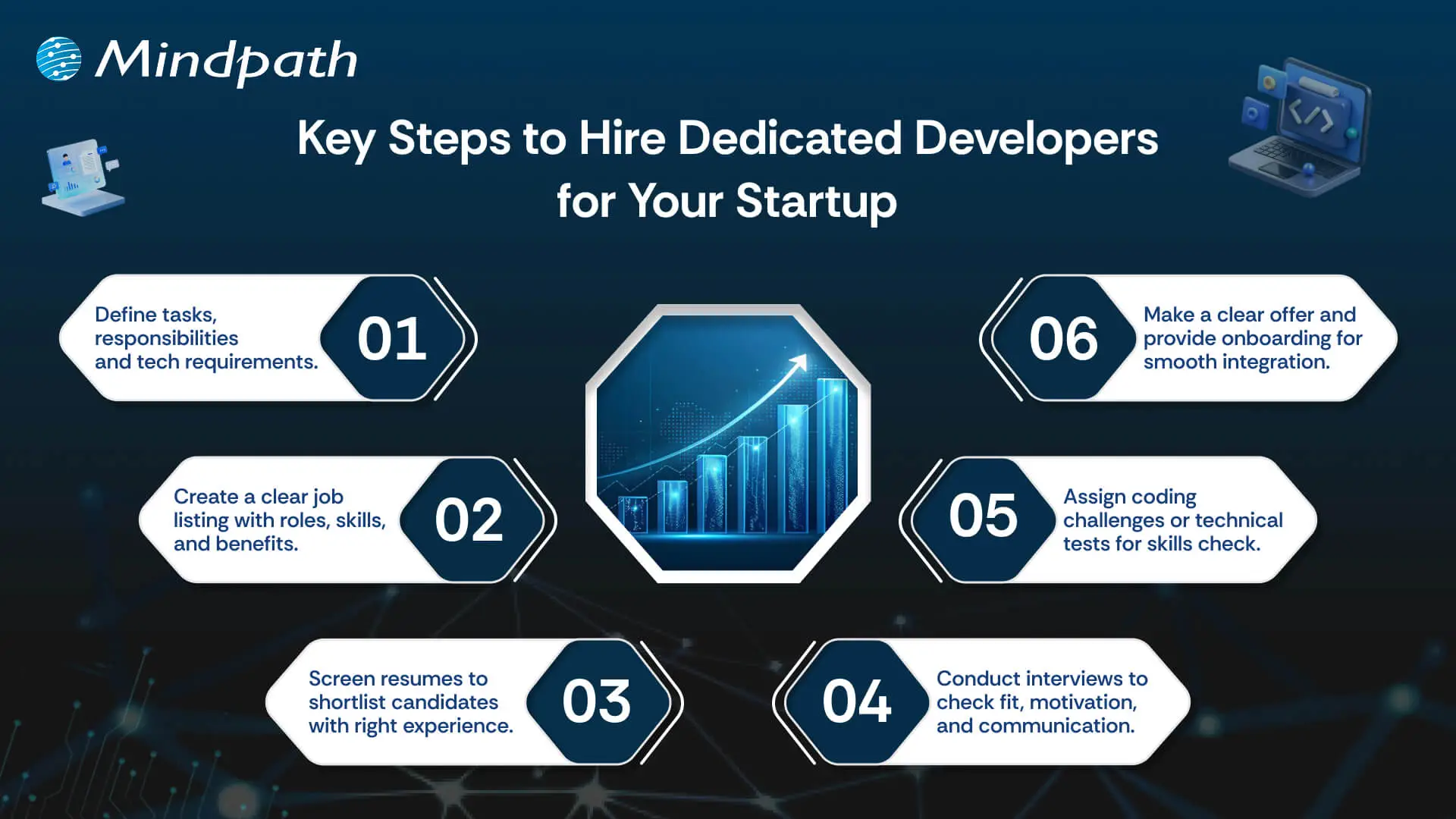
Key Steps to Hire Dedicated Developers for Your Startup

Recruiting appropriate technical talent determines the manner in which a startup is formed and developed. These are the major steps to hire dedicated developers for your startup in a clear-cut and controlled manner.
hire dedicated developer for your startup

1. Define Your Development Needs

Be clear about the tasks, responsibilities, and objectives of the developer position. Choose the technical infrastructure, level of experience, and the soft skills. Share these requirements to get the right candidates that would fit into your startup vision and culture. This will guarantee that you get the perfect match prior to the hiring process.

2. Create an Attractive Job Listing

Prepare a precise and brief job advertisement specifying the job, the requirements, and company benefits. Exhibit growth prospects and culture. Advertise in job boards, social media and professional networks to access competent candidates. A good listing attracts and enhances the quality of response.

3. Screen Resumes Efficiently

Filter through applications to identify those candidates who meet your requirements. Check technical skills, experience and applicable education. Find the transferable skills where necessary. Filter out applicants to proceed to the next step. This can save time and concentrate on the best talent.

4. Conduct Initial Interviews

Screen shortlisted candidates on the phone or via video call. Evaluate cultural fit, motivation, and communication skills. Question regarding experience and problem-solving. Present your business, objectives, and culture. This assists the two parties in assessing their compatibility prior to proceeding.

5. Test Technical Skills

Give coding challenges or relevant technical tasks. Evaluate skills based on your project needs. Ensure tests reflect real-world tasks they will handle. Review results carefully to confirm the candidate can deliver high-quality work. This step ensures practical readiness.

6. Make an Offer and Onboard

Share a clear job offer with salary, benefits, and start date. Upon acceptance, offer adequate on-boarding and support to ensure that they settle as soon as possible. Cultivate learning and development to create long-term engagement. This assists startups to successfully hire dedicated developers and assimilate them seamlessly.

Need to scale your development team quickly without long-term commitments? Explore our staff augmentation guide to learn how startups can add skilled developers on demand while staying flexible and cost-effective.

Ready to Hire Dedicated Developers in UK for Your Startup?

How well you hire the right tech candidate will help you to decide your startup’s future. If you stick to the proper procedure, you can effectively hire committed developers without wasting time. This will allow you to quickly develop and launch products, produce high-quality work, and build for long-term success. Defining what you are looking for, reviewing candidates, and assessing competencies helps minimize risks associated with the hiring process. Using this method will provide your company with a more effective development process and consequently generate superior business results.

Mindpath is your option to get the best solutions if you want to hire dedicated web developers for your startup. Our teams are committed to delivering bespoke web development services that are focused, fast, and of high quality. We are a perfect fit with your objectives as we keep on supporting and updating you. By selecting Mindpath, we guarantee your projects will be carried out efficiently, and with high technical standards.

Related Post

Related Post

ecommerce software development  

E-commerce is rapidly changing, and brands have to cope with it on a daily basis. Customer journeys need fast loading, effective information display, and dependable performance across all the devices. This compulsion makes e-commerce software development a fundamental business priority and not a peripheral activity. It influences product loading processes, payment processing, and growth of systems. We, as technology experts, are well aware of this change. It calls on teams to rebuild platforms in a purposeful, precise, and long-term growth perspective.

Based on this fact, attention turns to the planning and reinforcement of platforms. Intelligent e-commerce systems bridge the gap between business objectives and reality. They permit change and maintain performance. They also enhance brand confidence in an increasingly competitive environment. The connection between technology and strategy results in smarter decision-making. It initiates necessary debates in emerging businesses. So, this blog focuses on analyzing this field in detail and discussing what really makes e-commerce sites successful. Let’s dive in to know more!

Ready to transform your online store with a reliable and feature-rich platform? Mindpath’s software development services help businesses build innovative and scalable e-commerce solutions.

What Does E-commerce Software Development Mean?

To put it simply, e-commerce software development implies the development of digital systems that can assist businesses in selling online without any issues. These systems handle products, prices, orders, and activities of customers centrally. They assist e-stores in loading quickly and operating without failure. They are created by developers to suit the needs of customers and business objectives. Due to increasing online demand, powerful software assists brands to remain organized, responsive and engage in daily sales activity.

The process also facilitates growth and flexibility as business goes online. Through e-commerce development services, teams create a platform to facilitate payments, track orders, and manage users conveniently. Quality software links all the store’s functions intelligently. It makes teamwork easy and customers’ shopping straightforward. Such transparency enables businesses to win trust and provide a uniform online experience.

Also Read: Types of Software Development

Key Benefits of E-commerce Software Development

In the contemporary world, online selling requires more than a simple web site. Brands seek speed, control and growing demand platforms. The e-commerce software development services facilitate this transition with smarter digital basics. The following are some of the main advantages which make this method worth considering.

1. Built for Your Business Needs

Each business operates in its unique way, and software must be aware of that fact. E-commerce software development assists teams to mould features in accordance with actual workflow and objectives.

2. Ready to Grow with Demand

E-commerce stores evolve with the growth of products, customers, and purchase orders. E-commerce software development helps it grow without slowing down systems and disrupting normal operations.

3. Better Control Over Design and Experience

Brands desire stores that are appealing and feel right to the customers. This method offers complete ownership over layout and flow as well as shopping experience.

Must Read: Web Development vs Software Development

4. Smooth Connection with Existing Tools

Several companies are already utilizing accounting, inventory, or CRM software. All these systems are linked through a well-planned software that maintains smooth operations of the system.

5. Faster Performance for Shoppers

Speed is important when the customers are browsing or paying over the internet. Powerful development pays attention to a rapid load and seamless action in each step.

6. Stronger Protection for Customer Data

E-commerce sites deal with personal customer information on daily basis. Dedicated systems implement protection rules which secure data and establish enduring customer confidence.

Curious how businesses build platforms aligned with their exact workflows? Check out custom software development and discover how it ensures better control and security.

Features of an E-commerce Software Development

The demand of e-commerce software will keep increasing as the online firms continue to grow all over the world. Grand View Research estimated the market of e-commerce software in the world to be USD 7.12 billion in 2022. The market has the potential of reaching USD 20.90 billion in 2030 with a CAGR of 15.3 percent. This expansion is an indication that it requires functionality to handle inventory, taxation, and day-to-day operations.

1. Simple Navigation Flow

Good layouts enable the user to navigate through easily without wasting time. E-commerce software development makes categories and checkout user-friendly.

2. Smart Product Control

The stores update and sort listings effectively. This will enable customers to find products easier and also make shopping more enjoyable.

3. Secure Payment Handling

There are various payment methods, which enhances customer confidence. E-commerce software solution development assures that all dealings remain secure and intact.

4. Order Tracking System

Teams have a chance to track orders between placement and delivery. This enhances coordination, as well as minimizes errors in shipping.

5. Mobile-Ready Experience

Mobile users anticipate hassle-free browsing and purchase. Responsive design will ensure an easy experience across all gadgets.

Want to keep your online store competitive in a rapidly evolving market? Discover software development trends to learn how modern innovations are transforming e commerce platforms.

Emerging Trends in E-commerce Software Development

E-commerce environment continues to evolve along with technology and consumer demands. The trends in e-commerce software development are currently geared towards enhancing growth and user satisfaction.

1. Mobile-First Shopping

Smartphones are now taking over the online purchases. E-commerce software development achieves seamless and quick experiences across all mobile devices.

2. Smarter Recommendations

AI and ML can assist platforms in recommending the products that the users desire. This enhances interaction and marketing prospects successfully.

3. Virtual Product Experience

AR allows customers to have a virtual experience on the use of products and then purchase. It enhances confidence and decreases returns in online shopping.

4. Voice-Activated Buying

Voice commerce enables purchases by commands. It accelerates and simplifies the process of shopping among the tech-savvy customers.

5. Subscription Models

Subscription-based services provide customers with products at regular intervals. Recurring orders and automated billing are efficiently supported on platforms.

Want to plan your e commerce project without unexpected expenses? Discover software development cost to learn what factors influence budgeting and long term investment.

What to Consider While Choosing the Right E-commerce Software Development Company?

Choosing the appropriate partner determines the success of your online shop. E-commerce software development requires skills, trustworthiness and business insight.

1. Find a company that has high competence in e-commerce software development and a track record. Check on their previous works so that they could be able to cope with their business requirements.

2. Ensure that the technology stack that they are based on is reliable and up to date. Ensure that they are adept at such popular platforms such as Shopify, Magento or WooCommerce.

3. Check out their capabilities regarding the capacity to customize solutions to your business needs. A dynamic strategy assists in developing a platform that actually suits your operations.

4. Make sure that the firm is capable of developing scaled systems that increase with your business. With time, your platform is supposed to support increased traffic, products, and transactions.

5. Pay attention to effective communication and cooperation during the project. The development process is smooth and predictable due to regular updates and open discussions.

6. Consider their after-launch services such as support and maintenance. Constant support makes your online store efficient and modern.

Planning to upgrade your existing e commerce system for better performance? Discover how a skilled software development agency can modernize your platform with advanced technologies.

Ready to Take Your E-commerce to the Next Level?

E-commerce is changing at an alarming rate, and good software is one of the major factors to remain competitive. E-commerce software development assists companies to handle merchandise, finances and customer experiences effectively. It helps in growth, enhances performance, and establishes trust. Selecting suitable software and features is a guarantee of ease of operation, ease of use, and success over time. With intelligent planning and development, online stores become viable and scalable business platforms.

At Mindpath, we provide professional software development services that are specific to your business objectives. Our team is highly skilled in e-commerce software development and incorporates modern technologies in speed, security, and efficiency. They provide platforms that grow with your business, are easy to manage, and improve user experiences. Ongoing support and development means your online store will be competitive, receptive, and available to future possibilities.

offshore software development for business growth

Would you like to grow your business quickly without spending a lot of money? If so, offshore software development may be an appealing option for you. Many companies today are choosing this model due to the cost-saving element, access to global talent, and keeping pace with digital technology. So, for companies that want to grow fast and provide more resources to their primary company without the pressure on their in-house or workforce, offshore development is a viable choice.

Now with this increased interest, offshore development services in 2026 are perceived as a way to stay agile and innovate faster while providing the continued influx of technology in the marketplace. Businesses of all sizes, including small startups and large enterprise clients, are increasingly leveraging offshore teams to produce robust and dependable software solutions. In this blog, we will explore why this trend is growing and how your organization can benefit from it.

Ready to take your business to the next level? Partner with Mindpath for expert offshore development services that drive innovation, efficiency, and growth. Contact Us!

What is Offshore Development?

Offshore development refers to hiring a software development team from abroad to either build or manage your software projects. It’s a form of software development outsourcing and allows companies to choose to work with teams located in different countries. It is beneficial for companies to consider going offshore for lower costs, accessing greater developer skill sets, and spending their time on their core business processes.

For instance, if a company in the UK hires a software development team from India to develop its web application, the rates in India will be cheaper than in the UK, while still maintaining high-skilled developers. Thus, using offshore development can help a company scale quickly and effectively with good quality work.

According to a Business Research Insights Survey, the software offshore market was worth roughly USD 160.9 billion in 2024, and is on track to reach USD 413 billion by 2033, with a CAGR of 11.04%.

Offshore Development Benefits for Businesses

There is a growing number of businesses opting for offshore teams to deliver their software needs. The benefits of offshore development have made it a popular option for organizations seeking smart and adaptable options for growth. Let’s have a look:

offshore development benefits for businesses

1. Cost-Effective Solution

Offshore development services help businesses lower their software development costs without losing quality. Companies can hire skilled developers from countries where salaries are more affordable compared to local markets. This approach offers a smart way to achieve cost-effective software development without compromising on results. The money saved can then be used in other important areas like marketing, research, or improving infrastructure.

2. Focus on Core Business Goals

Offshore development lets companies’ hand over routine tech tasks to external teams. This helps free up internal staff to work on more important goals and long-term plans. With fewer day-to-day responsibilities, businesses can focus better on innovation and growth. It also gives them more time to strengthen their position in the market.

3. Access to Global Expertise

Working with global software development teams allows companies to tap into a wide range of skills and knowledge. They can bring in experts who specialize in tools or technologies that are hard to find or too expensive locally. This helps businesses build better solutions and stay updated with the latest trends. It also brings fresh ideas and faster problem-solving from experienced professionals around the world.

Also Read: Qualities of a Good Software Engineer

4. Mitigating Risks Easily

Working with offshore teams helps reduce risks that may affect your local operations. This includes not just natural disasters or political changes, but also technical issues like system failures or delays in development. Offshore partners can quickly step in to handle problems and share responsibility when challenges arise. This setup keeps your projects moving and makes your business more stable and prepared.

5. Boost Productivity

Offshore teams usually have clear roles and focus on getting results. This helps manage projects better and use resources more effectively. Many offshore developers work in well-organized environments that support smooth and efficient work. As a result, they often deliver high-quality work on time and sometimes even ahead of expectations.

6. Access to Latest Technologies

Offshore teams give businesses access to modern tools like AI, cloud computing, blockchain, and IoT. Many offshore developers already have experience with these technologies and know how to use them well. This helps companies stay up to date and try new ideas without spending extra on training or new systems. It also supports faster innovation and better tech solutions.

7. Speed Up Product Launch

Tech talent outsourcing helps businesses work faster by using teams in different time zones. When one team finishes their day, the offshore team can continue the work, keeping the project going around the clock. This constant progress helps fix issues quickly and speeds up development. As a result, companies can launch their products sooner and meet deadlines with ease.

Want to know how this round-the-clock development approach works best ? Understanding the stages of the software development life cycle helps ensure offshore teams collaborate efficiently while maintaining quality and timelines.

Are you facing any confusion between offshore software development and onshore software development? Let us learn about the difference between them.

Offshore vs Onshore Development: A Comparison Table

When planning a software project, businesses often choose between offshore and onshore development based on their goals, budget, and timeline. Both options have their own advantages and challenges. The table below gives a clear comparison to help you decide which model suits your business needs best.

Factor 

Onshore Development 

Offshore Development 

Definition  Development done by a local team Development handled by a team in another country
Location Within the same country Access to cost-effective global locations
Proximity Easy access to the team Remote but manageable with clear planning
Cultural Fit  Shared work culture Diverse perspectives and global work culture
Communication Face-to-face communication possible Efficient digital communication tools
Talent Base Limited to local skills Broader access to global tech talent
Language Barrier Minimal language issues Clear strategies help overcome language gaps
Time Zone Same time zone, easy scheduling 24/7 progress through time zone advantage
Work Cycle Fixed to local business hours Continuous work with round-the-clock development

Looking to Scale Smartly with Offshore Software Development?

Offshore software development continues to be a smart and flexible solution for businesses in 2026. It helps reduce costs, improves access to global talent, and supports faster innovation. By using offshore teams, companies can stay competitive, scale quickly, and focus on their main business goals. No matter if you’re a startup or an established company, offshore development can support your long-term growth.

At Mindpath, we offer reliable offshore development services tailored to your business needs. Our expert teams are equipped with the latest tools and technologies to deliver high-quality solutions on time. With a focus on communication, transparency, and results, Mindpath helps you build the right IT outsourcing strategy for long-term success.

Frequently Asked Questions

1. How do offshore development services ensure quality work when teams are remote?

Offshore teams follow structured processes, regular updates, and clear communication to maintain quality. Many companies also use agile methods, testing practices, and performance tracking tools. With the right planning and collaboration, remote teams can deliver reliable and high-quality results consistently.

2. Is offshore software development suitable for small businesses or only large enterprises?

Offshore software development is suitable for both small businesses and large enterprises. Startups can benefit from lower costs and faster development, while larger companies use it to scale operations. It offers flexibility for any business aiming to grow efficiently without heavy investment in local hiring.

3. What challenges can businesses face with offshore development, and how can they manage them?

Common challenges include time zone differences, communication gaps, and cultural differences. These can be managed by setting clear expectations, using collaboration tools, and scheduling regular meetings. A well-defined workflow and strong project management help ensure smooth coordination and project success.

4. How do offshore development services help businesses stay competitive in a fast-changing market?

Offshore development services give access to global talent, faster delivery cycles, and modern technologies. This allows businesses to innovate quickly and adapt to market changes. With continuous development and cost savings, companies can focus more on strategy and stay ahead of competitors.

5. What factors should be considered before choosing an offshore development partner?

It is important to check the partner’s experience, technical expertise, communication approach, and past projects. Understanding their work process and support system is also key. Choosing the right partner ensures better collaboration, smoother execution, and long-term project success.

Discover the benefits of offshore development, including cost savings, access to skilled talent, and enhanced flexibility.
MVP development

In the software development context, you must have come across the term MVP or minimum viable product. It is the simplest version of a product or application. MVP just has enough features so that initial users can test and provide their feedback. It is ideal for investors to look at the MVP of a product that is being pitched to them.

The importance of MVP development is vital in the prevailing business environment. Many startups fail today because they create products on the basis of assumptions. However, the best way to test those assumptions is by developing an MVP that the real users can see and use. It is the perfect time to learn about MVP and its relevance.

If you are looking to adopt MVP into your business, but don’t know where to start? Mindpath offers end-to-end MVP development services that help you validate ideas quickly while minimizing financial and technical risks.

An Insight into Minimum Viable Product

A Minimum Viable Product refers to the beta version of a new product that a business plans to create. It encompasses just enough features to capture the attention of early customers and collect feedback from them. The companies that adopt the MVP approach to collect as well as respond to user feedback are able to grow faster in the competitive market setting.

Businesses can use MVP in software development to test if customers are happy with their app before spending too much time and effort. As the needs and preferences of modern customers keep changing, it is fundamental for businesses to prioritize MVP development.

Benefits of Implementing MVP

You need to bear in mind that the concept of MVP product development comes from the lean startup methodology. It focuses on learning as well as building with scalability. When a business builds MVP, it is basically taking the first small step towards a new idea or product. This small step can enable businesses to understand the interest of the market in the product.

1. Gathering User Insights

Businesses can gain valuable insight from MVP development. It can teach them where to make improvements in their offering and scale back. Businesses can also add extra features in order to make their product or application more attractive and useful for the users.

2. Testing Business Idea

The key benefit of MVP is that it serves as a low-risk testing ground before businesses invest millions of dollars into a product. Startup businesses can validate their product through MVP development. It creates an opportunity to interact with customers and understand their needs.

3. Cost Efficiency

You need to remember that an MVP development company can help you in terms of cost-saving. Mature software products need years of development along with considerable investment. MVPs ensure that products are simple for coding as well as functionality, thereby reducing development cost. Once you start gaining customer feedback, you can start spending your money more wisely on the new product.

4. Assessing Market Demand

The MVP encompasses testing as well as analyzing the functionality of a product. Moreover, it helps in evaluating the market demand and helps in the acquisition of new customers in the market. It is vital for business organizations to understand the needs of their customers along with the existing solutions. The MVP approach empowers businesses to refine their offering and know whether their offering has a future in the market or not.

5. Securing Funding

Startups require funding in order to survive in the competitive market environment. MVP development for startups serves as a strategic method that can enable them to test the idea before reaching out to investors and other stakeholders. Such a systematic approach can help businesses to secure funds from investors who trust in their idea and Minimum Viable Product.

Cost of MVP Development

The role of MVP development is indispensable for businesses. So it is time to focus on the MVP development cost. Businesses may wonder – How much does MVP development cost? The answer to the question is not straightforward. The average cost relating to MVP development depends on a number of factors, such as the scope of the project and team composition. Similarly, contractual dynamics may also play an important role in impacting the cost of MVP development.

When it comes to MVP, the cost can be categorized into specific features as well as development phases. The common categories that you may come across include market research, prototyping, and MVP development. It is crucial to bear in mind that the research phase is conducted in parallel with prototyping.

Difference Between MVP, Prototype, and Proof of Concept

In order to get a holistic insight into MVP, you must understand how it is different from Prototype and Proof of Concept. A layman may think that these terms are interchangeable. However, that is not true. Each of the terms has a different meaning that businesses should be familiar with.

1. MVP

MVP refers to a launchable product version. It includes core features. The purpose of MVP development is to validate the market potential of a product and gain valuable feedback from users.

2. Prototype

Prototype refers to a preliminary model of a product. It can also be described as a mock-up that is designed to test the design concepts and technical feasibility. It also helps to assess the functionality of a product before its complete development.

3. Proof of Concept

Proof of Concept is a small experimental project. It is undertaken to demonstrate the feasibility or viability of a concept. It is mostly tested internally before further investment is made.

The main difference between these three terms has been presented in the table below:

Aspect MVP Prototype Proof of Concept
Purpose Market validation Technical exploration Feasibility testing
Complexity Functional product Non-functional model Basic technical demonstration
Audience Potential customers Internal stakeholders Technical team

Misconceptions Relating to MVP

There are a number of misconceptions that startups may have about MVP. It is essential to have proper clarity about MVP so that businesses can take advantage of the approach while developing their offering.

1. A common misconception is that MVP is an inferior quality product. However, in reality, an MVP is crafted in a strategic manner. It focuses on the product or software that can deliver core value while maintaining user experience.

2. Another common myth is related to the investment aspect. You may believe that MVP in web development requires no major investment. However, that is not true. Although MVPs are more cost-effective than the final product, they require resource allocation and technical implementation.

3. Businesses may have the idea that one MVP may be sufficient while developing a product. But the truth is that MVP development is an iterative process. Businesses must continuously incorporate the feedback of users so that the best version of the product can be made.

4. You may think that an MVP is a universal solution for all startups. However, this is a common misconception. Not all startups might be able to validate their product or idea through an MVP.

Ready to launch your MVP without delays? Visit our blog on hiring full-stack developers for MVP to learn how to find developers who can handle both front-end and back-end tasks with ease.

Final Words

In the current business landscape, the importance of MVP development cannot be negated. In order to sustain and survive in the complex business space, it is key for startups to develop a minimum viable product before investing completely in the actual product. It can empower businesses to refine their product or offering and create value for the end-users.

Businesses can take advantage of Mindpath’s minimum viable product development services. Our experts can help you develop your MVP in an efficient manner, and you can obtain relevant feedback to improve your offering. The MVP development process can play a strategic role, and it can give your business an edge.