Key Benefits of Hiring Remote Developers

Join our Newsletter!

Featured Posts

Support Is One Click Away

Home

Key Benefits of Hiring Remote Developers

benefits of hiring remote developers

Key Benefits of Hiring Remote Developers

Understanding the benefits of hiring remote developers can unlock thrilling possibilities for organizations looking to grow faster and smarter. In today’s world, companies tap into skilled workers worldwide instead of relying only on local talent. But how does the shift to remote development impact projects and teams? When organizations hire the right remote developers, they can deal with challenges more effectively, enlist more talent and expertise, and receive additional lateral thinking that may not always be available nearby.

At the same time, it’s not just about broadening the talent pool. Hiring remote developers allows companies to maximize savings, increase performance, and yield faster delivery speed. Isn’t that exactly what companies are looking for as they continue to modernize? With the pace of technology increasing, it’s more important than ever to tap into professionals who can adapt to change quickly and produce results. This is why businesses are employing remote teams as a sound way to grow and remain competitive. In this blog, we will outline some of the benefits that should make remote developers a consideration for any business.

Looking to scale your business that provides growth and innovation? Contact us, and we will help you explore how you can access fast and quick results.

Growing Demand for Remote Developers

The demand for remote developers is increasing rapidly with global hiring and flexible working arrangements. After COVID-19, companies learned that they could function just as well without physical workspaces, and developers discovered the advantages of flexible work. Companies now want specialized skills; they want specialized skills faster and cheaper, developers want remote or hybrid work, and specialized skill developers want fast and cheap work.

Taking everything into account, some of the key factors driving this new reality include shifting cultural dynamics post-COVID, the speed and efficiency of AI and cloud technology, and the ability to pull skills from anywhere in the world. Organizations can now create effective teams independent of place, reduce costs, and maintain a competitive position in an increasingly digital world.

Also Read: Remote Work Tools for Developers

Benefits of Hiring Remote Developers

Understanding the advantages of hiring dedicated developers has shown us how powerful hiring talent remotely has become. Companies can scale at an accelerated pace, reduce costs, and fill unique skills that might not exist locally. When companies find the right remote dedicated team, they can expect a well-thought-out project and long-lasting value.
Benefits of Hiring Remote Developers

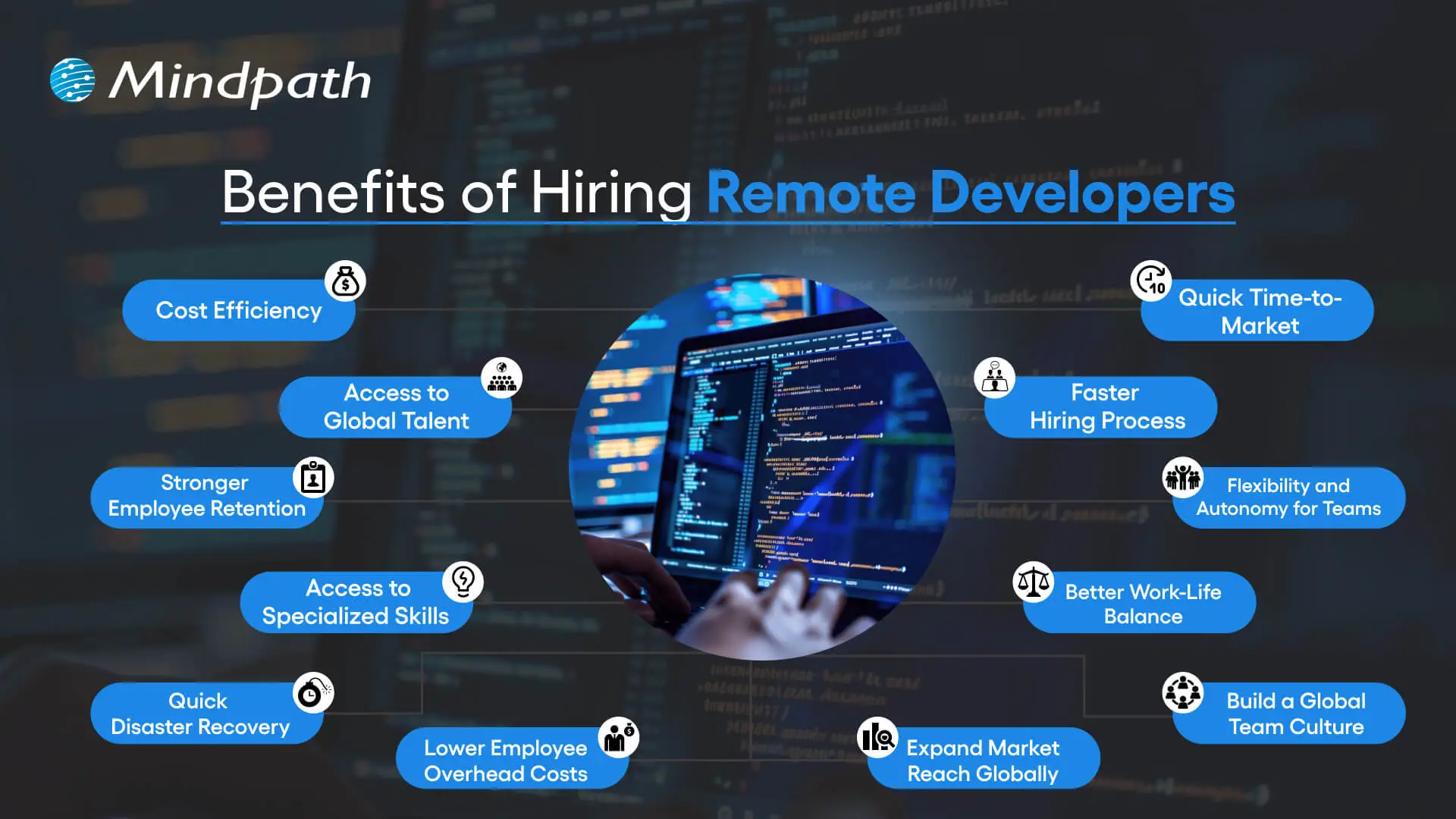
1. Cost Efficiency

Remote hiring can decrease expenses on space, utilities, and other operational costs. When hiring developers from places with lower costs of living, companies save even more on employee salaries and daily overheads, which can then be reinvested into research or innovation or even into paying for employee benefits. This enables companies to experience growth while continuing to be fiscally responsible.

2. Access to Global Talent

One of the major benefits of remote work is the opportunity to recruit talented professionals to join the team from anywhere in the world. Workers and their companies no longer have to feel restricted in the talent they can recruit, and many companies are developing diverse teams together with specialized skills and knowledge. Companies can now combine talent in technical skills, such as machine learning, with more creative areas, such as UI and UX design.

3. Stronger Employee Retention

One of the important benefits of hiring remote developers is increased employee retention, which is important for business stability. Employees have less stress from long commutes and improved work-life balance, which leads to increased job satisfaction. With higher satisfaction comes increased loyalty and lower turnover. This stability provides companies with predictable productivity, more control of expenditures, and longer-term growth.

4. Access to Specialized Skills

Remote hiring allows companies to locate developers and other providers with specialized skills that they may not have locally. Companies can search worldwide for developers skilled in machine learning, React development, healthcare technology, etc.

Even non-technology companies can find programmers and service providers in the specialized pathways without the need for in-house technical capacity. The appropriate specialized talent makes it possible to achieve quality, safety, and reliability standards for projects.

Looking for guidance on hiring specialized developers for your projects? Check out our detailed guide on hiring expert ReactJS developers to find the perfect match.

5. Quick Disaster Recovery

An additional benefit of hiring remote developers is business continuity. When a local office experiences disruption due to power outages or extreme weather, remote teams can maintain the pace of project execution. By engaging in a distributed team model, work is not curtailed at one point in the system. That is, it allows a project to better meet deadlines, reinforces trust with clients, and increases anchoring with the robustness of the overall business model and operations.

6. Lower Employee Overhead Costs

A key advantage of hiring a remote development team is the significant reduction in costs exceeding rent, utilities and office supplies. Onboarding is less expensive with remote developers because they are working off their own setups, so they will utilize minimal in-house resources. Training is also delivered through online modules, which will save costs and help keep teams up to date without wasting time.

7. Quick Time-to-Market

The biggest benefits of hiring remote developers is that it really helps to speed up product launches. As teams are already distributed around the world in different time zones, development, testing, and deployment can continue all day. This Shortens project cycles and allows businesses to meet deadlines in a timely manner. Being able to deliver faster keeps companies agile and gives them a significant competitive advantage.

8. Faster Hiring Process

Remote hiring allows companies to source and onboard the right talent quickly for projects on short notice due to access to a global talent pool. Many recruitment teams know that hiring offshore means you do not have to worry about relocation and cannot be delayed by a lengthy recruitment process. Skilled developers can start working on a project within a week. This speed allows companies more time for development, testing, and entering the market.

Need a faster way to scale your development team without long-term commitments? Discover how staff augmentation enables businesses to add skilled developers quickly while maintaining flexibility and cost efficiency.

9. Flexibility and Autonomy for Teams

One of the key advantages of employing remote developers is that it affords teams higher flexibility and autonomy in how they choose to work. Since developers can work at a time that suits them best, they produce higher-quality work.

Using this flexible work model creates lower stress, higher job satisfaction, and engagement. Businesses with flexible work models not only benefit from motivated teams but also from teams that achieve better results in less time.

10. Better Work-Life Balance

Remote developers benefit from the flexibility to have a day that will fit their personal and professional needs. This flexibility provides remote developers with the opportunity to spend time with family, for fitness, and for personal well-being, without worrying about any impact on their productivity.

As a direct result, mental and physical well-being improve, and performance at work improves as well. The benefits of hiring remote developers result in a happier team that will be focused and more efficient in tackling each project successfully.

11. Build a Global Team Culture

The benefits of hiring remote developers extend to creating a diverse team culture that blends ideas from around the world. Different perspectives and experiences lead to more creativity and stronger problem-solving. Online collaboration tools make it easy for teams to connect, share, and work together across borders. This global culture not only strengthens teamwork but also supports innovation and business growth.

12. Expand Market Reach Globally

With remote developers located across different regions, businesses gain real-time insights into diverse markets. These developers can share valuable knowledge on local consumer preferences, trends, and cultural expectations. This localized input helps tailor products or services for specific audiences more effectively. The benefits of hiring remote developers include faster, smarter market expansion with fewer blind spots.

Want to leverage remote talent for faster product launches worldwide? Explore how custom software development can help your business scale efficiently.

Ready to Experience the Benefits of Remote Working?

The benefits of hiring remote developers clearly show how powerful and practical this model has become for modern businesses. Companies gain access to global skills, improve retention, reduce overhead, and accelerate delivery. By building flexible and resilient teams, organizations can stay ahead of the competition and create sustainable growth in today’s fast-changing digital landscape.

At Mindpath, we make hiring remote developers simple and effective. Our dedicated developers bring specialized skills, innovation, and flexibility to your projects. With a focus on efficiency and quality, we help businesses scale faster, cut costs, and deliver solutions that drive real results. Partner with Mindpath and unlock the true potential of remote working.

Related Post

Discover how AutoML simplifies machine learning for businesses. Learn about its benefits, including cost savings, accuracy, and faster deployment.

Related Post

AR and VR in Education

Imagine a classroom where history lessons transport you to ancient Rome, science experiments happen in a virtual lab, and geography lessons let you explore the Amazon rainforest from your desk. Sounds exciting, right? This is the power of Augmented Reality (AR) and Virtual Reality (VR) in education. T But how exactly do AR and VR reshape education? What benefits do they bring to students and teachers alike? Let’s explore how these innovative tools are transforming the way we learn and teach. 

What is Augmented Reality (AR)?

Augmented Reality (AR) is a technology that integrates digital content, such as images, sounds, or animations, into the physical environment. Instead of replacing the actual world, like Virtual Reality (VR) does, AR improves what you see and feel by mixing virtual features into your surroundings. AR works with smartphones, tablets, AR glasses, and headsets. For example, you might use your phone’s camera to display a map on the ground in front of you or a 3D model on a table. This makes the actual world more engaging and thrilling. Augmented Reality can be used for a variety of purposes, including learning and decision-making as well as producing enjoyable and engaging entertainment. It enables users to experience situations in new ways, supplementing what they perceive with useful or intriguing information. AR, which combines the actual and digital worlds, provides a new and immersive method to engage with our surroundings.  

What is Virtual Reality (VR)?

Virtual Reality (VR) is a technology that generates a fully digital environment in which users can explore and interact as if they were real. Instead of viewing your real surroundings, you are immersed in a 3D virtual environment that feels like you’ve entered another universe. To enjoy VR, you often require specialized equipment such as VR goggles, headsets, or even suits. These technologies help you shut out your actual surroundings while increasing the immersion in the virtual one. For example, you might find yourself walking on a virtual beach, floating through space, or playing games in an extraordinary place. The purpose of VR is to make you feel as if you are actually “inside” the virtual environment, regardless of how realistic or fictional it is. It is used for entertainment, training, education, and many more purposes, providing limitless opportunities to explore and experience things in completely new ways.

Benefits of AR and VR in Education

1. Cost Effective

One of the primary advantages of AR and VR in education is their cost-effectiveness. Traditional training approaches can include large investments in classroom layouts, resources, and instructors, which can be costly. In contrast, AR and VR lower these expenses by providing a more efficient method of training delivery. These technologies minimize the requirement for physical resources and decrease the need for expert trainers. AR and VR dramatically reduce training time by allowing learners to practice and repeat tasks at their own speed without continual observation. This allows for faster skill development, lower training expenses, and the opportunity to train more people in less time. Furthermore, AR and VR training programs are scalable, which means they can be utilized to teach a big number of people in several places without requiring expensive travel or equipment. This allows organizations to swiftly onboard new staff and upskill existing ones. AR and VR minimize both direct and indirect expenses by providing an interactive and efficient learning environment, making them an important answer for current education and training programs. 

2. Enhanced Immersive Learning

AR and VR training provide levels of immersion and engagement that traditional techniques cannot match. These technologies enable students to engage in realistic simulations, which increases memory and comprehension of the information. AR and VR, by immersing students in lifelike situations, help to strengthen links between the learner and the subject, resulting in improved knowledge retention and engagement. This immersive experience allows trainees to practice real-world events in a secure and controlled setting, increasing their confidence and readiness for genuine circumstances. As a result, AR and VR training frequently leads to increased expertise and better performance. The capacity to mimic difficult activities or high-pressure scenarios makes these technologies especially useful in businesses that need specialized skills or rapid decision-making. 

3. Building Essential Skills

In several industries, individuals operate in hazardous conditions where safety is essential. Traditional training for such high-risk employment is frequently time-consuming, costly, and can include hands-on experience in dangerous environments. AR and VR, on the other hand, allow workers to learn the essential skills in a safe, regulated, and realistic virtual environment. Virtual reality simulations, for example, allow trainees to practice operating equipment and managing operations in places such as refineries or chemical plants. These simulations replicate real-world situations, including realistic sounds and images, giving trainees the impression that they are on-site but without the hazards. This immersive training strategy guarantees that personnel obtain the expertise and competences required to properly operate complicated machinery and high-pressure circumstances. Additionally, VR training does not disrupt existing operations and allows staff to be job-ready upon completion, reducing the time and cost of traditional training methods. 

4. Mastering High-Risk Tasks Safely

Certain professions, particularly in healthcare, aviation, and manufacturing, need precise execution of high-risk operations. In healthcare, for example, medical treatments must be executed with extreme precision to achieve beneficial results. AR and VR are revolutionizing this process by allowing experts to practice and improve their abilities in a safe, virtual environment. For example, doctors can utilize virtual reality training to mimic complicated surgery, such as spine operations, on virtual patients. This allows them to practice each phase of the treatment and acquire confidence before attempting it on a real patient. Furthermore, AR can overlay important data right in the surgeon’s field of view, offering real-time advice during surgeries. This form of training improves accuracy, minimizes the likelihood of mistakes, and ultimately results in improved patient outcomes. It also reduces the danger of malpractice disputes, which benefits both healthcare providers and institutions. 

5. Tailored Training Solutions

AR and VR training allows you to personalize learning experiences based on the unique needs of each individual. These technologies enable training programs to be customized, allowing students to advance at their own speed and in a way that best matches their learning style. For example, in industries such as automobile production, firms may utilize augmented reality to tailor assembly line instruction to each technician’s skill level. This method guarantees that each worker receives the proper teaching degree, leading to faster learning, fewer mistakes, and better performance. By providing personalized training, AR and VR assist learners in developing the skills they require more effectively, saving time and money while increasing overall productivity. This customized approach guarantees that training is not just effective but also aligned with the learner’s unique needs and abilities. 

AR and VR Services at Mindpath

Mindpath provides innovative Augmented Reality (AR) and Virtual Reality (VR) technologies that enhance learning and training experiences. Our AR and VR services assist companies and educational institutions in creating realistic, interactive environments for their teams and students to practice skills safely and successfully. Our AR services provide immersive experiences by superimposing digital information over the actual environment, allowing users to interact with virtual content in real time. Whether for training or product presentations, augmented reality makes learning more interesting and practical. With our VR services, we provide completely simulated settings in which customers can practice high-risk activities or complex processes with no real-world implications. This helps students to acquire confidence, enhance their abilities, and carry out tasks with accuracy. Mindpath’s AR and VR solutions are customizable to fit your specific training needs. Whether you’re in healthcare, manufacturing, or education, we provide tailored services that help individuals learn faster, retain information longer, and perform with accuracy.  

Wrapping Up!

Mindpath is at the forefront of revolutionizing learning and training experiences with new AR and VR technology. By providing customized, immersive solutions, we assist companies and educational institutions in improving skill development, retention, and training costs. Whether you work in healthcare, manufacturing, or education, our AR and VR services offer a secure and effective approach to master complicated jobs and high-risk processes. Our custom solutions are tailored to your individual requirements, ensuring that learners get the confidence and competence they need to succeed. Partner with Mindpath to unlock the future of training and learning by leveraging cutting-edge technologies that not only produce results but also pave the road for smarter, more effective training.  

Ready to transform your training and education with AR and VR?

Partner with Mindpath today to discover customized solutions that enhance learning and boost performance.

Discover how AR and VR are transforming education with immersive, cost-effective, and tailored training solutions that enhance learning.
Agentic ai vs generative ai

Artificial intelligence created the biggest ripples in the domain of technology in the last decade. Following the adoption of generative AI tools, there is a new type of AI that showcases how artificial intelligence continues evolving. The agentic AI vs generative AI comparison has become a hot topic of discussion for businesses worldwide. Which one do you think delivers the best of AI for your business?

Since the public release of ChatGPT, many businesses have gradually incorporated generative AI in their workflows. However, agentic AI emerged as a practical solution to address the unrealistic expectations users had from generative AI. Is agentic AI better than generative AI? You should know that each one of them has distinct strengths for optimizing professional business practices.

If you are looking to build innovative AI solutions that help enhance your business performance. Explore Mindpath AI development services to see how you can leverage the best through our expertise in agentic and generative AI.

Understanding the Definition of Generative AI

Many people would think of ChatGPT and other tools like Midjourney upon hearing generative AI. How can you define generative AI in the present context? You can assume that generative AI refers to the variant of artificial intelligence that focuses only on creation. Take a generative AI tool and imagine something that you want to create, such as an image or a letter to your friend. All you have to do is offer instructions and it can create your image or letter. 

How does generative AI create something new from your instructions? The core design of generative AI or gen AI revolves around models learning from existing data. Generative AI models use the knowledge gained from their training to create new output that features some elements of human creativity. 

You must have searched for ‘what is gen AI’ after learning about the mainstream adoption of ChatGPT, DALL-E and other generative AI tools. The effectiveness of these tools revolves around advanced machine learning models or neural networks to understand and recreate the patterns from their training dataset.

Even with the widespread adoption, generative AI does not come without limitations. The outputs by generative AI systems are as accurate and relevant as the data used for their training. On top of it, generative AI is not capable of making decisions on its own and just creates from the patterns it has learned.

Wondering how your business can leverage AI to stay competitive? Discover generative AI for business to learn how intelligent systems drive innovation, efficiency, and growth.

Emergence of Agentic AI

The quest to solve the limitations associated with gen AI led to the creation of agentic AI. With the use of smart agents, AI switched to proactive functionality from its traditional reactive nature. You can define agent AI as a new variant of artificial intelligence that focuses on specific tasks and autonomous operation. Smart AI agents will not only generate outputs based on your instructions but also learn in real time, make decisions, and implement actions required to achieve your goals. 

One of the most distinctive highlights of agentic AI, which makes it capable of autonomous decision-making, is adaptability. The best example of agentic AI is evident in agents used for customer support or in the infrastructure of autonomous vehicles. AI agents use sensors and algorithms to understand the environment and process information, followed by executing actions with different degrees of human oversight.

You can understand the answers to “what does agentic AI mean” in the fast-paced digital landscape by identifying how it acts with a purpose. Agentic AI is not only about responding to input like generative AI. On the contrary, AI agents understand the objectives and make informed choices to achieve the specific goals.     

Curious how Agentic AI and Generative AI fit into the broader AI landscape? Explore types of Artificial Intelligence to discover how ANI, AGI, and ASI provide the foundation for advanced AI systems.

Unraveling Key Differences in the Agentic AI vs Generative AI Debate

The arrival of agentic AI represents a major paradigm shift in the domain of artificial intelligence after generative AI. At the same time, you cannot ignore how generative AI is the most effective option for content creation. Therefore, an overview of the differences between agentic and generative AI is essential to pick the right option for your requirements.

1. Core Objectives

The foremost point in any generative AI vs agent AI comparison shall focus on the core purpose of the two types of artificial intelligence. Generative AI emphasizes creation and its core purpose is to create original content from user instructions. You can create images, draft emails or generate marketing materials with generative AI. The primary value proposition offered by generative AI revolves around augmenting the creativity of humans. Generative AI aims to achieve its purpose with the help of pattern matching and linguistic fluency.

Agentic AI works with the core purpose to achieve the goals assigned to it. The primary goal of agentic AI exceeds beyond content creation and aims to achieve a broader set of specific goals. The role of AI agents is to work autonomously without waiting for your prompts, which empowers them to identify opportunities and make relevant decisions. You can find answers to ‘what is agent AI vs generative AI’ in the fact that agentic AI can come up with different strategies and pick the right one to achieve the defined goals. For example, agentic AI use cases in software testing not only focus on writing test cases but also adopt a proactive approach to ensure software quality.

2. Dependence on Prompts

You wouldn’t get any prizes for guessing that generative AI is highly dependent on prompts. Generative AI has been designed to be reactive, which means that it responds only to user queries or prompts. You can have the most sophisticated LLMs in your generative AI systems and they won’t do a thing without human inputs. It clearly shows that generative AI is not capable of identifying problems or initiating conversations on its own. The reliance on prompts creates a significant roadblock for expanding the utility of generative AI. As a result, the most sophisticated generative AI models also need human oversight for every decision.

The difference between generative AI and agentic AI is evident in the fact that agentic AI has been designed for autonomy. AI agents operate within specific constraints to achieve defined goals albeit with complete autonomy. Agentic AI knows exactly when it must execute an action and determines the ideal strategy that can help in achieve the desired goal. You can notice the autonomy of agentic AI in how they leverage adaptive behavior and sophisticate decision trees in their architecture. Upon encountering problems, AI agents know how to solve them independently without human intervention.      

3. Use Cases in Real World

Another point of comparison between agentic AI and generative AI draws attention towards their utility. Generative AI has become the preferred choice for creative and analytical tasks that require human oversight. You can notice most of the use cases of generative AI in content creation and code generation. In addition, it also serves as a promising tool for design and visual creation by translating your ideas into real art. Businesses have also adopted generative AI as a promising solution for complex data analysis tasks to generate valuable insights.

The agentic AI vs generative AI comparison shall also showcase the growing use of AI agents in business functions. Agentic AI can streamline autonomous software testing with its capability to adapt to changes in the software application. Similarly, you can find successful examples of agentic AI applications in supply chain optimization. The other prominent use cases of agentic AI include algorithmic trading and robotic process automation.  

4. Workflow of Agentic and Generative AI

Most of the discussions on differences between agentic and generative AI also emphasize how the two variants of AI work. Generative AI works by providing unidirectional responses according to your input. For example, you provide instructions to generate an image and generative AI will create the image for you. Generative AI does not retain persistent memory or understand the objective you are pursuing as it focuses solely on the immediate instruction. It is one of the reasons for which using generative AI in multi-step processes involves human intervention at every stage.

Agentic AI stands out as the solution where generative AI poses problems. You can understand the difference between generative AI and agentic AI clearly in the various applications of agentic AI. Smart AI agents are capable of handling complex tasks that involve multiple steps and require memory retention. Agentic AI can maintain state across different interactions and track the progress made towards the defined objectives. Subsequently, it can adapt strategies on the basis of results in the intermediate steps to achieve the final goal.  

Looking to leverage the power of both autonomous and creative AI systems? Learn the benefits of AI to explore how Agentic and Generative AI together can transform strategy, operations, and customer engagement.

The following table showcases the notable differences between generative AI and agentic AI.

Criteria Generative AI Agentic AI
Core Objectives Generative AI aims to augment the creativity of humans by facilitating faster content creation. Agentic AI aims to achieve the defined goals with autonomous action.
Dependence on Prompts Generative AI is highly dependent on prompts. Agentic AI can take autonomous decisions without prompts.
Use Cases Generative AI is useful for content creation and data analysis tasks. Agentic AI is useful for autonomous software testing, algorithmic trading and robotic process automation.
Workflow Generative AI works by offering single-shot response to user instructions or queries. Agentic AI works with complex and multi-step workflows by adjusting strategies to achieve defined goals. 

Final Thoughts

The differences between generative and agentic AI reveal how artificial intelligence offers two distinct solutions to achieve different business goals. If you want to create content, generative AI is your best pick. On the other hand, you should choose agentic AI when you need your AI systems to work independently on specific tasks. The overview of the generative AI vs agent AI comparison can help you pick the ideal AI for your business.  

Mindpath is a leading platform to provide AI development services tailored to your business requirements. We also specialize in developing generative AI models to help you achieve promising improvements in productivity. Our ability to identify the pain points of the client and understand their vision helps us create the most relevant solutions. Reach out to us and give your business an additional edge in the AI revolution now.

mobile app development trends

Every year, new technologies reshape the way we use our mobile phones, and 2026 is no exception. If you are willing to create an app or just curious about the future of mobile technology, then staying updated with the latest mobile app development trends will be considered as a smart choice. These trends are not buzzwords but instead play a role in shaping the way individuals utilize apps, how they are developed by developers and how companies can expand through mobile platforms.

The mobile app world is changing at a quick pace, and 2026 will bring to us some of its most game-changing innovations. From smart AI features to faster and safer user experiences, mobile applications are becoming more effective and helpful in our day-to-day lives. This blog will walk you through the top 10 trends in mobile app development in 2026. 

Want to turn your mobile app idea into a powerful digital solution, but unsure where to start or whom to trust? Mindpath offers expert mobile app development services, building scalable applications tailored to your business needs.

Before learning about the trends, we must have a quick look at the market value of mobile app development: 

Interpreting the Mobile App Development Market Value

According to a study by Allied Market Research, the worldwide mobile app development industry was valued at $195.7 billion in 2023 and is likely to grow to $606.1 billion by 2032. This growth, with a CAGR of 13.1% between 2024 and 2032, is primarily because an increasing number of people are using smartphones and wish to have apps according to their individual requirements.

mobile app development google trends
Mobile App Development Google Trends

New technologies are helping to make apps smarter and more useful. More people shopping on phones and working remotely after the pandemic has also made mobile apps more popular around the world. Let’s see what are the latest trends for mobile app development in 2026.

Curious about the latest tools shaping modern mobile app development and how they impact performance and scalability? Read our blog on Mobile App Development Tools to explore the frameworks, platforms, and technologies developers rely on to build powerful apps.

Latest Mobile App Development Trends in 2026

The future of mobile app development is looking brighter than ever, with groundbreaking trends that are set to reshape the way we interact with technology. As we move forward, these emerging trends will drive innovation as well as set new standards for app performance and user experience. Let us take a look at it:  

1. Artificial Intelligence (AI)

Artificial intelligence (AI) in mobile app development is revolutionizing in 2026. With advancements such as Apple’s Core ML 3, developers are now able to more easily incorporate AI into their apps. AI will make apps smarter, enhancing performance and user experience, and will be a driving force in defining the future of mobile applications.  

2. Augmented Reality (AR) and Virtual Reality (VR)

Augmented Reality (AR) and Virtual Reality (VR) will be big trends in mobile app development in 2026. AR is becoming more practical and useful across different industries, while VR is enhancing gaming experiences on mobile devices. Both technologies are helping create more interactive and engaging apps. As these trends grow, we’ll see AR and VR shaping the way users interact with apps in exciting new ways. Based on research by Statista, revenue in the AR & VR market worldwide is projected to reach US$46.6bn in 2026, with an annual growth rate (CAGR 2026-2029) of 7.42%, leading to a projected market volume of US$62.0bn by 2029. 

3. Predictive Analytics

Predictive analytics is transforming how mobile apps work. By using AI and data analysis, apps can now predict what users want or need, offering personalized experiences. In 2026, this technology is widely used to improve app interfaces and user interactions. Apps will offer content and suggestions based on each user’s actions, making them feel more intuitive and relevant. 

4. Cloud Computing Integration

In 2026, cloud computing will become a key trend in mobile app development. It allows apps to store data and perform tasks on the cloud, rather than relying on the user’s device. This will not only improve app performance but also make development more efficient and cost-effective. As cloud technology continues to grow, it will play a major role in shaping mobile app functionality. According to Precedence Research, the global cloud computing market was valued at USD 753.11 billion in 2024 and is projected to grow to approximately USD 5,150.92 billion by 2034, with a CAGR of 21.20% between 2026 and 2034. 

Also Read: Cloud Computing Trends

cloud computing market

5. Chatbots

In 2026, chatbots will see widespread adoption in mobile apps, enhancing customer service and user interactions. Driven by AI, they will provide more natural, human-like responses, improving efficiency and responsiveness. This integration will streamline support processes and elevate the overall app experience, making it faster and more intuitive for users. 

Also Read: Benefits of Chatbots

6. 5G Technology

The rollout of 5G in 2026 will enhance app performance by providing faster speeds and lower latency. This will enable apps to support more advanced features and deliver smoother user experiences. With improved network efficiency, users can expect faster data processing and better overall functionality. The faster connectivity will also open doors for new, innovative app capabilities. 

7. Internet of Things (IoT)

The Internet of Things (IoT) is transforming how we interact with everyday devices, offering more convenience and automation. From controlling home appliances to managing security systems, IoT is becoming integral to modern living. As more devices become interconnected, the potential for smarter homes, workplaces, and healthcare solutions will continue to grow, creating a more seamless and efficient experience for users. 

8. Low-code /No-code Development

Low-code/no-code development is revolutionizing how apps are created by simplifying the process and allowing users with little to no coding experience to build apps. This approach speeds up development significantly, making it easier to create and modify apps quickly. By empowering business stakeholders and non-developers to participate in the process, it ensures the final product better meets user needs and business goals. Based on Statista statistics, the global low-code platform market is expected to reach around 65 billion U.S. dollars by 2027, reflecting its rapidly growing demand. 

9. Mobile App Security

Mobile app security is crucial as more businesses use apps to handle sensitive customer data. Vulnerabilities in apps can expose users to cyberattacks, leading to financial loss, fines, and a damaged reputation. To protect apps, developers must integrate strong security measures such as encryption, multi-factor authentication, and secure coding practices. Regular updates and testing are also essential to maintaining robust security. 

10. Apps for Foldable Devices

Foldable devices are making a strong comeback, with popular models like the Samsung Galaxy Z Fold 5, Huawei Mate X5, and Motorola Razr 40 leading the way. These devices allow users to adjust the screen size, providing both portability and an expanded experience. As their popularity grows, the demand for specialized mobile apps will rise, requiring optimized interfaces that adapt seamlessly as screens fold and unfold. 

Ready to discover how modern mobile apps are built? Explore the latest Mobile App Development Technologies that power innovative and user-friendly applications.

Embrace the Future of Mobile Apps with the Latest Technology and Trends

The future of mobile technology is full of exciting changes. The top trends in mobile development for 2026 show us how fast the industry is moving. From smarter AI to apps for foldable devices, each trend brings new ways to build better user experiences. Staying updated with these trends in mobile development is important for creating apps that are fast, secure, and user-friendly. 

At Mindpath, we specialize in using the latest technology for mobile app development. Our team follows the latest trends in mobile development to deliver apps that are modern, efficient, and built for the future. If you’re looking for a mobile app development company your search ends here. We at Mindpath have a team of professionals with expertise in creating AI-powered apps, apps built for 5G, or solutions optimized for foldable devices, we’re here to turn your idea into a reliable mobile solution. 

Frequently Asked Questions

1. How can businesses prepare for mobile app development trends in 2026?

To prepare for mobile app development trends, businesses should focus on scalability, user-centric design, and emerging technologies like AI and cloud integration. Conducting market research, upgrading technical infrastructure, and partnering with skilled developers can help ensure your app remains competitive and future-ready.

2. Will 5G completely change how mobile apps are built?

5G will significantly influence app architecture by enabling real-time features, high-quality streaming, and faster data processing. Developers may design more cloud-dependent and feature-rich apps. However, apps must still be optimized for users in regions where 5G connectivity is limited.

3. Are low-code and no-code platforms reliable for professional apps?

Low-code and no-code platforms are suitable for prototypes, internal tools, and simple applications. For complex, scalable, and high-performance apps, professional development is often required. Businesses should evaluate project complexity before choosing the right development approach. 

4. How important is security in modern mobile app development trends?

Security is a critical part of mobile app development trends as apps handle sensitive personal and financial data. Implementing encryption, secure APIs, regular testing, and compliance standards is essential to build user trust and prevent data breaches in an increasingly connected environment.

5. Should startups invest in emerging technologies like AR and IoT right away?

Startups should first evaluate their target audience and business goals. While AR and IoT offer innovative experiences, they may not be necessary for every app. Investing strategically in technologies that directly improve user value and solve real problems is the smarter approach.