Home

Why Should You Hire Node JS Developers for Your Business?

Why Should You Hire Node JS Developers for Your Business?

Lorem ipsum dolor sit amet, consectetur adipiscing elit. Ut elit tellus, luctus nec ullamcorper mattis, pulvinar dapibus leo.

Join our Newsletter!

hire node js developers

In this new age of technology, speed and performance are more important than ever. If you are creating an enterprise chat application, an e-commerce site or a custom dashboard, the right technology and right people behind it can be a game-changer. It’s the time to think smart, if you are aiming to stay ahead in the competitive market. Well, choosing to hire Node.js developer can help you build fast, scalable and reliable web applications that can match your business goals perfectly. 

Node.js is relied on by some of the world’s largest brands due to its event-based architecture and non-blocking I/O model. Node.js enables developers to support numerous connections at the same time, leading to extremely efficient backend systems. When you recruit Node.js developers, you’re hiring professionals with experience in optimizing performance while maintaining minimal development expenses. In this blog, we will look at the primary reasons why you should hire Node.js developers to be a great business decision for your growth and success. 

Looking to turn your ideas into high-performance web applications? Mindpath offers expert Node.js development services that are intended to transform your ideas into applications. 

Overview of Node.js

Node.js is an open-source platform that allows developers to execute JavaScript on the server, rather than just in the browser. It’s built upon Google’s V8 engine, which is very fast, so it can execute tasks efficiently. Node.js allows developers to utilize the same language to code the front and back ends of a website, which means that building stuff is easier and quicker.

What is so special about Node.js is how efficiently it can deal with lots of users simultaneously without lagging. This is perfect for real-time applications such as chats platforms or live streaming. It’s also simple to scale up your business, so even if your users increase, Node.js can keep up with it. And there are thousands of pre-built tools available through npm that make it easier for developers to create better apps without having to build them from scratch. 

With the increased demand for Node.js, hiring Node.js developers has also become essential.

Let’s find out what benefits Node.js developers can offer:  

Why Hire Node.js Developers?

Node.js is becoming a top choice for businesses that need swift and responsive web solutions and seasoned developers can unlock its full potential to create glitch-free, real-time applications. These are the reasons to hire Node.js programmers for your next project: 
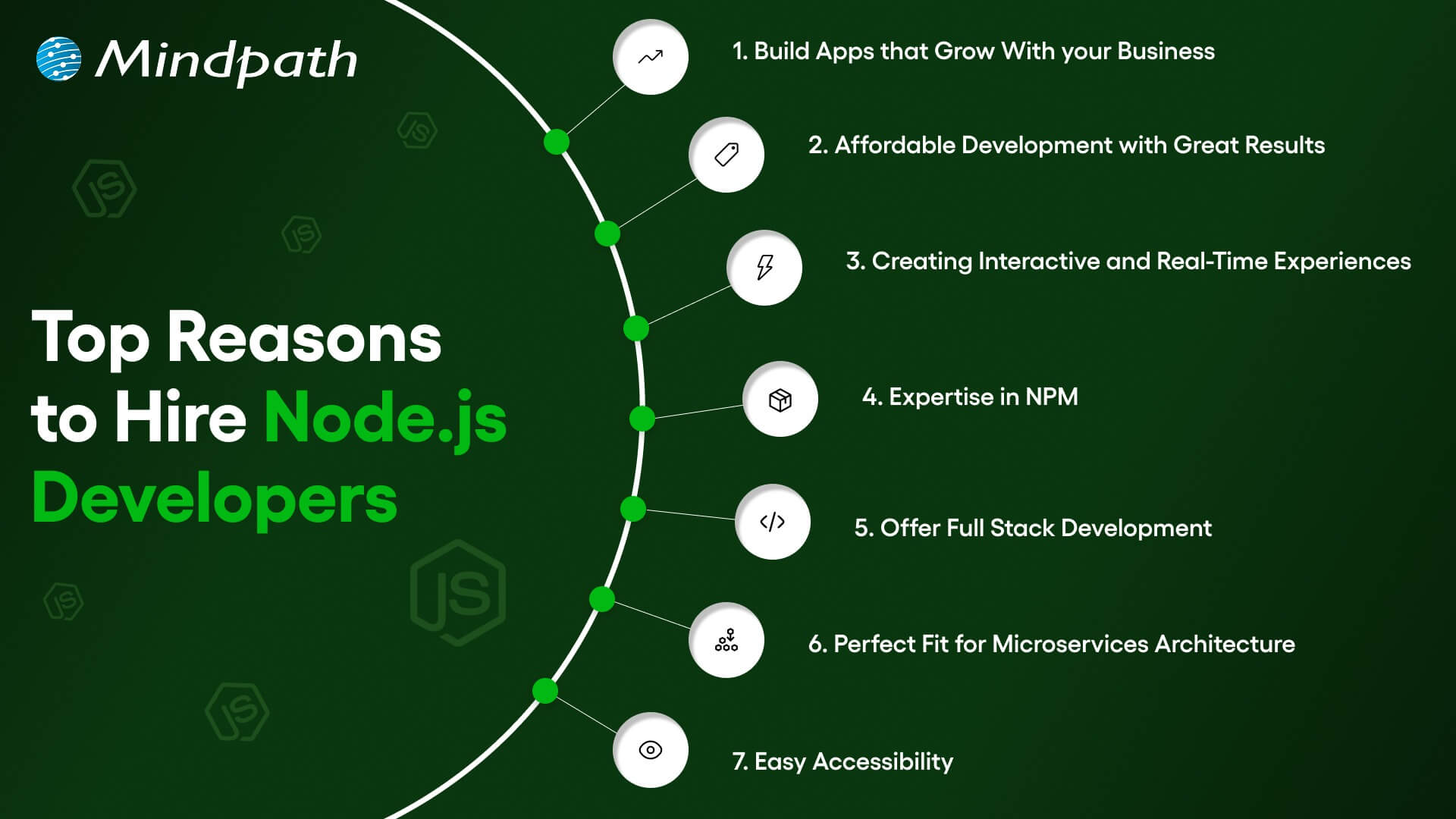
top reasons to hire node js developers

1. Build Apps that Grow With your Business

One big reason to bring in Node.js developers is their skill in building apps that grow with your business. As more people use your app, it needs to handle lots of users at the same time without slowing down. Node.js developers know how to make that happen. They use smart ways to manage traffic and keep everything running smoothly. Whether you’re starting small or expecting fast growth, they build your app ready for the future. If your app needs to respond quickly, handle real-time updates, or manage lots of users, these developers can handle that expertly. 

2. Affordable Development with Great Results

Using tools that don’t cost extra helps keep your project budget friendly. Developers skilled in Node.js know how to make the most of this free technology to build reliable and fast apps. Their experience means they can deliver quality work without unnecessary expenses. This balance of cost and performance makes a big difference for businesses looking to grow without overspending. With their help, you get a well-built application that won’t drain your resources but still meets your needs perfectly. 

3. Creating Interactive and Real-Time Experiences

When you want apps like chat, games, or teamwork tools that work instantly, developers with Node.js skills are the right choice. They understand how to build systems that don’t slow down, even when many users are active at once. Their work makes sure your app can handle lots of requests without waiting around, so everything feels fast and smooth. This means users can enjoy real-time updates and seamless interactions. Having these developers means your app will stay quick and responsive, giving your users a great experience every time they use it. 

4. Expertise in NPM

A good Node.js development company can offer you node.js developers who are experts in using NPM (Node Package Manager), the built-in tool that helps add new features quickly. Instead of building everything from scratch, these developers can easily find and use ready-made packages to speed up the process. This means your app can get new functions faster and updates happen smoothly. Their experience with NPM helps save time and effort, so your project moves ahead without delays. Hiring them means your app gets built efficiently while still being flexible for future changes.  

5. Offer Full Stack Development

With Node.js development, you get developers who can build both the front-end and the back end of your web app. They use the same language, JavaScript, for everything, which makes the process faster and more organized. These developers know how to create what users see and also set up the systems that keep your app working in the background. This means you don’t need two separate teams. It saves time, avoids confusion, and helps your app run smoothly from start to end. It’s a simple and smart way to get full-stack development done right. 

6. Perfect Fit for Microservices Architecture

Node.js developers are great at building apps using microservices Architecture. These are small parts of an app that can work on their own but also connect with other parts when needed. This makes the whole app easier to build, change, and grow. If one part needs an update, they can fix just that part without touching everything else. It keeps things flexible and clean. With Node.js developers, your app becomes easier to manage and ready to scale as your business grows. It’s a smart way to handle complex web apps without making things messy. 

7. Easy Accessibility

Node.js developers are easy to find because Node.js is based on JavaScript, a language most developers already know. This means that they don’t need much training to get started on your project. They can jump in quickly and begin working without long delays. This makes the whole process faster and smoother for you. Whether you’re starting something new or growing an existing app, having developers who already understand the tools saves time and effort. It’s a simple and smart choice when you want things done efficiently and without hassle. 

Looking to build fast and scalable NodeJS applications? Read our blog on hiring expert NodeJS Developers for High-Performance Apps to see how experienced developers can deliver robust, high-performing solutions for your business.

Ready to Build Powerful Applications with Node.js Developers?

Choosing to hire Node.js developers is one of the smartest choices for creating fast, real-time, and scalable web apps. These developers bring the right mix of front-end and back-end skills to keep your application running smoothly while handling more users as you grow. Their ability to work with modern tools and create user-friendly, high-performing apps makes them the right fit for businesses of all sizes. 

At Mindpath, our Node.js development services are designed to turn complex ideas into smooth, high-performing applications. Our developers are skilled in using the latest tools like NPM, real-time capabilities, and scalable systems to support your business needs. We bring both technical skill and practical experience to deliver solutions that are efficient, reliable, and easy to manage. 

Hire Node.js developers at Mindpath to give your business a strong edge in the digital space. Our team works closely with you to understand your goals, then builds powerful web solutions that meet them. Whether you’re starting small or planning big, we’ve got the skills to grow with you. 

Frequently Asked Questions

1. When is the right time to hire Node.js developer for a project?

The right time is when the project requires fast performance, real-time features, or the ability to handle many users at once. Hiring early in the planning stage also helps in building a strong architecture and avoiding costly changes later.

2. What skills should be checked before deciding to hire Node.js developer?

It is important to look for experience in JavaScript, understanding of asynchronous programming, and knowledge of frameworks and tools like NPM. Familiarity with APIs, databases, and scalable architecture also ensures the developer can handle real-world application needs effectively.

3. Can Node.js developers work on existing applications or only new ones?

Node.js developers can work on both new and existing applications. They can improve performance, add new features, fix issues, or even migrate parts of an application to Node.js, depending on the business requirements and technical goals.

4. How do Node.js developers help improve application performance?

Node.js developers use non-blocking architecture and efficient coding practices to handle multiple requests at once. This helps reduce delays, improve response time, and ensure the application runs smoothly even when many users are active simultaneously.

5. Is hiring Node.js developers suitable for startups with limited budgets?

Yes, Node.js is cost-effective because it uses open-source tools and allows faster development. Hiring skilled developers helps startups build scalable and high-performing applications without needing large teams or high infrastructure costs, making it a practical choice for growing businesses.

Support Is One Click Away

Featured Posts

Related Post

hire reactjs developer

ReactJS has been one of the most popular JavaScript libraries for user interface development. You might want to hire ReactJS developer for your next project to capitalize on the interesting features of ReactJS. Since its arrival in 2013, ReactJS has been a leading tool for frontend development with capabilities to develop high-performance user interfaces. Let us discover how you can find the best React developers in 2025 for your team.

Are you planning your next project and you need a ReactJS developer? Explore how Mindpath’s ReactJS development services can help bring your concept to life and help you achieve your business objectives.

Why is ReactJS Popular in 2025?

With so many libraries and frameworks emerging every year, it is reasonable to wonder about the reasons for which ReactJS is still popular. You should know that the demand for skilled ReactJS developers is still strong in 2025 as React is the cornerstone of modern web development. Businesses want to hire ReactJS developers for their web projects to capitalize on the various features of ReactJS.

One of the foremost reasons to choose React for frontend development is the backing of Meta, a tech giant. ReactJS was created by Meta, and even after becoming open-source, the library gets maintenance and support at par with the highest standards.

The other promising reasons to pick ReactJS for interface development include the component-based architecture, declarative syntax, cross-platform capabilities, and the virtual DOM. Each feature of ReactJS gives a strong reason to pick the best ReactJS developers for your next project.

The component-based architecture ensures that developers can create reusable UI components, thereby reducing the development time and ensuring easier maintenance. The declarative syntax of ReactJS enhances the predictability of code, which makes it easier to debug. On top of it, the virtual DOM helps in improving performance by avoiding direct modifications to the browser DOM.

Many companies also want to hire react native developers as ReactJS offers cross-platform development support with React Native. ReactJS is a versatile choice for businesses that want to leverage mobile apps for expanding their digital presence. Most important of all, ReactJS is still popular because it has a strong community that is growing continuously with new tools, libraries, continuous updates, and extensive resources.

Know Your Requirements to Hire React Developers

The search for skilled React developers might be a challenging task for hiring managers in 2025. Why? The competition among businesses to hire react developer also means that you can find a crowd of applicants for the job of React developers. Therefore, hiring managers must start their search for talented React developers with a clear understanding of their specific requirements. You have to keep the following points in mind while creating the job listing or description of the role.

1. Definition of Project Scope and Complexity

The first thing that you need to know before hiring React developers is the scope of your project. Are you building a single-page application or a complex web portal? Do you need interactive visualizations or have plans to scale up in the future? The answers to these questions can guide you through the React developer hiring process without obstacles. For instance, simpler projects will require a junior developer while complex web applications need senior developers who know API integration, state management and performance optimization.

2. Experience of the Developers

The next aspect of determining your hiring requirements from ReactJS developers is their seniority and experience. It is important to remember that the complexity of a project provides a clear direction when you have to determine the experience level you need in React developers. Junior developers might have less than two years of experience while mid-level React developers have two to five years of experience. Senior developers are the ideal picks for leading projects and making critical decisions, owing to their experience of more than five years.

3. Technical Skills of ReactJS Developers

Another prominent highlight in the process of creating a job description for ReactJS developers is the list of technical skills. You must specify the exact ReactJS developer skills that you need from a React developer in your team. The most important technical skills required from React developers include strong command over JavaScript and core ReactJS concepts, JSX, API integration and state management. You should also know that ReactJS developers must be fluent in HTML and CSS, testing frameworks, debugging and version control.

4. Soft Skills of ReactJS Developers

If you want ReactJS developers who can solve your problems, then you must focus on soft skills. Developers with problem-solving ability, communication skills, adaptability and attention to detail can serve as valuable assets for any organization. For instance, problem-solving skills can empower developers to break down complex problems and come up with efficient solutions. Similarly, adaptability enables ReactJS developers to understand new technologies and embrace change. Furthermore, communication skills and teamwork can help developers work effectively in different environments while tapping into the benefits of collaboration.

Are you missing out on the potential efficiency ReactJS offers for modern web apps? Discover the essential benefits of ReactJS development services to maximize your investment.

Searching for ReactJS Developers in the Right Places

The competition between ReactJS developers is high and with a vast talent pool, hiring managers often worry about the places to recruit React developers. If you know the right place to post listings for React developer jobs, then you can have an easier hiring process. Here are some of the top places to search for the best ReactJS developers.

1. Online Job Search Platforms

The best place to start listing ReactJS developer jobs is LinkedIn, the most popular professional networking platform. It is a great choice for posting job vacancies and searching directly for candidates with advanced filters, based on skills and experience. Some of the other notable job search platforms to hire dedicated developers for ReactJS projects include Indeed, Glassdoor and Monster. Hiring managers can use these job portals to post detailed job descriptions and attract a larger base of applicants for ReactJS development roles. Special job boards such as Stack Overflow Jobs and Discord communities can also help you find talented ReactJS developers.

2. Freelance Platforms

Another notable approach to hire resources for any business is freelancing. Some businesses want to hire remote ReactJS developers according to their budget or strategic plans. For example, remote work can empower developers to improve their productivity with better work-life balance. You can come across multiple freelance platforms such as Upwork and Fiverr to find ReactJS developers for small tasks or short-term projects. Freelance platforms also help you discover developers with specialized skills required for certain projects. One of the reasons to choose freelance platforms is the safety net of their rigorous scrutiny process, which ensures that you work with top-tier ReactJS developers.

3. Professional Networks, Communities and References

If you don’t find a React developer for your next project on different online platforms, job boards and freelance platforms, then you must choose the next best option. Businesses can hire expert ReactJS developers from professional networks and communities. For instance, GitHub is one of the best places to find a lot of ReactJS developers and measure their skills on the basis of their open-source contributions, coding style and portfolio. Developer conferences or React forums can help in obtaining references and identifying skilled developers. Always remember that references from industry contacts can help in identifying talented candidates who can also be the perfect cultural fit in your organization.

Is your current team struggling to handle large-scale React applications? Learn why hiring a React Development Company might be the smarter choice. 

Steps for Hiring the Best ReactJS Developers in 2025

After identifying the important requirements from ReactJS developers and the sources to hire top-tier talent, you need a strategic plan. The plan can not only streamline the hiring process but also offer the ideal template to make informed hiring decisions. You must keep the following points in mind to ensure the most productive hiring process to add talented ReactJS developers in your team.

Step 1: Design an Appealing Job Description

If you want the best ReactJS developers for your next project, then you must create an appealing advertisement. The job description serves as the ad to hire React developer on different platforms and makes the first impression on potential candidates. Experts recommend that the job description must be clear and concise to attract top talent among ReactJS developers. How can you design an attractive job description for React developer roles? You can start by mentioning a clear title that reflects the duties desired from the candidate. The job description must also provide a detailed company overview which shows why your company is a great place to work.

The job description must also include a list of the responsibilities for ReactJS developers in your organization. At the same time, you should also add the list of required skills for the job. While listing the responsibilities and skill requirements, you must be specific about them. On top of it, you must mention some additional skills that you need from ReactJS developers. The most important element that will complete your ReactJS developer job description is the outline of compensation and benefits.

Step 2: Use the Best Screening Techniques

Once you put the job description as a listing on different platforms, you will receive a lot of applications. The initial screening process is mandatory in all cases, whether you want to hire JavaScript developers or ReactJS developers. You can begin the initial screening process with a review of the resume and portfolio of candidates. It is important to check the experience of applicants in ReactJS projects and their work history. Hiring managers must also find out if candidates have contributed to open-source projects with ReactJS.

The effectiveness of the initial screening procedure for ReactJS developers also depends on how effectively you review their code. You should check the quality, structure and ease of maintenance of the code in different projects in a candidate’s portfolio. Automated coding assessment platforms can prove useful in measuring the proficiency of candidates in ReactJS development. The initial screening process may also involve a phone call for reviewing the communication skills, interests in role and salary expectations of applicants.

Step 3: Follow a Structured Approach to Interviews

Interviews for ReactJS developer roles might not be as simple as you have imagined. You should hire React programmers only after a multi-stage interview process for comprehensive evaluation of all candidates. The essential stages that you should include in an interview for ReactJS developer jobs include technical interview, system design interview and behavioral interview. Technical interviews must involve live coding exercises focused on core ReactJS concepts, algorithms and data structures. Hiring managers can provide real-world scenarios with coding challenges to evaluate the hands-on coding proficiency of candidates.

The system design interview is a type of advanced technical interview tailored for senior roles. The primary focus in the system design interview is on scalability, design patterns, complex systems and architecture. Candidates for senior React developer roles must be asked to design scalable React applications or recommend the structure for a large-scale project. Finally, the behavioral interview can serve as a useful tool to measure the soft skills of candidates. Behavioral interviews help in evaluating whether the candidate will be a perfect fit in an organization.

Step 4: Salary of ReactJS Developers in 2025

Another important step in the process for hiring ReactJS developers in 2025 focuses on determining the ideal salary. Awareness of the salary expectations can help a business identify the best compensation for React developers working on their projects. The cost of hiring ReactJS developer depends on various factors including location, experience, employment type, company size and specialized skills. The average annual salary of ReactJS developers in the USA varies between $70,000 and $180,000.

Seeking a development approach that reduces complexity while enhancing functionality? Read why React Web Development is ideal for modern projects.

Mistakes You Should Avoid While Hiring ReactJS Developers

The most crucial step in the process of hiring ReactJS developers is to acquire awareness of common mistakes. For instance, some employers focus a lot on the cost of hiring and go for cheaper options that lead them to problems in the long run. It is important to choose talent that will pushes your project forward on the path to long-term success. Ambiguity in the job description might also be one of the notable mistakes while hiring React developers.

If you want to hire dedicated ReactJS developers, then you must also pay attention to common pitfalls in technical and behavioral assessment of candidates. On top of it, recruiters must also pay attention to the references of a candidate and use updated interview questions.

Ready to Hire a ReactJS Developer Who Delivers Real Results?

You can hire the best talent for ReactJS development in 2025 by focusing on a systematic plan for the hiring process. Hiring managers can rely on professional ReactJS development services to find a way around the intricacies of the hiring process. Professional service providers can help you work with top-tier talent that you can choose according to your project requirements.

Mindpath Tech is your one-stop destination for hiring the best ReactJS developers with years of professional experience. We have been crafting visually appealing web apps and strengthened our reputation as one of the top end-to-end IT solutions provider. Consult with our experts and find ReactJS developers with the most relevant skills for your next project now.

Frequently Asked Questions

1. What is the right time to hire a ReactJS developer for a web project?

Ideally during the planning stage, before development begins. Early involvement allows developers to make informed architectural decisions, choose the right tech stack, and structure components correctly from the start. Delaying the hire until mid-development frequently results in costly structural rework that could have been avoided with proper planning upfront.

2. How should businesses decide between hiring a junior versus senior ReactJS developer?

Project complexity is the primary determining factor. Straightforward applications suit junior developers adequately, while complex platforms requiring advanced state management, API integration, and scalable architecture genuinely demand senior expertise. Mismatching experience levels to project requirements either wastes budget unnecessarily or accumulates technical debt that becomes increasingly expensive to resolve.

3. What are the most common hiring mistakes businesses make when recruiting ReactJS developers?

Prioritizing cost over capability, writing vague job descriptions, and neglecting behavioral assessments are the most frequent errors. Evaluating technical skills in isolation without assessing communication ability, problem-solving approach, and cultural fit consistently leads to team friction, missed deadlines, and project outcomes that fall well below initial expectations.

4. Is GitHub a reliable resource for evaluating ReactJS developer capabilities?

It is one of the most transparent evaluation tools available. Open-source contributions reveal coding style, component structure, version control discipline, and collaborative habits far more accurately than any resume. Reviewing a candidate’s repositories provides genuine insight into real-world coding quality before any formal interview stage begins.

5. What should businesses realistically budget when planning to hire a ReactJS developer?

In the United States, annual salaries range between $70,000 and $180,000 depending on experience, location, and specialization. Total hiring costs extend beyond salary to include recruitment expenses, onboarding, and equipment provisioning. Freelance or agency engagements offer more budget predictability for businesses with clearly defined project scopes and fixed timelines.

How much does hiring a ReactJS developer cost? Learn about factors affecting rates, and how to find the best talent within your budget.
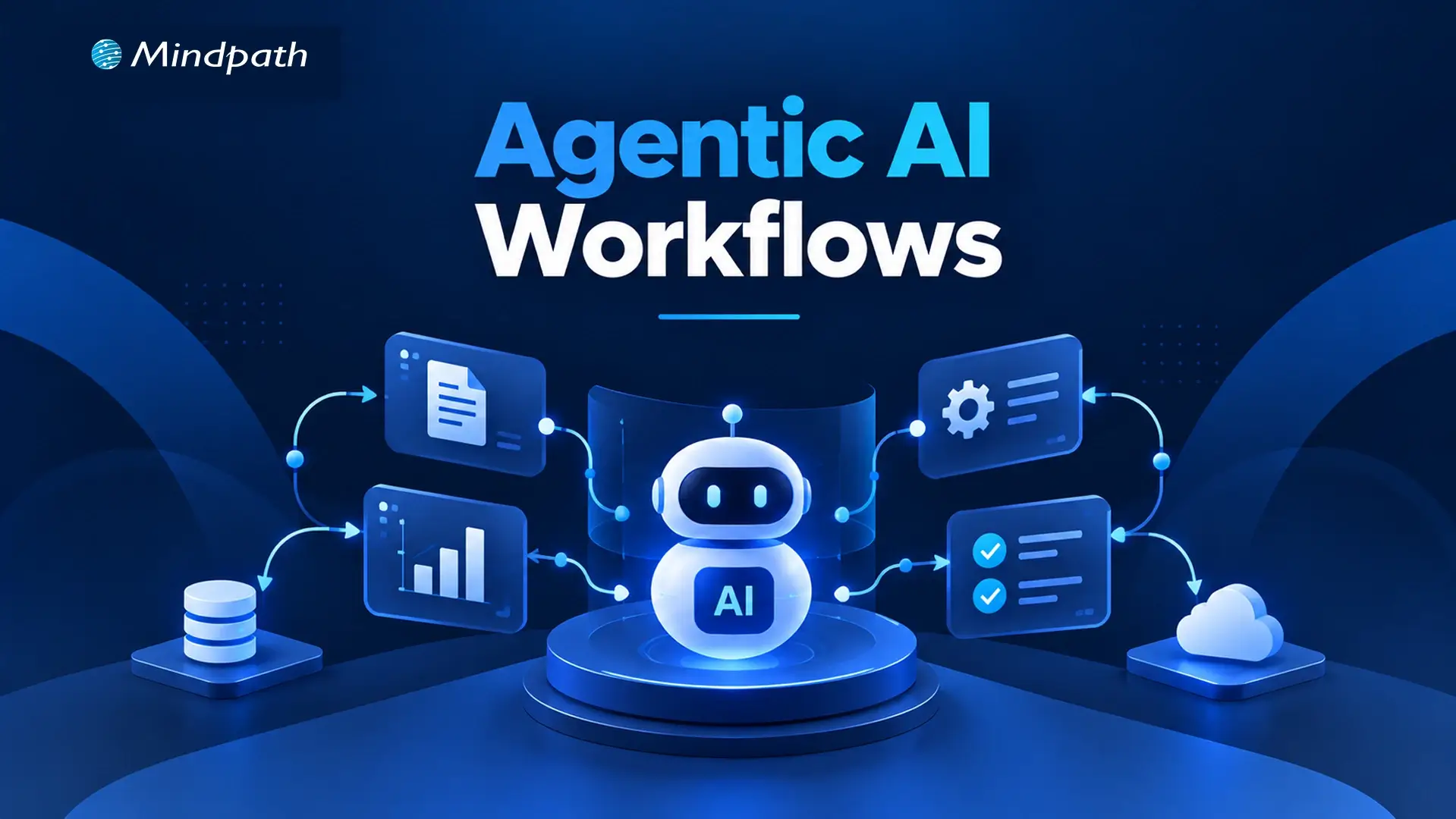
Chatbots to Agentic AI

Businesses today move fast. Customer expectations move even faster. The old model of deploying a simple chatbot to handle FAQs and call it “AI adoption” no longer cuts it in 2026. The real shift happening right now is the leap from chatbots to agentic AI, and it is reshaping how small and mid-sized businesses operate, compete, and grow. This is no longer a futuristic concept. It is an active, measurable business decision.

Key Takeaways

  • 01
    Agentic AI executes complete workflows autonomously, while chatbots only answer questions.
  • 02
    SMBs adopting agentic AI gain a measurable competitive edge over slower-moving peers.
  • 03
    Agents integrate directly with your existing tools, eliminating manual hand-offs entirely.
  • 04
    No-code platforms make agentic AI deployment accessible for non-technical SMB founders today.
  • 05
    Starting with one repetitive task is the smartest and fastest path to implementation.

So, think about this for a moment. Your competitors are not just automating conversations anymore. They are automating decisions, workflows, and outcomes. Agentic AI does not wait for instructions at every step. It reasons, plans, and acts autonomously across your entire business stack. SMBs that recognize this shift early will set the pace. Those that wait will spend the next few years catching up. In this blog, we break down exactly what this transition means, why it matters deeply for your business, and how you can start making it work today.

Looking to move beyond basic chatbots? Our Agentic AI development services help businesses build intelligent AI agents that deliver real business value.

How Does Agentic AI Differ from a Chatbot?

A chatbot is a rule-based conversational tool. It responds to queries, retrieves information, and operates within predefined boundaries. Agentic AI is an autonomous intelligence system. It receives a high-level goal, reasons through complexity, and executes multi-step tasks across tools, APIs, and workflows independently.

Consequently, the evolution from chatbots to agentic AI represents a fundamental shift in capability. A chatbot delivers an answer. An agent delivers an outcome. It plans, decides, coordinates across systems, and completes entire business processes without requiring human intervention at each step.

Let’s have a glance at the key difference through this table:

Category  Agentic AI  Chatbot 
Primary Purpose Works toward a goal and completes tasks from start to finish. Answers questions and responds to user messages.
Autonomy Can make decisions, plan actions, and work with minimal human input. Requires continuous user prompts and instructions.
Task Execution Handles complex, multi-step workflows and can adapt when situations change. Typically manages simple conversations or predefined tasks.
Tool & System Access Uses APIs, databases, business software, browsers, and other tools to perform actions. Mostly provides information; limited ability to take real actions.
Memory & Context Maintains task history, user preferences, and long-term context across interactions. Usually remembers only the current conversation session.
Outcome Delivers completed results (e.g., creates reports, books meetings, processes requests). Delivers responses, suggestions, or information only.

Why are SMBs Choosing Agentic AI Over Traditional Chatbots in 2026?

SMBs are not adopting agentic AI out of curiosity. They are doing it because the gap between a chatbot to AI agent is now a gap between falling behind and staying competitive. The business case is clear, measurable, and growing stronger every quarter. Here are the reasons why SMBs are making the switch right now.

1. Always-On Execution

Agentic AI operates continuously across time zones without failing. It handles complex, multi-threaded tasks around the clock, functioning truly as a 24/7 digital employee for your business.

2. End-to-End Automation

Unlike AI chatbots for customer service that stop at answering queries, agents take direct action. One agent can check inventory, process a return, and update your CRM automatically without a single human hand-off.

3. Autonomous Problem Solving

Agents use a built-in reasoning layer to break high-level goals into actionable steps. They analyze context in real time and respond decisively without waiting for human instruction at every turn.

4. Deep System Integration

Agents connect directly via API to your existing tech stack, including Slack, Google Drive, and inventory systems. They pull data, update records, and execute changes securely across your entire business infrastructure.

5. Real Cost Savings

Running an agentic workflow costs a fraction of a full-time employee’s salary. SMBs consistently recover significant operating capital monthly while eliminating the inefficiencies tied to manual staff time.

6. Dynamic Adaptability

Traditional chatbot flows break the moment a variable changes. The shift from chatbots to agentic AI means your system now adapts in real time, handles ambiguity, and course-corrects when processes go wrong.

7. No-Code Deployment

Advanced no-code platforms allow non-technical SMB founders to build and launch role-specialized agents quickly. You do not need a large in-house IT team to start seeing immediate, measurable value.

8. Scalability Without Hiring

Agentic workflows allow SMBs to handle sudden spikes in traffic or rapid business expansion confidently. You scale operations without the immediate pressure to hire, onboard, and train new employees.

Must-Know Insights on SMBs Using AI

  • Over 75% of SMBs actively use or experiment with AI today.
  • 97% of SMBs using voice AI agents report direct revenue increases.
  • Gartner predicts 25% of all IT work will run on AI agents by 2030.
  • 91% of SMBs adopting AI report measurable revenue gains consistently.
  • Growing SMBs lead AI adoption at 83%, far ahead of stagnant peers.

How to Transition Your SMB from a Chatbot to Agentic AI in 2026?

Making the switch sounds complex, but it does not have to be. Most SMBs already have the tools and workflows needed to start deploying conversational AI agents today. Here is exactly how you move from intention to implementation.

1. Start Small

Identify one high-value, repetitive task your team handles manually every day. Build your first agent around that single workflow before expanding further.

2. Map the Workflow

Write down every trigger, system, and decision rule a human follows to complete the task. This plain-language process becomes the core instruction set for your agent.

3. Connect Your Stack

A customer service agentic AI chatbot without tool access is simply a smarter chatbot. Equip your agent with API connections to the software your team already uses daily.

4. Set Human Guardrails

Identify every point in the workflow where an agent mistake would carry significant cost. Program the agent to pause and request human approval at each of those critical steps.

5. Pick Your Platform

The transition from chatbots to agentic AI no longer requires a large technical team. Explore no-code and low-code visual builder platforms to design and deploy workflows without writing a single line of code.

Is Your Business Ready to Move Beyond the Chatbot?

The shift from chatbots to agentic AI is not a distant trend. It is happening right now, and SMBs that act early will hold a serious competitive edge. The technology is accessible, the results are proven, and the window to move first is still open.

At Mindpath, we provide AI development services that help SMBs make this transition confidently. We build, integrate, and deploy agentic solutions tailored to your exact business needs. Let us help you move from conversation to action, starting today.

Frequently Asked Questions

low-rank adaptation (lora)

The landscape of artificial intelligence is advancing at a higher rate. And it has made it crucial to ensure efficient adoption of LLMs or Large Language Models.  Low-rank adaptation (LoRA) has emerged as an effective technique to fine-tune LLMs. Developers are now looking for scalable methods to customize AI models. Well, LoRA offers them a lightweight and cost-effective technique.

Furthermore, it has made the process of low-rank adaptation of LoRA in fine-tuning feasible, accessible, and efficient. In this detailed blog, we will explore more about the LoRA adaptation, understand what it is, and how it works. Besides, we will also discuss why it is an important method for fine-tuning LLMs in 2025. So, read on!

Struggling to figure out how advanced tuning methods like LoRA can give your business a competitive AI advantage? Mindpath’s AI development services help you harness LoRA-driven fine-tuning to build smarter, faster, and more efficient AI solutions.

Low-Rank Adaptation (LoRA) – An Overview

Before exploring more about low-rank adaptation (LoRA), let’s start with the basics, i.e., what is low-rank adaptation in LoRA? It is an efficient fine-tuning method that trains large LLMs to easily handle new tasks. The best part is, with this method, developers don’t need to change any parameters. Instead of updating all parameters. LoRA freezes the model weight and then injects a few new weights or trainable low-rank matrices. Fine-tuning with LoRA significantly lowers the number of trainable matrices without affecting the model’s base knowledge.

Importance of LoRA

Large language models such as ChatGPT are powered by massive neural networks. These networks have trillions of parameters. And during pre-training, these parameters are fine-tuned to make models work properly. While it makes AI models powerful, there is no guarantee that they will work efficiently for certain tasks. Adapting a larger language model to a specific use case, like custom support automation or legal documentation, requires full fine-tuning. For instance, if you want to fine-tune GPT-4, then you will have to work on around 1.8 trillion parameters. Besides, the process demands enormous infrastructure and GPU memory.

However, low rank adoption (LoRA) provides developers with a more efficient and smarter alternative. It allows them to inject small training parameters into specific layers. This, in turn, reduces GPU memory requirements. Furthermore, it leads to minimal disruption, lower costs, and quick training. If you think Low Rank Adoption is the only parameter-efficient method, let us inform you that QLoRA or Quantization LoRA is now gaining popularity in the industry. The reason behind this is that it combines high-precision computation with low-precision storage.

Low Rank Adaptation LoRA Example

Now, let’s have a look at a Low rank adaptation LoRA example in order to get a clear idea about the impact of LoRA. Let’s assume you want to fin-tune BERT. You may opt for a full fine-tuning. But for that, you will have to retrain nearly 108,314,886 parameters. Besides, the method is resource-intensive.

On the other hand, using LoRA, you can freeze the model’s original weights. It allows you to train only the necessary adapters related to your tasks. In fact, you can achieve the desired results just by training only 78,342 parameters. As a result, you will witness a significant reduction in training time as well as machine cost.

New to fine-tuning techniques like LoRA and unsure where to start? Explore Large Language Model (LLM) to build a strong foundation before diving deeper.

Low-Rank Adaptation (LoRA) Techniques

Now that you have a clear understanding of low rank adaptation (LoRA), let’s talk about the right way to use Low-Rank Adaptation (LoRA) Techniques. To ensure desired outcomes, developers can follow these steps.

1. Selecting a Base Model

 Begin by choosing a suitable AI model. You can opt for GPT-4 or GPT-3 as per your need.

2. Create Datasets

After the selection of a model, next, you need to collect quality datasets. Here, you must ensure that those datasets match your fine-tuning objectives.

3. Deploy LoRA Modules

While deploying LoRA adapters, choose the right attention layers. To avoid any issues, ensure a balance between performance and efficiency.

4. Rank Tuning

Select an appropriate rank. While smaller ranks can lower training costs, they can limit the model’s expressiveness. In general, the value can range between 4 and 46, based on the task.

5. Train Adapter Parameters

Here you need to be careful. First of all, freeze all the original parameters. Once done, you can start training low-rank parameters on your dataset. There is no need to train all parameters.

6. Process Validation

Use a separate validation set to monitor the performance of the model. Keep in mind that if the training data is limited and the rank is too high, this can increase the risk of overfitting.

7. PEFT Libraries Integration

To streamline the implementation process, developers can deploy libraries such as Hugging Face’s Parameter-Efficient Fine-Tuning library. It offers plug-and-play support.

Wondering how LoRA compares to traditional fine-tuning approaches? Discover OpenAI’s Fine-Tuning API to understand when efficient fine-tuning matters most.

The Hidden Cost of Full Fine-Tuning

To get a clear understanding of the importance of Low-rank adaptation (LoRA), it is critical to understand the exhaustive technique it replaces, i.e., Full Fine-Tuning.

A pre-trained large language model is essentially a huge network of weight matrices that encode the learned knowledge of the model. When developers go for a full fine-tuning, they feed the model specialized datasets. After that, the model adjusts each parameter to align with the new task.

This process involves calculating errors in the output and sending gradient updates through the entire network using an optimizer such as Adam. However, this technique comes with some critical drawbacks.

1. High Computational Cost

Fine-tuning a model with billions of parameters requires massive GPU memory. To store the AI model, optimizer stats, and necessary gradients, you will need enough VRAM, around hundreds of gigabytes.

2. Storage Inefficiency

Full fine-tuning creates a new model file. A 70B model, at 16-bit precision, can be around 140GB. Storing this size of file for every user who needs a custom AI model is unsuitable. That means maintaining separate models at large is nearly impossible.

3. Risk of Forgetting

Updating all weights to understand the new tasks can overwrite the existing capabilities of the model. For instance, it may not be able to translate language. This can significantly reduce the model’s versatility.

For years, AI model customization was exclusive to the AI labs that created them. However, things have started to change, all thanks to low-rank adaptation (LoRA). It has changed the rules of fine-tuning.

Curious about what LoRA actually optimizes inside modern AI models? Explore attention mechanism explained to understand the architecture behind efficient adaptation.

Why LoRA is an Excellent Option for Fine-Tuning LLMs?

Low rank adaptation (LoRA) is an ideal method for fine-tuning LLMs. After all, it brings efficiency, scalability and versatility to the process.

Here are some benefits of LoRA that prove why it is an excellent option.

1. Parameter Efficiency

As mentioned above, LoRA reduces the number of parameters. It makes fine-tuning possible utilizing low-resource hardware. Apart from this, it opens doors for independent developers to customize AI models.

2. Retain Pre-Trained Knowledge

By preserving base model weight, LoRA eliminates the risk of catastrophic forgetting. Using this, developers can ensure that a model’s general language understanding capability remains intact while expanding to new domains.

3. Scalable Fine-Tuning

With low rank adaptation (LoRA), fine-tuning is faster compared to other techniques. Developers can fine-tune multiple versions of models for various domains. There is no need to duplicate the entire model. As a result, version control will be easier.

4. Full Impact with Zero Latency

The weights of the adapter can be easily merged with the pre-trained models during inference. This helps maintain runtime performance without added latency.

5. Versatility

LoRA seamlessly integrates with popular transformer architectures such as BERT, T5, and GPT. That’s why it is a versatile fine-tuning solution in 2026.

Thinking about where LoRA-fine-tuned models create real business value? Discover generative AI use cases in diverse industries to see how efficient AI adaptation drives impact.

Final Thoughts

Low-rank adaptation (LoRA) is now transforming the process of fine-tuning large language models. By reducing the total number of trainable parameters while maintaining the model’s integrity, LoRA has made fine-tuning more scalable, cost-effective, and accessible. Whether you are developing a multilingual translator or a healthcare chatbot, it offers the precision and flexibility required to train AI for real-world applications.

Developing and fine-tuning AI models can get complicated. This is where Mindpath comes in. Our AI development services can help you in designing and fine-tuning models using low-rank adaptation (LoRA). While doing that, we also ensure that all the things fit perfectly into your workflows. Let us make your AI solution personalized and powerful.