Factors to Consider While Hiring NodeJS Developers

Join our Newsletter!

Featured Posts

Support Is One Click Away

Home

Factors to Consider While Hiring NodeJS Developers

Hire nodejs developers

Factors to Consider While Hiring NodeJS Developers

As a result of the rapid evolution of the digital landscape, businesses nowadays want faster, efficient, and more scalable options. This is why many companies choose to hire NodeJS developers who are able to develop high-performing applications without limitations of real-time responsiveness. As businesses compete for efficiency and seamless digital offerings, the demand for NodeJS expertise is increasing. But when hiring a NodeJS Developer, it isn’t just about technical knowledge; it’s about a deeper understanding of your business aims and objectives.

So, how do you make the right choice when the market is filled with so many options? This is the point where many decision-makers stop and consider. With numerous talented developers available, knowing what differentiates the right developer can be a challenge. Filling a role quickly is easy, but finding a developer who contributes positively to your long-term growth is different. Before proceeding to the next step, you should slow down and investigate the key factors to consider in making the right decision.

Looking for a Node.js developer who ensures your app performs at scale without compromising speed and security. HireNode JS developers from Mindpath who strive to provide you the best, world-class solutions.

Who is a NodeJS Developer?

A NodeJS developer is a technical professional who uses Node.js to create fast, scalable applications server-side. They’re responsible for everything from building prototypes to writing clean code that supports applications that power our world. Their responsibilities also include connecting back-end services with front-end systems to provide users with maximum efficiency and reliability.

Node.js developers are crucial for contemporary software projects because Node.js enables developers to utilize one programming language, JavaScript, for both the client side and server side. They develop great solutions thanks to the ability to do it quickly. They also have strong problem-solving skills and know how to utilize this technology to further enhance an application and prepare it for scale.

What are the Responsibilities of a NodeJS Developer?

Companies wanting to grow often look to hire dedicated Node.js developers as part of their technology teams. Node.js developers do more than code; they are an integral part of delivering solutions that will amplify your digital products.
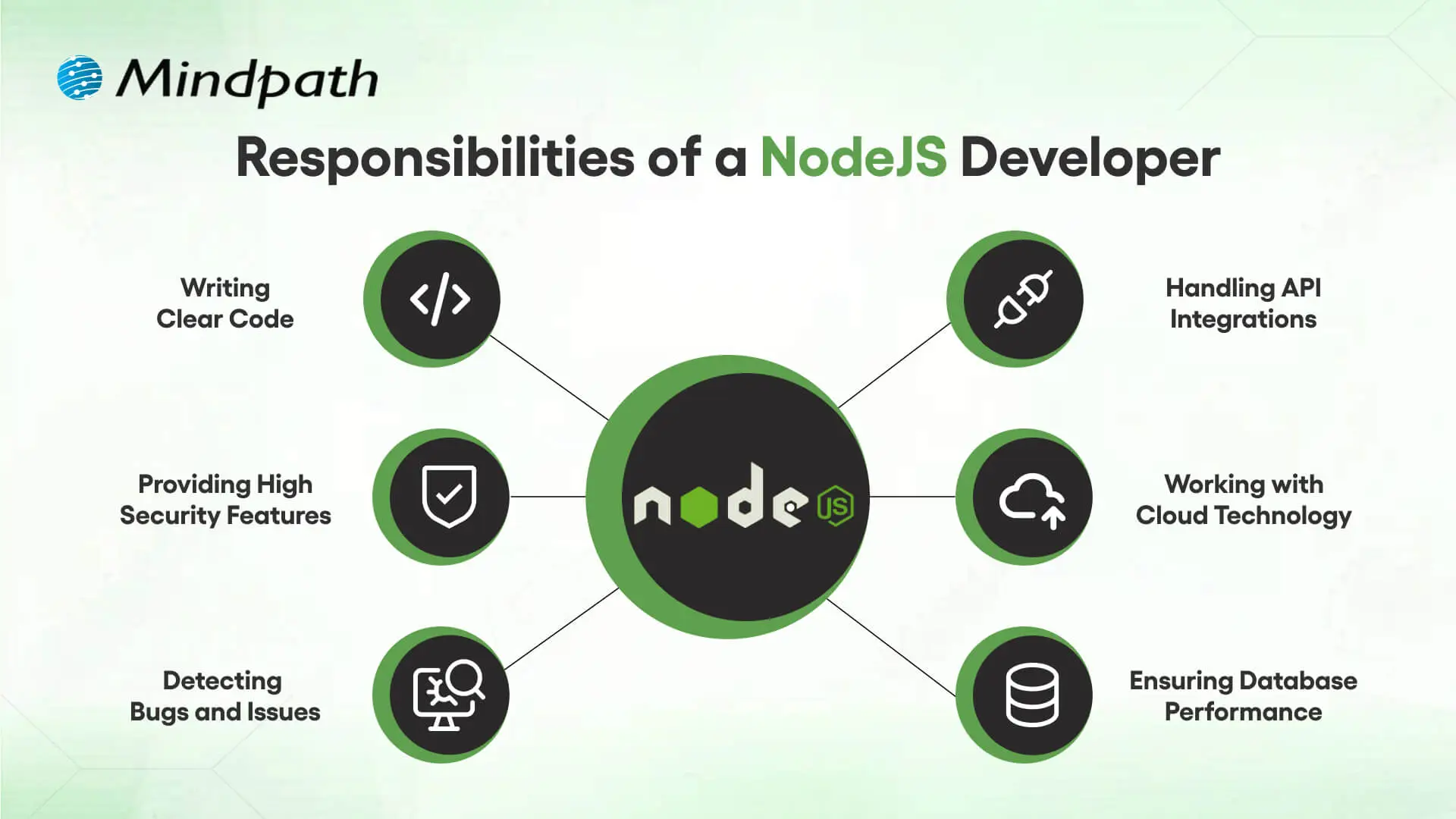
1. Writing Clear Code

When you hire Node.js developers, their job is to write clean and readable code. This will make it easier for other developers to maintain and grow the application.

2. Providing High-Security Features

Security is also a core part of a Node.js developer’s job. Developers need to identify their risks and add features that protect data and users.

3. Detecting Bugs and Issues

Bugs can give rise to slowed-down applications and degradation of performance. NodeJS developers are then also able to quickly identify and fix bugs to maintain stability on the systems.

4. Handling API Integrations

Most modern applications require API integration to add some functionality. Proficient NodeJS developers know how to use API integrations such as HTTP, buffers, and simple file handling.

6. Working with Cloud Technology

When you hire Node.js developers, it is common for these developers to work on the backend and, therefore, will work with cloud deployment. They will configure a cloud platform (such as AWS or Azure) to run the application to ensure it runs properly.

7. Ensuring Database Performance

A Node.js developer will oversee your databases so that the responses are quick. They ensure the back-end interacts with your front-end requests appropriately.

Unlock the new opportunities by Mastering Full-Stack Development with Node.js, the key to building a reliable application. Explore now and elevate your business to the next level.

Key Factors to Consider While Hiring Node.js Developers

Choosing the right talent can dictate whether or not your digital projects achieve ultimate success. If you are going to hire a Node.js developer, here are the important things to keep in mind before you do.
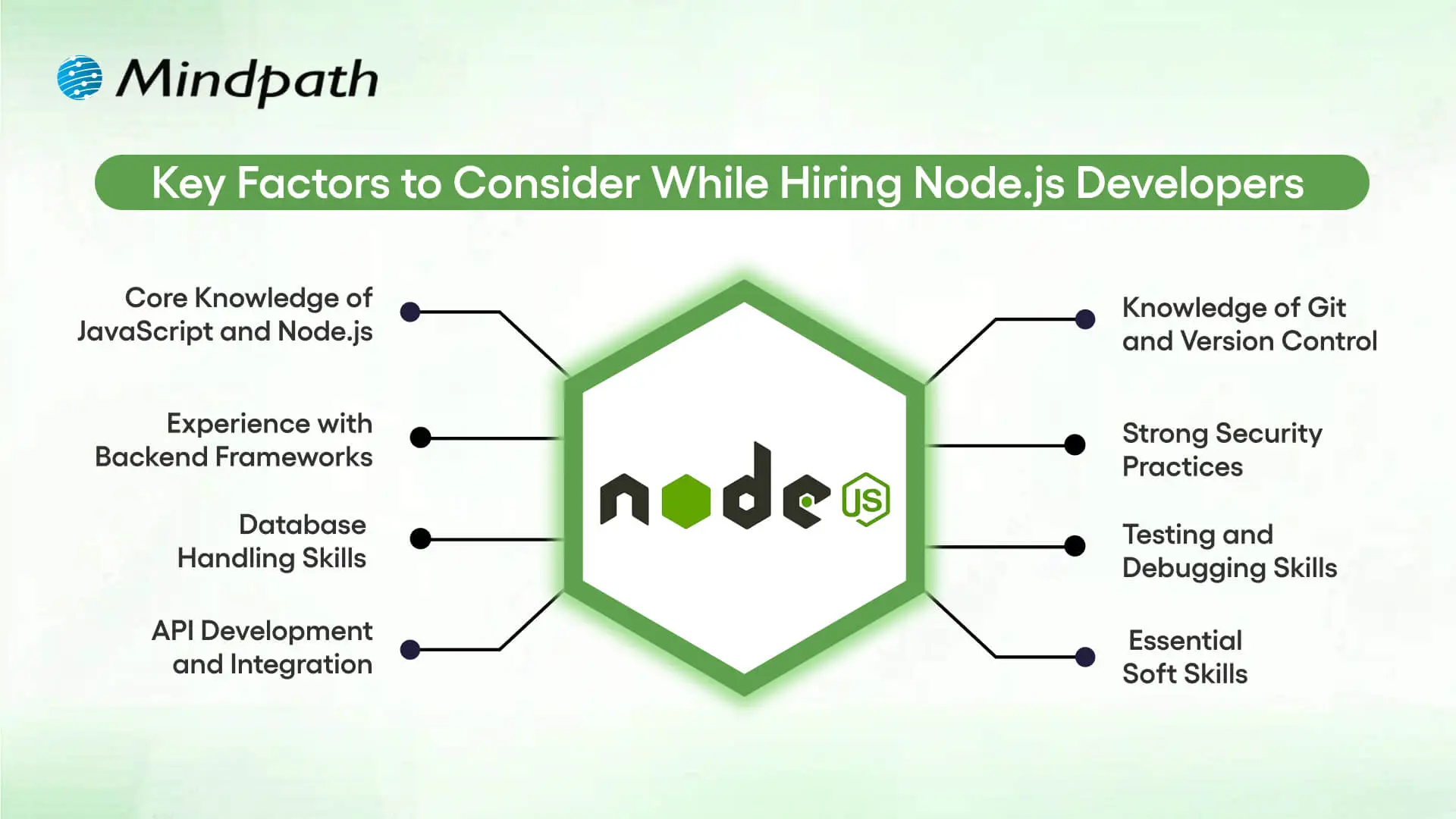
1. Core Knowledge of JavaScript and Node.js

When hiring Node.js developers, the first thing is to check their understanding of the basics of JavaScript and Node.js foundations. They should understand asynchronous programming, Node event loop, and code management through NPM, as well as managing dependencies, which is a large part of the Node.js developer roadmap related to developing scalable applications.

2. Experience with Backend Frameworks

A top-notch developer should really have practical experience with frameworks like Express.js, Koa.js, or Nest.js. The key benefit of these frameworks is that they make projects faster, and framework-less projects have no organization. If you’re hiring Node.js developers, you can easily test their framework knowledge with some simple tasks or some Node.js developer interview questions.

3. Database Handling Skills

All applications require databases, so any competent developer must know their databases MySQL, PostgreSQL, and they must know some NoSQL databases such as MongoDB. They need to understand caching as well as real-time data processing by having basic knowledge of tools like Redis. If you hire a Node.js developer with good database skills, your application will respond faster and stay robust.

4. API Development and Integration

APIs connect applications to additional services, and Node.js is often a popular choice to build those APIs as well. Developers must be familiar with RESTful APIs, GraphQL, and secure protocols like OAuth. Before you hire Node.js developers, be sure to ask them how they create APIs and manage API integration.

5. Knowledge of Git and Version Control

Git is an everyday tool for every developer, and they should be able to manage branches, pull requests, and conflicts without hindering the development. The knowledge of Git is a prerequisite for hiring Node.js developers for teamwork purposes.

6. Strong Security Practices

Security is always a primary concern. Developers need to understand encryption, input validation, and token-based authentication. When employing Node.js developers, look at how they implement these practices to protect applications and sensitive information.

7. Testing and Debugging Skills

Reliable applications need effective debugging and testing. Developers can leverage tools (such as Mocha, Jest, or Cypress) to find bugs early in application development. Knowledge of testing is a vital skill if you are planning to hire Node.js developers to help with long-term applications.

8. Essential Soft Skills

Technical skills are not enough to qualify for Node.js Developer jobs. Communication, collaboration, and problem-solving all make progress much easier on a project. These skills are equally important each time employers hire Node.js developers, as many projects will have challenging aspects.

As user experiences is evolving day by day, businesses need to adopt technologies that ensure speed, scalability, and reliability. Discover how Hiring Expert NodeJS Developers can help you deliver high-performance digital solutions.

Steps to Hire a Node.js Developer

While the search for the perfect talent can seem daunting, breaking the process down into clear steps makes it much easier. Below are the key steps to take when hiring a Node.js developer for your project.
Steps to Hire a Node.js Developer

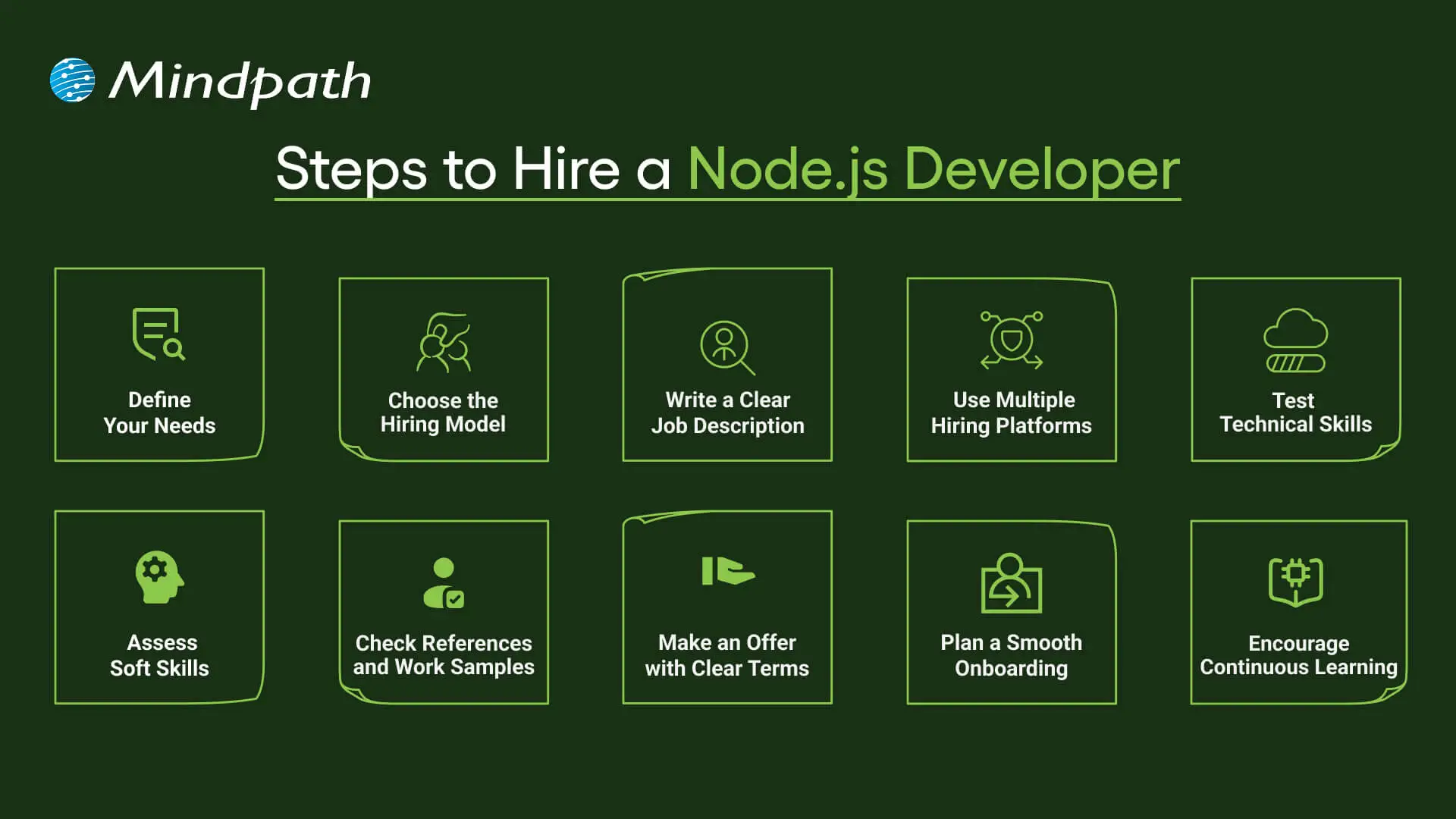
1. Define Your Needs

Start by defining your project scope, features, and tech stack. When you hire NodeJS developers, identifying clear requirements can save time and attract the right candidates.

2. Choose the Hiring Model

Determine whether you need in-house, remote, or offshore developers. Many companies hire NodeJS developers offshore for more flexibility and lower costs.

3. Write a Clear Job Description

A well-written job description allows candidates to know what they are applying for. Include as much as possible in the description, who you want, including the skills, the experience you expect, and if you are looking for a full-stack Node.js developer.

4. Use Multiple Hiring Platforms

Search for talent on LinkedIn, GitHub, and job boards that identify talented developers. These platforms enable developers to connect because of their special skill set.

5. Test Technical Skills

Evaluate coding expertise with tasks, interviews, or online coding challenges. This evaluates whether the developer can work with Node.js concepts properly.

6. Assess Soft Skills

Good communication and teamwork are as essential as coding, because they also allow the project to flow without delay.

7. Check References and Work Samples

It’s important to understand what the developer has done in the past, so it is good to check references and speak to previous clients or employers. This develops an understanding of the developer’s reliability and quality of effects.

8. Make an Offer with Clear Terms

Discuss salary, benefits, and expectations openly. Transparency builds trust and helps retain the developer.

9. Plan a Smooth Onboarding

Provide tools, resources, and guidance to new hires. A structured onboarding makes developers productive faster.

10. Encourage Continuous Learning

Support your team in learning new Node.js updates and practices. This keeps skills sharp and projects future-ready.

Want to enhance your website presence in today’s fast-paced digital world? Explore our detailed blog on how you can Increase Web Performance with Node.js Development Services.

Looking to Hire Expert Node.js Developers for Your Next Project?

Hiring the right Node.js talent can define the success of your digital projects. Skilled developers bring more than technical expertise; they align with business goals and deliver scalable, secure, and high-performing applications. By following clear steps and evaluating both technical and soft skills, you ensure your projects are built for long-term growth and innovation.

Mindpath stands out as a trusted Node.js development company offering top-tier Node.js development services. With a team of skilled developers, we help businesses build scalable applications tailored to their unique needs. By choosing Mindpath, you gain a partner focused on delivering secure, efficient, and future-ready solutions that accelerate your digital success.
Related Post

Discover the key factors influencing software development costs and how to optimize your budget. Learn how Mindpath can help.
Discover how to choose the best healthcare software development company with insights on expertise, experience, scalability, security, and cost factors.

Related Post

IT Staff Augmentation

Are you looking for ways to cut costs while maintaining a high-performing IT team? You’re not alone! Many organizations are exploring innovative solutions to optimize their budgets without sacrificing quality. One effective strategy is IT staff augmentation. But what exactly does that mean, and how can it help your organization save money? In this blog, we will explore how organizations can optimize costs with IT staff augmentation. So, let’s dive in! 

What is IT Staff Augmentation?

Staff augmentation refers to hiring outside specialists to cover vacancies or skill shortages within an organization. Using this method enables businesses to modify their staff according to the demands of a project. Businesses can minimize the long-term expenses associated with permanent recruitment by using augmented employees to help with certain projects instead of recruiting full-time employees. 

Staff augmentation is a great way to cut IT expenses. Companies save money on things like office space, taxes, and benefits because augmented personnel are not full-time employees. This facilitates cost prediction and budget management. Staff augmentation also provides access to a larger talent pool. Specialized talents can be found by businesses fast, saving them the time and trouble of extensive hiring procedures for permanent employees.  

Benefits of Cost Optimization Through IT Staff Augmentation

Benefits of Cost Optimization through IT Staff Augmentation

1. Flexibility

IT staff augmentation provides firms with a high level of flexibility. It enables them to rapidly modify their personnel in response to shifting market demands. Without having to commit to hiring full-time labor, organizations can readily increase or decrease their headcount as project demands change. This keeps them sensitive and flexible in a hectic setting. 

Additionally, its adaptability enables companies to investigate novel prospects. They can swiftly recruit the right individuals to capitalize on any emerging trends in the industry. Their capacity to adapt enables them to manage expenses and successfully maintain their competitive and creative edge.  

2. Reducing Overstaffing

The ability of IT staff augmentation to prevent overstaffing is one of its main benefits for businesses. During difficult economic circumstances, companies can recruit an excessive number of full-time employees using typical employment practices. If the workload lessens, this might result in needless expenses. 

Businesses can adjust the size of their workforce according to what they actually need right now by using IT staff augmentation. They can easily cut back on the number of temporary employees in the event of a sharp decline in demand, saving money by not having to pay for idle personnel or layoffs. Because of this flexibility, companies can lower financial risks and better control their expenses. This strategy also frees up organizations to concentrate on their primary business without having to worry about overworking their workforce.  

3. Access to Talent Pool

Staff augmentation enables businesses to bring in professionals with specialized talents that their existing staff could not possibly possess. This is especially helpful for tasks requiring specialized expertise or cutting-edge technology. 

Businesses can accomplish tasks more quickly and with greater quality by using a larger talent pool without incurring the long-term expenses of employing full-time professionals. Additionally, it keeps the business informed of the newest developments and fashions, enabling them to maintain their competitive edge. 

4. Cost Efficient

Hiring specialists through staff augmentation may save firms a significant amount of money. Companies may hire professionals just when necessary for certain projects, saving time and money by not having to go through the laborious and expensive process of employing full-time personnel. 

This saves companies money on things like long-term salary, benefits, training, and onboarding. They only pay for the work completed on the project, which keeps expenses reasonable and stable. It’s a wise approach to acquire the necessary skills without committing to a full-time job, enabling businesses to make better use of their cash. 

Steps to Optimize Costs with IT Staff Augmentation

Steps to Optimize Costs with IT Staff Augmentation

1. Define Your Needs

Before recruiting additional workers, you should have a comprehensive understanding of the project’s goals and expectations. Hiring the best candidates who can live up to those standards and produce the outcomes you want is made simpler as a consequence. 

Establishing clear objectives aids in directing the group and maintains focus on the most important things. It clears up any misunderstandings and guarantees that the new personnel and the organization are on the same page right away. Project execution runs more smoothly and has a better likelihood of success when objectives are clear. 

2. Choose the Correct Agency

Choosing a reputable IT staffing provider is essential for successful staff augmentation. Companies can feel confident as they can employ the best personnel by collaborating with a partner who has a strong track record and extensive industry knowledge. Reputable agencies are aware of the unique requirements of your company and project, enabling them to pair you with qualified individuals who will work well together. 

The ideal partner will do more than just fill jobs; they will also offer continuing assistance, guaranteeing open lines of communication and a positive working rapport between the business and the additional employees. In the long term, this saves money and time by lowering the chance of hiring mismatches and improving project performance. Efficiently accomplishing corporate objectives can be greatly enhanced by investing in the appropriate personnel partner.

3. Tracking Performance

Regularly tracking the performance of augmented staff allows organizations to find areas for development and ensure that project objectives are met. Companies that monitor progress are better able to promptly resolve problems and offer assistance as required, facilitating the seamless integration of new personnel with the team. 

Businesses can also track performance and make necessary modifications to improve the project’s overall efficacy. This strategy improves teamwork, increases output, and makes sure the group stays on course to reach goals.

4. Assess Long-Term Requirements

Staff augmentation is frequently utilized for temporary initiatives, but companies should think about if any of the enhanced jobs may turn into permanent positions in the event that more work becomes necessary. Companies are able to adapt swiftly to changes in the business and retain top staff due to this flexibility. 

Organizations can plan and determine if it makes sense to convert temporary roles into full-time employment by assessing long-term requirements. This proactive strategy guarantees that companies always have a competitive advantage and are ready for changes in the market or future expansion

IT Staff Augmentation Services at Mindpath

At Mindpath, we deliver the best IT staff augmentation solutions, allowing companies to scale and succeed. It is indeed our mission to integrate skilled professionals seamlessly into your team in ways that increase your capability and ensure that you can effectively deliver your project goals. Be it lending a helping hand for a specific project, having the right expertise on modernizing your technology, or being on the lookout for ways to design robust software systems, Mindpath has the right solutions for you. Here are some of our services:   

  1. Dedicated Development Teams: We can provide you with experienced developers, integral parts of your team, to help with supplementary expertise and faster projects’ timeframes. Our developers blend in perfectly, ensuring smooth collaboration and delivery of results.  
  2. Legacy Modernization: We can upgrade and modernize your old technology so that it can work with the best standards of today. We provide services such as an assessment of your existing systems, technology upgrade, data migration, and performance enhancements. 
  3. Architectural Consultation: We consult on the design of robust and scalable software systems. Whether you are kicking off a new project or looking to better existing systems, we will help you build a solid ground and choose the best-suited technology for your needs.

End Note

IT staff augmentation is a wise tactic for cutting expenses while retaining qualified personnel in a company environment that is changing quickly. Employing specialized expertise allows businesses to better manage costs, minimize overstaffing, and react swiftly to project demands. 
To maximize the benefits of staff augmentation, it’s essential to establish precise objectives, select the best partner, keep an eye on output, and evaluate long-term requirements. Mindpath provides customized IT staff augmentation solutions, including architectural consultancy, specialized development teams, and legacy modernization. Allow us to assist you in developing your skills and successfully completing your project’s objectives.

Ready to optimize your IT capabilities and achieve your project goals?

At Mindpath, we provide top-tier IT staff augmentation solutions tailored to your unique needs.

Discover how IT staff augmentation can optimize costs, enhance flexibility, and access specialized talent to boost your organization’s success.
wordpress-react-combine project
Are you curious about how to elevate your web app to the next level? Imagine combining React’s cutting-edge user interfaces with WordPress’s robust content management. Interesting right? In this blog, we’ll guide you through the process of merging these technologies to build a web app that’s both visually stunning and highly functional. So, let’s dig in! 

Overview of React 

React is a JavaScript library that enables the building of user interfaces, mostly single-page applications. It gives a possibility to create interactive elements and dynamic web pages by breaking their content into smaller, re-usable components. It helps in managing updates to the user interface and hence makes applications faster and more responsive. React is essential to today’s digital makeup since it will help in the creation of a much faster, interactive, and dynamic web application that would go a long way in enhancing user experience. Due to its component-based architecture, React simplifies the development process and supports complex applications with high performance, making it a preferred choice for modern web development, where user engagement and responsiveness count the most. 

Overview of WordPress 

WordPress is an extremely popular content management system, and millions of websites are running on it worldwide. Its user interface is very simple, so users can easily create, edit, and manage website content without needing to know how to code. With high flexibility in themes and various plugins, WordPress can be put to any purpose—from personal blogging to the most complicated business sites. WordPress is important due to the flexibility and user-friendliness in creating and managing websites efficiently for any kind of user. It provides access to unlimited customization because of its extended base of themes and plugins, hence becoming a mainstay tool in the modern world for web developers and content creators. 

Why Combining React and WordPress Can Be Beneficial for Developers.   

Integration of React with WordPress enriches development by putting the power of both together. React is empowered for reusing the components, which means simplicity in terms of coding and speed in development. Fast rendering with efficient state management means web applications work harmoniously and respond as the user expects. JSX syntax, with its combination of JavaScript and HTML, enables easier writing and readability of codes. WordPress complements React by taking care of the content and providing a clear user interface. The fact that React can keep data away from the presentation and manage it nicely helps not to lose data under any conditions. Taken together, React and WordPress make the building process much faster and more convenient for creating powerful and extremely dynamic web apps. 

Key Considerations When Building Your Web App with React and WordPress    

1. Existing Infrastructure  

Your existing infrastructure does affect how well React and WordPress work together. If your current system is compatible, the integration of React will go through smoothly and more quickly. For example, a headless setup where React is doing the front end and WordPress the back end could be best for modern needs. This, however, requires more development work, changes in your back-end system, and special expertise to do it correctly. 

2. Maintenance And Updates  

Regular updating and maintenance are vital in the case of a React and WordPress site. In case you do not update them regularly, your site will eventually have performance issues, it will be vulnerable to security exploits, or even crash. When it’s headless—in a setup where React and WordPress run separately—the updates become easier; one could independently update the front end and back end, which will be helpful in keeping the site’s stability and safety. 

3. Developer Skillset  

It requires a wide skill set to build a website with React and WordPress. One needs to be proficient in JavaScript, to understand JSX, and to use state management tools like Redux. One would also want to be familiar with modern development tools like Webpack and Babel and know how to work with APIs. If these competencies are missing in your team, including an expert on a project basis will make the development process smoother and more efficient. 

4. SEO Considerations 

SEO is critical to have your website show up in search results and bring in visitors. Using React with WordPress, SEO can be a little more complex. As its client-side rendering, React may make it hard for search engines to index your content. You can either implement SSR or SSG to make it easier for search engines to crawl and rank your site. Besides, meta, sitemaps, and canonical URLs should be properly set up for effective SEO within a headless WordPress setup. 

Ready to elevate your website to new heights?

At Mindpath, we seamlessly integrate React with WordPress to create dynamic, responsive web experiences.

Configuring React to Work with WordPress      

1. Write Modular Code 

Breaking your code into smaller, self-contained parts makes it easier to handle and reuse. This is like keeping your workspace organized: when everything has its place, it’s much easier to find anything that you may need and use it. Small, reusable components in React are ways by which you can keep your code neat, making changes or fixes on parts of your site without affecting the other parts. 

2. Use A State Management Library   

A state management library, like Redux, that keeps every bit of information of your app in one place. This is good for complicated websites where you deal with a great deal of information. This way, it becomes easy to handle changes and updates for your website to run smoothly and in the desired manner. 

3. Optimize Performance   

Performance optimization of the website enables quick and enjoyable usability by the user. This is achieved through caching, breaking down the code into smaller pieces that load only when needed, or lazy loading—parts of the website only load after becoming visible to the user. Doing this will get your site up and running quickly; this will also improve responsiveness. 

4. Implement A Consistent API   

A good API—like WordPress REST API or GraphQLwill help your React app and WordPress site to communicate smoothly. A consistent API would mean that data flows between the two without any problems. REST APIs offer flexibility, but their design is often varied. GraphQL APIs are more homogeneous and predictable, so it helps in use and understanding. 

5. Plan For Extensibility   

Make a site that will expand and evolve over time without a problem. That means keeping ahead by finding out ways to add new features or update existing ones without breaking the rest of the site. Having an extensible design means it will let your site easily change to meet future needs without having to start from square one. 

6. Automated Testing 

Automated testing means running your code for errors using tools automatically. This will ensure that mistakes are noted and cured in the beginning, thus ensuring that your website does what you want it to. Automated testing saves time and keeps your site stable; this reduces the chances of problems frustrating users. 

Build Your Web Using React and WordPress with Mindpath    

The experienced team at Mindpath uses React to improve user experience and WordPress as the foundation for creating powerful websites. With its incredibly strong and practical content management system, editing and managing website material is effortless. By integrating React, we can increase your site’s speed and amount of interaction while engaging users on a deeper level. Create a dynamic frontend for your website using React to make it load quickly and react to user input as smoothly as possible.

Mindpath offers the best of both worlds: the ease and versatility of WordPress paired with the contemporary, dynamic capabilities of React. We take care of the technical setup and customization so you can have an outstanding website experience and concentrate on your content and business objectives. 

Conclusion  

Combining React and WordPress gives synergy to your Web application, offering a digital experience that is at once impressive and compelling. Being able to interact with dynamically displayed interfaces from React and a robust content management system like WordPress, you are assured of having a site that is at once engaging, powerful, yet very easy to manage. Inherently, this automatically ensures the improvement of user interaction and performance while also making it seamless to update content and manage sites. Embrace this mix of technologies to develop a web app which would be fast, functional, and future-ready. This way, your web presence will always be at the top of its game.
Mindpath excels at bringing this integration to life. Our expert team combines the power of React with WordPress to deliver an ultra-fast, interactive site that is also easy to maintain and update. With Mindpath, you can confidently navigate the complexities of modern web development, ensuring your digital presence is both cutting-edge and effortlessly managed. 

Looking to enhance your WordPress site with cutting-edge React features?

Mindpath is your go-to partner! We specialize in integrating React’s dynamic capabilities with WordPress’s robust CMS to deliver stunning web experiences.

Combine WordPress and React for powerful web apps. Discover how to leverage robust content management with dynamic interfaces for enhanced user experience.
Machine Learning Applications

Have you ever wondered how businesses are staying ahead in the ever-evolving world of technology? As we step into 2025, machine learning is no longer just a buzzword—it’s a driving force behind smarter decisions, personalized experiences, and streamlined operations. But what are the top applications of machine learning that can truly transform your business? In this blog, we will dive into the possibilities and explore how this cutting-edge technology is reshaping industries worldwide.  

Machine learning is a form of technology that enables computers to learn and make choices independently without explicit instructions. It employs data to identify trends, forecast outcomes, and enhance over time. For instance, it operates features such as recommendation engines on e-commerce sites or virtual assistants like Siri and Alexa. Machine learning is increasingly integrated into our lives and enterprises. It enables businesses to operate more swiftly, enhance customer service, and potentially reduce costs. Understanding the application of machine learning can provide companies with an advantage in addressing challenges and maintaining a lead over their rivals. For individuals, it’s useful to grasp how this technology influences the tools and services we utilize daily.  

Let’s dive into the machine learning applications 2025! 

Top Machine Learning Applications in 2025

1. PyTorch

PyTorch is a robust framework for machine learning that has gained significant popularity in the last few years. It was constructed on a previous library named Torch, but as Torch is no longer maintained, PyTorch has become the preferred library for developers. A major advantage is TorchScript, which enables developers to transition smoothly between testing and production settings with minimal effort. It additionally facilitates distributed training, enabling machine learning models to be trained more quickly and on larger datasets, making it perfect for companies that require high performance.  

In 2025, PyTorch remains distinguished by providing extra tools such as Captum for comprehending how models arrive at decisions and PyTorch Geometric for developing intelligent systems that operate with interconnected data like networks or graphs. For users of scikit-learn, skorch guarantees compatibility, facilitating seamless integration. Programmers and enthusiasts have the option to participate in communities such as PyTorchDiscuss to exchange ideas and explore more complex machine learning subjects. As machine learning influences the future, PyTorch is essential in making these developments reachable and efficient.  

2. Accord.NET

Accord.NET is a machine learning library specifically created for C# programmers. Developed by César Roberto de Souza and initially released in 2010, it has gained popularity among users of the .NET platform. Accord.NET offers an extensive array of capabilities, such as tools for statistics, machine learning, and neural networks. It additionally provides a range of algorithms including classification, regression, and clustering, which are crucial for creating intelligent systems. In addition to machine learning, Accord.NET offers libraries for audio and image processing, enhancing its versatility for media analysis and recognition applications. Developers can obtain Accord.NET as source code, pre-built installers, or through NuGet packages, which serve as a package manager tailored for Microsoft’s development tools. As the significance of machine learning expands, frameworks such as Accord.NET simplify the process for developers to build creative applications while operating within known environments.  

3. Caffe

Caffe, which stands for Convolutional Architecture for Fast Feature Embedding, is a deep learning framework created by the Berkeley Vision and Learning Center in 2017. Crafted in C++, it aims for superior performance and adaptability, facilitating smooth transitions between CPU and GPU processing. It additionally offers interfaces for Python and MATLAB, enhancing its versatility for developers. Caffe is famous for its speed, handling more than 60 million images daily using only one NVIDIA K40 GPU. This makes it a perfect option for activities such as image classification and segmentation. It seamlessly works with GPU and CPU libraries such as NVIDIA cuDNN and Intel MKL, guaranteeing effective performance on different platforms. Caffe is commonly utilized in computer vision, speech processing, and multimedia applications because of its speed and dependability. It’s popular with startups, academic scholars, and global corporations.  

4. Scikit-learn

Scikit-learn is a popular library for machine learning in Python, providing an easy and effective approach to create predictive models. Initially launched in 2007 as a Google Summer of Code initiative by David Cournapeau, it has developed into one of the most widely used tools for machine learning. Scikit-learn is constructed on libraries such as NumPy, SciPy, Matplotlib, and Pandas, allowing for smooth integration with these tools, which makes it an ideal option for data scientists and developersAlthough mainly written in Python, certain core algorithms are implemented in Cython to improve speed and performance. Scikit-learn offers various supervised and unsupervised learning techniques, such as classification, regression, clustering, support vector machines, decision trees, and random forests. Its adaptability and intuitive interface render it perfect for both novices and experts aiming to develop robust machine learning models effectively.  

5. TensorFlow

TensorFlow is an open-source framework created by the Google Brain team in 2015 for machine learning purposes. It provides a variety of tools and libraries for creating, training, and deploying machine learning models. TensorFlow simplifies model creation for beginners through high-level APIs such as Keras. The platform offers great flexibility, delivering various levels of abstraction to meet your requirements. TensorFlow enables the deployment of models in diverse environments such as the cloud, web browsers, or on devices. For mobile applications, TensorFlow Lite is accessible, whereas TensorFlow.js is intended for training and deploying models within JavaScript settings. TensorFlow is compatible with several programming languages, including Python, C++, Java, and JavaScript. It additionally provides third-party packages for languages such as MATLAB, R, and Julia. TensorFlow is a great option for developers due to its flexible tools and wide-ranging compatibility, making it suitable for both small projects and extensive machine learning systems. 

6. Apache Spark

Apache Spark is a free, open-source framework for cluster computing that enables developers to efficiently process vast quantities of data. Created at UC Berkeley’s AMPLab and launched in 2014, Spark is centered on Spark Core, which emphasizes the Resilient Distributed Datasets (RDD) model for managing data across clusters. Spark SQL is a robust element that accommodates structured and semi-structured data through DataFrames. It’s very adaptable and can operate in various settings such as standalone clusters, Hadoop YARN, EC2, Mesos, or Kubernetes. This flexibility makes it a favored option for companies dealing with big data. Moreover, Apache Spark is capable of retrieving data from various sources, including the Hadoop Distributed File System (HDFS), as well as non-relational databases like Apache Cassandra, HBase, and Hive. The agility and versatility of Spark make it perfect for managing intricate data processing operations on multiple platforms. 

Also Read: Agentic AI: Empowering Machines with Decision-Making Abilities

Machine Learning Services at Mindpath

At Mindpath, we offer machine learning solutions to assist companies in making more informed decisions using data. Our team develops tailored solutions enabling you to examine data, forecast trends, and automate procedures. From creating algorithms to incorporating models into your systems, we guarantee that your machine learning tools function effortlessly to meet your requirements. Whether you’re enhancing customer experiences or streamlining operations, Mindpath’s knowledge in machine learning can assist you in uncovering valuable insights and fostering business growth. Allow us to assist you in maximizing your data and staying ahead of your rivals. 

Wrapping Note!

In 2025, machine learning will certainly transform the business landscape, presenting countless chances to innovate, improve efficiency, and maintain competitiveness in a world that relies heavily on data. The use of machine learning is revolutionizing industries worldwide, enhancing customer experiences, streamlining processes, and providing actionable insights. By utilizing robust frameworks such as PyTorch, TensorFlow, Caffe, and more, companies can unleash new possibilities and address intricate challenges effortlessly. At Mindpath, we recognize the significance of leveraging this advanced technology to enhance growth and efficiency. Utilizing our machine learning solutions, you can achieve a competitive advantage by making more informed decisions and optimizing your operations.  

Ready to unlock the power of machine learning for your business? 

Partner with Mindpath today to explore tailored solutions that drive growth and innovation.

Discover top machine learning applications in 2025 and how businesses can leverage them to innovate and stay ahead in a data-driven world.