Increase Web Performance with Node.js Development Services

Join our Newsletter!

Featured Posts

Support Is One Click Away

Home

Increase Web Performance with Node.js Development Services

Web performance with Nodejs

Increase Web Performance with Node.js Development Services

For many organizations that are seeking speed, scalability, and smooth user experiences, improving web performance with Node.js has become a top priority. Users today expect web applications and websites to be fast, responsive, and dependable. Users expect applications and websites to basically load instantaneously, be able to process many requests at the same time, and to be reliable during sudden traffic spikes. If an application lags or is slow, the user is quick to move on. In today’s modern development landscape, this is precisely why Node.js can be a game-changer.

Node.js is unique because it combines performance, flexibility, and real-time capabilities all in one environment. Developers can create performant applications while maintaining speed and availability, all at a lower cost to the business, which improves customer satisfaction. Isn’t that exactly the target for every brand today? When speed meets stability, natural growth occurs. Therefore, Node.js development could be a wise way to improve overall web performance. We will elaborate on how it can help you gain results in this blog.

Looking to enhance your web application performance to deliver speed and scalability? Mindpath’s Node.js development services will help you achieve business goals by developing high performing solutions.

How Node.js Powers High Web Performance?

Web performance with Node.js is optimal due to its structure and technical advantages. Node.js operates using a non-blocking, event-driven I/O model that allows applications to handle many requests at once and is able to execute tasks without waiting for one to complete before the next begins. When unauthorized, the single-threaded event loop cycles through the tasks, executing code sequentially while managing multiple or concurrent tasks. The V8 JavaScript engine makes Node.js fast by compiling JavaScript into machine language, allowing user more response to real-time tasks in their application. With the speed, responsiveness, and efficiency of Node.js, it is best suited for I/O-heavy and data-driven applications.

A second important reason why Node.js drives web performance optimization is that its ease of scalability, combined with real-time capabilities, handles thousands of concurrent connections seamlessly, which leads to the development of fast and interactive solutions. Developers can scale their application both horizontally and vertically and develop features and solutions while obtaining the best performance possible. Node.js supports real-time applications that incorporate instant messaging, gaming, and webpages that require live updates. The ability to provide immediate responses provides users with reliable experiences and, in turn, could effectively lead to stronger performance results.

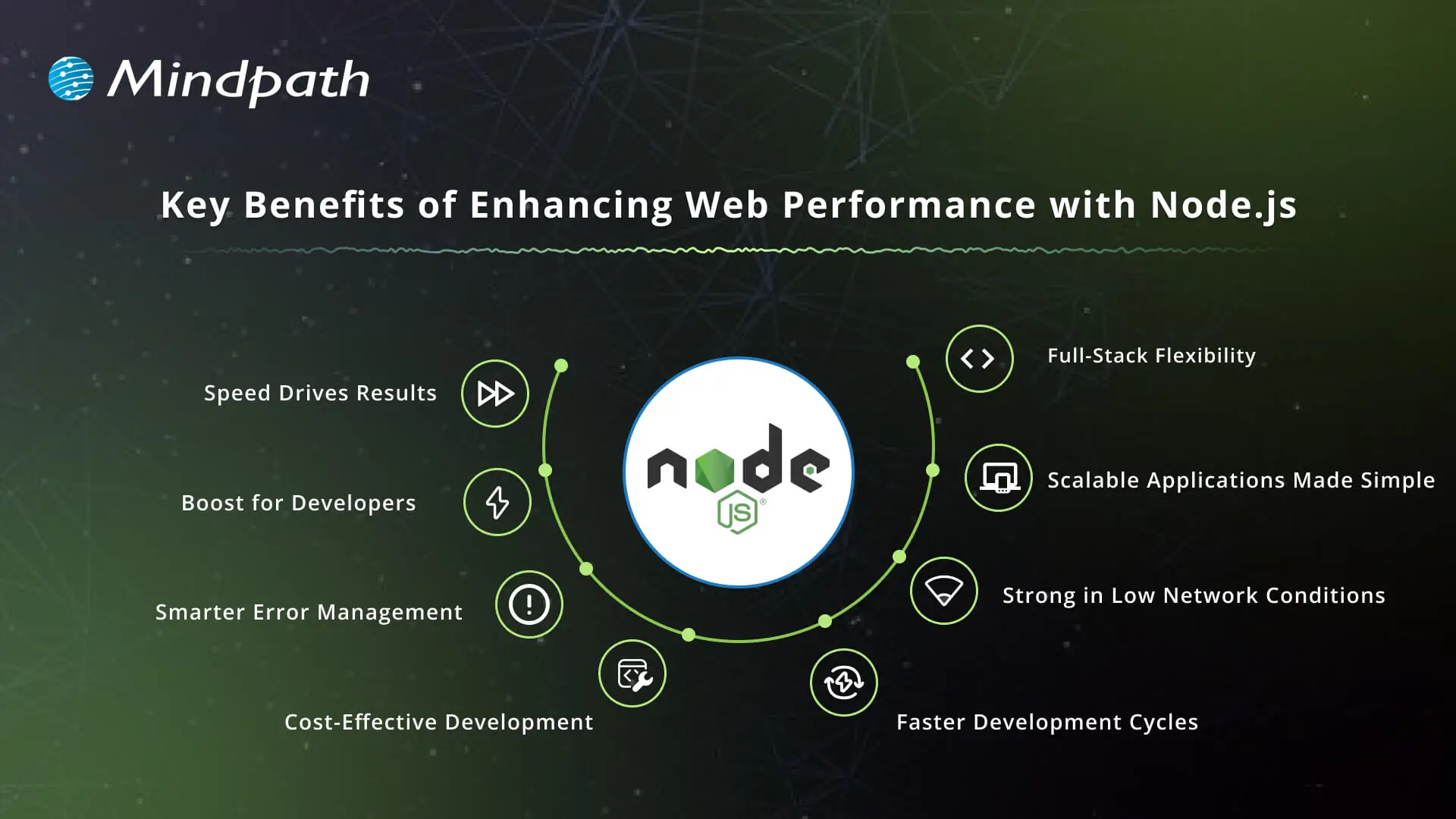
Key Benefits of Enhancing Web Performance with Node.js

Enhancing the performance of web applications is critical for providing an experience that is fast, scalable, and reliable. Node.js has unique benefits that make it a strong candidate for crafting optimized solutions.
Key Benefits of Enhancing Web Performance with Node.js

1. Speed Drives Results

Node.js provides unparalleled speed with its event-driven, non-blocking I/O model, which allows applications to handle multiple requests simultaneously. This means faster response for multiple incoming requests, despite how much traffic the application will be dealing with. Companies that rely on real-time interactions benefit from significant overall web app performance.

2. Productivity Boost for Developers

The single-threaded, event-driven design of Node.js is incredibly fast, efficient, and allows for development to move quickly. Teams can build fully interactive solutions like chats, live streams, and collaborative tools in one simple app, as opposed to other methods that are more complicated. When businesses hire Node.js developers, they can create productivity advantages that let them get the products into the market faster, hence improving web performance with Node.js.

3. Smarter Error Management

Node.js offers robust error-handling mechanisms for developers built into its framework. Developers can readily catch and process errors during runtime. This allows applications to be much more stable, thus improving reliability; all of this while enhancing the user experience regardless of the environment.

4. Cost-Effective Development

Node.js lowers the needed infrastructure with lower resource needs, while still accommodating high load needs. Business savings include operating costs such as licenses, maintenance contracts, and hardware upgrades. Such cost mitigation makes Node.js development services appealing to enterprises that prioritize long-term value.

5. Faster Development Cycles

Developers let you quickly create applications with Node.js, especially when developers are creating modular and reusable code. Node.js is normally used in conjunction with Node.js micro services, allowing smaller microservices to work well together as part of larger systems. This allows for quicker launches of applications and provides for easier updates to accommodate changing business requirements, while enhancing web performance with Node.js.

6. Strong in Low Network Conditions

Node.js handles slow or unstable networks efficiently. The asynchronous nature of Node.js allows each request to be immediately started without waiting, which results in helping to get rid of lags. This particular stability allows organizations to focus on delivering the best possible digital experience to users under various conditions.

7. Scalable Applications Made Simple

One of the primary benefits of Node.js is scalability, which is suitable for applications where demand is unpredictable. Developers can grow horizontally by using more instances or vertically by using better resources. A model of growth with both horizontal and vertical scaling provides growth where sustainability is the framework for implementation, resulting in Node.js performance.

8. Full-Stack Flexibility

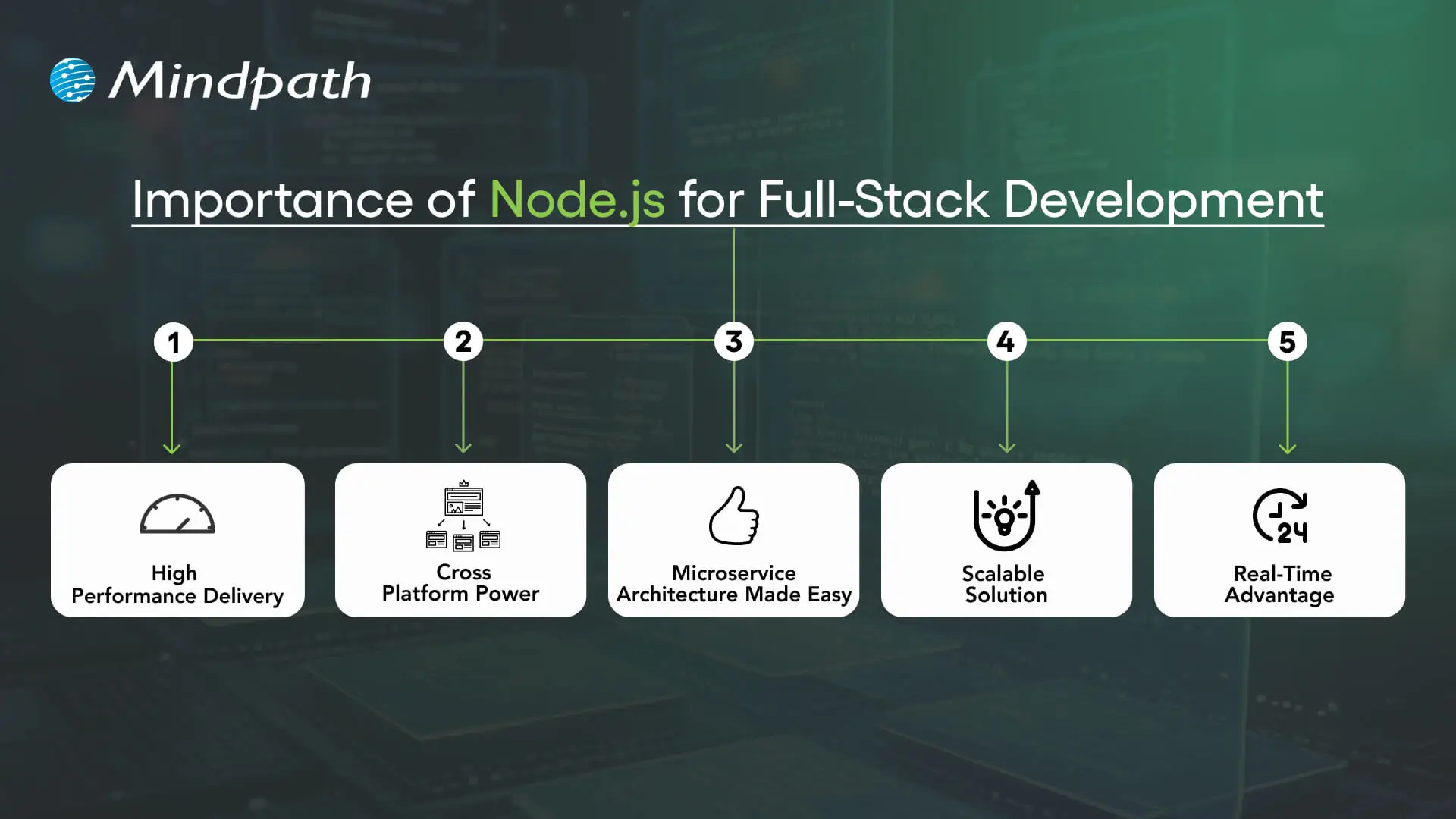
JavaScript provides the opportunity for end-to-end development and client-side and server-side programming with Node.js. With good performance, full-stack developers can build responsive and dynamic web applications. Using Node.js allows organizations to realize efficiencies in their processes and provide similar experiences across their clients’ ecosystems.

Want to enhance your web performance with full-stack development? Learn how to build fast and reliable applications by reading our blog on Mastering Full-Stack Development with Node.js.

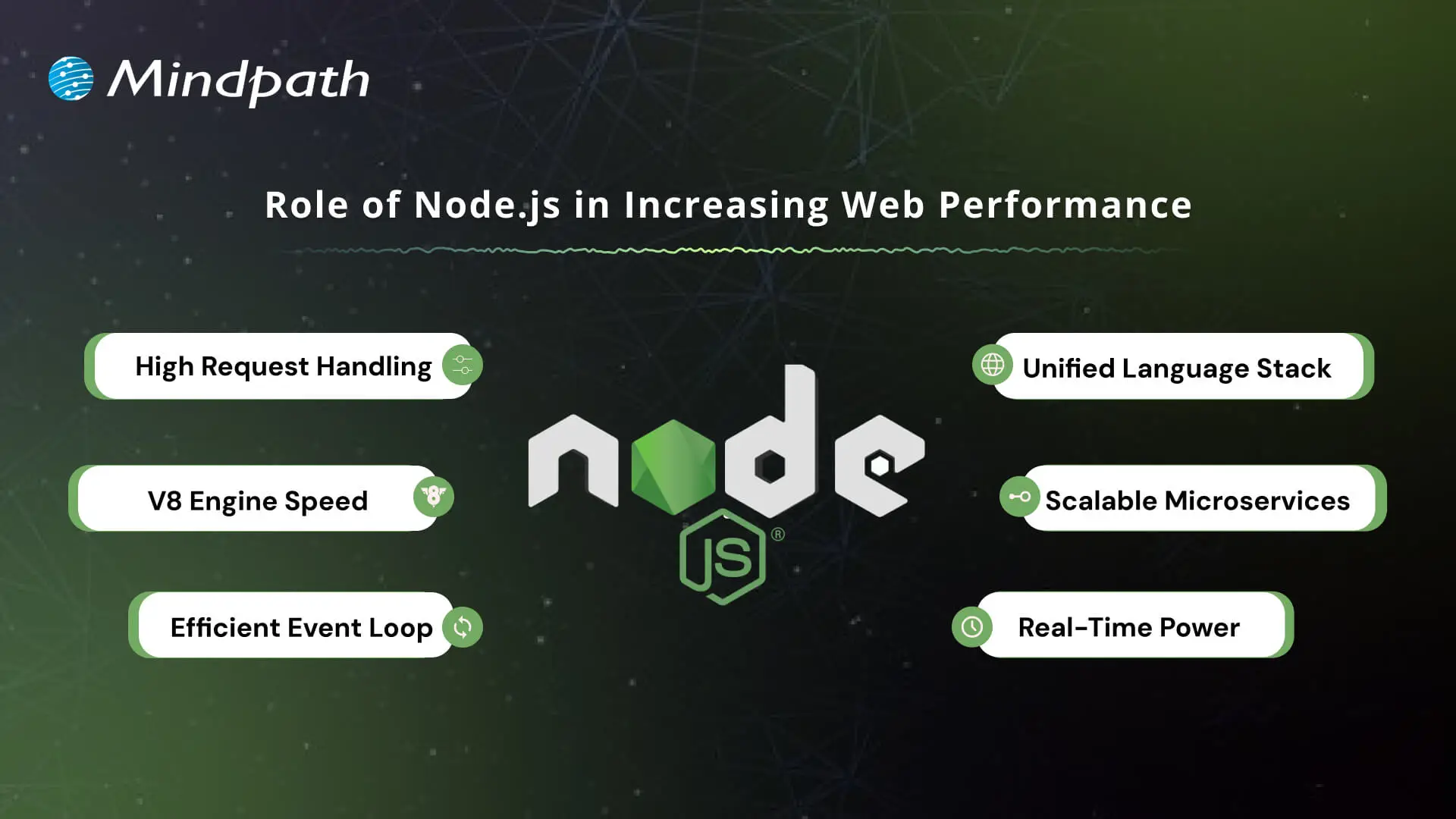
Role of Node.js in Increasing Web Performance

Node.js contributes significantly to building applications that are fast, scalable, and dependable. Its architecture allows developers to build solutions that are responsive and can handle a high volume of requests and traffic.
Role of Node.js in Increasing Web Performance

1. High Request Handling

Node.js accepts multiple requests simultaneously and does not wait for one request to finish before handling another. These attributes contribute to fast and responsive applications, especially important in real-time services like chats and streaming.

2. V8 Engine Speed

The platform utilizes the Google V8 engine to compile JavaScript into machine code. This improves performance by optimizing execution speed, which also indirectly improves the performance of web apps.

3. Efficient Event Loop

Node.js utilizes its event loop to manage asynchronous tasks, such as a file read or a database query. In this way, the server will never get stuck while waiting, which keeps applications smooth and seamless.

4. Unified Language Stack

Using JavaScript for both the front and back end simplifies the development process. In addition, it allows for improved code optimization and helps with better web performance with Node.js.

5. Scalable Microservices

Node.js allows for microservices, which break large applications into smaller, independent parts. Microservices make applications easier to scale and makes it easier to optimize for specific components.

6. Real-Time Power

For applications that need live updates, such as analytics tools or online games, Node.js is a great choice. It improves overall web performance with Node.js because it can handle multiple connections simultaneously.

Boost your Node.js application speed and efficiency by using the right tools. Check out the Top 25 Node.js Libraries in 2025 and take development to the next level.

Ready to Boost Your Web Performance with Node.js?

Node.js has shown its strength by improving speed, scalability, and reliability in modern applications. Through real-time features, effective architecture, and even inexpensive scalability, it can build digital experiences that users actually enjoy. Organizations that want to improve customer satisfaction can invest in Node.js to improve their chances of long-term success in competitive markets today.

At Mindpath, we are known to provide professional Node.js development services across globe, designed to develop scalable, high-performing solutions. When you hire Node.js developer teams with us, you tap into dedicated professionals who specialize in faster, secure, and business-ready apps. Our approach is to combine technical skills with business goals to ensure our clients achieve seamless performance, making meaningful growth with Node.js.


Related Post

Explore key factors for hiring talent through staff augmentation, compare with other methods, and discover Mindpath’s services for scaling and modernizing your tech.
Discover the top 8 emerging technologies set to revolutionize business decision-making in the near future, including Generative AI, Web3, Blockchain, and more.
Discover the cost to hire Node.js developers in London: £30-£70/hour for juniors and £70-£150/hour for experienced, depending on expertise and project complexity.

Related Post

healthcare software

Ever pondered how doctors can diagnose faster now-a-days? Or what helps hospitals and clinics to carry out all the operations smoothly? What’s powering the virtual health check-ups? Well, the answer to all these questions in your mind lies in one powerful solution and that is healthcare software. In this blog, we will walk you through the top 20 types of healthcare software in 2025. 

Before learning about the types, let us learn what is the meaning of healthcare software and some of its benefits. 

What is a Healthcare Software?

Healthcare software is a software that is created to help hospitals, clinics, doctors and patients in managing health related tasks smoothly. It assists in various tasks like booking appointments, keeping digital health records of patients, sending reminders, managing billing process and even making sure medicines get delivered on time. This kind of software makes it easier for the medical staff to focus on their work and help patients to get better care, both in person as well as online. 

The majority of people often get confused between medical software and healthcare software. Medical software is mainly used with medical devices to check and analyze a patient’s health which helps to decide the right treatment. On the other hand, healthcare software mainly focuses on improving the daily operations in healthcare and making patient experience organized and smoother. 

The demand for software in healthcare industry is growing rapidly around the world. According to Dimension Market Research, the global healthcare software as a service market was projected to reach about USD 36.8 billion and experts believe that this number will keep going up every year by around 10.9%, and by 2033, it can reach USD 93.4 billion which indicates that more hospitals and clinics are using this software to make their healthcare better and easier for everyone. 

healthcare software as a service

Benefits of Healthcare Software

Now that we have an idea about the definition of healthcare software and what it can do to the industry, let us know about some of its benefits: 

  • Boost Hospital Operations – It helps hospitals run more smoothly by making tasks like scheduling, billing, and patient record-keeping much faster and easier for staff. 
  • Better Data Handling – Doctors and nurses can quickly access up-to-date patient information, which helps them make better and faster decisions during treatment. 
  • Cost Effective – By reducing paperwork and cutting down on mistakes, hospitals can save a lot of time and money in their daily operations. 
  • Easy Bookings for Patients – Patients can easily book their appointments online without the stress of long phone calls or waiting in line. 
  • Improve Patient Care from Anywhere – Even if someone lives far from a hospital, they can still talk to their doctor through video calls and get care from the comfort of home. 
  • Easy Monitoring and Health Tracking – Health apps and reminders make it easier for patients to take their medicine on time and keep track of how they’re feeling every day. 

Let us come to our main topic now, the types of healthcare software: 

Top Healthcare Software in 2025

Having the best healthcare software is very important for making daily tasks easier in clinics, hospitals and labs. Today, many types of software in hospitals help doctors, nurses, and patients to work together and smoothly. Let’s have a look at some of them: 

1. Electronic Health Record (EHR) Software

EHR software stores patient data like medications, procedures, and doctor notes which helps doctors make better decisions and often includes billing features and a patient portal for easy access to health records and prescriptions. 

2. Medical Diagnosis Software

Medical diagnosis software allows doctors to share anonymized patient records to fill information gaps and improve diagnoses. It often uses AI to analyze data and suggest probable diagnoses. There are apps available for individuals to help users assess if they need medical attention. 

3. Medical Imaging Software

Medical imaging software processes MRI/CT/PET scans and creates 3D models. It helps with human anatomy modeling for individual patients, like creating a 3D print of teeth for orthodontics, or designing medical equipment such as artificial limbs. 

4. Medical Research Software

Medical research software aids in education and sharing research within the medical community. It trains healthcare professionals and supports diagnoses by referencing external cases, while also streamlining research processes to reduce costs and improve financial outcomes. 

5. Appointment Scheduling (Booking) Software

This software helps healthcare facilities manage appointments online. It allows patients to schedule appointments through an app or website, with email notifications and automatic reminders for both doctors and patients about upcoming appointments. 

6. Medical Database Software

This medical computer software stores data by disease, not by patient. It helps doctors make better treatment decisions by comparing similar cases and supports learning by offering access to detailed clinical case histories. 

7. Telemedicine Software

Telemedicine software lets doctors see patients online through apps or browsers. Some tools also offer e-prescriptions and billing. It’s super convenient for both patients and doctors, which is why it’s growing fast in the healthcare world. 

8. E-prescribing Software

E-prescribing software helps doctors manage prescriptions easily. They can track, renew, or cancel them digitally. It also connects with national drug databases, making the whole process quicker, safer, and more accurate for both doctors and patients. 

9. Medical Billing Software

Medical billing software helps hospitals manage invoices, payments, and other financial tasks. It’s often built into larger systems like EHRs, making it easier for accounting teams to handle everything in one place, quickly and accurately. 

10. Medical Equipment Management Software

Medical equipment management software helps clinics avoid manual tracking by automating maintenance schedules and sending inventory alerts. It keeps everything running smoothly and reduces the risk of missing important upkeep. 

11. Hospital Management Software

Hospital management software helps hospitals handle daily tasks like billing, accounting, patient management, inventory, bed management and others. It automates these operations to make hospital workflows smoother and more efficient for staff and administrators. 

12. Mobile Health (mHealth) Apps

mHealth apps make healthcare easier by helping patients book appointments, pay bills, and consult doctors online. They connect with EHR systems, so doctors can see medical records during virtual visits, improving care and saving time. 

13. Laboratory Information Management Systems (LIMS)

LIMS helps labs track samples, manage test data, and stay compliant with regulations. It reduces errors, speeds up processing, and keeps lab operations smooth, making sure patients get accurate and timely results. 

14. Personal Health Record Software (medical diaries)

Personal Health Record software, like the Tulipa app for Parkinson’s disease, allows patients to track symptoms, medication, and treatments. It helps generate health reports for doctor visits and alerts healthcare providers if a patient’s condition worsens. 

15. Radiology Information System (RIS)

A Radiology Information System (RIS) manages and stores radiology images and results. It works alongside PACS to streamline radiology department operations, ensuring efficient image storage and integration with EHR/EMR systems for enhanced patient care. 

16. ERP System

An ERP system for healthcare focuses on operational management, optimizing financial, supply chain, and human resources processes. It supports strategic planning, including expansions and mergers, without directly managing patient-facing tasks or data. 

17. Pharmacy Management Software

Pharmacy management software helps control and monitor inventory by classifying medicines, ensuring adequate stock, and avoiding shortages. It also supports drug price management and integrates with prescription systems for seamless access to medication information. 

18. Clinical Trial Management Software

Clinical trial management software records all the information related to the trials, such as patient information, study files, and approval from regulatory bodies. It is utilized mostly in top-class hospitals undertaking large-scale research to maintain compliance and proper trial management. 

19. Health Tracking Apps

Health tracking apps assist users in tracking fitness, diet, stress, and sleep. Many syncs with IoT devices like FitBit or Oura Ring to collect data. They’re popular for making healthy habits easier and more trackable every day. 

20. Remote Patient Monitoring (RPM)

Remote Patient Monitoring (RPM) enables healthcare professionals to gather patient information beyond the confines of standard settings, i.e., hospitals and clinics. RPM encompasses devices like blood glucose meters and heart rate monitors, which improve post-operative care and chronic disease care. 

Ready to Revolutionize Your Healthcare Solutions?

Healthcare is changing at a lightning pace, and software is leading the charge. From helping hospitals operate more effectively to making it easier for patients to access care, healthcare software is making a difference. In 2025, these technologies will continue to expand and make care easier, quicker, and more patient centered. 

At Mindpath, we recognize the need for state-of-the-art technology in the healthcare industry. Our healthcare software development services are built to improve operations, enhance patient care, and increase overall efficiency. Let Mindpath help you empower your health care business with robust, scalable, and innovative software that keeps up with the evolving healthcare environment. Let’s create a healthier tomorrow together! 

AI programming languages

In today’s digital world, smart phones are able to recognize voices, answer your queries with virtual assistant and can even sort your photos by location or people. All these features may seem like magic but in reality, it’s the power of artificial intelligence. From chatbots to intelligent assistants, AI is revolutionizing the way we live, work and interact. But behind all these changes lies something as crucial as AI, and they are AI programming languages.

Studying these languages is crucial for technology professionals as well as anyone interested in seeing how the future is being designed. These languages can help developers create smart systems that will be able to understand, learn and react just like humans. In this guide, we will take you through everything that you need to know about programming languages for AI. So, let’s dig in! 

Planning to elevate your business and get a personalized AI solution? At Mindpath, we offer AI development services designed to deliver solutions tailored to your business needs.

What are AI Programming Languages?

Artificial intelligence programming languages refers to the tools that are used to create smart computer languages that can think and learn just like humans. These languages help developers to build systems that can understand speech, read data, and even help in autonomous driving. Each language comes with its own tools and libraries to carry out these tasks easily. 

In programming with artificial intelligence, it’s helpful to use languages that offer strong support for tasks like data analysis and machine learning. For example, Python is well-known because it has helpful libraries such as TensorFlow and PyTorch, R is also great when you are working with statistics and data. So, these languages make it easier to build AI systems that can work well and can contribute in solving real-world problems. 

Must Read: Benefits of AI 

List of Top AI Programming Languages

When you are building smart applications, the choice of programming language plays a major role in it. But with so many options out there, it is important to learn about each and decide which one can provide what benefits. The best AI programming languages can offer the features, libraries, and flexibility needed to handle tasks like machine learning, data processing, and automation. Let’s dive deep!

1. Python

Python is one of the top choices for developing smart systems due to the fact that it’s easy and beginner friendly. It’s widely used for training machine learning models, doing data analysis, and building AI tools like chatbots or image recognition apps. Being an AI coding language, Python has numerous strong libraries such as TensorFlow and PyTorch, which make complicated tasks manageable. It also enables rapid testing and development, which is useful in constructing and refining AI models. It is useful for AI in decision-making, where quick iteration on data models is crucial.

2. R

R is an excellent language to use when dealing with lots of data. It makes it easier for individuals to comprehend patterns, generate charts, and analyze results in an easy manner. It is employed by numerous scientists and developers to explore more into data and make intelligent predictions. R is also useful when creating and testing simple machine learning models. With its strong data-handling capabilities, R is particularly valuable for AI in business strategy, helping organizations analyze trends, optimize operations, and make data-driven decisions. R also has numerous tools that assist in making it simpler to verify and compare results. It gets along great with other programming languages as well, so it can be beneficial for other AI projects that require solid data analysis. 

3. Java

Java is a good option for large AI projects, particularly for businesses that require systems to function across different platforms. As an AI language, Java assists programmers in developing intelligent tools that are simple to maintain and expand. It accommodates machine learning, deep learning, and large data tasks through helpful tools and frameworks. Java is also reliable for maintaining things safe and clean, as it has the capability to delete unwanted data automatically.  

4. SQL

SQL is a helpful tool when working with a lot of structured data. It makes it easy to find, manage, and prepare data that can be used to train AI models. Since artificial intelligence needs good-quality data, SQL plays an important role in getting that data ready. It works well with other tools used in AI projects and is great for handling large datasets. As one of the trusted artificial intelligence languages, SQL is simple to use and supports many steps in the AI development process.

Curious to know how AI impacts your industry? Discover the top AI trends that drive innovation and shape the future of business.

5. Scala

Scala is a good choice for building strong AI applications, especially when dealing with big data. It can easily manage large sets of data and is made to work fast and smoothly. Scala also works well with popular tools like Apache Hadoop and Spark, which help developers build and run AI projects more easily. Since it supports multi-tasking and can run many processes at once, Scala is useful for complex AI work. It also works nicely with Java, making it even more flexible. 

6. Julia

Julia is an AI programming language known for its speed and ability to handle complex calculations. It’s great for deep data analysis and training advanced machine learning models. Julia has a user-friendly syntax which is better, making it easier to learn compared to some other languages. It also works well with languages like Python, C, and R, giving developers more flexibility. With powerful libraries, Julia is perfect for building efficient data models and neural networks. 

7. C++

C++ is a powerful language used for AI applications because it offers great performance and uses system resources efficiently. It’s great for running heavy tasks like deep neural networks quickly. Developers often choose C++ for its ability to handle complex jobs, including real-time processing and tasks like computer vision. Its speed and resource management are vital for building sophisticated systems that drive AI transforming the future of technology.

8. Haskell

Haskell is a language that focuses on writing clean and reliable code, making it ideal for AI research and building new algorithms. It is great for prototyping and teaching programming concepts. Many AI developers use Haskell for its strong typing and functional programming style, which ensures precision and reliability. Haskell is also used in roles like AI research, where its features help verify algorithms and improve safety, especially in important fields like healthcare and autonomous vehicles. 

 Important Note: Some programming languages are not the best choice for AI because they don’t have the right tools or are too slow for complex tasks. Here are a few languages that are generally avoided when building AI applications: 

  • PHP: It is mainly used for making websites and doesn’t have strong tools or libraries needed for artificial intelligence and machine learning work. 
  • Ruby: It is easy to read and write, but it runs slowly and doesn’t offer strong support for AI or machine learning tools, which makes it hard to use in real projects. 
  • C: It can be powerful, but it is too low-level for AI and needs manual memory management, which can lead to errors and unstable programs. 
  • Fortran: It is an older language that lacks modern features like dynamic memory and safety, which makes it risky and less useful for today’s AI development. 

Ready to adopt AI programming languages and transform the way websites are built? Read our blog on AI in web development to explore its impact on creating smarter, more dynamic sites.

Curious How AI Languages Are Powering Smarter Technology?

AI programming language is the key to building smart, efficient, and reliable applications. Whether it’s Python for ease, R for data analysis, or Java for large systems, each language has something unique to offer. While some languages lack the tools or speed for AI tasks, the right one can make AI development smoother and more powerful. Understanding these options helps both beginners and experts create systems that truly think, learn, and improve the way we interact with technology. 

At Mindpath, we specialize in Artificial Intelligence development, using the best programming languages like Python, Java, and more to create intelligent solutions that align with your business goals. From automating processes to enhancing user experiences and developing data-driven systems, our expert developers build AI applications tailored to deliver real-world results. 

reactjs app development

Are you considering developing a quick, responsive application for your next project? With so many technologies options which one are you thinking to prefer? This can be challenging, right? What if we say, ReactJS app development can be the ideal solution you are looking for?  

Developers around the world appreciate React for its component-based structure, which allows them to build complex interfaces with reusable code.  Whether for startups or enterprises, ReactJS ensures flexibility, smooth maintenance, and rapid development. Report says, React has been used on around 4.8% of all websites across the world, which is over 11 million sites. Many high-traffic websites also trust React, with about 6.2% of the top 10,000 websites utilizing it.

What is ReactJS?

Famed for its flexibility and performance, ReactJS is a well-known JavaScript library which is utilized to develop efficient and user-centric web and mobile applications. Created by Facebook and officially released in 2015, it was designed to simplify the process of building dynamic and engaging user interfaces. 

React is favorite among developers and organizations with a 5.9% share of the global market, cementing its position as a leading solution for ReactJS app development due to its versatility, speed, and resilience. Curious to know why is React used for application development? Let us learn more about its benefits for app development! 

Mindpath offers professional ReactJS development services to help companies to create reliable, effortless applications. ReactJS is a leading framework for modern app development for the following reasons.

Advantages of Choosing ReactJS for App Development

ReactJS continues to be a preferred tool for modern application development and its real value becomes clearer when you look at how it supports better performance and flexibility. Here are some reasons why it works so well for app development: 

Advantages of ReactJS for App Development

1. Fast and Safe Updates with Virtual DOM

ReactJS implements a Virtual DOM, which makes updates instantly without impacting the entire app. When any developer makes any updates, the Virtual DOM identifies what is the update and updates only that specific piece, thus making the app smoother and quicker. This is highly impactful in enterprise app development, where apps are enormous and intricate. Developers can safely test the updates within the Virtual DOM prior to updating it to the app if the change is safe. In this way, the app performs smoothly, and risks are minimized prior to release. 

2. Reusable Components

One of the greatest advantages of working with React app development is reusability of components. This implies that the developers don’t have to write the same code over and over again. They can create new features by reusing bits of the app which have already been created. These reusable pieces of the app are referred to as components. As every component remains independent, adjustments done to one will not impact others. This saves time and makes the app reliable. It also simplifies the maintenance and future update of the app.  

3. Ideal Framework for Flexible Development

ReactJS is widely regarded as a highly flexible framework. It is capable of adapting to what developers or projects require with ease. This ensures that the ReactJS development for applications is easy and less stressful. Its source code is easy and uncomplicated, allowing developers to make adjustments without stress. Thanks to this, companies can save time and money in developing their apps. Also, developers can rapidly inspect, edit, and maintain various segments of the application with the help of React developer tools. It is one of the primary reasons that several organizations prefer using ReactJS to create up-to-date and simple to maintain apps. 

4. Encourage Hybrid App Development

In the current competitive environment, it is important to reach a larger crowd, and ReactJS makes hybrid app development very easy. It enables developers to create React native apps with a single codebase, which means no need for a different code for Android and iOS. Not only does this save time, but also maintenance and updates are made easy because the same code works smoothly on both platforms. By using ReactJS for app development, the developers can provide a seamless and uniform user experience on devices, making it the perfect choice for companies that wish to increase their reach and provide high-quality apps with efficiency. 

5. Versatility in Enterprise App Development

For any business, building an app that can grow smoothly is very important. With ReactJS, it’s easier to develop apps that can handle more users, data, and new features without any problems. In enterprise app development, ReactJS helps manage the code and structure in a simple way. Developers can easily update or expand the app without affecting other parts. This means ReactJS apps stay strong and efficient even when the business grows. Because of its flexible and reliable nature, ReactJS is a great choice for creating scalable enterprise applications that are easy to maintain and improve. 

6. Seamless Learning Curve

ReactJS is famous for being easy to learn, particularly for developers who are already familiar with JavaScript. Its straightforward architecture and reusable components allow it to be easier to create and maintain applications. That’s why most teams use ReactJS for app development because it allows them to work faster with fewer hassles. Whether you’re just beginning or need to scale, it’s simple to create React apps that are flexible and efficient. This seamless learning curve saves time and is therefore an intelligent decision for companies that are eager to develop robust and easy-to-use applications without wasting any time. 

While choosing the right tool for front-end development, Angular vs. React is a common debate. Are you confused between Angular and React as well? Read our blog: Angular vs React: Choose the Best Frontend Development Platform.

Ready to Build a High-Performance App with ReactJS?

ReactJS has become a preferred choice for building fast, reliable, and scalable web and mobile applications. Its component-based architecture and Virtual DOM make updates seamless and improve app performance. Developers can easily manage large projects with reusable code, reducing time and cost. ReactJS also supports hybrid app development, allowing businesses to reach a wider audience across platforms. With its simple learning curve and strong community support, it remains a go-to solution for modern digital products. Choosing ReactJS means choosing efficiency, innovation, and long-term growth for your app development journey. 

Planning to use ReactJS for app development for your business? At Mindpath, we specialize in delivering powerful ReactJS development services tailored to your business goals. Our expert developers know how to build scalable apps that work smoothly across devices. Mindpath also offers expert support if you’re looking to hire ReactJS developers for your next project. Our team consists of skilled professionals who are well-versed in building responsive, scalable, and user-friendly ReactJS applications and can turn your app idea into a powerful digital product.