How Custom Web Development Services Can Streamline Your Business Operations 

Join our Newsletter!

Featured Posts

Support Is One Click Away

Home

 How Custom Web Development Services Can Streamline Your Business Operations 

custom website development services

 How Custom Web Development Services Can Streamline Your Business Operations 

Companies consistently wrestle with the challenge of maintaining a smooth operation and competing in an ever-changing world. Custom website development services provide the missing link to develop a platform that matches your exact needs and workflows. When a website is built around a real process that matches a real workflow, the company will improve efficiency, and simplify tasks. This simplifies how teams work faster and will improve the extent customers interact on your website. A good website becomes a tool for growth to enable outcomes without adding more work.

Many businesses have adopted custom website development because of the time-saving nature of routine work automation, greater collaboration, and more rapid responses to shifting needs. When technology is a partner with a skilled web design company to streamline operations to connect people across different teams and functions, its powers can enhance overall productivity. A business’s online presence can become a powerful accelerator of success when a company can tie it to real business goals. In this blog, we will detail how these services can modernize and streamline your business.

Want to build a website that not just exists but also gives your brand a great online presence? Mindpath offers web development services to ensure responsive designs and smooth performance, which makes every click an opportunity for the business.

Understanding Custom Website Development Services

Custom web development means creating a website from the ground up to fit the needs of a business. Rather than just using templates or a cloned website, a custom website development company will build your platforms to express the brand’s identity, work with existing systems, and provide a uniquely personalized experience for users. Every aspect of the site is built to serve the company’s needs and enables the site to be fully functional and engaging.

By taking this approach, businesses will also have the flexibility to add features that are appropriate for their business and will help make the website easier to manage as the business grows. Additionally, there is the ability to know their site will be secure and have capacity for more users or more content over time. For companies, custom web development offers a website that looks professional, works well, and can grow with their businesses.

Must Read: Web Design and Development Services

How are Custom Web Development Services Streamlining Business Operations?

Custom web development services are primarily concerned with designing a website that reflects a business’s unique goals and key strategies. These services ensure an online presence that is at once professional and trustworthy, and sufficiently adaptable for use as a tool for the business’s development and other operational needs, both now and in the future.
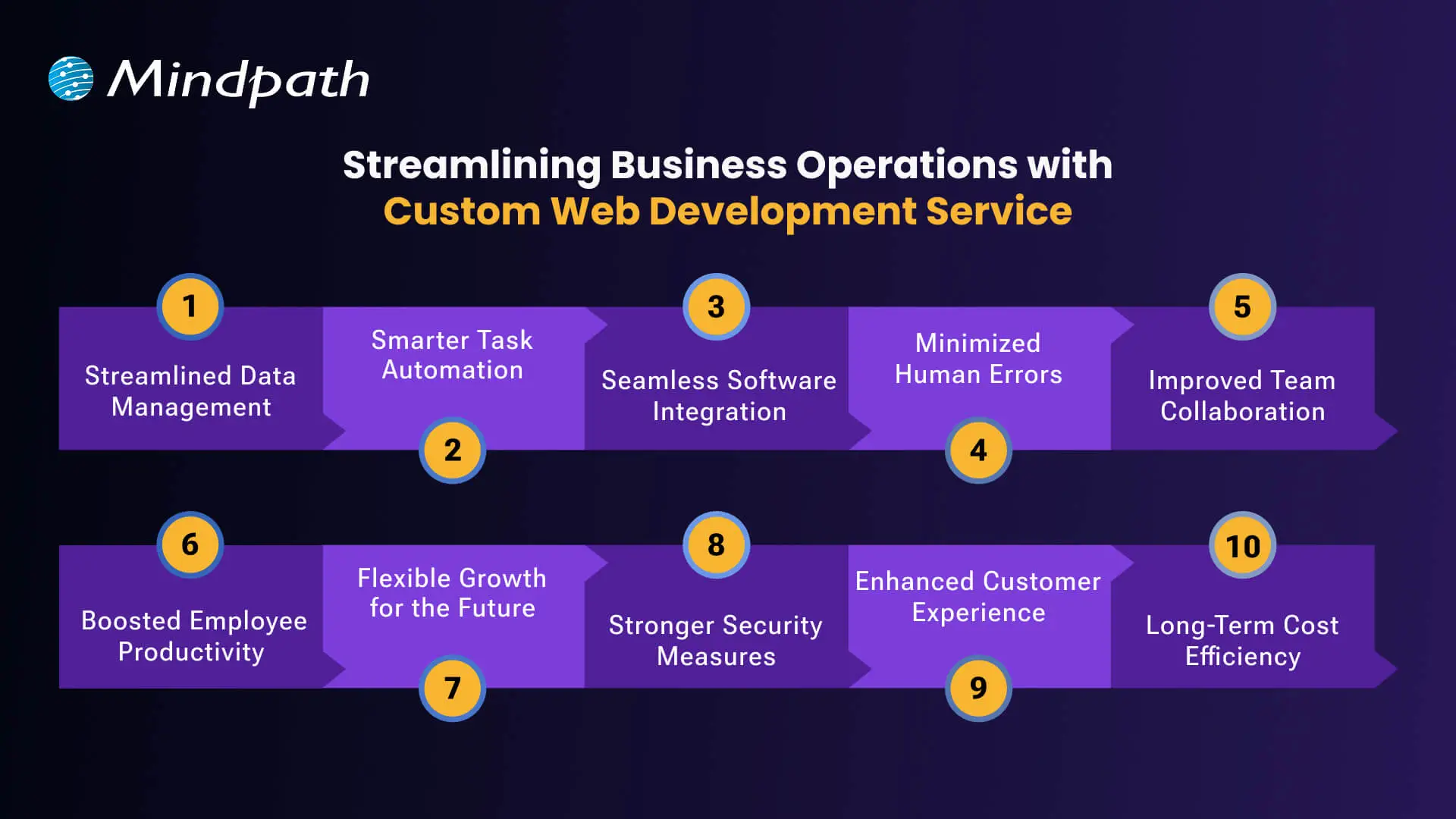
Streamlining Business Operations with Custom Web Development Service

1. Streamlined Data Management

A custom web application enables the collection of information from multiple locations, thus ensuring that each department has the same up-to-the-minute information. Dashboards and reporting functions pull together the information to enable visual, timely, better decision making, and it increase overall efficiency.

2. Smarter Task Automation

Custom web development services enable automation of repetitive tasks such as order processing, invoicing, and inventory management. Minimally, this frees up the time of employees to focus on more strategic objectives and accelerate the pace of operations and thus total productivity.

3. Seamless Software Integration

A custom web development company can design applications that integrate smoothly with your existing systems like CRM or ERP tools. It is a way that frees people from the heavy work of manual data transfer in different applications and at the same time, enables the seamless integration of workflows and processes. The result is a more efficient and cohesive operational environment.

4. Minimized Human Errors

Custom-built applications incorporate highly developed validation and error-checking mechanisms. Businesses save time and avoid mistakes, improve accuracy, and reduce costs by removing the risk of human error in data entry or repetitive processes. Employees can focus on actual work and add value instead of fixing an error.

5. Improved Team Collaboration

A custom web application provides a centralized platform for sharing documents, tracking progress, and communicating in real-time. Teams can coordinate tasks more effectively, reducing misunderstandings. This enhances inter-departmental collaboration and streamlines daily workflows.

Curious how artificial intelligence can transform the way websites are built and managed? Explore our article on AI in web development to discover how AI can enhance your site’s efficiency, usability, and performance.

6. Boosted Employee Productivity

With a custom web application, teams can share documents, track progress, and communicate in real-time all in one location. This increased coordination among team members leads to a better understanding of tasks, which improves departmental collaborations and caters to their day-to-day duties better.

7. Flexible Growth for the Future

Custom web development provides businesses with solutions that expand with them. This means that the platform can accommodate more users, storage of larger datasets, and use cases when the business expands, and all without a complete redesign. This level of flexibility is important for maintaining a valuable website as a tool over time.

8. Stronger Security Measures

Custom solutions enable developers to incorporate tailored security protocols to safeguard sensitive data. Unlike generic software, custom applications can include encryption, authentication, and enhanced security measures tailored to your firm. Organizations at least know that their customer and operational data are of the highest security.

9. Enhanced Customer Experience

Custom web development services play an important role in elevating customer engagement and communication. Just to illustrate, an automated follow-up or a tracking system for orders can be a way of informing your customers at each step, thus attracting them. Consequently, it becomes a cycle of strengthening your relationships and building trust with your clients over time.

10. Long-Term Cost Efficiency

Custom website developers may have a higher upfront cost, but the ROI can be huge over time. Eliminating continuing software fees and inefficient processes can ultimately save the business money. Custom software solutions create well-performing, reliable systems that promote growth and success.

Want to build a complete website without coordinating with multiple developers? Explore our post on full-stack development for web projects to discover how a full-stack approach simplifies your workflow and accelerates delivery.

Ready to Streamline Your Business with Custom Web Development Services?

Custom web development services help businesses improve efficiency, strengthen teamwork, and enhance customer interactions. By creating websites that match real business goals, companies can save time, reduce errors, and manage operations with ease. A well-designed website acts as a strong foundation for growth and lasting success.

At Mindpath, our expert team delivers professional website development services that align with your business goals. Each custom web development service is designed to create fast, secure, and scalable websites that enhance performance and user engagement. We focus on crafting digital solutions that simplify operations and help your business grow with confidence.

Related Post

Discover how ReactJS powers scalable, high-performance web apps. Learn key features, optimization tips, and how Mindpath can help.

Related Post

Remote development team
Globalization has been a phenomenon that blurred boundaries and helped many businesses expand internationally. While the world is reaching toward realizing the idea of a “Global Village”, reservations and misconceptions about hiring remote employees and teams prevail.   COVID-19 showed business leaders the endless potential of remote working. While the world remained locked up, remote working allowed businesses to keep going, especially the ones dependent heavily on IT services  With rapid digitization, IT services have become more crucial than ever for businesses belonging to all categories and industries. According to Statista, the revenue of the IT services market is projected to reach USD 1,420 billion by 2024. Out of the total revenue, the IT Outsourcing segment is dominating the market with a projected volume of USD 541.10 billion in 2024.   Hiring a remote development team is a sound business decision with multiple benefits. In this blog, we will cover all the information essential if you are considering hiring remote developers or development teams for your business.  

Remote IT Development Teams: An Overview

Remote development teams consist of developers and tech professionals working from different geographical locations. These teams collaborate with businesses virtually, understanding their requirements, creating various wireframes, creating delivery plans, working on development, and delivering, deploying, and testing the final product. When hiring talent via staff augmentation, it’s essential to ensure that these remote teams are well-integrated into your project, enabling seamless collaboration and meeting your business goals efficiently.  Businesses are inclined towards hiring remote developers to access a wide talent pool within budget. Especially mid-sized and small businesses that cannot accommodate a full-fledged IT team to develop and maintain their website, apps, and other digital platforms can hugely benefit from hiring an offshore team.  

Benefits of Hiring a Remote Development Team

1. Access to a Global Talent Pool

One of the primary benefits of hiring a remote development team is the ability to access a diverse range of skills and expertise. Casting a wider net can help businesses recruit the top talents in the technology fields such as development, design, implementation, etc.   Emerging technologies like AI, ML, data science, DevOps, Blockchain, Cloud Computing are taking over the world. By looking beyond geographical boundaries, you can find developers with specific technical capabilities that may not be available locally.

2. Cost Efficiency

Hiring remote developers can be more cost-effective than maintaining an in-house team. A report by Deloitte suggests that 63% of companies outsource their development tasks to reduce costs.   You can reduce expenses related to office space, equipment, and other overhead costs. Moreover, the ability to hire from regions with lower living costs can further reduce payroll expenses without compromising on talent quality. 

3. Flexibility and Scalability

Remote teams offer greater flexibility. You can scale your team up or down based on project requirements without the logistical challenges associated with in-house teams. According to studies, 53% of businesses have dealt with capacity issues, and 38% improved the service quality by hiring a remote development team.   This flexibility allows you to manage resources more efficiently and respond quickly to changing project needs. 

4. Increased Productivity

Remote developers often experience fewer distractions than traditional office environments, increasing productivity. There is also no time for commuting to a physical workplace, saving time for more strategic actions.   With a properly managed remote team, you can leverage different time zones to maintain a near-continuous workflow, ensuring that your project progresses even outside typical working hours. 

5. Environmental Benefits

Hiring a remote development team not only saves your costs and improves productivity but can also contribute to reducing your company’s carbon footprint. With fewer employees commuting to a central office, there are fewer greenhouse gas emissions, aligning your business with environmentally sustainable practices.

Challenges to Consider

1. Communication Barriers

Effective communication is crucial for the success of any development project. When working with a remote team, time zone differences and language barriers can pose significant challenges. It is essential to establish clear communication protocols and utilize collaboration tools to ensure everyone is on the same page.

2. Managing Productivity

Tracking productivity can be more challenging with a remote team. Setting clear expectations, establishing measurable goals, and using project management tools are vital for keeping remote developers on track. Regular check-ins and progress updates can also help in maintaining accountability. 

3. Cultural Differences

Cultural differences can impact team dynamics and workflow. Understanding and respecting these differences is important for fostering a collaborative environment. Encouraging an inclusive culture where all team members feel valued can help mitigate potential conflicts and improve overall productivity. 

Best Practices for Working with Remote Developers

1. Define Clear Objectives

Before hiring a remote development team, define your project goals, timelines, and deliverables. Clear objectives provide a roadmap for the team and help in aligning their efforts with your business objectives. 

2. Invest in the Right Tools

Leverage technology to bridge the gap between remote team members. Tools like Slack/MS Teams for communication, Jira/Azure DevOps for project management, and GitHub for version control can enhance collaboration and streamline workflows. 

3. Build a Strong Onboarding Process

A well-structured onboarding process ensures that remote developers understand your company culture, project expectations, and their specific roles. Providing comprehensive training and resources can help new team members integrate smoothly and start contributing quickly. 

4. Foster Team Engagements

Regular team-building activities, virtual meetups, and open communication channels can help in building a cohesive team. Encouraging social interaction and recognizing individual contributions can boost morale and foster a sense of belonging among remote developers. When comparing IT staff augmentation vs. traditional hiring, these practices are essential in maintaining a strong, engaged team, regardless of the hiring model, while benefiting from the flexibility and scalability that staff augmentation offers.

Wrapping Up

Hiring a remote development team can offer numerous benefits, from access to a global talent pool to cost savings and scalability. However, it also requires careful planning and management to overcome challenges such as communication barriers, productivity tracking, and cultural differences.  If you’re considering hiring a remote development team, Mindpath’s Team Augmentation services can be an invaluable resource. Our experienced professionals can seamlessly integrate with your existing team, bringing specialized skills and expertise to help you achieve your project goals. With Mindpath, you get the flexibility and scalability of remote development without the common pitfalls. Partner with us to unlock the full potential of your development projects.  Feel free to reach out to us with any questions or to discuss your specific requirements. Together, we can build something great! 
Hiring a remote development team is a sound business decision with multiple benefits. Read things to keep in mind while hiring a remote team.
Mobile app development 

In this fast-paced digital world, mobile app development has become a key channel for businesses to help grow and support their customers. Every tap, click and swipe is part of the user’s experience and lasting commitment to the brand. As customers rely more on their smartphones for shopping, entertainment, and other services, those companies that develop an intuitive e-commerce mobile app will have a better competitive advantage and will have their customers engaged with them.

As technology progresses every day, businesses can no longer rely solely on traditional platforms. Mobile apps now offer convenience, personalization, and live interaction that websites often cannot provide. Mobile apps help brands deliver seamless experiences and help build awareness and growth. This blog post will provide key advantages of mobile app development and help take your business to new heights.

Want to fully experience the benefits of mobile app development in your business? Mindpath offers mobile app development services, which help your business unlock new opportunities through innovative design and seamless functionality.

What is Mobile App Development?

Mobile app development refers to building software applications that are operated on mobile devices such as smartphones and tablets. Mobile app development is simply the process of designing the app’s interface and coding the app itself. These apps are designed to serve particular functions, which means they will facilitate the ability for a user to use services, shop online, or stay connected to others.

Mobile applications are capable of making use of the integrated functionality offered by a device, such as GPS, camera, bluetooth, and microphone, which sets them apart from traditional software. Developers today create the majority of applications for the Android or iOS platforms because these two dominate the worldwide market. Developers may use various frameworks & tools to construct applications that function smoothly, are visually attractive, and work seamlessly across devices.

Must Read: Mobile App Development Trends 

What is the Process of Mobile App Development?

Developing a mobile application involves several necessary steps to take your idea to a working app. Each step plays a role in enabling usability, reliability, and scalability of the mobile app that is aligned with the business goals.

Process of Mobile App Development

1. Ideation and Conceptualization

The first step in the mobile app development process is coming up with a concept for your app. The teams think of an exciting mobile app development idea, find a way to solve problems for users, depict their target audiences, and identify key features.

2. Planning and Analysis

During this step, the teams conduct market research, determine app features, and establish goals. A proper framework documents timelines, budgets, and resources that will enable mobile app development startups and teams to stay on track.

3. Design

Designers create the aesthetic design and layout of the app to ensure it looks pleasing and is easy to use. Designing with simplicity and enjoyment in mind will allow users to navigate the app easily and have a positive experience while working.

4. Development

This is where developers start coding and building both the front and back ends of the app. The mobile app development process at this stage focuses on creating functional features that bring the design to life.

5. Testing

Before an app is launched, several tests are conducted to identify any malfunctions, like bugs or performance problems. This is a necessary step in order to ensure that the app is performing normally and responding correctly for the users.

6. Deployment

After the application has successfully gone through the testing stage, the app is published on the app stores, i.e., Google Play or Apple App Store. Companies that provide mobile app development will also develop a listing and promotional materials to be prepared for the launch.

7. Maintenance

Once the app has launched, it should be updated on a regular basis to fix bugs and continue to work with new devices or software versions. Maintaining the app will give users satisfaction, and enjoying the app for an extended period of time will keep users active.

Is your business app prepared to handle today’s security challenges? Discover how application security best practices for web and mobile apps keep user data safe while supporting sustainable growth.

Benefits of Mobile App Development

The advantages of mobile app development support businesses in more easily reaching customers and accelerating growth. By utilizing a mobile app development service, businesses can build simple and effective mobile apps that enhance user experience and increase engagement.

1. Enhance Customer Engagement

Mobile apps enable users to engage with your brand more often, keeping your business top of mind and relevant. Mobile app development allows businesses to develop features such as favorites, shopping lists, and review capabilities, all of which act as tools to enhance engagement.

2. Build Strong Brand Identity

An app that is well-designed becomes a permanent ambassador for your brand. Mobile app developers can collect relevant user data through the app, which can help improve your brand and continue to deliver value to your audience.

3. Increase Customer Loyalty

Mobile applications can host loyalty programs that encourage customers to revisit and repeat purchases. By giving discounts or rewards instantly, the app creates a sense of engagement with the app and helps build longer-term positive relationships.

4. Improve Customer Interaction

Mobile applications provide a convenient way for customers to purchase products because the app saves payment details and even previously favorite products. This all allows for an easier customer experience, which leads to convenience, improves customer satisfaction, and increases future conversions.

5. Personalize Marketing Efforts

Businesses can provide targeted offers and recommendations based on how users interact with their app. Personalized communication helps make users feel appreciated and encourages engagement.

Looking to build apps faster and smarter? Explore how mobile app development tools streamline development and boost productivity.

6. Boost Profits

Mobile apps typically drive sales and reduce marketing expenses by improving engagement, loyalty, and the overall user experience. Investing in the app is worthwhile because it is an efficient means of maximizing return.

7. Leverage Social Media Integration

Mobile applications can seamlessly connect to their social media channels, allowing individuals to easily share products or submit reviews. This advertising practice provides brands with exposure and social proof.

8. Provide Unique Value to Customers

Apps can offer features that are not available anywhere else, such as augmented reality try-ons, AI in mobile app development for intelligent chat support, and app-exclusive discounts. This adds convenience and encourages individuals to visit again.

9. Target Your Niche Market

Mobile apps provide a competitive advantage over other markets with specialized features and experiences. Businesses can effectively target and engage a broader segment of their target market.

10. Strengthen Communication

Push notifications ability and geotargeting gives businesses the ability to communicate with users in real time. Apps allow businesses to send relevant and time-sensitive messages without interruption from other communication channels.

Want to stay ahead in app innovation? Discover how mobile app development technologies power scalable, future-ready applications.

Ready to Elevate Your Business with Mobile Apps?

Mobile app development offers businesses a powerful way to engage customers, build loyalty, and boost growth. By leveraging AI in mobile apps, companies can deliver smarter personalization, real-time support, and data-driven user experiences that stand out in competitive markets.. Leveraging the benefits of mobile apps helps businesses strengthen their brand, improve customer experience, and maximize sales in today’s digital world.

Mindpath provides professional mobile app development services to help businesses turn ideas into functional, user-friendly apps. Our team of experts focuses on designing apps that engage users, integrate key features, and deliver measurable results. With Mindpath, companies can launch high-quality apps that drive growth, enhance customer experience, and ensure long-term success.

hiring reactjs developers

The fast-paced growth of the digital landscape has not only empowered businesses but also made them think about their online presence. Companies have been hiring ReactJS developers to capitalize on the diverse capabilities of ReactJS for creating robust user interfaces. The notable features of ReactJS include the virtual DOM, a thriving ecosystem, and modular architecture. Let us find out the important factors you must keep in mind while hiring React developers.

Want to hire ReactJS expert for your next project? Discover how Mindpath’s ReactJS development services will help you achieve your specific business goals.

What Should You Keep in Mind While Hiring ReactJS Developers?

The search for expert ReactJS developers has gained momentum as a response to more businesses turning towards online platforms. However, business owners might experience some trouble in hiring React developer as they will find it difficult to understand coding nuances and technical jargon. At the same time, finding the best React developer who can also be a cultural fit is a huge challenge.

Hiring managers must also go through a massive talent pool of React developers to find the top expert for their next web project. On top of it, employers have to look for more than just technical skills in React developers to create successful web projects. The following checklist can help you hire the best ReactJS developers for your web projects.

Must Read: ReactJS Trends

1. Specify the Project Requirements

One of the foremost factors to consider when hiring ReactJS developers is the outline of project requirements. You should know your project scope and complexity level to identify the ideal React developer who would align with your project vision. The project requirements should not be limited to defining the type of project, but also the timeline, desired features, budget, and complexity.

With a clear impression of these aspects of your project, you can determine the skills and experience required from candidates. For instance, you will need a junior developer for smaller tasks and a senior developer for leading initiatives to scale up web projects.

2. Never Compromise with Technical Fluency

The easiest solution to challenges in hiring expert ReactJS developers involves focusing on the technical skills of applicants. You need developers who know more than the fundamental concepts of React and have various crucial technical skills. Candidates must have strong understanding of JavaScript features such as arrow functions, closures and destructuring.

Applicants for React developer jobs should also have in-depth understanding of the important concepts in ReactJS. Some of the important React concepts include React Hooks, component lifecycle methods, virtual DOM and reconciliation. People applying for ReactJS developer jobs must also know how to work with state management libraries such as Redux.

The other crucial technical skills in a checklist for hiring ReactJS developer include fluency in HTML and CSS, version control with Git and API integration. Aspiring React developer must also know how to work with testing frameworks, build tools and package managers like NPM. Another prominent technical skill that React developers must have is performance optimization.

Want to keep your large React app fast and responsive as it scales? Discover the best practices for optimizing React performance for large applications.

3. Optimizing the Interview Process

The effectiveness of your hiring process depends a lot on the quality of the interview. If the resume serves as an advertisement, then the interview helps you test the product. Employers should divide the interview process into different stages to evaluate the distinct competencies of applicants. The best practices for hiring ReactJS developers suggest that the interview must include technical assessment, portfolio review, live coding session and behavioral interview. Each stage in the interview process will help you measure the overall proficiency of candidates rather than focusing on specific areas of expertise.

The technical assessment should have coding challenges to test the problem-solving skills and coding style of applicants. You can find out whether they use efficient algorithms, data structures and React concepts in their code. Hiring managers should choose live coding sessions in interviews for senior React developer roles. The portfolio review involves checking for active contributions of candidates on GitHub and their past projects. Employers can use the portfolio review to find out whether the applicant has problem-solving skills.

The technical assessment and portfolio review must be accompanied with behavioral interview questions. The best react developer hiring tips point out that behavioral interview questions can help you learn more about the developer. For example, you can find out how they approach complex issues, their preferred development workflow and their preferences for collaboration. The behavioral interview will help you understand the capabilities of a React developer applicant on a more personal level.

4. Don’t Forget the Soft Skills

Among the many factors that you should keep in mind while hiring React developers, the list of soft skills will never lose its significance. As a matter of fact, soft skills like communication, adaptability, problem-solving and collaboration are essential requirements for almost every job. Why are soft skills important for ReactJS developers? Soft skills serve as the catalyst for transforming a group of individuals into a powerful team.

Most of the guides on how to hire ReactJS developers also focus on other soft skills such as attention to detail, proactivity and accountability. React developers need attention to every detail of the UI development process as it can help in crafting robust and engaging user experiences. On top of it, proactivity implies that the candidate will be always ready to take initiative. At the same time, accountability can ensure that the developers take responsibility for all their actions.

5. Determine Realistic Compensation

The most crucial highlight in the hiring process is the cost of hiring ReactJS developers. Hiring managers must offer a compensation package that fits perfectly with the role and responsibilities of the developer. For example, junior developers can earn between $70,000 and $90,000 while senior developers can earn more than $150,000.

The ideal way to make sure that the candidates feel that the compensation is right involves a clear job description and smooth onboarding process. Tell the developers what they have to do on the job to make them understand why they are being paid a specific amount. In addition, try to include programs for continuous learning and growth of developers.

Looking for specialists who can handle complex front-end challenges in your business? Learn why partnering with an expert React Development Company is a smart move.

Final Thoughts

The answers to “What are the key things to consider before hiring a ReactJS developer?” focus specifically on project requirements, technical skills, soft skills and the interview process. On top of it, determining the ideal compensation for ReactJS developers is also an important concern in the hiring process.

Do you need professional ReactJS development services for your next web application? At Mindpath Tech, we have the best developers who can handle all your frontend development needs. Our team of proficient ReactJS developers has the experience of working on multiple projects. We not only offer the assurance of efficient web development but also resourceful solutions to optimize your digital presence. Join us and work with top-tier ReactJS talent on your revolutionary web app right now.

Hiring ReactJS developers? Explore essential factors like experience, skills, and project requirements to ensure a successful collaboration.