Generative AI Revolution: The Role of Generative AI in Transforming Business

Join our Newsletter!

Featured Posts

Support Is One Click Away

Home

Generative AI Revolution: The Role of Generative AI in Transforming Business

how generative AI is transforming business

Generative AI Revolution: The Role of Generative AI in Transforming Business

The generative AI revolution is changing the business landscape. From design automation to optimized operations and improved client experience,  GenAI is enabling new opportunities across the spectrum of industries. Companies now leverage this technology to not only save uptime, but to innovate more rapidly, customize and provide service to their consumers more favorably, and remain competitive in an ever-expanding digital world.

Generative AI allows machines to learn patterns and create new output in a number of ways. Businesses are now adapting to this change and thinking about how they can move forward in a new way. It is gradually becoming a key part of business innovation and digital evolution. In this blog we will discuss the growing influence of GenAI and its role in transforming the modern business environment. To begin with, let us have an understanding of GenAI.

Looking for ideas to reshape your business with generative AI? Unlock smarter growth, faster innovation, and personalized customer experiences with our robuts and scalable AI development services.

What is Generative AI?

Generative AI is a form of artificial intelligence that can generate new things, such as text, images, music, or video, by learning from existing data. For example, if you give 1,000s of product descriptions from an online store, it will generate completely new and unique product descriptions for similar products, all by itself. GenAI does this by looking at patterns and learning about how things can be constructed so it can produce something new that looks very realistic.

This type of technology is spreading and evolving rapidly across the globe. A research from Statista shares that the market size of generative AI is expected to be US$66.89 billion in 2025, with annual growth of 36.99% every year, reaching a market size of US$442.07 billion by the year 2031. Among all countries, the United States is estimated to have the largest market size in 2025 at US$21.65 billion.

How Does Generative AI Work?

Generative AI uses neural networks to examine existing data to identify patterns and create new data that appears to be real. Most generative AI models utilize an unsupervised or semi-supervised learning process that is less of a hurdle, because it tends to require a broad array of unlabeled data. Consequently, it becomes much simpler for organizations to develop more powerful AI systems.

Generative AI examples can be seen in all businesses today. For example, Jasper is a tool that helps marketers create blog posts or advertising copy, and DALL·E creates images based on simple text descriptions. These foundation models make it possible to perform tasks like writing, designing, or summarizing in seconds, improving speed and creativity.

Want to stay ahead in the rapidly evolving world of GenAI? Explore the top Generative AI Trends shaping the future of development and strategy.

How is Generative AI Transforming Business?

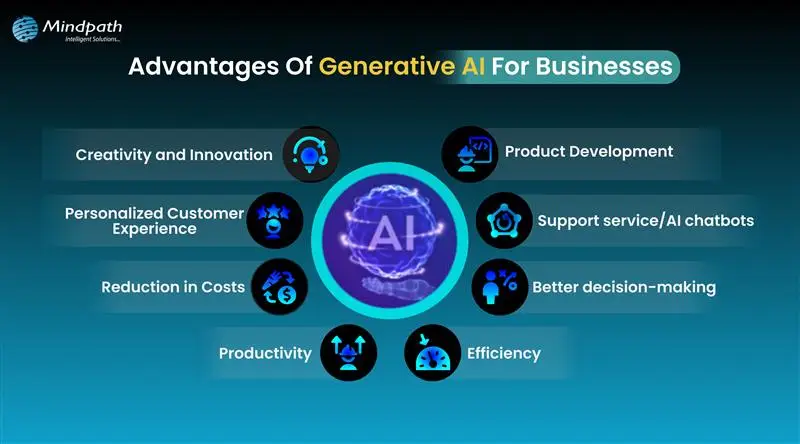
The generative AI revolution is changing the way companies operate, innovate, and treat their customers. With generative AI in business, tasks which took hours can now be completed in minutes, increasing speed and creativity for teams. Here’s the way it is changing the business world:
generative ai for business

1. Boost Creativity for Marketing and Innovation

GenAI is changing creative industries by bringing ideas to life faster by offering design concepts and fresh content ideas. This supports quicker campaign launches and product development. It also gives teams more time to focus on refining ideas or exploring new ones. As a result, human creativity grows while the creative process becomes faster and more effective.

2. Enhance Customer Support

The GenAI revolution is helping businesses improve customer service like never before. Instead of making customers wait for answers, generative AI can quickly find the right solution by pulling information from many sources. It also creates clear post-call summaries, making support faster, more accurate, and more personalized, leading to better customer satisfaction and trust.

3. Improve Sales Communication with Smart Insights

The economic potential of generative AI is clear in sales. It can write call summaries and follow-up emails, helping reps spend more time with customers. Sales managers can track how well AI-generated messages perform, like whether they speed up deals or increase order values. This leads to better sales processes and stronger customer communication.

Wondering how GenAI for business can be your key to success? Generative AI for business enhances innovation, and streamlines operations—thus empowers companies to stay competitive and get future-ready.

4. Boost Content Creation for Better Productivity

Generative AI helps businesses create high-quality content quickly by providing first drafts in just a few seconds. This allows teams to produce more sales messages, marketing content, and product documents in less time. As a result, companies can respond faster to customer needs while giving employees more time to focus on building stronger customer connections.

5. Create Personalized Customer Experiences

The role of AI in business growth and human empowerment is very clear when we think of how it can assist businesses in creating personalized customer journeys. By understanding their customer data, likes/dislikes, and behaviors, GenAI makes it easy for businesses to create personalized suggestions and relevant content. AI personalized customer experiences can truly bring better connections, embed customer loyalty, and create a better experience for everyone involved.

6. Speed Up Development with Smarter Coding

Generative AI applications can help developers save time by writing routine code and automating common tasks. The role of GenAI in app development brings unexpected benefits such as boosts productivity, reduces errors, and keeps projects on track. It also supports non-technical teams through no-code and low-code tools, making app creation easier for everyone, not just engineers, and allowing more people to contribute to digital solutions.

Also Read: Generative AI Use Cases across Industries 

Ready to Embrace the Generative AI Revolution in Your Business?

The generative AI revolution is creating exciting new possibilities across industries by helping businesses work faster, smarter, and more creatively. From personalized customer experiences to automated content and improved development, generative AI is no longer a future trend; it’s the present opportunity. Now is the time to explore how it can redefine the way your business operates and grows.

At Mindpath, we offer smart and scalable GenAI solutions that help businesses unlock real value. From custom AI applications to intelligent automation and personalized customer engagement tools, our AI development services help businesses fuel innovation, boost productivity, and empower teams. Let us help you stay ahead in this fast-changing digital world with cutting-edge generative AI services.

Related Post

Discover how is generative AI changing creative work by boosting efficiency and making tools more accessible for all creators.
Discover how integrating ReactJS with cutting-edge technologies can boost business growth, enhance user experiences, and streamline web app development.

Related Post

Web Scraping with Node.js
Web scraping is the process of utilizing a specialized program to mechanically collect information from websites. Instead of manually copying and pasting data, web scraping allows you to instantly gain pricing, photos, and news items from the internet. It operates by making requests to websites, capturing the necessary data, and organizing it in an understandable format. This is very useful when you need to collect a large amount of information from many pages.

How to Conduct Web Scrapping with NodeJS

1. Set Up a Node.js Project

Begin by creating a folder for your web scraping project. Inside the folder, initialize a new Node.js project. This will generate a package.json file, which contains your project details and dependencies. Create a main file (e.g., index.js) to write your scraping code. To confirm everything is working, add a simple script in your package.json to run your main file and test your Node.js setup.

2. Install Axios and Cheerio

Next, install the essential libraries for web scraping: Axios and Cheerio. Axios is used for fetching web pages, while Cheerio helps parse and extract data from the HTML. You can evaluate the target website to determine which libraries are best suited for your needs.

3. Download Your Target Website

Connect to the website you wish to scrape using Axios. This involves sending a request to the website’s URL to retrieve its HTML content. Since many websites try to block scraping, ensure you include a User-Agent header, making the request appear as though it’s coming from a legitimate web browser.

4. Examine The HTML Page

To extract the data, inspect the website’s HTML code. Right-click on an item and select “Inspect” to view the page’s HTML structure. Look for the tags and CSS classes that organize the data you want to scrape. This will help you determine the best approach for selecting the right elements.

5. Use Cheerio to Select HTML Elements

Once you have the HTML content, use Cheerio to extract the data. Cheerio lets you select HTML elements using CSS selectors, similar to how jQuery works. You can target elements by class, ID, or by nesting within other elements. This helps to narrow down the exact data you want to extract.

6. Extract Data from the Target Webpage

Now that you’ve selected the elements, the next step is to extract the data. Organize the extracted data into a structured format, such as an array or object. Clean up any irrelevant information and ensure the data is properly organized. If the page has multiple sections, repeat the process for each one, adjusting your selectors as needed. Once completed, you’ll have well-organized data ready for use.

Mindpath, provides web scraping services using Node.js
to help you obtain crucial information from websites. Node.js allows us to easily download and extract data from web pages. This procedure entails retrieving the website content and then
locating the specific data you want, such as text or photos.

Contact us today

Easily automate data collection with Node.js web scraping! Use Axios and Cheerio to extract structured data from websites quickly.
Node.js

Looking to build a real-time chat application? Have you ever wondered how chat apps handle instant messages so efficiently? With Node.js, you can create a fast, scalable solution that supports real-time communication. Let’s explore how Node.js can power your next chat app and bring your ideas to life!

Overview of NodeJS

Node.js is a platform that enables developers to run JavaScript outside of a web browser, making it ideal for developing server-side apps and tools. Instead of merely running code in the browser, Node.js allows you to utilize JavaScript for activities such as web server management and networking. It operates by utilizing an “event loop.” When several requests are received, Node.js adds them to a list and processes them one by one, ensuring that everything goes smoothly and without getting stuck. Node.js employs a strong engine called V8, which is the same engine used by Google Chrome, to convert JavaScript into rapid machine code. It also includes a big library of reusable code known as npm, which developers can utilize to simplify and speed up the development process. 

Advantages of NodeJS in Building Real -Time Chat Applications

1. Event-Driven Design

Node.js uses an event-driven design, which makes it ideal for developing real-time chat apps. New messages, user connections, and disconnections are all common in real-time chat apps. Node.js handles these events effectively, responding to each one as it happens. Instead of waiting for one process to complete before beginning another, Node.js employs an event loop. This implies it can do numerous jobs simultaneously without slowing down. When a new message comes or a person enters a conversation, Node.js creates an event and processes it right away. This allows chat apps to work smoothly even when there are a large number of users or messages active at the same time. This method enables Node.js to handle real-time communication rapidly and with minimal delays. It’s ideal for designing rapid, engaging experiences where customers anticipate immediate replies, such as a chat app. Node.js allows developers to design apps that respond rapidly to users, resulting in a smooth and engaging experience.  

2. Quick Development and Launch

Node.js’ enormous and active developer community makes it faster and easier to construct real-time chat apps. This community gives access to a diverse set of libraries, frameworks, and tools for simplifying complicated tasks. Instead of starting from scratch, developers can take advantage of these tools to accelerate the development process. In addition to rapid development, Node.js apps are simple to deploy. Its lightweight and efficient architecture enables applications to function seamlessly across several devices and servers. Node.js simplifies the deployment process, whether you’re using a tiny server or a cloud platform. Node.js also makes scalability easy. As your chat app grows and draws more users, you can quickly increase its capacity without making significant modifications to the code or infrastructure. This flexibility is especially valuable for real-time chat applications, which need to handle increasing user traffic efficiently. By enabling quick development and easy deployment, Node.js saves time and effort while ensuring your chat app is ready to perform at its best. 

3. Real-Time Communication Tools

Node.js provides a diverse set of modules and frameworks that are ideal for developing real-time chat apps. These technologies are particularly intended for real-time collaboration, making the development process considerably easier and faster. One of the most popular libraries is Socket.IO, which is frequently used in real-time applications. It gives developers everything they need to add features like instant chat, live alerts, and user status updates. Socket.IO enables developers to effortlessly establish two-way communication between the server and clients, resulting in a seamless and responsive chat experience. The availability of such ready-to-use libraries shortens the time and effort necessary to develop real-time functionality from scratch. Instead, developers can concentrate on customizing the chat application to satisfy specific purposes, such as group chats, one-on-one interactions, or advanced features like typing indicators. 

4. Speed and Scalability

Node.js is recognized for its great performance and scalability, making it ideal for real-time chat apps. Its non-blocking I/O paradigm enables the server to do several jobs concurrently without being overloaded. In a real-time chat app, users continually send and receive messages, as well as connect and disconnect. Node.js does all of these tasks effectively by managing several connections at the same time. Unlike conventional servers, which might slow down when there are too many users online, Node.js maintains seamless performance even with a large user base. This performance is especially critical for chat apps, as users demand immediate conversation with no delays. Whether your project serves a few or millions of people, Node.js scales quickly to meet demand. By adding more servers or resources, your app can grow alongside its user base without needing a complete overhaul. With Node.js, you can build chat applications that are fast, reliable, and capable of handling heavy traffic, ensuring a great experience for all users. 

5. WebSocket Integration

Node.js is extremely compatible with WebSockets, an essential technology for real-time communications. WebSockets establish a permanent connection between the server and the client, allowing for immediate two-way communication. This is required for features such as live messaging and alerts in real-time chat apps. Node.js, when used with frameworks like Socket.IO, makes WebSockets easy and efficient. Socket.IO not only makes it easier to implement WebSockets, but it also adds features like managing reconnections and offering fallback alternatives for older browsers that may not completely support WebSockets. This strong support ensures that real-time chat apps developed with Node.js provide a consistent and dependable experience independent of the user’s device or browser. Using WebSockets, developers can construct quick, responsive chat apps that seem immediate to the user, meeting the expectations of modern real-time communication. 

NodeJS Services at Mindpath

At Mindpath, we specialize in creating high-performance and scalable Node.js solutions. Our team of experienced developers is dedicated to delivering outstanding results by catering to your business needs. Be it the development of a new application or the enhancement of an existing one, our experts will help you get it right. Here’s a rundown of what our Node.js development services look like: 

1. Node.js Web App Development

Our developers create high-performance, scalable web applications using Node.js. We are committed to providing your digital appearance with an invulnerable add-on, optimized completely with the business goals, to create applications that will create a lasting impression. 

2. Node.js CMS Development

We develop custom-made content management systems to assist in the effective management of your content. Our CMS solutions are designed to simplify content management, providing you with an intuitive interface to handle all your content effortlessly.

3. Node.js API Development

We create strong and powerful APIs that will enable other systems to be smoothly integrated. Our APIs are designed to enhance functionality and connectivity, ensuring smooth and reliable communication between different applications. 

4. Node.js Consulting Services

We assure you expert help in maximizing your business projects with Node.js potential. We provide strategic guidance and technical insights to optimize your Node.js applications, driving innovation and efficiency. 

5. Node.js Maintenance & Support

Our maintenance and support practice are continuous for on-the-go help. Our team is always ready to address any issues and provide continuous improvements, ensuring optimal performance and reliability. 

6. Node.js Migration Services

We will support you in the node.js migration of your existing applications for scalability and performance improvements. Our migration services are designed to minimize disruption and ensure a seamless transition to a more efficient and powerful platform. 

Wrapping Note

Node.js is an excellent platform for building real-time chat applications, offering speed, scalability, and efficient real-time communication. Its event-driven design, robust libraries, and WebSocket support ensure seamless and responsive interactions, even with a large user base. At Mindpath, we specialize in crafting innovative and scalable Node.js solutions tailored to your unique needs. Whether you’re starting fresh or enhancing existing systems, our team is here to bring your ideas to life. 

Ready to build your real-time chat app with Node.js?

Partner with Mindpath for expert development and scalable solutions.

Learn how Node.js powers real-time chat apps with speed, scalability, and WebSocket support. Discover Mindpath’s expert Node.js services.
Hire Top ReactJS Developers in New York

Are you looking for skilled ReactJS developers in New York to build a high-performance web application? Do you need experts who can create fast, scalable, and interactive user interfaces? Finding the right developers can be challenging, but with the right team, you can turn your vision into reality. In this blog, we’ll explore why hiring ReactJS developers in New York is a great choice and how you can find the best talent for your project.

Hiring ReactJS developers in New York can help your company get a competitive advantage by accessing top talent in one of the world’s leading tech centers. With ReactJS as the leading framework for developing fast, scalable, and dynamic online apps, having talented engineers on your team assures consistent performance and amazing user experience.

New York has a broad pool of professional ReactJS developers capable of designing everything from basic web applications to sophisticated business solutions. Whether you require front-end specialists or full-stack experience, employing the appropriate people may help your projects innovate and run more efficiently. By selecting developers with excellent technical abilities and industry expertise, you can design powerful, future-ready apps that are suited to your specific business requirements.

Let’s explore the steps to hire ReactJS Developers in New York!

Steps to Hire ReactJS Developers in New York

1. Define your project

Before hiring a ReactJS developer in New York, it’s critical to have a clear project outline. Begin by establishing your company objectives, the purpose of the application, and the precise functionality required. A clear vision will allow you to properly interact with potential developers and ensure they understand your objectives. Determining the scope of your project is equally crucial. Identify technological requirements, such as API integration, database administration, and third-party services. Evaluate if you require a front-end expert or a full-stack ReactJS developer who can do both front-end and back-end work. Another important element to consider is feasibility. Determine the budget, timing, and resources needed for development. If your project requires scalability, make sure your selected developer is familiar with sophisticated ReactJS concepts such as server-side rendering and state management. A well-thought-out strategy aids in the recruitment of qualified candidates and assures the success of the ReactJS development project.

2. Search for candidates

Finding the ideal ReactJS developer in New York necessitates a thorough search across several platforms. Begin by looking via employment websites, professional networks, and developer forums to connect with competent people with relevant expertise. Platforms like LinkedIn, GitHub, and Stack Overflow can assist find developers that are actively involved in the ReactJS ecosystem. Once you’ve narrowed down your list of applicants, you must study their portfolios and previous work. Look for applications developed using ReactJS and evaluate their ability to generate responsive, high-performance user interfaces. A solid portfolio should show skill in component-based architecture, state management, and API connectivity. Also, look for applicants that have contributed to open-source projects or have strong coding profiles on platforms like GitHub. Their previous work demonstrates their coding style, problem-solving abilities, and familiarity with real-world applications. A comprehensive examination of their experience assures that you pick a professional ReactJS developer for your project.

3. Assess candidates

Assessing ReactJS developers in New York necessitates a comprehensive assessment of both technical knowledge and soft skills. Begin by conducting technical interviews to assess their expertise in ReactJS, JavaScript, and related technologies. To assess applicants’ problem-solving skills, ask them to complete coding challenges, debug programs, or work on real-world React problems. Their knowledge of state management, component architecture, and API connections should be relevant to your project requirements. Beyond technical capabilities, assess their communication, collaboration, and flexibility. An excellent developer should be able to concisely communicate complicated concepts, interact efficiently, and adapt to changing project needs. Cultural fit is also vital, since developers who share your company’s values and work style create a more productive workplace. Checking references from previous employers or clients can provide information about their dependability and work ethic. When feasible, consider a trial period to evaluate their performance in real-world work before making a long-term commitment.

4. Analyze technical skills

When hiring a ReactJS developer in New York, it is critical to evaluate their technical capabilities to ensure they have the necessary competence for your project. Begin by evaluating their understanding of ReactJS principles such as component-based design, JSX, state management, and lifecycle methods. A talented developer should be proficient in JavaScript (ES6+), TypeScript, and current front-end development techniques. Handling complex applications requires experience with state management tools like Redux, Context API, and Recoil. Additionally, evaluate their ability to integrate third-party APIs, operate with RESTful and GraphQL APIs, and optimize performance for scalability. Knowledge of React frameworks like Next.js might also be useful. Practical coding assessments, whiteboard challenges, and analyzing their GitHub repositories can assist them assess their problem-solving abilities and code quality. By extensively evaluating their technical talents, you can choose a ReactJS developer who can effectively produce high-quality, scalable web apps.

Ready to hire skilled ReactJS developers in New York for your next project? At Mindpath, we provide top-tier ReactJS experts who deliver high-performance, scalable, and user-friendly applications tailored to your business needs. Whether you need front-end specialists or full-stack expertise, our developers ensure seamless execution from start to finish.
Contact Mindpath today and take your project to the next level.

Discover the ultimate guide to hiring Node.js developers in London. Learn about the skills, benefits, and cost factors involved in finding the right talent for your project.