Emerging Technologies for Small Businesses: Shaping the Future of Growth

Join our Newsletter!

Featured Posts

Support Is One Click Away

Home

Emerging Technologies for Small Businesses: Shaping the Future of Growth

emerging technologies for small businesses

Emerging Technologies for Small Businesses: Shaping the Future of Growth

Did you notice how quickly the business environment is shifting for small enterprises? Business owners are seeking better ways to operate their business, acquire customers, and outpace the competition. That is where the role of emerging technology for small businesses becomes crucial. These technologies are no longer considered unattainable, but they are important considerations in your daily routine. If you’re trying to understand how to keep up with the pace, you’re already on the right path.

This transition isn’t merely an upgrade of tools. It’s a change in how small businesses think, plan, and grow. Through artificial intelligence, automation, and cloud services, these technologies are evolving the way companies can more efficiently make the moves toward enhanced workflows, laterally engage new markets, and leverage a better use of resources. What once seemed complex or expensive is now easier to adopt and use. In this blog, we’ll look at how these emerging technologies are shaping a stronger and smarter future for small businesses.

Adopting the right technologies can be challenging for small businesses. At Mindpath, we help small and growing businesses harness emerging technologies, from AI and automation to custom web and app development, to drive sustainable growth.

Importance of Emerging Technologies for Small Businesses

Emerging technologies in business are becoming very important for small businesses that want to grow and stay competitive. These tools help small teams work faster, reduce costs, and serve customers better. These technologies make everyday tasks easier and help businesses manage more with less effort. For small businesses, this means saving time, avoiding manual errors, and focusing more on customer needs and business goals.

As the market keeps changing, small businesses must keep up with new trends and tools. Using the right technology helps improve service, increase profits, and make smarter decisions. It also helps small businesses compete with larger companies by giving them the same tools to operate smoothly and efficiently. In today’s fast-moving world, using the right technologies is a good idea and important for growing and staying successful.

Want to stay ahead in a rapidly evolving business landscape? Discover how digital transformation for businesses enables small businesses to adopt emerging technologies and unlock new growth opportunities.

Impact of Emerging Technologies on Small Businesses

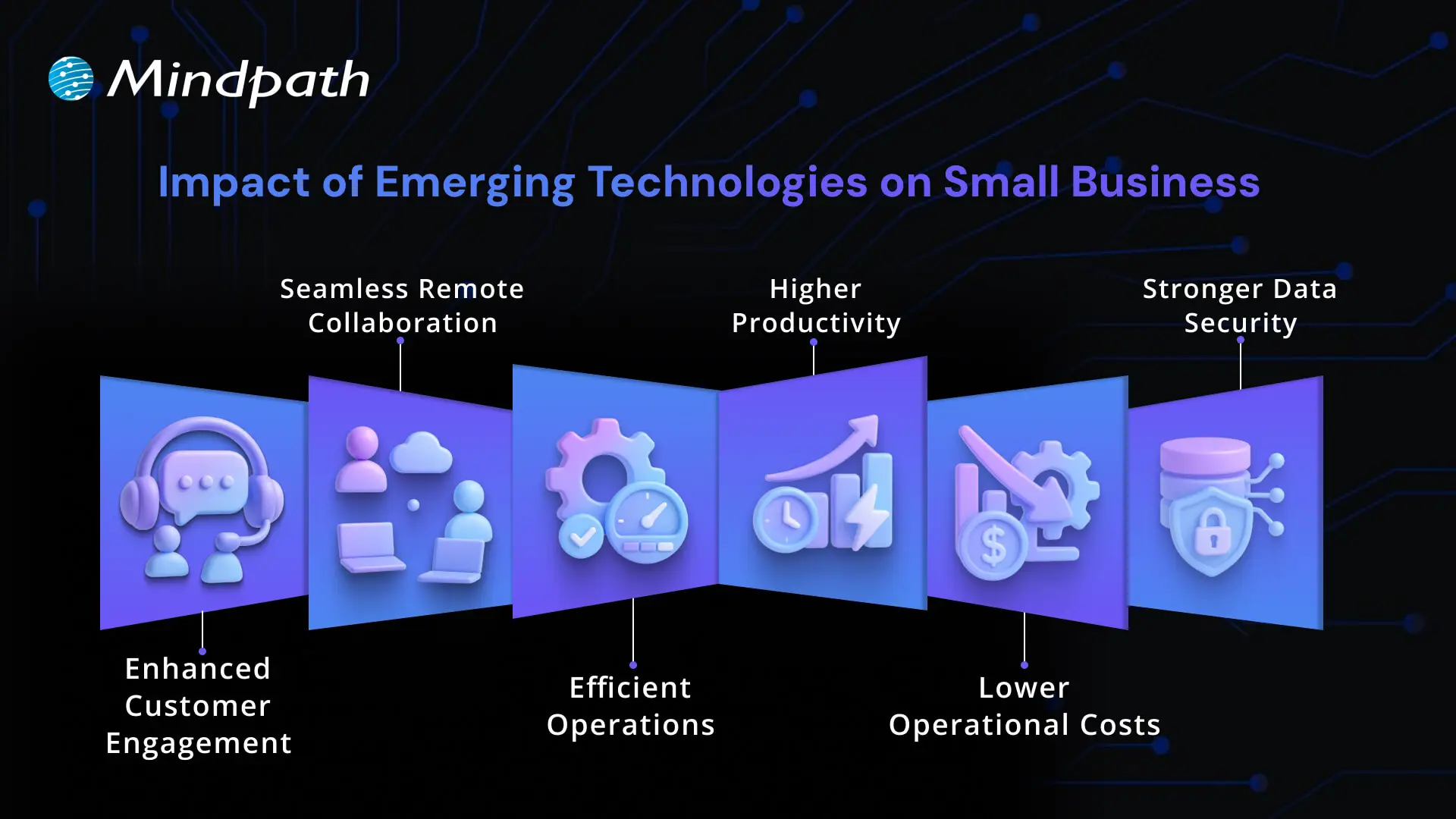
The future of small businesses is being shaped by constant changes in technology. As digital tools become more advanced, the impact of emerging tech on local businesses is becoming harder to ignore. Here are some key areas where this shift is starting to make a difference.
Impact of emerging technologies on small business

1. Enhanced Customer Engagement

Emerging technologies for small businesses are changing how they talk to their customers. Tools like live chat, easy websites, and chatbots help give quick answers. These tools also help businesses know what their customers like or need. This builds stronger trust and long-term relationships.

2. Seamless Remote Collaboration

Digital transformation for small businesses makes it simple for teams to work from different places. Online tools help people talk, share work, and stay connected. This solves the problem of working across locations. It keeps everyone on the same page and helps the business run better.

3. Efficient Operations

New technology helps small businesses work better every day. Tools like AI and cloud systems reduce the time spent on manual tasks. This means fewer errors and quicker results. Emerging technologies for small businesses help manage operations smoothly and save time.

4. Higher Productivity

How technology is changing small businesses can be seen in faster and more efficient work. New tools help track inventory, manage customers, and understand buying habits. This improves decision-making and cuts down on mistakes. Businesses save time and get better results.

5. Lower Operational Costs

New tech helps small businesses save money and stay efficient. Automation tools reduce extra work and help finish tasks quickly. Online platforms for sales and support are more affordable now. This helps businesses grow while using fewer resources.

6. Stronger Data Security

Small businesses worry about keeping customer data safe. With new tech tools like secure cloud storage, that’s easier to do. These tools help prevent online threats and protect payment details and private information. This keeps the business and its customers safe and confident.

Curious how AI can give your small business a competitive edge? Learn about the Future of AI and how emerging technologies are reshaping growth, efficiency, and innovation for businesses like yours.

Top Emerging Technologies for Small Businesses

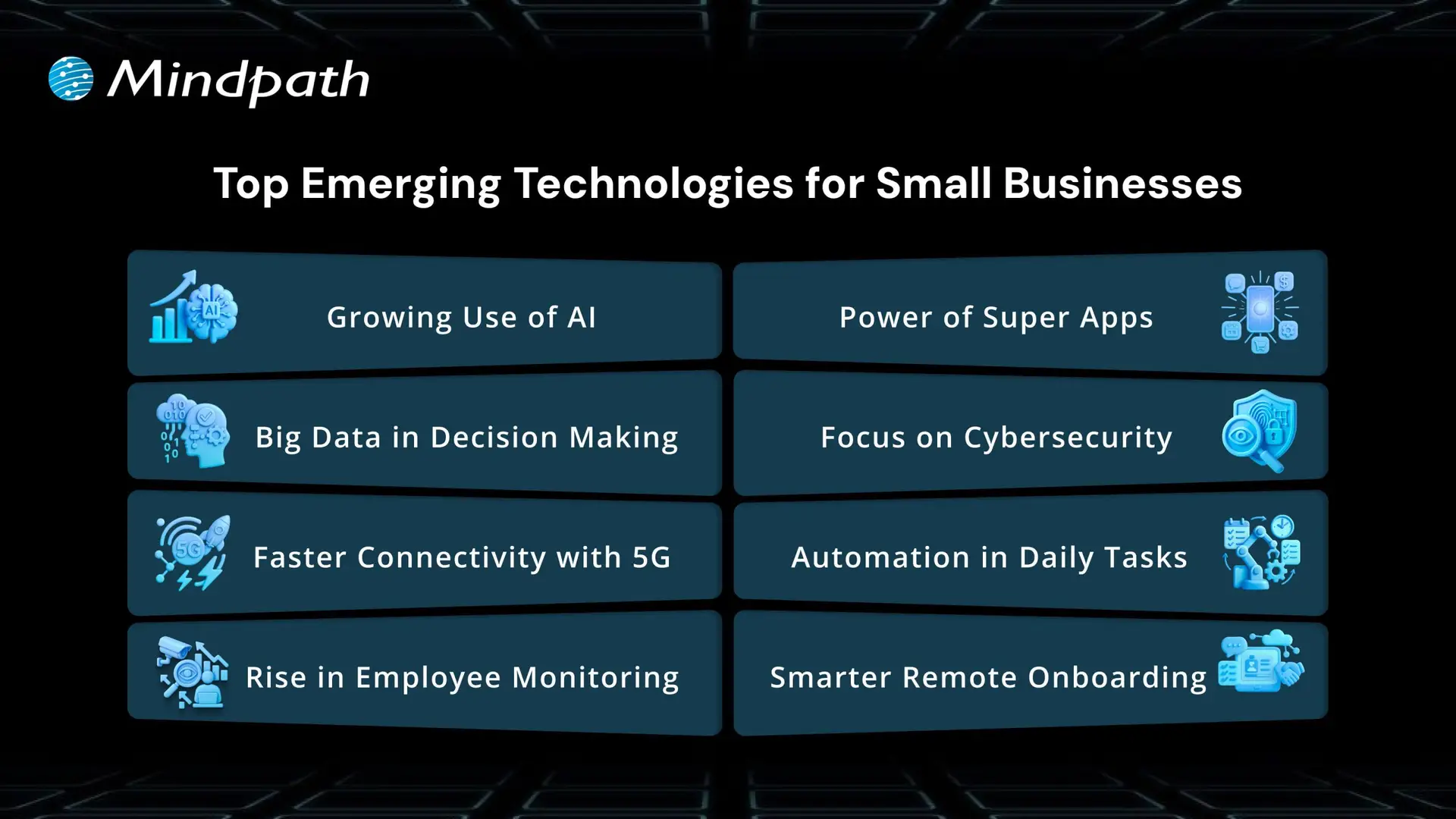
Emerging technologies in business are opening new opportunities for small companies to grow, compete, and serve their customers better. Here are some of the top technologies that are helping small businesses work smarter and achieve more:
Top Emerging Technologies for Small Businesses

1. Growing Use of AI

AI for small businesses is becoming easier to use and more helpful. It’s already improving customer service, reducing errors, and saving time in industries like retail and insurance. Businesses are seeing a quick return on their AI investments through features like chatbots and fraud detection. This highlights how AI for customer services and other emerging technologies are making small business operations more affordable and practical.

2. Big Data in Decision Making

Big data is helping small businesses understand their market and make better decisions. Many companies are already seeing increased profits through the use of data tools. This shows that data is not just for large enterprises anymore. Small businesses can now use insights to improve planning and stay ahead.

3. Faster Connectivity with 5G

5G brings faster data, less delay, and better connections for devices. It helps small businesses use more smart tools and supports the growing number of IoT devices. As 5G becomes more available, small businesses can expect smoother communication and faster service. This will push emerging technologies for small businesses into more areas of daily work.

4. Rise in Employee Monitoring

As hybrid work grows, more companies are using employee monitoring software. It helps track productivity and improve communication between remote teams. With higher demand since the pandemic, businesses now rely on these tools to manage their teams better. These systems are becoming a core part of small business technology trends.

Must Read: Top App Ideas 

5. Power of Superapps

Superapps combine many tools into one, helping businesses manage tasks more easily. They solve problems like software not syncing and reduce wasted time. Small businesses can benefit from apps that handle messaging, scheduling, and customer data all in one place. This kind of smart unification improves efficiency and teamwork.

6. Focus on Cybersecurity

Many small businesses still believe they won’t face cyberattacks, but the risk is growing fast. New threats require better protection for data and systems. By leveraging AI in cybersecurity, businesses can detect threats faster, respond more effectively, and strengthen their overall security posture. More businesses are now focusing on backup plans and stronger security tools. Acting early helps avoid major problems later.

7. Automation in Daily Tasks

More businesses are turning to automation to reduce workload and save money. It helps with tasks like pricing, inventory, and customer service. Even with fewer workers, companies can still run smoothly and meet their goals. Automation is becoming a must-have for efficiency and smart growth.

8. Smarter Remote Onboarding

Remote onboarding is now a key step for hiring and welcoming new team members. Businesses are using technology to make new hires feel connected and supported. Software helps introduce the company culture and build the right relationships. This helps companies keep talent and improve their team experience from day one.

Looking to scale your tech capabilities without breaking the budget? Learn about the key benefits of hiring remote developers and how they can help small businesses adopt emerging technologies faster and smarter.

Power Your Business Growth with Smart Tech

The future belongs to small businesses that move with change. By adopting emerging technologies for small businesses, you work smarter, cut waste, and serve customers better. These tools help you compete, make faster decisions, and grow with confidence. What once felt out of reach is now practical, scalable, and ready for you to use as you plan the next step.

Mindpath helps you turn tech goals into real progress. Our team guides your choices, sets up the right tools, and trains your people to use them well. We focus on clear steps, measurable results, and support that grows with you. Let’s map your priorities and launch changes that deliver value fast for lasting growth and stronger customer results in practice.
Related Post

Discover the transformative power of conversational AI chatbots. From cost savings to increased sales, learn how chatbots can drive growth.
Discover the ultimate guide to hiring Node.js developers in London. Learn about the skills, benefits, and cost factors involved in finding the right talent for your project.

Related Post

agentic ai examples

Generative AI represented a major milestone in the evolution of artificial intelligence. It played a crucial role in enhancing employee capabilities and brought AI closer to the average user. However, you should also look at agentic AI examples to discover how artificial intelligence has moved one step ahead. Agentic AI revolves around the use of agents that not only generate content but also have capabilities for autonomous decision-making.

You should know that big names, including NASA, NVIDIA and Microsoft, have been leading the race for adoption of AI agents. The growing use of AI agents in business is a testament to the fact that they are better than chatbots, which take thousands of prompts to generate remotely useful outputs. An overview of the business use cases of agentic AI can help you understand its true potential.

Ready to use the future-leading  AI solution in your operations? Mindpath offers AI development services that empower your businesses, help you automate processes, and drive innovation.

Understanding the Fundamentals of Agentic AI

LLMs empowered businesses with many capabilities, albeit with a reactive nature and the inability to retain context or memory. Therefore, the utility of LLMs and generative AI was restricted to improving individual productivity in different tasks. Agentic AI marked a shift towards autonomous decision-making and established the foundation of proactive artificial intelligence. 

The most popular agentic AI use cases showcase how agents have introduced a revolutionary transformation in the working of AI. Agentic AI encompasses autonomous AI systems that have capabilities like memory and reasoning and can solve complex problems. 

AI agents can understand the goals for multi-step problems and break them down into subtasks alongside interacting with humans and systems. The agents can also execute the subtasks and adapt to new changes with minimal human intervention. 

Also Read: Generative AI for Business

Why Should Your Business Choose AI Agents?

Many business owners will wonder why they should adopt AI agents. Is it just because big companies are using agentic AI? The examples of agents in AI have proved how agentic AI brings a new set of capabilities to the use cases of AI across different industries. 

Businesses can now have AI systems that not only learn from data but also process information in real-time and execute tasks with different levels of human oversight. Agentic AI delivers promising benefits for businesses such as

  • Enhanced productivity
  • Personalized workflows
  • Operational efficiency at scale
  • Better accuracy and faster decision-making
  • Cost optimization
  • Easier cross-team collaboration

Are you missing opportunities to make faster, smarter decisions because your business isn’t leveraging AI to its full potential? Learn from our blog AI decision-making use cases guide to discover practical ways AI can accelerate insights and give your business a competitive edge.

How Have Businesses Used AI Agents?

Agentic AI is capable of managing everyday tasks and can also enhance agility across enterprise operations. It has been reshaping the way businesses in different industries work with a proactive approach. The curiosity about agentic applications of artificial intelligence is gaining momentum among businesses as AI agents revolutionize workflows. Awareness of the use cases of AI agents in business can provide the ideal foundation to embrace them. 

1. Customer Support Automation

Chatbots and voice assistants have been the most prominent contributions of artificial intelligence in the domain of customer support. Businesses must recognize the limitations of chatbots and voice assistants as they require the right prompts to deliver useful responses. However, AI agents can achieve automation of customer service beyond answering few commonly asked questions.

AI-powered customer service agents don’t need human guidance to function and solve complex multi-step problems. AI agents can offer customer support in different industries for diverse functions without being limited to a specific number of questions. Their capabilities for autonomous decision-making help them in understanding the customer’s need and providing relevant answers.       

2. Proactive Threat Mitigation

Cybersecurity is one of the biggest concerns for businesses as most organizations have security systems that cannot keep up with emerging threats. The adaptability of agentic AI tools ensures that they can learn and respond to security risks in real time. Agents have smart capabilities for round-the-clock network monitoring to identify anomalies and respond to threats before they cause any damage. 

Agentic AI can add an intelligent and dynamic threat detection system that not only offers safeguards but also creates a more resilient security system. You can rely on AI agents for running simulations of attacks to identify vulnerabilities before malicious attackers. On top of it, agentic AI can also facilitate real-time scoring of user activity which helps your team focus on critical threats. 

3. Automation of Enterprise Workflows

Organizations have been experiencing different issues in managing their enterprise workflows with little to no improvement from using various tools. The search for answers to ‘what is agentic AI’ reveals how agents excel at automation without human intervention. Agents can help businesses in streamlining processes through automation of repetitive tasks. For example, AI agents can use meeting notes to issue project tickets without human inputs. 

Agentic AI can help businesses in pooling all their data to avoid information silos. Their ability to retain context helps them develop in-depth understanding of how your business works. As a result, AI agents can enhance productivity and efficiency in enterprise workflows without incurring additional overheads.

4. Faster and Streamlined Software Development

Businesses need smarter software development tools that enhance productivity and transform the traditional notions of customer experience. The rising adoption of AI development services is clearly visible in the use of AI coding assistants, also known as copilots. Agentic AI can help in creating a new generation of AI coding assistants that can write large segments of code. 

Even with mixed reviews, agentic AI has gained appreciation from experts who believe that smart agents will write most of the code in future. Coding assistants will not only help in writing code but also leverage special agents to review code and identify errors. Agents also have the capability to leverage reverse engineering for extracting specifications from code, which makes them a powerful catalyst for coding automation.

Curious how tailored solutions can accelerate growth? Check out the custom software development benefits to see how personalization drives efficiency and innovation.

5. Accelerated Lead Conversion

How many times have your sales teams struggled to convert leads into potential customers? You can find answers to ‘what is agentic AI example’ in the use of agents for lead conversion. Sales representatives can use AI agents to get the accurate insights for zeroing in on the right prospects. For example, agentic AI can help businesses by highlighting the prospects that are most likely to convert. As a result, your sales teams will focus specifically on leads that have real potential.

Another promising contribution of agentic AI to the sales department of your organization is the assurance of offering personalized content. Smart AI agents offer customized follow-up responses, thereby informing your sales representatives about how they can communicate with leads. Furthermore, agentic AI also helps in identifying high-risk deals that may lose momentum.

6. Creating Smarter Product Roadmaps

Business owners must also recognize the scope for improving the methods for developing product roadmaps with agentic AI. With every stakeholder demanding priority for their feature, it becomes difficult to know which aspect deserves your attention. The value of an agentic AI development company becomes clearly visible in such cases where your product team needs agentic AI. 

Professional development companies can help you avoid redundancies in product roadmap development with different functionalities. You can use agents for gathering qualitative data from user research, surveys and feedback to gain holistic understanding of customer requirements. The comprehensive user behavior analysis with agentic AI can create the path for developing smoother customer experiences.                    

7. Enhancing the Agility of Operations Teams

The real-world use cases of agentic AI in business also draw attention towards issues in operations teams. Manual processes not only lead to inefficiencies and delayed decisions but also the inability to dig deeper into data for identifying bottlenecks. The benefits evident in agentic AI examples across different business operations can be applied for operations teams of your organization.

AI agents can help businesses with demand forecasting by drawing accurate prediction of supply requirements. At the same time, the proactive nature of AI agents empowers them to adjust shipping and delivery routes in real time. Agentic AI also offers the advantage of tracking supplier performance and identifying risks which can slow down production. 

8. Establishing Intelligent HR Operations

HR is one of the prominent entries among the many business functions you can transform with AI agents. As a matter of fact, agentic AI use cases in HR operations are low-risk and high-value use cases. It is for this reason that most of the companies using agentic AI leverage it for human resource operations. 

AI agents can make many things easier for HR, including providing responses to simple questions of employees. In addition, smart AI agents can also help HR with internal knowledge retrieval, documentation and tagging alongside other business processes. Every agent in your HR system will be tailored for one specific task and will have the ability to interact with each other. 

Looking to stay ahead in the rapidly evolving world of artificial intelligence and understand how emerging technologies can impact your business? Check out our blog on the top AI trends to see how AI is transforming the industry and driving innovation.

Final Thoughts

The real use cases of agentic AI in businesses reveal many interesting insights on their actual potential. You can capitalize on AI agents to bring a certain degree of autonomy in various business operations while incorporating human oversight. Agentic AI marks another phase in the evolution of artificial intelligence by facilitating the creation of systems that are proactive and can take decisions on their own.

Mindpath is a pioneering agentic AI development company with a credible record in creating AI agents for different business functions. We have developed AI agents capable of integrating seamlessly into your enterprise workflows. Our team has the ability to ensure that your agentic AI systems align with your business needs and vision. Consult with our experts and discover the most efficient ways to embrace agentic AI now.

Hiring the proper ReactJS developer in California is essential to developing a high-quality, scalable application. In today’s competitive technology industry, it is important to properly examine prospects. Several aspects impact the success of your project, including technical knowledge and communication abilities. Taking these important factors into account will assist you in finding a developer who fulfils your company requirements and assures seamless development.

1. Competitive Salary

California is home to some of the most prominent technology organizations, making it a very competitive employment market for ReactJS developers. To recruit and retain top people, competitive compensation is required. Developers with extensive experience in ReactJS, state management libraries like Redux, and current frameworks sometimes command higher wages owing to demand. Salaries vary according to experience, location in California, and the intricacy of the work. Junior developers may have lower wage expectations, but mid-level and senior developers with demonstrated skill expect higher pay. Keeping up with industry wage trends ensures that your offer remains competitive. In addition to competitive base pay, performance-based incentives, bonuses, and stock options can help make your employment offer stand out. Providing a well-structured remuneration package will enhance your chances of securing skilled ReactJS developers who can contribute effectively to your project’s success.

2. Benefits Package

A solid benefits package is essential for recruiting and retaining ReactJS employees in California, in addition to a competitive wage. With the growing cost of living, developers prioritize advantages such as complete health insurance, dental and vision care, and mental health services. These bonuses improve work satisfaction and general well-being. Retirement programs, such as employer-matched 401(k) contributions, enhance the long-term value of your offer. Paid time off, parental leave, and wellness initiatives all help to promote a healthy work-life balance, making your organization more desirable to developers looking for stability. Other incentives, such as learning and development opportunities, conference sponsorships, and home office stipends, might help your employment offer stand out. Offering remote work permits, commuting advantages, or gym memberships boosts employee happiness. A well-rounded benefits package doesn’t just attract top ReactJS developers but also helps with long-term retention, ensuring your project has the stability and expertise needed for success.

3. Remote Work Flexibility

The need for flexibility has increased, and many experienced ReactJS developers in California choose remote work arrangements. Being open to employing remote developers inside the state helps you to tap into a larger talent pool without being constrained to a single area, such as San Francisco or Los Angeles. Employers and developers benefit from the flexibility that remote work provides. It helps businesses save money on office space while allowing developers to work in a pleasant, distraction-free environment. Offering hybrid or entirely remote positions might attract highly skilled individuals who might be unwilling to relocate. Invest in communication technologies like Slack and Zoom, as well as project management systems like Jira and Trello, to guarantee remote collaboration is efficient. Setting clear expectations for deliverables, meetings, and deadlines can assist in sustaining productivity. By embracing remote work flexibility, you can hire top ReactJS talent across California, improving the chances of securing developers with the right skills and expertise for your project.

Finding the right ReactJS developer requires competitive salaries, strong benefits, and flexible work options. At Mindpath, we connect you with top ReactJS talent in California, ensuring the perfect fit for your project.

Get expert developers who deliver high-performance, scalable applications. contact Mindpath today! to build your ReactJS team with confidence!

Discover the ultimate guide to hiring Node.js developers in London. Learn about the skills, benefits, and cost factors involved in finding the right talent for your project.
Need Expert Legal Software Solutions
Want more efficiency in your legal practice? Professional legal software development can automate routine tasks with increased accuracy and enhancement of data security. In this blog, we will explore how Mindpath can provide you with top-tier development services.   Legal software is a specially designed package or application to aid legal processes. These are tools for activities such as secure electronic signatures and review of contracts. While most of the time, lawyers go about with general tech tools like email and shared drives, legal software is specially used for legal needs only. Today, there are several types of legal software in use. Some of these are consumer-facing, enabling individuals to represent themselves in legal matters such as bankruptcy or parking tickets. Others are designed for law firms and related to management of operations, particularly those firms. In the light of requirements for boosting efficiency, security, and client satisfaction, legal software development services are in high demand, especially among law firms and legal departments. With remote work slowly becoming the norm, there is now a call for legal software that introduces secure document access anywhere and the possibility of collaboration from everywhere. It also helps attorneys automate routine tasks, manage case files, and adhere to changing regulations. As legal work becomes more sophisticated, there is a demand for specialized tools that can help with intricate tasks and provide valuable insights.  Let us dive deep into this blog where we will explore the benefits of professional legal software and offers guidance on choosing the right solutions for your practice and most importantly why Mindpath is the ideal partner for legal software development services. 

Benefits of Professional Legal Software Development 

1. Boosting Work Efficiency and Output 

It can enable lawyers and their teams to have much more time for important, challenging work by taking care of some of the repetitive tasks involved. For example, software designed for the analysis of contracts may go through it very fast and provide the attorney more time for the actual negotiation and strategies in the case. Moreover, legal project management tools help lawyers and their employees to keep themselves organized by displaying the ongoing tasks in front of their eyes all the time. In this way, they can manage their priorities and deadlines more effectively. 

2. Improves Teamwork and Transparency 

Legal technology can certainly pave the way for smoother collaboration among all members of your law firm while keeping them well-informed. Take the case of a Document Management System or even Project Management Software—these tools make it quite easy to share information among team members. These tools also have provisions for instant messaging or video calls for quick communication. This keeps the flow of tasks and projects smooth, and everyone is always on the same page. It further helps in making the decisions more transparent as the members can view and take part in discussions regarding the cases or projects. In essence, legal technology usage permits a much more connected and collaborative work environment that benefits both the firm and its clients. 

3. Elevating Client Experience 

Legal technology improves client satisfaction since clients can track the progress of their cases more easily by use of client portals and online document systems. Therefore, clients can obtain updates about their cases without contacting their lawyer all the time. These tools also allow for quicker and more efficient communication, enabling the legal teams to respond to the client with ease and know how to resolve problems. By speeding up tasks and improving accuracy, legal technology helps in the resolution of cases faster, ensuring the entire process goes smoother for clients. 

4. Harnessing Data for Better Insights and Decisions 

In today’s data-driven world, every attorney must utilize data efficiently to deliver the best services to his or her clients. Legal technology can help in this regard with the ease of access and usability of the data. Next-generation tools such as predictive analytics and artificial intelligence enable law firms to quickly analyze a large amount of information and find useful trends for better decision-making. These technologies also organize data and store it, making it easily accessible to team members for access and utilization when required. This speeds up research and reviews of documents, helping attorneys at law firms get a better understanding of client requirements by going through data from them. In effect, legal technology makes handling and use of data easier and more efficient. 

How to Choose Professional Legal Software Solutions   

  • Engage Key Players in Choosing Legal Tech – Consider anyone who will use or manage your new legal technology. Consider the feedback from daily end-users, decision-makers, and subject matter experts so you get what suits your needs and goals.
  • Identify Your Needs – Before you search for new legal software, identify your needs and goals. Be clear about which tasks or processes you want to enhance, or which features you require. This clarity can help in finding the solutions that best fit your requirements.
  • Review Your Current Tech Stack – Review how efficient and valuable your current legal technology really is. Get feedback from users and review usage data to understand where value lies. Benchmark your tech stack against others within the industry to find out how effective it is. Consider how new software will work with your current systems to meet your needs, receive support, and offer potential for integration.  
  • Key Challenges – When choosing new legal tech, ensure it will integrate with existing systems, that it allows for team training, and the fact that the support needs from it are available; its security and compliance criteria are met in view of the Data Laws; be sure the tech will grow with your firm.
  • Request Demos and Test Software – After determining your needs, look for legal software that best fits those needs, considering cost, ease of use, and integration capabilities. Test software with demos or free trials to ensure they align with your requirements. Read reviews and follow up on references from other firms to ensure the buyer is making an informed decision.
  • Align with Business Goals – Measure new technology performance with clear metrics and track data over time. Periodically review results for adjustment as may be required, assuring those technologies support business goals effectively. 

Looking to enhance your legal practice using cutting-edge technology?

With Mindpath, you get specialized legal software development services that assist in making your operations flow seamlessly and proficiently.

Why Choose Mindpath for Legal Software Development Services 

Mindpath specializes in legal software development. With this specialization comes deep industry knowledge and the expertise to handle the difficulties of legal industry with tailored solutions. Our team designs custom-made software according to your exact needs and helps you to attain desired goals.  

We focus on making our software easy to use and intuitive, ensuring that it works well for everyone who uses it. The solutions we provide are designed for business growth—we adapt as your needs change. There’s also continued support and maintenance to keep everything running smoothly and securely. 

By choosing Mindpath for legal software development, you’ll get a partner who knows exactly what you need and delivers a solution that is dependable and efficient. 

Conclusion 

In a shifting legal landscape, the right technology makes all the difference. Professional legal software development is designed for efficiency, collaboration, and client satisfaction. It aids a law firm in smoothing out its operations in service of its clients through the automation of routine tasks, better communication, and leveraging data insights. When searching for new technology solutions, guide yourself by the things you really need and support that by reviewing your current tools, making sure that any new system will give way to business goals. The right legal software transforms practices into an effective and responsive environment that is very competitive. 

Mindpath specializes in providing tailored legal software development services to meet such needs with exactness. With years of experience in developing intuitive, powerful solutions, Mindpath can help transform your practice into one that’s more effective and responsive to the competitive environment. 

Ready to Transform Your Legal Practice?

Maximize your customized technology at Mindpath. Our very expert solutions will simplify and maximize the overall efficiency of your operations. 

Boost your legal practice with Mindpath’s expert software solutions. Enhance efficiency, client satisfaction, and streamline operations seamlessly.