Home

MVP Development Cost and Timeline: A Founder’s Guide

MVP Development Cost and Timeline: A Founder’s Guide

Join our Newsletter!

MVP development Cost

Building a new product requires founders to balance business goals, limited budgets, investor expectations, and launch deadlines. Without a clear plan, development costs can rise quickly, and delays can push a product launch further away. Understanding MVP development cost early helps founders prioritize essential features, allocate resources wisely, and make informed decisions before development begins.

Key Takeaways

  • 01
    MVP development cost depends on product complexity, features, platform, and technical requirements.
  • 02
    Clear feature priorities help founders control budgets and avoid unnecessary development expenses.
  • 03
    A realistic MVP development timeline supports better planning and resource allocation.
  • 04
    Choosing the right development team helps maintain quality and delivery efficiency.
  • 05
    Post-launch maintenance and improvements should be included in the overall budget.

The total investment depends on product complexity, platform requirements, integrations, team structure, and testing needs. A realistic budget and timeline can help prevent scope creep and set achievable expectations. In this blog, we cover MVP development costs in 2027, estimated timelines, key pricing factors, and practical ways to plan your budget.

Looking to turn your product idea into a market-ready solution?
Mindpath offers MVP development services to help you prioritize essential features, plan development, and build a product aligned with your business goals.

What Is an MVP, and Why Does It Matter for Startups?

A minimum viable product (MVP) is an early version of a product with enough core functionality to test a business idea with real users. In MVP app development, the goal is to validate demand and gather feedback before investing in a full-scale product.

An MVP helps startups make better decisions through these key benefits:

1. Validate Assumptions

Gather real user feedback to understand whether the product solves a genuine problem.

2. Prioritize Features

Identify which functionalities users need most before expanding the product.

3. Reduce Investment Risk

Test market demand before committing significant resources to unproven ideas.

4. Attract Investor Interest

Use early user feedback and validation results to strengthen funding discussions.

5. Improve Product Usability

Identify friction points and refine the user experience based on actual usage.

6. Accelerate Time to Market

Launch essential features sooner and begin learning from real customers.

7. Support Informed Decisions

Use user behavior and feedback to guide future development priorities.

An MVP differs from a prototype, which primarily demonstrates a concept or user flow. A fully developed product offers broader functionality, while an MVP focuses on essential features that deliver core value. Its success depends on meaningful user insights and usability, not the number of features it includes.

How Much Does It Cost to Build an MVP in 2027?

The MVP development cost in 2027 depends on the product’s complexity, required features, and technical requirements. A basic product requires less development effort, while applications with multiple user roles, advanced integrations, or complex business logic need a larger investment. The following MVP development pricing ranges provide an initial budgeting reference.

MVP Type Indicative Cost (USD) Typical Scope
Basic MVP $10,000–$25,000 Core features, simple workflows, limited integrations
Mid-Complexity MVP $25,000–$60,000 Multiple user roles, APIs, dashboards, complex workflows
Complex MVP $60,000–$120,000+ Advanced integrations, complex business logic, demanding security or scalability requirements

These figures are indicative planning estimates, not fixed quotes or universal market averages. Actual costs vary by development location, team experience, technology choices, product requirements, and engagement model.

Certain requirements can increase the budget considerably. AI-enabled functionality, real-time processing, regulated data handling, and multiple third-party integrations often require additional engineering, testing, and security measures.

Before approving a quote, founders should confirm what the estimate covers, including UI/UX design, quality assurance (QA), project management, deployment, and post-launch support. Comparing proposals against the same scope helps identify hidden expenses and establish a more realistic budget for development costs.

MVP Development Timeline: How Long Does It Take to Develop an MVP?

A typical MVP takes 6–14 weeks to develop, while complex products may require 16–24 weeks or longer. The timeline depends on feature complexity, platform requirements, integrations, team size, and testing needs.

Development Phase Estimated Duration Key Activities
Discovery and Planning 1–2 weeks Requirements, core features, project scope
UI/UX Design 1–3 weeks Wireframes, user journeys, interface design
Core Development 3–7 weeks Frontend, backend, essential features
Testing and Refinement 1–2 weeks Quality checks, bug fixes, usability testing
Deployment and Launch 1 week Production setup, release, performance monitoring

These are indicative estimates, and some phases can overlap. Changing requirements, delayed approvals, and integration challenges may extend delivery. Defining milestones early helps founders manage the MVP development cost, avoid unnecessary delays, and maintain product quality.

How to Reduce MVP Development Cost Without Sacrificing Quality

Founders can control development expenses by making informed decisions before and during development. These strategies help keep the project focused while maintaining functionality, security, and usability.

1. Prioritize Essential Features

Build only the features needed to solve the primary user problem. Defer secondary functionality until user feedback justifies further investment.

2. Validate Before Coding

Use customer interviews, wireframes, and clickable prototypes to test assumptions before committing to expensive development work.

3. Choose the Right Platform

Select web, native mobile, or cross-platform development based on user needs and product requirements.

4. Reuse Proven Tools

Use established APIs, authentication services, and managed cloud infrastructure where appropriate to reduce development effort.

5. Avoid Premature Scaling

Build for current requirements while keeping future expansion in mind, rather than investing in unnecessary infrastructure.

6. Define Clear Requirements

Establish deliverables, milestones, and approval processes before you hire MVP developers to minimize costly scope changes.

7. Plan a Realistic Schedule

A well-defined MVP development timeline helps coordinate resources and reduce delays without rushing testing or compromising quality.

Should You Hire MVP Developers or Choose an MVP Development Company?

Choosing the right development model depends on your budget, technical expertise, project complexity, and need for ongoing support.

Development Model Key Advantages Potential Limitations Best Suited For
Freelance Developers Flexible hiring and lower initial overhead Requires coordination across different specialists Small, clearly defined MVPs
In-House Team Greater control and long-term product knowledge Recruitment, salaries, and ongoing management costs Startups building products continuously
MVP Development Company Coordinated expertise in planning, design, development, and testing Engagement costs vary by scope and service level Founders seeking end-to-end development support

Before choosing a partner, evaluate technical expertise, relevant experience, pricing transparency, project milestones, source-code ownership, and post-launch support.

The right development model helps founders balance delivery quality, available resources, and MVP development cost while keeping product goals and future development needs in focus.

Plan Your MVP Budget and Launch Timeline with Mindpath

Planning your MVP development cost and timeline starts with clear priorities, realistic budgets, and the right development approach. Focus on essential features, validate your idea with real users, and account for ongoing maintenance. These decisions help founders reduce unnecessary spending while building a reliable product for future growth.

At Mindpath, we provide MVP development services to help startups turn ideas into market-ready products through strategic planning, design, development, and testing. As an experienced MVP development company, we help founders build focused products aligned with their goals.
Ready to Build Your MVP?

Turn your idea into a market-ready product with the right strategy.

Frequently Asked Questions

Compare estimates against defined features, development milestones, testing requirements, and support costs to identify missing expenses before approving a budget.
Revisit feature priorities, postpone nonessential functionality, and discuss alternative approaches with the development team without compromising security or core usability.
Expand the product when user feedback, adoption data, and validated business needs demonstrate that additional features will deliver meaningful value.
Finalize requirements early, assign clear responsibilities, provide timely feedback, and agree on milestones to reduce misunderstandings and unexpected changes.
A well-planned budget leaves room for maintenance, user feedback, and essential improvements without exhausting resources during the initial development phase.

Support Is One Click Away

Featured Posts

Related Post

AIOps vs DevOps

Modern IT teams don’t struggle to collect operational data. They struggle to make sense of it. A single incident can trigger hundreds of alerts across monitoring tools, leaving engineers to sort through noise before they can even start fixing the problem.

Key Takeaways

  • 01
    DevOps improves software delivery through collaboration, automation, CI/CD, and continuous monitoring.
  • 02
    AIOps applies AI to analyze operational data, detect patterns, and support faster incident response.
  • 03
    AIOps and DevOps address different needs but can work together across modern IT environments.
  • 04
    Successful AIOps adoption depends on reliable data, strong observability, integration, governance, and human oversight.
  • 05
    Organizations can introduce AIOps gradually by applying AI to specific operational use cases.

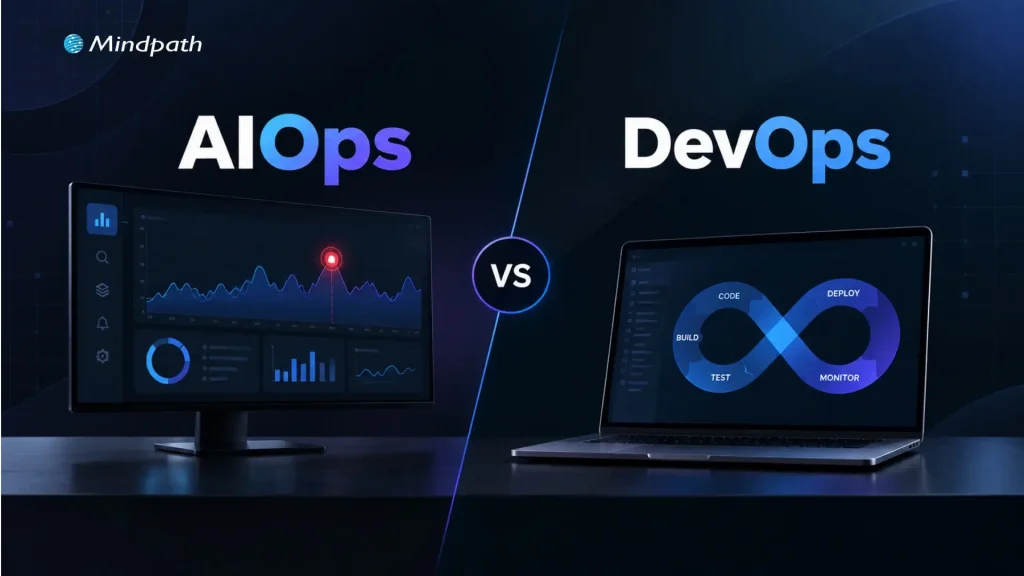
DevOps gave teams the pipelines, automation, and collaboration to release software quickly and reliably. But faster delivery also means more services, more deployments, and more data to interpret. That’s why AIOps vs DevOps has become an important question for IT teams. DevOps speeds up how software is built and shipped, while AIOps uses AI to cut through alert noise, find root causes, and respond faster. In this blog, we’ll explore how the two differ and how an AI DevOps approach can bring them together.

Ready to build more intelligent IT operations?

Mindpath helps businesses apply AI to operational workflows, data, monitoring, and automation.

What Is DevOps?

DevOps is a software development and operations approach that brings teams, processes, and technologies together across the application lifecycle. It focuses on improving collaboration, automating repetitive tasks, and creating consistent workflows for building, testing, deploying, and maintaining applications.

By integrating development and operations practices, DevOps helps teams release software more frequently while maintaining reliability and operational control. It also supports continuous feedback, infrastructure automation, and faster responses to issues across development and production environments.

Key features and benefits of DevOps: 

1. Continuous Integration and Delivery

2. Automated Testing and Deployments

3. Infrastructure and Configuration Automation

4. Faster Software Release Cycles

5. Improved Collaboration Across Teams

6. Continuous Monitoring and Feedback

What Is AIOps?

AIOps applies artificial intelligence and machine learning to IT operations, helping teams analyze the large volumes of data generated by applications, infrastructure, networks, and monitoring systems. It combines operational data with intelligent analysis to identify patterns and surface relevant insights.

AIOps can correlate events across multiple systems, detect unusual behavior, support root-cause analysis, and automate selected operational responses. This helps IT teams handle complex environments with greater visibility while reducing the manual effort involved in monitoring and incident investigation.

Key features and benefits of AIOps: 

1. Intelligent Event Correlation

2. Anomaly and Pattern Detection

3. Automated Alert Analysis

4. Faster Root-Cause Investigation

5. Predictive Operational Insights

6. Automated Incident Response

7. Reduced Alert and Operational Noise

AIOps vs DevOps: What Is the Difference?

AIOps and DevOps both aim to improve IT operations, but they address different aspects of the technology lifecycle. DevOps focuses on collaboration, automation, and software delivery, while AIOps uses AI-driven analysis to make IT operations more intelligent and responsive.

Area DevOps AIOps
What it is A culture and set of practices that unites development and operations An approach that applies AI/ML to IT operations data
Core objective Ship software faster and more reliably Detect, diagnose, and resolve operational issues faster
Main question it answers “How do we build and release this efficiently?” “What is going wrong, why, and what should we do?”
Where it operates Build → test → deploy → operate Monitor → detect → analyze → respond
Type of automation Rule-based and scripted (pipelines, IaC, deployments) Adaptive and data-driven (correlation, anomaly detection, suggested or automated remediation)
Data used Code, build logs, pipeline results, deployment history Logs, metrics, traces, events, alerts, and tickets at large scale
How decisions are made Predefined workflows and thresholds Learned patterns and statistical models
Typical use cases CI/CD, infrastructure automation, release management Alert noise reduction, anomaly detection, root-cause analysis, predictive alerts
Example tools Jenkins, GitHub Actions, GitLab CI, Terraform, Ansible, Kubernetes Dynatrace, Datadog, Splunk, PagerDuty, BigPanda
Key metrics Deployment frequency, lead time, change failure rate MTTD, MTTR, alert volume, false-positive rate
Primary users Developers, DevOps and platform engineers SREs, IT operations, NOC and incident response teams
AI dependency Not required Central to the approach
Main limitation Struggles to interpret huge, noisy operational data manually Depends on data quality and needs human validation

What Should Organizations Consider Before Adopting AIOps?

AIOps works best when organizations have the right operational foundation in place. AI-driven analysis depends on the quality of the data, systems, and workflows available to it. Before adoption, teams should assess how their existing IT environment can support intelligent analysis and automation.

1. Data Quality

AI is only as good as its input. Are logs, metrics, and events consistent and complete?

2. Observability

Observability provides context for accurate analysis. Do we have visibility across apps, infrastructure, and services?

3. Tool Integration

Integration enables cross-system analysis. Can monitoring, cloud, and ITSM tools share data?

4. Security and Governance

Security and governance help prevent unsafe automated actions. Do AI actions follow our access controls and policies?

5. Human Oversight

Human oversight keeps risk under control. Which actions are automated and which need approval?

6. Team Readiness

Team readiness drives trust and adoption. Do engineers know how to validate AI-generated insights?

AIOps adoption should therefore align with the organization’s existing DevOps practices and operational maturity. Starting with well-defined use cases, reliable data, and controlled automation can help teams introduce AI into IT operations without disrupting established processes.

How DevOps and AIOps Work Together?

The need for AIOps generally becomes clearer as IT environments grow in scale and complexity. Teams managing distributed applications, cloud infrastructure, multiple monitoring systems, and high volumes of operational data may need capabilities that extend beyond conventional DevOps automation.

For organizations building an AI DevOps strategy, AIOps can complement existing processes by adding intelligence to monitoring, incident analysis, and operational decision-making. The approach can be particularly relevant when teams face recurring incidents, excessive alert volumes, fragmented operational data, or increasing pressure to respond quickly.

1. Handle Growing Operational Data

Analyze large volumes of logs, metrics, events, and traces.

2. Reduce Alert Overload

Identify relationships between related events and focus attention on significant issues.

3. Improve Incident Response

Provide additional context during investigation and troubleshooting.

4. Manage Complex Environments

Connect operational signals across cloud, applications, infrastructure, and services.

5. Extend Automation

Support intelligent actions alongside established DevOps workflows.

Lifecycle Stage DevOps Contribution AIOps Contribution
Build and test Automated CI pipelines and testing Flags patterns in failed builds or flaky tests
Deploy Automated, repeatable releases Detects anomalies right after a release
Monitor Dashboards, alerts, and feedback loops Correlates events across systems and reduces noise
Incident response Runbooks, on-call processes, rollbacks Suggests probable root cause and triggers low-risk fixes
Improve Post-incident reviews and process updates Surfaces recurring issues and trends

The decision does not have to be framed as AIOps vs DevOps. DevOps can remain the foundation for software delivery and automation, while AIOps adds intelligence where operational complexity demands deeper analysis and faster response.

Building an Intelligent IT Operations Strategy

Building intelligent IT operations is not about replacing existing DevOps practices with AI. It involves strengthening the operational foundation first, then introducing AI where it can provide meaningful analysis, automation, and decision support.

Step Action Example Success Metric
Strengthen DevOps Standardize CI/CD, IaC, and workflows Unified pipeline templates Deployment frequency, change failure rate
Improve observability Centralize logs, metrics, traces, and events One monitoring platform or data layer Coverage of monitored services
Connect data Integrate cloud, app, and ITSM tools Alerts linked to tickets and deployments Reduction in data silos
Introduce AI selectively Start with one use case Event correlation for one service Alert volume reduction
Automate carefully Begin with low-risk, repetitive actions Auto-restart a failed service MTTR, automation success rate
Measure and refine Review outcomes regularly Monthly incident trend review MTTD, MTTR, recurring incidents

This approach allows organizations to introduce AIOps gradually while building on established DevOps processes. The result is a more connected operating model where automation handles defined workflows and AI helps teams interpret complex operational signals.

How Can Your Team Combine AIOps and DevOps?

The AIOps vs DevOps discussion shows that both approaches address different operational needs. DevOps establishes efficient delivery and automation practices, while AIOps adds AI-driven analysis to complex IT environments. Together, they can help teams improve visibility, respond to incidents faster, and build more intelligent operational workflows.

At Mindpath, our AI development services help businesses apply AI across operational workflows, data environments, and business processes. From AI strategy and data engineering to intelligent automation, we help teams build practical AI capabilities aligned with their technical requirements and operational goals.

ai ethics guide

AI ethics is the multidisciplinary field that governs the responsible design, deployment, and regulation of artificial intelligence systems in alignment with human values. It plays a key role in making sure that AI systems create measurable value for society while protecting human rights and preventing harm. It involves a broad range of considerations such as fairness, transparency, privacy, security, accountability, and the prevention of bias and discriminatory outcomes in automated decision-making.

While talking about the topic relating to artificial intelligence, one cannot ignore the importance of AI ethics. As AI is growing at an exponential rate, it is essential to understand the role of AI ethics in the prevailing AI realm. As AI is impacting the lives of people in diverse ways today, it is the right time to broaden the insight into AI ethics. The AI Ethics guide will help you explore AI Ethics at an in-depth level and understand why it matters so much today. 

Ready to adopt AI in a way that it operates ethically and protects your business from risks as you scale? Mindpath offers trusted AI development services that help you build transparent, responsible, and future-ready AI solutions.

Key Areas of AI Ethics

The definitions of AI may vary considerably. However, AI ethics combines a number of elements, including security, safety, and human concerns. It also involves the responsible use of AI by taking into consideration the environmental concerns. The chief areas of the AI ethics framework include:

1. Avoiding AI Bias 

AI systems learn from data. The systems with poor design are likely to demonstrate biased behavior. You must remember that AI models with poor training may showcase bias against minorities. This is when AI ethics principles come into the picture. AI ethics principles relating to fairness and justice can make sure that the possibility of bias can be curbed effectively. 

2. Artificial Intelligence and Privacy 

Artificial intelligence relies on information in order to learn. A considerable amount of this information comes from users. Thus, it automatically gives rise to privacy concerns for users. This is because not all users are well-aware of the information that has been gathered about them and how it is being used. An AI ethics framework can make sure that there is no compromise when it comes to the privacy of users. It even ensures that their information is used in a responsible manner.

3. Avoiding AI Mistakes 

It is essential to bear in mind that poorly constructed AI systems are prone to making mistakes. Such mistakes may lead to diverse consequences, such as the loss of revenue or accidents. This is why the AI Ethics guide stresses the importance of adequate and proper testing so that AI will not pose a risk to humans. 

4. Management of AI Environmental Impact 

With each passing day, AI models are getting larger and bigger. These large models consume a high volume of energy for the purpose of training. Thus, AI has become a large consumer of resources in the prevailing times. Ensuring the ethicality of AI is essential so that researchers can design energy-efficient AI systems that can strike a balance between energy efficiency and performance. 

Planning to align innovation with responsible governance? Discover the types of AI to learn how each category impacts compliance and ethical standards.

Understanding AI Ethical Principles

The AI Ethics guide sheds light on the five Ethical principles of AI that you need to bear in mind. You need to familiarize yourself with the AI ethics principles so that you can understand their relevance in the real-world setting.

1. Transparency

One of the fundamental ethical principles relating to AI revolves around transparency. AI systems and tools need to be transparent in nature so that people can understand how they work. The role of transparency is cardinal to understanding how AI systems make decisions. It will help disclose the overall functionality of AI systems to humans. 

2. Fairness

In case you are wondering, what are the 5 ethics of AI? You need to remember that one of the key principles is related to fairness. AI systems need to be fair and just in nature so that the possibility of biased behavior can be eliminated. While creating AI models and systems, developers need to adopt a fair approach so that these systems will not generate discriminatory outcomes. The AI systems need to treat all individuals and groups in an equitable manner. One of the key AI ethics examples involves addressing biased behavior in hiring algorithms.

3. Accountability 

While talking about – What are the 5 ethics of AI? You cannot ignore the importance of accountability. In fact, accountability is a critical component of AI ethics. A chain of accountability should be in place so that appropriate individuals and organizations can be held responsible while using AI systems. There needs to be a clear line of responsibility so that systems can operate in a trustworthy way. When it comes to accountability in the context of AI teams, they need to understand the importance of prevention as a cure. 

4. Reliability

In order to be ethical in nature, AI systems need to function in a reliable manner. It can ensure that the outcomes that have been achieved by the particular system are consistent and reproducible. Reliability is especially important when AI is being used in important areas such as healthcare and finance. It is fundamental to monitor AI systems to ensure that they are reliable and dependable in nature. 

5. Privacy and Security

AI systems need to respect the privacy as well as the security of users. It is essential to have in place proper security measures so that sensitive data can be stored in a secure and safe manner. Some of the measures organizations can adopt include data encryption, identifying system vulnerabilities, and safeguarding against malicious attacks. It is fundamental to adopt responsible data collection practices along with the deployment of robust data governance practices. One of the common AI ethics examples involves protecting user data privacy in the healthcare setting. 

Want to implement artificial intelligence responsibly without risking compliance or trust? Discover an AI roadmap to learn how a structured approach ensures ethical and sustainable adoption.

Technical Requirements for Creating Ethical AI Systems

In order to make sure that AI systems are ethical in nature, it is essential to focus on the technical aspects. Organizations need to fulfill a number of technical requirements so that AI systems can function in an ethical and responsible manner.   

1. Focus on Bias Detection

There is a need to use diverse data sets in order to detect as well as correct bias in AI models. It is a key step that has to be taken in order to ensure that AI systems can operate in a fair manner. 

2. Focus on Explainability

The role of explainability and transparency is high while talking about AI ethics. The developed AI systems should function transparently for users. Methods such as decision trees and feature importance scores can be adopted to boost transparency. 

3. Data Privacy

The safe management of data used by AI systems is a must. Moreover, proper compliance with relevant privacy laws is essential so that the privacy of users will not be compromised at any stage. Practices such as anonymization and data encryption need to be adopted while using AI systems. 

Curious why some organizations struggle with responsible AI rollout? Check out challenegs of AI adoption and discover how the right approach balances innovation with ethical oversight.

Ready to Build Ethical AI That Drives Real Business Value?

In the era of artificial intelligence, the role of AI ethics is extremely important. It helps ensure that this powerful technology is used in a responsible and trustworthy way. As AI continues to evolve rapidly, understanding and applying ethical principles becomes essential for businesses, developers, and organizations. By prioritizing ethical practices, organizations can adopt AI with greater confidence while creating long-term value for society. 

At Mindpath, we provide expert AI development services which help organizations build responsible and future-ready AI solutions with strong ethical foundations. Our experts focus on transparency, data security, and fairness so businesses can innovate confidently while protecting trust and compliance. Partner with Mindpath to turn AI innovation into responsible and sustainable growth.

conversational AI chatbots

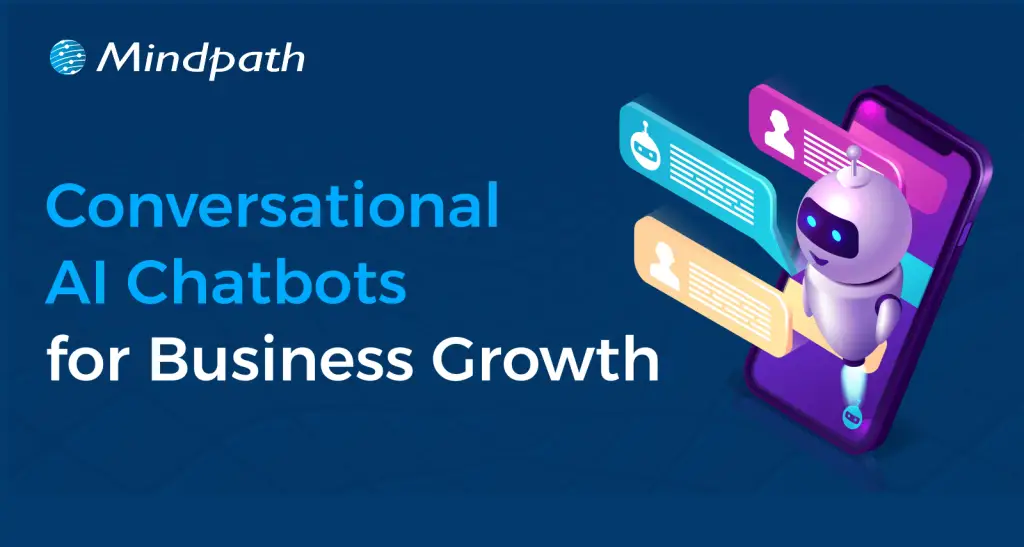
How can businesses handle thousands of customer requests and provide 24/7 support? The answer is conversational AI chatbots. These intelligent assistants automate customer support, assist with sales, and integrate with existing business systems, helping organizations improve efficiency and deliver better customer experiences.

These AI chatbots are fast becoming a staple in today’s business toolset. Many organizations are beginning to use them, supplementing their customer interaction and task management processes. Chatbots can fit conveniently into many different areas of an organization. As usage continues to expand, understanding their value is important. This blog will detail how these AI chatbots are increasing the effectiveness of business operations in simple ways. 

Looking to enhance customer engagement with a personalized AI solution? Our custom chatbot development services specialize in building conversational AI chatbots tailored to your business needs and goals.

What is a Conversational AI Chatbot?

A conversational AI chatbot is an intelligent program that understands natural language and responds like a human. It helps users find information, resolve queries, and complete tasks through websites, apps, and messaging platforms, providing instant support 24/7.

These chatbots use natural language processing (NLP), machine learning (ML), and large language models (LLMs) to understand context and improve conversations. From assisting online shoppers to supporting employees, conversational AI chatbots help businesses streamline communication and enhance user experiences.

Curious to know how AI can enhance your e-commerce strategy and give your business a competitive edge? Read our detailed blog on how AI in e-commerce is transforming the future.

Types of Conversational AI Chatbots

Conversational chatbots come in different types, each designed to handle specific kinds of interactions. Understanding these types helps in choosing the right chatbot for your business needs.

1. NLP Chatbots

Natural Language Processing (NLP) chatbots can understand user intent and context, making them capable of handling complex or varied language inputs. Unlike rule-based bots, they interpret full sentences to deliver more relevant and precise answers.

2. Menu-Based Chatbots

Menu-based chatbots use decision tree-type logic and offer users a set of predefined buttons or options to choose from, guiding them through a structured conversation. These bots are ideal for handling simple FAQs like tracking orders or checking pricing but can be limited in handling complex queries.

3. Machine Learning Bots

Machine learning chatbots learn from past user interactions and improve over time, allowing for highly personalized and context-aware conversations. They can remember user preferences and reuse information in future chats, enhancing the customer experience.

4. Hybrid Chatbots

Hybrid chatbots combine rule-based systems with AI capabilities to deliver both structured and intelligent responses. They can escalate complex issues to human agents, allowing seamless integration between automation and live support.

5. Rule-Based Chatbots

Rule-based chatbots operate using if-then logic and keyword recognition, providing answers based on specific triggers set by the developer. They work best when queries are predictable and can be mapped to predefined responses using keywords or phrases.

All these chatbot types can be integrated into a powerful conversational AI platform to provide comprehensive and intelligent customer support solutions.

According to a study by Tidio, the conversation rate of chatbots in some industries has been observed to reach up to 70%.

Benefits of Conversational AI Chatbots For Business Growth

Conversational AI chatbots are becoming a powerful tool for businesses looking to improve how they work and grow faster. Here are some of the key benefits they offer for driving business growth:

1. Get Useful Customer Feedback Easily

Chatbots can ask for feedback right after a chat session by sending a quick question or rating option. To encourage responses, they can offer discounts or small rewards. Businesses can then check feedback and chat logs to discover common issues and improve services. It’s a smart way to collect insights without bothering the customer.

2. Understand Customer Needs

AI chatbots can figure out what the customer wants and how they feel by reading their words and tone. They understand if a message is urgent or if a customer is upset. When needed, they pass this helpful info to an agent. This gives the agent better context to respond more personally and calmly. 

3. Support Your Sales Team with Smart Help

AI chatbots help with sales by chatting with website visitors, gathering lead details, and booking demos. They answer common product questions and encourage customers to stay longer and learn more. This reduces cart abandonment, increases conversion rates, and supports upselling, all with minimal effort. 

4. Handle Repetitive Questions Automatically

One of the best AI chatbot features is the ability to answer common questions instantly. They manage simple tasks like order tracking, returns, and payment issues without needing a support agent. This saves time for both the customer and your team. It also reduces the number of tickets and keeps agents free from more serious problems.

If you’re exploring smarter ways to deliver customer support. Read our blog on AI for Customer Service, where we highlight how chatbots and virtual assistants can improve customer satisfaction and drive measurable business growth.

5. Increase Lead Generation

Instead of filling out forms, customers can chat naturally with AI bots to share their needs. Chatbots collect useful data like preferred products, location, and language. This data is shared with the marketing team, helping them create personalized campaigns and understand customer behavior better.

6. Keep Customers Engaged with Timely Updates

Chatbots can send helpful messages like order updates, appointment reminders, or payment alerts. They also follow up with feedback requests and help continue conversations across different platforms. With custom branding and fun elements like emojis or images, they make every interaction feel friendly and engaging. 

7. Lower Business Costs

Every business wants to reduce costs while improving service quality. Chatbots help by managing simple tasks, answering frequent questions, and routing chats to the right place. This reduces the need to hire additional agents. Some chatbot platforms are easy to set up without coding, saving time and helping businesses see value faster.

8. Scaling Customer Support Efficiently

Chatbots act like additional support agents by handling many customer questions at once. They manage simple requests efficiently, which helps your team focus on more complex issues. This makes it easier to serve a growing number of customers without increasing staff size, saving time, and reducing pressure on your support team. 

Wondering how to turn AI concepts into actionable business solutions? Check out our AI Consulting Services guide for insights on planning, deploying, and scaling AI effectively.

Want to Transform Your Business with Conversational AI Chatbots?

Conversational AI chatbots are changing how businesses talk to customers, manage support, and grow. From smart replies to handling repetitive tasks, these chatbots are now a valuable part of any modern business setup. They simplify operations, improve customer experience, and help teams work more efficiently without adding extra load. 

We at Mindpath are custom chatbot development company, we help businesses build custom conversational chatbots that fit their goals. Whether it’s for customer support, lead generation, or sales, our expert solutions make chatbot integration easy and impactful. Let us help you scale faster and connect better with your customers using the best AI chatbot tools.  

Discover the transformative power of conversational AI chatbots. From cost savings to increased sales, learn how chatbots can drive growth.