How DevOps Drives Cost Efficiency in Business Operations

Join our Newsletter!

Featured Posts

Support Is One Click Away

Home

How DevOps Drives Cost Efficiency in Business Operations

DevOps

How DevOps Drives Cost Efficiency in Business Operations

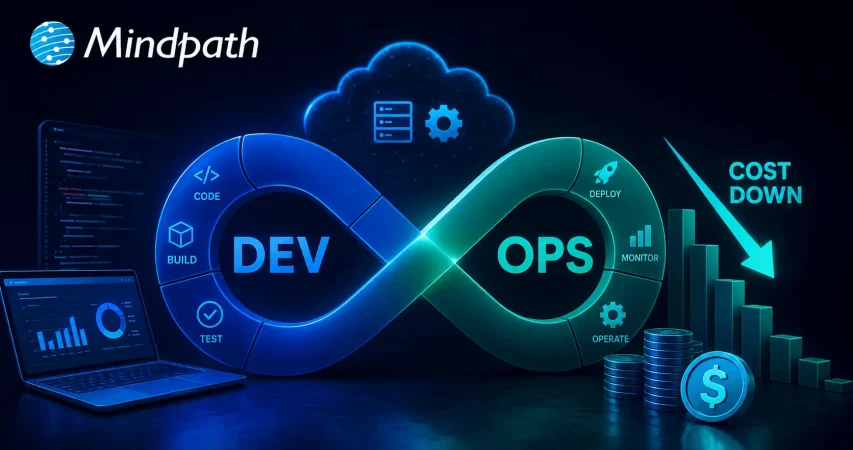
Are you looking for a way to lower your business costs while boosting efficiency? What if you could achieve both by simply improving how your teams collaborate and work together? DevOps offers a powerful approach to streamline operations, automate processes, and eliminate waste—all of which can lead to significant savings. Curious about how DevOps can impact your bottom line? In this blog, we will explore the ways this methodology can transform your business and help you save money in the process.  DevOps is a method that brings together the development (Dev) and IT operations (Ops) teams to collaborate closely and effectively. It entails automating and improving the software development, testing, and deployment processes via the use of methods and tools. The purpose of DevOps is to make the entire process quicker, easier, and more dependable by increasing collaboration and communication among developers and IT workers. DevOps began in 2007 when individuals realized that the conventional style of working, in which developers and IT teams worked independently, was holding down progress. DevOps enables enterprises to produce software faster and with fewer issues by merging the work of both teams. It’s all about working together, automating tasks, and optimizing processes.  So, let’s dive in to explore how DevOps can help save business costs! 

How DevOps Can Help Saving Business Costs

1. Using Cloud Infrastructure

Cloud infrastructure is an effective means to reduce IT expenditures while increasing flexibility and efficiency. Cloud services enable enterprises to scale their resources up or down in real time. Additional resources can be allocated during peak demand periods, while they can be lowered during quieter periods. This guarantees that you only pay for what you use, reducing needless costs and optimizing your budget. Cloud platforms also make processes more efficient by providing automation tools. Tasks like resource management, monitoring, and upgrades can be automated, minimizing the need for human intervention and saving both time and money. Furthermore, the cloud eliminates the need for expensive on-premises infrastructure, resulting in lower maintenance and hardware costs. Businesses that integrate cloud infrastructure into DevOps techniques can save money while also improving efficiency, flexibility, and overall performance. This establishes a solid platform for providing dependable and scalable solutions. 

2. Automating with Infrastructure-as-Code (IaC)

Infrastructure-as-Code (IaC) is a method of managing your IT infrastructure that involves writing it as code, similar to providing precise instructions. Instead of manually configuring servers, databases, or networks, you describe the configurations and dependencies in code, and tools like Terraform or AWS CloudFormation do the rest. This strategy saves time, assures consistency, and allows you to easily replicate or upgrade your infrastructure. With IaC, you can make changes fast, scale resources, and maintain a dependable environment without having to do repeated manual tasks. It also lowers the need for additional documentation, as the code itself is the most accurate and up-to-date reference. To ensure success with IaC, it’s essential to securely configure resources, automate tests to validate the code, and continuously monitor the infrastructure. By adopting IaC as part of your DevOps practices, businesses can simplify infrastructure management, minimize errors, and cut costs through better efficiency and automation. 

3. Optimizing with Containers

Container orchestration makes it easier to manage a large number of containers running on many computers or servers. Containers are self-contained containers that include everything an application needs to function, such as code, libraries, and dependencies. Managing a few containers manually may be possible, but as the number of containers increases, the process gets more complicated. Container orchestration automates this process, ensuring that containers are deployed, scaled, and managed efficiently. It also enables containers to communicate and collaborate easily, eliminating human effort and minimizing mistakes. Kubernetes is a popular container orchestration tool that provides enterprises with a dependable approach to manage large-scale applications. Businesses that use container orchestration may achieve easier operations, improved resource utilization, and cost reductions while preserving application performance. 

4. Streamlining with CI/CD Pipelines

Implementing a Continuous Integration and Continuous Delivery (CI/CD) pipeline is an important DevOps approach that allows firms to save money by automating software development and delivery operations. During the Continuous Integration (CI) phase, developers routinely communicate and integrate code updates into a common repository. Automated systems then test and compile the code to guarantee that everything works properly. This avoids costly complications by identifying problems early in the development phase. CI also saves time on manual integration activities, freeing up resources for other important work. Continuous Delivery (CD) follows CI by automating the deployment of tested code to production or other environments. With solutions like Kubernetes or Docker, the process becomes more frictionless, minimizing delays and the need for manual labor. Automated testing guarantees that only stable and dependable updates are delivered, reducing downtime and mistakes that might result in increased costs. 

DevOps Development Services at Mindpath

At Mindpath, we provide DevOps services that streamline software development and reduce costs. Our team uses cloud infrastructure, automation, and container management to help your business scale efficiently. We automate IT processes with Infrastructure-as-Code (IaC) and manage container orchestration using Kubernetes. Our Continuous Integration and Continuous Delivery (CI/CD) pipelines ensure faster, error-free software delivery. With our DevOps expertise, businesses can improve efficiency, cut costs, and achieve high-quality results with minimal manual effort. 

Final Thought!

Incorporating DevOps into your business processes is a strong method to save costs and increase efficiency. Businesses can reduce operating costs by using cloud infrastructure, automating with Infrastructure-as-Code, optimizing with containers, and simplifying processes with CI/CD pipelines. DevOps not only reduces human work and mistakes, but it also speeds up software delivery and improves team cooperation. Mindpath’s DevOps services are meant to help organizations realise these benefits, allowing them to prosper in a fast-paced, competitive market. By implementing DevOps, you can improve productivity, cut expenses, and provide higher-quality outcomes with less work. 

Ready to optimize your business operations with DevOps?

Partner with Mindpath today to streamline your processes, reduce costs, and achieve high-quality results effortlessly!

Related Post

Discover expert strategies to hire top education software developers and create innovative solutions that enhance learning experiences and adapt to new trends.
Discover the ultimate guide to hiring Node.js developers in London. Learn about the skills, benefits, and cost factors involved in finding the right talent for your project.

Related Post

role of AI agents

In the fast-changing business world, AI agents are making a big impact by helping businesses work faster and smarter. As a business owner, you can certainly consider using AI agents for the purpose of automating repetitive tasks and gaining data-driven insights that can help in making strategic decisions. In fact, the strategic integration of AI agents by retail businesses has shown a 30% decline in operational costs, reports Experro in AI Agent Statistics 2025. It shows that when used well, AI agents can boost business efficiency and give a strong competitive edge. 

AI agents have definitely cemented their place in the business realm of the 21st century within a short span of time. Although the novel technology is in its nascent stage, it has shown immense promise. Let us explore the role of AI agents in the modern business landscape.

Want to stay ahead in this fast-paced world by implementing AI agents in your operations? Mindpath offers AI development services that provide advanced AI solutions and enhance business growth.

What are AI Agents?

An AI agent refers to a novel system that is capable of autonomously performing tasks by designing workflows. They can encompass an array of functions beyond natural language processing. Some of their core functions include problem-solving and decision-making. AI agents can even perform actions and interact with their environment. 

What makes AI agents unique is that they are capable of solving complex tasks across enterprise applications. They can solve tasks relating to software design and code generation. Additionally, they are capable of solving tasks relating to conversational assistance as well as IT automation. AI agents basically utilize advanced natural language processing techniques for the purpose of comprehending and responding to the inputs of users. 

Curious how AI agents can improve your organisation’s choices? Discover AI in Decision Making to learn how intelligent systems enhance efficiency, reduce risks, and support strategic planning.

Benefits of Using AI Agents In Business Operations

The use of AI in business operations has gained momentum in recent years. Business entities of different natures and sizes have been integrating the capabilities of artificial intelligence in order to simplify and streamline their operations. Furthermore, the emergence of AI agents has been nothing less than a boon for businesses. Some of the popular AI agent examples that you may come across today include Siri as well as Google Assistant.

Some of the top benefits that businesses enjoy by adopting AI agents in their processes and operations include: 

1. Increased level of productivity

AI agents undoubtedly increase the overall productivity of business entities. This is possible since AI agent software is able to automate repetitive and time-consuming tasks. Businesses can leverage AI agents and ensure that their human employees can be free to focus on more complex and high-value tasks and processes. This automatically increases the output of businesses. 

2. Cost savings

AI agents deliver considerable cost savings for business entities by automating routine operations and minimizing the requirement for labour. With the help of AI agents, you can also decrease operational expenses in a number of areas, such as customer service. Furthermore, by relying on AI agents, the possibility of errors is reduced significantly.  

3. Better customer experience

The incorporation of AI agents by businesses creates an opportunity to enhance customer experience. With the help of AI agents, such as chatbots, businesses can offer personalized responses to their customers. Moreover, these AI agents can ensure to respond to the queries and complaints of customers instantly. Therefore, the overall satisfaction level of customers can be enhanced if businesses use AI agents. In fact, the introduction of AI agents in the customer service landscape is nothing new today.

4. Improved operational efficiency

Businesses are able to accelerate their workflows and streamline their processes by leveraging AI agents. AI agents create an opportunity for businesses to coordinate diverse processes and decrease delays. So, businesses are able to focus on their priority areas and optimize their operations. Furthermore, the 24/7 availability of AI agents ensures that there is productivity in an ongoing manner without any downtime. 

Wondering how AI agents can directly impact customer engagement? Explore AI Chatbot Examples to discover how intelligent automation improves conversions and customer support.

Revolutionary Impact of AI Agents on Business Operations

In the digital era, numerous digital tools and technologies have come into existence that have been adopted by businesses. However, a technology that is full of promise is none other than the AI Agent. Several business entities have witnessed the power of AI agents. In order to understand the revolutionary nature of AI agents, you need to take a look at their key impacts:

1. Automation

AI agents are optimizing the workflows of businesses through automation. They serve as valuable tools that can automate complicated or complex tasks that would otherwise need human resources. AI agent automation is undoubtedly one of the main areas that has undergone change in the modern business landscape. This shift certainly represents a major change in how businesses operate and handle tasks while ensuring resource optimization. Automation has definitely been acting as a key driver when it comes to modernizing business operations. 

2. Data-Driven Insights

The data-driven insights that are powered by AI agents have the potential to help businesses make strategic decisions. As a business owner, you can definitely consider integrating AI agents into your decision-making process. Since AI agents are capable of analyzing a large volume of data, your business can strategically utilize them to uncover patterns and trends. Using AI agents in decision-making is of high strategic value since it can empower businesses to optimize their processes and forecast demands. Moreover, through the data-driven insights, you will be capable of detecting risks that may not be noticed by human beings. 

3. Improved Customer Service and Support

The impact of AI business transformation can be felt in the area of customer service and support. The activities that are undertaken in the customer service domain are typically repetitive, and they are high in volume. In recent times, businesses have been integrating AI agents in their customer service function in order to promptly respond to the needs of the customers. This shift has been creating value not only for businesses but also for customers. Business entities are able to promptly respond to their customers thanks to AI agents. Similarly, customers do not have to wait for long hours to get their queries resolved.  

4. Increased Scalability

Heightened scalability through AI agents has certainly been transforming business operations today. This is because organizations are able to handle a high workload without having to increase their human resources. While adopting conventional models, businesses had to hire more staff to meet demand. However, that is not the case when it comes to AI agents. AI agents are capable of managing high volumes of tasks in an autonomous manner. Hence, there is efficient as well as rapid scaling that creates value for businesses.   

Want to tailor AI agents for your specific business needs? Explore OpenAI Fine-Tuning to discover how you can customize models for smarter, task-specific intelligence.

Best Practices While Incorporating AI Agents

In order to derive optimum value from AI agents, it is fundamental for businesses to adopt best practices. Such practices can play a catalytic role and enable your business to transform its operations in the intended manner. Some of the best practices that business entities need to bear in mind are:

1. Maintaining expert oversight

It is true that AI agents are capable of making decisions in an independent manner. However, human experts need to have the final authority over the decisions made by AI agents. As AI agent development is still a new concept, the role of human beings cannot be negated. Furthermore, it is crucial to set clear guidelines relating to the level of autonomy of the agents. 

2. Provision of internal data for training

Business entities need to bear in mind that the effectiveness of AI agents depends on the data used for training. As a business owner, you need to make sure that the AI agents remain connected with the appropriate data sources. This step is crucial to increasing the overall effectiveness of AI agents in the business context. 

3. Fostering a collaborative mindset

The staff should understand how AI agents work so that they can be optimally put to use. Members from the technical and non-technical teams must work together to gain a detailed insight into the key features and functionalities of AI agents. They need to locate areas where AI-based automation can alleviate or remove challenges. 

4. Emphasis on regular training

Business firms must arrange training workshops and other educational sessions so that their team members can cultivate essential skills to leverage AI agents. The team members need to be updated about the latest developments in the AI landscape.

Looking to see how AI agents can boost your business growth? Explore AI in Business Strategy to discover how autonomous systems align with long-term goals and competitive advantage.

Final Words

AI agents have certainly emerged as a revolutionary force in the contemporary business realm. Business firms can leverage these novel tools to streamline their work processes. Moreover, you can make use of AI agents to simplify how you handle your work and operations. In the prevailing business era, AI agents can certainly act as a lifesaver for your business and help you accomplish your business goals and objectives in an efficient and effective manner. 

Mindpath offers world-class AI development services that perfectly meet the needs of modern businesses. You must leverage these services so that your business can be equipped to capitalize on AI agents in an optimal manner. Our top-notch solutions can certainly transform your business processes and practices while giving you a competitive edge against your rivals and competitors. 

attention mechanism explained

In the rapid innovation of AI, there are some innovations that don’t just boost existing techniques but also completely change the field. And one such innovative breakthrough is the attention mechanism. Are you searching for the attention mechanism explained in easy words to get a better idea about it? If yes, then this is the right place for you. The attention mechanism has completely changed the process of textual sequential data handling. Besides, it increases NLP’s capabilities. The attention mechanism also has a massive impact on computer vision, along with other domains. 

In this detailed blog, we will dive deep into the attention mechanism explained through some easy examples. Besides, we will go through different types of attention mechanisms and understand why it is a game-changer for AI models.  

Want to see how the attention mechanism can transform your workflows by enabling more precise AI applications? Mindpath’s AI development services bring these advancements to life through scalable, high-performance AI solutions designed for your business goals.

What is the Attention Mechanism?

Before exploring the attention mechanism explained in detail, let’s try to decode the basics. 

Suppose you are reading a sentence that says “John is playing football”. What will be your answer if someone asks “Who is playing football?” You will instantly say “John”. If you analyze, you will understand that here you don’t through the entire sentence. You just focus on the important part, i.e., the subject or name. This is what the attention mechanism does. 

The attention mechanism in AI directs AI models to focus on only the relevant data and assign weights to input tokens. This dynamic focus lets models understand the context more accurately and generate accurate outputs. The attention mechanism has increased AI models’ performance in tasks such as question answering, image analysis, summarization, and translation. 

The Example of Attention Mechanism

To understand more about the process of attention mechanisms, consider this sentence translation task as an example. 

Let’s take the sentence “ The dog is enjoying his treat.” When a model translates the sentence, it needs to understand the subject first. Based on that, it will generate the result. An attention mechanism helps models assign scores or weights to every word. Then, it considers the score to understand the important words. “The” gets a low score as it is a determiner. Dog receives the highest weight as it is the subject. The word “Sat” mostly attends to the word “Dog” to understand the meaning clearly.  By adjusting these scores, models generate results that are more accurate. Well, it’s just like how we focus on a crucial part when describing meaning. 

Must Read: OpenAI Fine-Tuning API Tutorial

What are the Different Types of Attention Mechanisms?

Now that we have discussed the attention mechanism explained with an example, let’s explore the different types of attention mechanisms. Each mechanism plays an important role in how models process, understand, and prioritise data while performing tasks such as contextual reasoning or summarisation. 

1. Additive Attention

Introduced by Bahdanau et al., this was one of the oldest attention mechanisms. It was primarily used for machine translation. It functions by combining the query of the decoder with the encoder’s hidden state or the key. After that, it passes them through a feed-forward neural network to calculate the attention score. It is a perfect option for handling input and output sequences of varying lengths. 

2. Self-Attention

This marks a major turning point in AI models. A crucial feature of Transformer models,  self-attention helps AI models focus on different parts within the same sentence. This makes the model understand the context. Self-attention enables more accurate contextual understanding. That’s why it is vital for AI models such as GPT,  T5, H20.ai, and BERT. 

3. Multiplicative Attention

This version of the attention mechanism simplifies the process. Instead of concatenation, this mechanism utilizes a dot product between the decoder and encoder’s hidden states to compute the score. It is more efficient as well as faster compared to additive attention. It is also available in two sub-variants, such as Global attention and Local attention. 

4. Cross-Attention

It is generally used to compare two input sequences. When performing tasks such as machine translation, the AI model utilizes information from the target as well as the source sequences to establish relationships between them. This mechanism enables models to focus on the relevant parts to generate new elements. Developers can use it the self-attention mechanism to make transformer models handle complex tasks. 

5. Scale Dot-Product Attention

Transformer models like GPT, come equipped with this mechanism.  It calculates the weights by taking the key vector and the dot product of the query. It eliminates sequential bottlenecks, which are common in earlier models like Recurrent Neural Networks. 

6. Multi-Head Attention

As a powerful extension of self-attention, it can run multiple operations in parallel. Each head learns various aspects of data. For instance, while one head may capture semantics, another may focus on syntax. The outputs are then combined and transformed. This makes the model create a more nuanced and richer representation of the input. 

These types of attention mechanisms demonstrate the advancement of attention techniques in AI. With these innovations, AI models have moved beyond rigid processing. 

Looking for efficient ways to optimize large AI models? Discover Low-Rank Adaptation (LoRA) to explore techniques that increase model performance with minimal resources.

The Rise of Transformer Architecture

In 2017, a paper named “Attention Is All You Need” introduced the Transformer architecture. It abandoned convolutional and recurrent layers.

You might be wondering why it is revolutionary. Here are the reasons. 

1. Elimination of Long-Range Dependencies

By computing attention between multiple data points in a sequence directly. This solves the long-standing issues of processing long-term dependencies. The distance between words will always be the same, regardless of their position in the original sentence. 

2. Parallelisation

In general, RNNs are sequential. That means you may need to use the hidden state of the previous step to compute the next. On the other hand, self-attention enables AI models to carry out computations for various parts in the sequence in parallel. This, in turn, significantly speeds up model training times. 

3. The Transformer Effect

The transformer architecture, powered by attention mechanisms, can unlock the maximum potential of transfer learning. By effectively pre-training on unlabeled datasets, models such as can learn deep language representations. 

After that, these models can be further optimised with minimal labelled data. They can offer accurate outcomes while performing various tasks. 

Wondering how transformer-based AI models work behind the scenes? Explore the Large Language Model (LLM) guide to learn how attention layers power advanced AI applications.

Applications of Attention Mechanism in AI

The attention mechanism is a core element of modern AI. It enables various AI models to focus on the input data’s relevant parts. Here is how it is driving impact. 

1. Machine Translation

Attention mechanism helps AI models analyze the right words present in source sentences. This, in turn, makes translation context-aware and more accurate. 

2. Image Captioning

Focusing on certain areas of an image helps models to create more descriptive and meaningful captions. 

3. Question Answering Systems

Attention enables AI models to focus on relevant parts of a question. As a result, they produce more precise answers with updated information. 

4. Speech Recognition

It also significantly improves how models maintain a balance between text and spoken words. The results? Improved fluency and recognition accuracy. 

Looking to implement advanced AI solutions in your business? Explore AI consulting to discover how expert guidance helps leverage attention-powered models for smarter and data-driven results.

Enabling Smart Learning in AI Models

After going through this attention mechanism explained in easy words, we can say that it marks a vital moment in AI model evolution. By giving models a context-aware way to focus on the relevant data, the attention mechanism eliminates the limitation of step-by-step processing. 

That is why today’s AI models can process images with impressive accuracy. Besides, they can offer meaningful conversations. Thinking about harnessing the power of the attention mechanism for your AI tools? Mindpath can help you with this. Our AI development services help businesses deploy, optimise, and integrate attention mechanism-powered models. We ensure you benefit from high-performance, context-rich AI. The future of smart learning is here, and we can lead you to attain the desired success. 

Data and Analytics Trends

Have you ever wondered how data is shaping the future? As businesses continue to rely on insights to make smarter decisions, the world of data and analytics is evolving at lightning speed. What trends will dominate in 2025? How will they transform industries and influence everyday life?  

Data and analytics trends are significant because they enable firms to make better decisions. Companies that use cutting-edge tools and techniques can better understand their customers, enhance their goods, and identify new growth prospects. These patterns also make it simpler to anticipate future issues and handle them more quickly. In today’s rapidly changing world, being updated on data and analytics trends provides organizations a significant edge, allowing them to remain ahead of the competition and prosper in the long run. 

Let’s explore the top data and analytics innovations to watch out for in the coming year! 

Data And Analytics Trends In 2025

1. AI and ML Transform Data Analytics

Artificial Intelligence and machine learning are altering the way organizations utilize data. These modern technologies assist in automating monotonous operations, analyzing vast volumes of data, and identifying trends that people might overlook. This allows businesses such as healthcare, retail, banking, and telecommunications to work more efficiently, solve issues faster, and make better judgements. One significant advantage of machine learning is its capacity to analyze data in real time, detecting unexpected patterns or problems and alerting teams to action. This saves time and helps to avoid larger complications. 

Self-driving automobiles provide an excellent illustration of AI and machine learning in action. These devices utilize complex algorithms and cameras to accurately detect objects and ensure safe navigation. This technology has the huge potential to make self-driving cars generally accepted, opening the door for safer and more intelligent transportation systems. It demonstrates how powerful AI and ML can be in determining the future of many sectors.  

2. Empowering Everyone with Data Democratization

Data is no longer only for specialists; it has become a significant resource for everyone in an organization. Businesses are attempting to make data more accessible and usable, especially for those without technological expertise. This trend, known as data democratization, means that more employees can benefit from insights and apply them to better decision-making. Companies do this by simplifying how data is organized, providing user-friendly tools, and training people on how to utilize data successfully. Generative AI technologies aid in the discovery of insights, while data fabric tools link systems and data mesh organize data by business sector. Employees also have access to self-service resources such as data visualization dashboards, learning knowledge bases, and concept testing tools.  

3. DataOps for Better Analytics

DataOps, which stands for Data Operations, is transforming how businesses manage and use their data. It simplifies the whole data management process, resulting in faster and higher-quality data analysis. By automating operations and cultivating a collaborative culture, DataOps ensures that data flows swiftly and consistently, making it simpler to extract useful insights. Companies use DataOps to create organized pipelines for collecting, processing, and securely delivering data from source to destination. These pipelines accelerate data transfer while ensuring security and compliance with laws. This enables firms to develop higher-quality analytics, resulting in more informed choices and faster problem-solving. 

For example, an important food store used DataOps to optimize its data flow. By integrating its systems with a unified data platform, the firm synchronized data throughout its entire infrastructure, allowing for real-time monitoring and more efficient operations. This not only increased productivity but also guaranteed that all levels of the organization had access to reliable, actionable data. As more firms use DataOps, they are seeing its potential to turn data management into a competitive advantage, driving innovation and expansion. 

4. Prioritizing Data Governance

As data becomes more fundamental to corporate activities, protecting its security, integrity, and compliance is essential. This is when data governance becomes crucial. It entails developing policies and processes for data access, sharing, privacy, and compliance with legislation. Data that is both dependable and of high quality is essential in analytics. Without adequate governance, firms risk using inconsistent or incorrect data, which can result in bad judgements. By setting explicit standards, businesses can guarantee that their data is accurate, consistent, and secure.  

Data governance is essential for firms that manage vast volumes of data from numerous sources, particularly sensitive information. For example, a telecoms corporation used a robust governance structure to increase data protection and administration. They improved data control by establishing consistent rules and processes, while also preserving compliance and protecting it from danger. 

5. Hybrid Cloud Gains Momentum

Hybrid cloud computing is gaining popularity because it combines the benefits of both cloud and on-premises technology. It enables organizations to select the appropriate resources for their services, applications, and data management, resulting in increased flexibility and performance.  For data analytics, hybrid cloud computing assures that enterprises can access their data at any time and from any location. It also allows for seamless integration of cloud and on-premises applications, eliminating data silos and offering more accurate, complete insights. City Plumbing Suppliers is an excellent example of a hybrid strategy, which they implemented during their cloud migration. By upgrading their old platform and combining it with cloud-based infrastructure, they could benefit from both on-premises and cloud environments. This enabled the organization to increase performance, expand better, and provide more complex services. 

6. Edge Analytics Takes the Spotlight

As the Internet of Things (IoT) and edge computing evolve, processing and analyzing data near to its source has emerged as an important trend in data analytics. This change improves data management and reduces operating expenses by allowing for faster and more efficient analysis. Edge analytics minimizes latency in IoT systems, resulting in faster decision-making. This is especially significant in real-time applications, where early detection of problems can help prevent equipment failures, decrease downtime, and save money. 

One excellent example of edge analytics in action is predictive maintenance for industrial firms. These systems monitor equipment by collecting data from sensors positioned around the facility. When the system identifies any odd behavior, it promptly warns operators, allowing them to take action before a problem happens. This ensures smoother operations and cost savings. 

How Mindpath Can Help?

Mindpath can help your company capitalize on the most recent data and analytics developments. We have the experience to help you use              Artificial Intelligence and machine learning to improve data analysis, make data available to everyone in your organization, and ensure your data is safe and well-managed. We can help you adopt DataOps to accelerate data processing and increase insight quality. We also help organizations build up data governance policies to ensure that their data is accurate, safe, and consistent with legislation. If you’re looking for hybrid cloud solutions or edge analytics, Mindpath can help you integrate these technologies into your organization to improve performance, make faster decisions, and save money. 

Wrapping Note!

The future of data and analytics is fast changing, with significant technologies like Artificial Intelligence and machine learning, data democratization, DataOps, data governance, hybrid cloud computing, and edge analytics expected to affect sectors by 2025. These advancements will enable firms to get deeper insights, make better decisions, and remain ahead of the competition. As businesses seek to maximize the benefits of these innovations, it is crucial to have the necessary tools and knowledge to apply them successfully. Mindpath is here to help you navigate these disruptive trends, providing the resources and tools you need to optimize your data management, make better decisions, and drive commercial success. 

Ready to stay ahead with the latest data and analytics trends?

Let Mindpath help you leverage AI, DataOps, and more to transform your business.

Discover the top data and analytics trends for 2025, from AI and ML to hybrid cloud and edge analytics and learn how Mindpath can help.