How to Choose the Right SaaS Development Services?

Join our Newsletter!

Featured Posts

Support Is One Click Away

Home

How to Choose the Right SaaS Development Services?

SaaS Development Services

How to Choose the Right SaaS Development Services?

Selecting the appropriate SaaS development services may seem like walking through a rapidly shifting technological environment. Businesses in the present day require solutions that are innovative, scalable, and flexible. You may end up comparing different providers, and each one of them claims to have unique expertise. The difficulty lies in finding a service that is consistent with your objectives and generates real value. It involves thinking outside the box and taking into account teamwork, problem-solving, and sustainability. So, how are you going to find a service that best suits your business vision?

The key is to find a partner that is knowledgeable about your growth strategy and technology needs. Successful SaaS development services engage both hands-on experience and progressive innovation. When you are seeking options, make sure you take into account compatibility with your team, development strategy, and scalability. You require a clear understanding of procedures, communication, and delivery schedule. This blog will help you make the right decision in your SaaS development journey. Let’s dive in together!

Want to choose the right partner to build scalable and efficient SaaS software for your business? Mindpath’s  SaaS Development Services provide expert developers and custom solutions to deliver growth-oriented applications.

Understanding Software-as-a-Service (SaaS) Development

SaaS development refers to the development, deployment, and maintenance of software applications delivered over the Internet as a service. These applications are cloud-based, unlike the conventional software. They are available to users either on a web browser or on an app interface. An effective SaaS development service makes applications to be scalable, secure and user-friendly. It concentrates on delivering constant updates and excellent user experiences across all devices.

SaaS development needs proper software engineering and cloud knowledge. Developers should also know what customers require and what is trending in the market. This understanding enables the creation of software, which is efficient, reliable, and sustainable. SaaS development focuses on cooperation, problem-solving, and constant enhancement in order to fulfill business objectives. It guarantees the product to expand with the user requirements without compromising the performance or security at any point.

The following are reasons why businesses today require SaaS development services:

1. Cost Optimization

SaaS reduces start-up infrastructure and the cost of licensing. Companies enjoy the benefit of stable prices and expenditure.

2. Scalable Architecture

SaaS software development is capable of scaling users and features in an easy way. The systems can easily adapt to growth and demand.

3. Anywhere Accessibility

The use of the cloud allows remote and distributed teams. Users can be able to work anywhere safely.

4. Rapid Deployment

The SaaS solutions take a shorter time to launch via browsers. This minimizes the setup time and fast-tracks time to value.

5. Simplified Maintenance

Service providers deal with updates, security, and performance. SaaS developers assist in lowering internal IT workloads.

6. Innovation Readiness

SaaS solutions are compatible with contemporary tools and artificial intelligence. This helps companies remain competitive and data oriented.

Key Steps to Choose the Right SaaS Development Services

The choice of SaaS development services requires a clear idea, planning, and business orientation. The most important steps to selecting SaaS application development services that facilitate long-term growth are as follows.
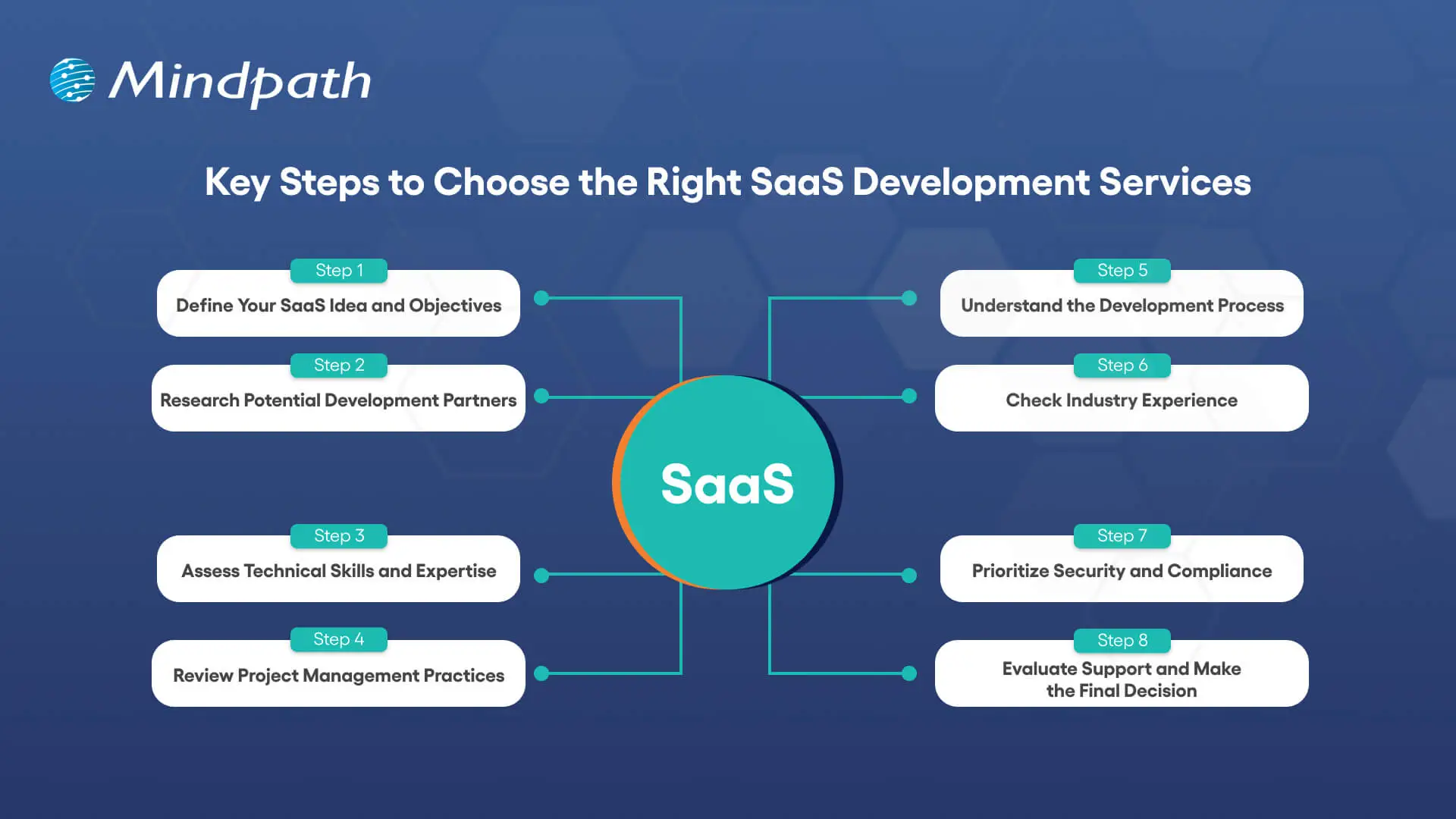
1. Define Your SaaS Idea and Objectives

Be clear about your SaaS concept, what problem it will address, and who your audience will be. Clear goals contribute to the alignment of attributes, functionality, and business objectives in the long run. This transparency enables the SaaS development services to create a product that is focused and efficient.

2. Research Potential Development Partners

Begin by doing research on credible SaaS development companies that have a successful track record with SaaS projects. Check their portfolios, case studies, and feedback from clients to determine credibility. This study can assist you in narrowing down partners who can provide scalable solutions.

3. Assess Technical Skills and Expertise

Evaluate the technical competence of the in-house development team in the front end, back end, and cloud computing. Ensure that they know the process of developing secure and scalable SaaS applications. Well-developed technical capabilities reduce the development risks and improve the overall performance of the product.

4. Review Project Management Practices

Understand how the company manages schedules, work and communication in the development process. Agile project management is flexible and responds more rapidly to changes. Analytical thinking will ensure consistency and quality in development.

5. Understand the Development Process

Inquire about their entire development cycle such as designing, testing, and implementation. Make sure that security and performance, as well as scalability, are considered at an early stage. A trusted Saas development platform enhances easier cooperation and implementation.

6. Check Industry Experience

Experience in the industry helps teams to know more about your business challenges. Experienced developers are able to foresee risks and recommend workable improvements. This results in improved custom SaaS development projects.

7. Prioritize Security and Compliance

Make sure that the development team has good security standards and compliance requirements. The process of development should include data protection and compliance with regulations. This ensures the safety of user information and builds up confidence in the product.

8. Evaluate Support and Make the Final Decision

Evaluate the capacity of the company to offer long-term support and maintenance. Constant improvement and interaction are key to successful products. Select SaaS development services, which reflect your growth plans and vision.

Ready to Transform Your Business with SaaS?

Selecting the appropriate SaaS development services will keep your company competitive, scalable and efficient. Successful SaaS products are the result of clear planning, technical expertise and strong project management. Using systematic steps assists in choosing partners who provide secure, reliable and innovative solutions. Having the right team ensures your software keeps up with the business requirements and enhances performance and user satisfaction.

At Mindpath, we provide professional custom SaaS development services based on your business objectives. We are a team of prolific developers and present scalable, secure, and user-friendly solutions. Our priorities are innovation, a smooth partnership, and continuous support to achieve optimal performance of your SaaS product. Mindpath is the choice that ensures a future-proofed platform that is designed to expand with your users and business vision.

Related Post

Discover the key factors influencing software development costs and how to optimize your budget. Learn how Mindpath can help.
Discover key factors for choosing the right Node.js development company. Learn how Mindpath ensures success!

Related Post

GenAI in Retail & E-Commerce

Have you ever wondered how technology is changing the way we shop? Imagine walking into a store where the products seem to know your preferences or visiting an online shop that feels personalized just for you. With GenAI applications making waves in retail and e-commerce, these scenarios are becoming a reality. How are retailers harnessing the power of artificial intelligence to enhance customer experiences and streamline operations? In this blog, we will explore the exciting world of GenAI in retail and E-commerce. 

Generative artificial intelligence (generative AI) is a form of AI capable of producing new content and ideas, such as conversations, stories, images, videos, and music. AI technologies aim to replicate human intelligence in nontraditional computer tasks such as image identification, natural language processing (NLP), and translation. Generative AI represents the next phase in artificial intelligence. You can teach it to understand human language, programming languages, art, chemistry, biology, or any other complicated topic. It leverages previously trained data to tackle new issues. For example, it can acquire English vocabulary and compose a poem using the words it processes. Your organization can utilize generative AI for a variety of applications, including chatbots, media production, and product development and design. 

Now, let’s dive in to explore GenAI Applications in retail and E-commerce! 

GenAI Applications in Retail and E-commerce

1. Virtual Shopping Assistants

Chatbots are becoming increasingly important in retail as they use artificial intelligence to assist customers when shopping online. These virtual assistants can answer product-specific queries, such as pricing and availability. They also recommend things based on customer preferences, making the buying experience more personalized. 

Chatbots also answer basic customer care questions, such as how to return an item or handle product faults. They can help clients track their orders and understand the delivery timings. One of the benefits of chatbots is that they can gain from the content on your website and other resources. This means they can receive more education about your company, making it easier for them to answer enquiries. 

Chatbots are available 24 hours a day, seven days a week, so clients can look for assistance at any time. If a customer needs to speak with a person, the chatbot may collect their information and forward it to your sales or support staff for further action. This manner, you can ensure that clients get help whenever they need it, even outside of normal office hours. 

2. Real-Time Sales and Support Solutions

Generative AI benefits customers in retail, but it also improves the experience of support agents and sales colleagues. AI systems can simplify and improve consumer interactions by giving real-time help. For example, systems such as Talkative provide useful functionality for agents. One important element is the knowledge base, which enables rapid replies during live conversations. When configured, generative AI can get the knowledge base and provide suitable responses based on the context of the discussion. This enables agents to respond faster and provide more precise information.  Another useful feature is the AI Agent Copilot, which is intended to improve reaction time and quality. This features an internal chatbot called “Navi” that supports agents by answering queries depending on the current discussion and knowledge base. This can be especially useful during sales pitches, allowing agents to complete agreements more successfully. Furthermore, an AI Autocomplete tool anticipates and completes agent messages, saving typing time and speeding up answers. Furthermore, AI Agent Rephrases enhance the messages that agents send during conversations. Instead of manually revising each response, the AI proposes better language and may change the tone to meet the circumstance, whether that means making it more friendly, professional, or just fixing syntax and spelling. 

3. AI Training for Sales Teams

Training sales and support workers is essential for sustaining excellent service standards in the retail business. Generative AI can automate and improve this training process, ensuring that agents are well-equipped to help clients successfully. For example, you can use an AI training platform to provide realistic customer interaction scenarios for agents to practice. This allows agents to practice answering frequent product enquiries and managing returns, which helps them build confidence and enhance their abilities. 

AI training can boost your retail business in a variety of ways. For new employees, it can replicate common customer enquiries, allowing them to learn in a helpful atmosphere. Furthermore, the AI can give precise product knowledge, allowing agents to solve problems and properly reply to consumer enquiries. Agents can also improve their sales skills by dealing with virtual customers in low-pressure settings. This allows students to improve their pitching abilities and learn how to properly handle objections. Furthermore, AI can assist agents improve their communication and empathy by providing feedback on their encounters, resulting in greater customer connections. 

Finally, the training tool can help agents prepare for tough scenarios, such as dealing with difficult clients or receiving urgent complaints. Role-playing these scenarios allows agents to acquire effective dispute resolution tactics and preserve client happiness. 

4. AI-Driven Marketing Strategies

Generative AI in retail does more than simply automate customer service and improve the e-commerce experience; it also increases customer satisfaction through optimized marketing and advertising. 

One of the primary advantages of generative AI is its potential to simplify the creative process for marketing teams. By automating content generation, many marketing materials can be generated rapidly and efficiently. Retail businesses can develop online content such as blogs and landing pages, as well as compelling product descriptions. 

Furthermore, generative AI can help create engaging social media posts and targeted email campaigns, as well as educational infographics, eye-catching promotional movies, and thorough brochures. This technology enables retail businesses to generate a wide variety of marketing material while dramatically decreasing the time and expenses associated with traditional content generation techniques. Retail firms may use generative AI to improve their capacity to interact with customers and boost engagement. 

GenAI Services at Mindpath

Mindpath provides Generative AI services to assist retailers and e-commerce enterprises in improving their operations and customer service. Our clever chatbots offer 24-hour service, answering customer inquiries and aiding with orders, making shopping easier for everyone. We also help companies engage with their customers by swiftly creating interesting marketing material such as product descriptions, social media postings, and email campaigns. Furthermore, our AI-powered training programs prepare sales and support professionals by resembling client interactions. This allows them to enhance their abilities and offer better service. 

Wrapping Up!

The integration of Generative AI in retail and e-commerce is transforming the way businesses interact with customers and manage operations. By utilizing virtual shopping assistants, real-time support solutions, AI-driven training programs, and innovative marketing strategies, retailers can create a more personalized and efficient shopping experience. Mindpath’s Generative AI services empower businesses to enhance customer engagement, streamline processes, and ultimately drive sales growth. As technology continues to evolve, embracing Generative AI will be essential for retailers aiming to stay competitive in an ever-changing market. With these advanced tools at their disposal, businesses can better understand and meet customer needs, ensuring success in the dynamic world of retail and e-commerce. 

Want to transform your retail experience?

Partner with Mindpath to discover how our Generative AI solutions can elevate your business.

Explore the impact of Generative AI in retail and e-commerce, enhancing customer experiences, streamlining operations, and driving engagement.
The cost of hiring a ReactJS developer in New Jersey varies based on several factors, including experience level, project complexity, and location. Developers charge different rates depending on their expertise, with junior developers costing less than senior professionals. Additionally, project costs can range from a few thousand dollars for simple applications to tens of thousands for complex enterprise solutions. Understanding these costs can help you budget effectively and find the right developer for your needs. Below is a breakdown of ReactJS developer costs in New Jersey.

1. Hourly Rates by Experience Level

Hourly rates for ReactJS developers depend on their expertise. Junior developers charge between $12 and $40 per hour, making them ideal for basic projects. Mid-level developers charge $40 to $80 per hour and are suitable for more complex applications and API integrations. Senior developers with extensive experience in large-scale projects can cost $80 to $150+ per hour. The higher the experience level, the higher the rate, but also the greater the efficiency and quality of work.

2. Cost for Simple ReactJS Projects

For small-scale applications, prototypes, or basic websites, hiring a ReactJS developer in New Jersey can cost between $5,000 and $15,000. These projects often involve standard UI development, minimal backend integration, and basic features. If you need a simple yet effective React-based solution, hiring a junior or mid-level developer may be the most cost-effective approach. However, ensuring quality requires choosing a developer with at least some hands-on experience.

3. Cost for Complex ReactJS Applications

If your project requires advanced functionalities, API integrations, database management, and optimized performance, expect to pay anywhere from $20,000 to $60,000 or more. These applications often need mid-level to senior developers who can write scalable, maintainable code and handle challenging development tasks. Costs also increase if you require additional services like UX/UI design, third-party tool integrations, or real-time features.

4. Factors That Affect the Cost

The total cost of hiring a ReactJS developer isn’t just about hourly rates; it also depends on factors like project timeline, required skill set, and location. Developers in major cities may charge higher rates, and if your project demands full-stack development, additional frameworks, or post-launch support, the cost will rise. To optimize your budget, clearly define project needs and hire the right developer with the necessary expertise.

Looking for skilled ReactJS developers in New Jersey? Mindpath offers expert ReactJS development services tailored to your project needs. Whether you need a simple web app or a complex enterprise solution, our experienced developers deliver high-quality, scalable, and cost-effective solutions. Hire top ReactJS talent today and bring your vision to life with Mindpath’s expertise.
Contact us now to get started!

Discover the ultimate guide to hiring Node.js developers in London. Learn about the skills, benefits, and cost factors involved in finding the right talent for your project.
genai hallucinations

The whole world has welcomed artificial intelligence into almost every aspect of everyday life. At the same time, the concerns for careful and responsible use of AI have also been coming under the limelight. One of the notable highlights associated with responsible AI usage points at GenAI hallucinations, which can affect the credibility of generative AI. The use cases of generative AI have opened the doors to numerous opportunities for businesses worldwide across different sectors.

The arrival of generative AI improved efficiency across different areas, including the development of marketing materials and streamlining customer service. Generative AI also promises massive shifts in the conventional approaches to work. However, the insidious threat of generative AI hallucinations places huge roadblocks in the path to large-scale adoption of AI. Let us learn more about GenAI hallucinations and how to avoid them.

Deploying GenAI successfully requires more than just technology, it needs expertise and precision. Our AI development services help businesses design, train, and implement models that deliver reliable and consistent results

Understanding GenAI Hallucinations

Artificial intelligence has been modeled to think, act and work like humans. Just like humans come up with false or misleading answers when they don’t know how to respond to some questions, AI may also do the same. The basic explanation for generative AI hallucination is almost the same as generative AI models can offer nonsensical answers as factual responses. Businesses must know that AI hallucinations can invite legal challenges, affect critical decisions and lead to loss of trust.

You can get a better idea about GenAI hallucinations when you know why AI models hallucinate. AI hallucinations are the result of the approaches through which AI models learn and generate new content. Assume that a student has read multiple books in the library but has not learned how to use his knowledge in the real world. The student can connect different ideas and present convincing ideas, although some of them might not have any plausible impact.

Curious how Generative AI is transforming industries? Explore our blog on Generative AI Revolution to understand the innovations shaping the future of AI and its business applications.

Common Reasons Underlying GenAI Hallucinations

The definition of AI hallucination suggests that it represents any situation where generative AI models present false and nonsensical answers as factual output. At this point of time, you might want to dive deeper into the gen AI hallucination meaning to identify the factors that lead to AI hallucinations. The most common culprits for AI hallucinations include insufficient or biased training data, complex prompts, model architecture and overfitting.

Generative AI models learn from the training data and their effectiveness depends on the quality of data. If the data contains biases or is incomplete, then the AI models will reflect the same flaws in output of the models. Similarly, unclear prompts can also lead AI models to generate made-up information just to serve responses. The internal working and learning approach of gen AI models are also some of the notable factors responsible for hallucinations.

The consequences of these factors can be far-reaching, especially in terms of legal conflicts. On top of it, businesses should worry about AI hallucinations as they can have a negative impact on customer trust, operational efficiency and brand reputation. You can find gen AI hallucination examples in which lawyers were fined for wrong citations and businesses had to incur massive losses due to fabricated financial forecasts.

For instance, an attorney in New York used ChatGPT to conduct legal research for an injury claim. The federal judge noted that the lawyer had provided quotes and citations that never existed. The generative AI tool had not only made them up but also suggested that they were available in all major legal databases.

Wondering how businesses are putting Generative AI into action today? Explore our blog on Generative AI Use Cases in diverse industries to see real-world applications driving innovation across sectors.

How Can You Avoid GenAI Hallucinations?

Businesses must understand the consequences of AI hallucinations and follow a multi-layered approach to address the limitations. The best way to avoid them involves a combination of human oversight and technical safeguards. On top of it, businesses must follow a culture of critical evaluation with generative AI to prevent hallucinations. The following points can play a major role in strengthening a business with protection from hallucinations.

1. Pay Attention to Data Quality and Governance

The foremost solution to GenAI hallucinations is data quality as high-quality data is essential for creating reliable generative AI systems. What can a business do to ensure high-quality training data for their generative AI systems? The easiest way to remove hallucination in generative AI models is through cleaning your training data. It is important to clean the training data by removing duplicates, irrelevant entries and outdated information. On top of it, businesses must also use robust data cleaning methods to ensure accuracy, timeliness, validity and consistency.

The next crucial recommendation for improving data quality involves building a knowledge base for each business. The knowledge base will serve as a reliable source of truth, which offers company-specific and accurate information. In addition, businesses should also use diverse and representative data to reduce bias.

2. Choosing and Enhancing Gen AI Models

The choice of a generative AI model can have a significant influence on the possibilities of AI hallucinations. You should know how to identify the language model for specific tasks. For example, you may need advanced models like GPT-4 for complex applications while lighter models will be useful for simpler tasks. However, choosing the right AI models may be difficult in certain cases.

The list of ways to solve the problem of hallucinations in AI also points at techniques like Retrieval-Augmented Generation or RAG. The primary advantage of RAG is the ability to connect generative AI models to external data sources in real-time. With the help of RAG, AI models retrieve relevant information for responding to different queries. As a result, the models are less likely to hallucinate and will provide factual responses.

Also Read: Gen AI Tools

3. Prompt Engineering

The way you interact with generative AI models also affects the quality of their output. You must learn about the importance of prompt engineering in eliciting desired responses from AI models. Businesses can avoid GenAI hallucinations by following the best practices of prompt engineering. The first recommendation anyone would give for prompt engineering is to maintain accuracy in prompts. When you give clear and detailed instructions with the relevant context to an AI model, you can expect credible responses.

Businesses can also use advanced prompting techniques to improve accuracy alongside understanding the decision-making process of AI models. Effective prompt engineering can also help you fight against AI hallucinations by repeating key instructions at the beginning and end of the prompts to obtain desired responses.

4. The Human Element

The overview of some ChatGPT hallucination examples, like the one involving a New York attorney, suggests that human intervention could have solved the problem. Rather than trusting the output of AI models blindly, businesses should choose the human-in-the-loop validation approach. Continuous feedback loops for checking AI outputs against actual data can play a vital role in reducing AI hallucination.

Businesses should also implement critical evaluation training to help employees evaluate generative AI outputs. On top of it, every business must offer transparency into the working of their AI models to reduce confusion in the event of AI hallucinations.

What’s next for intelligent technologies? Read our blog on Generative AI Predictions to learn about the emerging trends defining the future of AI.

Final Thoughts

The answer to ‘what is an AI hallucination’ establishes a direct link between quality of data, prompting techniques and human-in-the-loop validation. AI hallucination is the result of the ways in which AI models learn and respond to user queries. With the growing adoption of generative AI, businesses must avoid GenAI hallucinations to protect their brand and avoid financial losses. Learn more about the effective solutions to AI hallucination now.

Learn what Gen AI hallucinations are, why they happen, and how to prevent them with effective strategies for building reliable AI systems.