14 Game-Changing SaaS Trends Every Tech Leader Should Know

Join our Newsletter!

Featured Posts

Support Is One Click Away

Home

14 Game-Changing SaaS Trends Every Tech Leader Should Know

Saas trends

14 Game-Changing SaaS Trends Every Tech Leader Should Know

The landscape of Software as a Service (SaaS) is changing faster than ever. As all businesses are now adopting the cloud-first approach, SaaS tech leaders should stay ahead of SaaS trends to remain innovative and competitive.

Current market trends can help service providers to know about the Saas challenges and come up with feasible solutions to tackle them. Whether you are investing in a SaaS technology, scaling your development strategy, or leading SaaS projects, these 14 SaaS trends will help you understand the market and what approaches you should consider to remain competitive.

Want to stay ahead of your competitors by using the latest Saas technologies in your business? Mindpath offer SaaS devlopment services to receive customized solutions that help you innovate faster and smarter.

The Rising Popularity of SaaS Technologies

SaaS has emerged as a dominant force in today’s digital landscape. It is transforming the way businesses deploy, access, and scale their software programs. With time, the popularity of SaaS platforms continues to rise across all industries. And some major reasons behind this are:

  • Businesses don’t have to worry about local installations and get instant access to solutions.
  • SaaS is scalable, and businesses can adjust usage without investing in the IT infrastructure.
  • Subscription models lower expenditure, making it accessible to all, including startups and SMBs.
  • Deployment, upgrades, and maintenance are handled by the service providers.
  • SaaS is highly beneficial to support the remote teams and provides access to necessary resources in real time.
  • SaaS platforms have the ability to integrate with existing workflows and systems.

SaaS service providers enable businesses to be customer-centric and agile. However, to remain competitive, these service providers have to keep up with innovation and adapt their platforms to the changing market demands.

Planning to build a scalable SaaS product but unsure how to choose the right development partner for your needs? Explore our guide on choosing the right SaaS development services to discover key factors that ensure long-term success.

The optimal way to attain that is by adhering to the trends arising in the SaaS market. Read to explore those trends.

14 SaaS Trends Driving the Future of SaaS

Now that we have unpacked SaaS’s impressive benefits, let’s uncover the SaaS trends that are redefining the landscape of SaaS technologies. Here is what is driving the next big wave of SaaS innovation.

1. API-First Architecture – The New Standard

Most modern SaaS projects now opt for API-first design since it can integrate third-party services and tools without any difficulty. It can assist in increasing flexibility and scalability as well as developer experience. Besides, this approach will simplify the process of creating custom workflows.

2. Edge Computing and SaaS

With the help of edge computing, the SaaS platforms can process data closer to the source. This, in turn, reduces latency while enhancing performance. It is quite helpful in real-time analytics, logistics, and IoT.

Through edge capability integration, SaaS solution providers can enhance security, offline functionality, and responsiveness.

3. AI-Powered SaaS Solutions

Artificial Intelligence has become a necessity. Most SaaS platforms are now embedding AI to personalize user experiences, automate workflows, and offer predictive insights. It has also enabled accurate fraud or risk detection.

SaaS platforms that are lacking intelligence are losing relevance. After all, customers want more than just task automation. They want tools that can anticipate requirements and support their decision-making.

Curious about how AI can transform your SaaS strategy and drive smarter business decisions? Discover our detailed guide on the benefits of AI to explore how it enhances efficiency, innovation, and growth.

4. Changes in Subscription Models

SaaS pricing is now shifting from the monthly packages to hybrid, freemium, and usage-based models. Some are also available with outcome-based pricing models. Such flexible pricing structures have helped service providers to improve retention and customer value.

As these platforms evolve, businesses significantly benefit from personalized pricing. On the other hand, providers get deep insight into product engagement and user behaviour.

5. Enhanced Privacy, Compliance, and Security

Trust is an important asset. The customers believe that service providers are safe and in compliance. But that trust can be hampered with just a single instance of data breach or GDPR conflict. Thus, SaaS providers should focus on the use of zero-trust frameworks and advanced encryption.

Besides, the deployment of automated compliance tools can help a lot here. Furthermore, they should keep themselves updated about evolving regulations such as DORA, HIPAA, GDPR, and PDPL.

6. Vertical SaaS

SaaS development companies are now going niche. Why? Well, generic SaaS tools may not help users with industry-specific needs, workflows, or regulations. They are launching SaaS technologies for specific industries like finance, education, or healthcare.

Vertical SaaS platforms are significantly influencing the future of SaaS by offering tailored compliance, deep domain expertise, and flexibility. The vertical SaaS market is expanding, and it is forecast to reach USD 263420 million by 2031 (Source: Market Monitor Global)

7. Micro-SaaS Solutions

Micro-SaaS businesses typically have a narrow focus on use cases and develop add-ons for big SaaS platforms. They are agile, quick to launch, and lean. Micro-SaaS businesses offer highly targeted solutions, with their flexibility supporting rapid adaptation to changes. They are best suited to deal with overlooked issues in various saturated SaaS markets.

Must Read: Conversational AI Chatbots

8. Conversational UX Will Be a Game Changer

The interface of SaaS platforms is evolving rapidly, with chat-based navigation, natural language processing, and voice assistants. These features increase accessibility and user engagement.

This is one of the vital SaaS trends that most SaaS providers have adopted, making their software interaction feel more human-centric. This trend has become a core component of SaaS development.

9. RevOps

Speaking of the most significant trends in SaaS, we cannot omit the emergence of Revenue Operations (RevOps). It unifies marketing, customer success, and sales into an AI-powered platform. These tools provide SaaS companies with end-to-end visibility.

This means that the retention, forecasting and profitability can be easily enhanced. For instance, the advanced lead scoring system in the RevOps tool can help sales teams focus on prospects who are more likely to convert.

10. Blockchain Integration in SaaS

It is undeniable that blockchain is quickly changing the SaaS market by introducing decentralized, secure, and transparent data management. Other use cases that we may take as an example are encrypted transactions, smart contracts, and identity verification.

The adoption of blockchain in SaaS applications provides better trust, compliance, and traceability. This is essential for legal, healthcare, and finance SaaS providers who aim to have better data integrity.

Looking to accelerate your SaaS development process without heavy coding efforts? Explore our guide on low-code platforms to discover how they enable faster development and greater flexibility.

11. Low-Code/No-Code Platforms

The low-code and no-code approach is one of the most popular trends in 2026, as it can support easy and fast development. SaaS providers are also supporting this move. In fact, they are also integrating this into their platforms.

Why? In a world where speed matters, allowing non-technical teams to create their own tools can help unlock a new level of productivity. The workflow of finance, operations, and HR teams can be automated with a couple of clicks.

12. Business Intelligence and Predictive Analytics

SaaS platforms are now using predictive analytics to predict market trends, customer behavior, operational risks, and more. This helps businesses to make data-driven decisions faster than before.

Service providers have realized that business intelligence has become a crucial asset. They are optimizing it to enable businesses to enhance performance.

13. Sustainability-Focused Solutions

Sustainability-focused SaaS, or green SaaS, is now gaining traction as organizations are prioritizing eco-friendly options. Carbon tracking, cloud efficiency, and sustainable hosting are leading this transformation.

These trends in the SaaS industry reveal growth in the demand for ethical solutions. And the future of SaaS will be based on how it is aligned with long-term business sustainability and environmental responsibilities.

14. Localization and Globalization of SaaS Tech

It has been seen that SaaS service providers are now expanding globally, and they are also localizing compliance, customer support, and content. By offering region-specific features and multilingual interfaces, they are enjoying continuous international growth.

SaaS companies are evolving and scaling their platforms across multiple geographies while offering all the necessary elements.

Curious how SaaS innovations are evolving to support more efficient and future-ready business operations? Explore our guide on sustainable technology to discover how eco-friendly approaches are shaping the next generation of SaaS solutions.

The Next Chapter in SaaS Innovation and Growth

Well, the current trends are looking really impressive, establishing a solid foundation for SaaS market growth. But what will happen after 2025? Well, predicting the future of SaaS technologies is a little difficult. However, the direction of the journey is clear: SaaS is becoming more intelligent, ambient, and embedded.

New technologies like quantum computing, Zero-UI, blockchain, etc., will bring massive changes in this landscape. For instance, quantum computing will force developers to rethink SaaS security models. On the other hand, Zero UI will lead to enhanced user engagement by offering interfaces powered by context, voice, and predictive behavior.

What’s more? There will be an increasing focus on regulation, privacy, and sustainability. SaaS leaders who thrive will not be the ones who just predict the future, but those who design for resilience and volatility.

Ready to Leverage the Latest SaaS Trends for Your Business Growth?

SaaS is evolving rapidly with trends like AI integration, API-first architecture, and predictive analytics shaping its future. Businesses that adapt to these innovations can improve efficiency, enhance user experiences, and stay competitive in a fast-changing digital landscape.

At Mindpath, we provide expert SaaS development services to help businesses adopt the latest technologies and build scalable, secure solutions. From strategy to deployment, our team ensures innovation and performance. Partner with us to accelerate your SaaS journey.
Related Post

Discover the ultimate guide to hiring Node.js developers in London. Learn about the skills, benefits, and cost factors involved in finding the right talent for your project.
How much does hiring a ReactJS developer cost? Learn about factors affecting rates, and how to find the best talent within your budget.
Discover the benefits of offshore development, including cost savings, access to skilled talent, and enhanced flexibility.

Related Post

Benefits of saas

Are you still relying on on-premise software to manage your business operations? In today’s evolving world, traditional software models are considered costly, outdated, and also challenging to maintain. The shift towards SaaS (Software as a Service) is redefining how organizations function. Besides, the benefits of SaaS are truly impressive compared to traditional models. 

As cost-efficiency, rapid deployment, and remote work become top priorities for businesses, SaaS has emerged as a crucial element of modern IT strategy. In this blog, we will discover more about it and understand what are the benefits of SaaS. Furthermore, you will understand how these tools support business operations. So, let’s dive deep into it. 

Planning to move your business to a cloud-based software model for better flexibility and cost efficiency? Mindpath’s SaaS Development Services deliver tailored solutions that improve performance, scalability, and user experience.

What is SaaS? – A Simple Explanation

Software as a Service, or SaaS, is a cloud-based software model where tools are hosted by third-party providers. The service providers offer the tools to organizations on a pay-as-you-go basis. As a result, businesses can access SaaS applications anytime they want with an internet connection. 

Some common examples of SaaS platforms are Zoom, Salesforce, Google Workspace, Mailchimp, and Shopify. Speaking about some common benefits of SaaS, these are continuous innovation, seamless collaboration, and faster deployment. 

Some key characteristics of SaaS are: 

1. Accessible from anywhere and anytime 

2. Subscription-based pricing models

3. Automatic and hassle-free updates 

4. Flexibility and scalability 

Looking to match your business needs with a skilled SaaS development provider? Check out how to choose the right SaaS development services to ensure perfect alignment.

Key Benefits of Software as a Service

Now that we have an understanding of SaaS, it’s time to explore the values SaaS platforms bring to the table. From small startups to large organizations, SaaS tools offer powerful solutions to enhance productivity and streamline multiple operations. 

Here are some impressive software as a service benefits that make these tools a crucial element of every business’s success. 

1. Cost-Efficiency

We would say this is one of the most compelling Benefits of SaaS. Opting for traditional software means you will have to invest in IT personnel, hardware, and licenses. However, SaaS tools eliminate these expenses by providing you  with: 

  • Lower initial investment

There is no need to buy expensive software licenses and hardware. 

  • Transparent billing

With different subscription models, you can plan your budget easily. 

  • Low Maintenance Costs

The service providers will handle regular patches, updates, and service maintenance. 

These things make SaaS attractive for small businesses and startups with a restricted budget.

2. Scalability- It Grows with Your Business

As your organization grows, so do your software requirements. All trusted SaaS service providers have powerful and massive IT infrastructure. This makes it highly scalable and flexible. When your business grows, you can just change your subscription plan, and you are ready to go. 

Using SaaS platforms, organizations can: 

1. Upgrade and downgrade their plats based on requirements. 

2. Add or remove users with a few simple clicks 

3. Access modern features without making any changes to the tool. 

Organizations just need to pay for the services they use, making it an adaptable solution. 

Looking to understand how different development approaches impact SaaS performance? Check out the types of software development to gain insights for building high-quality SaaS solutions.

3. Mobility and Accessibility

In this world, where global teams and remote work are the latest trends, accessibility is vital. It can be achieved through SaaS solutions. These tools are easily accessible through any device with an internet connection.  

SaaS allows employees to effortlessly collaborate from any location. Besides, the software can be accessed from smartphones, laptops, tablets, and desktops. What’s more? Multiple teams can smoothly work on the same projects simultaneously. 

This high level of accessibility enhances overall productivity while supporting an agile workforce. 

4. Reliable Data Storage and Automated Backups

As SaaS is powered by cloud technology, your data will be regularly stored and backed up. Businesses can customize their storage options based on their needs. Furthermore, they can increase or decrease the features. 

On the other hand, with SaaS tools, you don’t need to worry about running out of space. No matter what your storage requirements are, you can easily find an ideal plan that will work for your business. 

Must Read: Cloud Security Tools

5. Hassle-Free Maintenance and Automatic Updates

Users of traditional software are well aware of the disruptive and time-intensive manual update process. One of the significant advantages of software as a service is that updates are handled by the service provider. 

Furthermore, there are other benefits to consider, such as: 

  • Continuous Improvement

Service providers regularly roll out new, advanced features along with security patches. 

  • No Manual Setup

Updates are delivered and installed by the SaaS service provider. Users don’t need to perform any action. 

  • High Uptime

All updates are deployed during off-peak hours to avoid disruption. 

It ensures that your organization has access to the latest security enhancements and features. 

6. Compatibility- Effortless Integration

Most SaaS tools utilize Application Programming Interface or API for data transfer. It makes these tools highly compatible, and they can be integrated with almost all technologies. 

Modern SaaS platforms easily connect with ERP, accounting, marketing tools, and CRM. As a result, it will be easier for you to manage and streamline repetitive tasks. The interconnected ecosystem boosts data visibility and supports informed decision-making.

7. Enhanced Security

Undoubtedly, security is a major concern for every business. And trusted SaaS providers always prioritize cybersecurity. With the best SaaS tool, you will enjoy the following security benefits: 

  • Regular Backup

Most SaaS tools support automated data backup, ensuring quick data recovery in the event of system failure. 

  • Data Encryption

SaaS providers use advanced security features to keep sensitive information protected. 

  • Compliance

These tools adhere to the major industry standards such as HIPAA, GDPR, and more. 

With the help of a SaaS provider’s expertise, your organization can attain the maximum level of security. 

Planning to create a SaaS application that perfectly fits your business needs? Discover the custom software development process to ensure your SaaS is designed for success.

8. Faster and Hassle-Free Deployment

One of the key advantages of SaaS is how quickly you can get started with it. These tools can be deployed within a few hours or days. There is no need to wait for months. You just need to sign up with the tool and start taking advantage of the features.

On the other hand, SaaS tools’ intuitive interfaces and easy-to-understand tutorials can help your team get started quickly. If deployed properly, you will be able to witness the changes within a few days. This rapid deployment supports your business’s quick digital transformation. 

9. Business Intelligence and Data Analytics

Many SaaS tools provide users with built-in analytics features. These features allow businesses to track multiple key performance indicators, evaluate operational efficiency, and monitor user behaviour. 

Moreover, these tools simplify reporting by offering actionable insights and visual dashboards. As you will have access to the latest, accurate data, making informed decisions will be easier. Whether you are refining your strategy or scaling it,  SaaS tools empower faster and smarter business moves. 

Curious about the common pitfalls businesses face with SaaS solutions? Check out the challenges of SaaS to safeguard your adoption strategy.

When to Opt for SaaS Instead of Traditional Software?

Although SaaS is not the right option for every scenario, some do. Let’s explore the key situations where SaaS may shine, with a focus on the software as a service advantages.

1. You are a Startup and Scaling Fast

SaaS allows you to launch a product faster, pay monthly, and it will scale seamlessly as you grow. It helps your team to stay lean. You don’t have to worry about lock-in or hardware investments. Just enjoy the agility. 

2. You Need Quick Deployment with Lower Upfront Costs

Ask yourself the following questions: 

  • Do you have a limited budget?
  • Do you need software that can work instantly for your business? 
  • Are you worried about costly  IT infrastructure?

If yes, SaaS is the right option for you. With this, you will get instant access along with a predictable monthly fee. The best thing is that most SaaS tools come with free trials and offer basic features for free. 

3. Your Team Needs Remote Access and Flexibility

If you are managing remote or hybrid teams, a SaaS platform can ensure smooth collaboration and access. In fact, these platforms are designed for accessibility and can keep your crucial data synchronized across devices safely. 

SaaS Readiness Checklist: Know If Your Business is Prepared

Transitioning to a cloud infrastructure doesn’t mean your organization can implement SaaS models. In fact, it has been seen that some organizations found SaaS tools unsuitable as their workflows and systems were not aligned with the cloud-based facility. 

However, if you have a robust software product, a trusted recurring payment system, and a huge customer base, then you are well-positioned to experience the Benefits of SaaS.  

When implemented properly with the help of an expert, a SaaS tool can benefit both service providers and users. It provides customers with user-friendly and seamless experiences. On the other hand, it enables your business to enhance its products and services. For a successful deployment, ensure that: 

1. Your software or product is market-ready.

2. A robust recurring payment system is in place.

3. Your existing infrastructure is compatible with the new cloud solution.

4. You have a scalable and responsive support team. 

5. Your compliance and data security protocols are robust. 

6. Your team can continuously measure as well as optimize product performance. 

If your organization aligns with these statements, then you can successfully embrace SaaS platforms and enjoy all the Benefits of SaaS. When you have a solid foundation, SaaS models can drive long-term success, customer satisfaction, and sustainable growth. 

Future Trends in SaaS

SaaS is evolving, driven by smarter cost control, industry-specific solutions, and AI. Talking about the future trends, we may expect to see a shift toward scalable, secure, and intelligent software ecosystems. 

Some major future Saas trends to consider are: 

1. AI-powered SaaS tools offering more Benefits of SaaS, including automated financial forecasting and AI-powered customer support. 

2. More sophisticated SaaS tools offering deeper compliance support, workflow alignment, and customization. 

3. No-code or low-code enablement to empower non-technical users.

4. Compliance-driven and privacy-first SaaS solutions. 

5. Increasing adoption of API-first and module SaaS tools that can help create custom stacks. 

Ready to Unlock the Full Potential of SaaS for Your Business?

SaaS is transforming the way organizations operate, offering scalability, enhanced collaboration, cost-efficiency, and robust security. By adopting SaaS solutions, businesses can streamline operations, improve productivity, and stay agile in today’s fast-evolving digital landscape.

At Mindpath, we deliver custom SaaS solutions tailored to your business needs. Our expertise ensures seamless integration, optimized workflows, and future-ready systems. Partner with us to harness the power of SaaS, maximize efficiency, and achieve measurable results while minimizing investment.

sustainable technology

Ever wondered why many businesses are rushing into sustainable tech? Why is it so crucially important in today’s fast-changing world? In this blog we will explore how sustainable technology is changing business, and why it is essential. Understanding how these technologies work and the value they can bring to business enterprises can help in meeting regulatory requirements, enhancing brand reputation, and enhancing environmental performance. We can learn how embracing sustainable technology is already helping companies meet today’s needs while positioning themselves for a successful and responsible tomorrow. 

So, let us dive in! 

What is Sustainable Technology?   

Sustainable technology is the design and use of technology to benefit the environment, society, and the economy. This means two things: creating technology with eco-friendly processes and materials and using technology to help solve environmental and social problems. Other examples include solar panels, which provide clean energy, and software enabling businesses to trace their environmental footprint.  

While developing sustainable technology, companies are very considerate about the resources used, their origin, and how to reduce the negative effects in the form of pollution or electronic waste. Businesses use sustainable technologies to realize some of the desired environmental targets, such as reducing fossil fuel use or source reduction of waste.  

For example, they can work on an electric car or initiate projects that reduce carbon emissions. Businesses can also make use of technologies such as Artificial Intelligence to find areas where it can slash down on waste and reduce emissions, thus switching over to renewable energy sources and decreasing their carbon footprint. 

Sustainable Technology Solutions That are Revolutionizing Modern-day Businesses    

1. AI-Powered ESG Reporting 

AI-powered ESG reporting is the intelligent and faster way for a business to track its efforts toward sustainability. In sharp contrast to manual methods of ESG reporting, AI-driven methods are not only far more accurate but also have the dexterity to bring out results within a remarkably short time, incomparably faster than human ability. Using the AI, businesses would be updated in real time—basically, companies can directly see what effect any sustainability change they make will have. Such technology can scan documents, analyze keywords against them, and store important data from relevant files for easy retrieval at reporting time. This automation not only saves time and money but also gives the accuracy of the ESG data. 

2. Embracing Digital Documentation 

The digital revolution makes it easy and secure for businesses to create, share, store, and edit important documents. The shift to digital can reduce office waste by a potential 70% since the average office worker uses around 10,000 sheets of paper yearly. The switch from paper to digital can be challenging, but with OCR technology, it allows the user to quickly scan physical pages and digitize them into documents. This reduces the burden of using too much paper and makes files accessible to all. Additionally, file storage in the Cloud is another area that companies should consider. Cloud computing uses less energy compared to running many different servers for companies, and the amount of storage space can increase as required with less hassle. 

3. Remote Work Technology 

Most of the business units have adopted work from home throughout the pandemic and closed doors to offices for good. It saves the carbon print left if one must commute to their workplace every day. Such a change is made possible with the help of technologies that include workflow technology, tools for integration, e-mail, apps for screen recording, and instant messenger applications. The use of this technology has reduced significantly the need to travel to conferences and other business events, which means a concurrent reduction in carbon emissions. However, the sustainability benefits of remote working depend on the set-up of the home office by the employee. For example, the carbon footprint of an employee may be considerably reduced when the job requires driving more than 6 km to work. In contrast, when the driving distance is less or if public transport is used, home-working may increase CO2 emissions because of the additional use of energy in the home. Hence there is a need to encourage employees to be green at home. 

4. The Internet of Things (IoT) 

The IoT is the network of connected devices, including smart home devices and sensors. Businesses can apply IoT in PACE dimensions related to understanding their ecological footprint and emission reduction. IoT makes workspaces more energy-efficient through monitoring and controlling devices. Some companies that deliver products have the potential to reduce their environmental impact with smart fleets. IoT-enabled fleets send vehicle data back to the office through telematics, which will enable managers to plan efficient routes that can save fuel and be more effective. This data might underline the best driving practices that would help further cut fuel use and boost sustainability. 

Sustainable Technology Use Cases    

1. Decreasing Carbon Footprints 

Sustainable technologies help companies transition from a linear economy, where the use of raw materials is very high, to a circular economy, which is based on leasing, recycling, refurbishing, repairing, re-using, and sharing products as far as possible. This space, therefore, helps companies lower their carbon footprints while serving the interests of both the people and the planet. Sustainable technologies now assist companies in keeping track of crucial ESG metrics, including energy use, emissions, and water consumption. This will enable businesses to understand their position in trends of sustainability, beef up actions to cut emissions, and, as a result, help in answering healthy regulatory requirements and improving the environmental performance of the company. 

2. Improving Brand Reputation 

Sustainability is important for reputation and success. It attracts a workforce and investors sensitive to environmental and social issues in the world. Sustainable technologies attract environmentally aware talent and meet the needs of investors who value transparency of information. Sustainable technologies help businesses keep track of and improve their efforts in sustainability. For example, IoT devices track energy consumption, allowing them to benchmark and, therefore, report on progress, demonstrating commitment to sustainability. 

3. Meeting Regulatory Requirements and Global Standards 

Regulations are constantly changing, with laws like the Corporate Sustainability Reporting Directive (CSRD) requiring companies to report on their environmental impact. Even without mandatory rules, companies are encouraged to follow the United Nations’ Sustainable Development Goals (SDGs), which promote environmentally friendly technologies. To stay ahead, organizations should use sustainable technologies that track, measure, and report their ESG performance. This helps them meet current and future regulatory requirements and global standards. 

4. Visualizing Supply Chains 

One of the ways in which sustainable technologies make a difference is through complete transparency, which can be used to improve supply chains. For instance, AI can trace carbon emissions to identify ESG opportunities and risks. Machine learning is applied in demand forecasting and fleet management to avoid waste and achieve higher energy efficiency. Moreover, with the help of such technologies, companies can be kept updated with their partners and suppliers, which is useful in ESG reporting. Tools like GRI or TCFD require reporting on Scope 3 emissions, which are related to operations outside the company’s direct influence. This helps businesses to be ahead and give a cleaner picture of the supply chains. 

Curious About How Mindpath Can Transform Your Tech?

Find out how our bespoke solutions in modernization and AI can benefit your business.

Mindpath: A Leader in Innovative IT Solutions 

Mindpath is a forerunner in IT innovation and offers customized solutions for your business. We are an Innovation Centre focused on staff augmentation—bringing experienced and qualified professionals to integrate with your team for any short- or long-term project. Our modernization services upgrade legacy systems and optimize processes for better efficiency, security, and long-term growth. We are leaders in digitization. Therefore, we have State-of-the-Art Web Development and App Solutions to enhance your presence online. In addition, with our excellence in bespoke chatbot development and artificial intelligence, your business will harness the very latest technology available to help give you that edge.  

Conclusion 

In the current world complexities, businesses have found sustainable technology to be central to their way of growth and competitiveness. Evermore, innovations that businesses embrace these days are the ESG reporting powered by AI, digital documentation, remote work technology, and the IoT, which help these companies in the reduction of their environmental impacts and bring about an increase in operational efficiency and reputation. These technologies are pivotal for organizations to meet regulatory requirements, visualize their supply chains, and, of course, their sustainability targets. The commitment to sustainability practices is not a fad but a strategic edge, one that imbibes the global norm of standards and sets the pace toward long-term success.  Mindpath leads in IT innovation and can help your business grow. Staff augmentation by Mindpath deals with the integration of top professionals in your team for the implementation of various short- and long-term projects. Besides that, our modernization services update your legacy systems and aid in enhancing your company’s efficiency and security. Advanced web and application development with bespoke chatbot and AI solutions complete the comprehensive services in ensuring our business stays at the cutting edge of technology. 

Ready to Innovate?

Discover how Mindpath’s tailored IT solutions can transform your business.

Explore how sustainable technology is transforming businesses. Discover its benefits, from AI-driven ESG reporting to digital documentation and IoT innovations.
front end vs back end vs full stack

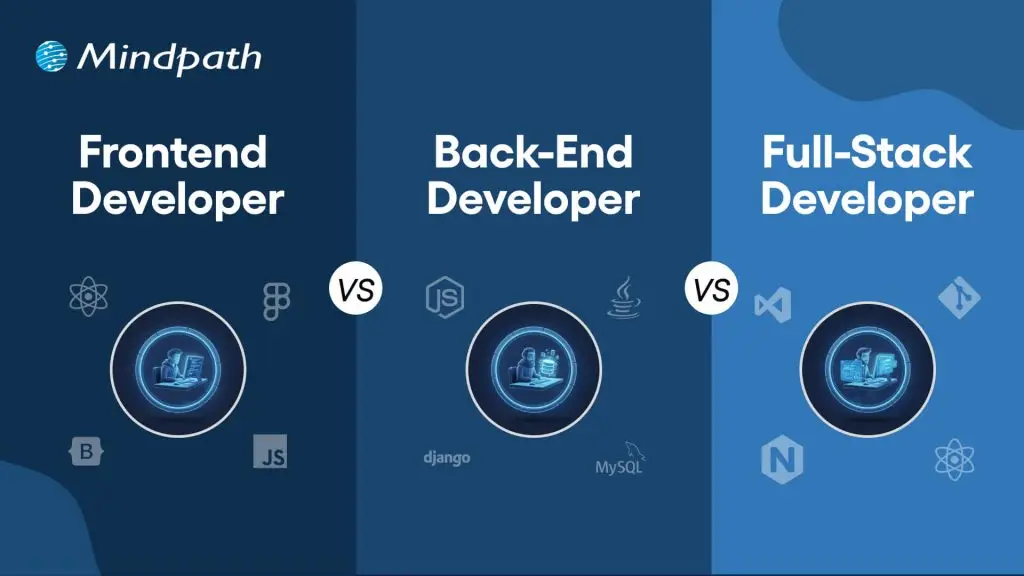
Web development is one of the formidable tools that have helped businesses stay strong in the era of digital transformation. It has also attracted attention towards the frontend vs backend vs full stack comparison, since the three distinct components have a distinct role in web development. If you have to begin your next web project anytime soon, then it is important to learn the significance of these terms.

Businesses have been tapping into the digital revolution with the help of websites and web applications to establish their digital presence. However, business owners must know whether they should pick full-stack developers or a combination of frontend and backend developers. Let us compare frontend development, backend development, and full-stack development to find the best choice for your next web project.

Not sure about what to choose, frontend, backend, or full-stack developer for your next project? At Mindpath, our web developmet services give you the best of both expertise that speeds up your development process and provides seamless end-to-end solutions.

Unraveling the Components of Web Development

The general impression about web development is that it focuses on building websites or web applications. As you dive deeper into web development, you will find the backend and frontend divisions quite clearly. Where does full-stack development enter the picture? You can find a perfect answer to the question with brief overviews of the two crucial components in web development.

Fundamentals of Frontend Development

The term ‘frontend’ gives out the meaning of frontend development. It stands for the part of web applications that is visible to users. Frontend developers have to create different aspects of the user interface, including text font, colors, menu styles, and buttons. Most of the frontend vs backend vs full stack development comparisons paint frontend development as the process of creating the aesthetics of web applications. On the other hand, the comparisons miss the fact that frontend developers also create the user experience.

Frontend developers take on different tasks such as developing intuitive user interfaces, optimizing for performance, and ensuring accessibility on different devices. The other crucial tasks involved in frontend development include testing the frontend for errors and ease of navigation, and optimizing the user experience. Working as a frontend developer means that you will have to use languages like JavaScript, HTML, and CSS. On top of it, developers should know how to use frameworks like React and Angular to improve performance and responsiveness.   

Fundamentals of Backend Development

The backend of a web application represents the components that run the application from behind the scenes. Most of the answers to “What is a backend developer?” reveal that they focus on the server, databases, and APIs. Backend developers have to ensure that all these components work in unison with each other efficiently and provide the desired functionalities. The responsibility of backend developers starts with understanding the main objectives of the website or web application and creating the relevant architecture.

Backend developers will have to ensure that there are ideal systems in place for data storage with the assurance of easier scalability. The biggest task of a backend developer is to create and optimize the server-side logic for efficient performance across different devices. Another crucial task that separates the front and back ends of a web application is API management for seamless functionality on diverse platforms. As a backend developer, you should also focus on creating the website architecture with flexibility for adding upgrades in the future. 

The extensive list of responsibilities of backend developers also includes the implementation of algorithms, backend security, and integrating payment systems. To achieve all these responsibilities, a backend developer must be an expert in one of the server-side programming languages, like PHP, Python, and Java. Backend developers also use frameworks like Django to expedite the development process. The skills required for backend developers also include tools like SQL and Oracle.

Why Do You Need Full Stack Development?

The overview of frontend development and backend development reveals their significance in the web development lifecycle. However, the front-end, back-end, and full-stack relationship becomes clearly evident when you combine the two crucial processes of web development. A full-stack developer can do the work of frontend and backend developers with little to no support from other professionals. The primary responsibilities of full-stack developers revolve around the user experience, servers, data modeling, databases, and hosting. 

Full-stack developers write code for the frontend and backend of web applications while collaborating with design teams and stakeholders. In addition, they also optimize the code with consistent testing and debugging. You can notice the full-stack vs frontend vs back-end development differences in the other responsibilities of full-stack developers. For instance, a full-stack developer not only implements servers and databases on the backend but also designs the user interactions on the frontend of the application.   

The tasks in full-stack development indicate that developers will need better technical proficiency than frontend or backend developers. Apart from fluency in frontend and backend programming languages, full-stack developers must also have strong soft skills.

There are unique advantages that full-stack development brings beyond its technical skills. Explore the benefits of full-stack development, which empowers businesses to accelerate innovation.

Diving Deeper into the Frontend vs Backend vs Full Stack Debate

Business owners who want to create web projects must be worried about the decision between choosing full-stack developers or backend and frontend developers. You can use the frontend vs full stack vs back-end developer comparison to determine the staffing requirements for your next web project. 

1. Focus Areas

Creating an effective web application or website requires attention to different areas of the application. The best way to differentiate frontend development and backend development from full-stack development requires the identification of the areas they focus on. Frontend development focuses on the graphical user interface and user experience, while backend development focuses on the server-side operations and data management. 

Full-stack development involves combining the focus areas of front and back ends of an application to deliver the required functionalities. The focus area of a full-stack developer is the complete application development lifecycle.

2. Objectives

The next important point of difference between frontend development and backend development focuses on the goals. Frontend developers work to deliver a positive user experience with a website or web application that looks good. The goals of frontend development also revolve around creating an appealing aesthetic for the web application while ensuring responsiveness and accessibility. 

The frontend vs backend vs full stack comparison also sheds light on how backend developers aim to create a high-performance and efficient app. Backend development relies on leveraging logic to achieve different functionalities alongside addressing user experience issues.    

3. Responsibilities

You can get a better impression of the differences between full-stack, frontend, and backend developers by learning about their responsibilities. The primary responsibility of a frontend developer involves implementing visual designs and layouts for a web application. Frontend development responsibilities also include creating a responsive design and interactive elements for the user interface. As a frontend developer, you will also have the responsibility of ensuring cross-browser compatibility for the application.

The responsibilities of a backend developer revolve around database management, API development, and backend security. Backend development also focuses heavily on creating, implementing, and maintaining the server architecture. The back-end vs full-stack vs frontend comparison will draw attention to the ways in which full-stack developers take on a broader set of responsibilities. Some of the notable responsibilities of full-stack developers include end-to-end development, system integration, and server and website architecture design. On top of it, full-stack developers must also take complete ownership of the project. 

4. Technical Skills

Another effective approach for comparing frontend and backend developers with full-stack developers is the technical proficiency required for the jobs. The full-stack vs back-end vs frontend debate in web development becomes quite simple in terms of the technical proficiency required in each area. Frontend development involves the use of technologies like HTML, JavaScript, and CSS. The other notable tools used in frontend development include frameworks like React, Vue, and Angular. 

Backend developers rely on programming languages like Python, PHP, and Java to write server-side logic. On the other hand, they also utilize frameworks like Django to leverage tools for faster and efficient development. Full-stack developers use a combination of all backend and frontend technologies, depending on the project requirements.

Here is an overview of the differences between full-stack, front-end, and backend developers.

Criteria Frontend Backend Full Stack
Focus Areas Frontend development focuses on the user interface and experience. Backend development revolves largely around server-side operations and database management. Full-stack development focuses on the complete application development lifecycle.
Objectives Frontend developers aim to make the application look good and easy to interact with. Backend developers aim to ensure that the web application works as intended by the client. Full-stack developers focus on building a complete web app with the frontend and backend elements.
Responsibilities Frontend developers take the responsibility of creating interactive elements and implementing visual designs with better responsiveness. Backend developers have to take care of server architecture, database management, API development, and backend security. Full-stack developers are responsible for designing the complete architecture, end-to-end development, and system integration.
Technical Skills Frontend developers know how to work with HTML, CSS, JavaScript, and frameworks like React and Angular. Backend developers know how to use programming languages like Python, Java, and PHP for server-side coding and other backend frameworks. Full-stack developers must have a strong command of backend and frontend technologies.

Want to know if full-stack development is becoming essential for modern web projects? Explore on how it helps businesses integrate systems efficiently and drive growth in our blog: Is full-stack development the future of web projects?

Final Thoughts

The insights on the differences between backend, frontend, and full-stack development reveal how full-stack offers a better choice. Why should you choose two different developers when one full-stack developer can do their jobs? However, the frontend vs backend vs full stack development comparison shows that frontend and backend developers also have unique strengths. Therefore, you need to consult with experts before you prepare a strategy for your next web project.

We at Mindpath have been offering expert web development services and delivering to one client after another with continuously growing customer satisfaction. You can come to us with any idea for web applications, and we can promise to create robust and appealing solutions that can attract your target audience. We have a team of experienced full-stack developers, frontend developers, and backend developers who have worked on multiple projects. Reach out to our consultants and make the most of our expertise in web development now.