What is Legacy Modernization – A Comprehensive Guide 

Join our Newsletter!

Featured Posts

Support Is One Click Away

Home

What is Legacy Modernization – A Comprehensive Guide 

legacy modernization

What is Legacy Modernization – A Comprehensive Guide 

Technology is a high-paced thing, and companies are under pressure to keep up with it. Legacy Modernization has come to be a serious agenda among companies that currently use the old systems to conduct their daily operations. You may find that the performance is slowing down, maintenance costs are increasing, and security threats are increasing yearly. All these problems cause tension amongst teams and restrict innovation. Then, what actually happens when the old systems are retarding progress? And how do companies get back in control without derailing the fundamental processes?

Meanwhile, leaders desire systems that can enable development, flexibility, and more intelligent decision-making. Their goals are to enhance performance besides safeguarding the vital data and business logic. Such an equilibrium needs a good technical direction and strategy. Thus, it is critical to comprehend the acceptable strategy to achieve success in the long term. This blog will discuss all the major points of legacy modernization step by step.

Ready to move beyond outdated systems that slow down your business? Mindpath offers legacy modernization services to help you upgrade and transform legacy applications into scalable and future-ready solutions.

What is Legacy Modernization?

Legacy modernization involves updating old software and infrastructure to new modern technologies and architectures. It enhances the performance, security and scalability without altering the underlying business logic. Businesses rely on it in order to remain competitive and promote growth. This strategy enhances the current systems and makes them ready to meet the current digital requirements without necessarily interfering with day to day activities.

However, legacy system modernization goes beyond technical upgrades. Companies need to reconsider procedures, user experience and long term objectives. They enhance efficiency, mitigate risk and facilitate innovativeness with strategic change. An effective modernization strategy puts technology into business performance and establishes a platform to achieve the long-term digital development.

Must Read: Benefits of Modernizing Legacy Systems

Why is Legacy Modernization Important?

Outdated systems slow progress and increase risk. The modernization of legacy applications helps businesses improve performance, security, and flexibility. Here are some of its key benefits:

1. Legacy modernization reduces high maintenance and infrastructure costs. It also reduces the reliance on the old systems and costly specialists support.

2. It enhances the rate of speed and general dependability of the system. Teams are also able to update at a higher pace and handle changes with ease.

3. It enhances security because it eliminates the risks associated with outdated software. Organizations remain updated on new compliance standards and regulations as well.

4. It improves agility and promotes inter-team innovation. Companies are able to introduce new functionality in a shorter time and react to the needs of the market.

5. Contemporary systems can easily manage increasing traffic and information. They are also compatible with cloud computing and other sophisticated analytics solutions.

6. It improves user experience by making the user interfaces and performance cleaner. There is a greater work efficiency and confidence among the employees when using the system.

Curious about the best way to transition from legacy systems to modern platforms? Check out our legacy modernization roadmap blog to uncover proven steps and strategies.

How to Modernize Legacy Applications?

Organizations must take a clear and strategic approach to legacy modernization to avoid disruption and control risk. A structured plan helps teams upgrade systems efficiently while supporting business goals and future growth.
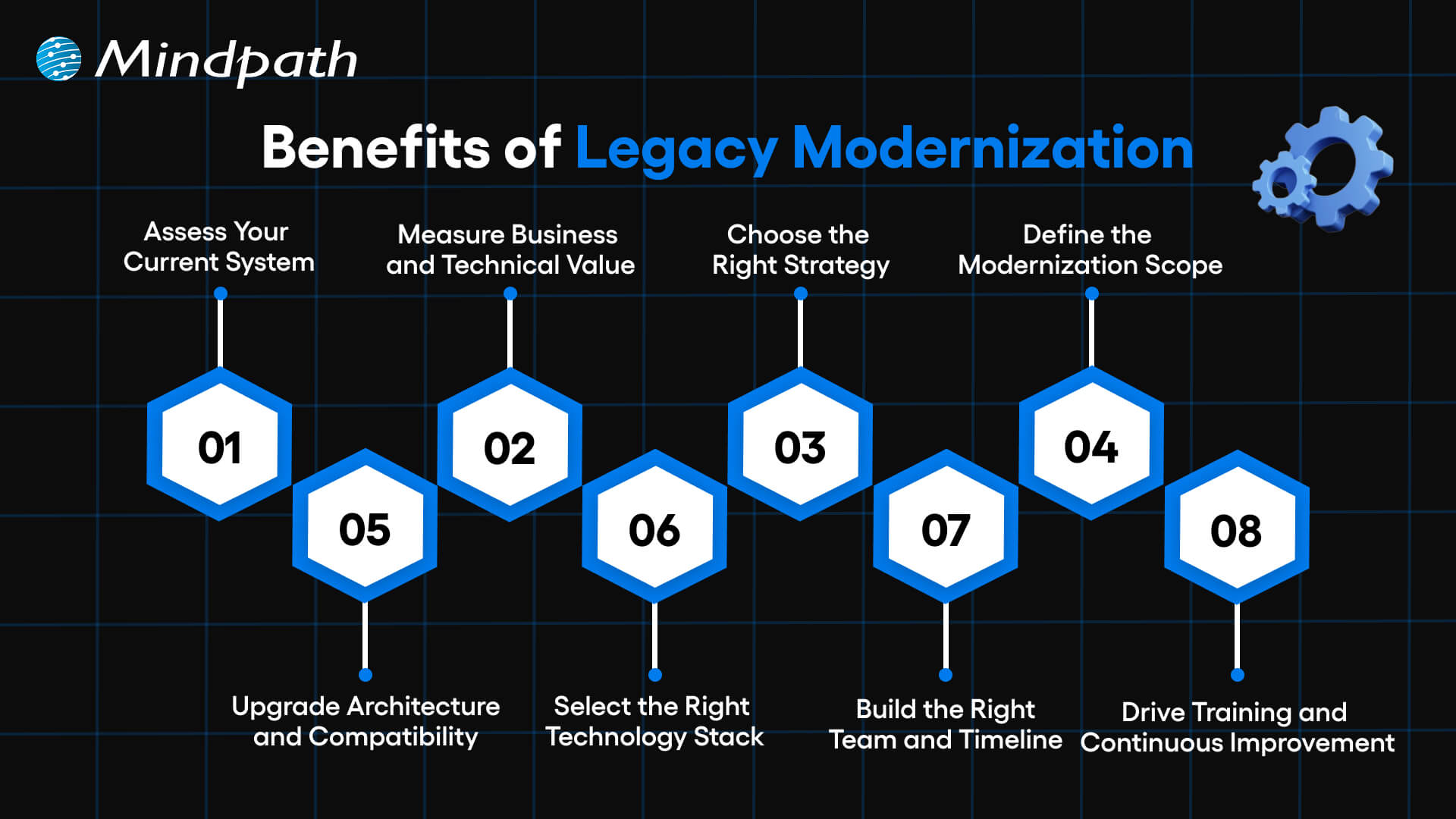
benefits of legacy modernization

1. Assess Your Current System

Evaluate your applications both business and IT. Determine deficiencies in performance, security and scalability. This step builds a strong base for legacy modernization decisions.

2. Measure Business and Technical Value

Assess business fit, agility, cost, complexity and risk. Know the amount of value each system brings in the present day. Clear insights strengthen your legacy app modernization strategy.

3. Choose the Right Strategy

Select a legacy modernization approach that aligns with business goals. Compare such options as rehost, refactor, rebuild or replace. Take the course of action that brings more quickly and reduces the risk.

4. Define the Modernization Scope

Target key points that lead to business performance. Eliminate the old and unwanted functions that complicate things. A clear scope helps teams modernize legacy applications with confidence.

5. Upgrade Architecture and Compatibility

Use scalable architecture when needed e.g. microservices. Enhance dynamism and streamline administration of the system. Enhance seamless integration with other tools/ platforms.

6. Select the Right Technology Stack

Select technologies that will be able to accommodate existing needs and expand in the future. Never act on your judgment without consulting experts. Good testing will guarantee effectiveness, protection and dependability.

7. Build the Right Team and Timeline

Create a cross functional team with established responsibilities and ownership. Develop and maintain documentation. Set realistic milestones to guide legacy modernization progress.

8. Drive Training and Continuous Improvement

Train the staff on effective use of the new system. Onboarding is encouraged by means of structured support. Continuous updates keep legacy modernization relevant and sustainable.

Want to align your legacy systems with your long-term business goals? Explore the legacy modernization strategy for business growth to build a result-driven transformation plan.

Key Challenges in Legacy Modernization

There are some valid advantages of legacy modernization, but it also possesses actual challenges. During the transition, organizations have to be ready to overcome technical, financial, and operational challenges.

1. Complex Legacy Code

Systems are difficult to comprehend and expand due to old-fashioned code and lack of documentation. Such complexity slows the development and raises its maintenance costs.

2. Integration Barriers

The old systems also fail to make connections with cloud providers and new APIs. Architecture reengineering will require teams to be mindful of downtime and the gaps in security.

3. Security and Compliance Gaps

The existing security and regulations are not met in aging systems. It is necessary that Legacy Modernization involves proactive protocols, encryption, and compliance control updates.

4. High Costs and Limited Resources

Modernization demands investment in equipment, education, and infrastructures. Lack of a proper roadmap will increase costs and strain internal resources.

5. User Resistance to Change

Employees tend to be at ease with the well-known systems. Good communication, training will enable teams to adjust to Legacy Modernization programs.

6. Performance and Scalability Limits

Old applications are unsuitable to meet the increasing data and user requirements. Legacy Modernization enhances speed, stability, as well as long term scalability.

7. Knowledge and Skill Gaps

It may be challenging to locate professionals with knowledge of old technologies. Lack of experience will put risks and time delays at a higher level and make the project more complex.

8. Data Migration Risks

Migration of mass volumes of old data can result in loss, corruption or compatibility problems. There has to be audits, backups and testing of data to ensure data integrity in Legacy Modernization.

Planning to integrate AI into your legacy infrastructure for better decision-making? Learn about AI-driven legacy system modernization to transform your systems intelligently.

8 Legacy Modernization Strategies for Modern Businesses

Companies must have a strategy in place when modernizing old systems. The right legacy modernization strategies assist in decreasing risk and faster business worth.
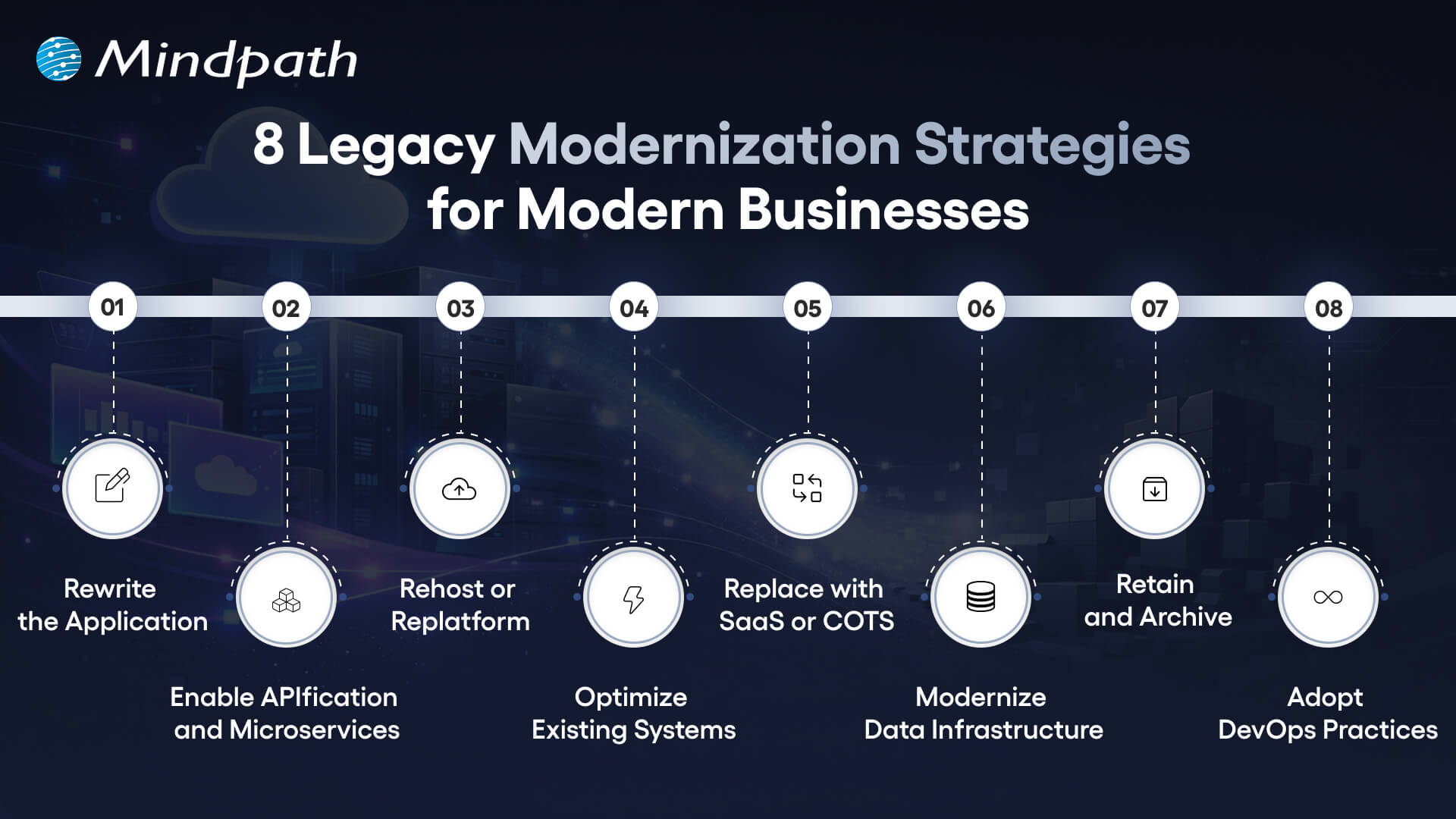
8 legacy modernization strategies for modern businesses

1. Rewrite the Application

Rewrite the old systems using new languages. This strategy will modernize the application and enhance quicker updates. It also reduces the long term maintenance.

2. Enable APIfication and Microservices

Divide monolithic systems into small services. APIs can be used to better integrate them. Innovation is accelerated through this model.

3. Rehost or Replat form

Migration to the cloud with minimal code modification. It is a move that minimizes infrastructure expenses within a very short time. The teams enhance scalability without causing much disturbance.

4. Optimize Existing Systems

Check the workloads as well as code performance gaps. Minimize the usage of infrastructure and operations expenditures. Utilize savings to finance additional upgrades.

Must Read: Monolith to Microservices

5. Replace with SaaS or COTS

Use pre-made platforms that will satisfy business requirements. Accomplish security and compliance. Implement solutions in a shorter time and with reduced risk.

6. Modernize Data Infrastructure

Move the old databases to scaled systems. Enhance the speed, analytics, and flexibility. This step should be aligned to Legacy Modernization.

7. Retain and Archive

Retain those systems that retain the necessary value. Audits of applications that are rarely used in the archive. Unnecessary changes and risks should be avoided.

8. Adopt DevOps Practices

Implement continuous integration and testing. Publishing is faster and teamwork becomes better. Enhance the performance and stability of the systems.

Planning to enhance your modernization efforts with better automation and continuous delivery? Discover DevOps best practices to build a more agile and scalable transformation process.

Key Trends for Legacy Modernization System

Organizations are still redefining their technology environment to remain competitive. The modernization trends point to the new directions that lead to faster, smarter and more scalable transformation.
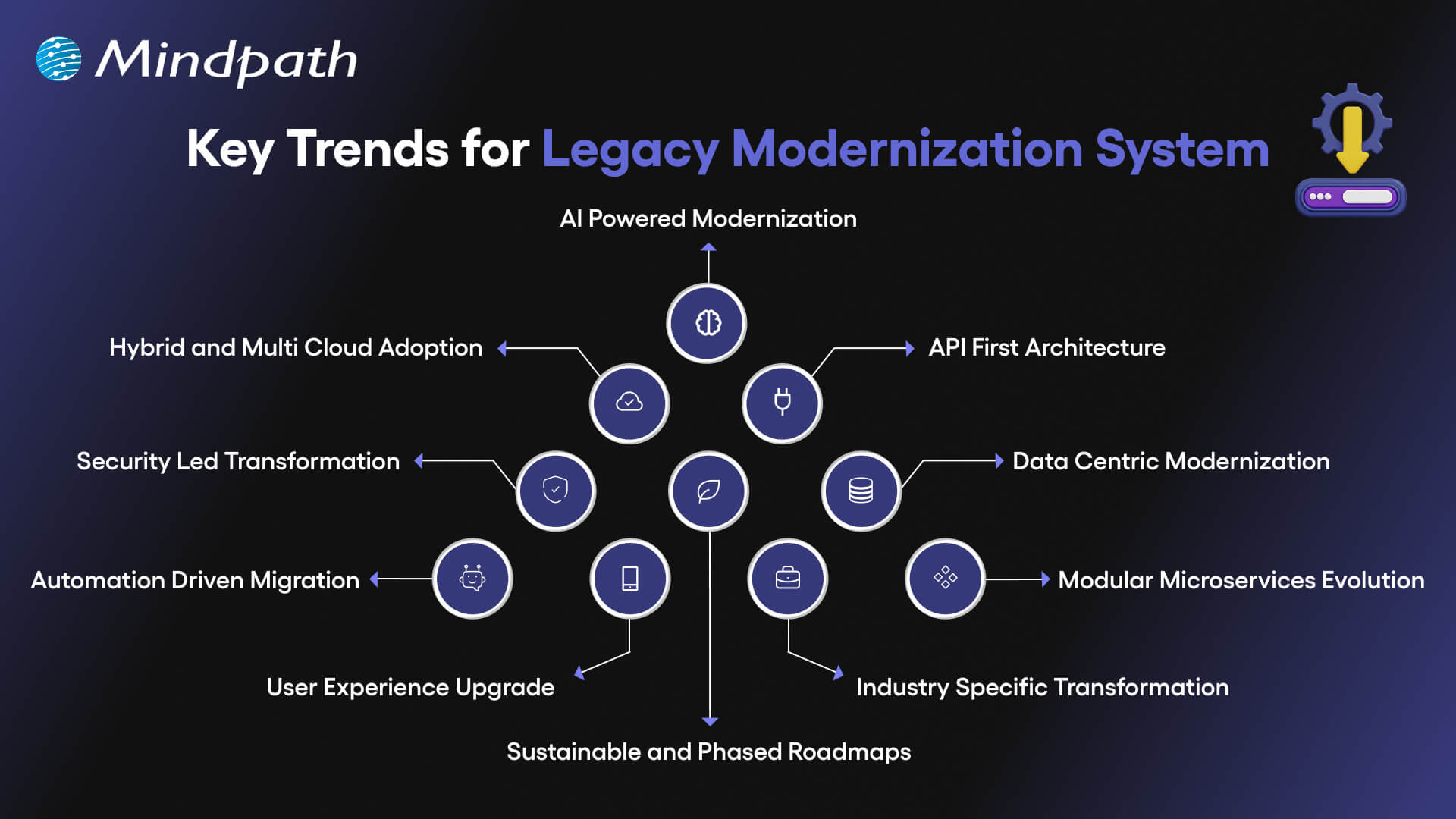
key trends for legacy modernization system

1. AI Powered Modernization

Code refactoring, re-architecture and system analysis are now assisted by AI. According to legacy modernization trends, many enterprises spend lots of money in AI. It enhances preciseness, less threat, and accelerates change.

2. Hybrid and Multi Cloud Adoption

Organizations have stopped relying on one cloud provider. They operate hybrid and multi cloud environments to be flexible and resilient. Container platforms assist systems to operate efficiently in environments.

3. API First Architecture

Enterprises substitute monolithic models with modular API based models. The APIs enhance integrations, scalability, and expedited feature upgrade. The change holds its ground in the contemporary legacy modernization patterns.

4. Security Led Transformation

The presence of stringent rules encourages companies to advance the old security checks. Zero trust models, encryption, and enhanced access management are implemented in teams. Every modernization roadmap is currently being influenced by security.

5. Data Centric Modernization

Isolated data warehouses are sent to unified lake house platforms by businesses. This measure enhances real-time understanding and information controls. Powerful data strategy is a key to successful legacy software modernization.

Curious about how AI can reduce costs and improve system capabilities? Check out the benefits of AI to transform your business operations.

6. Automation Driven Migration

Code scanning, risk detection, and recommendation are processes performed by AI-based tools. Jurisdictional testing and documentation lowers the manual work involved. These applications reduce migration time.

7. Modular Microservices Evolution

Businesses upgrade microservices using containers and orchestration technology. AI assists in tracking and optimization of working loads. This will enhance system stability and scalability.

8. User Experience Upgrade

The future UX concentrates on customization, usability, and functionality. Component based design models substitute strict legacy interfaces. These enhancements are in line with wider patterns of legacy modernization.

9. Industry Specific Transformation

Banks, healthcare providers, and manufacturers need individual solutions. Modern systems are now able to comply with strict industry rules. A strong legacy modernization framework supports niche requirements effectively.

10. Sustainable and Phased Roadmaps

Companies are ready to upgrade slowly than to rewrite everything. Planned phase will guarantee the sustainability of long term and reduce disruption. This approach makes modernization anticipative and expandable.

Want to make your legacy modernization efforts more environmentally responsible? Explore sustainable technology to build eco-friendly and future-ready systems.

Examples of Legacy Systems

Several organizations are still using the old systems to execute important activities. These are the legacy systems that are still in use and support day-to-day processes in spite of low adaptability and scalability.

1. Cloud Enablement in Financial Services

To enhance scaling and reporting, a fintech company has transferred the core systems to the cloud. This legacy modernization decreased manual labor and increased reliability.

2. Clinical Platform Enhancement

A microservices-based upgrade of an oncology system to speed up its performance. The transformations enhanced integration and helped to make medical decisions faster.

3. High-Performance Trading Systems

Microservices and automated deployments were embraced in a trading platform. This legacy modernization enabled speed and increased volume of transactions.

4. Digital Leasing Transformation

One leasing system upgraded its infrastructure to initiate operations more quickly. The upgrade made the operations less complex and efficient.

5. Smart Assessment Innovation

One of the education platforms presented AI-based grading tools. The educators used to save some time and received more rapid performance feedback.

6. Scalable K-12 Learning Infrastructure

One school system optimized its cloud environment to its maximum. The upgrade also enhanced the uptime and made the learning process stable.

Wondering how to connect legacy modernization with broader business goals? Explore about digital transformation for business to align technology with strategic growth.

Ready to Future Proof Your Business?

Legacy systems limit growth, increase risk, and slow innovation. Organizations that invest in legacy modernization improve performance, security, and scalability while reducing long term costs. A clear strategy helps teams modernize in phases and avoid disruption. With the right approach, businesses build flexible systems that support innovation, improve user experience, and create lasting competitive advantage in a fast changing digital market.

Mindpath stands as a trusted legacy modernization service provider delivering practical and scalable solutions. Our team assesses existing systems, defines a clear roadmap, and executes modernization with minimal disruption. We focus on performance, security, and cloud readiness to create measurable business value. With proven expertise and strong technology partnerships, Mindpath helps enterprises modernize confidently and achieve sustainable digital growth.

FAQs

1. What is Legacy Modernization and why should my business consider it now?

Legacy modernization helps businesses upgrade aging systems to improve speed, security, and scalability. Companies adopt it to reduce operational risks and support innovation. When technology limits growth, modernization creates a strong digital foundation. It also prepares organizations to integrate cloud, data analytics, and automation effectively.

2. How do I know if my organization needs legacy modernization?

Frequent system failures, high maintenance costs, and slow feature releases signal deeper issues. If your teams struggle to scale or integrate modern tools, your systems likely restrict progress. Legacy modernization helps you overcome these limits and align technology with current business goals and customer expectations.

3. How can Mindpath support our modernization journey?

Mindpath’s legacy modernization services focus on strategy, assessment, and execution with minimal disruption. Our experts analyze your systems, design a practical roadmap, and implement scalable solutions. As a trusted legacy modernization company, Mindpath ensures measurable performance gains and long-term technology stability.

4. What technical approaches work best for modernizing complex legacy systems?

The right approach depends on architecture, dependencies, and business priorities. Teams may rehost applications in the cloud, refactor code into microservices, or rebuild critical components. A structured legacy modernization plan ensures integration stability, secure data migration, and improved system performance.

5. How do we manage risk during legacy application transformation?

Teams reduce risk through phased execution, automated testing, and strong DevOps practices. Clear documentation and system audits help identify hidden dependencies early. Mindpath’s legacy modernization services follow controlled deployment models that protect data integrity and maintain operational continuity throughout the transition.

Related Post

Discover how DevOps can save your business costs by improving efficiency, and enhancing collaboration across teams for high-quality delivery.
Discover AI 2024 trends shaping our world—from multimodal models to optimized solutions. Explore how AI can revolutionize your business with Mindpath’s cutting-edge services.

Related Post

what is autoML

Automated machine learning is a process of automating the complex machine learning process that traditionally requires in-depth technical expertise. It is a valuable practice of automating the end-to-end development of ML models. So, if you are asking what AutoML is, it uses non-experts to generate and implement artificial intelligence systems. Other than this, it can align the AI workflows for keen developers and data scientists.

Due to its heavy usage, automated machine learning market value will reach USD 22.3 billion by 2035. Similarly, AutoML tools can simplify your ML model creation capabilities.

Ready to simplify your machine learning processes with the power of AutoML? Contact us today to discover how automated solutions can accelerate your AI journey and drive better results.

What is AutoML Through a Practical Perspective?

If we define AutoML through a practical perspective, it is a framework that automates the complete lifecycle of building, training, testing, and deploying machine learning models. So, instead of manually assessing the algorithms and parameters, AutoML systems can intelligently experiment with multiple combinations. This can help you land on the most efficient solution.

How Does AutoML Process?

After learning what is AutoML, let us proceed towards its working process. So, the solution works by creating a series of machine learning pipelines to handle the given task, and afterwards it identifies the optimal choice. Moreover, model assessment and selection are automated as part of the iterative process of picking the best solution. Here, you can go through the working steps of automated machine learning.

1. Data Creation and Pre-processing

In this step, developers gather raw data and integrate it into a training dataset. With proper data preparation, your training data will remain free from any type of bias and encourage your model to be successful. Accurate data can offer you more authentic predictions and insights.

You should connect the automated machine learning platform with the training data source. Further, you should remember that the data preparation process occurs before the deployment of an AutoML solution. The AutoML solution preprocesses and cleans the data efficiently. So, thorough data processing can also sharpen your AI model performance vastly.

2. Feature Engineering

After we define the AutoML pre-processing step, let us get into feature engineering. So, data features are the major elements of a dataset that ML models use to make predictions or any integral decisions. Feature engineering is a transformative procedure through which a data scientist gathers new information from input data. Further, they prepare it for machine learning.

Automated feature engineering automates the process of finding the feature space and fills the missing values while selecting the best features to use. However, it can be very difficult for you to build a single feature manually. So, let AutoML AI handle the task for you.

3. Model Selection along with Hyperparameter Tuning and Training

Now, as you are well aware of what is AutoML, can you identify which model is required for the use case? When it comes to traditional machine learning, model selection needs expert knowledge about AI model types along with their abilities and limitations.

AutoML tools can easily enhance the traditional process. It helps in automatically creating and training several models at a time with a series of hyperparameter configurations and algorithms. There are many AutoML solutions that put together multiple models in a process called ensemble learning.

4. Testing and Validating the Solution

Data scientists are required to validate the progress of an ML algorithm during the training phase. After the training, the following model is tested with new datasets to assess its performance in real-world conditions. The performance of the model is verified with metrics that include an F1 score, a confusion matrix, etc.

5. Deployment of the Model

Model generation is just the initial phase in the timeline of the product. Thorough models need to be made available to users and should be assessed for their performance. This step ensures they are reliable and serving with accuracy. So, without any automation, development teams need to write scripts and generate systems to integrate the model into the operations.

This structured automation enables organizations to garner faster outcomes with consistent quality. So, when teams define AutoML, they can express it as a productive multiplier that eliminates the gap between raw data and actionable intelligence.

Ready to take AutoML to the next level? Check out how large language models are transforming machine learning with smarter predictions and advanced automation.

Why Automated Machine Learning is Reliable for Modern Businesses?

The increasing importance of automated machine learning is directly related to the growing demand for AI-driven data. Traditional machine learning pipelines need extensive manual intervention, which can significantly limit your speed and scalability. So, automation eliminates such barriers and enables your businesses to operate AI more efficiently.

Major reasons organizations have been adopting automated machine learning include,

1. Consistent model performance.

2. Faster delivery to market for AI solutions.

3. Non-experts can improve their accessibility.

4. Better usage of data science teams.

Planning to leverage machine learning without a large data science team? Explore AI solutions for small businesses to see how AutoML and intelligent tools help streamline processes.

How Do Multiple Industries Use AutoML?

As per the recent scenario, the AutoML market has a CAGR of 38.0%. A series of industries has been adopting AutoML to verify patterns in huge datasets.

1. Telecommunications

These companies can use AutoML to predict which customers are more likely to renew their contracts. This is how the following companies can enhance their decision-making abilities, starting from marketing to customer service.

2. Insurance

AutoML is capable of simplifying the working structure of insurance companies while encouraging their actuarial processes. So, insurers can get more time for in-depth analysis and validation. This is how they can justify their policies to regulators.

3. Data Science

AutoML is generally useful for non-experts, but it can also empower pro data scientists. So, AutoML accesses data scientists to use several algorithms to find the best models effectively.

Curious how to customize AI models for specific tasks? Explore OpenAI’s Fine-Tuning API guide to learn how fine-tuning enhances AutoML workflows and delivers more accurate, tailored results.

What Type of AutoML Tools Have Been Signifying Their Performance in the Market?

There is a series of AutoML tools that creators have been utilizing in recent scenarios. Let us learn about them.

1. Auto-pyTorch

This is an autoML solution curated to automate the ML projects generated with PyTorch.

2. AutoKeras

This is known to be an open-source tool built on the Keras library and TensorFlow.

3. Lale

This is an open-source, semi-automated Python library that helps ensure seamless integration with scikit-learn pipelines.

4. Google Cloud AutoML

It is Google’s AutoML solution available on its Cloud platform for ML.

These are some of the eminent AutoML tools you need to be knowledgeable about. Similarly, AutoML AI has also been seeking the attention of users because of its endless capabilities. This represents the combination of artificial intelligence with automation techniques to optimize machine learning workflows. So, instead of completely depending on static rules, AutoML AI systems can learn from your previous experiments and enhance your future model selections.

Looking to optimize large language models efficiently? Explore Low-Rank Adaptation (LoRA) to learn how it enables fast and resource-friendly fine-tuning for LLMs alongside AutoML workflows.

Advantages of AutoML over Traditional Machine Learning

AutoML serves plenty of advantages over traditional and manual machine learning workflows by reducing complexities and accelerating execution abilities.

1. Quick Model Development

AutoML effectively reduces the time needed to build machine learning models by automating data preparation. Further, it incorporates faster feature engineering, algorithm selection, and hyperparameter tuning.

2. Minimal Skill Barrier

Traditional machine learning needs strong knowledge in programming, statistics, and model optimization. So, AutoML minimizes such a barrier by enabling you to build an effective model without intense data science knowledge.

3. Reduces Human Error

Manual experimentation can give rise to mistakes in pre-processing, feature selection, and tuning. On the other hand, AutoML standardized the workflows by reducing inconsistencies and errors caused by manual approaches.

4. Consistent Evaluation

AutoML ensures models are properly trained, tested, and compared with the usage of consistent evaluation metrics. So, this makes your performance reliable and enables organizations to make data-driven decisions.

Curious how AutoML builds smarter AI systems? Explore AI models to learn how different architectures and algorithms power automated machine learning and enhance predictions.

Disadvantages and Other Concerns

While AutoML can offer an endless automation facility, it can’t completely replace the human expertise requirements. So, it is necessary to understand its disadvantages to be a responsible user.

1. Risk of Over-Fitting

AutoML might create highly authentic models that perform well on training data. But, somehow, they might lack good performance on new data if you do not validate them precisely. So, it is necessary to monitor them continuously.

2. Dependence of High-Range Data

AutoML systems depend heavily on the quality of input data. So, poor data can’t offer you authentic predictions that you desire, no matter how effective the automation process is.

3. Lags Behind in Transparency

This limitation can be a risk in regulated industries where decisions need to be transparent.

Final Words

Understanding what is AutoML necessary for industries that want to remain competitive in this data-driven economy. By automating the complicated aspects of machine learning, AutoML can empower your business to be faster and more scalable with AI initiatives. This is where Mindpath comes as your ultimate partner.

Here, you can get modern AutoML solutions to transform your raw data into meaningful and valuable insights. Further, you can streamline your decision-making abilities while adopting scalability. As a user, the experts here can help you adopt the best features of AutoML that can make you understand the deep learning systems more efficiently.

Discover how AutoML simplifies machine learning for businesses. Learn about its benefits, including cost savings, accuracy, and faster deployment.
top AI trends

AI trends are growing at an accelerated rate, creating new opportunities and challenges for leaders in today’s workforce. From intelligent automation to advanced data analysis, AI is delivering smarter and leaner business processes, and playing a critical role in AI in decision-making. Fascinating, isn’t it? AI now permeates companies of all sizes for improving decision-making and performance. These transitions are already contributing to how businesses will operate and compete across every industry in 2026!

It is vital to keep up with the trends in AI because they are directly relevant to how businesses grow, change, and ultimately fulfill growing expectations. The faster leaders recognize trends, the smarter they can invest and prepare their teams, in order to gain an advantage over their competitors. If you do not pay attention to these trends, you may run the risk of missing advancements in tools, significant improvements in workflows, and smart strategies.

Want to know what are the top AI trends for 2026? This blog will provide you with all the AI trends business leaders will want to be aware of and should pay particular attention to in 2026.

Wondering how to get started with AI development the right way? Our AI Development Services can help you build impactful solutions from concept to deployment.

What is Artificial Intelligence (AI)?

Artificial Intelligence (AI) is a type of technology that helps computers in thinking, learning, and making choices like people. It allows machines to use language, read information, and analyze data to give helpful responses. In business, AI is primarily being utilized to make workflow quicker and smarter.

For example, AI allows an organization to better appreciate the needs of its customers, and provide its products or services to them, when they need them, in a timelier manner. AI functions for businesses efficiently by helping cut down the time taken for a task that people typically take a lot longer to do. AI can minimize errors, take care of repeated and tedious work, and it can operate indefinitely without breaks.

It means that an organization can receive a product quicker, save time to increase productivity, and use their time to pursue other important goals. AI can also help organizations improve the quality of their products and services by being able to produce and share insights derived from their data, helping ensure smarter, and more informed decisions.

Let us know about some AI statistics that highlight how organizations are adopting and managing AI technologies in 2026:

  • According to Statista, the AI market is expected to reach US$244.22 billion in 2026 and grow to US$1.01 trillion by 2031, with a CAGR of 26.60%.
  • As per McKinsey AI report, more than three-quarters of organizations now use AI in at least one business function.
  • An artificial intelligence survey from Forbes reveals that 25% of enterprises will deploy AI agents in 2026 to handle complex, multi-step tasks.
  • Analytics Insight states that 80% of retail executives plan to accelerate AI adoption through automation by the end of 2026.

Is your business missing out on the advantages AI can offer? Explore the benefits of AI from increasing efficiency and cutting costs to making smarter, data-driven decisions that drive growth.

Top AI Trends for 2026

Trends in artificial intelligence are shaping how businesses operate, innovate, and grow in 2026. As more companies start using AI to improve workflows and decision-making, these key developments are driving real impact across industries.

1. AI Reasoning Gets Smarter

Among the latest developments in AI, one major shift is its growing ability to reason and make sense of complex situations. In 2026, large language models can think more like humans, helping businesses go beyond basic insights. They now support smarter planning and stronger decision-making. This means companies are using AI not just to understand data, but to act on it more confidently.

2. Generative AI Reshaping Content Strategy

The best artificial intelligence trend in 2026 is the rise of generative AI in content creation. It allows businesses to create text, visuals, and videos instantly from basic prompts. This helps teams produce more personalized content at scale without extra effort. It’s making content strategies faster, smarter, and more effective across industries.

Also Read: Top GenAI Trends 

3. AI Agents Redefining Business Efficiency

One exciting use of AI in business is the rise of intelligent AI agents that act like real team members. These smart tools handle tasks like finding new leads, managing admin work, and analyzing data in real time. By doing this, they help teams work faster and focus on bigger goals. Companies are now seeing lower costs and fewer errors due to these advanced AI systems.

4. Multi-Agent Systems Streamlining Workflows

A new shift in AI is the use of multiple agents working as a team to handle complex business tasks. Each AI agent focuses on a specific job, like customer service or finance, and they all work together smoothly. This makes it easier to automate detailed processes that once needed people to manage them. The result is faster work, better accuracy, and stronger connections between business systems.

5. Industry-Driven AI in Action

Different industries are now using AI in ways that fit their unique needs. Sectors like finance, healthcare, insurance, and manufacturing are leading the way because they already follow strong rules around data and systems. These fields need custom AI tools for tasks like managing claims, tracking supply chains, or handling appointments. Tailored AI solutions are helping these industries work faster, meet rules, and serve people better.

How is AI reshaping the way websites are built and optimized? Explore our detailed article on AI in Web Development to see how it’s driving smarter design, faster deployment, and better user experiences.

6. GPUs Powering the Future of AI

A key new technology in AI is the growing use of GPUs to run advanced models. These powerful chips help process large amounts of data quickly, which is essential for AI tasks. As AI adoption grows, the demand for GPUs is rising across both cloud and on-premise systems. They now play a central role in building fast, efficient, and scalable AI infrastructure.

7. A Shift Towards Small Language Models (SLMs)

One trend catching the eye of artificial intelligence companies to invest in is the move from large to small language models. These smaller models, called SLMs, can do many of the same tasks as LLMs but use fewer resources. They are faster, cheaper to run, and easier to manage, making them a smart choice for everyday use. With techniques like pruning and knowledge sharing, SLMs are becoming more efficient without losing quality.

8. Businesses Turn to Open-Source AI

Open-source AI is becoming a strong choice for businesses that want more freedom and flexibility. Unlike closed systems, open-source models let companies build and manage AI tools on their own, keeping data private and costs lower. They can also fine-tune models using their own data to get better results. This shift is helping more businesses create powerful AI solutions without relying on big tech providers.

9. RAG Brings More Accuracy

One growing method to reduce wrong answers from AI is called Retrieval-Augmented Generation, or RAG. It helps AI pull information from reliable and current sources, making responses more accurate. While it improves relevance, it doesn’t always provide personalized answers without added context. Still, RAG is becoming a valuable tool for businesses looking to make AI more useful and trustworthy.

10. Swarm Learning Driving AI Progress

Swarm learning is a new way for AI systems to grow by sharing what they learn with each other. Instead of learning alone, connected AIs exchange knowledge in real time. This helps them improve faster and solve problems more efficiently. It’s a smart way to build stronger AI by working as a team.

Looking for smarter ways to handle customer queries and optimize workflows? Explore our blog to see how conversational AI chatbots can transform your business.

Is Your Business Aligned with the Top AI Trends?

AI trends are reshaping how businesses grow, compete, and deliver value across every industry. From reasoning models to open-source tools and AI agents, these trends are helping companies simplify operations, improve decision-making, and stay ahead. By understanding what’s emerging in 2026, leaders can better prepare for new opportunities and future success.

At Mindpath, we offer AI development services that align with the latest AI trends and business goals. We create intelligent tools, automation systems, and custom AI models that improve decision-making and increase efficiency. Our solutions are built to fit your operations, boost productivity, and support long-term growth. With Mindpath, businesses gain reliable and future-focused AI support.

Frequently Asked Questions

1. How can businesses practically start adopting the top AI trends without major disruption?

Businesses can begin by identifying small use cases like automation or data analysis and gradually scaling. Starting with pilot projects helps test results without risk. With proper planning and training, teams can smoothly adopt new technologies while maintaining daily operations and minimizing disruption.

2. Why are the top AI trends important for long-term business growth?

The top AI trends help businesses stay competitive by improving efficiency, reducing costs, and enabling smarter decisions. Companies that adopt these trends early can respond faster to market changes, improve customer experiences, and build stronger strategies for sustainable long-term growth.

3. How do AI agents differ from traditional automation tools in real business scenarios?

AI agents go beyond simple automation by making decisions, learning from data, and handling multi-step tasks independently. Unlike traditional tools, they adapt to situations and improve over time. This makes them more useful for complex workflows that require intelligence and flexibility.

4. What challenges should leaders consider before implementing AI trends in their organization?

Leaders should consider data quality, integration with existing systems, team readiness, and ethical concerns. Proper planning, clear goals, and employee training are essential. Addressing these challenges early ensures smoother adoption and helps businesses gain maximum value from AI investments.

5. How are the top AI trends influencing everyday employee roles and responsibilities?

The top AI trends are shifting employee roles toward more strategic and creative tasks. Routine work is increasingly automated, allowing teams to focus on problem-solving and innovation. Employees also need to learn new skills to work effectively alongside AI-powered tools and systems.

digital transformation for businesses

Do you think about your company’s future and ask yourself what digital transformation for businesses means? If so, you’re not alone! Many business owners and leaders are trying to figure out how they will continue to be relevant and competitive in a world that is constantly changing. Digital transformation is changing how you work, how you serve and support customers, and how your team grows. So why is it so important?

Digital transformation for businesses impacts every area of a business, from routine activities to strategic targets. It allows you to work smarter, make better decisions, and respond rapidly to changing customer demands. Adopting digital tools and an alternative mindset can help businesses maximise productivity and create new opportunities. Understanding the process is a prerequisite to helping your business flourish in today’s environment. In this blog, you’ll discover how.

Implementing digital transformation in your business can be challenging; you need expert guidance. Partnering with Mindpath will help you in exploring personalized strategies that will reshape your business. Contact us to start your transformation journey.

What is Digital Transformation?

Digital transformation is the use of modern technology across all areas of a business to change how it works inside and how it connects with customers. It can involve updating old systems, adding new tools, and finding better ways to get work done. Companies take this step to keep up with industry changes and market trends. It is a serious shift in how work is planned and delivered every day.

The digital transformation process requires the involvement of people at every level, from leaders to staff. It is not a single project but an ongoing effort, as technology and business needs keep evolving. Companies must stay open to new ideas and improvements to remain competitive. Digital transformation helps an organization stay prepared and flexible in a fast-changing world. It is a commitment to keep moving forward.

Curious which technologies can give small businesses a competitive edge? Explore emerging technologies for small businesses to see the innovations driving digital transformation.

Why is Digital Transformation Important?

Digital transformation is important because it helps companies keep up with changes in their industry and meet customer needs in new ways. It improves how businesses work by using smarter tools and systems, which makes daily tasks more organized and efficient. Focusing on digital transformation for small businesses can help smaller companies compete with bigger ones and stay prepared for what’s next.

One big reason companies choose digital transformation is to replace outdated manual work with better technology. This makes daily tasks easier and helps the whole company run more smoothly. According to digital transformation McKinsey research, 68% of people said they transform their operations mainly to modernize how they work. A clear plan helps every company adapt and stay ready for what comes next.

What are the 4 Types of Digital Transformation?

There are different ways a company can approach digital transformation depending on its goals and needs. Here are four main types of digital transformation every business should know about:

4 types of digital transformation

1. Domain Transformation

Domain transformation happens when a company enters a new market beyond its usual industry. This is often made possible by advanced digital transformation technologies.

2. Cloud Transformation

Cloud transformation moves data and systems to the cloud for better access and storage. Companies can choose public, private, or hybrid models for flexibility.

3. Business Model Transformation

Business model transformation means changing how a product or service is delivered by using modern digital tools. It’s a smart move within any digital transformation framework.

4. Business Process Transformation

Business process transformation improves how work gets done inside the company. It’s a big step in digital transformation for business success.

Benefits of Digital Transformation for Businesses

Digital transformation helps companies improve how they work and respond to changing demands. Below are some of the main benefits it can offer:

1. Cost Savings

One of the biggest advantages of digital transformation for businesses is saving money by removing outdated processes. With better systems in place, companies can spot problems sooner and use resources more wisely.

2. Better Customer Experiences

When processes run smoothly and technology is up to date, customers enjoy faster service and better support. Digital transformation for businesses also makes it easier to adapt based on customer feedback.

3. Support for Sustainability

Modern tools help companies design products and processes that use less energy and fewer materials. This cuts down waste and supports long-term environmental goals.

4. Faster Processes and Higher Productivity

When companies use smart tools and automation, everyday tasks become quicker and more accurate. This gives employees more time to focus on work that adds real value instead of getting stuck on repetitive jobs.

5. Valuable Data Insights

Digital transformation for businesses makes it easier to collect useful data and turn it into insights that help leaders make better choices. This way, different departments can understand trends and work together with clear, reliable information.

6. New Business Models

Following a clear digital transformation roadmap lets companies create fresh ways to reach customers and stay ahead in the market. New ideas and flexible services open the door to growth and higher revenue.

7. Strong Profit and Growth Potential

Companies that have a solid digital transformation strategy often see steady profit growth because they work more efficiently and serve more people. It also helps them expand into new areas over time.

8. Strong Competitive Edge

Digital transformation for businesses helps them stand out with fresh ideas and unique services. Companies that keep innovating stay ahead of the competition and handle change more easily.

9. Quick Adaptation to Change

Digital transformation for businesses gives them the tools to adjust plans when the market changes suddenly. This helps keep things running smoothly and protects the company’s future.

10. Simple Compliance and Regulations

Smart systems help track the right data to meet industry rules and quality standards. This makes it easier to share reports and pass audits without extra stress.

What are the 5 main areas of digital transformation?

Every successful digital transformation covers key parts of a business to make sure changes bring real value. Here are the five main areas of digital transformation that companies focus on:

5 main areas of digital transformation

1. Business Model

Digital transformation often means rethinking how a business makes and delivers its products or services. Companies may find new ways to earn revenue using online platforms or new technologies. This helps them stay competitive and reach more people.

2. Customer Experience

Customer experience means using technology to make every interaction better for your customers. This could be through faster service, easier online tools, or more personal communication. The goal is to keep customers happy and loyal to your business.

3. Operations

Improving operations means making everyday work run more smoothly with digital tools. Automation and better systems help teams save time and avoid mistakes. This keeps the business running efficiently and ready for growth.

4. Technology

Every digital transformation depends on using the right technology, like cloud services, AI, or smart data tools. These tools help companies collect information, solve problems, and create new ideas. Staying updated with technology is key to long-term success.

5. Workforce

Employees need the skills to work well with new digital systems. Companies should train their teams and encourage learning new things regularly. This builds a flexible workforce that can handle changes and keep the business moving forward.

Real-world Examples of Digital Transformation

Knowing about real Digital transformation examples makes it easier to understand how technology can truly change a business. Here are some real-world cases that show what’s possible when companies embrace digital transformation.

Real World exmaples of Digital Transformation

1. Tailored Customer Rewards

Starbucks uses AI in its app to create rewards and suggestions that feel personal to each customer. This digital approach keeps customers happy and loyal to the brand.

2. Personalized Product Fit

Nike’s SNKRS app and foot scan tool help customers find shoes that fit perfectly. This smart use of technology makes shopping easier and gives Nike useful data for better designs.

3. On-Demand Entertainment

Netflix changed how people enjoy movies by moving from renting DVDs to streaming online. This gave people freedom to watch what they want, when they want, without late fees.

4. Cloud-Based Service Models

Adobe transformed from selling boxed software to offering cloud subscriptions like Creative Cloud and Document Cloud. This makes their tools easier to use and keeps customers updated with the latest features.

5. Interactive Buying Experience

Audi introduced Audi City, a digital showroom where people explore cars using large screens and virtual tools. This makes the car-buying process modern, fun, and more convenient in small spaces.

Ready to Future-Proof Your Business?

Digital transformation for business helps you stay competitive, meet customer needs, and grow in a fast-changing world. Using AI and business technology together lets you work smarter, adapt quickly, and make better choices every day. Embracing this change now opens the door for fresh ideas and keeps your company strong in any market.

At Mindpath, we empower you to develop a clear approach to digital transformation by bridging people, processes, and technology. Our experts will guide you through every step of the journey and will ensure your team is employing the best tools to drive ongoing digital transformation. Let’s make your organization agile, productive, and ready for growth using intelligent digital solutions tailored specifically to you.

Frequently Asked Questions

1. How can a business know if it is ready for digital transformation?

A business is ready when it clearly understands its goals, current challenges, and areas that need improvement. Readiness also depends on leadership support, willingness to adopt change, and having a plan to train employees and integrate new technologies into daily operations.

2. What are the common mistakes businesses make during digital transformation?

Many businesses focus only on technology and ignore people and processes. Lack of clear strategy, poor communication, and resistance to change often lead to failure. Successful transformation requires alignment between teams, continuous learning, and a well-defined roadmap that guides every step.

3. How long does digital transformation typically take to show results?

Digital transformation is an ongoing process rather than a one-time project. Some improvements, like automation or process optimization, may show results quickly, while larger changes in business models or customer experience can take months or even years to deliver full value.

4. Is digital transformation only relevant for large enterprises?

Digital transformation is equally important for small and medium-sized businesses. It helps them compete with larger organizations by improving efficiency, reducing costs, and enhancing customer experiences. Even small changes, such as adopting cloud tools or automation, can create meaningful impact.

5. How can businesses measure the success of digital transformation?

Success can be measured through key metrics such as improved productivity, faster processes, customer satisfaction, and revenue growth. Businesses should track both operational and strategic outcomes to understand how well digital initiatives are contributing to overall performance and long-term goals.

Explore how digital transformation reshapes businesses, boosts efficiency, enhances customer experiences, and drives sustainable growth for success.