AI in E-commerce: How AI is Transforming the Future of E-commerce?

Join our Newsletter!

Featured Posts

Support Is One Click Away

Home

AI in E-commerce: How AI is Transforming the Future of E-commerce?

AI in e-commerce

AI in E-commerce: How AI is Transforming the Future of E-commerce?

Have you ever thought how do online stores seem to know what exactly you are looking for? How do these stores make your online shopping so much easier by showing you the perfect product at the perfect time? Well, it’s not just by luck, but the power of artificial intelligence which is changing the way we shop online. But how exactly is AI in e-commerce shaping the future of online shopping?

In today’s tech world, artificial intelligence (AI) is making an influential impact across many industries. Businesses are using AI benefits to improve their services and reach more customers. Among all the industries, e-commerce is seeing a major conversion with the help of AI, as it helps in creating personalized shopping experience, increasing sales and offering better customer support. AI also helps retailers to understand customer behavior, recommend the perfect choices as well as build stronger connections with them.

But this raises the question: how can AI help businesses in the e-commerce sector improve their operations and enhance customer experience? Curious to know? Let’s dive in!

Want to transform your e-commerce website with AI to avail its revolutionary benefits? At Mindpath, we offer AI development services designed to elevate your business and enhance customer experiences.

Understanding the Role of AI in E-commerce

AI in e-commerce refers to the use of artificial intelligence technologies to make online shopping better and easier. These systems can learn from customer’s behavior, answer their questions automatically, and also suggest products that people might like. It is like having a digital assistant that supports both the business and the shoppers. 

E-commerce stores use AI in many simple yet powerful ways. It helps show products that match a customer’s taste, runs chatbots for quick replies, and manages inventories by predicting what people might like to buy. It also helps with creating smart ads and adjusting prices based on demand. Using AI in business strategy helps online businesses grow faster. It improves how customers shop by giving them a more personal and easy experience. It also saves time and money for the business by handling routine tasks. In the long run, it builds trust, keeps customers coming back, and helps the store stay ahead of the competition. 

Also Read: AI transforming future

The Benefits of AI in E-commerce

With the rise of artificial intelligence in e-commerce, the ability to predict trends, analyze data and personalize experience has become more easily approachable. Businesses now can improve customer interactions, amend tasks and stay ahead in a competitive market with AI. Here are some of the key benefits of AI in e-commerce businesses.
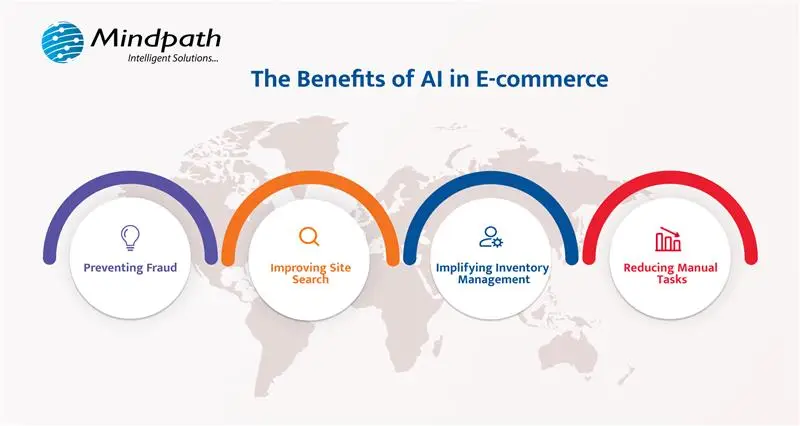
1. Preventing Fraud

E-commerce businesses usually face a huge challenge with online fraud, but with e-commerce AI tools, these frauds can be prevented easily. AI can quickly spot any suspicious activity by understanding the patterns and detecting anything unusual such as incorrect shipping addresses or any other signs of fraud. Also, it can detect fraud even while reviewing thousands of transactions at once which helps to prevent losses and keeps the store guarded. AI has the ability to learn and improve which can benefit in continuously strengthening its fraud detection, helping you to focus on growing your business.

2. Improving Site Search

AI in e-commerce is making site search smarter and more accurate. AI can better understand what customers are looking for due to the advancements in natural language processing. Whenever a customer types to search for something, AI can automatically fix spelling mistakes, suggest synonyms and even fill missing words. It can also help customers in visual search as well search voice search options. With the help of these smart features, AI can reduce customer’s frustration and provides them exactly what they want, improving shopping experience and giving businesses a competitive advantage in the e-commerce market.

benefits of AI in e-commerce

3. Simplifying Inventory Management

With artificial intelligence in e-commerce, inventory management has become much easier. AI can predict how much stock you need based on past data and trends which helps to avoid overstocking or running out of items. AI also makes warehouse tasks smoother as bots can help store and retrieve products quickly, saving time and effort. This technology makes managing stock more accurate and efficient, allowing businesses to focus on growing while AI handles the tricky parts of inventory management.

4. Reducing Manual Tasks

AI can reduce the need for manual labor by taking over repetitive tasks in e-commerce. Instead of employees handling simple, time-consuming tasks, AI automates these processes and saves valuable time and improves competence. By handling tasks like answering basic customer queries, processing orders, and managing inventory, e-commerce AI allows businesses to focus on more important activities. While this may change the roles of human workers, it helps businesses cut costs and enhance productivity, making overall operations more streamlined and effective.

Want to reduce manual work and make your e-commerce platform more effective? Discover how AI in Web Development can streamline operations and enhance customer experiences.

Real World Use-Cases of AI in E-commerce

Artificial intelligence is already making a big impact in the e-commerce world. Many well-known online stores are utilizing it in smart ways to improve the way people shop and how smoothly their systems run. Here are some of the real-world examples showing how AI is used every day in e-commerce.
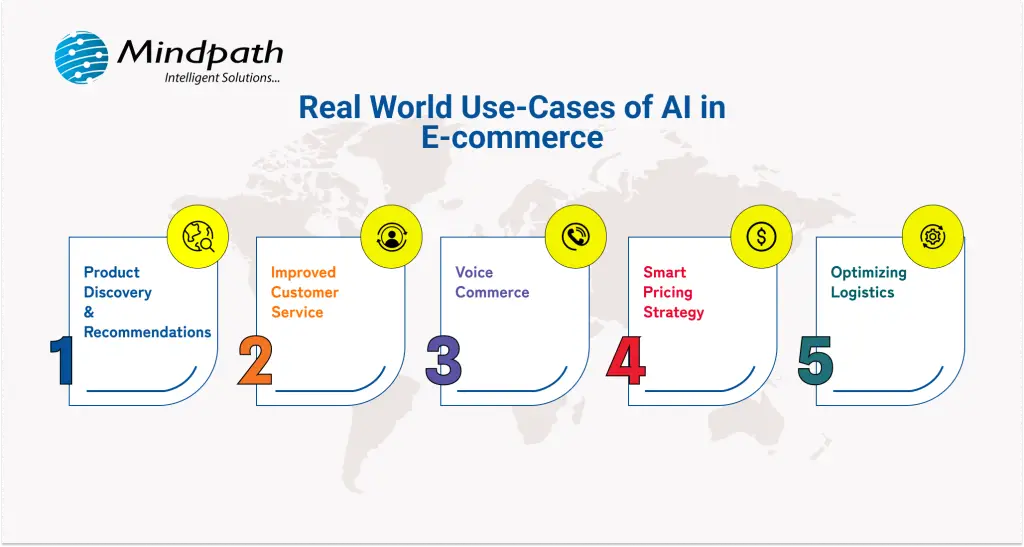
1. Product Discovery and Recommendations

AI in e-commerce is shaping how customers discover products online. Websites like Amazon, Shein, Etsy and eBay show products based on the browsing and purchasing history of their customer with personalized product recommendations. For instance, if you search for a purse on Amazon, it will suggest other similar brands of purses that you may like. This AI-driven system makes shopping more enjoyable and also boosts sales and customer trust. E-commerce advertising also benefits from this, as targeted recommendations lead to more engagement, improving overall customer experience.

2. Improves Customer Service

Customer service is improving with the help of AI-powered chatbots and virtual assistants, which can quick and personalized support. Artificial intelligence for customer service in retail stores helps businesses automate responses, answer customer queries, and offer tailored solutions. By using technologies like machine learning and natural language processing, AI can understand customer inquiries and offer accurate responses. For example, H&M uses AI-powered chatbots to help customers with product details, availability, sizing and even delivery options. This makes customer shopping easier and helps businesses deliver faster and efficient customer service.

use cases of AI in e-commerce

3. Voice Commerce

Voice commerce, also known as V-commerce, is changing how we shop online with the help of AI. By using voice assistance like Amazon’s Alexa, Google Home, and Walmart’s voice services, customers can shop simply by speaking. These AI-driven assistants understand commands through natural language processing (NLP) and can offer tailored product recommendations. They also help customers with order updates and product inquiries. AI in e-commerce examples include big companies like Amazon, Walmart, and Google Shopping that are leveraging voice technology to improve shopping experience.

4. Smart Pricing Strategy

The role of AI in e-commerce is changing the pricing strategies by allowing price adjustments based on various factors like demand, supply, and competitor prices. AI trends use data analysis to predict demand patterns and automatically modify prices. Major companies like Amazon, Walmart, and Best Buy have adopted AI to implement smart pricing strategies which allow them to remain competitive, attract more customers and improve satisfaction by offering relevant prices. These examples demonstrate how advanced technology can optimize pricing in the ever-evolving market.

5. Optimizing Logistics

In e-commerce, smart logistics powered by AI improves delivery efficiency by using real-time data and predictive analytics. This technology helps businesses track shipments, prevent delays, and make better decisions. For instance, Cainiao, Alibaba’s logistics arm, uses AI to ensure deliveries within 24 hours across China. Similarly, Amazon employs AI to optimize delivery routes, reducing costs and speeding up deliveries. These uses of artificial intelligence in daily life are making logistics smarter, cutting costs, and providing a better customer experience.

Looking to streamline your business operations and enhance customer experiences? Discover how conversational AI chatbots can help your business transform its workflows and boost efficiency in our blog.

Ready to Adopt AI Revolution?

Artificial intelligence is revolutionizing e-commerce by enhancing customer experiences, streamlining operations, and driving innovation. From smart pricing and personalized recommendations to AI-powered customer service and logistics, the role of AI in e-commerce is transforming the industry in powerful ways. As technology continues to evolve, businesses that embrace AI will stay ahead of the curve, offering better services and smarter solutions.

At Mindpath, we provide top-tier AI development services to help businesses thrive in the world of e-commerce. Our AI solutions are designed to improve customer experience, streamline operations, and boost sales. From personalized recommendations and dynamic pricing to efficient inventory management and smart logistics, we integrate AI to make your e-commerce platform smarter and more efficient. Trust Mindpath to bring AI-powered innovations that will optimize your business and help you stay ahead in the ever-evolving e-commerce landscape.
Related Post

Discover how Augmented Reality (AR) is transforming e-commerce with immersive shopping experiences, boosting engagement, and improving sales.
Discover the key factors influencing software development costs and how to optimize your budget. Learn how Mindpath can help.
Learn how to hire offshore developers with our comprehensive guide. Maximize your business growth by accessing skilled talent and streamlining your process.

Related Post

Benefits of agile methodology

Approaching software development without a flexible mindset can often result in delays and stress. This is where the benefits of agile methodology come into play. Agile allows a team to react quickly to change, provide value continuously, and maintain common goals. Agile fosters teamwork, quick delivery, and incremental updates. If you ever find that you are constantly feeling stuck or that things are moving too slowly, then Agile can provide a steady flow that will keep things moving forward and adjust its plans accordingly.

Agile offers structure while maintaining flexibility. Project work is broken down into smaller bits and allows for feedback and change along the way. This helps keep developers, testers, and clients engaged through the process. People can track progress more easily and receive results faster. Agile doesn’t just focus on completing tasks, but on building something useful at every step. This blog highlights some of the primary benefits of Agile that many of today’s teams prefer to embrace.

Explore how custom software development services using agile methodologies elevate your business performance. Reach us at Minpath, and we will provide expert guidance to you every step of the way.

What is Agile Methodology?

Agile methodology is an adaptive and collaborative method of software development based on the principles set forth in the values of the Agile Manifesto. Agile focuses on teamwork, the ability to adapt, continuous improvement, and the delivery of working software in small, manageable pieces. An agile team is self-organized and can adapt quickly to changes during the development life cycle. So, what is the main objective of agile methodology? It is to be responsive and provide value more quickly.

Agile focuses on helping teams select tools and techniques for their goals rather than abiding by a single standardized process. Each project can look a little different, but they all follow the same Agile principles by planning in short iterative cycles, soliciting feedback, and adjusting from there. Ultimately, Agile allows teams to deal with uncertainty during a project in order to improve at every turn.

Also Read: Types of Software Development

Types of Agile Methodologies

Agile provides several methodologies that adhere to its fundamental principles; however, they differ in structure and practice. Each is intended to foster teamwork, speed, and flexibility in its own unique way.

Types of Agile Methodologies

1. Crystal

Crystal is a lightweight agile methodology that encourages rapid delivery of working software, communication with customers, reducing risks, and frequent releases. It is flexible with respect to team size and project complexity, and it promotes collaboration and communication to improve team and customer feedback.

2. Scrum

Scrum is a prescribed agile framework that arranges work into fixed-length sprints, which allow the team the opportunity to inspect how much work was done so far and adjust based on that. The goal is to enhance visibility, facilitate some level of collaboration consistently, and have continuous improvement as the team works through it with prescribed roles and ceremonies.

3. Kanban

The kanban approach is concerned with delivering work continuously and has a strong lean focus on improving the process. The visual workflow helps teams find bottlenecks, work on reducing cycle times, and allows managing work to be simplified using boards and cards.

4. Lean

Lean focuses on maximizing customer value by eliminating waste and improving efficiency throughout the development process. It supports fast delivery, strong team collaboration, and quick response to feedback.

5. Scrumban

Scrumban fuses the structured planning of Scrum with the visual task management of Kanban to allow flexible value-based delivery. It is an adaptable and process-focused method that allows teams to incorporate regular updates, rapid releases, clear task ownership, and adaptability as project needs change.

Wondering how Agile practices fit into the bigger picture of building high-impact web applications, our web app development roadmap outlines the full step-by-step journey from planning to deployment.

Top Benefits of Agile Methodology

Agile provides a modern approach for the management of software projects, which is focused on flexibility, collaboration, and rapid delivery. Here are some important agile software development benefits that aid teams in creating better products with better timeliness.

Top Benefits of Agile Methodology

1. Customer-Centric Results

Agile methodologies promote regular feedback and involvement from customers in every aspect of development, leading to products that can be tailored to more accurately fit the needs of the user. One of the key agile software development advantages is that this increases customer satisfaction (as perceived by customers during development) and trust moving forward.

2. High-Quality Deliverables

With every sprint of work teams are testing and improving their work. You will note that the ongoing improvement is one of the key benefits of agile software development, and it helps teams develop stable and reliable products. Solving problems early is part of the workflow.

3. Flexibility to Change

Agile teams can quickly adjust plans in response to new feedback or ever-changing goals, and ease of change is one of the greatest strengths of agile software development. The essence of agility is the ability to stay aligned with business needs without spending unnecessary time or going off track.

4. Clearer Planning and Estimations

Agile operates within short, structured cycles, which allow for considerably improved estimation of timelines and budgets. This is one of the most important benefits of agile software development, especially for project managers whose primary goal is to solicit the meters for project planning in the most effective way possible. Predictable progress encourages smarter decisions.

5. Reduced Development Risks

Frequent reviews and updates allow teams to catch issues early when they are still not serious problems. This built-in risk control offered by agile is of major benefit to agile project success. Agile provides full visibility into work progressing at all times.

6. Stronger Team Collaboration

Agile encourages daily stand-ups, a routine dialogue, and real-time feedback/updates. This collectively helps with teamwork, collaboration, and confusion regardless of role. Better communication is one of the fundamental advantages of agile methodology and contributes to an easier, smoother project flow.

Want to know how businesses turn ideas into scalable software solutions? Explore the custom software development process and the role Agile plays in efficient execution.

Ready to Embrace the Agile Advantage?

Agile has changed the way modern teams build software by promoting collaboration, speed, and flexibility. The benefits of agile methodology include higher customer satisfaction, better product quality, reduced risk, and smoother workflows. By using short cycles and continuous feedback, Agile helps teams deliver faster, smarter, and with greater confidence, making it a preferred choice for many development teams today.

Want to apply these custom software development benefits to your next project? At Mindpath, we offer custom software development services built around proven agile methodologies. Contact us and our team will help you with clear communication, flexible planning, and faster delivery that meets your business goals. With Mindpath, you get tailored solutions that revolve around your business requirements and deliver long-term value with every sprint.

Multi Cloud vs Hybrid Cloud

Deciding between multi-cloud vs. hybrid cloud strategies is becoming an important choice for organizations that want to remain agile and scalable. Every organization needs to find a way to balance flexibility, security, and performance, and this holds true with cloud architecture as well. The more complex challenge is determining which model can optimize operations while allowing the teams in the organization to innovate unhindered. As technology progresses to new heights, a strong cloud architecture can be a differentiating element within an organization’s growth.

It is essential to be certain of how both cloud models serve your business objectives and technical goals to make the better decision. It is not just an issue about infrastructure, but positioning your organization for the future and digital resilience. Understanding their differences helps organizations make confident and data-driven decisions in a world where technology changes rapidly. In this blog, we will explain some of the fundamental principles of multi-cloud and hybrid cloud so that the decision on which is best for you will be less difficult.

Want to determine which cloud strategy will be ideal for your organization? Contact us to get deeper insights and make smart business decisions that lead to future growth.

Understanding the Fundamentals of Hybrid Cloud and Multi-Cloud

A hybrid cloud combines both private and public cloud services in order to provide an adaptable and secure environment for computing. Organizations can house sensitive data in a private cloud to protect it, while still utilizing the on-demand, scalable, and cost-effective computing of the public cloud. Hybrid clouds offer enhanced control, resource utilization, and performance. Utilizing a hybrid cloud allows organizations to efficiently manage workloads across the types of cloud while enjoying the benefits of both cloud types.

A multi-cloud strategy uses multiple cloud service providers to achieve specific corporate objectives. In the multi-cloud vs. hybrid cloud debate, companies will tend to prefer multi-cloud solutions for flexibility, avoiding being locked into a single vendor platform, and minimizing operational risks such as downtime or loss of data. Each application in a multi-cloud environment can run on a public cloud platform or private cloud platform based on relative performance or cost needs.

Wondering how application architecture impacts multi-cloud and hybrid cloud success? Explore cloud-native development to learn how cloud-native apps improve scalability and flexibility.

Advantages of Hybrid Cloud

A hybrid cloud gives companies the right combination of flexibility and control, helping companies manage data securely and securely provide scalability and efficiency for operations.

1. Strong Security and Data Control

Hybrid cloud allows companies to maintain improved control of sensitive data and mission-critical systems. Companies can use private servers to store private information and public clouds for everyday tasks, allowing for a balance between security and freedom.

2. Smarter Cost Management

Businesses can reduce their costs by maintaining constant workloads on private systems, while variable workloads can move to the public cloud. This model allows for a pay-as-you-go system that reduces risk of overspending and improves cost optimization.

3. Faster Performance and Low Latency

Hybrid cloud enhances performance by positioning time-sensitive jobs, such as analytics or IoT applications, nearer to the end user. The configuration call for helps to reduce latency and increase response times for the users.

4. Reliable Disaster Recovery

Businesses are able to store crucial data in the public cloud while ensuring that a main version is also preserved on their premises and if there is a systems failure, they can quickly restore and resume business as usual with minor interruptions.

5. Greater Scalability on Demand

Organizations can easily scale their capacity up or down via the public cloud when they find themselves in busy periods or running promotional activities that bring in high traffic. After the busy period ends, they can scale down their capacity, so they aren’t wasting money and resources.

6. Better Compliance and Data Governance

Hybrid cloud helps companies follow data protection rules by keeping customer data on local servers. At the same time, they are still able to carry out non-sensitive work in a public cloud, thus making an informed decision on multi-cloud vs hybrid cloud.

7. Boosted Innovation and Flexibility

Teams can experiment with fresh tools and services in the public cloud without interfering with core systems. This illustrates that the difference between multi-cloud vs hybrid cloud can drive business innovation and flexibility within the digital age.

Is your cloud strategy aligned with long-term digital growth goals? Discover digital transformation for businesses to understand how the right cloud approach accelerates innovation.

Examples of Hybrid Cloud

These are some real-world hybrid cloud examples and how organizations use this approach to improve business flexibility, security, and efficiency.

1. Digital Transformation

A hybrid cloud modernizes IT systems with a remote workforce and protects data in a secure environment.

2. Disaster Recovery

Hybrid clouds help your business continue operating normally by recovering data at a fast speed in the event of outages.

3. Development and Testing

Developers develop and test apps in their public clouds, then port to private clouds.

4. Cloud Bursting

During peak traffic, additional workloads move from private clouds to public clouds without impacting performance.

5. Edge Computing

Delivers and processes data near the user, resulting in faster and lower latency experiences.

6. AI & Machine Learning

A hybrid cloud supports AI workloads with the best scalability and the security of their data.

Looking for ways to optimize costs and scale applications seamlessly in complex cloud setups? Discover serverless architecture in cloud computing to explore how serverless solutions support modern cloud architectures.

Advantages of Multi-Cloud

The following are the main benefits of a multi-cloud strategy that will help to improve business performance and facilitate better operations.

1. Business Continuity Edge

In comparing multi-cloud vs. hybrid cloud, one advantage of multi-cloud is that it allows operations to continue even if one of the providers has an outage. By spreading workloads across a combination of platforms, businesses provide continued performance and reliability.

2. Flexible Cost Management

In the hybrid cloud vs. multi-cloud comparison, another of the advantages of multi-cloud is improved cost control. This allows companies to choose the cheapest cloud provider for each workload and optimize resources effectively.

3. Customized Security Approach

Multi-cloud allows organizations to engage with providers that best suit their compliance and security requirements. This helps to ensure improved data security and better alignment with regulatory standards.

4. Independent Provider Choice

Using a multi-cloud strategy, organizations will have less reliance on one vendor. They will have the flexibility to move workloads, negotiate terms, and meet changing demand in the market.

5. Optimized Technology Access

Each cloud provider has a service that they do best, e.g., AI, analytics, or integration. Multi-cloud allows organizations to select the cream of the crop and combine them together to get the best performance and innovation.

6. Enhanced Global Reach

Multi-cloud allows applications to be deployed across multiple locations to minimize latency and enhance speed. This is especially useful for global companies that need to provide consistent, reliable speeds globally.

7. Ongoing Innovation Power

By utilizing countless ecosystems in the cloud, firms are able to engage with new, emerging technologies that give them flexibility and even a competitive advantage regarding innovation and continued growth.

Curious about where cloud adoption is heading next? Explore cloud computing trends to discover emerging technologies shaping multi-cloud and hybrid strategies.

Examples of Multi-Cloud

Here are real-world examples of multi-cloud that demonstrate how businesses use multiple providers to enhance their performance, flexibility, and reliability.

1. Specialized Services

A business may use Google Cloud for analytics and AWS or Azure for AI tools to get the best of each platform.

2. Disaster Recovery & Continuity

A financial firm can rely on OCI for core apps and IBM Cloud as a backup to ensure uninterrupted operations.

3. Cost & Performance Balance

A retailer may host its e-commerce site on one cloud and run analytics on another to save costs and improve speed.

4. Diverse SaaS Usage

An organization can follow a multi-cloud approach by using Salesforce for CRM and Workday for HR management.

5. Compliance & Data Security

A healthcare provider may store patient data in a private cloud while using a public cloud for general operations.

Looking to build healthcare software that meets strict compliance and data security standards? Explore our blog on healthcare software to discover how secure cloud-based solutions protect sensitive patient data.

Multi-Cloud vs. Hybrid Cloud: A Comparison Table

Below is a brief comparison table showcasing the primary differences between hybrid cloud and multi-cloud, so you can gauge which model may work better for your business requirements.

Aspect Hybrid Cloud Multi Cloud
Definition Combines private and public clouds to work as one integrated environment. Uses multiple public cloud providers for different workloads.
Primary Goal Balance security with scalability by keeping sensitive data on private clouds. Maximize flexibility and performance by choosing the best services from each provider.
Architecture Integrates on-premise infrastructure with one or more cloud services. Operates across multiple independent cloud platforms without tight integration.
Data Management Data moves between private and public clouds based on need. Data is distributed across several cloud platforms for specific tasks.
Security Control Offers stronger control and compliance for sensitive workloads. Security depends on each provider’s standards and your management strategy.
Cost Efficiency Reduces cost by keeping predictable workloads in private environments. Optimizes cost by comparing pricing and using best-fit providers.
Use Case Ideal for regulated industries needing data privacy and scalability. Perfect for businesses aiming for high availability and vendor flexibility.
Example A bank using private cloud for transactions and public cloud for analytics. A retailer using AWS for e-commerce, Google Cloud for data, and Azure for AI.

Ready to Choose the Right Cloud Strategy for Your Business?

Deciding between multi-cloud vs. hybrid cloud depends on your organization’s needs for flexibility, performance, and security. Both approaches empower businesses to innovate and scale effectively. Understanding their core differences helps you design a cloud strategy that aligns with your goals and builds a strong foundation for long-term digital success.

At Mindpath, we deliver expert cloud computing services to help businesses design secure and scalable environments. Our team builds tailored multi-cloud vs. hybrid cloud solutions that enhance performance, reduce costs, and boost efficiency. Partner with us to create a future-ready infrastructure that keeps your business innovative, adaptable, and competitive in a fast-changing digital world.

Learn the key differences between multi-cloud and hybrid cloud strategies and discover how Mindpath’s cloud services can help.
Image showing a person working on a laptop.

Want to know about the potential conversational AI use cases? You have reached the right place; let’s dive deep and understand the top use cases of conversational AI.

The advancement of the human race seen in recent times is mindboggling. At the spearhead of the pioneering force of development are the advances in technology made by man. With the rapid pace of development, humans realize the need to create artificial intelligence at par with human intelligence.

Especially after the massive disruption caused by the pandemic, we search for artificial intelligence applications capable enough to take up a significant chunk of manually completed tasks. The pandemic and subsequent social distancing have made us trust machines to complete specific tasks that can be hazardous to our health. Artificial intelligence is an important factor in machines replacing manual labor at most places.

With the rise in artificial intelligence applications, the AI-human relationship is evolving to make it more interactive and fruitful. One core technology that lies at making the use of AI more satisfying for humans is conversational AI. Conversational AI is a set of technologies that help a computer register, process and understand human language. Conversational AI renders a more human touch to AI applications by giving human-AI interactions a more conversational flow.

In this way, conversational AI makes it convenient for people to use complex machines. Conversational AI increases machines’ efficiency by helping them understand the user’s needs in a better way.

Understanding Conversational AI Use Cases

Conversational AI is one of the most promising sectors of Artificial intelligence, with its market share growing from $4.2 billion in 2019 to $15.7 billion by 2024. It is only natural for conversational AI use cases to increase in the next few years. As the accessibility of computers and intelligent devices increases, conversational AI use cases also improve. Conversational AI is used in both the commercial and domestic sectors today. Here are the few conversational AI use cases that highlight the revolution that conversational AI truly is.

IT and Data Security Services

One of the primary conversational AI use cases is found in the IT sector and data security. IT companies are using chatbots as the primary interface of customer support services. The chatbots help customers in accessing support services at any time. These chatbots are programmed to address the fundamental issues faced by a customer and offer troubleshooting solutions. If the customer’s type of concern is of higher complexity, it gets forwarded to the IT support executive. Having a chatbot in the IT services helps filter out the customer requests according to the complexity and priority of the concerns.

–  Using a chatbot in the customer support chain helps resolve issues, increase the staff’s productivity, and better incident management.

–  The chatbots also provide more data security to the customers as they are not exposed to a third party.

–  Chatbots are used in the IT service support sector, troubleshooting, and customer information sector.

Sales Management

Conversational AI platforms like chatbots and virtual assistants are used to handle the different processes involved in sales. In this way, chatbots and virtual assistants help in improving the sales management of an organization. Chatbots can be integrated into warehouse systems, databases, and CRM systems to simplify and streamline. Large-scale manufacturing companies use virtual assistants to schedule despatch of product shipments. Chatbots also help in maintaining sales databases. Chatbots can also assist lead management. Moreover, chatbots help in checking the lead status and fill in the lead details for sales executives.

Marketing and Promotions

Use cases for AI in conversational marketing are in every industry if appropriately observed. Every successful company takes its marketing strategy seriously. Companies are now using technology to support their marketing goals. One of these technologies is conversational AI. Companies are using different online platforms like websites and social media for marketing. The chatbots integrated into these platforms are excellent examples of conversational AI use cases. Chatbots help in gathering customer insights and potential leads from online platforms. Demographics and data insights lay the foundation of the marketing strategy for companies. Conversational AI applications provide crucial data to the marketing teams so that they can create efficient strategies.

Chatbots interact with potential customers to gather good leads. For highly interested potential customers, chatbots help in scheduling demos and meetings. Chatbots observe a visitor’s website activity to recommend products that can be relevant to them. There are many more ways in which conversational AI supports marketing activity and customer acquisition.

Internal Virtual Assistant

Apart from helping a company interact with its customers, a chatbot can also help an organization establish channels of internal communication. This helps in improving the coordination between the different teams of an organization. Internal virtual assistants and intranet chatbots can help set up meetings with the staff, sending out reminders to everyone involved, and improving internal communication in general.

Employees can do small tasks like applying for leaves, approving leaves, and staying informed on internal updates with intranet chatbots’ help. Chatbots can also help in the organization of documents and making them accessible to employees when needed. This decreases the hassle of working and allows an employee to become self-reliant in the workflow.

Furthermore, chatbots can keep the employees in the loop for recent developments, perform simple tasks for them and improve the company’s workflow in general.

Retail Industry Operations

In 2020, the retail industry was in for a revamp to embrace the new normal. As retail became tech-empowered, it also served as a strong example of conversational AI use cases.  The use of chatbots and other conversational AI forms act as virtual shopping assistants for people who want to shop from home. Even inside a store, chatbots help the customers in exploring the inventory for their chosen product. Intelligent chatbots help customers find suitable product recommendations according to their preferences and needs. In e-commerce websites, chatbots help in adding products to the cart and checking out with them. Even in offline stores, conversational AI helps customers make payments and checkout without human interactions.

Bottom Line

Conversational AI plays a vital role in carrying out operations in almost all sectors. The above-mentioned are a few of the use cases of Conversational AI in today’s era. If a user wants to learn more about conversational AI under a conversational AI tutorial, he/she cannot forego the use cases of conversational AI in different fields. With the adoption of conversational AI chatbots for your business, you can take your business to the next level of growth.

Want to know more about conversational AI? Reach our experts at eBotify and they will explain to you the concepts of conversational AI and chatbots.

Want to know about the potential conversational AI use cases? You have reached the right place;