AI in Business Strategy: Driving Growth and Innovation

Join our Newsletter!

Featured Posts

Support Is One Click Away

Home

AI in Business Strategy: Driving Growth and Innovation

AI in business strategy

AI in Business Strategy: Driving Growth and Innovation

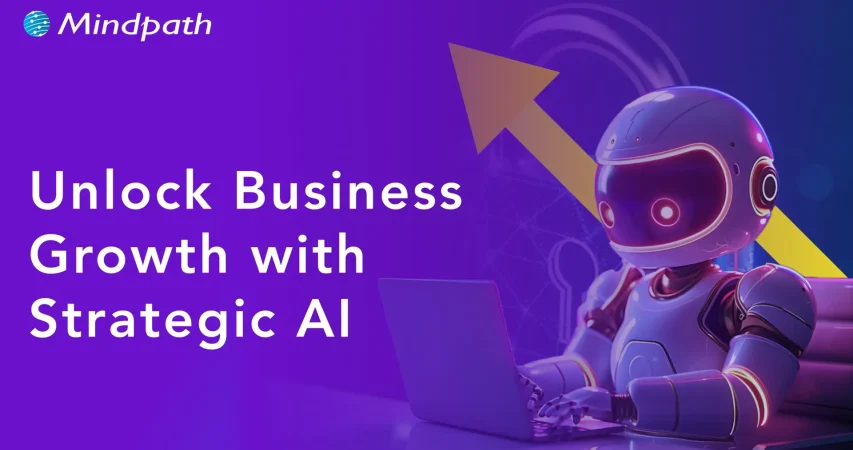
Think about the potential of AI in business strategy, accelerating your organization with enhanced insights and improved decisions. Imagine having intelligent tools to assess complex data, identify unseen patterns, and let your team have more freedom to genuinely innovate and grow. By adopting the right mindset, companies today are giving themselves a true competitive advantage with AI and changing every aspect of their operations daily.

This intelligent technology is helping companies find new opportunities, create more relevant customer experiences, and briskly adapt to changes in market needs. Embedding artificial intelligence benefits organizations to yield positive results. When used prudently, AI becomes a trusted partner in increasing efficiencies and establishing long-term, viable success.

In this article, you will learn about how AI can transform your strategy and scale your business. Let’s dive in!

Want to enhance your business strategy with artificial intelligence? Mindpath AI development services have a combination of providing strategic insights with hands-on expertise to provide intelligent growth across your organization.

What is an AI Business Strategy?

A business strategy is like an explicit blueprint that directs a company toward its goals. It answers important questions about where a business wants to go, how it plans to get there, and what makes it different from the rest of the marketplace. A clear strategy helps everyone understand the overall objective of the business and keeps colleagues headed in the right direction while working together.

Bringing AI into the plan strengthens the marketing strategy. An artificial intelligence strategy or AI strategy for business growth means using artificial intelligence to better facilitate your business objectives. This could mean improving customer service, making more effective decisions with your data, or even many other entirely distinct initiatives. The aim is to leverage smart tools to execute better, smarter, faster, while staying ahead of your competition.

Also Read: AI in E-Commerce

Benefits of an AI Business Strategy

Having an AI business strategy can open up new opportunities and make your company more competitive. Here are some key benefits that show why investing in AI is worth it:
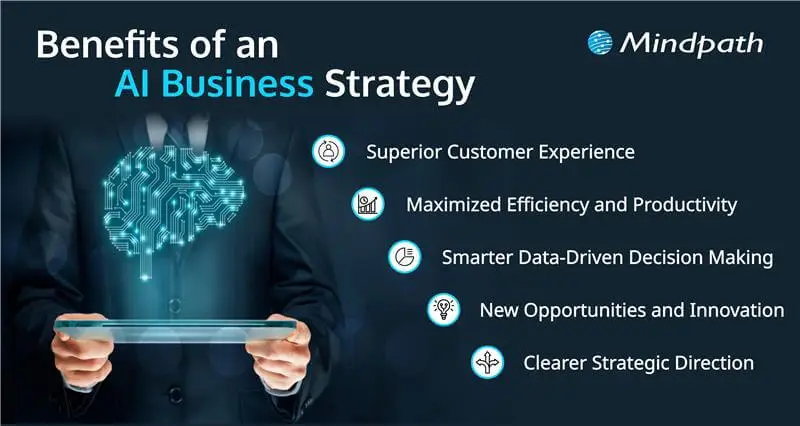
benefits of an ai business strategy

1. Maximized Efficiency and Productivity

AI can take care of repetitive work, so teams can spend more time on creative ideas and solving problems. It makes daily tasks easier and quicker, which improves workflow in every department. By spotting delays and gaps in processes, AI helps companies get things done faster. This boost in productivity helps businesses stay competitive. Companies can do more with less time and effort when using AI in business.

2. Smarter Data-Driven Decision Making

Using AI in business helps leaders make better decisions based on real data. AI tools can study huge amounts of information and find trends or risks that people might miss. This means managers can act faster and with more confidence. Predictive tools even help businesses see what customers might want next. Smart decision-making is key to staying ahead in a changing market.

You can learn more about how AI can transform decision-making in our guide, Power of AI in Decision-Making.

3. New Opportunities and Innovation

AI encourages companies to try new ideas and find fresh ways to earn money. It supports innovation by helping teams develop new products or enter new markets. With AI, companies can test different ways to work and reach more people. This can create new income streams and keep a business strong in tough markets. Staying open to new ways of working keeps the company growing.

4. Superior Customer Experience

AI for customer service makes it easier to understand what customers like and want. Businesses can offer more personal services, like tailored suggestions or special offers. Chatbots and AI tools give customers quick answers, anytime they need help. This keeps people happy and more likely to come back. Good customer service is always important, and digital transformation with AI makes it even better.

5. Clearer Strategic Direction

AI business strategies help companies plan for the future with clear data. Teams can set better goals because they know what is working and what needs to be changed. AI tools keep an eye on the market and help businesses adjust plans when needed. This makes it easier to stay on track even if things shift. A strong strategy backed by AI keeps everyone moving in the same direction.

Want to know if your business is ready to implement AI in the right way? Explore our blog – AI Readiness Checklist.

How to Build an AI Business Strategy?

Building an AI business strategy takes careful planning and clear goals. Here are some practical steps to help you get started the right way:
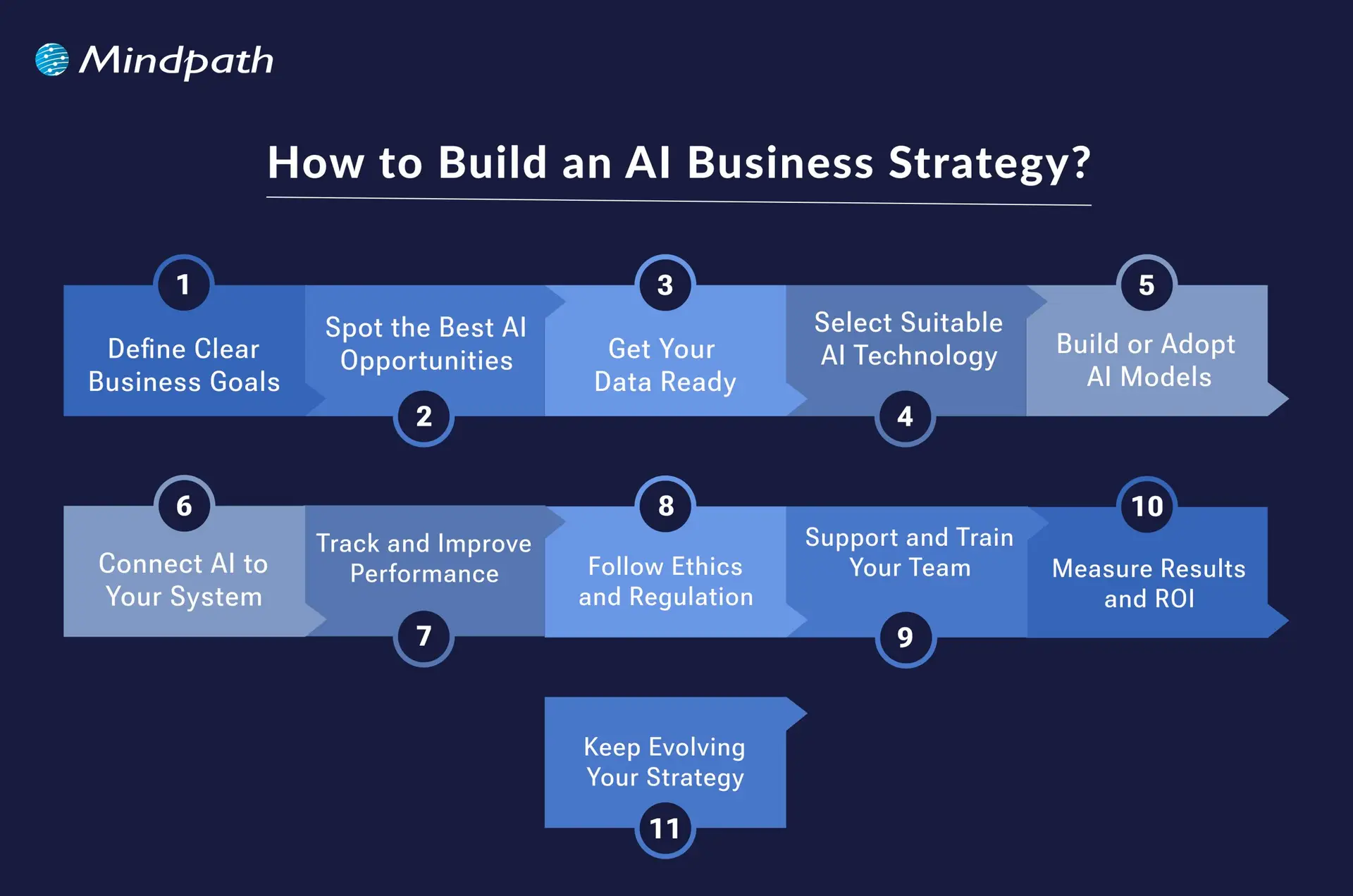
How to Build an AI Business Strategy

1. Define Clear Business Goals

Start by deciding what you want to achieve with AI, like increasing sales, lowering costs, or improving customer service. Clear goals strategized by the expert AI consultant help you focus your efforts where they matter most. Knowing what you want makes it easier to pick the right AI tools later. A strong direction keeps your entire team aligned and motivated.

2. Spot the Best AI Opportunities

Look at your daily operations and see where AI can add the most value. This might be in customer support, marketing, supply chain, or product development. Finding the right areas will help you get quick wins and build confidence. Prioritizing these areas makes your investment more effective.

3. Get Your Data Ready

Good data is the foundation for AI success. Collect useful data from different parts of your business and make sure it’s accurate and well-organized. Clean and reliable data will help your AI tools work properly. Better data means better insights and fewer errors down the road.

4. Select Suitable AI Technologies

Explore the AI tools that match your goals and the type of data you have. This could include machine learning, chatbots, or automation software. Choose technologies that are practical and align with your strategy. Pick tools that your team can actually use and manage well.

5. Build or Adopt AI Models

Develop AI models that fit your business needs, either with your own experts or trusted partners. Some companies build custom models, while others use ready-made solutions. Test your models to make sure they perform well in real-world situations. Good models help you solve problems faster and smarter.

Ready to adopt the recent AI trends into your business? Read our detailed blog on Top AI trends, which provides a deeper understanding of how to implement AI into your business for future growth.

6. Connect AI to Your Systems

Make sure your new AI tools work smoothly with your current software and workflows. This may need teamwork between IT, data, and business teams. Good integration helps people use AI with less hassle. Seamless systems keep operations running without major disruptions.

7. Track and Improve Performance

Keep an eye on how your AI strategy is working post-implementation. Use regular checks to fix any issues and update the system with fresh data. A little maintenance keeps your strategy useful and accurate over time. Monitoring helps you spot new opportunities for improvement too.

8. Follow Ethics and Regulations

Think about the rules and responsibilities that come with using AI. Protect customer privacy and make sure your AI solution doesn’t create unfair bias. Stay up to date with local and international laws. Acting responsibly builds trust with customers and partners.

9. Support and Train Your Team

Help your team learn how AI fits into their work. Offer training so they feel comfortable using new tools and workflows. Encourage them to ask questions and share feedback. Well-trained employees make AI adoption smoother and more effective.

10. Measure Results and ROI

Decide which numbers will show if AI is really helping your business. This might be cost savings, higher sales, or better customer feedback. Keep tracking these results over time to see progress. Proving ROI makes it easier to get support for future AI projects.

11. Keep Evolving Your Strategy

Treat your AI business strategy as a work in progress. Keep testing, learning, and improving how you use AI as your goals change. Regular updates keep you competitive in a fast-changing market. A flexible approach helps you make the most of every opportunity.

Planning to leverage the power of artificial intelligence, understanding the technologies that drive it has become a crucial advantage. To dive deeper into the tools and technologies behind AI innovation, explore our detailed guide on the AI programming languages.

Ready to Transform Your Business with AI?

Adopting AI in business strategy helps your company make smarter choices, improve operations, and deliver better customer experiences. By understanding your goals and using AI wisely, you can drive innovation and stay ahead of the competition. Start with clear steps, keep learning, and stay flexible. This approach ensures that AI becomes a real advantage for your business growth.

At Mindpath, our AI development services are designed to help you unlock real results with confidence. We create solutions that match your unique needs, from custom AI models to smooth system integration. Our team works closely with you to ensure your strategy delivers value today and in the future. Let’s build an AI-powered roadmap for your success.

Related Post

Discover how Generative AI is revolutionizing customer service with automation, efficiency, enhancing customer experience and more.
Discover the ultimate guide to hiring Node.js developers in London. Learn about the skills, benefits, and cost factors involved in finding the right talent for your project.

Related Post

Recruit Computer Programmers in 2024

Looking to hire a computer programmer in 2024 but feeling overwhelmed by the process? Wondering how to find the perfect fit for your team amidst the sea of talent? Don’t worry! In this blog we will learn about the simple steps to recruit a computer programmer in 2024. 

A computer programmer writes and fixes code for software and apps. They utilize specialized programming languages to write instructions that computers follow to do things. This means they create the applications and programs we use every day, ranging from social networking apps to corporate tools. Programmers frequently work alone or in collaboration with other technical specialists, such as software developers and engineers. Their job includes not only developing code, but also identifying and resolving any issues that may arise, ensuring that everything functions well. 

As technology grows more integrated into our daily lives, talented programmers are in high demand in many sectors. Hiring a computer programmer is vital because they help in developing and updating the software that keeps our digital world working smoothly. Without them, many of the tools and apps we use would not exist or function correctly. 

So, let’s dig in to explore the simple steps to recruit a computer programmer! 

Steps to Recruit Computer Programmers

1. Define Your Requirements

Before you start looking for a computer programmer, you should know exactly what you’re looking for. Determine which programming languages the programmer should be familiar with, such as Java, Python, or JavaScript, based on the requirements of your project. Consider what technologies and tools they should be familiar with, especially if you’re creating anything specific such as a website. Decide if you need someone with extensive knowledge to take on leadership responsibilities or someone with a few years of experience to undertake routine tasks. Consider the personal abilities you value, such as being an effective communicator or team player. Knowing these details can assist you in finding the ideal programmer for your requirements. 

2. Estimate Your Cost

Before you begin looking for a computer programmer, you must first determine your budget. The cost of employing a programmer varies greatly depending on their degree of expertise, location, and the unique abilities they bring to the table. For example, a highly experienced programmer or one with specialized abilities may command a greater wage than someone with less experience or more generic skills. Setting a budget ahead of time not only helps you identify a programmer that fits inside your budget, but it also ensures that you are realistic about your financial situation. 

3. Clear Job Description

When recruiting a computer programmer, it’s essential to have a clear job description. This allows potential applicants to understand exactly what you’re looking for, ensuring that you recruit the right kind of individuals. Begin by using plain and straightforward language. Avoid using technical terms or sophisticated terminology that may mislead candidates. Clearly outline the position, including the activities and responsibilities that the programmer will be handling. Be precise about the technologies and programming languages they’ll be using. 

Include a list of the required qualifications and skills, such as years of experience and any specific background needs. Do not forget to add the soft skills essential to you, such as teamwork or communication. This manner, you’ll attract individuals that not only have the necessary technical talents but also fit in with your company’s culture. 

4. Conduct Interview

Conducting interviews helps you get to know the individuals and assess their abilities. Enquire about their programming background, problem-solving skills, and communication style. You might also assign them a coding challenge to put their abilities to the test.  

Interviews can be conducted via video, phone, or in person, and should include both technical and behavioral topics. The technical section evaluates coding abilities, whereas the behavioral section examines communication and team fit. Involve other team members in the selection process to verify the candidate is a good fit for the team. 

5. Evaluate Skills

A computer programmer’s communication abilities are critical to the success of any project. They must properly communicate their ideas and work successfully with team members. During the employment process, these soft skills should be assessed. To assess a candidate’s ability to break down technical nuances, ask them to describe a complicated programming concept in easy words. Additionally, assess their responsiveness and clarity in responding to your enquiries. 

Good communication skills include the ability to listen and deliver constructive feedback. Pay attention to how they connect with others; this might provide insight into their teamwork and problem-solving ability. Ensuring that a programmer can explain their ideas and collaborate well with your team will considerably improve the overall success of your projects. 

6. Propose an Offer

Once you’ve identified the best computer programmers for your project, make an official offer. To minimize misunderstandings, clearly state the project scope, timing, and budget. Be precise about what to expect and how the project will be managed. Discuss your communication expectations properly. This covers preferred modes of communication, frequency of updates, and response time frames. If your staff are in separate time zones, make rules to manage possible obstacles, such as overlapping working hours or dealing with urgent concerns. Include any additional terms or conditions, such as confidentiality agreements or specific targets. This guarantees that both parties are on the same page and contributes to a strong basis for a successful working relationship. 

7. Onboarding the hire

To ensure a seamless start to your collaboration, you must efficiently onboard your new hire. Once the hiring procedure is complete, it’s time to put your new computer programmer’s skills into action. Begin by giving them full access to systems and tools. Introduce them to the immediate staff and make sure they understand their roles and duties. Begin the project by outlining the initial tasks and setting expectations for delivery. This will allow your new team member to integrate fast and contribute to the project’s success from the beginning. 

Ready to hire top computer programmers? 

Connect with Mindpath to find the perfect fit for your project and start achieving your goals today! 

Hire Computer Programmers at Mindpath

At Mindpath, recruiting computer programmers is a simple and advantageous procedure that ensures your project’s success. We start by knowing your specific needs and goals to connect you with the right personnel. Our objective is to make the hiring process as simple and efficient as possible, offering ongoing help from beginning to end.  Here’s how we make hiring easier: 

1. Discuss Your Needs

Reach out to us to discuss your project requirements. We’ll work with you to create a detailed plan that outlines the project scope, timeline, and budget. 

2. Find the Right Programmer

Based on your needs, we’ll recommend skilled programmers who are well-suited for your project. You’ll have the opportunity to interview and select the ones who fit best with your vision. 

3. Start the Project

Once you’ve chosen your programmer, we’ll kick off the project with a clear plan and timeline. We’ll keep you informed with regular updates and seek your feedback to ensure everything is on track. 

4. Get Ongoing Support

We’ll continue to assist you throughout the process and beyond, addressing any issues promptly and ensuring your goals are met. 

Wrapping Note!

Recruiting an appropriate computer programmer is an essential stage in achieving your project’s objectives and assuring success. By following the simple but effective steps outlined—defining your requirements, estimating costs, creating a clear job description, conducting thorough interviews, evaluating skills, proposing a well-defined offer, and effectively onboarding—you can streamline the hiring process and find a programmer who perfectly fits your needs. 

Mindpath simplifies the process by providing specialized help at every stage. We offer a seamless and productive recruiting process by knowing your project needs and finding and integrating the perfect programmer. Our aim is to give continuing support and resolve any concerns, ensuring that your project not only meets, but exceeds, your expectations. 

Looking for dedicated programmers?

Mindpath makes hiring easy and efficient. Contact us now to get started and elevate your project with the best! 

Hybrid Cloud

Imagine a world where businesses can enjoy the flexibility of public cloud services while keeping sensitive data safe in a private environment. Sounds ideal, doesn’t it? That’s the promise of hybrid cloud! But why is it gaining so much attention? What makes it the perfect choice for modern businesses? Let’s dive into the key benefits of this game-changing approach. 

What Is Hybrid Cloud?

A hybrid cloud is a configuration that combines private and public cloud technologies. It combines private servers in your office or data center with public cloud services from firms such as Google Cloud or Amazon Web Services. This architecture allows enterprises to store and manage their data and apps in the most appropriate location for their purposes. For example, sensitive or vital data can be kept protected in the private cloud, while less crucial operations can be done on the public cloud to save money and enhance speed. Businesses can also shift workloads across various clouds, making it an extremely adaptable and practical option. Hybrid clouds are popular because they provide businesses with the best of both worlds: security and flexibility. They are especially useful during digital transitions, when firms need to change their systems without totally shutting down their existing activities. This strategy enables businesses to work smarter, save money, and expand more effectively.  

How Does Hybrid Cloud Work?

A hybrid cloud combines two or more types of cloud environments, such as private data centres and public cloud services, into a single system. This connectivity enables enterprises to effortlessly transfer data and applications across various environments. The hybrid cloud requires robust networking to function properly. This is accomplished via techniques such as local networks (LAN), virtual private networks (VPN), and APIs, which allow smooth communication between the various elements of the cloud. Virtualization and containerization are two common current technologies used in hybrid cloud systems. These solutions simplify resource management and sharing by producing virtual replicas of hardware or software. These resources are also managed using specialized software, which enables organizations to swiftly change or assign them as needed. 

Advantages of Hybrid Cloud

1. Better Return on Investment (ROI)

A hybrid cloud enables you to integrate your existing private infrastructure with public cloud services. This allows you to simply extend your computer capacity without having to invest in expensive new hardware or run additional data centers. Instead of investing more in physical servers, you can leverage the public cloud to meet additional storage, computing power, and processing requirements. This technique guarantees you only pay for what you use, which helps to keep prices down. By embracing the public cloud’s flexibility and scalability, you improve your capacity to manage rising workloads while saving money on infrastructure. As a consequence, organizations can enhance their return on investment (ROI) by employing cloud services more efficiently and lowering operating costs. This combination of flexibility and cost savings makes hybrid cloud an excellent solution. 

2. Enhanced Speed and Performance

Hybrid cloud solutions enhance performance, particularly for applications that require quick processing and minimal latency. By combining private and public cloud resources, data can be processed closer to end users, saving travel time and resulting in faster response times. This is vital for applications that need real-time processing, such as video streaming, online gaming, and financial transactions. For applications deployed in remote regions or with high performance requirements, a hybrid cloud configuration can guarantee that data is handled quickly by allocating resources to the best location. This can be accomplished by edge computing, which brings processing closer to the user, minimizing latency and improving the user experience. By lowering latency, hybrid cloud enables organizations to provide quicker, more dependable services, hence boosting overall application performance and customer happiness. 

3. Accelerated Innovation

Hybrid cloud solutions allow enterprises to use cutting-edge technologies such as AI and machine learning without having to entirely replace or expand their present infrastructure. This makes it easy to implement modern tools and capabilities while minimizing costs and interruption. Businesses can maximize their existing systems while gaining access to the cloud’s scalability and flexibility by combining private and public cloud services. This allows teams to operate more effectively, minimizing the time required to create and deploy new apps. Organizations can bring innovations to market faster by shortening development cycles and responding to customer needs and industry developments in real time. The hybrid cloud method enables firms to explore, create, and deploy apps more quickly, providing a competitive advantage. This mix of technological access and operational flexibility accelerates innovation, allowing businesses to stay competitive in a rapidly changing digital market. 

4. Stronger Control Over Applications

A hybrid cloud model provides enterprises with more flexibility over where their applications are hosted and how computing resources are distributed. This flexibility enables businesses to select the optimum environment for each application, ensuring that sensitive data is kept safe and regulatory needs are satisfied. This is particularly significant in regulated businesses. Businesses can enhance their data privacy and control by hosting particular apps in private clouds or on-premises. Simultaneously, less sensitive apps can operate on the public cloud, improving scalability and efficiency. Businesses can leverage hybrid cloud to guarantee that their applications are efficiently managed, reducing risks while still benefiting from the flexibility and cost savings provided by public cloud services. This control enables organizations to achieve privacy requirements and regulatory compliance. 

5. Flexible and Efficient Operations

Hybrid cloud computing allows enterprises to pick the environment that best meets their needs. Hybrid solutions, whether in a private or public cloud, enable you to adapt and grow in response to individual requirements. One of the primary advantages of hybrid cloud is the ability to construct apps with containers. Containers make programs portable, allowing them to be seamlessly transferred between public and private clouds. This flexibility enables enterprises to take use of the finest aspects of any cloud environment, therefore improving performance, security, and cost-effectiveness. A hybrid cloud allows you to easily modify your operations to suit changing demands, such as scaling up during peak hours or relocating apps to a more secure environment when necessary. This versatility benefits companies to stay agile, reducing downtime and improving overall operational efficiency. 

Also Read: Multi-Cloud vs. Hybrid Cloud: Key Differences You Need to Know

Cloud Computing Services at Mindpath

At Mindpath, we provide a variety of cloud computing services to help your organization function smoothly and efficiently. Whether you need to store data, operate apps, or extend your operations, our cloud solutions offer the flexibility and security you want. We assist you in selecting the best cloud configuration for your organization, whether it’s a private cloud for sensitive data or a public cloud for ease of access and scalability. Our staff guarantees that your cloud environment is optimized for speed, cost-effectiveness, and security, enabling you to focus on developing your business rather than worrying about technology. Mindpath’s cloud computing services allow you to develop quicker, enhance productivity, and take use of the newest cloud technologies to remain ahead of the competition. 

Wrapping Note!

Hybrid cloud is transforming businesses by offering a mix of flexibility, security, and scalability. It allows companies to optimize resources, improve performance, and innovate faster, all while ensuring data privacy and compliance. At Mindpath, we provide tailored cloud computing services to help you harness the full potential of hybrid cloud, enabling your business to stay agile and competitive. Let us help you take your business to the next level with the power of hybrid cloud. 

Ready to leverage hybrid cloud for your business?

Partner with Mindpath today to explore our tailored cloud solutions and stay ahead in the digital world!

Discover the benefits of hybrid cloud for businesses, including improved performance, innovation, and flexibility.
emerging technologies for small businesses

Did you notice how quickly the business environment is shifting for small enterprises? Business owners are seeking better ways to operate their business, acquire customers, and outpace the competition. That is where the role of emerging technology for small businesses becomes crucial. These technologies are no longer considered unattainable, but they are important considerations in your daily routine. If you’re trying to understand how to keep up with the pace, you’re already on the right path.

This transition isn’t merely an upgrade of tools. It’s a change in how small businesses think, plan, and grow. Through artificial intelligence, automation, and cloud services, these technologies are evolving the way companies can more efficiently make the moves toward enhanced workflows, laterally engage new markets, and leverage a better use of resources. What once seemed complex or expensive is now easier to adopt and use. In this blog, we’ll look at how these emerging technologies are shaping a stronger and smarter future for small businesses.

Adopting the right technologies can be challenging for small businesses. At Mindpath, we help small and growing businesses harness emerging technologies, from AI and automation to custom web and app development, to drive sustainable growth.

Importance of Emerging Technologies for Small Businesses

Emerging technologies in business are becoming very important for small businesses that want to grow and stay competitive. These tools help small teams work faster, reduce costs, and serve customers better. These technologies make everyday tasks easier and help businesses manage more with less effort. For small businesses, this means saving time, avoiding manual errors, and focusing more on customer needs and business goals.

As the market keeps changing, small businesses must keep up with new trends and tools. Using the right technology helps improve service, increase profits, and make smarter decisions. It also helps small businesses compete with larger companies by giving them the same tools to operate smoothly and efficiently. In today’s fast-moving world, using the right technologies is a good idea and important for growing and staying successful.

Want to stay ahead in a rapidly evolving business landscape? Discover how digital transformation for businesses enables small businesses to adopt emerging technologies and unlock new growth opportunities.

Impact of Emerging Technologies on Small Businesses

The future of small businesses is being shaped by constant changes in technology. As digital tools become more advanced, the impact of emerging tech on local businesses is becoming harder to ignore. Here are some key areas where this shift is starting to make a difference.

Impact of emerging technologies on small business

1. Enhanced Customer Engagement

Emerging technologies for small businesses are changing how they talk to their customers. Tools like live chat, easy websites, and chatbots help give quick answers. These tools also help businesses know what their customers like or need. This builds stronger trust and long-term relationships.

2. Seamless Remote Collaboration

Digital transformation for small businesses makes it simple for teams to work from different places. Online tools help people talk, share work, and stay connected. This solves the problem of working across locations. It keeps everyone on the same page and helps the business run better.

3. Efficient Operations

New technology helps small businesses work better every day. Tools like AI and cloud systems reduce the time spent on manual tasks. This means fewer errors and quicker results. Emerging technologies for small businesses help manage operations smoothly and save time.

4. Higher Productivity

How technology is changing small businesses can be seen in faster and more efficient work. New tools help track inventory, manage customers, and understand buying habits. This improves decision-making and cuts down on mistakes. Businesses save time and get better results.

5. Lower Operational Costs

New tech helps small businesses save money and stay efficient. Automation tools reduce extra work and help finish tasks quickly. Online platforms for sales and support are more affordable now. This helps businesses grow while using fewer resources.

6. Stronger Data Security

Small businesses worry about keeping customer data safe. With new tech tools like secure cloud storage, that’s easier to do. These tools help prevent online threats and protect payment details and private information. This keeps the business and its customers safe and confident.

Curious how AI can give your small business a competitive edge? Learn about the Future of AI and how emerging technologies are reshaping growth, efficiency, and innovation for businesses like yours.

Top Emerging Technologies for Small Businesses

Emerging technologies in business are opening new opportunities for small companies to grow, compete, and serve their customers better. Here are some of the top technologies that are helping small businesses work smarter and achieve more:

Top Emerging Technologies for Small Businesses

1. Growing Use of AI

AI for small businesses is becoming easier to use and more helpful. It’s already improving customer service, reducing errors, and saving time in industries like retail and insurance. Businesses are seeing a quick return on their AI investments through features like chatbots and fraud detection. This highlights how AI for customer services and other emerging technologies are making small business operations more affordable and practical.

2. Big Data in Decision Making

Big data is helping small businesses understand their market and make better decisions. Many companies are already seeing increased profits through the use of data tools. This shows that data is not just for large enterprises anymore. Small businesses can now use insights to improve planning and stay ahead.

3. Faster Connectivity with 5G

5G brings faster data, less delay, and better connections for devices. It helps small businesses use more smart tools and supports the growing number of IoT devices. As 5G becomes more available, small businesses can expect smoother communication and faster service. This will push emerging technologies for small businesses into more areas of daily work.

4. Rise in Employee Monitoring

As hybrid work grows, more companies are using employee monitoring software. It helps track productivity and improve communication between remote teams. With higher demand since the pandemic, businesses now rely on these tools to manage their teams better. These systems are becoming a core part of small business technology trends.

Must Read: Top App Ideas 

5. Power of Superapps

Superapps combine many tools into one, helping businesses manage tasks more easily. They solve problems like software not syncing and reduce wasted time. Small businesses can benefit from apps that handle messaging, scheduling, and customer data all in one place. This kind of smart unification improves efficiency and teamwork.

6. Focus on Cybersecurity

Many small businesses still believe they won’t face cyberattacks, but the risk is growing fast. New threats require better protection for data and systems. By leveraging AI in cybersecurity, businesses can detect threats faster, respond more effectively, and strengthen their overall security posture. More businesses are now focusing on backup plans and stronger security tools. Acting early helps avoid major problems later.

7. Automation in Daily Tasks

More businesses are turning to automation to reduce workload and save money. It helps with tasks like pricing, inventory, and customer service. Even with fewer workers, companies can still run smoothly and meet their goals. Automation is becoming a must-have for efficiency and smart growth.

8. Smarter Remote Onboarding

Remote onboarding is now a key step for hiring and welcoming new team members. Businesses are using technology to make new hires feel connected and supported. Software helps introduce the company culture and build the right relationships. This helps companies keep talent and improve their team experience from day one.

Looking to scale your tech capabilities without breaking the budget? Learn about the key benefits of hiring remote developers and how they can help small businesses adopt emerging technologies faster and smarter.

Power Your Business Growth with Smart Tech

The future belongs to small businesses that move with change. By adopting emerging technologies for small businesses, you work smarter, cut waste, and serve customers better. These tools help you compete, make faster decisions, and grow with confidence. What once felt out of reach is now practical, scalable, and ready for you to use as you plan the next step.

Mindpath helps you turn tech goals into real progress. Our team guides your choices, sets up the right tools, and trains your people to use them well. We focus on clear steps, measurable results, and support that grows with you. Let’s map your priorities and launch changes that deliver value fast for lasting growth and stronger customer results in practice.

Discover how emerging technologies like AI, social media, and data analytics are transforming small businesses, helping them grow, innovate, and stay competitive.