Angular vs React vs Vue: Which One You Should Choose?

Join our Newsletter!

Featured Posts

Support Is One Click Away

Home

Angular vs React vs Vue: Which One You Should Choose?

Angular vs React vs Vue

Angular vs React vs Vue: Which One You Should Choose?

Do you want to create web applications for your business, but are unsure about which framework to choose? Choosing the correct framework for your next project can be challenging because it must be perfect in terms of speed, performance and creating attractive UIs. When we discuss ideal frameworks; React, Angular and Vue are the most popular ones that come to our minds. But the main question is – which one should you choose from these three, i.e., Angular vs React vs Vue?

Confused, right? Well, we got you covered! This blog will walk you through the difference between Angular vs React vs Vue which will give you a clear idea about which one to choose for your next project. So, let us find out! 

Confused about whether Angular, React, or Vue is the right framework for your next project? Mindpath offers expert ReactJS development services to help you choose and build scalable, high-performing web applications.

Overview of Angular, React, and Vue

When you’re setting out to develop a website or web application, one of the initial choices is selecting an appropriate front-end framework.  Angular, React, and Vue are three of the leading choices today. All three work differently, and the choice of the best one is based on your project requirements, your team’s expertise, and your long-term objectives. Let us try to understand their fundamentals: 

Understanding Angular

Angular is a robust framework developed by Google that enables developers to create contemporary web applications. It is built in TypeScript, which is a type-safe variant of JavaScript, and it’s particularly well-suited for creating large and complex apps.  

One of the greatest things about Angular is that it only gets better with periodic updates, every six months. Such updates tend to introduce new features, enhancements, and bug fixes, which make your app up-to-date and secure. 

Here are the important features of Angular:

1. Dependency Injection

Angular makes it easy to share data and logic between parts of your app using services. These services are “injected” where needed, helping keep your code clean and testable.

2. Angular CLI

Angular comes with a command-line tool that helps you quickly create, test, and build apps. It saves time by automating common tasks like generating files or setting up projects.

Must Read: Reactjs Trends

3. Cross-Platform Development

With Angular, you can use the same code to build web, mobile, or even desktop apps. This means faster development and less work for different platforms.

4. MVC Architecture

Angular organizes your code into three parts: data (model), display (view), and logic (controller). This structure keeps things neat and easy to manage.

5. Reactive Programming

Angular handles real-time updates smoothly using reactive programming. It helps your app respond to user actions instantly without waiting on the server.

Want to know how React skills can help you build portfolio-ready applications? Explore our detailed ReactJS web development guide to understand its real-world potential.

Understanding React

React is a JavaScript library developed by Facebook that assists developers in creating user interfaces that are fast, smooth, and interactive. It’s commonly used to develop both websites and mobile applications.  

One of the reasons developers adore React is that it’s so flexible. You can use the tools and features you require, without being locked into a rigid structure. This allows you to have greater control over how your app is constructed. React also makes development quicker by enabling you to reuse snippets of code in various portions of your application.  

Here are the important features of React:

1. Virtual DOM

React uses a virtual copy of the real DOM to check for changes before updating the screen. This avoids reloading everything and makes the app faster.

2. One-Way Data Binding

In React, data flows in just one direction, data transferred from top to bottom. This makes it easier to control how data moves in the app.

3. JSX (JavaScript + HTML)

JSX lets you write HTML inside JavaScript, which makes the code cleaner and easier to understand. It helps developers work faster without switching between languages.

4. High Performance

Due to virtual DOM and reusable components, React apps run very smoothly. Only the parts that change are updated, which saves time.

5. Component-Based Structure

React breaks the app into small pieces called components. Each one handles its own look and logic, and you can reuse them anywhere. 

Wondering how to keep your React app fast as it becomes more complex? Explore our detailed guide on optimizing React performance for large applications to learn easy ways to keep your app fast and smooth.

Understanding Vue

Vue is a new JavaScript framework that helps in the construction of user-friendly and high-performance web applications by developers. It’s fast, lightweight, and extremely flexible, which is why more developers and businesses are starting to use it. 

What distinguishes Vue is that it brings together useful aspects of React and Angular. It’s easy to learn and suits well for developing apps that must be fast to market without compromising on performance or quality. Due to its clean structure and simple syntax, developers can start using Vue easily and develop apps that are easy to maintain. 

Here are the important features of Vue:

1. Lightweight and Fast

Vue is a small framework (just 21KB), allowing for quick load times and faster development. It enables developers to write clean, concise code and speed up the process.

2. Excellent Performance

With its virtual DOM lighter than React, Vue updates only what’s needed, making apps faster and more efficient. It delivers impressive performance, even with large data sets or complex tasks.

3. Easy Debugging

Vue provides live feedback on how the UI looks as you write code, making debugging quick and straightforward. This helps developers catch errors early, even if they’re new to coding.

4. Built-in Tools

Vue includes Vue Router for easy navigation and Vuex for efficient state management. These built-in features save time by providing everything needed to build a full application.

5. Flexibility and Reactivity

Vue can be used for both small and large apps, giving developers flexibility. Its reactive system ensures real-time updates when data changes, keeping the app fast and responsive.

Now that we have understood the fundamentals of Angular, React and Vue, let us learn about the difference between Angular vs Vue vs React.

Planning to build your next project with React but not sure what expertise to prioritize? Discover the key ReactJS developer skills you should look for by reading this comprehensive breakdown.

Angular vs React vs Vue – A Quick Comparison

Here’s a quick comparison of React, Angular, and Vue to help you understand their strengths in terms of popularity, ecosystem, learning curve, performance, and architecture. This will give you a clear view of what each offers:  

1. Popularity

React is extremely popular in web development with most big players using it to support their front-end requirements. Angular is robust in features, commonly used by big applications and top companies like Google and Upwork. Vue is becoming more popular as a light, adaptive framework, a favorite among both businesses and developers. 

2. Ecosystem

In the debate of React vs Vue vs Angular, React has a robust ecosystem with state management in React using tools like Redux, and the ability to create mobile apps with React Native. Angular also supports state management and mobile development with NativeScript while providing a structured framework for building apps. Vue offers useful libraries, state management with Vuex, and smooth integration with Laravel for full-stack development.

3. Learning Curve

In Angular vs React vs Vue comparison, Angular comes with a steeper learning curve due to its complex project structure and TypeScript requirement while React is easier to start with, due to its simpler, component-based approach and Vue, though a bit more complex than React, is still beginner-friendly and has a syntax similar to HTML, making it accessible for most developers.

4. Performance and Memory

For performance in Vue vs React vs Angular, Angular uses real DOM, which can slow down larger applications, while React and Vue leverage virtual DOM for faster rendering and better memory management. This makes React and Vue more efficient in handling dynamic web apps and scaling performance effectively.

5. Architecture

React, when compared with Vue vs Angular architecture, is flexible without having a set design pattern and emphasizes components as building blocks. Angular has the MVC pattern but is component-based and gives a clean structure. Vue uses the MVVM pattern but is flexible enough to use different patterns and can integrate smoothly with third-party tools.

Need a clear path to build React expertise across your team? Discover a strategic React roadmap that helps teams build scalable, high-quality applications faster.

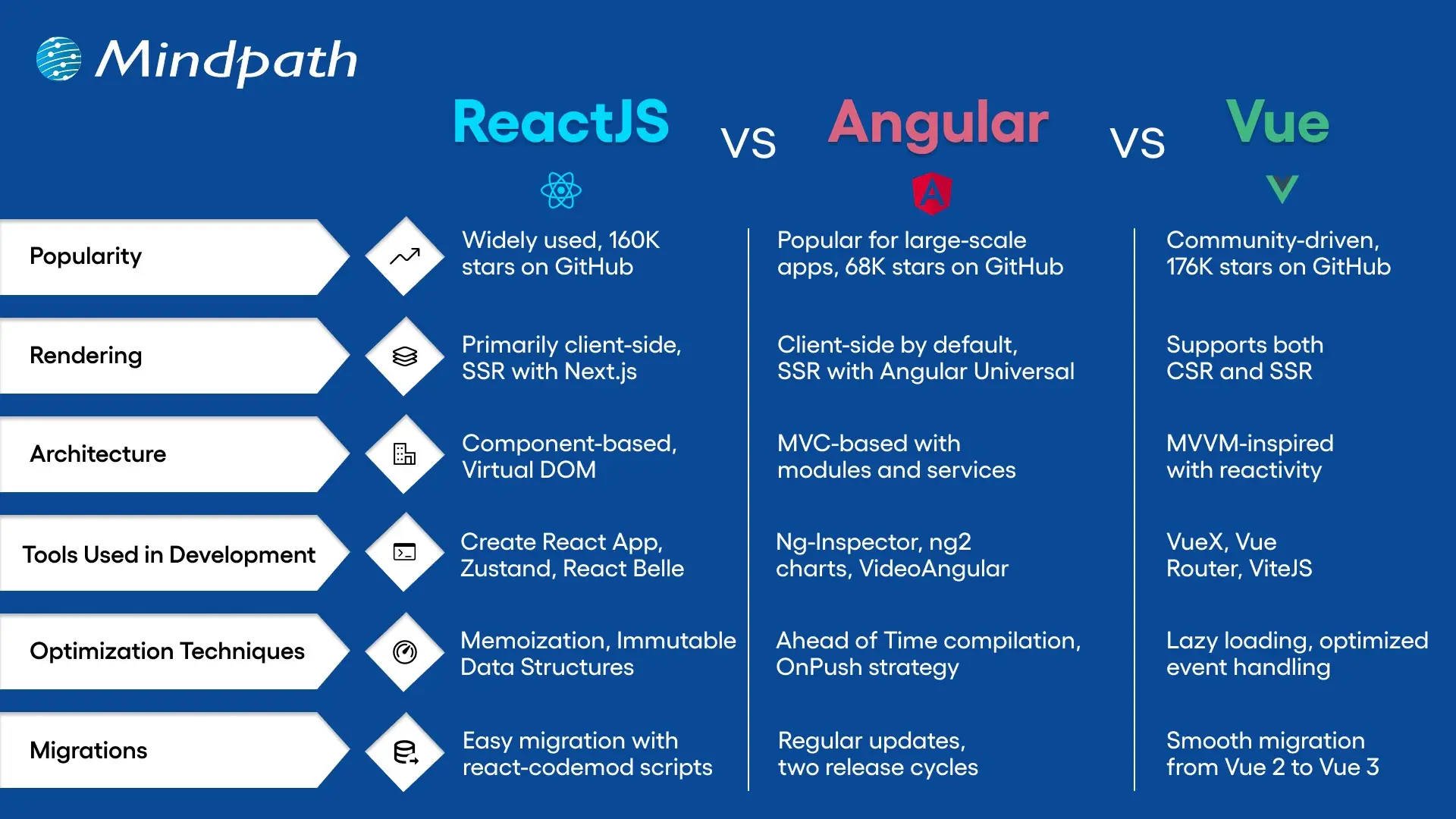
ReactJS vs Angular vs Vue Comparison Table

Here’s a quick comparison of Angular, React, and Vue across key factors. This table highlights their unique strengths to help you choose the right framework for your project: 
Choose the Right Framework for your Web Applications

Selecting between Angular vs React vs Vue is based on your project and team expertise. Each offers distinct advantages for web applications today. Angular is best for big-scale, enterprise-oriented applications with a full toolkit. React provides flexibility, reusability, and an enormous ecosystem and is best for dynamic and quick-loading UI. Vue is small in size, simple to learn, and ideal for small to medium-sized applications with a nice balance of simplicity and performance. 

At Mindpath, we specialize in delivering high-performance web solutions with our ReactJS development services. Our experienced developers build scalable, responsive, and feature-rich applications tailored to your business needs. No matter if you’re upgrading an existing product or starting from scratch, our team ensures seamless development and fast delivery, backed by modern tools and proven practices. 

Related Post

Related Post

AI tools for devops

Artificial Intelligence has certainly surfaced as a transformative force in the DevOps realm. In the current times, DevOps teams and professionals have the opportunity to leverage top Artificial Intelligence tools in order to streamline the software development process while promoting resource optimisation. 61% entities have reported that the adoption of AI in DevOps has significantly boosted their delivery ability.

Both novice and experienced DevOps professionals need to familiarise themselves with the strategic role of AI for the DevOps approach. The insight is crucial to capitalise on the capabilities of AI and strengthen how the DevOps approach is adopted while developing software solutions. Let’s identify some of the major AI tools that are revolutionising DevOps at the moment.

Want to adopt AI in DevOps with full potential? Mindpath’s AI Development Services provide full assistance on how you can select and implement the right tool according to your specific requirements.

Best AI Tools for DevOps Teams

Artificial Intelligence has been gaining high prominence in the DevOps arena. Within a short span of time, diverse AI tools have emerged that have simplified the work of DevOps teams. These tools have immense potential to redefine the DevOps approach.

It is imperative to identify the AI tools for DevOps so that you can simplify diverse processes relating to automation, security, code development and many more. Some of the top AI tools for DevOps professionals include:

1. GitHub Copilot

GitHub Copilot is undoubtedly one of the most popular AI tools for DevOps experts that exists today. It can be used as an extremely useful tool that is powered by Artificial Intelligence, which simplifies coding. It is capable of making suggestions to coders. Moreover, it can also assist coders by providing valuable assistance in entire functions. As a result, by leveraging the specific tool in the DevOps landscape, it is possible for developers to write code in an efficient manner. Furthermore, by leveraging the specific tool, the possibility of making errors is substantially reduced. GitHub Copilot represents a significant step toward the future of AI in software development and DevOps workflows.

2. AWS Codeguru

The popularity of Amazon Codeguru has been skyrocketing in recent times. It serves as a perfect tool that DevOps professionals can use for the purpose of automating code analysis. A highlight of this particular artificial intelligence for DevOps is that it is capable of making intelligent recommendations relating to code reviews. Coders and software developers can also rely on the specific tool to gain insightful suggestions relating to the performance of applications. With the help of this top-grade AI tool, DevOps teams can locate issues and improve the quality of their code, and fully leverage the benefits of AI in their development workflows.

3. Datadog

Datadog is a popular AI-driven platform that simplifies the processes for development teams. It is certainly among the top DevOps for business tools that can be used for diverse purposes such as monitoring, security, and performance. This tool offers rich insights to DevOps teams in terms of the behaviour of the software application and the overall health of the infrastructure. It certainly serves as a holistic tool that can offer observability power in an end-to-end manner to DevOps teams. You can definitely capitalise on this tool to achieve goals relating to real-time observability, unified monitoring, and troubleshooting.

4. Splunk

Splunk has gained a solid reputation in the DevOps scene of the current times. It acts as a robust data analytics and monitoring platform that can be used by DevOps teams. By choosing the specific AI-based tool, you can get complete visibility across the full software development lifecycle. In case you have limited familiarity with the particular tool, you can consider partnering with top providers of DevOps services. DevOps teams can leverage Splunk for diverse purposes, including monitoring of performance, event and log monitoring.

5. Sysdig

Sysdig serves as one of the most comprehensive DevOps platforms available for software developers at present. It has been specifically designed for diverse purposes such as monitoring and security in containerised environments. A chief highlight of the tool is that it integrates operations along with top security and offers unified control and visibility to teams. Thus, throughout the software development lifecycle, DevOps professionals can have a solid insight into the process. Moreover, you can rest assured about compliance and monitoring aspects by utilising the tool.

Trying to keep up with the rapidly evolving DevOps landscape as we move into 2026? Explore the latest DevOps trends shaping modern development, automation, and AI-driven workflows.

6. Dynatrace

In the contemporary DevOps landscape, the Dynatrace tool has been playing a cardinal role. It acts as an ideal observability platform that can be leveraged by DevOps teams while developing top-notch software applications. You can take advantage of this app to simplify processes relating to monitoring, collaboration, and automation. Furthermore, Dynatrace offers a broad range of tools that can create value for you relating to resilience engineering, release validation, and automated remediation of problems. The powerful capabilities of the AI tool can empower your DevOps team while developing novel software solutions.

7. Ansible

Ansible is a popular open source automation tool that streamlines DevOps practices for professionals. This tool is primarily used for the purpose of streamlining as well as automating a broad range of IT tasks and processes. It significantly contributes to the DevOps process by focusing on areas such as configuration management, deployment of applications, and the provisioning of infrastructure. Moreover, DevOps teams can leverage the AI-based tool to perform orchestration. This is because Ansible facilitates the orchestration of complex workflows and supports the coordination of multiple tasks.

8. Harness

In the current DevOps realm, Harness has emerged as a holistic software delivery platform., By using the specific tool, your DevOps team can automate the full software development process. Therefore, starting from continuous integration and continuous delivery, you can automate ongoing tracking of errors. Harness has been recognised as one of the most useful tools for DevOps professionals. With the help of the AI tool, your DevOps team can certainly accelerate the software development process and minimize the possibilities of errors and mistakes.

9. Argo CD

In recent times, Argo CD has surfaced as a popular AI tool that can be used by DevOps professionals. It is basically a declarative continuous delivery tool. By using the tool, it is possible for DevOps teams to automate the management as well as the deployment of software apps within Kubernetes clusters. The fact that it is open source in nature enables DevOps teams to use it in a highly versatile and flexible manner. The specific tool offers a broad range of features to users, such as single sign-on integration, multi-cluster management, and many more.

10. Snyk

While adopting the DevOps approach to develop software solutions, one cannot ignore the security aspect. This is when the Snyk tool comes into the picture. Snyk is a developer-first platform that incorporates security elements into the software development process. You can utilize this specific AI tool in your DevOps process for scanning vulnerabilities in code, containers and open-source dependencies. This tool is well-suited for diverse DevOps teams since it perfectly integrates with various elements, such as developer workflow, as well as cloud platforms. You can leverage the tool since it offers actionable insights that can enhance the overall quality of your software solution.

Looking to overcome DevOps hurdles such as security risks, and scalability issues? Discover DevOps challenges and solutions that help organizations overcome these issues and improve operational efficiency.

Benefits of AI Tools in DevOps

The use of AI tools in DevOps processes can give rise to a host of benefits for DevOps teams. Some of the major benefits that you must be aware of include:

1. Better reliability

DevOps teams can leverage AI capabilities to create highly reliable software solutions. This is mainly possible by making use of the predictive analysis function of AI technology.

2. Faster Software creation process

Software development can be quite time-consuming. However, by leveraging AI tools, it is possible to automate diverse processes. It can ultimately speed up the software development process for teams.

3. Proactive resolution of issues

Issues can act as major bottlenecks while developing software applications. With the help of the right AI tools, it is possible for DevOps teams to proactively deal with issues. Therefore, the overall quality of the software solution can also improve.

4. Improved collaboration

By using AI tools or generative AI tools for DevOps, it is possible for professionals to enhance collaboration. Collaboration can certainly open up new and better opportunities that can strengthen the overall process relating to the development of software solutions.

Want to learn how DevOps can transform your business and accelerate your development processes? Discover the benefits of DevOps for a deeper understanding of its impact and value.

Final Words

In the dynamic DevOps arena, the use of artificial intelligence tools is considered to be a necessity. DevOps teams need to be aware of the top tools so that they can strategically use them while creating software solutions. The selection of the right kinds of tools can certainly streamline the software development processes for you. Some of the top tools that you must be aware of include GitHub Copilot, AWS Codeguru, Datadog, Splunk, Sysdig, etc.

We at Mindpath help businesses to make the most of the top AI tools for DevOps with our AI Development Services. Our professionals ensure that the perfect AI tools are chosen that are in line with your DevOps processes. Moreover, you can see how intelligent DevOps can strengthen the quality of your software solutions.

Magento vs wordpess

The question relating to Magento vs WordPress is not new in 2025. However, businesses as well as professionals need to know how these platforms are different from one another so that they can make a wise selection. With Adobe pushing major updates to Magento WordPress has been continuing to dominate the CMS landscape like never before. 

Several modern businesses and professionals all across the globe have been wondering, “Which is better, Magento or WordPress?” You should be able to answer this question as well. This is because the WordPress vs Magento debate has been directly impacting how online stores compete with each other in the crowded digital marketplace. Let us look at these platforms at a deeper level so that you can choose the ideal tool that perfectly aligns with your needs. 

Selecting the right platform can define website success. At Mindpath, we offer WordPress development services that help you elevate your business by creating a custom website that maximizes performance and drives results.

A Quick Overview of Magento

Magento is a popular open-source e-commerce platform that came into existence in 2008. Currently, it is owned by Adobe, and it has been rebranded as Adobe Commerce. It has certainly emerged as a powerful eCommerce platform that is built for enterprises and growing online retailers. 

One of its unique features that has contributed to its popularity is its scalability. Magento supports large product catalogs and multi-store management. It has novel B2B features going beyond the capabilities of usual CMS platforms. It offers businesses robust tools for diverse purposes, including checkout optimization and marketing automation. Over the years, Magento has gained high popularity in the dynamic business community. 

Must Read: WordPress vs Webflow

A Brief Insight into WordPress

WordPress is a top web content management system (CMS) that is known to power a large number of websites on the internet. It is known for its flexibility, ease of use, and vast plugin ecosystem. WordPress serves as a valuable tool for businesses that allows them to launch everything from blogs and corporate sites to online stores, especially when supported by custom WordPress development, which tailors the platform to unique business needs. Moreover, they do not have to worry about high development overhead.

Some of the core strengths of WordPress lie in content publishing as well as SEO optimization with robust tools such as Yoast and Rank Math. Another unique feature of WordPress is the ability to scale through a large number of themes and extensions. It is time to answer the question: Is Magento better than WordPress?

Key Differences between Magento and WordPress

WordPress and Magento have emerged as revolutionary forces in the contemporary business world. It is a must for professionals and businesses, especially e-commerce businesses, to know about Magento vs WordPress. Some of the major differences between WordPress vs Magento that you must take into account are

1. Purpose of the Platform

One of the key differences between Magento and WordPress is related to the purpose of the platforms. Magento or Adobe Commerce has been built primarily for enterprise-grade eCommerce. Its unique features relating to catalog management and multi-store support are specifically designed to create value for e-Commerce businesses. especially as AI in e-commerce becomes more influential in driving personalization and automation. WordPress was originally created as a content management system. However, it can be extended into the e-Commerce realm through plugins. It is specifically ideal for small to medium-sized online stores.

2. Performance and Scalability

Magento is capable of handling large product catalogs and high traffic. It is also an ideal tool that is designed for complex integrations. It certainly serves as the best tool for mid-sized and large enterprise businesses. It is definitely easier to set up WordPress. In fact, users can scale it for moderate traffic. However, the specific platform may require managed hosting or heavy optimization for handling large stores.

3. Ease of Use

While choosing a platform, it is fundamental for you to take into account the ease of use. WordPress is certainly more user-friendly than Magento. In fact, professionals as well as businesses can easily navigate the tool even if they have limited technical knowledge. However, that is not the case with Magento. This is because it is more complex in nature and requires technical knowledge. You need to bear in mind that it is not beginner-friendly. In case you plan to use Magento, you need to seek support from experts. 

Worried about security risks and vulnerabilities on your WordPress site? Read our guide on safeguarding WordPress vulnerabilities to learn how to protect your site and keep it secure against threats.

4. Customization

Both WordPress and Magento offer extensive customization to users. Magento allows business entities to build custom product pages. You can also integrate third-party tools in a seamless manner. Users even have the option to capitalize on its advanced features and capabilities so that their needs can be perfectly met. Even though WordPress is also customizable in nature, it highly relies on plugins. It is true that essential e-Commerce functionalities are available. However, business entities may require additional plugins for features relating to payment gateways and inventory management.  

5. SEO Capabilities

If you wish to compare WordPress or Magento, it is a must to look at their SEO capabilities. This is because search engine optimization is a must for the success of e-commerce businesses in the prevailing business landscape. Both WordPress and Magento offer robust SEO capabilities to users. But WordPress has a small edge over Magento thanks to its large library of SEO plugins. The specific tool makes it easier for businesses to optimize their content and meta tags. You can certainly leverage these capabilities of WordPress and help your business website rank higher online. Although Magento offers excellent SEO capabilities, you need to possess technical knowledge to leverage them in an optimal manner. 

6. Security Features

One of the most common concerns for online businesses today revolves around cybersecurity. So it is critical to take into account the security features while choosing a novel platform for your e-Commerce business. One of the key strengths of Magento is related to its robust security features. It has built-in security patches along with data encryption features. Another key feature that you should not miss is related to advanced fraud protection features. These security features undoubtedly make Magento a reliable and safe choice for e-commerce businesses.  In the case of WordPress, the security fundamentally depends on third-party plugins. As WordPress is commonly used, there is a chance for you to get targeted by online hackers or cybercriminals. 

Ready to make your hiring process smooth and avoid picking the wrong developer? Our WordPress Developer Checklist gives you a clear, step-by-step framework to evaluate every candidate.

Magento vs WordPress – Comparison Table

The table below gives an insight into the major differences between WordPress and Magento. As the WordPress Magento debate is gaining momentum in the e-commerce realm, you need to look at the differences so that you can choose the ideal platform that best suits your needs. However, an important thing to bear in mind while looking at the differences is that users can use Magento in WordPress in order to use them together.

Magento WordPress
Platform Purpose Designed for e-Commerce Content Management System and can be extended to e-Commerce 
Performance and Scalability Ideal for large e-Commerce businesses Well-suited for small and medium-sized business sites 
Ease of Use Need for technical knowledge Easier to use 
Customization
SEO Capabilities Depends on technical expertise  Better SEO Capabilities 
Security Features High security  Lower security

Who is the Winner: WordPress or Magento?

The exact choice between Magento and WordPress entirely depends on the needs of the users, including their business size, goals, and technical needs. You need to remember that there is no clear winner between these two platforms. 

Magento is suited for enterprise-level stores, and it is ideal for high-volume sales along with multi-store management. In case your business needs advanced features such as B2B support along with custom checkout flows, you must choose the specific platform. You can definitely leverage its strong scalability and enterprise-grade security. However, you need to remember that if you choose Magento, your business must be ready to make a higher investment, and it must possess the necessary technical expertise.

WordPress is definitely a better choice for small to mid-sized businesses. It is an excellent choice for users who are in search of a simple and pocket-friendly tool. The strengths of WordPress, such as its excellence in content publishing and SEO flexibility, can create value for both businesses and professionals. 

Want to ensure your WordPress site is running on the right PHP version for top performance and security? Check out our guide on WordPress PHP compatibility to keep your site efficient, stable, and future-ready.

Final Words

While making the comparison between Magento vs WordPress, you need to remember that there exists no one-size-fits-all solution. Magento stands out for enterprises and fast-scaling retailers that depend on novel features. WordPress is a simpler choice for small and medium-sized businesses. It is great for you if you are in search of flexibility and lower upfront costs. The best platform for you entirely depends on your business needs and goals, its size, and the available technical resources.

If you’re planning to build a website and want to use the best of WordPress, Mindpath WordPress development services will help you with that. Our experts ensure that the capabilities and functionalities of the platform can be optimally utilized to create value for your business. The decision can certainly give an edge to your business in the competitive space.  

AI and ML innovations in Fintech
Imagine if your bank could know fraud before it happens, or your financial decisions were made faster and smarter. What if customer service was so attuned to your needs that speaking with them feels more like a chat with a friend? AI and Machine Learning are making these possibilities a reality today in the Fintech industry. Interesting, right? In this blog we are going to explore the key benefits as well as some use cases of AI and ML in the FinTech industry.  Artificial intelligence and machine learning are changing the way in which the FinTech industry works. This technology is being used to make financial services provided by FinTech companies smarter, faster, and more personalized. By using AI and ML, Fintech can analyze heaps of data in seconds and come up with proper decision-making, easy following of rules, and smoother customer experience. For instance, AI can be used to power chatbots that answer customer queries or build systems that tell whether a person is a good candidate for a loan.   In other words, AI and ML help Fintech companies provide better services that are much more inclined to individual needs. AI and ML play a huge role in making financial services better and more efficient. Through AI, Fintech companies can offer their services in a personalized way, like providing their clients with customized financial recommendations or using chatbots to answer their questions. Such technologies also lead to cost reduction because they replace repetitive functions with more important work. AI will enhance fraud protection by detecting and preventing threats, ensuring security for both customers and companies.   Let us dig deep to explore the benefits and use cases of AI and ML in the FinTech industry! 

Benefits of AI and ML for Fintech Companies

1. Advanced Fraud Detection

Artificial intelligence and machine learning make it much simpler to detect and prevent financial fraud. Traditional security systems, like firewalls, might overlook suspicious activity, but AI can analyze large amounts of data from many sources, including records of transactions, client profiles, and even social media.  

This aids in the detection of concealed symptoms of fraud, which would otherwise go undiscovered. AI allows systems to swiftly recognize unusual patterns, such as huge transactions or weird locations, that may suggest fraud. This means that financial institutions can decrease fraud losses while also improving the security of their payment and transaction systems. 

2. Streamlined and Automated Business Operations

AI and ML-powered operations are revolutionizing how financial duties are managed, making procedures more efficient and timesaving. AI can automate repetitive operations such as data input, verification, and reconciliation, saving time by extracting information from bank accounts, invoices, tax forms, and contracts. AI systems excel at analyzing vast volumes of unorganized text data, allowing reports to be generated fast. Furthermore, AI may use market data, economic indicators, and previous performance to anticipate investment possibilities and prepare for future cash flows. It improves financial planning accuracy by analyzing previous cash flow data and current market situations.  

3. Elevated Customer Service

Improved customer service powered by AI and ML greatly enhances how you connect with your customers. These technologies use client data, transaction history, and behavior to better understand specific requirements. This insight enables you to provide personalized product suggestions, financial advice, and focused marketing initiatives. Using AI for customer service allows you to swiftly answer commonly asked questions, assist with simple enquiries such as verifying account balances or recent transactions, and improve response times. AI also allows you to provide personalized suggestions based on consumer preferences, offer 24-hour live chat assistance, and communicate in many languages. 

4. Smart Financial Decisions Making

AI significantly enhances financial decision-making by detecting hidden patterns in data and evaluating their influence on your company. It enables you to simulate numerous scenarios, such as different investment, loan, or credit conditions, to understand how they may affect your results. By analyzing complicated financial data, AI aids in developing smart strategies that reduce risks and provide this knowledge in simple, understandable formats. AI also keeps you up to date on the newest data, allowing you to identify new ways to save money. It can immediately detect unexpected transactions or market swings, allowing you to alter your financial plans accordingly.  

5. Efficient and Strategic Resource Allocation

AI assists financial institutions in more effectively allocating resources by analyzing market data, previous performance, and risk indicators. This allows them to determine the best methods to invest assets, balance risk and return, diversify portfolios, and optimize resource utilization. AI may also categorize customers based on their behavior and preferences, allowing for more focused resource allocation. This translates to more successful marketing efforts, specialized product offers, and personalized customer service. Furthermore, AI assists in determining the optimum times to spend money on advertising for the greatest impact. 

Ready to elevate your financial technology?

Mindpath’s expert AI\ML solutions transform your operations with advanced analytics, automation, and tailored insights. 

Top Use Case of AI/ ML in Fintech

1. Algorithmic Trading

Algorithmic trading allows financial institutions to automate trading choices and manage large numbers of deals swiftly. Instead of manually handling each transaction, businesses utilize AI and ML algorithms to execute pre-set trading orders. TradeSmart, for example, uses AI and machine learning. They employ these technologies to automatically execute trades based on rules established by machine learning algorithms. By analyzing enormous volumes of historical data from multiple stock markets, TradeSmart assists investors in developing more successful trading methods. This enables for faster and more efficient trading than doing it by hand. 

2. Fraud Detection

Machine learning is critical in detecting and preventing fraud because it analyses enormous amounts of data to identify odd patterns and hidden links. Traditional fraud detection approaches may be restricted, but machine learning algorithms are more sophisticated and can detect abnormalities more efficiently. For example, Danske Bank in Denmark went from an outdated rule-based system to a machine learning technique for identifying fraud. This improvement dramatically enhanced their capacity to detect true fraud and minimize false warnings, demonstrating how powerful machine learning can be in combating financial crime. 

3. Regulatory Compliance

Machine learning is important in regulatory compliance because it helps financial firms manage complicated laws and regulations. ML algorithms can evaluate enormous quantities of regulatory papers and identify links between various norms, making it easier to stay current with changing regulationsFor example, cloud-based systems powered by machine learning may automatically track and update regulatory changes as they occur. Furthermore, ML can analyze transaction data to spot abnormalities, ensuring that all consumer transactions match legal requirements. Machine learning helps financial organizations stay compliant and manage regulatory needs more effectively. 

4. Stock Market Analysis

In the stock market, machine learning (ML) is used to make sense of the massive volumes of data generated by trading activity. While historical data serves as a basis, ML algorithms use real-time information such as news and trade outcomes to find patterns and trends. Traders utilize this information to make better judgements regarding their trading strategy. They select which ML algorithms to utilize based on their ability to forecast market moves and detect interesting patterns in data. This allows them to estimate stock market developments more precisely. 

5. Loan Automation

Machine learning is revolutionizing loan automation by analyzing more data than previous approaches, without being limited to FICO ratings and income information. Lenders may use machine learning to better assess risk by combining data from many sources. This includes information from social media accounts, phone records, energy bills, rent histories, and even health exams. Machine learning algorithms use this different data to provide exact risk assessments. If a borrower’s risk score matches the lender’s requirements, the loan may be immediately granted. Unlike human assessors, machine learning algorithms examine loan applications without bias or emotion. This promotes fair lending processes by decreasing the effect of racial, gender, and other prejudices, resulting in more equitable loan decisions. 

AI/ML Services at Mindpath

At Mindpath, learn how to provide AI and machine learning services that help your fintech business become smarter and more efficient. We work with the most advanced technologies to help you predict future trends, solve complex issues, and make informed decisions.  

Our advanced predictive analytics tools process financial data to predict market trends and customer behavior, to keep you ahead of every curve. On machine learning applications, we provide solutions that learn from financial data about how to manage your risks and make your trading strategies smarter over time.  

Utilizing our insights, fueled by your data, we derive useful information from you to help you make smarter investment decisions and optimize financial operations. In addition, our automation solutions save you lots of time and reduce errors by automating routine tasks, such as transaction processing and compliance management.  

Our AI and machine learning services are therefore aimed at boosting fintech operations by making them smarter and more innovative, so your business can be faster and more competitive in today’s financial industry. 

End Note

AI and machine learning are changing complex financial tasks into sleek, efficient processes within the vast FinTech space. It starts with detecting fraud accurately to loan approval and personalized customer services. Thus, this helps fintech businesses to make wiser financial decisions, manage their resources, and, in the long run, serve their clients in the most outstanding way. As these technologies continue to develop, so will innovation and efficiency in financial services, paving the way for a much more secure, intelligent, and customer centric future. 

At Mindpath, we are committed to making your fintech business to its full potential with AI and machine learning. Empowering the fintech landscape into the future will be based on predictive analytics and machine learning applications that our company specializes in, the outcomes and trends it brings to light, and automation solutions that drive operational efficiencies. We drive advanced technologies into your business for better decision-making, operational efficiency, and able to deliver hyper-personalized experiences. 

Looking to revolutionize your FinTech services?

Mindpath’s AI and ML solutions offer smarter fraud detection, streamlined operations, and personalized customer experiences.