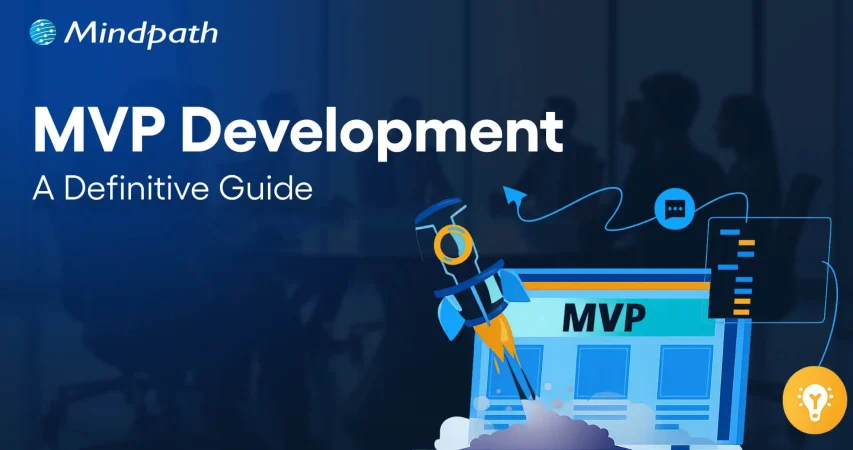
What is MVP Development? – A Definitive Guide

Join our Newsletter!

Featured Posts

Support Is One Click Away

Home

What is MVP Development? – A Definitive Guide

MVP development

What is MVP Development? – A Definitive Guide

In the software development context, you must have come across the term MVP or minimum viable product. It is the simplest version of a product or application. MVP just has enough features so that initial users can test and provide their feedback. It is ideal for investors to look at the MVP of a product that is being pitched to them.

The importance of MVP development is vital in the prevailing business environment. Many startups fail today because they create products on the basis of assumptions. However, the best way to test those assumptions is by developing an MVP that the real users can see and use. It is the perfect time to learn about MVP and its relevance.

If you are looking to adopt MVP into your business, but don’t know where to start? Mindpath offers end-to-end MVP development services that help you validate ideas quickly while minimizing financial and technical risks.

An Insight into Minimum Viable Product

A Minimum Viable Product refers to the beta version of a new product that a business plans to create. It encompasses just enough features to capture the attention of early customers and collect feedback from them. The companies that adopt the MVP approach to collect as well as respond to user feedback are able to grow faster in the competitive market setting.

Businesses can use MVP in software development to test if customers are happy with their app before spending too much time and effort. As the needs and preferences of modern customers keep changing, it is fundamental for businesses to prioritize MVP development.

Benefits of Implementing MVP

You need to bear in mind that the concept of MVP product development comes from the lean startup methodology. It focuses on learning as well as building with scalability. When a business builds MVP, it is basically taking the first small step towards a new idea or product. This small step can enable businesses to understand the interest of the market in the product.

1. Gathering User Insights

Businesses can gain valuable insight from MVP development. It can teach them where to make improvements in their offering and scale back. Businesses can also add extra features in order to make their product or application more attractive and useful for the users.

2. Testing Business Idea

The key benefit of MVP is that it serves as a low-risk testing ground before businesses invest millions of dollars into a product. Startup businesses can validate their product through MVP development. It creates an opportunity to interact with customers and understand their needs.

3. Cost Efficiency

You need to remember that an MVP development company can help you in terms of cost-saving. Mature software products need years of development along with considerable investment. MVPs ensure that products are simple for coding as well as functionality, thereby reducing development cost. Once you start gaining customer feedback, you can start spending your money more wisely on the new product.

4. Assessing Market Demand

The MVP encompasses testing as well as analyzing the functionality of a product. Moreover, it helps in evaluating the market demand and helps in the acquisition of new customers in the market. It is vital for business organizations to understand the needs of their customers along with the existing solutions. The MVP approach empowers businesses to refine their offering and know whether their offering has a future in the market or not.

5. Securing Funding

Startups require funding in order to survive in the competitive market environment. MVP development for startups serves as a strategic method that can enable them to test the idea before reaching out to investors and other stakeholders. Such a systematic approach can help businesses to secure funds from investors who trust in their idea and Minimum Viable Product.

Cost of MVP Development

The role of MVP development is indispensable for businesses. So it is time to focus on the MVP development cost. Businesses may wonder – How much does MVP development cost? The answer to the question is not straightforward. The average cost relating to MVP development depends on a number of factors, such as the scope of the project and team composition. Similarly, contractual dynamics may also play an important role in impacting the cost of MVP development.

When it comes to MVP, the cost can be categorized into specific features as well as development phases. The common categories that you may come across include market research, prototyping, and MVP development. It is crucial to bear in mind that the research phase is conducted in parallel with prototyping.

Difference Between MVP, Prototype, and Proof of Concept

In order to get a holistic insight into MVP, you must understand how it is different from Prototype and Proof of Concept. A layman may think that these terms are interchangeable. However, that is not true. Each of the terms has a different meaning that businesses should be familiar with.

1. MVP

MVP refers to a launchable product version. It includes core features. The purpose of MVP development is to validate the market potential of a product and gain valuable feedback from users.

2. Prototype

Prototype refers to a preliminary model of a product. It can also be described as a mock-up that is designed to test the design concepts and technical feasibility. It also helps to assess the functionality of a product before its complete development.

3. Proof of Concept

Proof of Concept is a small experimental project. It is undertaken to demonstrate the feasibility or viability of a concept. It is mostly tested internally before further investment is made.

The main difference between these three terms has been presented in the table below:

Aspect MVP Prototype Proof of Concept
Purpose Market validation Technical exploration Feasibility testing
Complexity Functional product Non-functional model Basic technical demonstration
Audience Potential customers Internal stakeholders Technical team

Misconceptions Relating to MVP

There are a number of misconceptions that startups may have about MVP. It is essential to have proper clarity about MVP so that businesses can take advantage of the approach while developing their offering.

1. A common misconception is that MVP is an inferior quality product. However, in reality, an MVP is crafted in a strategic manner. It focuses on the product or software that can deliver core value while maintaining user experience.

2. Another common myth is related to the investment aspect. You may believe that MVP in web development requires no major investment. However, that is not true. Although MVPs are more cost-effective than the final product, they require resource allocation and technical implementation.

3. Businesses may have the idea that one MVP may be sufficient while developing a product. But the truth is that MVP development is an iterative process. Businesses must continuously incorporate the feedback of users so that the best version of the product can be made.

4. You may think that an MVP is a universal solution for all startups. However, this is a common misconception. Not all startups might be able to validate their product or idea through an MVP.

Ready to launch your MVP without delays? Visit our blog on hiring full-stack developers for MVP to learn how to find developers who can handle both front-end and back-end tasks with ease.

Final Words

In the current business landscape, the importance of MVP development cannot be negated. In order to sustain and survive in the complex business space, it is key for startups to develop a minimum viable product before investing completely in the actual product. It can empower businesses to refine their product or offering and create value for the end-users.

Businesses can take advantage of Mindpath’s minimum viable product development services. Our experts can help you develop your MVP in an efficient manner, and you can obtain relevant feedback to improve your offering. The MVP development process can play a strategic role, and it can give your business an edge.
Related Post

Discover how React can enhance your ecommerce site with faster loading, seamless interactions, and more for better shopping experience.
Explore how digital transformation reshapes businesses, boosts efficiency, enhances customer experiences, and drives sustainable growth for success.

Related Post

ai and business

Have you ever considered how AI and business actually fit together? You may have heard a lot about AI being faster and smarter, but is your business actually prepared for it? Many people are excited about new technology, but they often overlook whether they have a solid foundation. Take a second to think about it- is your business possibly ignoring some signs that say you are not prepared for AI yet?

AI can help any business develop, but starting without preparation can create issues. There are companies that jump into AI without having the right tools or people, or even ideas. This could waste valuable time and resources and lead to frustration. Integrating AI in business strategy from the start ensures you’re prepared and can identify potential challenges early. In this blog post, you’ll learn five easy indicators that show your business may not be ready for AI yet.

Want to future-proof your business with AI? We at Mindpath offers exceptional AI development services that help your business get AI-ready and unlock next level of growth! 

What Being ‘AI Ready’ Really Looks Like?

Being ready for AI means your business has the right people, tools, and plan to make it work well. When you think about AI and business together, it’s more than just buying new software. You need good data that’s easy to use, a team that knows how to work with AI, and clear goals that AI can help you reach. A business ready for AI knows how to bring people and smart technology together.

Look at Amazon. They show how AI in e-commerce can work side by side with business to help customers and save money at the same time. This happens because they plan ahead and know exactly how AI will help. If you want your business to be ready to use AI, start by checking your data, training your team, and making a simple plan that fits your real needs. When you get this right, AI in business can really help you grow.

Must Read: Benefits of AI

What is an AI Readiness Checklist?

An AI Readiness Checklist is a simple tool that helps you see if your business is really ready to use AI in the right way. It covers important things like your data, your technical tools, and how well your team understands AI. When you think about AI helping your business grow, this checklist shows you what’s strong and what needs more work.

A good AI checklist looks at your technical setup, the quality of your data, your team’s skills, and whether your company is open to new ways of working. This way, you can fix any gaps before you bring AI into your business. By using an AI checklist, you can make sure you’re set up for success and get real value from AI in business.

How is AI reshaping the way websites are built and optimized? Explore our detailed article on AI in Web Development to see how it’s driving smarter design, faster deployment, and better user experiences.

AI Readiness Checklist for Businesses

Before you bring AI into your daily operations, it’s important to know where you stand. A good AI readiness checklist will help you see if your business is truly prepared for this step. Here are the key areas to focus on as you plan your AI and business journey.

AI Readiness checklist for businesses

1. Robust Data Foundations

Good data is the backbone of any artificial intelligence business idea. Check that your data is clean, organized, and ready for AI tools to use well. Strong data governance keeps your insights trusted and prepares your business for AI integration.

2. Leadership and Team Alignment

A strong AI and business plan starts with people who believe in it. Make sure leaders fully support your strategy and teams understand the goals. A clear roadmap and open communication help everyone move toward strategic AI adoption together.

3. Technology and Process Readiness

Your tools and workflows must support AI smoothly. Research the best AI solutions for your existing systems and test them with pilot projects. Use simple frameworks to track results and find the best areas for automation.

4. Governance, Ethics, and Security

Responsible AI needs strong rules and security in place. Create clear ethical guidelines and monitor how AI works in your company. A good AI checklist helps protect your artificial intelligence business ideas and builds trust for the long term.

5. Financial Planning and ROI

Every digital transformation roadmap needs clear budget planning. Create realistic budgets, show expected returns, and track savings as you go. This makes it easier to get leadership buy-in and keeps AI and business costs under control.

Looking to streamline your business operations and enhance customer experiences? Discover how conversational AI chatbots can help your business transform its workflows and boost efficiency in our blog.

5 Signs Your Business is Not Ready for AI

Many companies jump into AI without checking if they’re really prepared. Missing a few basics can lead to wasted time and money. Here are five signs that show your business is not ready for AI yet.

5 Signs Your Business is Not Ready for AI

1. Stuck in Paper-Heavy Processes

Paper forms, files, and manual approvals slow down daily work and limit growth. AI needs clean, digital data that is easy to find and process. If you’re still tied to paper, you’ll struggle to get real results from AI. Going digital is the first step to connect AI and business ideas that really work.

2. Running on Outdated Technology

Old systems can hold you back from adding smart AI tools. If your technology can’t talk to modern platforms, your AI plans won’t go far. Keeping rigid, legacy software in place only adds roadblocks. Updating your systems is essential for future-proofing your business with AI.

3. Poor Data Quality and Structure

Messy or incomplete data will confuse even the best AI tools. AI needs clear, well-organized data to find patterns and deliver insights. If your data is spread everywhere and filled with errors, you’re not ready yet. A strong data foundation helps your AI and business strategy succeed.

4. No Clear Data Strategy in Place

Without a clear plan, your data might be scattered, outdated, or not useful at all. AI can’t do much if it doesn’t have good data to work with every day. A strong data strategy shows what to collect, how to store it, and who can use it. This is key for turning business ideas AI into real results and leveraging AI in decision-making.

5. Lack of Real-Time Data Insights

AI works best when it has fresh, up-to-date information at its fingertips. If you only rely on old monthly reports, you will miss the full power of AI. Real-time data helps AI spot changes and take action fast. It’s a big step for future-proofing businesses with AI in any industry.

Want to future-proof your AI strategy? Don’t miss our insights on the Top AI Trends in 2025 every business should be ready for.

Ready to Make AI and Business Work Together?

Preparing your business for AI means more than just buying new tools. It’s about building strong data foundations, modern systems, and a clear strategy that connects people and technology. Knowing the signs that you’re not ready yet can save time, money, and stress. With the right plan, AI can help your business grow stronger together and bring real results.

Mindpath’s expert AI development services help you create practical, future-ready solutions. Our team works closely with you to plan, build, and integrate AI into your daily operations. We focus on clean data, secure systems, and smart strategies that fit your business needs. Let us help you connect AI and business in ways that truly work.

Cloud security tools

The rising popularity of cloud computing technology in the business world has automatically led to the popularity of cloud security tools. If you leverage cloud solutions in any manner, you need to be aware of the top cloud-based security tools that are available in the market right now. These tools can certainly make or break the cloud cybersecurity posture of your organization. 

Now is the best time to learn about the top 10 cloud security tools. The insight can definitely empower you to derive optimum benefits from these tools while leveraging cloud computing technology. It is time to dive into the world of the best cloud security tools.

Want to stay ahead of evolving cloud security threats with the right tools? Mindpath’s managed cloud services combine expert management with advanced security tools to keep your cloud safe and optimized.

What are Cloud Security Tools?

Cloud security tools include a diverse range of technologies, practices, and controls. They collaborate in order to protect data, the cloud infrastructure, along with all the applications within the cloud environment. The main objective of cloud computing security tools is to defend users against internal or external cybersecurity threats. They also play a catalytic role in mitigating business disruptions that may be caused by power outages, natural disasters, or other kinds of serious events. 

Business entities need to bear in mind that the need for cloud security solutions is multidimensional in nature. Encryptions as well as antimalware tools help shield applications and data from possible threats. Similarly, firewalls are responsible for regulating traffic flows to cloud resources for determining which data can pass through. Identity and Access Management (IAM) solutions make sure that only authorized individuals can be given access to resources on the cloud. The role of cloud security tools and solutions is of high strategic importance for organizations.

Wondering how emerging trends are shaping cloud security? Check out the latest cloud computing trends to learn what’s driving secure cloud adoption.

Top 10 Cloud Security Tools

Now that you have a basic understanding of cloud computing security solutions, it is essential to look at some of the top cloud security products that are available to you. You need to familiarize yourself with the most popular tools so that you can choose the best product that can meet all your needs perfectly.

1. Auth0

Auth0 is a well-known identity and access management solution that is available in the market today. It can enhance cloud security by offering secure authentication as well as authorization for applications, users, and APIs. It is a highly developer-friendly platform that offers flexible security solutions. 

It is highly adaptable in nature, which makes it extremely suitable for businesses of varying sizes. Its robust APIs, coupled with extensive integration options, make it simpler to embed identity and access management into the applications of organisations without compromising the experience of users.

2. Datadog

Datadog is a highly versatile and robust cloud monitoring platform. It integrates in a seamless manner with popular cloud service providers such as AWS, Google Cloud, and Microsoft Azure. The real-time analytics, as well as customizable dashboards, make it easy for businesses to not only track but also to secure their cloud environments. The tool offers the right kind of insights that businesses require in order to maintain security while scaling their operations in a flexible manner.

3. Microsoft Defender for Cloud

These cloud security products offer robust security solutions for Google Cloud, Azure, and AWS. The best thing about this tool is that it perfectly integrates with the Microsoft ecosystem of other security solutions. Some of its core offerings include vulnerability management, threat detection, and compliance monitoring. The built-in automation feature can even help business organizations to detect and mitigate different types of cybersecurity risks and threats.

Also Read: AI in Cybersecurity

4. Wiz

Wiz is a robust cloud security platform that offers complete visibility along with protection across diverse cloud environments. This tool is capable of continuously scanning the cloud infrastructure, containers, and virtual machines for the purpose of identifying misconfigurations. 

It also helps locate vulnerabilities as well as compliance risks.  It adopts an agentless approach, unlike conventional agents. It connects directly to cloud service providers for rapid deployment.  It not only correlates security findings to highlight the most critical risks, but it also helps teams prioritize the remedial solution.

5. Sysdig

Sysdig is among the popular cloud security tools that can monitor as well as safeguard cloud native applications and services. With the help of this tool, business entities can ensure real-time compliance. A unique feature of this cloud security tool is that it makes use of an open-source threat detection engine. This tool can scan container images prior to their deployment, thereby preventing vulnerabilities. Some of the other offerings of Sysdig include runtime protection, visibility, and cloud audit activities.

Planning to build scalable applications without managing servers? Check out our blog on serverless architecture in cloud computing to learn how it simplifies deployment while supporting secure and efficient workloads.

6. Tenable Cloud Security

Tenable Cloud Security is a popular tool in the market that can safeguard your cloud workloads. It can even monitor threats and assess vulnerabilities in an effective and efficient manner. It is considered to be an ideal solution for dynamic cloud environments. With Tenable, you can customize your security policies and streamline the compliance of your cloud infrastructure. You can leverage the continuous monitoring feature in order to keep a constant tab on cloud activities on a frequent basis.

7. Check Point Cloud Guard

Check Point Cloud Guard is a holistic cloud security platform. It has been designed to protect workloads, assets, and applications across private, public, and hybrid cloud environments. It serves as a useful tool since it offers advanced threat prevention along with posture management and network security. 

It offers proper visibility into configurations and helps in detecting misconfigurations as well as vulnerabilities on the cloud. Check Point Cloud Guard helps business entities maintain a solid cloud security thanks to its AI-driven threat intelligence coupled with unified management.

Must Read: Benefits of AI

8. Palo Alto Networks Prisma Cloud

Palo Alto Networks Prisma Cloud is a highly scalable cloud security tool that is available in the market today. It safeguards hybrid environments along with multi-cloud environments. This tool places high emphasis on proactive detection of cloud computing threats and their mitigation. You can leverage this tool to ensure there is seamless compliance as well as risk assessment management. This solution integrates advanced analytics along with AI insights to strengthen security on the cloud.

9. Trend Vision One Cloud Security

Trend Vision One Cloud Security is among the best cloud native security tools that you can find today. It is designed to secure cloud environments throughout their entire lifecycle. This tool offers visibility along with compliance management and threat detection. It effectively integrates cloud workload protection and cloud security posture management, which can help in the identification of vulnerabilities and misconfigurations on a real-time basis. It helps business entities detect, investigate, and respond to threats quickly since it is powered by AI-driven analytics and threat intelligence.

10. CrowdStrike Falcon Cloud Security

In order to address cloud security risks, you can choose CrowdStrike Falcon Cloud Security. It serves as a comprehensive platform that can secure your workloads, containers, and the entire cloud infrastructure. These cloud security solutions offer real-time visibility and threat detection. You can use the flexible tool in order to update or change your cloud security strategy. This tool can connect with the cloud ecosystems and identify and resolve cloud computing attacks and risks. You can also discover misconfigurations and ensure data security. 

There exists a diverse range of cloud computing security tools today. You need to know your needs well. The insight can certainly help you choose the right tools and solutions in order to deal with cloud computing vulnerabilities and risks.

Looking to improve cloud security as environments become more complex? Learn more about cloud-native development and how it supports secure and scalable apps.

Final Words

You need to familiarize yourself with the best cloud security tools that are available for users today. Your ideal choice depends on diverse factors such as your needs, the features of the tool, and many more. Some of the top tools that exist today include Auth0, Datadog, Microsoft Defender for Cloud, and many more. You need to know the strengths of each of these tools so that you can effectively identify the tool that perfectly aligns with your needs. 

Mindpath’s excellent managed cloud services can help businesses effectively identify and choose the best cloud computing security solutions. The experts will use their capabilities and experience to help businesses find the best security solution that perfectly aligns with their business needs and expectations. You can definitely rest assured by partnering with the trusted name.   

Agile Methodology

In today’s rapidly evolving digital world, agile methodology is changing how businesses plan, build, and deliver projects. Rather than drawn-out timelines with large cycles of progress, teams are able to move steadily through short sprints with defined goals. This process allows leaders to maintain visibility at every stage of the project while maintaining a firm hold on customers’ needs. Isn’t that what every business wants, speed with flexibility? Using this process makes projects feel lighter, more reactive and adaptive, and easier to navigate and manage, thus transforming work into a journey of growth and learning.

At its core, agile emphasizes collaboration, transparency, and continuous improvement. Because everyone knows what to expect and when, the flow of work stays uninterrupted. There is a connection between teams and their clients that helps decrease surprises and strengthen trust. Small changes are easier to accommodate after the fact than big changes once the project is underway. In this blog, we will unpack Agile in extraordinary detail, illustrating why it is more than a method and how it leads to sustainable success.

Are you looking to achieve sustainable success for your business? Contact us to choose the right direction in this fast-paced digital world, and we will guide you on how you can enhance your business performance.

What is Agile Methodology?

The agile development meaning is simple and strong: it consists of a project management approach that splits the total work into smaller pieces we can manage as sprints. Each sprint focuses on delivering a usable output in which we can be flexible and adaptive to the process. Upon completing the sprint, we review where we have gone, gather feedback, and improve the next cycle. This way we are progressing, while having clarity, with a greater velocity, while getting closer to what customers want.

The agile methodology exists with the guidance of the Agile Manifesto, a guiding document of values and principles established in 2001 by software professionals, where the key aspects of collaboration, working software, flexibility, and customer satisfaction are prioritized over formalized processes. The Agile Manifesto lays out the values, which consist of 12 principles that teams can follow to help ensure consistent efforts to deliver value.

Below are the 4 values of Agile:

1. Individuals over Processes

Agile prefers a team working together, rather than strict processes.

2. Software over Documentation

Working software is more important than paper.

3. Customers over Contracts

Customers provide feedback to the development more than the details described in the contract.

4. Changeover Plans

Adapting to change is valued more than sticking to fixed plans.

Not sure which software development approach fits your Agile project goals and business needs? Explore the key types of software development and how choosing the right path can help your Agile teams deliver better, more tailored results.

What are the 12 Principles of Agile?

The 12 Principles of Agile methodology build on the 4 core values and are used to help put them into practice in real-world projects. They provide a key for teams to focus on collaboration and flexibility, and continuously deliver value to customers.

Principles of Agile Methodologies

1. Customer Satisfaction

Customers should be satisfied by receiving value sooner rather than later.

2. Embrace Change

Adopt the mindset that the most valuable features might change and keep an open mind toward new needs, even late in a project.

3. Frequent Delivery

It’s important to deliver and share updates frequently to make sure that you’re showing consistent value to customers.

4. Collaboration

Remove silos and work together as a team.

5. Motivated Teams

Organize work around motivated individuals, people who are ready to work hard and have a commitment to their work.

6. Face-to-Face Communication

Conversations will make for a quicker, clearer understanding.

7. Working Software

Demonstrate progress with working software.

8. Sustainable Pace

Progress can continue if a sustainable speed is possible so that the team goes home and rests and comes back tomorrow.

9. Continuous Excellence

Strive to be smarter & faster by raising the quality.

10. Simplicity

Opt for the simplest & most effective solutions rather than the complicated & ineffective ones.

11. Self-Organizing Teams

Allow teams to organize themselves and provide real value.

12. Reflect and Improve

Regularly stop and reflect to learn and improve for value.

Curious about how Agile fits into real software build workflows from idea to launch? Learn the custom software development process to understand how Agile practices help teams stay flexible and aligned with business goals.

Advantages of Agile Methodology

Agile methodology provides a flexible approach to project management that keeps customer needs first. These are the main advantages that make it a highly-sought after strategy for modern development.

Advantages of Agile Methodology

1. Stronger Collaboration

The agile methodology creates constant client involvement, building transparency, and ensuring developers stay aligned with real needs.

2. Accurate Planning

With agile, project managers can estimate costs and timelines more precisely through short, iterative sprints.

3. Flexibility in Change

Agile methodology project management allows quick adjustments to market shifts or client requirements without slowing progress.

4. Better Quality

Agile integrates continuous testing, which helps identify issues early and deliver reliable, high-performing products.

5. Lower Risk, Faster ROI

By following agile methodology practices, teams reduce risks with frequent feedback and deliver faster returns through incremental value.

Not sure how development structure impacts long-term ROI? Explore how Agile-driven SDLC models reduce rework, control costs, and deliver measurable business value.

What is the Process of Agile Methodology?

The agile methodology process emphasizes looking at projects in smaller, more manageable steps to create quick, flexible progress. The agile project methodology has teams working because of different cycles, quickly adapting to changes and delivering value in every step.

Process of Agile Methodology

1. Requirements

Teams root through customer requirements and prioritize them against business objectives and user needs. It’s a liberation activity that sets the course of the project and a solid base for the later phases.

2. Planning

The planning phase creates a roadmap for development and delivery. Teams agree on the schedule, sprint goals, and resources within the confines of the agile framework to maintain flexibility.

3. Development

Developers develop features in short iterations using Agile methodologies. The aim is to deliver working software quickly across agile techniques; collaboration and adaptability are important.

4. Testing

Once a feature is built, the team immediately tests the feature. Testing is performed to ensure the software works properly and meets the quality expected by the customer.

5. Deployment

The product or feature is launched for actual use. Early releases will enable users to provide feedback that can inform future improvements in the agile methodology process.

6. Maintenance

Teams constantly maintain and enhance the software to meet customer requirements. In agile methodology, the maintenance step of the product becomes an evolving process within the context of ongoing agile system development.

Worried that Agile alone won’t prevent costly mistakes in your software delivery? Explore common mistakes in custom software development projects and how proper planning and Agile practices can help avoid them.

When Does Agile Deliver the Most Value?

The agile style works best for projects that need flexibility and constant advancement. Here are several examples of where it offers the most value.

Best Situations for Using Agile Methodology

1. Evolving Needs

The agile methodology is the best option for projects with changing or ambiguous requirements because it allows teams to shift focus quickly while still maximizing delivery.

2. Complex Projects

Large and complex projects become easier to handle when broken into smaller, manageable parts. This approach reduces errors and improves coordination.

3. Customer Guidance

Regular customer feedback ensures the product meets actual needs. It creates a strong link between users and the development team.

4. Speed to Market

Short sprints make it possible to release working features quickly. This helps businesses gain a competitive edge faster.

5. Small to Medium Teams

Agile methodology works best for teams of a few to a few dozen people. It keeps communication simple and collaboration effective.

6. Cross-Functional Skills

Teams with developers, testers, and designers working together achieve higher quality. This collaboration reduces dependency on outside resources.

7. Transparency

Everyone involved can see the project’s progress clearly at all times. This openness builds trust and accountability.

8. Risk Management

Teams detect issues early and resolve them before they grow bigger. This approach reduces delays and prevents unexpected problems.

Struggling to justify the business case for investing in custom development alongside Agile practices? Discover the top benefits of custom software development and see how Agile can help you unlock scalable, tailored solutions that grow with your company.

Want to Unlock Success with Agile Methodology?

The agile methodology has transformed how businesses manage projects, deliver value, and respond to change. Focusing on flexibility, collaboration, and continuous improvement, it gives teams the tools to adapt quickly while keeping customers at the center. Its principles and processes ensure projects move smoothly, delivering higher quality outcomes and long-term success in a competitive digital landscape.

At Mindpath, we use the agile methodology to design and deliver custom software that evolves with your business. Our approach blends speed, adaptability, and technical expertise to create solutions that meet real needs. With strong collaboration and a focus on innovation, we help businesses reduce risk, accelerate growth, and achieve sustainable results through high-performing, tailored products.

Discover how Agile methodology transforms web and app development with flexibility, collaboration, and faster delivery.