Skills to Look for While Hiring NodeJS Developers

Home

Skills to Look for While Hiring NodeJS Developers

Skills to Look for While Hiring NodeJS Developers

Join our Newsletter!

nodejs developer skills

In today’s fast-paced digital world, businesses need apps that can grow and work well to stay ahead of the competition. It’s more important than ever to have skilled backend developers because of technologies like real-time systems, microservices, and cloud-based platforms. A lot of people want to hire Node.js developers because they can make event-driven apps that work well.

When you want to hire NodeJS developers, it’s not enough to just find someone who knows how to code in JavaScript. It needs to know more about both technical skills and real-world experience. Companies that want to hire nodejs developers should look for people who have a mix of core programming skills, backend knowledge, and the ability to solve problems.

Planning to find skilled NodeJS developers who can deliver high-quality applications? Mindpath provides professional services where you can hire expert NodeJS developers tailored to your business needs.

This guide talks about the most important skills that NodeJS developers need to have and helps you find the right person for your job.

Why NodeJS Developers are in High Demand?

Node.js has changed how backend development works by allowing developers to write code for the server in JavaScript. It can handle a lot of requests at once because it doesn’t block and is event-driven. This is why it’s so good for systems that need to work in real time and grow.

Because of this, businesses in a lot of different fields are actively looking for NodeJS developers to make modern apps like APIs, streaming services, and tools for working together. Because of this growing need, it’s important to be very clear about what you want from node js developers before you start looking for them.

Understanding Node.js Developer Job Requirements

Before looking for Node.js developers, companies should know what their project needs are. 

These are the requirements most of the time:

  • Experience with server-side development
  • Knowledge of APIs and database integration
  • Familiarity with modern development tools and frameworks
  • Understanding of scalability and performance optimization

Clearly stating these needs will help you find people who are a good fit for both your business and technical needs.

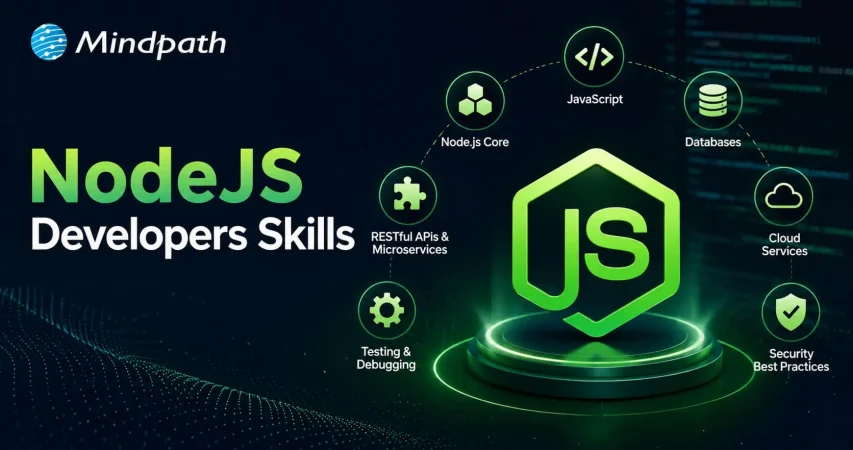
Core NodeJS Developer Skills to Look For

The most important thing for any developer to know is how to do their job. You need to know how to use NodeJS well to make apps that work well and can grow.

1. Proficiency in JavaScript

Because Node.js is built on JavaScript, programmers need to know a lot about basic ideas like callbacks, promises, closures, and how to write code that runs at the same time as other code.

2. Knowledge of Node.js Frameworks

Developers should be familiar with popular frameworks like Express.js, which help them build APIs and backends more quickly.

3. API Development and Integration

A good developer should be able to make and use RESTful APIs that let the front-end and back-end systems talk to each other without any problems.

4. Database Management

To handle data well, you need to know how to use databases like MySQL, MongoDB, or PostgreSQL.

5. Version Control Systems

You need to know how to use tools like Git if you want to work with other people and manage code.

These are some of the most important things that a Node.js developer should be able to do.

Node.js Backend Developer Skills

You need to know more when you work on backend development. Strong Node.js backend developer skills make sure that apps are safe, can grow, and work well.

Key backend skills include:

  • Server-side architecture design
  • Performance optimization
  • Security implementation (authentication, authorization)
  • Handling asynchronous operations
  • Error handling and debugging

You need these skills to build strong backend systems that can deal with problems in the real world.

Technical and Soft Skills for NodeJS Developers

NodeJS developers need to know a lot about technology and have good people skills.

  • Technical Skills

Knowing how to program, use frameworks, and development tools are all examples of technical skills. These skills help developers make apps that work and are useful.

  • Soft Skills

Soft skills play a crucial role in team collaboration and overall project success. Important soft skills include communication, problem-solving, adaptability, and time management. These abilities help developers effectively collaborate with team members, understand project requirements, adjust to changing needs, and manage tasks efficiently. A developer with strong soft skills can contribute to a smoother workflow and deliver high-quality results.

Advanced Skills That Add Value

  • Beyond the basics, advanced skills can significantly enhance a developer’s capabilities.
  • Knowledge of microservices architecture
  • Experience with cloud platforms like AWS or Azure
  • Familiarity with containerization tools like Docker
  • Understanding of CI/CD pipelines

These advanced capabilities are often preferred when businesses hire dedicated Node.js developers for complex projects.

Evaluating Candidates During Hiring

Businesses need to use a structured evaluation process to hire Node.js developers successfully.

1. Technical Assessment

Test candidates on JavaScript concepts, API development, and problem-solving skills.

2. Portfolio Review

Examine previous projects to understand their experience with real-world applications.

3. Practical Assignments

Assign tasks that reflect actual project requirements to evaluate their performance.

4. Communication Evaluation

Assess how well candidates communicate ideas and collaborate with teams.

This method helps you choose people who have the right mix of skills and experience.

Hiring Models to Consider

Companies can choose from a number of different hiring models for NodeJS developers based on what they need.

1. In-House Developers

Best for projects where a lot of people need to work together for a long time.

2. Freelancers

Good for small projects or ones that don’t take long to finish.

3. Dedicated Developers

Dedicated nodejs developers will only work on your project when you hire them.

4. Development Companies

When you hire a nodejs development company, you get teams with a lot of experience and all the development services you need.

Common Mistakes to Avoid

Companies often make mistakes when they hire people that can affect how well the project goes.

  • Paying attention only to hard skills and not soft skills
  • Not being clear about what the project needs
  • Not doing tests in real life
  • Picking workers based on price instead of quality

The hiring process will go more smoothly if you don’t make these mistakes.

Future of NodeJS Developer Skills

As more companies start to use new technologies, the demand for Node.js developers will likely rise. Knowing how to use cloud computing, microservices, and real-time apps will become more and more important.

Because technology changes all the time, NodeJS developers will always be in demand.

Ready to Hire the Right NodeJS Developer?

Hiring the right NodeJS developer is one of the most important decisions for building scalable and high-performing applications. By focusing on both technical expertise and soft skills, you can ensure your project is handled efficiently and delivers strong results. Define your project requirements clearly, evaluate candidates thoroughly, and choose developers who align with your business goals. Hire expert NodeJS developers from Mindpath, a trusted NodeJS development company that builds reliable, efficient, and future-ready solutions designed around your unique business needs.

Take the next step today and build a team that gives your business a competitive edge!

FAQs

1. What are the key NodeJS developer skills?

Key skills include JavaScript proficiency, API development, database management, and knowledge of Node.js frameworks.

2. Why is hiring NodeJS developers important?

They help build scalable, high-performance applications using modern backend technologies.

3. What are the skills required for NodeJS developer roles?

Skills include asynchronous programming, backend development, database handling, and problem-solving abilities.

4. Should I hire dedicated NodeJS developers or a company?

Dedicated developers are ideal for focused projects, while a NodeJS development company offers complete solutions.

5. What soft skills should NodeJS developers have?

Communication, teamwork, adaptability, and time management are essential soft skills.

Related Post

Hiring a ReactJS developer in California comes with various cost factors, including experience level, employment type, and market demand. California’s thriving tech industry drives salaries higher than in other regions, making it essential to budget wisely. Whether you’re hiring a freelancer, full-time employee, or outsourcing to an agency, understanding these cost variations can help you make an informed decision. Below are key factors that influence the cost of hiring a ReactJS developer in California.

1. Experience Level

The cost of hiring a ReactJS developer in California varies greatly according to expertise. Junior developers with little hands-on experience charge less rates, but mid-level and senior developers with advanced abilities, extensive ReactJS knowledge, and experience with large-scale apps command more pay. Companies seeking top-tier talent must be willing to invest more in experienced developers capable of handling complicated jobs and contributing to strategic decision-making.

2. Location Within California

Developer wages and rates vary according to location. Tech centers such as San Francisco, San Jose, and Los Angeles have high living costs, resulting in higher compensation and competition for talented developers. Hiring ReactJS developers in less costly California locations, on the other hand, may be a more cost-effective alternative. When preparing their hiring budget, businesses must consider location-based compensation variations.

3. Project Complexity

The development cost of a project increases as it becomes more complex. If your application requires complex functions such as real-time data updates, third-party integrations, or AI-powered features, expect to spend extra for qualified developers. Simpler projects with a minimal UI and functionality can require less resources, making them more cost-effective. Understanding project complexity allows you to more properly estimate developer expenses.

4. Specific Skills and Expertise

ReactJS specialists with specialized knowledge in areas such as Redux, GraphQL, server-side rendering (Next.js), and speed optimization charge premium rates. Businesses searching for specific expertise or developers familiar with contemporary React frameworks may need to invest extra. It is essential to ensure that a developer’s expertise matches the demands of your project in order to justify paying more for specialized skills.

5. Employment Type

The nature of employment has a substantial influence on recruiting expenses. Full-time ReactJS developers demand salary, benefits, and long-term commitments, although freelancers or contract-based hiring may provide greater flexibility and cheaper initial expenses. However, hiring through agencies or outsourcing organizations might be more expensive owing to additional administration and administrative costs. Choosing the correct employment model helps to strike a balance between cost and quality.

Finding the right ReactJS developer at the right cost can be challenging but Mindpath, makes it easy. We connect you with skilled developers who fit your budget and project needs—whether you’re looking for junior talent or senior expertise. With our flexible hiring models, you get cost-effective solutions without compromising on quality. Let’s build something great together!

Get in touch with Mindpath today and hire the best ReactJS developers in California!

Discover the ultimate guide to hiring Node.js developers in London. Learn about the skills, benefits, and cost factors involved in finding the right talent for your project.
devops best practices

Does your team prepare itself well enough to handle the fast pace of software development in 2026? As there are so many changes happening in the way businesses build and deliver products, it is very important to pause and think about what’s working and what’s not, isn’t it? The perfect solution for this lies in following DevOps best practices, so that you can keep your software development processes smooth and your teams connected.  

Well, DevOps can help your business improve teamwork, speed up release, and even reduce errors. Its goal is to create a robust process supporting development and operations. If you are asking what the best practices for DevOps are, and how they may help your business improve on delivery, performance, and collaborate between teams, then this blog can serve you better. 

Before delving into the main topic, let us first understand the fundamentals of DevOps. 

Want to reduce downtime and accelerate software delivery? Mindpath offers expert DevOps services, which help streamline your workflows, automate deployments, and improve overall efficiency.

What is DevOps?

DevOps is a proactive approach to linking development and IT operations teams to collaboratively work in a way that transforms the software development process. With DevOps, both teams can share responsibilities in building, testing, and releasing software. The main purpose of it is to improve speed, reduce errors, and deliver better results.

DevOps also improves communication across teams, which reduces delays and results in fewer disruptions. Automating repetitive tasks gives teams more time to focus on solving problems. It also allows for faster feedback loops, meaning teams can address problems quickly and improve product quality over time. This approach allows teams to adapt to change more easily while also scaling systems and keeping up with customer demand. 

Looking to elevate your business with smarter workflows? Check out our Benefits of DevOps blog to learn how it accelerates innovation while fostering collaboration across teams.

What are the 7 Key Principles of DevOps?

There are several main principles that define how teams work and deliver software. These principles provide an underpinning to enhance collaboration, automation, and improvement across a work ecosystem. Now, let’s explore the 7 key principles of DevOps: 

1. Strong Team Collaboration

DevOps brings developers and operations teams together to work as one. This helps solve problems faster and build better software. 

2. Customer-Centric Approach

Every decision is made by keeping the customer in mind. Teams collect feedback and use real-time tools to improve the user experience. 

3. Data-Driven Decisions

DevOps teams rely on real data-driven decisions before making changes. This helps them choose the right tools and improve their results with confidence. 

4. Automation Across the Workflow

Tasks like testing, deployment, and setup are automated to save time. This lets teams focus on planning, solving problems, and improving the product. 

5. Continuous Improvement

DevOps supports small and frequent updates instead of waiting for one big release. This helps teams meet user needs quickly and make steady progress. 

6. Embracing Failure as Learning

If something goes wrong, teams treat it as a chance to learn. This mindset helps them improve and make smarter decisions in the future. 

7. Shared Responsibility

In DevOps, the entire team takes responsibility for the software from beginning to end. Developers and operations work closely at every stage to build, test, and fix issues together. 

Struggling with speed, collaboration, or automation in DevOps? Our DevOps Challenges and Solutions blog explains how modern businesses address these issues.

What are the DevOps Best Practices?

To get the most out of DevOps, teams follow a set of proven methods that support faster delivery, better quality, and stronger teamwork. These top DevOps practices help create smooth workflows and make it easier to manage changes and fix problems quickly. Let’s explore the most effective DevOps methods that can drive real results. 

1. Continuous Integration/Continuous Deployment (CI/CD)

One helpful way to speed up your CI/CD pipeline is by using a smart testing platform that runs tests faster and more efficiently. It allows teams to run large sets of tests in parallel, get faster feedback, and use resources wisely to lower costs. A key benefit is that it keeps your tests stable across different environments, which helps improve software quality and delivery speed. 

2. Use Infrastructure as Code (IaC) for Better Control

Infrastructure as Code lets teams manage and set up their infrastructure using code instead of doing it manually. This makes deployments faster and keeps environments consistent across all stages of software delivery. Using IaC also helps track changes easily and improves teamwork by allowing developers to handle infrastructure in a clear and organized way. 

3. Integrate Security into Your DevOps Process

Adding security checks early in the development pipeline helps find and fix vulnerabilities before they cause problems. This approach keeps your software safe and ensures it meets important security rules. Using automated security tools makes it easier for teams to maintain strong protection without slowing down delivery. 

4. Leverage Configuration Management Tools

Configuration Management tools help automate system setup and updates to keep environments consistent across teams. They work well with CI/CD pipelines to speed up deployments and make collaboration easier. By using these tools, teams can also enforce security rules and track changes to meet compliance requirements. 

5. Adopt Shift-Left Testing for Faster Issue Detection

Starting to test early in the development process helps find problems before they grow bigger. Using automated and AI-driven testing tools makes it easier to catch errors quickly and improve the quality of the code. This approach also speeds up delivery by reducing the time spent fixing issues later on. 

Must Read: DevOps Trends

6. Automate Testing for Reliable Software

Automated testing is a key DevOps best practice that helps check code quality quickly and consistently. By using automated test tools in your DevOps pipeline, teams can find and fix problems early. This ensures every change is tested before going live, making software more reliable and ready for continuous delivery.  

7. Use Cloud Services for Flexibility and Speed

Cloud services make it easy to quickly set up and scale resources as needed while automating many tasks. They support key DevOps practices like automated pipelines, security integration, and managing infrastructure with code. Using cloud platforms helps teams deliver software faster and maintain smooth, reliable operations. 

8. Adopt Containerization

Using containerization is a smart DevOps best practice that helps keep software running the same way in development, testing, and production. Containers make it easier to scale applications and use resources more efficiently. This approach reduces errors and speeds up delivery by ensuring consistency across all stages. 

9. Implement Microservices Architecture

Microservices break down applications into smaller, independent parts that can be updated and scaled down on their own. This makes it easier for teams to manage and improve specific services without affecting the whole system. To make this work well, strong monitoring, testing, and automation are important to keep everything running smoothly. 

10. Focus on Continuous Improvement

Continuous improvement means always looking for ways to do things better by learning from past experiences. Teams can use the Plan-Do-Check-Act cycle to test small changes, check results, and keep improving. This helps them build better software faster and fix issues more quickly. 

Wondering how DevOps can accelerate growth and efficiency in your organization? Read our blog on DevOps for Businesses to discover strategies that streamline operations, enhance collaboration, and improve software delivery.

Want to Transform Your Software Delivery with DevOps Best Practices?

Following DevOps best practices helps teams build software faster, reduce errors, and work better together. By using automation, cloud tools, and early testing, your team can improve software quality and speed up delivery. These practices make workflows smoother and help your business keep up with fast-changing demands with time. 

At Mindpath, we apply proven DevOps practices like CI/CD, containerization, and infrastructure as code to streamline software delivery. Our expert teams focus on collaboration, automation, and continuous improvement to ensure secure, high-quality releases. With our DevOps-centric approach, your business can achieve better performance and faster results. 

Frequently Asked Questions

1. What are the main benefits of following DevOps best practices for a business?

Implementing DevOps best practices improves collaboration between development and operations teams, speeds up software delivery, reduces errors, and enhances system reliability. It also allows businesses to respond faster to market changes while maintaining consistent quality and security across applications.

2. How can DevOps best practices improve software delivery speed?

By automating repetitive tasks, integrating CI/CD pipelines, and using containerization and infrastructure as code, DevOps practices streamline workflows. Early testing and continuous feedback loops help teams detect and fix issues faster, reducing bottlenecks and enabling quicker, reliable releases.

3. Why is security integration important in DevOps workflows?

Integrating security early in the DevOps pipeline ensures vulnerabilities are identified and resolved before software goes live. Automated security checks maintain compliance, prevent data breaches, and protect user information without slowing down development or delivery processes.

4. How do microservices and containerization contribute to DevOps efficiency?

Microservices break applications into independent modules, allowing updates or scaling without affecting the entire system. Containerization ensures consistent environments across development, testing, and production. Together, they reduce errors, improve scalability, and make deployment faster and more reliable.

5. Can small businesses adopt DevOps best practices effectively?

Yes, DevOps practices are scalable for businesses of all sizes. Even small teams can leverage automation, cloud infrastructure, and CI/CD pipelines to improve collaboration, speed up releases, and maintain software quality. Early adoption supports growth while keeping operational costs efficient.

Discover essential DevOps best practices to enhance efficiency, streamline processes, and boost collaboration for your business with Mindpath.

Support Is One Click Away

Featured Posts

Related Post