Lead Generation Chatbot: Automate Lead Generation and Sales 

Join our Newsletter!

Featured Posts

Support Is One Click Away

Home

Lead Generation Chatbot: Automate Lead Generation and Sales 

lead generation chatbot

Lead Generation Chatbot: Automate Lead Generation and Sales 

Have you thought about the impact that a lead generation chatbot could have on attracting and engaging customers for your business? The benefits of chatbots are clear: Because these chatbots start conversations immediately, they create a welcoming experience that encourages visitors to leave their details. They make conversation feel fluid and natural, keeping prospects looking, listening, and engaged, without breaks. They can help you seize opportunities as soon as they arrive, ensuring no lead gets away, and usually bring a steady stream of interested prospects to your business.

In addition to just collecting contact details, these chatbots can also qualify a lead, figuring out their needs and pairing those needs with the appropriate solution. They can answer questions quickly, suggest services, and schedule meetings in real time. This efficient method saves time for your sales team while keeping the customer journey uninterrupted. Chatbots are automating lead management and personalizing lead management like never before. In this blog, we will take a closer look at their use cases.

Want to build a powerful chatbot tailored to your business needs? Mindpath’s custom chatbot development services will provide expert solutions to enhance customer experience and boost lead generation.

What is a Lead Generation Chatbot?

A lead generation bot is an intelligent online marketing tool that engages with visitors on your website, captures their information, and even starts to categorize them as potential customers. The chatbot works constantly, so you will never miss another sales opportunity. It will ask some thoughtful questions and have a pleasant tone to ensure prospects feel like they were treated respectfully, while also extracting valuable contact information for your business.

A chatbot does not wait for visitors to do something like the outdated contact form. Its proactive behavior opens up the conversation and allows visitors to interact. A chatbot speaks to visitors instantly, answers questions, leads visitors to book a demo, or suggests the next step. Your chatbot can take information collected and send it directly to your marketing tools, so lead follow-up is fast and organized.

Looking to see how AI chatbots can boost your sales? Check out real-life examples of AI chatbots that increased conversions to discover strategies that truly work.

Benefits of AI Chatbots for Lead Generation

Lead bots are impacting how companies are collecting and converting potential customers through real-time interaction. Utilizing AI chatbots for lead generation allows for the quick acquisition of information while taking potential customers smoothly into the next step.
Benefits of AI Chatbots for Lead Generation

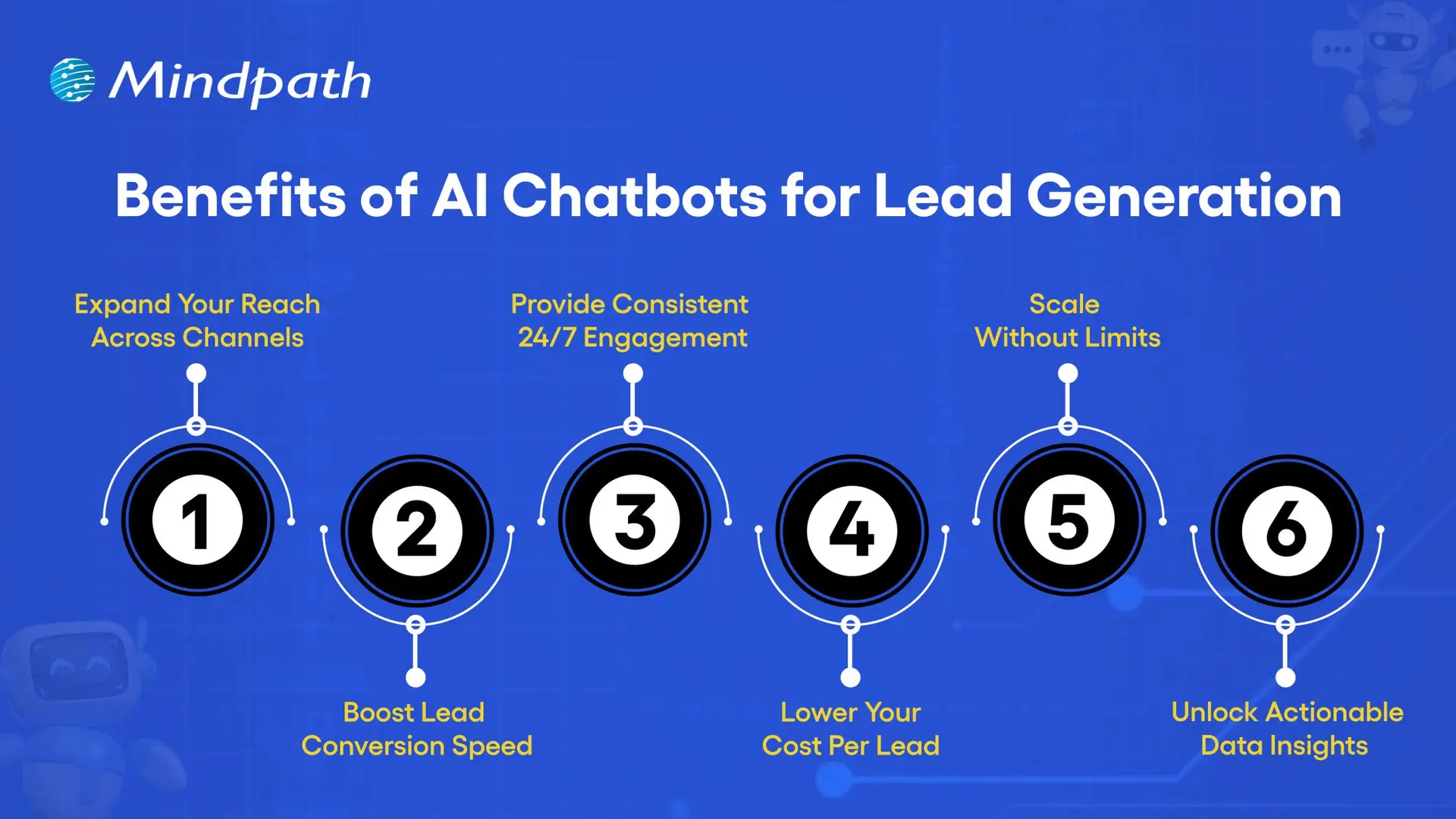
1. Expand Your Reach Across Channels

A lead generation chatbot can talk to prospects through your website, email, social media, and various messaging channels such as WhatsApp. You’re connected to customers on their most convenient platforms, and it makes it easy to have a conversation. The more dialogues you open across key communication points, the more customers will engage, putting you in a better position to convert a quality lead. When you utilize lead generation tools such as chatbots, your business remains prominent and accessible across all communications.

2. Boost Lead Conversion Speed

A sales chatbot AI can qualify prospects quickly and send them on to your sales team or follow-up system. With real-time engagement, you can respond to inquiries and gather needed information without delays. Which means that leads stay warm and are more likely to take action sooner rather than later. An AI chatbot for customer support can also help field questions that affect purchasing decisions, enhancing conversion rates even further.

3. Provide Consistent, 24/7 Engagement

A lead generation chatbot is available 24/7 and is able to engage with visitors when they show that they are serious about purchasing. Customers can get answers or help whenever they need them without waiting for store hours. This establishes trust with the customer and reduces the chances they will drop off during the purchasing process. This level of availability also strengthens connections with customers and the level of engagement overall.

Also Read: AI for Customer Services

4. Lower Your Cost Per Lead

Chatbot sales systems take away the manual and extra people that traditionally went into copy and qualifying leads, which will have a direct impact on chatbot pricing as more value is received for less money. Because of the efficiency of Conversational AI chatbot sales automation and how they scale, businesses won’t have to pay more to scale the amount of leads generated to scale resulting in every lead gained becoming progressively cheaper over time.

5. Scale Without Limits

By utilizing a chatbot for sales automation, businesses have the ability to manage hundreds of conversations simultaneously. This means you will never miss out on having a conversation with a potential customer, regardless of the demand, and your chatbot will operate seamlessly even during peak traffic and campaigns. Scalability like this means everything to growing businesses that want to take their reach to the next level.

6. Unlock Actionable Data Insights

A sales chatbot AI is able to collect in-depth insights around visitor behavior, intentions to buy, and preferences that can help improve your marketing campaigns and target customers more accurately. Captured custom chatbot analytics can inform more about which conversations converted into sales and why. Taking this data-driven approach, every single interaction, both now and in the future, improves through the method of practice.

Wondering how top businesses make smarter choices? Discover the importance of data-driven decision-making for businesses to drive growth and stay ahead.

How to Build Your Own AI Chatbot for Lead Generation?

Building a lead generation AI chatbot can help your business engage prospects, answer questions instantly, and collect valuable data automatically. With the right tools and strategy, you can create a chatbot that not only interacts with visitors but also converts them into potential customers.
Steps to Build Your Own AI Chatbot for Lead Generation

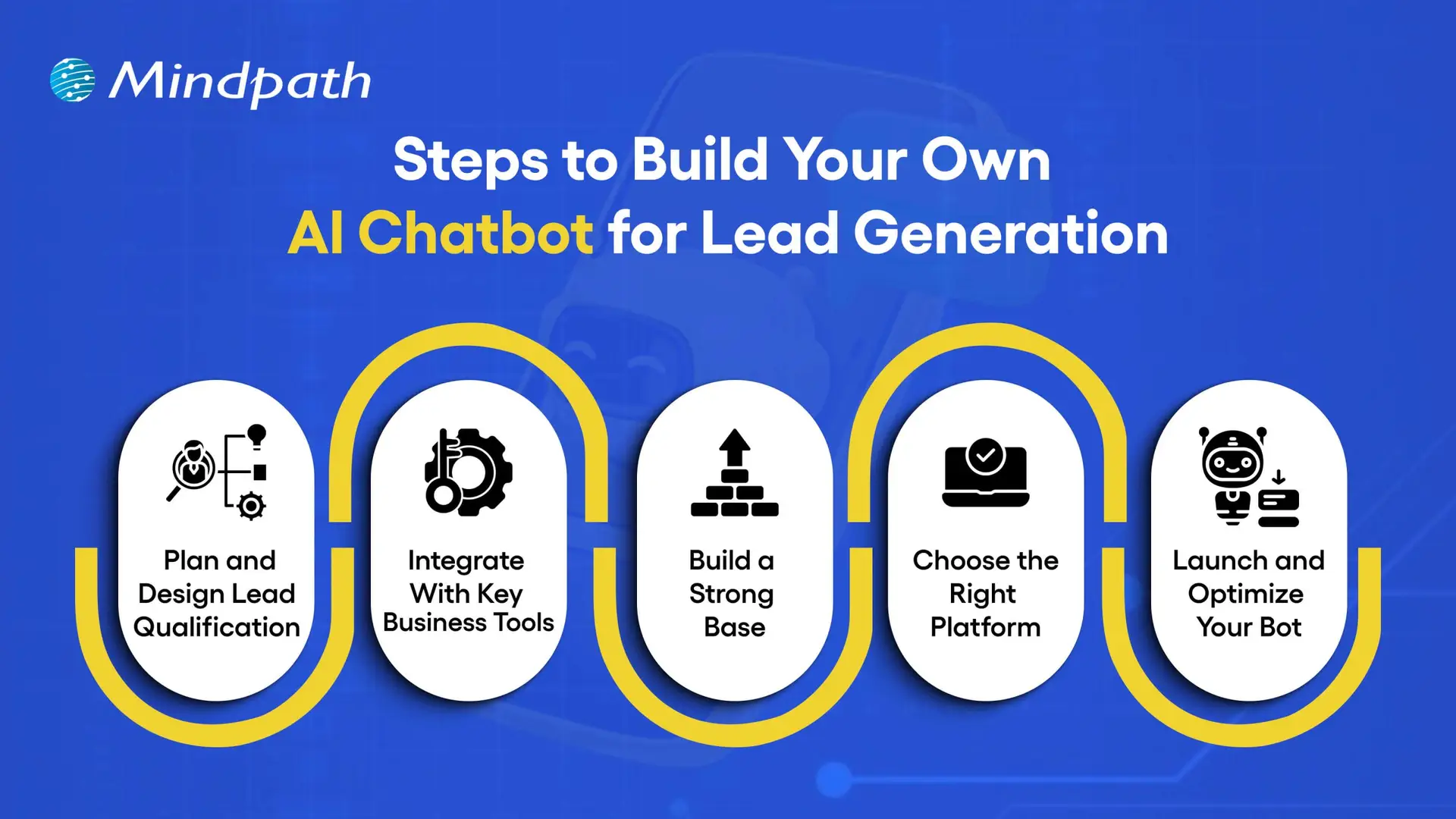
1. Plan and Design Lead Qualification

Define what a valuable lead means for your business before creating your lead generation chatbot. Plan key questions to qualify prospects and decide the follow-up steps, such as sending them to sales or booking meetings. Choose the platforms, like your website or WhatsApp, where the chatbot can engage the most visitors.

2. Integrate With Key Business Tools

Connect your chatbot to essential tools like CRM for tracking, email platforms for follow-ups, and scheduling tools for instant bookings. Use analytics to track performance and refine your strategy. Whether through custom or pre-built options, integrations make your chatbot a powerful automated sales AI bot.

3. Build a Strong Base

Plug-in solutions offer ready-made bot structures but limit customization. AI-powered platforms can set up your chatbot quickly with features that save time. A DIY build gives full control but requires more effort to create a flexible and high-performing bot.

4. Choose the Right Platform

Pick a platform with features like lead scoring, CRM integration, and multi-channel capabilities. Decide between coding, low-code, or no-code options based on your team’s skills. The right choice will help you create a reliable lead generation chatbot template that supports your goals.

5. Launch and Optimize Your Bot

Deploy your bot where it can have the most impact, such as your website or popular messaging apps. Start with a small audience to test and refine performance. Keep updating it to ensure your lead generation chatbot consistently delivers results.

Curious how chatbots understand and respond like humans? Learn what conversational AI is to see how it powers smarter lead generation and sales.

Looking to Build a Custom Chatbot for Your Business?

A lead generation chatbot improves the way businesses connect with potential customers. It engages prospects instantly, qualifies them effectively, and guides them toward the next step. With features like multi-channel reach, scalability, and data insights, it streamlines lead capture and boosts conversion rates while ensuring a smooth and professional customer experience at every stage of the interaction.

At Mindpath, our custom chatbot development services are designed to create solutions that match your business goals and enhance lead generation. We build chatbots that engage visitors, qualify leads faster, and integrate smoothly with your existing systems. With our expertise, you can deploy a chatbot that drives conversions, strengthens relationships, and supports your business growth effectively.
Related Post

Elevate your brand with a custom WordPress website. Enjoy unique design, enhanced functionality, scalability, and top-notch security for your business.

Related Post

MVP development

In the software development context, you must have come across the term MVP or minimum viable product. It is the simplest version of a product or application. MVP just has enough features so that initial users can test and provide their feedback. It is ideal for investors to look at the MVP of a product that is being pitched to them.

The importance of MVP development is vital in the prevailing business environment. Many startups fail today because they create products on the basis of assumptions. However, the best way to test those assumptions is by developing an MVP that the real users can see and use. It is the perfect time to learn about MVP and its relevance.

If you are looking to adopt MVP into your business, but don’t know where to start? Mindpath offers end-to-end MVP development services that help you validate ideas quickly while minimizing financial and technical risks.

An Insight into Minimum Viable Product

A Minimum Viable Product refers to the beta version of a new product that a business plans to create. It encompasses just enough features to capture the attention of early customers and collect feedback from them. The companies that adopt the MVP approach to collect as well as respond to user feedback are able to grow faster in the competitive market setting.

Businesses can use MVP in software development to test if customers are happy with their app before spending too much time and effort. As the needs and preferences of modern customers keep changing, it is fundamental for businesses to prioritize MVP development.

Benefits of Implementing MVP

You need to bear in mind that the concept of MVP product development comes from the lean startup methodology. It focuses on learning as well as building with scalability. When a business builds MVP, it is basically taking the first small step towards a new idea or product. This small step can enable businesses to understand the interest of the market in the product.

1. Gathering User Insights

Businesses can gain valuable insight from MVP development. It can teach them where to make improvements in their offering and scale back. Businesses can also add extra features in order to make their product or application more attractive and useful for the users.

2. Testing Business Idea

The key benefit of MVP is that it serves as a low-risk testing ground before businesses invest millions of dollars into a product. Startup businesses can validate their product through MVP development. It creates an opportunity to interact with customers and understand their needs.

3. Cost Efficiency

You need to remember that an MVP development company can help you in terms of cost-saving. Mature software products need years of development along with considerable investment. MVPs ensure that products are simple for coding as well as functionality, thereby reducing development cost. Once you start gaining customer feedback, you can start spending your money more wisely on the new product.

4. Assessing Market Demand

The MVP encompasses testing as well as analyzing the functionality of a product. Moreover, it helps in evaluating the market demand and helps in the acquisition of new customers in the market. It is vital for business organizations to understand the needs of their customers along with the existing solutions. The MVP approach empowers businesses to refine their offering and know whether their offering has a future in the market or not.

5. Securing Funding

Startups require funding in order to survive in the competitive market environment. MVP development for startups serves as a strategic method that can enable them to test the idea before reaching out to investors and other stakeholders. Such a systematic approach can help businesses to secure funds from investors who trust in their idea and Minimum Viable Product.

Cost of MVP Development

The role of MVP development is indispensable for businesses. So it is time to focus on the MVP development cost. Businesses may wonder – How much does MVP development cost? The answer to the question is not straightforward. The average cost relating to MVP development depends on a number of factors, such as the scope of the project and team composition. Similarly, contractual dynamics may also play an important role in impacting the cost of MVP development.

When it comes to MVP, the cost can be categorized into specific features as well as development phases. The common categories that you may come across include market research, prototyping, and MVP development. It is crucial to bear in mind that the research phase is conducted in parallel with prototyping.

Difference Between MVP, Prototype, and Proof of Concept

In order to get a holistic insight into MVP, you must understand how it is different from Prototype and Proof of Concept. A layman may think that these terms are interchangeable. However, that is not true. Each of the terms has a different meaning that businesses should be familiar with.

1. MVP

MVP refers to a launchable product version. It includes core features. The purpose of MVP development is to validate the market potential of a product and gain valuable feedback from users.

2. Prototype

Prototype refers to a preliminary model of a product. It can also be described as a mock-up that is designed to test the design concepts and technical feasibility. It also helps to assess the functionality of a product before its complete development.

3. Proof of Concept

Proof of Concept is a small experimental project. It is undertaken to demonstrate the feasibility or viability of a concept. It is mostly tested internally before further investment is made.

The main difference between these three terms has been presented in the table below:

Aspect MVP Prototype Proof of Concept
Purpose Market validation Technical exploration Feasibility testing
Complexity Functional product Non-functional model Basic technical demonstration
Audience Potential customers Internal stakeholders Technical team

Misconceptions Relating to MVP

There are a number of misconceptions that startups may have about MVP. It is essential to have proper clarity about MVP so that businesses can take advantage of the approach while developing their offering.

1. A common misconception is that MVP is an inferior quality product. However, in reality, an MVP is crafted in a strategic manner. It focuses on the product or software that can deliver core value while maintaining user experience.

2. Another common myth is related to the investment aspect. You may believe that MVP in web development requires no major investment. However, that is not true. Although MVPs are more cost-effective than the final product, they require resource allocation and technical implementation.

3. Businesses may have the idea that one MVP may be sufficient while developing a product. But the truth is that MVP development is an iterative process. Businesses must continuously incorporate the feedback of users so that the best version of the product can be made.

4. You may think that an MVP is a universal solution for all startups. However, this is a common misconception. Not all startups might be able to validate their product or idea through an MVP.

Ready to launch your MVP without delays? Visit our blog on hiring full-stack developers for MVP to learn how to find developers who can handle both front-end and back-end tasks with ease.

Final Words

In the current business landscape, the importance of MVP development cannot be negated. In order to sustain and survive in the complex business space, it is key for startups to develop a minimum viable product before investing completely in the actual product. It can empower businesses to refine their product or offering and create value for the end-users.

Businesses can take advantage of Mindpath’s minimum viable product development services. Our experts can help you develop your MVP in an efficient manner, and you can obtain relevant feedback to improve your offering. The MVP development process can play a strategic role, and it can give your business an edge.

Hire NodeJS Developers in London
The cost of hiring Node.js developers in London varies according to expertise, project complexity, and firm size. Junior developers often charge £30-£70 per hour, but experienced developers charge between £70 and £150 per hour. It’s critical to assess your project’s requirements and budget appropriately. The following are significant factors that determine these expenses.

1. Experience Level

The experience of a Node.js developer significantly impacts the hourly rate. Junior developers with limited experience in Node.js typically charge lower rates, between £30 – £70 per hour. They can handle basic tasks but may need more guidance. In contrast, senior developers with extensive experience in complex Node.js projects and advanced skills may charge £70 – £150 per hour. Their expertise includes managing large-scale applications, leading teams, and solving intricate technical challenges, justifying their higher rates.

2. Project Complexity

The complexity of the project plays a crucial role in determining developer rates. Projects requiring expertise in advanced Node.js frameworks (such as NestJS or Express) or specialized areas like cloud integration and real-time services will demand developers with advanced skills. Such projects often require a deeper understanding of architecture and scalability, leading to higher rates. Developers with specialized knowledge will charge more to reflect the increased technical demands and the project’s overall complexity.

3. Company Size and Location

The size of the company and its location can also influence Node.js developer rates. Larger companies located in central London typically offer higher hourly rates, ranging from £70 to £150. These companies often have more significant resources, larger budgets, and complex projects. In contrast, smaller startups or businesses based in suburban areas may offer lower rates, typically between £30 to £70, as they often work with tighter budgets and smaller-scale projects. However, location does not always guarantee lower rates, as other factors such as the project type can still affect pricing.

At Mindpath. we offer expert Node.js developers with the right experience to meet your project’s needs, whether you’re looking for junior talent or senior developers with specialized skills. Our developers are proficient in advanced frameworks, real-time solutions, and complex cloud integrations, ensuring your project is in capable hands.

Start building your team with Mindpath today!

Discover the cost to hire Node.js developers in London: £30-£70/hour for juniors and £70-£150/hour for experienced, depending on expertise and project complexity.
Web development trends

The landscape of web development is evolving faster than ever. What was an innovation just a few years ago is now obsolete. Developers and businesses should stay ahead of the curve to remain relevant and competitive. From decentralized technology to AI-powered automation, the latest web development trends are redefining how web apps and websites are developed and optimized. 

These trends do not just revolve around making technical upgrades. They involve strategic shifts that influence digital growth and user experience. By embracing these advancements early, you can enjoy a decisive edge in this competitive digital world. Following a well-structured web development roadmap can help you prioritize the right technologies, tools, and methodologies for maximum impact.

In this blog, we will talk about some major trends in web development processes, methodologies, and tools that are constantly transforming this landscape. 

Using these trends in your business requires expert guidance. At Mindpath, we offer web development services where our guidance will provide you with the direction you need to stay ahead of the competition.

The New Era of Web Development

Web development is now entering a transformative era, significantly driven by user-centric designs and technological innovations. In the future, we can expect to see faster, personalized, and smarter websites.

Besides, the demand for Progressive Web Apps will increase as these apps provide users with an app-like experience without downloading an app. What’s more? With machine learning and IoT widely integrated into websites, the web will evolve into a more responsive, intelligent, and interactive ecosystem. 

Must Read: AI in Web Development

Let’s further explore the top web development trends that are shaping the next generation of digital experience.  

Top Web Development Trends 2026

As we move deeper into 2026, here are some trends that are reshaping how web applications and websites are built and deployed. These innovations enhance scalability, performance and align with increasing demand for transparency, security and personalization.

1. Code Will Become Optional: AI-Assisted Development

In 2026, AI-powered web development tools will streamline multiple tasks, from code creation to UX enhancement. Platforms such as OpenAI Codex, GitHub Copilot, Tabnine, and more help developers by suggesting improvements, writing boilerplate code, debugging, and more. 

Besides, web application development trends in 2026 include predictive analytics, AI-assisted personalization, intelligent chatbots, etc. Such intelligent capabilities have become integral to modern web development projects with source code, reducing development time and enhancing user engagement. 

2. The Rise of Jamstack Architecture

Jamstack (which combines JavaScript, APIs, and Markup) has become one of the most popular web development technologies. This modern architecture decouples the front-end from the back-end. It leads to improved security, better scalability, as well as faster load times. For marketing pages, e-commerce sites, and content-heavy platforms, Jamstack would be an excellent choice 

3. Blockchain Technology

Blockchain is here to facilitate continuous flows of records and transactions, called blocks. This technology is cryptographically secure and records every transaction in a tamper-proof and transparent manner.  

Web developers can use this to create high-performance, decentralized applications that eliminate centralized control and intermediaries. 

4. Progressive Web Apps

By combining the features and functionalities of native mobile apps and websites, PWAs are changing the web development process. These apps offer an app-like experience while being cost-effective and accessible. 

A report indicates that the global PWA market is projected to grow from USD 1.9 billion in 2014 to USD 9.7 billion by the end of 2034 (Source: Emergen Research). This clearly shows the rising adoption of PWAs by businesses.

5. Machine Learning in Browsers

Thanks to the latest web development technologies like TensorFlow.js and WebAssembly, web developers can easily run various machine learning models in browsers. This facilitates voice recognition, real-time personalization, predictive UX, and more. It is now possible to create privacy-conscious and faster applications that can adapt to user behaviour. 

Are your web apps providing the best possible experience for users? Discover UI/UX design trends in web application development to learn how modern design trends can enhance usability and engagement.

6. Micro-Frontends

It breaks down the complete UI into manageable, smaller components. This modular approach significantly enhances scalability and facilitates parallel development. This can be an excellent solution for large-scale development projects. 

7. No-Code and Low-Code Platforms

Low-code development is getting popular among developers. Platforms such as Bubble, OutSystems, and Webflow let non-technical users create functional websites with minimal coding. It reduces costs and accelerates prototyping. Low-code or no-code development is one of the impactful dev trends in 2026 for small businesses and startups.  

8. Single Page Applications

These web apps are created as a single page, and they can dynamically update content in real-time. SPAs help reduce costs, and businesses can use cloud technology to attain scalability. Some examples of popular SPAs are Google Maps, Facebook, Airbnb, Twitter, and Netflix. 

9. WebRTC Advancements

WebRTC is a major technical advancement in the field of web app development. It is an open-source technology and uses HTML and JavaScript APIs to add communication features to browsers. There is no need to use any external software or plugins.

With the help of RTCPeerConnection, RTCDataChannel, and MediaStream, it enables peer-to-peer data, video, and audio sharing. 

10. Edge Computing

It refers to the processing of data closer to the source instead of depending on centralized data centers. It reduces latency, improves privacy and performance while helping businesses to keep costs low. 

Edge computing is becoming significantly crucial for business, and it is estimated that by 2028, it will reach USD 378 billion (Source: IDC Research). 

Choosing the right technologies is crucial for building a high-performing web app. Explore the tech stack for your web app success to discover the best tools and frameworks for your project.

11. Motion UI Frameworks

These frameworks help bring a static interface to life by integrating optimized transitions and animations. For example, Animate.css offers ready-to-use animations that are compatible with multiple browsers. It is a great option for sliders and home pages. 

You can implement animations that are not just visually appealing but also serve functional purposes, such as highlighting vital information, guiding visitors through a certain process, etc. 

12. Adaptive and Responsive Design

Web development trends in 2026 also include the wide use of adaptive designs. With wearables and foldable devices entering the mainstream, adaptive design is now evolving. Developers are prioritizing gesture optimization, context-centric layouts, and device-specific breakpoints. 

This shift is central to modern web development trends, ensuring a consistent user interface across screens and devices. 

13. Server-Driven UI

It enables servers to identify the behaviour and structure of the front-end for dynamic content rendering and quick updates. It transmits JSON-based instructions to the frontend and controls the UI layouts.

This development approach allows faster deployment, seamless CMS integration, personalization, and cross-platform consistency. It is a strategic shift in today’s web development trends.

14. Data-Driven UX and Real-Time Analytics

Developers are now integrating session recording, heatmaps, real-time user behaviour tracking, and more for design decisions. This approach reduces guesswork and assumptions while enhancing user satisfaction. 

Product metrics, email analytics, Google Analytics, and social media analytics are some commonly used analytics tools to get important quantitative data. This approach aligns with new web development trends and can also boost conversion rates. 

15. AI-Assisted SEO Optimization

With search engines, SEO is also evolving. AI tools are now helping with content scoring, meta tag generation, keyword clustering, and improving internal linking. 

For developers and content strategists, it means better alignment with user needs and faster optimization cycles. 

Looking to build a website that drives engagement and conversions? Explore web design and development services to discover how professional design and development make an impact.

Latest Web Development Languages for 2026

Staying updated with the Latest Web Development Languages is also important to create future-proof and scalable web applications. Here are some key languages that cater to frontend as well as backend needs.

1. JavaScript

The backbone of front-end development, and it helps create interactive and dynamic user interfaces. 

2. TypeScript

An ideal option for large-scale projects due to its error reduction and maintainability. 

3. Go

Also called Golang, it is popular for its concurrency and speed. It is widely used for websites requiring high performance. 

4. PHP

A dominating language for server-side scripting. Frameworks such as Laravel are modernizing PHP development.

5. Rust

Well-known for performance and memory safety, Rust works well for secure backend systems and web assembly projects. 

Want a web application built to match your workflow perfectly? Discover our custom web development services to learn how we create bespoke digital experiences.

Dev Trends to Watch in 2026

In 2026, the application development trends cover CI/CD automation, AI coding, and more. Here are some major dev trends you should consider. 

1. Mico Frontends

Dividing user interfaces into independently-deployed, smaller parts with an aim to achieve flexibility, collaboration, and scalability. 

2. AI-Assisted Coding

Smart testing tools and code generation tools powered by AI are simplifying workflows. 

3. CI/CD Pipelines

Automated testing ensures that web applications and websites are updated on time and faster. 

4. Sustainable Development

Coding architectures and practices that meet global accessibility standards and reduce energy consumption are getting popular in dev trends. 

5. 5G Integration

Developers can leverage 5G technology to optimize CDNs or Content Delivery Networks and create high-performing websites. 

It can be said that the future of web development holds more such exciting innovations. 

Integrating CI/CD into your development cycle can boost productivity. Explore CI/CD Pipelines to discover tools and techniques for seamless automation.

It’s Time to Embrace the Trends

The 2026 web development trends clearly signal a shift toward adaptability, speed, and intelligence. Businesses optimizing their landing pages or creating new websites from scratch, these new technologies in web development can offer strategic opportunities to enhance the digital experience.  

If you are searching for an expert who can guide you through this evolving landscape, Mindpath would be the best option for you. We offer comprehensive web development solutions designed to take your digital experience to a whole new level. Our experts keep themselves updated with the current web development trends so that you can enjoy the desired results. Let us develop a perfect website integrated with advanced features and capabilities, and stand out in this competitive market.