What is Conversational AI: An Ultimate Guide

Join our Newsletter!

Featured Posts

Support Is One Click Away

Home

What is Conversational AI: An Ultimate Guide

what is conversational ai

What is Conversational AI: An Ultimate Guide

Companies today understand that it’s essential to have satisfied customers at every touchpoint, to keep in front, and that is where the magic of Conversational AI resides. Are you wondering what is conversational AI? It is the technology that informs smart chatbots and virtual assistants that provide 24/7 interactions for infinitely scalable engagements. Organizations leverage conversational AI to reduce waiting hours, respond to customer inquiries in real-time, and keep delivering a consistent quality of service.

This amazing technology is enhancing efficiencies, saving costs, and maximizing customer satisfaction. Conversational AI stands to revolutionize the performance of an organization, as well as the measurement of its growth, by automating processes with personalized support. If you’re interested in how it works and what benefits it has in store for you, let’s discuss all its amazing features in this blog, step by step.

Are you looking to implement smart chatbots or a virtual assistant in your business to enhance customer engagement? Mindpath’s AI Development Services will help you achieve customer satisfaction with 24/7 support.

What is Conversational AI?

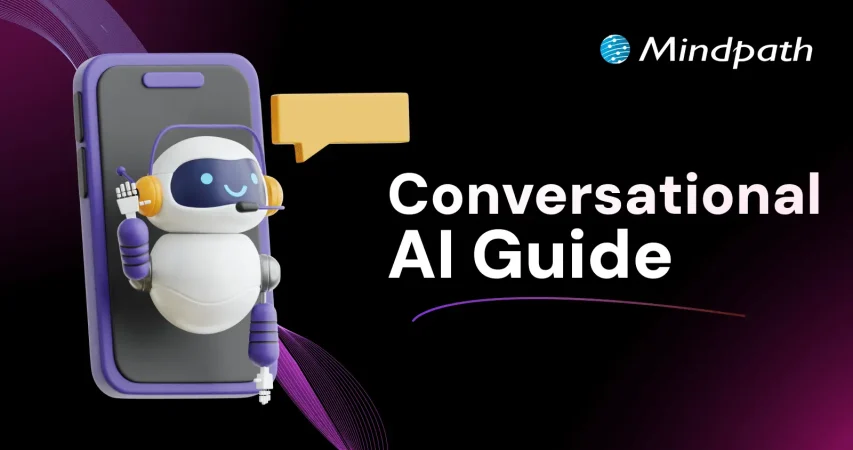
Conversational AI is smart technology that helps artificial intelligence bots like chatbots and virtual assistants talk with people in a natural, human-like way. It’s all about making AI more human, so interactions feel real and engaging. By understanding what we say and how we say it, these systems make conversations easier and more helpful for everyone.

Conversational AI is built using machine learning and natural language processing, and it harnesses the knowledge of millions of conversations. Learning from these conversations allows artificial intelligence bots to improve upon responding to questions, solving problems, and predicting what a customer may need next more accurately. It’s a powerful step toward making AI more human and building better customer experiences.

Also Read: How conversational AI chatbots help businesses!

Types of Conversational AI

There are different types of Conversational AI technologies a business can use to meet customers and deliver its services to them. Each one operates in its own way and could have its own niche when it comes to customer support, sales, or engagement objectives.

1. Voice Bots/Assistants

Voice bots and assistants are a type of conversational technology that interacts with people through spoken language. They listen to what a person says, figure out what they need, and respond naturally. This makes everyday tasks easier, from playing music to managing smart home devices.

2. AI Chatbots

AI chatbots are a powerful type of conversational AI designed to hold natural, human-like chats. These conversational agents use advanced language models to understand context and respond in a way that feels personal and clear. They help businesses handle complex questions and provide better support around the clock.

3. Interactive voice response (IVR)/Interactive voice assistants (IVA)

Interactive Voice Response and Interactive Voice Assistants are a type of conversational AI that helps people navigate phone systems using voice or keypad inputs. They understand what a caller needs and guide them to the right solution without long wait times. This makes customer service smoother, faster, and more convenient.

Wondering how conversational AI is advancing into systems capable of autonomous action and decision-making? Explore how Agentic AI is redefining intelligent, self-directed digital behavior.

Advantages of Conversational AI

Conversational AI has become an important part of how companies connect with people today. Here are some key advantages it can bring to your business.
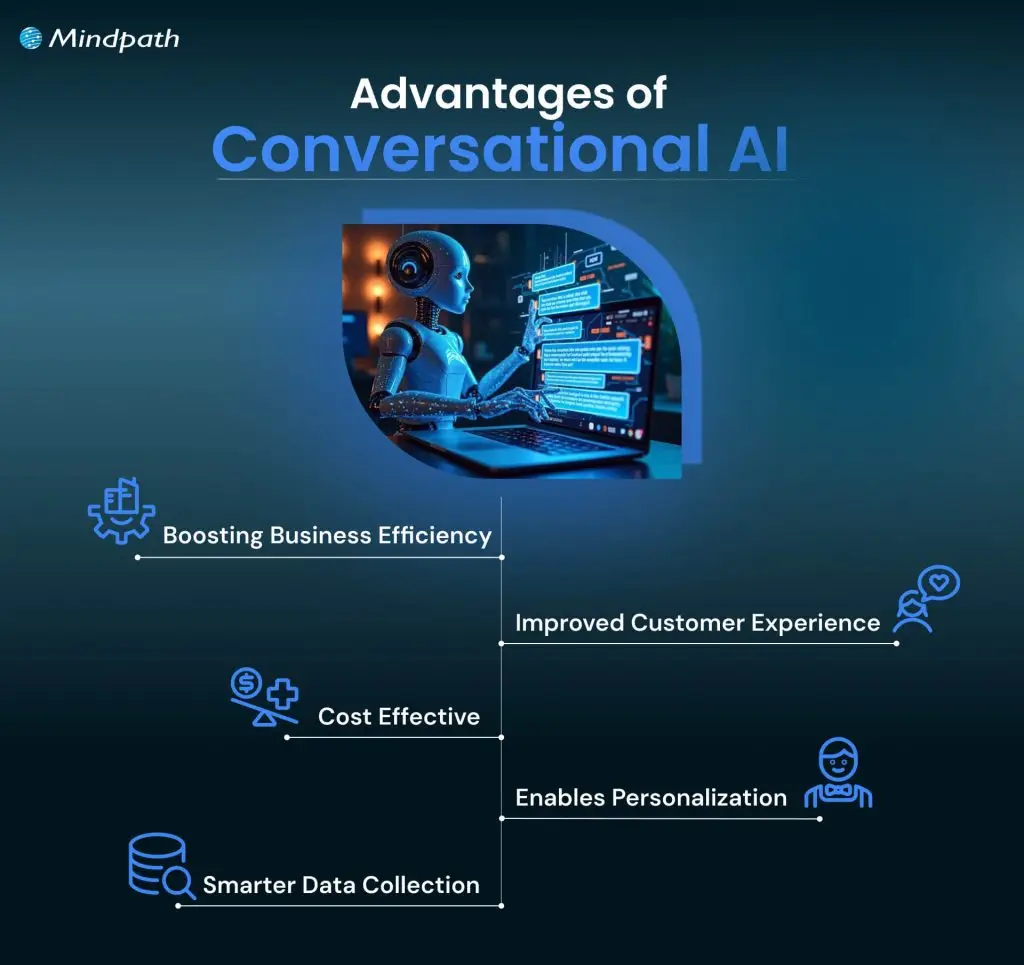
Advantages of Conversational AI

1. Boosting Business Efficiency

Conversational Artificial Intelligence can manage many routine tasks without needing a human agent every time. This means your team can spend more time on important work while the AI handles simple customer conversations. With artificial intelligence conversation tools available 24/7, your business can solve customer queries faster and work more efficiently, showcasing the many benefits of chatbot technology for operational productivity.

2. Cost-Effective

A good conversational AI platform can handle customer calls and chats automatically, with little need for extra staff. By making AI more human and accurate, it helps you manage high volumes of requests without extra cost. This saves money on daily operations and reduces mistakes, keeping your business cost-effective.

3. Improved Customer Experience

Artificial intelligence bots make it easy for customers to get quick answers and help whenever they need it. This technology offers personalized replies and a smooth, contactless service for people all over the world. It creates a better customer experience and keeps people happy with your business.

4. Enables Personalization

This technology learns from each customer’s information, like location and past interactions, to offer a more personal chat experience. It can suggest helpful answers and next steps based on what each person needs. This makes solving problems faster and reduces the need for follow-up calls.

5. Smarter Data Collection

This technology helps you collect useful information from every customer conversation. By tracking what people say and how they interact, you can spot trends and understand what customers really want. This makes it easier to improve your sales and marketing strategies over time.

Want to explore the innovations shaping the future of conversational AI? Explore our blog on the top AI trends to discover the emerging technologies redefining intelligent communication.

Use Cases of Conversational AI

Conversational AI can be used in many ways to make business operations smoother and customer interactions better. Here are some common use cases that show how an example of conversational AI works in real life.

1. Conversational IVR Systems

Modern IVR systems let customers speak naturally instead of pressing buttons to find help. For example, airlines now use conversational IVR to let travelers say things like “Change my flight” or “Check flight status” and get quick answers without waiting for a live agent.

2. Seamless Transfer to Live Agents

When a bot can’t handle a request, it passes the chat to a live agent along with all the details, so nothing gets lost. For example, a telecom company’s virtual assistant can detect when a billing issue is too complex and smoothly transfer the full conversation to a specialist who can resolve it faster.

3. Round-the-Clock Support

These chatbots answer simple customer questions at any time of day without needing a live agent. For example, an online retailer’s chatbot can help shoppers check order status or find return instructions even after business hours.

4. Tailored Product Recommendation

This technology suggests items people might like based on what they’ve bought or browsed before. For example, a streaming service’s chatbot can recommend new shows or movies based on what you’ve just finished watching.

Ready to build conversational AI that boosts sales and strengthens customer engagement? Learn how AI in e-commerce transforms online shopping experiences and drives measurable business growth.

5. Effortless Onboarding

These assistants help new employees feel confident and prepared by guiding them through company policies and tasks step by step. For example, an HR team can use an AI onboarding assistant to help new hires complete paperwork, set up work tools, and get reminders about training sessions.

6. Task Automation

These bots connect chats to your business tools, so tasks like updating customer records or creating tickets happen instantly. For example, the best conversational AI chatbot for an e-commerce store can automatically create a return request and send an update to the warehouse team.

7. Faster Lead Conversion

These chatbots ask visitors the right questions to see if they’re a good fit for your product or service. For example, a real estate company’s chatbot can collect details about a buyer’s budget and location, then connect them with the right agent.

8. Timely Updates

These AI tools send helpful reminders and updates before customers even ask, keeping everyone informed and stress-free. For example, a healthcare provider can use this to remind patients about upcoming appointments or share wellness tips.

If you want to use AI to improve your healthcare services. Learn from our blog AI in Healthcare, where we highlight real-world use cases of conversational systems supporting medical professionals and patients.

Conversational AI Best Practices

Using Conversational AI, the right way can help you get the best results for your business and your customers. Here are some best practices to keep in mind as you build and manage your AI solutions.
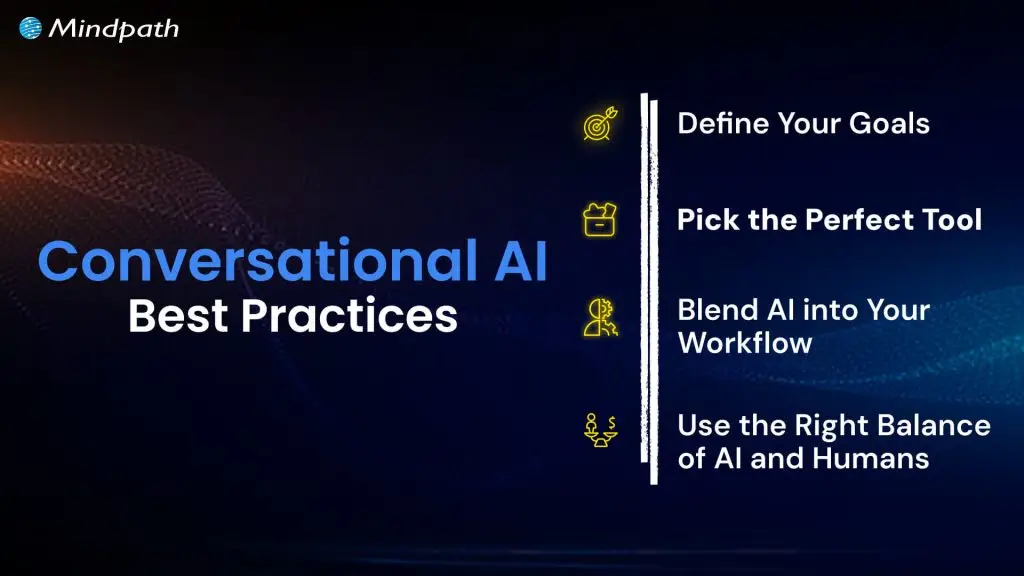
Conversational AI Best Practices

1. Define Your Goals

Always be clear about why you want to use conversational AI and what you want to achieve. Make sure it fits well with your bigger business plans, so it truly adds value.

2. Pick the Perfect Tool

Pick a conversational AI tool that fits your industry and matches your budget and goals. Make sure it can grow with your business, so you get the most value over time.

3. Blend AI into Your Workflow

Connect your conversational AI with your other business tools so it works smoothly with your daily tasks. This makes your processes faster, more accurate, and more useful for your team.

4. Use the Right Balance of AI and Humans

Let AI handle simple, repetitive tasks while your team focuses on work that needs a human touch. Always set clear points where the bot should hand over to a person for the best customer experience.

Curious how AI can optimize your workforce and improve business outcomes? Check out AI redefining job roles in Tech to see how intelligent systems are reshaping employee roles and driving operational efficiency.

Take the Next Step with Conversational AI

Conversational AI is transforming how businesses connect with people by making everyday interactions faster and more personal. It helps companies work smarter, serve customers better, and grow with less effort. Now that you know what is conversational AI, you can start using it to create more value.

Mindpath offers professional AI development services to help you build and launch conversational AI that matches your business goals. Our experts create secure, easy-to-scale chatbots, voice assistants, and smart integrations. Let us help you deliver great customer experiences and stay ahead in the AI space.

Related Post

Discover the ultimate guide to hiring Node.js developers in London. Learn about the skills, benefits, and cost factors involved in finding the right talent for your project.

Related Post

Hiring the right ReactJS developer is essential for building a high-quality online application. A talented developer should have a solid JavaScript background, knowledge of React ideas, and front-end programming experience. They must also be skilled in state management, user interface creation, testing, debugging, and version control to guarantee that the program runs smoothly. Aside from technical capabilities, problem-solving ability and collaboration are equally crucial. The following are the main abilities to look for when hiring a ReactJS developer in New Jersey

1. Strong JavaScript and React Fundamentals

A skilled ReactJS developer should have a solid grasp of JavaScript fundamentals, including ES6+ features like arrow functions, promises, and async/await. They must also be proficient in React concepts such as JSX, components, props, state management, and lifecycle methods. A deep understanding of rendering optimization ensures smooth application performance. Since React is built on JavaScript, hiring a developer with strong expertise in both JavaScript and React ensures they can efficiently build dynamic and responsive user interfaces tailored to your project’s needs.

2. State Management and Component-Based Architecture

Efficient state management is essential for handling complex applications. Look for developers with experience in Redux, Context API, or MobX to manage app-wide state effectively. They should also understand component-based architecture, which helps in building reusable, scalable, and maintainable UI components. A developer with expertise in React hooks and modular design can streamline development, reduce redundancy, and improve overall application performance, making your web solution more efficient and easier to scale.

3. Proficiency in HTML, CSS, and UI Development

A ReactJS developer should have strong HTML and CSS skills to create well-structured, visually appealing, and responsive user interfaces. Knowledge of CSS frameworks like Tailwind, Bootstrap, or Material-UI is a plus. They should also understand flexbox, grid layouts, and media queries to ensure the application works seamlessly across different devices. Well-structured UI components enhance user experience and performance, so hiring a developer who excels in front-end development is crucial for a successful project.

4. Testing, Debugging, and Version Control

Testing is key to building error-free applications, so ensure the developer is familiar with Jest, React Testing Library, or Enzyme for unit and integration testing. Strong debugging skills help identify and resolve issues quickly. Additionally, expertise in Git and GitHub is essential for version control, collaboration, and managing code changes efficiently. A developer with these skills can ensure a smooth workflow, minimize bugs, and maintain high-quality code throughout the development process.

Finding the right ReactJS developer can be challenging, but Mindpath makes it easy! Our expert developers have strong JavaScript skills, deep React knowledge, and experience with state management, UI development, testing, and debugging. Whether you need a junior, mid-level, or senior developer, we help you find the perfect fit for your project.
Let’s build something great together! Contact Mindpath today to hire top ReactJS developers in New Jersey!

Discover the ultimate guide to hiring Node.js developers in London. Learn about the skills, benefits, and cost factors involved in finding the right talent for your project.
Hire ReactJS developers in Canada

The pace of digital transformation makes every business think about the best ways to create intuitive, user-friendly, and visually appealing web applications. Thus, many businesses have been looking for the best ways to hire ReactJS developers in Canada and capitalize on the economies of scale. As one of the most business-friendly countries, Canada offers many reasons to choose it for any business venture.

ReactJS is the most powerful framework for frontend development, trusted by big companies such as Netflix. You can capitalize on the skills of ReactJS developers to create web apps that not only resonate with your values but also help you achieve business goals. Let us discover the notable aspects that you should keep in mind to find competent React developers for your next web project.

Want to take your web projects to new heights? Mindpath’s ReactJS developers in Canada deliver tailored solutions by creating responsive and engaging applications that will align with your business needs.

Tapping Into the Tech Scene in Canada

Many readers would have assumed that Canada is not the ideal destination for hosting technology-based businesses. On the contrary, hiring ReactJS developers in Canada might be easier than in other locations due to its tech-savvy workforce and innovative spirit. Canada has emerged as one of the prime destinations for top-tier tech talent for many reasons. Along with a highly educated workforce, the country also hosts a thriving startup ecosystem.

Canada has some of the most popular educational institutions in the world, such as the University of British Columbia and the University of Toronto. The institutions produce graduates with impeccable fluency in technical skills, and many institutions offer specialized programs for software engineering. As a result, the workforce in Canada boasts a significant number of developers who are fluent in ReactJS.

Another prominent reason to consider Canada as a prime tech hub is the growing ecosystem of tech companies. For instance, Toronto harbors the Silicon Valley of the North, while Vancouver is home to multiple startups. Businesses can look for options to hire React developers in Canada, as the country attracts top talent and also hosts events where React developers showcase their skills. Most important of all, the cost of hiring React developers in Canada is more competitive than the hiring costs in the USA or other major destinations.

Weighing the Relevance of ReactJS in 2025

New technologies and frameworks for web development can make old frameworks obsolete. However, ReactJS is still a powerhouse for web development even after more than a decade of its arrival. It was created by Meta, which still takes responsibility for its maintenance even after making it open-source. Apart from the fact that it was created by a tech giant, ReactJS is a powerful frontend development framework due to its distinctive features.

Business owners and hiring managers want to explore the React developer job market in Canada to capitalize on the utility of ReactJS. The component-based architecture of the framework helps in creating reusable UI components that ensure better speed and scalability in development. The other notable features of ReactJS include the virtual DOM and its declarative syntax, which make it easier for developers to develop high-performance web apps.

Virtual DOM is a revolutionary feature of ReactJS as it ensures code stability and better performance with the assurance of a limited number of direct modifications in the actual DOM of browsers. On top of it, the thriving ReactJS community also offers a collection of tools and learning resources that help developers address project complexities with ease.

Skills Required in Top ReactJS Developers

Almost anyone in the tech landscape can become a ReactJS developer, as it is comparatively easier to learn than other frameworks. However, basic knowledge of ReactJS concepts does not make a developer the ideal pick for your web projects. The answers to “What skills should a ReactJS developer in New York have?” will help you understand that React developers must have a mix of technical and soft skills. In addition, companies searching for React developers in Canada will need developers who understand the local tech landscape.

1. Technical Skill Requirements from React Developers

Since ReactJS is a JavaScript framework, hiring managers should choose developers who have an in-depth understanding of JavaScript. It is important to ensure that ReactJS developers have a strong command of the latest ES6+ specifications of JavaScript. Fluency in functional and asynchronous programming is an essential skill that helps ReactJS developers in creating syntactically effective solutions. The important technical skills of ReactJS developers also include mastery of ReactJS concepts such as props, state management, hooks, and components. Professional ReactJS developers are also fluent in advanced features such as the React Router, Redux, and Context API.

The list of ReactJS developer skills to look for also focuses on knowledge of frontend development tools. For instance, developers must know how to work with build tools like npm and yarn. On top of it, proficiency in HTML and CSS makes a ReactJS developer capable of optimizing web apps for easier navigation. The other important skills required for ReactJS developers include the ability to understand API integration and testing. Recruiters should check whether candidates for React developer jobs know how to work with testing frameworks like the React Testing Library.

2. Soft Skill Requirements from ReactJS Developers

As a business owner, you must understand the importance of having ReactJS developers who know how to work in an organization. You cannot have technical experts who don’t know how to communicate or solve problems with innovative approaches. Most of the React developer hiring tips emphasize the necessity of having soft skills that help a developer navigate the business aspect of their job. The essential soft skills required from ReactJS developers include critical thinking, adaptability, communication, and attention to detail.

Developers without critical thinking abilities are likely to be stuck with emerging problems. Critical thinking skills can help ReactJS developers think of innovative solutions to problems from unconventional perspectives. React developers must also be adaptable to changes in the technological landscape and stay updated with new features of ReactJS. Furthermore, a React developer with attention to detail can ensure that a business gets the most efficient web apps without multiple reworks.

Ideal Hiring Model for ReactJS Developers

The hiring model defines the approach a business adopts to use the services of ReactJS developers. You can find different hiring models, such as in-house developers, freelancers, remote developers, or professional agencies. If you want to know ReactJS developer hourly rates, then you might need developers for short-term projects or to address specific skill requirements. Depending on the requirements, businesses can choose one of the following hiring models to tap into the expertise of ReactJS developers.

1. In-House Developer Teams

Many organizations have in-house developer teams to work on web development projects. However, organizations without a hefty budget for hiring developers, such as startups, will find it difficult to recruit in-house developers. In-house ReactJS developers can offer many advantages, such as direct control over how they work. On top of it, businesses can ensure that in-house developers align with the company culture in their work. In-house React developers are more likely to follow the company’s vision and values.

2. Remote ReactJS Developers

The next big option for any hiring manager to bring ReactJS developers on board is remote work. Recruiters can choose remote ReactJS developers in Canada from various platforms that offer access to pre-vetted talent. Remote developers can help a business avoid the trouble of hiring a full-time employee. The biggest advantage of choosing remote developers for ReactJS projects is the assurance of capitalizing on a global talent pool.

3. Professional ReactJS Development Services

Among the many options to add the most competent ReactJS developers to your organization, professional development services will stand tall. Why? Business owners don’t have to worry about how to hire ReactJS developers while working with professional development services. Professional ReactJS development agencies have teams of experienced developers who have worked on multiple web development projects. As a result, businesses can get the output of an in-house developer team from professional React development services without any concerns about managing resources.

Strategic Process for Hiring ReactJS Developers in Canada

The awareness of essential skills and hiring models to welcome ReactJS developers into your organization can provide a strong foundation to create the hiring process. You don’t have to think about ReactJS developer cost in Canada from the beginning. On the contrary, the following steps will help you with a strategic approach to pick the right talent for ReactJS web development projects.

1. Prepare a Job Description for Top-Tier Talent

The hiring process always starts with the creation of a job description that outlines key responsibilities, job title, and skills required for the job. Some hiring managers also choose to add the estimated salary in the job description. However, it is important to understand that the job description is the best resource to attract the top ReactJS talent in Canada to any company. Applicants for ReactJS developer jobs use the job description to understand what to expect from the job.

The job description helps in understanding the complexity of projects that developers have to work on and the level of experience required for the projects. As a result, the job description ensures that only qualified candidates apply for the ReactJS developer jobs.

2. Explore the Ideal Platforms to Find Talent

Hiring managers can use the job description to find the best talent only when published on the right platforms. The ideal platforms that can support your efforts to hire ReactJS developers in Canada include professional networking platforms and job boards. LinkedIn is one of the best examples of professional networking platforms to find skilled ReactJS developers. You can publish job listings on LinkedIn and also review the qualifications of candidates from their profiles directly.

The other notable places to find expert ReactJS developers include job boards like Glassdoor and Indeed. Businesses should also consider exploring online forums and visiting community meetings for ReactJS developers to pick the best talent for their web projects.

3. Screening and Interview Process

The most crucial part of the hiring process deals with the screening of candidates and the interview process. The screening process must focus on the assessment of the job applications and resumes of applicants. Hiring managers can also call candidates to interact with them over the phone or via video calls. It will help in determining whether they will be an ideal fit for the job. The first call helps in finding a lot about the communication skills and technical fluency of candidates in React development.

Once you have completed the screening, the hiring process will shift towards interviews. The interviews for hiring ReactJS developers must include a comprehensive assessment of coding capabilities and understanding of React concepts. Live coding sessions, simulated coding challenges, and questions on core React concepts can help in testing the candidate’s practical skills.

4. Know the Hiring Costs

Another crucial aspect of hiring React developers is the hiring cost. Many people assume that hiring costs only focus on the salary of ReactJS developers. The answers to “What is the cost of hiring a ReactJS developer in Canada?” will also include the recruitment and onboarding costs. Recruitment costs include the costs of publishing job descriptions and the expenses for the screening and interview process. The onboarding costs include costs for training and the resources and equipment provided to qualified candidates after the interview.

The average annual salary of a ReactJS developer in Toronto is around CAD $68,000 for entry-level roles (Source). You can also find some platforms that predict that the average salary of React developers is almost $140,000 per year (Source). While the salary forms a major chunk of the hiring costs, it can vary according to location, experience, and responsibilities.

Final Thoughts

The insights into the process of hiring professional React developers in Canada can help you recruit the best talent. With a tech-savvy workforce and thriving ecosystem of innovation, Canada is a promising destination for business growth. As businesses grow, they need proficient ReactJS developers to create engaging and intuitive web apps for their digital presence.

Mindpath offers Canada-based ReactJS development services to businesses of all sizes across various industries. Our reputation as an end-to-end IT solutions provider revolves around catering to the client’s vision and requirements. On every project, all our team members use their experience as well as insights to design elegant solutions. Connect with us and discover the ideal roadmap to create your next web project right now.

Discover the key factors influencing software development costs and how to optimize your budget. Learn how Mindpath can help.
Cloud Computing Trends 2024

Are you curious about how cloud computing will evolve in 2024? What new technologies will shape the way we store, process, and access data? As the cloud landscape continues to grow and evolve, staying updated on these trends is more crucial than ever. In this blog, we will explore the latest cloud computing trends set to redefine the digital landscape this year. 

Cloud computing is the practice of employing internet-based services rather than maintaining everything on your personal computer. Imagine you need to save data, run programs, or use tools, but instead of doing it on your device, you access them over the internet. The real data, such as your files and applications, is stored on large, powerful computers known as servers, which belong to businesses such as Google, Amazon, and Microsoft. They handle everything, so you don’t need to worry about monitoring or maintaining anything. As long as you have internet connectivity, you may utilize everything you need, such as storage or software, at any time and from any location.  

Understanding cloud computing trends is essential for both your career and business. Businesses can pick the finest services and solutions, save money, and increase efficiency by having a thorough awareness of these trends. Staying up to date on what’s new and popular allows you to make better decisions, stay ahead of the competition, and maximize the benefits of the cloud. 

So, let’s dig in to explore the cloud computing trends 2024! 

Cloud Computing Trends 2024

1. Kubernetes and Docker

In 2024, Kubernetes and Docker will be key players in cloud computing. These technologies make cloud application management and deployment easier and more efficient. Docker enables you to organize your program and its dependencies within a lightweight, portable container. This implies that your program can work properly on any platform, including your PC and the cloud. Kubernetes goes a step further, managing and coordinating these containers. It automates processes such as scaling up or down and balancing workloads, ensuring that everything functions smoothly without requiring continual manual changes. As more businesses use cloud computing, Kubernetes and Docker are becoming increasingly important for improving and flexibly delivering cloud services.  

2. DevSecOps

In 2024, DevSecOps will be an essential approach to cloud computing security. It stands for Development, Security, and Operations, and it focusses on implementing security measures from the beginning of the development process. Rather than waiting until an application is complete to check for security flaws, DevSecOps ensures that security is built in throughout. This helps to defend against issues such as hacking, service outages, and unauthorized access to data. Cloud service providers offer tools and services that enable DevSecOps easy to utilize. Businesses may use these technologies to ensure their cloud environments are secure and free of possible dangers. 

3. Disaster recovery and backup

Disaster recovery and backup will be essential in 2024 for ensuring the security of your cloud data. If anything goes wrong—like a server breakdown, a power outage, a natural disaster, a cyberattack, or a hardware failure—having a robust backup strategy allows you to recover your data fast. Cloud computing simplifies this process by keeping copies of your vital data online. This manner, if something occurs to your primary PC, you can swiftly recover everything from the cloud. Many companies automatically store important data and information to cloud servers. This means companies don’t have to worry about losing important information and can keep their operations functioning smoothly even during catastrophes. 

4. Edge computing

Edge computing is changing the way we handle information by bringing it closer to where it originated. This reduces delays and speeds up operations. With the emergence of 5G networks, edge computing is becoming increasingly significant since it enables real-time data processing and enhanced security. Edge computing is becoming increasingly important as more devices connect to the Internet of Things (IoT), allowing for faster data analysis and smoother communications. Edge computing improves speed by bringing data processing closer to the source, ensuring that data is handled safely and effectively. 

5. Internet of Things (IoT)

The Internet of Things (IoT) is a rapidly emerging technological trend. IoT collects massive volumes of data via a network of sensors and devices, which is subsequently stored on cloud servers. This data is analyzed to offer relevant information for making business decisions. IoT connects various devices, computers, and networks, enabling them to communicate and share information. It can collect data remotely and control things from a distance. This smart connection is crucial for IoT’s appeal in cloud computing since it allows for more effective data management and utilization across several platforms. 

6. Low Code and No Code

Low-code and No-code Cloud solutions are transforming the way we develop applications by making it easy for anybody, not just experts, to create software. These platforms enable people to create apps and employ AI technologies with minimum technical knowledge. Instead of writing large amounts of code, you can quickly develop and launch projects using simple, user-friendly tools. This speeds up the development process, reduces errors, and makes technology more accessible to a larger audience. Users can easily construct apps using popular tools like Figma and Zoho, without having to maintain complex coding systems. 

7. AI and ML

Artificial intelligence (AI) and machine learning (ML) are leading cloud computing trends. These technologies demand a significant amount of computing power and storage to manage data and train models, but they also provide strong and cost-effective solutions. In 2024, we can expect AI and machine learning to drive trends such as self-automation, which allows systems to handle themselves, and personalized cloud services that adapt experiences to individual demands. These technologies will also enhance data security and privacy. Major technology businesses, such as Amazon, Google, and IBM, are aggressively investing in AI and machine learning. Amazon’s AWS DeepLens and Google Lens, for example, make use of machine learning to provide enhanced capabilities and improve user experiences. 

Cloud Computing at Mindpath

Mindpath’s cloud computing platform enables businesses to leverage advanced technologies without having to handle it all themselves. Mindpath provides a variety of cloud services that allow you to conveniently and securely store data, execute programs, and access resources online. 

Our cloud solutions are intended to be adaptable and scalable, allowing them to expand alongside your organization. Whether you need to back up important information, operate complex apps, or optimize your IT infrastructure, we have you covered. We guarantee that everything goes smoothly and securely, enabling you to focus on what is most important to your organization. 

Final Thought

As we look ahead to 2024, the cloud computing world is full of intriguing possibilities. Keeping up with these trends is essential from the rising relevance of Kubernetes and Docker in application management to the creative breakthroughs in AI and ML that are creating smarter, more secure solutions. Edge computing and IoT technologies are changing the way we manage and process data, while low-code and no-code platforms make app creation easier than ever. 

At Mindpath, we are dedicated to assisting organizations in navigating these changes and realizing the full potential of cloud computing. Our cloud solutions are adaptable and scalable to match your demands, whether you want to strengthen your IT infrastructure, secure your data, or innovate with cutting-edge technology.  

Ready to Transform Your Cloud Experience?

Dive into cutting-edge technologies with Mindpath’s tailored solutions and keep your business ahead in 2024.