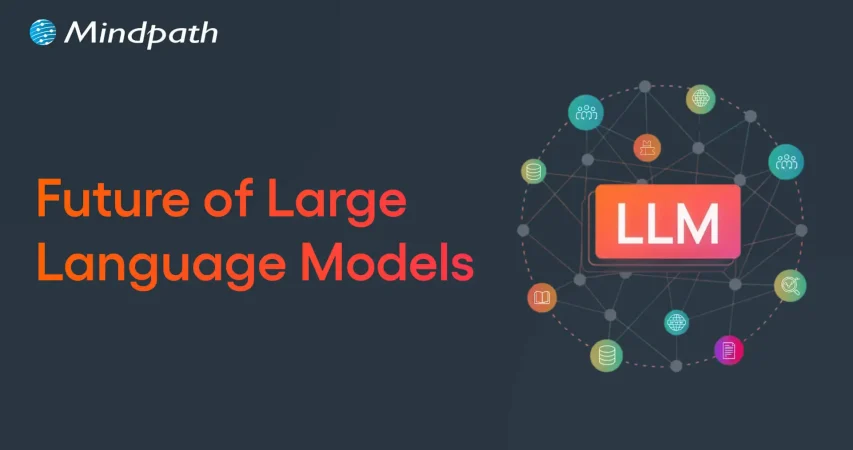
The Future of Large Language Models (LLMs) Beyond ChatGPT

Join our Newsletter!

Featured Posts

Support Is One Click Away

Home

The Future of Large Language Models (LLMs) Beyond ChatGPT

Future of Large Language Models (LLMS)

The Future of Large Language Models (LLMs) Beyond ChatGPT

Large Language Models (LLMs) are one of the most transformative, or we can say critical, breakthroughs in AI. LLMs are redefining how people communicate, create, and make decisions. It is believed that the future of large language models (LLMs) will have a greater influence and go beyond just chatbots. AI models like Claude, Bard, and ChatGPT have shown their ability to produce human-like text. However, we are just beginning to explore what LLMs can do. Next-generation LLMs will be multimodal and hyper-intelligent, capable of managing more complicated tasks. This blog will discuss the present state of LLMs and their future in AI. Most importantly, we will understand how to guide modern AI responsible for safe, inclusive and meaningful impact.

Want to explore how the next wave of LLM advancements can transform your customer experiences? Mindpath’s AI development services will help you implement cutting-edge LLM capabilities tailored to your unique goals and industry.

Basics of Large Language Models (LLMs)

Let us explain this to you in simple words. Large Language Models (LLMs) are sophisticated and advanced artificial intelligence systems. These systems have the capabilities to understand and generate human-like text. 

These models are developed utilizing deep learning methods or transformer architecture. It enables them to easily analyze a massive amount of data to generate relevant text. LLMs can handle different tasks, such as content generation, translation, and summarization. 

Must Read: Generative AI Tools for Content & Code Creation

Evolution of LLMs – Understanding the Key Milestones

Before we start a detailed discussion on the future of large language models (LLMs), it would be nice to take a moment to appreciate how far LLMs have come. From just a simple, rule-based chatbot to a multimodal AI system, LLMs’ evolution is quite extraordinary.

1. Pre-2010- Laying the Foundation

  • 1950s -1970: NLP groundwork was laid out by AI research. A major milestone was Eliza. This was the first chatbot that could mimic human-like interaction. It was written in rule-based scripts.
  • 1980s- 1990s: NLP changed to statistical techniques and could support data-driven and more flexible language processing.

2. The Emergence of Vector Representations

  • 2010:  Many NLP works were powered by Machine Learning. 
  • 2013: Google presented Word2vec to the world. It effectively captured semantic relations and improved the performance of NLP.

3. Rise of RNNs and Attention

  • 2014: Seq2seq or Sequence-to-sequence models and RNNs or Recurrent Neural Networks witnessed massive popularity.
  • 2015: The attention mechanism came to the limelight. It also allowed AI models to emphasize important components in a sequence, which enhanced the speed and quality of translation.
  • 2017: The paper “Attention is All You Need” introduced the transformer architecture. That revolutionized NLP and allowed better sequence handling. 

Wondering what enables LLMs to focus on the most relevant information in a sentence? Discover attention mechanism explained and check out how it works in real AI models.

4. Emergence of BERT & GPT

  • 2018: OpenAI released a system called Generative Pretrained Transformer or GPT. It showcased unsupervised learning of AI models. On the other hand, Google launched Bidirectional Encoder Representations from Transformers or BERT in October. The aim was to enhance the contextual understanding of models.

5. Scaling Up

  • 2019: OpenAI launched GPT-2 with around 1.5 billion parameters. It produced context-based, extended text. 
  • 2020: GPT-3 was introduced with 175 billion parameters. The model was incredible in answering questions, text generation and translation.

6. Multimodality and Democratisation

  • 2021 – 2022: Newer models began to appear. That includes the Meta OPT and Google LaMDA. OpenAI introduced a multimodal AI model, DALL-E, capable of generating images with text analysis.

Apart from these, GPT-4 and other creative systems, including Midjourney, increased the capabilities of multimodality. 

7. Open Innovation, Efficiency, and Localization

  • 2024: LLMs witnessed significant improvements in alignment, training efficiency and reasoning. Furthermore, open-source models also gained traction. The use of lighter architectures enabled on-device deployment. 
  • Organizations adopted fine-tuned LLMs and RAG or Retrieval-augmented Generation for domain-specific and secure use. 
  • 2025: LLMs are embedded in different sectors such as finance, education and healthcare. The rising adoption forced organization to shift focus to data privacy and regulatory compliance. 

From rule-based models to today’s multimodal, responsible AI systems, this timeline reflects the remarkable evolution of large language models (LLMs). Now, let’s talk about the future of Large Language Models (LLMs) and the driving factors behind the rising trends.

Planning to customize large language models for specific business use cases? Check out OpenAI’s Fine-Tuning API tutorial to learn how tailored AI models improve performance.

The Future of Large Language Models (LLMs)

The future of Large Language Models (LLMs) goes beyond chat-based interactions, establishing a foundation for significant advancements. It will not be wrong to say that new models are set to revolutionize how organizations function. 

The introduction of the LLMs into the major workflows will enable organizations to experience unprecedented levels of strategic foresight, accuracy and automation. Now, let’s understand about the influence of LLM on major AI-centric industries.

1. Healthcare

Large language models are significantly reshaping the global healthcare industry by: 

  • Supporting bioinformatics and making the process of drug discovery quick and effective. 
  • Automating documentation to lower the administrative workload. 
  • Summarizing multiple medical literature quickly to enable evidence-based, quick decisions. 
  • Improved patient engagement through interactive and intelligent chatbots.

Must Read: AI in Healthcare

2. FinTech

Even though the adaptation rate is not that high, every financial institution can benefit from the integration of LLMs through: 

  • Automated yet accurate financial reconciliation and reporting. 
  • Pattern-based risk modelling and fraud detection. 
  • Processing and handling complex regulatory frameworks while ensuring maximum accuracy. 

3. Legal Tech

In the field of legal services, large language models enable:

  • Real-time tracking of compliance. 
  • Faster contract analysis as well as drafting.
  • Improved legal research, covering multiple jurisdictions. 
  • Precise summarization of case laws and legal precedents.

4. SaaS and Enterprise

The LLMs are transforming several enterprise operations by: 

  • Enhancing team collaboration and communication.
  • Automating workflows in different departments. 
  • Helping developers with tasks like documentation, debugging, code generation and more. 
  • Creating as well as maintaining dynamic knowledge bases. 

Also Read: Saas Trends

5. Marketing

In marketing, these models support creativity and performance through: 

  • Automating SEO-rich product descriptions and blog writing. 
  • Creating hyper-personalized emails, social media content and ad copy. 
  • Increasing ad campaign targeting using predictive language modelling.
  • Understanding and analyzing market trends and customer sentiment. 

These applications clearly demonstrate that the future of Large Language Models (LLMs) will be defined by scalable impact, niche-specific intelligence, and deep integration. Almost every industry is now adopting customized LLMs, and this increases the potential for LLMs’ transformation. 

Want to fine-tune large language models without high computational costs? Check out Low-Rank Adaptation (LoRA) to learn an efficient approach to model customization.

Key LLMs Trends to Watch

As large language models (LLMs) are continuously evolving, various key LLM trends are emerging. These trends will surely redefine LLMs’ trajectory in the coming years.

1. Smart and Smaller Models

Lightweight and efficient AI models such as TinyLlaMA and Mistral have proved that performance and efficiency can coexist. 

2. Retrieval-Augmented Generation

RAG significantly influences how LLMs process external data. The combination of real-time data retrieval and generative capabilities has enabled models to offer accurate responses. 

3. Multilingual Mastery

LLMs will become fluent in different languages, enabling global accessibility. 

4. Community-Driven Advancement

Various community-driven AI models will influence innovation, especially in research and education. 

5. Autonomous Agents

LLMs will be autonomous. They will perform tasks like planning and execution without any human intervention.

These amazing trends are an indication of a bright future of Large Language Models (LLMs), where they will transform from passive to highly intelligent systems.

Ready to understand how different AI categories shape the evolution of large language models? Check out types of AI to learn how each form impacts modern LLM development.

Challenges and Considerations

The increased impact of LLMs in industries presents certain issues. These problems should be addressed to make the deployment sustainable and responsible.

1. Improving equity and minimizing bias. 

2. Maximizing energy efficiency and sustainability in models.

3. Designing LLMs keeping privacy, regulation, and copyright in mind.

Well, collaborative governance, interdisciplinary research, and transparent development methods will have important roles in the future of LLMs in AI.

Curious how organizations turn LLM innovation into real business value? Discover AI consulting to check out strategic approaches for deploying AI effectively.

Looking Ahead – Moving Toward a Massive Transformation

ChatGPT may have brought the large language models (LLMs) to the limelight, but the true transformation of LLMs is just beginning. It can be said that the future of large language models (LLMs) is more exciting. They will change how users interact with AI models and how these models collaborate with users across different industries. 

However, you should keep in mind that staying ahead of the trends means leveraging more than just tools. It requires an extensive knowledge on the philosophy that backs the models. And this is where Mindpath can help. Whether you are optimizing your existing AI system or creating AI-integrated workflows, our AI development services can assist you in harnessing the true power of modern LLMs. From ethical guidance to tailored implementation and optimization, we can handle everything. Consider us as your trusted AI partner and prepare to unleash the transformative capabilities of LLMs.


Related Post

Discover the top Node.js trends shaping digital technology in 2024, from AI and TypeScript to IoT and cloud computing. Explore how Node.js drives innovation!
Discover the ultimate guide to hiring Node.js developers in London. Learn about the skills, benefits, and cost factors involved in finding the right talent for your project.

Related Post

MVP for startups

Every entrepreneur believes that they have the next big “idea” that could disrupt an industry. The chances of success for your startup depend completely on how you translate that idea into a product that solves the problems of customers. This is where you need to think about the value of MVP of startups and their impact on your growth. 

The MVP or minimum viable product is an important step in building the foundation required to achieve the desired goals for your startup. Without an MVP, you are likely to invest in developing products that may not be successful. Learning about the significance of a minimum viable product can help you identify the reasons to build one for your startup.

Are you a startup struggling to validate your idea before investing heavily? Mindpath offers MVP Development Services to help you test concepts and launch faster with minimal risk.

Understanding the Definition of MVP

Before you dive into the benefits of MVPs, you must understand its definition. The minimum viable product is the simplest version of the product you intend to sell to your customers. It includes only the basic features and helps you check the utility and relevance of the product with the help of feedback from actual users. The growing popularity of MVP development for startups across various industries has led many entrepreneurs to think about its benefits. 

Is a MVP really necessary for your startup? Many startup owners will think that investment in developing a MVP may increase their financial burden. On the other hand, you should think about the consequences of creating a full-fledged product with everything you have and more, only to end up with failure. MVPs can help startups test their ideas without investing all their resources and make necessary improvements before creating final products. 

Demystifying the Reasons to Build an MVP for Startups

The notion of establishing your own startup might be an exciting one albeit with one big challenge. Did you know that almost 90% of startups fail? Therefore, many entrepreneurs choose MVP development services for startups to increase their chances of surviving the competition. An overview of the benefits of the minimum viable product can explain for why every startup must create one. 

1. Aligning Your Product with the Target Market

One of the foremost reasons for which startups should develop an MVP revolves around ensuring that the final product is suited for the target market. Entrepreneurs should know “what is MVP” and how to use it to find the right market for their product and services. Testing the basic version of the product you want to build with real users gives you access to actual and relevant feedback. 

Your MVP will tell you whether the target market needs your product and how to improve it with useful features. Startups can leverage MVPs to experiment with product design and refine it till they achieve the right product-market fit. The MVP can easily identify whether your product cannot solve a real problem for your target audience in early stages.

2. Developing Products for Your Core Audience

A minimum viable product not only helps you develop products for the market but also for your core audience. The core audience of a startup includes customers who are more likely to buy their products and services and contribute more to their revenue. Any entrepreneur searching for MVP startup meaning must know that creating products that cater to the core audience increases possibilities of success. Tailoring your product for the core audience ensures higher customer satisfaction as they will believe that their needs have been kept in mind while developing the product. 

The MVP offers an opportunity to obtain valuable feedback from the core audience and make product improvement decisions on the basis of actual user experiences. You can not only identify the features that your customers want in a product but also discover relevant market trends. As a result, you can ensure that your product can evolve along with market demands while addressing the needs of your target audience.

3. Introducing Products at a Faster Pace

The next promising reason to look for opportunities to create an MVP is the assurance of faster time to market. Most of the startups struggle to accelerate the time to market due to various constraints. The utility of MVP solutions for startups becomes clearly visible in faster testing of product ideas. If you can identify how your product will solve the pain points of your target audience, then you will gain an early advantage over competitors.

The feedback received for an MVP from actual users help in refining your product by identifying exactly what works the best. Startup owners can avoid assumptions and use insights that help in making informed decisions for improving their products. It provides an ideal tool to reduce unwanted expenses during the development process and streamline your efforts. You can rely on the MVP for building a community of early adopters and their experiences will provide a strong foundation to attract new users.   

Preparing to build software that truly matters, you need a clear and efficient starting point. Explore our blog on MVP in software development to learn how early validation and focused execution can turn your idea into a successful product.

4. Making Your Product More Flexible

Another top reason to hire a MVP development consultant for your startup focuses on creating more responsive products. The dynamic business landscape keeps changing constantly and so do your target audience’s needs. Startups cannot afford to build products that fail to adapt to changing user requirements. Your MVP plays a major role in adapting and refining your product on the basis of user feedback. 

The minimum viable product provides the guarantee that your product can evolve according to changing preferences of your target users. Entrepreneurs can check whether their product is responsive to user-centric updates and enhances customer satisfaction. Product flexibility is a crucial advantage of the MVP approach that offers the assurance of success for your product in the long run.

5. Playing Safe with Your Investment in Product Development

Any startup that begins product development without a MVP is likely to invest everything in creating a full-fledged product. What if the product you have created with almost all of your resources does not meet your customer’s expectations? This is where MVP development can save you from unwanted expenses by helping you scale up investment as your product gains traction. Entrepreneurs can leverage MVPs as a more sustainable approach to product development with financial safety. 

You can start with the basic version that will require minimal development costs and add features according to user feedback. The MVP reduces financial risk by avoiding a full-scale product launch before creating the ‘perfect’ product. On top of it, developing the MVP helps you with strategic allocation of resources. Startup owners can use their MVP to invest gradually in product development as the product design becomes more suitable for success.  

6. Leveraging Short-Term Wins for Long-Term Success

The list of benefits associated with MVPs for any startup would be incomplete without including the short-term wins. The milestones in MVP development for startups not only provide an effective roadmap for product development but also enhance the momentum for your project. Startups can view the successful completion of milestones as a source of motivation for their teams and stakeholders. 

Stakeholders and investors will perceive the short-term wins as the representation of a startup’s capabilities to deliver on their promises. When an investor notices tangible outcomes from the product development process, they are likely to continue supporting your product. Meeting user needs in early stages helps in building a strong user base for your product and guarantees long-term success.

7. Enhancing Precision in Product Development

Most of the explanations for MVP meaning in business emphasize the ways in which it helps in identifying relevant features. The minimum viable product serves as a useful tool to adapt the core features of your product to user expectations. The feedback obtained from real users of MVPs not only helps in identifying core features but also in refining them. 

Startups can focus on features that their target users care the most about and ensure alignment with user needs. The MVP development cost can prove to be a successful investment as it enhances precision in product development. Apart from prioritizing features, your MVP also helps you understand technical complexities in the product. As a result, you can introduce improvements that help your users navigate the complexities with ease.    

Want your MVP to move from concept to reality fast? Check out our blog on hiring full-stack developers for MVP to see what skills and qualities matter most, which leads to successful builds tailored to your needs.

Final Thoughts

The benefits of a minimum viable product for startups offer strong reasons to build one for every startup product idea. Many startups fail to recognize the fact that starting small delivers massive benefits in the long run. When you build MVP for a new product, it helps you develop products that align with the preferences of your target audience. In addition, the MVP proves to be a formidable resource for earning the trust of your stakeholders and investors.

Mindpath is a MVP development company with years of experience in building minimum viable products for startups in different industries. We have guided startup owners through the process of creating their MVPs with our expertise and resources. Our strengths in creating MVPs can spell the difference between success and failure for your startup. Reach out to our consultants and create your MVP now.

generative ai in market research

Generative AI is undoubtedly among the most promising technologies that have come into existence in recent years. The impact of Generative AI can be felt in diverse domains such as healthcare, business, and many more. The global generative AI market size is expected to touch USD 890.59 billion by the year 2032.

A particular area where generative AI is being used as a revolutionary tool is market research. Typically, businesses conduct market research, which helps them to make strategic decisions. In recent times, businesses across diverse industries have been leveraging generative AI in order to simplify their market research process. If you are curious to know, ‘How is generative AI in market research?’ You will find an answer to this question now.

Ready to take advantage of generative AI for smarter market research? At Mindpath, we offer AI development services to build custom solutions that deliver actionable insights and a competitive edge.

Role of Generative AI in Market Research

Before understanding the exact role of generative AI in market research, one must have clarity on “what is generative AI.” Generative AI refers to the type of AI technology that is capable of creating new content. Thus, this novel technology can create content in diverse formats like images, texts, video, and audio. It relies on the patterns that it has learned from the existing data.

Today, the role of generative AI in market research is of immense value. By integrating this novel technology, businesses are able to gain valuable insights into the latest market trends. Moreover, they are able to predict customer behavior and needs in an effective manner and deliver offerings in a prompt manner. According to McKinsey AI Report 2025, the potential of generative AI is immense. This innovative technology has the power to maximize the productivity of businesses.

Must Read: Generative AI Tools for Content & Code Creation

Benefits of Generative AI in Market Research

The economic potential of generative AI in the next productivity frontier is immense. In the market research landscape, generative AI is already playing an instrumental role in creating value for businesses. Some of the chief benefits of generative AI include:

1. Ability to gain faster insights

Generally, market research is a lengthy process for businesses. Traditionally, businesses took several days or even weeks to conduct market research. However, the adoption of generative AI in market research has simplified the entire process. Businesses can conduct market research in an efficient and accurate manner with the help of generative AI. Thanks to the novel technology, the boundaries of market research AI have expanded for businesses.

2. The bigger picture of customers

Thanks to generative AI, businesses are able to get a bigger picture of their existing as well as potential customers. By using the capabilities of generative AI, businesses are in a position to understand the exact preferences of their target audience. Moreover, they are able to create detailed customer profiles, which helps to create value for them.

3. Improved cost efficiency

Previously, businesses had to incur significant costs to carry out market research. Many businesses had to hire researchers or interviewers. Even if research was carried out in-house, it was time-consuming and expensive. However, the integration of generative AI in the market research process has made it much more cost-efficient. By adopting the novel technology, businesses are able to automate recurring tasks. Thus, the possibility of human errors is reduced significantly.

Curious how the generative AI revolution is reshaping market research? Explore the generative AI revolution to see how it’s transforming insights and decision-making.

Top Use Cases

Today, a greater number of businesses have started to rely on generative AI to conduct market research.  In order to understand the potential of this innovative technology, it is necessary to look at the real-world use cases of it. Some of the top use cases include:

1. Automation of data collection

Many business entities are adopting generative AI to automate how they gather data from the market. For example, they are able to generate survey questions. Moreover, this novel technology enables business entities to analyze the responses of their audience in an instant manner. As a result, it is possible to save valuable time and resources while undertaking market research activities.

2. Generation of research reports

After conducting research, businesses create reports based on the research findings and insights. The adoption of generative AI in the market research process has simplified how businesses create content for their reports. Instead of relying on manual report generation, businesses are able to use it to generate quality and accurate reports that are based on their market research. Thus, they can refer to these informative documents to craft their business strategies and plans.

3. Information synthesis

In the current era, a large number of data is available for businesses. This automatically makes the market research process very tedious in nature. However, by using generative AI for market research purposes, businesses today are able to synthesize information effectively. This is because generative AI is capable of sifting through a large volume of data in a precise and efficient manner. By synthesizing information at a comprehensive level, businesses are able to gain valuable and accurate insights.

Wondering how generative AI is changing industries beyond tech? Check out generative AI use cases in diverse industries to see its impact on marketing, healthcare, finance, and more.

Future Trends

The future trends for generative AI in market research are full of new opportunities and possibilities. It may redefine the entire market research landscape. As the impact of it can already be felt today, it is necessary for businesses to keep a tab on future trends. Some of the top future trends include:

1. Better collaboration between AI and humans

In the future, the use of generative AI for conducting market research may facilitate better collaboration between AI technology and human researchers. As a result, the overall richness of the research process may be enhanced. This type of collaboration can help businesses get better insights, which can impact their operations.

2. Higher personalization in research

The integration of generative AI in market research may contribute to heightened personalization. Businesses may rely on AI-driven solutions so that they can tailor their research approaches as well as strategies. So they may be in a position to get their hands on more precise and accurate insights. It can certainly empower business entities to take advantage of their research findings and create value for their market audience.

3. Real-time research

By using generative AI, businesses may be able to carry out research activities on a real-time basis. In the evolving market landscape, such a research technique can be of high strategic relevance for businesses. By gaining accurate insights in real time, businesses can deploy strategies in a proactive manner. Moreover, new opportunities can arise in their path to move ahead of their competition.

Looking to leverage the best tools for generative AI in market research? Explore top GenAI tools to learn how cutting-edge solutions enhance data analysis, insights, and decision-making.

Final Words

The adoption of generative AI in market research has been nothing less than revolutionary. The rapid adoption of novel technology in diverse areas is likely to contribute to the growth of the generative AI market in the future. Gradually, businesses have started realizing the amazing potential of it.

The benefits, as well as the use cases of generative AI in market research, highlight its promising nature. In fact, the future of generative AI in the market research context is very bright. Business entities need to capitalize on the capabilities of generative AI so that they can strengthen their market research process and gain an edge over their competitors. AI development services can help organizations design and implement custom generative AI solutions tailored to their market research needs.

Explore how generative AI is transforming market research, enhancing data management, collection, analysis, and insight sharing for smarter decision-making. 
The cost of hiring a ReactJS developer in Canada varies based on several factors, including experience level, location, project complexity, and hiring model. Developers with advanced skills command higher rates, while junior developers are more budget friendly. Additionally, hiring models like freelancers, agencies, or full-time employees can influence pricing. Understanding these cost variations helps businesses plan their budget effectively. Below is a breakdown of the hourly rates for ReactJS developers in Canada and the key factors that affect pricing.

1. Cost of Junior ReactJS Developers

Junior ReactJS developers in Canada typically charge $55 – $75 per hour. These developers have basic knowledge of React fundamentals, JavaScript, and frontend technologies but may lack hands-on experience with complex projects. They are ideal for small-scale applications, maintenance tasks, and assisting senior developers. While cost-effective, hiring junior developers may require additional training and guidance to ensure quality output. They are best suited for businesses looking for affordable development resources without the need for deep technical expertise.

2. Cost of Mid-Level ReactJS Developers

Mid-level ReactJS developers charge $80 – $120 per hour in Canada. They possess strong expertise in React, state management (Redux), API integration, and front-end best practices. These developers can handle end-to-end development, optimize performance, and manage application scalability. They are suitable for medium to complex projects where independent problem-solving is required. Businesses hiring mid-level developers can expect efficient coding, reduced development time, and well-structured applications while maintaining a balance between cost and expertise.

3. Cost of Senior ReactJS Developers

Hiring senior ReactJS developers in Canada costs $120+ per hour, depending on expertise and project scope. They have extensive experience with React, advanced state management, performance optimization, and architecture design. Senior developers are ideal for large-scale applications, enterprise solutions, and complex integrations. They provide technical leadership, mentoring, and strategic planning to ensure high-quality development. While expensive, their expertise significantly reduces project risks and ensures long-term success by delivering optimized, scalable, and maintainable applications.

4. Factors Affecting ReactJS Developer Costs

Several factors influence ReactJS developer rates in Canada:

Experience level: Senior developers demand higher rates due to their expertise.

Location: Cities like Toronto and Vancouver may have higher costs than smaller regions.

Project complexity: Advanced features, AI integration, or real-time capabilities increase pricing.

Hiring model: Freelancers may charge lower hourly rates, while agencies offer full-service teams at a premium. Full-time employees require salaries, benefits, and overhead costs. Businesses should assess these factors when planning their development budget.

Need skilled ReactJS developers in Canada at the right price? Mindpath, connects you with top-tier talent, from junior to senior developers, tailored to your budget and project needs. Whether you’re building a scalable web app or optimizing an existing one, our experts ensure high-quality, cost-effective development. Let’s bring your project to life with the best ReactJS professionals in Canada. Contact Mindpath today and hire expert developers for your business!

Get in Touch Now!

Discover the key factors influencing software development costs and how to optimize your budget. Learn how Mindpath can help.