AI in Healthcare: Redefining the Future of Healthcare

Join our Newsletter!

Featured Posts

Support Is One Click Away

Home

AI in Healthcare: Redefining the Future of Healthcare

AI in healthcare

AI in Healthcare: Redefining the Future of Healthcare

Can you imagine a scenario of walking into a hospital where doctors are assisted by intelligent machines which can predict diseases, suggest treatments and even monitor your health in real time? Sounds futuristic, doesn’t it? Have you ever pondered how artificial intelligence is transforming the future of healthcare? Well, that’s precisely where AI in healthcare stands out! Interested to know more about this unique combination of AI and healthcare? Let us learn more about it! 

Want to deploy AI solutions that drive smarter medical decisions and improve patient experiences? At Mindpath Tech, we provide healthcare software development services designed to make technology work seamlessly for your organization.

Role of AI in Healthcare

AI in healthcare refers to the use of artificial intelligence to assist doctors and nurses in hospitals and clinics. These programs look at a lot of medical data such as test results and scans and find patterns which can help in detecting health problems of patients early. They can even help in suggesting the best treatments based on each patient’s health history. Not only this, but AI is also used to carry out routine tasks like setting appointments or checking records, so that staffs can get more time to care for patients. 

The benefits of AI are being used in many parts of healthcare. It is helping doctors to read X-rays and scans so that health problems can be spotted earlier. Intelligent robots will assist doctors to perform surgery with ease. AI assists researchers in discovering new drugs at a quicker rate by analyzing vast amounts of information. Even patients can use AI-based apps to monitor their health and receive reminders about taking medications or adhering to treatment regimens. 

According to a Grandview’s Market Research Survey, the worldwide AI in healthcare market was valued at more than 26 billion dollars in 2024, and it’s expanding very quickly. Experts predict that it can expand by as much as 39% annually until 2030. Why? Because more clinics and hospitals want to work faster, make fewer errors, and help patients feel better sooner. 
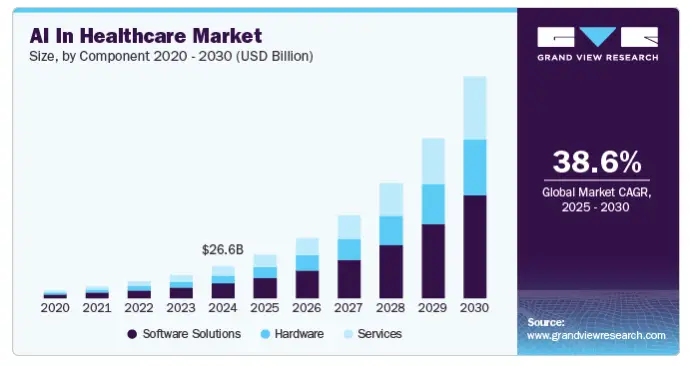
AI in Healthcare - Market
Source: www.grandviewresearch.com

Benefits of AI in Healthcare

Hospitals nowadays are challenged with providing quicker and improved care with fewer resources. Technologies such as AI are assisting them in doing it more effectively. following are some advantages of AI in Healthcare that is important to know: 
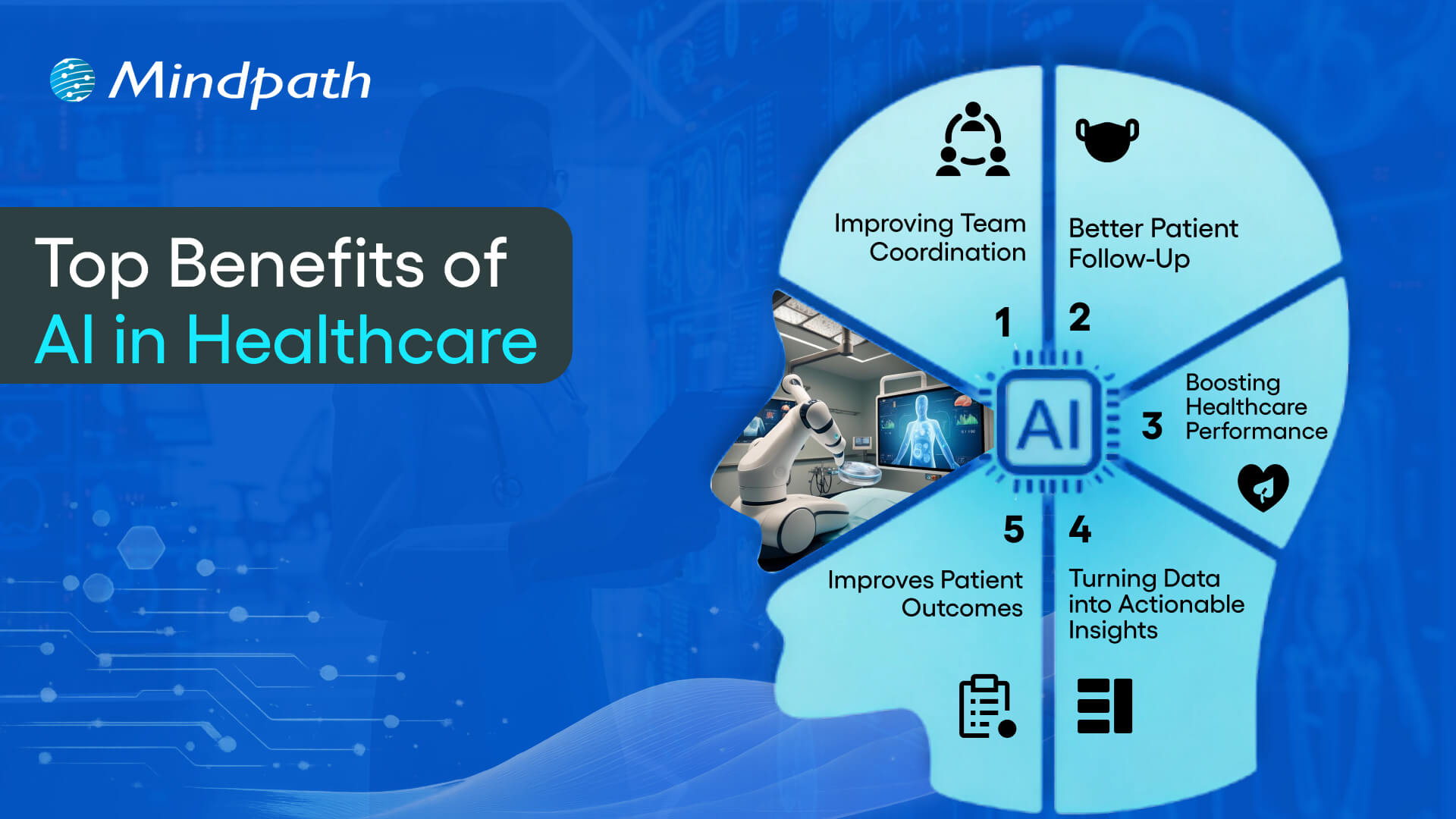
1. Improving Team Coordination

AI for healthcare facilitates easier sharing of critical patient information among doctors and nurses. It consolidates everything into a single place to enable teams to communicate with each other easily and quickly. This translates to quicker decisions, improved treatments, and more efficient teamwork. AI for hospitals enables various departments to communicate with one another, which is crucial during emergencies. When everybody has the proper information at the right moment, patients receive their care on time without confusion or delays. 

2. Better Patient Follow-Up

AI assists hospitals in tracking patients and ensuring that they do not miss any important check-ups. By identifying potential health problems early, AI facilitates doctors to act early and administer the appropriate care. This ensures that patients are treated on time and follow-ups are handled more efficiently. Hospitals can track patients more efficiently with AI, resulting in improved long-term care and healthier patients. AI consulting services can guide hospitals in selecting the right tools and workflows for patient monitoring.

4. Boosting Healthcare Performance

AI in medical field enables healthcare systems to achieve significant objectives, referred to as the quadruple aim. The aims prioritize better patient care, low healthcare expenses, facilitation of medical staff, and enhanced overall health. Thanks to AI, hospitals can individualize care, minimize waiting times, and optimize the entire process. This results in improved patient outcomes, reduced expenses, and a healthier, less stressful medical team.  

5. Turning Data into Actionable Insights

Hospitals can use AI to gather and organize a lot of data from various sources. This enables doctors and nurses to make quick and easy decisions. By making all that information useful, medical teams are able to provide patients with more accurate and timely care. This streamlines the process, eliminates errors, and ensures that patients receive the proper treatment based on current information available. 

6. Improves Patient Outcomes

Patients receive faster and more precise treatment with the use of AI in healthcare. It assists doctors in identifying health issues earlier and making the correct decision on treatment without wasting time. This results in quicker admissions, reduced hospital stays, and improved recovery. Everything goes more smoothly, and patients are more comfortable. By making the care process more efficient, this technology promotes improved health outcomes and allows hospital staff to spend more time in taking care of patients. 

Looking to understand which programming languages are best for developing AI solutions? Explore our blog on AI Programming Languages to gain practical insights to get started.

Let us now look at some of the real-world AI in healthcare examples that show how this technology is being used to improve patient care, speed up diagnosis, and support medical teams in everyday hospital tasks: 

Real World AI in Healthcare Examples

These artificial intelligence examples in healthcare highlight how hospitals are using AI to improve diagnosis, speed up treatment, and support better decisions. Each example shows the positive impact of AI in daily medical practice: 

1. Faster MR Scans

AI accelerates MRI image acquisition, allowing radiology departments to manage more patients more effectively. AI enhances image quality, reduces scanning time, and increases patient comfort, particularly for patients who are anxious or experience pain during the test. 

2. Smarter CT scans 

AI helps ensure patients are correctly positioned for CT scans, reducing errors and improving image quality. It also enhances image reconstruction, supporting better diagnostics while helping radiology teams work more efficiently with consistent and clear results. 

3. Assist in Image Reading for Radiologists

AI assists radiologists by highlighting areas of interest in medical images and supporting segmentation tasks. This allows them to focus on deeper analysis and make quicker, more confident decisions, ultimately improving both workflow and patient care. 

4. Better Teamwork in Cancer Care

AI brings together data from radiology, pathology, genomics, and health records to give a clear view of a patient’s condition. This helps care teams make faster, more informed decisions to guide personalized treatment and improve outcomes. 

5. Guiding Doctors in Surgery

AI helps doctors during minimally invasive procedures by quickly analyzing CT images and sharing results across teams. It supports accurate planning and guidance, helping physicians work more efficiently and make timely decisions for better patient care. 

6. Simplifying Ultrasound Measurements

AI streamlines ultrasound by automating measurements, reducing manual effort and variability. It ensures fast, consistent results, allowing healthcare professionals to focus on clinical judgment while enhancing diagnostic accuracy and improving the experience for both patients and staff. 

7. Remote Cardiac Patient Monitoring

AI-powered analysis of remote ECG recordings enables early detection of heart rhythm disturbances like atrial fibrillation. This allows clinicians to provide faster, more efficient care, enhancing patient outcomes by offering timely and proactive cardiac treatment outside the hospital setting. 

Wondering how healthcare organizations can implement AI effectively and achieve better patient outcomes? Read our blog on the role of AI consultant explains how expert AI consulting can guide healthcare providers in overcoming challenges, and unlocking the full potential of advanced technologies.

Ready to Embrace the Future of Healthcare with AI?

AI is revolutionizing healthcare by simplifying operations, enhancing diagnosis accuracy, and facilitating quicker, more tailored treatment. By automating mundane tasks, AI enables healthcare workers to spend more time on patient care, leading to better overall outcomes. With its ability to process large volumes of data, AI also facilitates proactive interventions, minimizing errors and enhancing efficiency in hospitals globally.  

At Mindpath, we offer healthcare software development services with expertise in using the latest AI technology to develop innovative solutions for medical facilities. Our tailored AI-powered platforms enhance hospital efficiency, provide smooth patient care, and enable medical staff to make informed decisions with ease. Learn how Mindpath can assist in revolutionizing your healthcare practice with innovative solutions designed specifically for you. 
Related Post

How much does hiring a ReactJS developer cost? Learn about factors affecting rates, and how to find the best talent within your budget.

Related Post

ReactJS

Are you ready to unlock the full potential of your business? Imagine combining the power of ReactJS with other cutting-edge technologies to boost your growth and enhance your digital presence. In this blog, we will explore how integrating ReactJS with other tools can transform your business operations, improve user experiences, and drive long-term success.  

In today’s fast-paced digital environment, businesses must use the correct technologies to remain competitive and provide the greatest customer service. Integrating ReactJS into your applications is an essential step towards doing this. Businesses can utilize ReactJS when combined with other technologies to develop quicker, more responsive websites and apps that are easier to maintain and grow. This connection improves performance, enriches user experiences, and enables organizations to remain adaptable in an ever-changing market. 

Curious to see how this synergy can work for you? Let’s dive in and discover the possibilities! 

Integrating ReactJS with Other Technologies

1. ReactJS with Python

Combining ReactJS and Python provides a robust platform for developing full-stack apps. ReactJS is well-known for its dynamic and interactive user interfaces, but Python excels at sophisticated server-side activities and data processes. Businesses that use Python for backend operations can power ReactJS apps more effectively, particularly when dealing with massive quantities of data or real-time processing. 

One of the primary benefits of combining ReactJS with Python is the speed with which data can be handled. Python is perfect for applications that must manage complicated data, such as single-page apps that require speedy and precise data retrieval. Many well-known firms have profited from this combo. Spotify, for example, employs ReactJS for its front end and Python for data processing on the back end. Similarly, Instagram uses ReactJS and Python to manage millions of user interactions while ensuring seamless performance.  

2. ReactJS with Node

By combining ReactJS and Node.js, developers can construct full-stack JavaScript apps that use the same language on both the client and server sides. This integration simplifies and speeds up the development process by requiring developers to focus on only one language throughout the stack. One of the primary advantages of mixing ReactJS and Node.js is the ability to create real-time apps. Node.js is recognized for its event-driven architecture, which makes it ideal for real-time data handling. When combined with ReactJS’ interactive, dynamic user interfaces, it provides users with a smooth and responsive experience. 

Major organizations such as LinkedIn and Uber use this mix for their platforms. LinkedIn employs ReactJS and Node.js to provide a quick, real-time user experience, whereas Uber depends on ReactJS for the front end and Node.js to manage real-time location updates and ride requests, providing smooth communication and a unified experience for users. 

3. ReactJS with Express

Combining ReactJS with Express provides a solid basis for building full-stack JavaScript apps, easing both front-end and back-end development. This combination increases the development workflow and overall efficiency by managing dynamic user interfaces on the client side with ReactJS and server side with Express. 

One distinguishing aspect of ReactJS and Express is their ability to efficiently manage asynchronous tasks. Both technologies are excellent at managing asynchronous data queries, making them suitable for creating dynamic, data-driven single-page applications (SPAs). This leads to a quicker, smoother user experience with continuous updates and interactions, eliminating the need for frequent page reloads. 

When combined, ReactJS and Express offer a powerful solution for building fast, scalable, and efficient web applications, where both the front-end and back-end work in perfect harmony to deliver an optimal user experience. 

4. ReactJS with Next.js

Combining ReactJS and Next.js provides significant advantages for developing modern online apps that are quick, scalable, and SEO friendly. Next.js allows React developers to construct server-rendered apps that not only reduce load speeds but also improve search engine optimization (SEO), guaranteeing that your website ranks higher and performs better. 

One of the primary benefits of combining Next.js and ReactJS is Server-Side Rendering (SSR). SSR enables React apps to be pre-rendered on the server before being delivered to clients, resulting in quicker load times and improved SEO performance. Next.js now supports Static Site Generation (SSG), which allows you to create static pages ahead of time. This strategy is appropriate for dynamic websites that need to be fast and optimized while still giving an outstanding user experience.  

5. ReactJS with React Native

Integrating ReactJS with React Native provides significant benefits for creating online and mobile applications in a single environment. This combination enables developers to construct cross-platform mobile apps with near-native performance while using the same codebase as for web app development. 

One significant advantage of utilizing ReactJS with React Native is the ability to reuse code between web and mobile platforms. This not only speeds up the development process but also assures consistency, saving time and effort in creating distinct apps for different platforms. React Native also offers a near-native mobile experience, with smooth and responsive performance on iOS and Android devices. 

6. ReactJS with Redux

Combining ReactJS and Redux provides an effective approach for handling complicated states in large-scale applications. Redux is an effective approach to manage the state of your project, making it easy to trace changes and assure consistency throughout the application. 

One of the primary advantages of integrating Redux with ReactJS is centralized state control. Redux lets you maintain the application’s state in one location, ensuring that updates are consistent throughout the program. This is especially useful for big web applications where handling states across numerous components can be onerous. Redux facilitates the predictable flow of data, making it easier to manage even the most complicated ReactJS applications. Another advantage is the ease of testing and debugging. Since Redux acts as a single source of truth for the application state, it becomes much easier to trace errors and identify problems, streamlining the debugging process and improving the reliability of your app.  

7. ReactJS with Java

Combining ReactJS and Java is a potent combination for developing enterprise-grade online apps, where the power of Java on the backend meets the flexibility of ReactJS on the frontend. This connectivity enables developers to build dynamic, scalable systems capable of handling complicated needs. 

One of the primary advantages of combining ReactJS with Java is having to have a robust backend powered by Java while utilizing ReactJS for a flexible and dynamic frontend. Java’s strong nature guarantees that the program scales effectively, while ReactJS allows for building responsive, user-friendly interfaces with seamless interactions. 

Furthermore, integrating ReactJS and Java provides cross-platform compatibility, allowing online apps to execute effortlessly across several platforms. This allows firms to reach a larger audience while maintaining fast performance and consistent functionality across devices. 

Also Read: 5 Key Benefits of React JS Development Services in 2024

Integrate ReactJS with Technologies at Mindpath

At Mindpath, we specialize in integrating ReactJS with various technologies to build powerful, scalable, and efficient web applications. By combining ReactJS with other tools and frameworks, we can deliver smooth, interactive user interfaces alongside strong, reliable backends.  Whether it’s ReactJS paired with Node.js for faster development, Express for efficient state management, or Python for handling complex data operations, we ensure that your application performs seamlessly across all platforms. Our expertise in integrating ReactJS with technologies like Redux, Next.js, and more allows us to create real-time, SEO-friendly, and mobile-optimized applications. 

Wrapping Note!

Integrating ReactJS with other advanced technologies is a game-changer for businesses aiming to enhance their digital presence, streamline operations, and deliver superior user experiences. By combining ReactJS with tools like Python, Node.js, Express, and Redux, businesses can create dynamic, fast, and scalable web applications that meet the demands of today’s competitive market. Whether you’re building complex data-driven platforms or developing mobile apps with seamless user experiences, ReactJS offers the flexibility and power to take your projects to the next level. At Mindpath, we are committed to harnessing the potential of ReactJS and other cutting-edge technologies to help your business thrive. Let us help you unlock new possibilities and achieve long-term success by integrating the best tools for your digital transformation journey. 

Ready to take your business to the next level?

Partner with Mindpath for seamless ReactJS integrations and cutting-edge technology solutions.

Discover how integrating ReactJS with cutting-edge technologies can boost business growth, enhance user experiences, and streamline web app development.
Security Practices for E-Commerce Website
Is your e-commerce website truly secure? In an era where online threats are constantly evolving, safeguarding your business and customers is more critical than ever. Have you implemented the essential security practices needed to protect sensitive data and build customer trust? In this blog, we will explore the key practices every e-commerce site should follow to stay secure and reliable.   Keeping an e-commerce website secure is crucial since it safeguards both the company and its customers. When customers purchase online, they provide personal information such as names, addresses, and payment information. If a website is not secure, hackers can access this information, resulting in financial loss and identity theft for clients. A security breach can damage a company’s brand, cost it revenue, and even land it in legal problems. So, robust security promotes client trust, safeguards crucial data, and keeps the organization running efficiently.  Let’s explore the key practices for securing the e-commerce website! 

Best Practices to Secure E-Commerce Website

1. Authentication

Establishing secure password guidelines is the first move in protecting your e-commerce website. Encourage users to choose complicated passwords that are difficult to guess. It also helps to remind people to update their passwords on a frequent basis. Adding two-factor authentication (2FA) is another wise decision, as it demands users to authenticate their identity with something they own, such as a phone, in addition to their password. 

Use role-based access controls for administrative accounts and anybody who requires special access. This implies crucial elements of your site, such as client data or order information, can only be accessed by specific people depending on their roles. Limiting access reduces the likelihood of unauthorized alterations or leakage. 

2. Awareness

Regular employee training is essential for keeping your e-commerce site secure, since many cyber dangers take advantage of human errors. A well-designed training program should include subjects such as identifying phishing emails, generating strong passwords, managing sensitive data, and reporting suspicious behavior. It’s also beneficial to keep personnel informed about the newest security trends and concerns so they know what to look out for. 

Consider doing simulations, such as mock phishing exams, to allow staff to practice recognizing fraud in a safe setting. Encourage a security-conscious culture in which workers are comfortable reporting possible risks. The more aware your staff is about cybersecurity, the more prepared they will be to safeguard the company and customer information from attacks. 

3. Security Audits

Regular security audits are essential for securing your e-commerce website. Routine external security evaluations and penetration tests can reveal hidden vulnerabilities before they cause issues. These tests simulate real-world cyber-attacks to highlight any flaws and identify areas for improvement in your security procedures. 

In addition to these planned audits, continual monitoring is crucial. With 24/7 monitoring, your system can notice odd activity, such as numerous logins attempts or access from unexpected devices, which can indicate an issue with security. This real-time tracking enables you to immediately respond to threats and remain ahead of cyber concerns. Combining these proactive and continuous security methods can dramatically lower the likelihood of an attack on your website and your customer’s data. 

4. Payment Gateways

Using reliable third-party payment gateways is one of the most effective ways to ensure secure transactions on your e-commerce website. These gateways are built with robust security features to secure crucial payment information, such as credit card numbers, throughout each transaction. Processing payments using reputable suppliers reduces the danger of handling sensitive data yourself, which is more prone to breaches. 

It’s also important to avoid keeping sensitive payment information, such as credit card numbers, on your own servers. By placing this sensitive data in the hands of the payment processor, you reduce security risks and guarantee that both your company and your customers are better secured from potential data theft. 

5. Regular Software Updates

Keeping all software up to date is crucial for ensuring the security of your e-commerce website. This includes your content management system (CMS), any plugins that improve your site’s functionality, and any third-party tools you utilize. Software updates frequently include crucial safety fixes that address vulnerabilities that hackers may exploit. 

You can safeguard your website against known risks by checking for updates regularly and implementing them as soon as possible. Set up automatic updates whenever feasible to avoid missing key patches. Keeping up with software changes ensures that your website functions efficiently and securely, giving customers a safe purchasing experience. 

6. HTTP

HTTPS is essential for safeguarding your e-commerce site. This entails installing an SSL/TLS certificate that encrypts sensitive data, such as payment information, while it passes between your server and your clients. Encryption prevents hackers from intercepting and accessing this data during transmission. 

When selecting an SSL certificate, there are three options: Extended Validation (EV), Organization Validation (OV), and Domain Validation. Each category provides varying levels of validation and security. An EV SSL certificate is recommended for e-commerce sites as well as enterprises in the financial or banking industries. This kind gives the highest level of validation and demonstrates to clients that your website is trustworthy. 

Avail Security Practices for Your E-Commerce at Mindpath

Mindpath provides essential security techniques to help keep your online store safe. We help you create strong passwords, employ secure payment methods, and keep your website software up to date. Our team also trains your employees how to identify internet risks and what to do if they see anything strange. We use encryption to ensure the security of client information, such as payment data. With our assistance, you can safeguard your business and develop trust with customers, ensuring they feel comfortable buying on your site. Let us assist you with maintaining the security and functionality of your e-commerce website! 

Wrapping Up!

In today’s digital age, protecting the security of your e-commerce website is not a choice; it is a requirement. You can create a strong defense against cyber-attacks by applying the best practices we’ve outlined, such as strong authentication, staff awareness training, frequent security audits, trusted payment gateways, up-to-date software, and the usage of HTTPS. 

These safeguards not only protect your company from financial losses and legal concerns, but they also develop confidence with your customers by assuring them that their personal information is secure when purchasing on your website. At Mindpath, we are dedicated to assisting you in establishing and maintaining these crucial safety procedures, so you can concentrate on expanding your organization. Together, we can develop a safe and efficient online buying experience for your customers. 

Ready to secure your e-commerce website? 

Partner with Mindpath today to learn how our expert security practices can protect your business and enhance customer trust!

Discover essential security practices to protect your e-commerce website, ensuring safe transactions and building trust with your customers.
Node.js eCommerce
Imagine a world where your eCommerce platform runs at extraordinary speed, performs thousands of transactions effortlessly, and delivers real-time updates to your customers. Sounds like a dream, right? In 2024, this dream can become a reality with Node.js. But is it truly the best choice for your eCommerce business? In this blog we are going to explore how Node.js can be the perfect choice for your e-commerce platforms.  In today’s world, having an eCommerce platform is essential for any business that wants to sell products online. These platforms aid in managing everything from customer orders to sales data, making the running of businesses easy. However, picking the right technology for your eCommerce platform can be challenging with so many options available. The choice of technology for any eCommerce platform is important because it has a direct implication on how well your online store will perform. The right kind of technology will ensure that your website works smoothly and results in quick loading time along with good customer experience. It will also help in inventory management, secure payment processing, and tracking your sales effectively.   Of all technologies, Node.js can turn into the best choice for an eCommerce platform. Its flexibility and modern approach make it the most fitting for such dynamic webstores to grow your business. Choosing Node.js creates a firm foundation for your eCommerce success.  So, let us dive deep to explore how Node.js can be the top choice for building your eCommerce platform in 2024! 

Benefits of Using Node.js for eCommerce  

1. Speed and Performance  

Node.js is fast due to the V8 engine it runs on. This engine turns JavaScript right into machine code, making it work way quicker than other languages that need to be interpreted. Node.js handles multiple requests simultaneously without any performance issues because it is an event-driven and non-blocking I/O model. This means that, even while your eCommerce site is very busy with a lot of traffic, Node.js manages to keep response times fast. 

2. Scalability  

Node.js can process many requests quickly because it has a non-blocking I/O model and a single-threaded event loop. Its modular architecture makes it simple to scale up by adding more servers or increasing server capacity. Because of its adaptability, you can increase the capacity of a Node.js server or add more servers to handle increased traffic, allowing your eCommerce platform to expand without interruption. 

3. Large Community  

Node.js has an incredible and active developer community that provides assistance, resources, and tools. A wide range of packages and modules are available in this active community to assist you in creating dependable and effective eCommerce solutions. It’s simpler to solve issues and stay up to date with the most recent advancements with such broad assistance and an expanding collection of materials. This implies that Node.js can help you create and manage your eCommerce platform more successfully. 

4. Modular Approach  

Ecommerce systems handle a large amount of data, which can make code management tough but Node.js’ modular approach simplifies this. This strategy allows developers to divide down code into smaller, more manageable chunks or modules. Node.js facilitates the efficient development, maintenance, and testing of your eCommerce application by organizing code into functional blocks. 

5. Integration with Other Technologies 

Node.js integrates effectively with a variety of technologies, making it a versatile option for developing eCommerce apps. It seamlessly interfaces with front-end frameworks, databases, and other programming languages. This compatibility enables you to link your eCommerce platform to important services such as payment systems and third-party integrations. You may use Node.js’ capabilities to build strong, efficient, and scalable eCommerce solutions that fit your company’s and customers’ demands. 

Curious about the power of Node.js for your next project?

At Mindpath, we deliver cutting-edge solutions that propel your business forward with precision and speed.

Best Practices for Building an Ecommerce Platform with Node.js  

1. Choose a Reliable Node.js Ecommerce Engine  

Choosing the best Node.js eCommerce engine is the first step towards creating a successful online business. An eCommerce engine is a toolset designed to offer the core functionality of an online store. It simplifies product and order administration, payment processing, client follow-up, and other features that a developer can use to create and edit an eCommerce website. A decent eCommerce engine will save time for developers because it already has the fundamental functions, allowing for the development of new features and customization based on the website’s specific demands. 

2. Consider a Modular Approach  

When developing eCommerce apps using Node.js, taking a modular approach is advantageous. Node.js offers modules, which are tiny, self-contained bits of code that handle certain tasks. This approach makes troubleshooting easier because problems with one module do not affect the entire application.  A modular approach also speeds up development by allowing numerous developers to work on various portions at the same time, as well as simplify maintenance by ensuring that modifications to one module do not affect others. To do this, identify essential features, split them down into smaller modules, create explicit interfaces between them, and utilize tools like npm to manage dependencies. Frameworks like Nest.js and Express.js may help you construct a more powerful and adaptable eCommerce platform by extending the modular design. 

3. Integrations  

When creating an eCommerce site using Node.js, contemporary integration technologies are essential for successful operation. APIs (Application Programming Interfaces) enable your platform to interact with other services like payment gateways, shipping suppliers, and CRM systems. For example, APIs can connect to payment processors such as Stripe to conduct transactions easily. Webhooks provide an additional integration technique by providing automatic updates across systems. A webhook, for example, can alert the delivery provider when an order is received, ensuring that it is fulfilled promptly. Stripe is a popular example of a webhook for payment events, whereas Twilio is used for SMS notifications. Using APIs and webhooks contributes to a more connected and efficient eCommerce platform, which improves the entire consumer experience. 

4. Frontend Development  

The frontend of an eCommerce application, including style, layout, and functionality, is critical for user engagement. Modern front-end technologies improve consumer satisfaction and engagement. Jamstack, an acronym for JavaScript, APIs, and Markup, is a prominent method. It focusses on pre-built HTML, serverless functions, and client-side JavaScript to provide speed, security, and reliability. Jamstack sites employ static site generators to improve load speeds and security, which is critical in eCommerce. It also allows for easy connection with services like payment gateways and shipping providers via APIs and webhooks. 

5. Implement Security Measures 

Strong security measures must be established on an eCommerce platform to safeguard private data, including payment and client information. Proper security protects your platform from dangers like hacking, phishing, and other cyberattacks, ensuring that your customers’ data is protected. To do this, first secure your server. Make sure it’s properly set up, all security updates are up to date, and firewalls and intrusion detection systems are in place to prevent unauthorized access. HTTPS encrypts data transactions between the server and users, protecting sensitive information such as login passwords and payment details. Implement user login and permission restrictions to guarantee that only authorized users have access to certain portions of the platform. This involves creating secure passwords and implementing role-based access limits. Validating input, utilizing prepared statements, and encoding output can help prevent common security risks like cross-site scripting (XSS) and SQL injection. To repair any security vulnerabilities, update all software and plugins on a regular basis to the current version. Perform frequent security audits and tests, including testing and code reviews, to detect and resolve any flaws. By adhering to these guidelines, you can be assured that your eCommerce platform is secure, develop confidence with your clients, and safeguard their sensitive information. 

Node.js Development Services at Mindpath 

  1. Node.js Web App Development: We create powerful, scalable web applications using Node.js. Our focus is on delivering a seamless digital experience that aligns with your business goals and makes a lasting impact.


  2. Node.js CMS Development: We design custom content management systems that make handling your content easy. Our CMS solutions provide a user-friendly interface for managing all your content effortlessly.


  3. Node.js API Development: We build robust APIs that enable smooth integration with other systems. Our APIs enhance functionality and ensure reliable communication between different applications.


  4. Node.js Consulting Services: We offer expert advice to help you maximize the potential of Node.js for your projects. Our consulting services include strategic guidance and technical insights to boost your application’s performance and innovation.


  5. Node.js Maintenance & Support: We provide ongoing maintenance and support to keep your applications running smoothly. Our team is always ready to resolve any issues and make continuous improvements.


  6. Node.js Migration Services: We assist in migrating your existing applications to Node.js, improving scalability and performance. Our migration services ensure a smooth transition with minimal disruption. 

Conclusion 

Node.js, in 2024, is the foremost technology in the development of high-performance eCommerce. It is an excellent base that delivers development with very great speed, high scalability, and integrability with other technologies in the development of dynamic and efficient online stores. Node.js can guarantee businesses that their eCommerce sites don’t have any difficulty handling high traffic, real-time updates, and superior user experience. Therefore, adopting Node.js will position an eCommerce platform for success within the competitive digital landscape today.  

At Mindpath, we happen to be the experts in unleashing the true potential of Node.js when it comes to the development of supreme eCommerce solutions. This ranges from full-cycle web app development and custom CMS solutions to robust API development, professional consulting, ongoing maintenance, and smooth migration support. We ensure that the Node.js applications developed for our clients are not just high-performance and scalable but also oriented to business needs.

Wondering how Node.js can transform your digital strategy?

At Mindpath, our expertise in Node.js ensures scalable and innovative applications tailored to your needs.

Discover the top Node.js trends shaping digital technology in 2024, from AI and TypeScript to IoT and cloud computing. Explore how Node.js drives innovation!