What is DevSecOps – An Implementation Guide

Join our Newsletter!

Featured Posts

Support Is One Click Away

Home

What is DevSecOps – An Implementation Guide

What is devsecops

What is DevSecOps – An Implementation Guide

In the digital world of the 21st century, DevSecOps has undoubtedly become the backbone of secure software delivery. It has perfectly blended DevOps and security practices in order to protect applications from cyber threats without hampering innovation. With the surge in cloud DevSecOps organizations across diverse sectors are embedding automated testing and compliance, along with continuous monitoring, directly into CI/CD pipelines.

It is the right time for you to know how DevSecOps works and why it matters for DevOps cybersecurity. DevSecOps is now essential for resilience, whether you are developing cloud-native apps or securing your software supply chain. It is time to look at how businesses can implement DevSecOps in the real world.

Curious about how DevSecOps implementation helps businesses in achieving secure and scalable pipelines? Contact us and let our experts provide you with full guidance.

An Insight into DevSecOps

In recent times, DevSecOps has certainly surfaced as an innovative approach for Development, Security, and Operations. It combines security into every single phase of the software development lifecycle to create software efficiently while curbing vulnerabilities. 

DevSecOps solutions make sure that security is shared across the development and security teams, in addition to the operations team. It is achieved through the automation of security processes and practices within CI/CD pipelines. This approach has gained massive popularity in the past few years since it fosters collaboration while empowering business entities to deliver secure and high-quality software solutions. 

Also Read: Benefits of DevOps

Key Benefits of DevSecOps

The DevSecOps concept gives rise to a host of benefits for users, including professionals as well as businesses. Now that you know what is DevSecOps, it is time to get familiar with its key benefits. 

1. Faster Delivery of Software

DevSecOps creates the opportunity for you to integrate security into the development pipeline. Thus, it allows businesses to rapidly deliver highly secure code. It is capable of addressing issues early on and while streamlining the release process. 

2. Better Agility

Automation serves as a catalyst and reduces bottlenecks relating to manual security. It allows security teams to lay emphasis on high-value tasks. Moreover, they feel empowered to respond in a prompt manner to threats and risks.

3. Diminished Time to Market

The concept of cybersecurity DevOps is capable of catching as well as fixing vulnerabilities at an early stage. It therefore minimizes the requirement for expensive as well as time-consuming remedial actions at a later stage. It is good news for software developers since it accelerates software project timelines. 

4. Top-Notch Security 

You need to leverage DevSecOps so that you can strengthen the security posture when it comes to custom software development. Security gaps can be reduced exponentially as DevSecOps embeds security into each stage of the DevOps lifecycle.

6. Better Compliance with Laws and Regulations

You need to use DevSecOps tools since they ensure compliance at all stages of software development. With security checks that are automated and compliance tools, modern businesses can rest assured about their compliance requirements.

Curious about the latest shifts reshaping how software and websites are built and deployed? Check out our blog on DevOps trends to stay ahead of the curve and make sure your projects leverage modern best practices.

Steps to Implement DevSecOps

The implementation of DevSecOps means weaving security into each and every phase of the DevOps pipeline without compromising the delivery. At present, organizations face rising cyber risks along with stricter compliance standards, which makes a structured approach essential. You need to follow the steps below in order to effectively implement DevSecOps while developing a software solution.

Step 1 – Evaluate your Current Security Practices

While implementing DevSecOps, the very first step that you need to take involves the assessment of your current security practices. You need to do a careful and comprehensive evaluation of the security tools and processes that are in place. You also need to identify gaps along with appropriate areas of improvement while taking into account the organizational goals and context.

Step 2 – Establishment of Security Goals and Objectives

Now it is time to establish security objectives. You must keep in mind to define clear and well-defined security goals and objectives that are perfectly aligned with the vision of your organization. At this stage, you can even consider involving stakeholders from the development, security, and operations teams. It is vital to prioritize shared understanding along with unified commitment. 

Step 3 – Implementation of Security Training and Awareness Programs

You need to conduct training programs at this stage of the implementation process. These training programs can play a strategic role and help the staff members to cultivate essential skills and capabilities. It is also essential to promote security awareness while fostering an accountable security culture within the organization. 

Step 4 – Integration of Security into the Software Development Lifecycle

At this stage, you need to combine security practices and controls at every phase of the software development lifecycle. You must focus on implementing tools along with automation that are capable of facilitating secure code reviews as well as vulnerability scanning. The tools must also support threat modelling. 

Step 5 – Emphasizing Continuous Security and Automation

It is vital to prioritize automation when it comes to cybersecurity DevOps. So you need to automate security testing, such as dynamic analysis and static analysis. You must also consider automating software composition analysis so that you can get feedback on an ongoing basis. It is a wise decision to integrate security into the continuous integration and deployment pipelines, as it can help ensure security checks at every stage. 

Must Read: DevOps vs DevSecOps

Step 6 – Implementation of Infrastructure as a Code Security

You must also apply the security principles to Infrastructure as a Code (IaC) scripts and templates. It is undoubtedly a critical step when it comes to DevSecOps implementation. Businesses must ensure that they leverage version control for the Infrastructure as a Code template for maintaining traceability. You can even consider applying policy as code frameworks in order to enforce security baselines for cloud resources.

Step 7 – Fostering Communication and Collaboration

You need to encourage cross-team collaboration along with transparent communication. You can ensure this through regular meetings and by using shared tools. It is essential to prioritize joint decision-making. It is equally important to set up and maintain a DevSecOps culture so that it can promote trust along with accountability within the organization.

Step 8 – Implementation of Continuous Monitoring and Incident Response

It is critical at this stage to adopt continuous monitoring of applications and infrastructure. This is because such a practice can help in detecting as well as responding to security incidents in a prompt manner. You must also establish an incident response plan that can facilitate effective and efficient mitigation in case of a security breach.

Step 9 – Focus on Regular Assessment

One cannot overemphasize the importance of regular assessment and improvement while implementing DevSecOps. You must conduct assessments to evaluate the effectiveness of the implemented DevSecOps practices periodically. It is equally essential to improve the security processes and adjust to emerging threats on an ongoing basis. Businesses must also make sure to incorporate the feedback from the key stakeholders.

Step 10 – Remaining Abreast with the Latest Security Practices

It is imperative for modern businesses to stay updated with the latest security trends and industry standards. You need to bear in mind that your business needs to engage in continuous learning. So in your organization, you need to encourage security professionals to take an active part in training programs as well as online communities.

Facing hurdles in your deployment process? Read our guide on DevOps challenges and solutions to learn actionable strategies for smoother, more efficient workflows.

Best Practices While Implementing DevSecOps

There are a number of best practices that you need to keep in mind while implementing DevSecOps within your business. You need to adopt these practices so that you can derive optimum value from DevSecOps implementation. 

1. Emphasis on Security

You need to shift security to the left. It means that the security component has to be integrated at an early stage in the software development lifecycle. Several practices, such as threat modelling and secure coding practices, need to take place during the development stage in order to reduce the risk before the production stage. 

2. Automation

The role of automation is indispensable when it comes to DevSecOps implementation. You need to embed appropriate security controls into CI/CD pipelines and ensure static as well as dynamic code analysis. 

3. Importance of Continuous Testing

Continuous testing is an essential component of DevSecOps as it allows teams to identify security gaps and vulnerabilities. You need to test code on a continuous basis so that the number of security issues can be reduced before that may reach the production stage. 

Ready to modernize your tech operations and accelerate product delivery? Explore our blog on DevOps for Businesses to learn how DevOps helps businesses build, deploy, and scale with confidence.

Final Words

DevSecOps is no longer an optional thing for businesses when it comes to developing software solutions. It serves as the ultimate foundation for building secure and resilient software applications that are compliant in today’s world. Businesses need to integrate DevOps and security practices across the entire pipeline in order to reduce security risks and uncertainties. If DevSecOps implementation is done in the right manner, it can foster innovation and business resilience. 

The top-notch DevOps services of Mindpath can ensure that your business can successfully adopt DevSecOps. With the help of expert guidance and support, your business can achieve innovation, which can give it an edge in its operational domain.

Related Post

Discover the top 8 emerging technologies set to revolutionize business decision-making in the near future, including Generative AI, Web3, Blockchain, and more.
Discover the essential factors for hiring a top WordPress developer. Learn about expertise, communication, experience, cost, and finding the right platform.

Related Post

reactjs developer skills

The advantages of ReactJS have made every business owner think about its utility in developing web projects. It is the most powerful and commonly used JavaScript library for creating intuitive interfaces. If you want React developers in your team, then you must know the ReactJS developer skills that you should look for in candidates. The declarative approach and component-based architecture of ReactJS have revolutionized the process of front-end development. Let us find out the skills that you need in ReactJS developers to create successful web projects.

Want to hire ReactJS developers for your next web project? Explore more on Mindpath’s React JS development services to get expertise in developing a web application aligned with your business goals.

Discovering the Skillset of Expert ReactJS Developers

The general assumption about the skillset of ReactJS developers is that they know how to work with React. However, fluency in React itself is not the only addition in the React skill set for any developer. React developers must have a broader skillset beyond the library to craft impactful web projects. The following skills can help business owners identify the best React developers for their next web project.

1. HTML and CSS

The foremost addition in a list of ReactJS skills is the combination of HTML and CSS, which play a crucial role in organizing the styling of the web experience. React developers must know the concepts of semantic HTML and how to use the right HTML tags for better SEO and accessibility. ReactJS developers should have an in-depth understanding of the fundamentals of CSS, such as selectors, CSS Grid, responsive design principles, and the box model.

Apart from CSS fundamentals, the essential React skills for developers also include knowledge of CSS preprocessors and frameworks. Developers can use the pre-processors to streamline styling workflows and improve ease of maintenance in larger projects.

2. JavaScript ES6

JavaScript ES6 or ECMAScript 2015 brought many interesting features to the domain of modern web development. When you hire React developer for the next web project, you should check their level of fluency in JavaScript ES6. The distinctive features of JavaScript ES6, such as arrow functions, template literals, and ES6 classes, make React web development more efficient. For instance, arrow functions can ensure simpler syntax for functions and intuitive management of the context.

ReactJS developers must know how to leverage ES6 classes for a more structured use of JavaScript along the lines of component-based architecture. Developers can also use features like template literals to embed expressions in strings, thereby creating cleaner code.

3. Event Handling and DOM Manipulation

The virtual DOM in React is one of its distinctive features. All the listings for React JS developer jobs showcase the necessity of learning about DOM manipulation. At the same time, you must know that direct DOM manipulation is not required in React. On the other hand, developers must know the process through which the browser renders and interacts with the Document Object Model. DOM manipulation is required in scenarios where you want to build interactive and dynamic user interfaces.

Another crucial addition among skills required for ReactJS developer is event handling. It focuses on responding to different user events through event listeners and callback functions. Therefore, React developers must know the fundamentals of event delegation, capturing, and bubbling.

4. Git

You cannot think about hiring React developers who don’t know how to work with Git, the most popular version control system. Git helps in promoting team collaboration and source code revision management to ensure efficiency in the development lifecycle. ReactJS developers must know the fundamental concepts, such as commits, repositories, branches and merges. On top of it, developers must also know how to work with branching strategies, hosting platforms of Git and conflict management.

Git is a promising tool for frontend development with React as it provides the ideal foundation for collaborative development. Developers who know how to work with platforms like GitLab and GitHub can ensure better efficiency in team collaboration, project management and code reviews.

Must Read: Cost of Hiring ReactJS Developer

5. Redux

The list of technical skills you should search in the profiles of ReactJS developers also includes Redux. It is a specialized library used for state management in larger and more complex React applications. The cost of hiring ReactJS developers is justified when you notice how fluency in Redux can offer credible benefits to your web projects. The most promising features of Redux include centralized state management, application scalability and predictable state updates.

Redux works with a single storage for all states of an application, thereby ensuring consistency in management of state transition. Efficient state management also serves as a catalyst for easier scalability and managing increasing complexity without vulnerability to bugs. Centralized state management with Redux also ensures predictability in the behavior of your web applications, thereby facilitating easier maintenance and debugging.

6. JavaScript XML or JSX

Every ReactJS developer must know how to work with JavaScript XML or JSX. It is also one of the notable additions among react developer must-have skills as it serves a critical role in ensuring simpler development and management of UI components. JSX helps developers write HTML-like structures in JavaScript, offering a seamless blend of markup and JavaScript logic. JSX also provides an easier solution for creating and managing the user interface components of their web applications.

The other notable applications of JSX include data and logic integration. JSX can help in injecting data and logic directly into the UI, thereby ensuring dynamic content rendering, required for modern web applications. On top of it, the declarative nature of JSX ensures that the code is easily readable and accessible for debugging.

7. React Hooks

Professional ReactJS developers must also have strong command on React Hooks, a revolutionary feature for state management. Hooks have introduced new perspectives on managing React features in functional components. It is one of the essential ReactJS developer job skills and aspiring developers must know about the important hooks they must learn to create web applications.

The notable React Hooks that a developer must know include ‘useState’, ‘useEffect’, ‘useRef’ and ‘useContext’. Each hook serves a distinct function such as providing direct access to DOM elements or managing component-specific state. On top of it, ReactJS developers must know how to create reusable logic through custom hooks.

8. Testing, Debugging and Performance Optimization

The most important skill that you can find in expert React developers is testing and debugging skills. You can find answers to “why hire React developers?” in their skillsets that focus on comprehensive testing to create robust apps. The notable testing methods include unit testing, that involves testing the individual components independently or integration testing. React developers must also know how to work with debugging tools and browser developer tools to inspect the code.

Apart from testing and debugging, React developers must also know the best practices for performance optimization. Skilled ReactJS developers can use different techniques such as virtualization, code splitting and bundle size optimization to craft responsive applications.

Want to improve your application’s speed without increasing development time or infrastructure costs? Discover how optimizing React performance benefits business owners looking for efficiency and ROI.

Mandatory Soft Skills

Most of the discussions about skills of ReactJS developers focus only on the technical skills. Choosing a React JS development service for capitalizing on the expertise of skilled developers also requires attention to soft skills. You need developers who have the capabilities for critical thinking and problem-solving with efficient solutions. React developers must have skills for clear and concise communication that empowers them to work in collaboration with other teams.

React developers should also have attention to detail for crafting intuitive user experiences and writing code without bugs. Most important of all, ReactJS developers should strive to learn continuously and improve their skills to stay updated with emerging technologies and recent ReactJS trends.

Final Thoughts

The thought of hiring a developer from a reputed ReactJS development company might seem like a challenge. Interestingly, you can find the best ReactJS developers at Mindpath for your next web project; they help you build modern web solutions. The notable technical skills of React developers include knowledge of HTML and CSS, JSX, JavaScript ES6, React Hooks and direct DOM manipulation. On top of it, ReactJS developers must also have soft skills such as communication, adaptability, critical thinking and problem-solving. Learn how to pick the best ReactJS developers for your web projects now.

Find out what makes a great ReactJS developer! Explore core skills like component-based architecture, hooks, state management, and more.
Web Development Costs

Understanding the web development costs is a significant question many businesses struggle with before initiating a project. Web development is the easiest way to make your products and services connect with global audiences. In fact, entrepreneurs are well aware of the profitable aspects and booming growth they can adopt through the online market. Talking about the trends, progressive web applications are growing fastest at a CAGR of 14.00%. Moreover, around 71% of businesses already have a website. 

So, it becomes necessary for you to understand how much a web development costs. For your information, there are numerous factors that influence the cost of web development. This guide can help you with a complete breakdown, no matter if you are starting from scratch or have a small budget. 

Planning to build a website and need a clear cost roadmap? Mindpath delivers scalable web development services designed to fit your business goals.

What Does the Web Development Cost Include?

Before you get into the web development costs, it is necessary to research your competitors and how uniquely you need to develop your site. Moreover, developing a good and reliable website is not just about writing code or initiating good designs. The total website development cost breakdown is dependent on your website’s structure. 

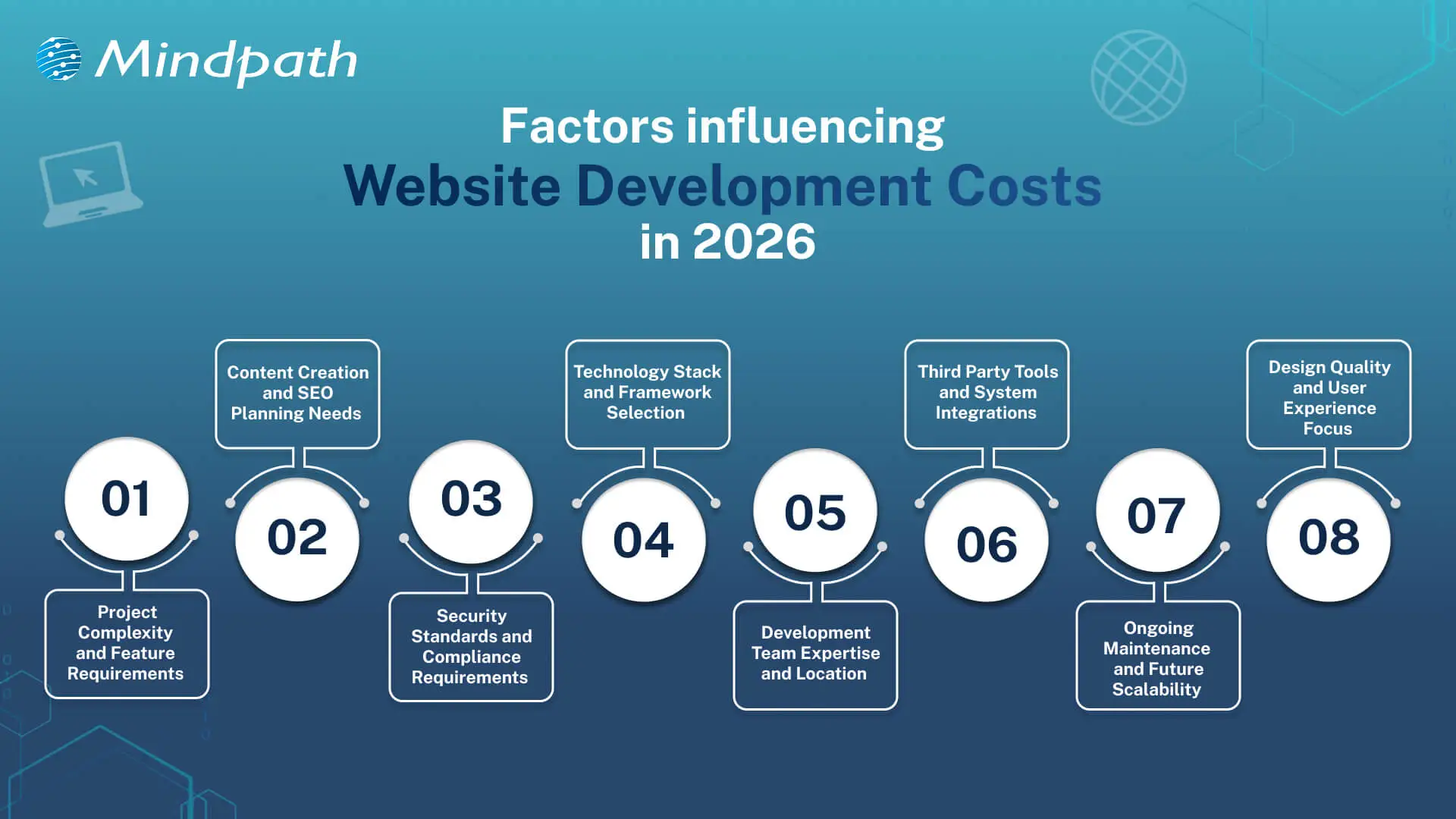
Further, you need to be considerate about the functionality, technology stack, and the requirements for post-launch support. Here are some quick factors that influence the web development prices

1. Type of website

A static website might cost you less than an interactive SaaS project.

2. Technology Stack

Use of leading frameworks like Laravel, React, or Next.js can increase the development timeline along with their charges. 

3. Customization Values

If your website is developed with a pre-built template, the cost will be much lower. On the other hand, custom approaches can heighten the price range. 

4. Development Approach

If you are valuing the expertise of a professional web development company, the development charges will be higher than those for a freelancer. However, the projects from a certified company always win in the competitive edge. 

Curious why some web projects cost more than others? Discover web development tools and see how technology choices influence productivity and expenses.

What are the Average Web Development Costs for Multiple Industries?

The average web development cost majorly depends on the type of website you are relying on. Further, it also depends on the way you are creating and launching it. 

1. Small Business

A small website development cost generally falls between USD 1000 and USD 10,000. Basically, it will include 5 to 10 pages, including content management systems such as WordPress. Moreover, there will be some useful features like service pages, contact forms for reaching the business, along with mobile responsiveness. 

So, if you are serving locally or a startup business, this web development pricing can be useful. 

2. Corporate Operations

A corporate website will include some good features like ERP integrations and scalable architecture.  So, for such a business, the web development costs will be around USD 10,000 to USD 50,000. 

Such a price range offers proper performance optimization and user engagement. Further, it also enhances a business’s reach on global platforms while including many advanced options in it. 

3. E-commerce Sites

When it comes to e-commerce sites, the cost of web page development automatically heightens. Further, the cost breakdown depends on your catalog size, custom product pages, payment gateway integration, and shipping management systems. 

Many users also consider building their entry-level store through platforms like WooCommerce and Shopify. However, a completely customized e-commerce website can range up to USD 50,000. This will cover all types of essentials, such as automating the inventory management and multi-vendor benefits. To enhance your customer experience, you should be careful about the project’s security. 

4. Custom Web Applications

The overall cost of custom web development will fall in the range of USD 25,000 to USD 160,000. Your web application will include several important platforms like booking engines, SaaS products, real-time dashboards, and internal management systems. 

These are some custom solutions that need to be built from scratch and require advanced backend architecture, API integration, scalable database, etc. The web application development is comparatively challenging and requires the involvement of experts. 

This is the general idea about the average web development costs for multiple business types. So, the costs might vary depending on the various requirements of your projects. 

Looking to understand how emerging trends affect web development costs? Check out the latest web development trends to see how new technologies and practices influence project scope.

Website Development Cost Breakdown as Per the Types

You must be aware of the fact that every website has its unique development scope. So, the web development prices generally depend on your site’s functionality, complexity, and the intended need of the project. Here, you can go through the expected cost of web page development

Web Development Type Key Functions Development Phase Estimated Cost 

Basic Clean and understandable UI, contact forms, page navigation, search tools, etc., 6 to 12 weeks, USD 10,000 to USD 20,000. 

Standard User interaction, seamless content management, API usage, database support, etc., 3 to 6 months USD 20,000 to USD 45,000. 

Advanced High-level data flow, custom modules, real-time functionality, etc., 12 months plus. Starts at USD 50,000 and increases with custom inclusions. 

Planning your web development budget more effectively? Explore web development technologies to see how choosing the right stack affects cost and performance.

Website Development Cost As Per the Chosen Experts

There are multiple options available in the market to personalize your web development. Let us explore some valuable vendor types that have been offering the best web development costs while enhancing the facilities through viable inclusions. 

1. Team of Expert Web Developers

Hiring a professional web development team can be the best option available in the market. However, you might think it is an expensive investment. But remember that this option offers the highest level of security. 

Apart from this, these agencies consist of experienced people who can easily customize your projects as per your business goals. Such companies can help you with an accelerated web development process. Apart from leveraging design and developmental solutions, they also ensure website maintenance while developing a marketing strategy. The web development pricing of the full-fledged agencies will be around USD 15000 to USD 150,000 and more. 

2. In-house Development Team

Creating your own web development team offers you the advantage of having dedicated professionals at your fingertips. However, the process can be resource-intensive and time-consuming. You need to be assured of effective management and create a positive work environment. Other than this, it can be challenging for you to find candidates who match your required skills and budget. 

Remember that an in-house web development team is necessary if the website is essential to your business. The average web development cost of these experts can be between USD 80,000 and USD 200,000 per year. 

3. Freelance Developers

Freelancers will charge you around USD 15 to USD 80 per hour. They are the only viable options that come within a small budget. They are best suited for your small websites, MVPs, or any budget-centric projects. Further, they offer flexibility with the contracts and easily scale the tasks. 

4. DIY Efforts

Many businesses just take the challenge to create their website on their own. However, it takes high skills and commitment. The process remains slower, and you might commit mistakes that your business can’t bear at all. 

Curious how web development costs compare to full-scale software projects? Discover software development cost insights to understand long-term budgeting and investment planning.

How to Pick the Best Web Development Partner?

If you require your development process to be effective enough, only prioritizing the website development cost breakdown is not enough. You need to prefer the right development team or company that can make your project a success. Moreover, they should satiate your budget without being a burden on your pockets. 

A right development partner should meet your budget, business requirements, and technical needs. So, you should look for experts who have good experience with your project type and industry. The experts should follow clear communication while being transparent regarding their process and charges. They should offer a detailed proposal regarding their web development pricing. So, no matter if you are choosing a professional agency or a freelancer, just be assured of their support and clarity. 

What are Some Ongoing Costs that you might experience after a Website Launch?

Launching a site is just half of your journey. There are other elements related to it that can proceed with ongoing costs. Some of the major ones have been listed below. 

1. Hosting Charges

Hosting charges usually come on an annual or a monthly basis. Shared hosting can be a bit approachable, while cloud hosting might hamper your budget. 

2. Maintenance Efforts

To let your website offer desirable results, you need to continuously test its performance and fix bugs when required. 

3. Support Packages

Your company might require support packages from web developers to keep the website performance-oriented. 

Want to avoid unexpected web development costs? Check out the web development roadmap to understand project milestones and cost drivers.

Conclusion

It is a great thing to understand the website development cost breakdown before you think about any project. This can help you set clear goals while maintaining your budget. On the other hand, costs differ as per your goals, industry, requirements, and complexity of your projects. Breakdowns available in this guide can help you plan your projects with clarity. A well-defined budget with a solid plan can help you prevent your company from costly surprises and help your website to fulfil your business goals precisely. 

So, if you are ready to experience the next step with a personalized cost estimation and strategy customized specifically for your business needs, consider the excellence of Mindpath’s web development services. Here, the team can help you build a website that can match your vision while pushing you ahead in the market. 

Low-code No-code Development

The app development arena has been undergoing constant evolution. One of the major developments that has captured the attention of one and all is the Low-Code/ No-Code modular approach. It is a must for modern businesses as well as individual app developers to familiarize themselves with low-code no-code development. It certainly holds the potential to revolutionize the application development process. 

According to the recent report by Future Business Insights, the low-code development platform is expected to grow from $ 37.39 billion in 2025 to $ 264.40 billion by the year 2032. This major jump automatically highlights the growing popularity of low-code platforms. In order to leverage this application development model, it is imperative for businesses to have a clear understanding of what is low-code or no-code development.

Want to take your business to the next level with the use of low-code development services? Contact us and get full guidance and support on how you can implement low code/ no code innovation for your organization.

An Insight into Low-code or No-code Development

In the dynamic digital space, low-code no-code have certainly emerged as a transformative force. It can be defined as the app development process that involves minimal coding. It serves as a visual approach in the app development setting. By adopting such an approach, it is possible for businesses or individuals with minimal coding skills to develop applications. 

The key difference between low-code and no-code development lies in the degree of coding that is necessary.  Low-code platforms act as highly effective tools that can help in creating apps. However, one must possess knowledge relating to coding to a certain degree. No-code platforms act as drag-and-drop platforms that entirely eliminate the need for coding. By leveraging top low-code no-code development services, businesses can develop high-performing applications.

Must Read: Low-Code vs. No-Code Development

Mechanism of Low-Code No-Code Development

In the traditional app development process, app developers or programmers had to engage in highly complex coding processes. Such processes were essential to create the features as well as the functions of the intended apps. As a result, app developers were expected to possess solid skills and expertise relating to coding and computer programming languages. 

However, by using the Low-code No-code Development approach, it is possible to visually choose and connect reusable components. By doing so, app developers and businesses can identify the specific components that represent specific capabilities. Then they can link them together in order to develop the desired workflow. 

Low-code and No-code tools undoubtedly simplify how developers create apps. By using such tools, they can easily develop applications as if they were drafting a flowchart instead of writing code in a detailed manner. Moreover, such platforms come with several features that allow developers to experiment during the app development process. The simple drag-and-drop interfaces of low-code and no-code tools streamline the entire application development process. 

As low-code and no-code solutions continue to grow, it’s helpful to see where they fit among the top web development trends in 2026, shaping the industry.

Benefits of Low-Code No-Code

In the past, the development of software applications was quite time-consuming. Businesses would have to deploy teams that would be responsible for app development. However, today the situation is very different as they have the option to use low-code/no-code tools.  These tools have the potential to simplify how applications are developed. Now that you know the low-code no-code meaning it is time to explore its benefits. 

1. Faster app development process

One of the fundamental benefits of low-code and no-code revolves around a faster development process. By using the best low-code no-code platforms, businesses can certainly speed up their app development process. Such tools create the opportunity for app developers to design apps efficiently without having to do complex coding from scratch. 

2. Lower app development cost

The cost relating to app development can give rise to financial constraints for businesses. In fact, conventional app development processes were quite costly. However, by adopting the low-code no-code model, businesses can develop top-performing apps in an affordable manner. By choosing top tools, the need for high-cost development resources can be reduced considerably.  

3. Ideal tool for non-developers

Non-developers who have limited insight into software development can capitalize on low-code and no-code tools to venture into the development space. These tools can act as the perfect partners that can aid in designing a diverse range of applications. Businesses can utilize the model to democratize app development. As a result, the reliance on IT teams for app development can be reduced considerably. 

4. Higher agility

In the prevailing digital context, the low-code no-code approach enables businesses to undertake diverse processes relating to prototyping and testing. By using low-code or no-code platforms, businesses can modify the workflow, data sources, and user interfaces. Moreover, such modifications can be done in a quick and agile way. 

While low-code/no-code tools offer speed, traditional approaches still have value; learn more about optimising development with Custom Web Development Services.

Drawbacks of the Low-Code No-Code Model

To get a comprehensive insight into low-code and no-code development, it is essential to understand the associated drawbacks. Only by being aware of the shortcomings can businesses decide how they can optimally use low-code or no-code. Some of the major drawbacks of low-code and no-code include:

1. Restricted degree of flexibility

One of the main drawbacks of the low-code no-code approach is that it diminishes flexibility for app developers. This is because their ability to customize their app is reduced to a considerable extent. As low-code and no-code frameworks rely on pre-built components, businesses that wish to develop highly tailored apps may not be happy with the outcome. 

2. Issues relating to performance

Another major drawback of low-code and no-code that businesses need to be aware of revolves around performance concerns. Sometimes, the apps that are developed using low-code or no-code tools may struggle to handle a large volume of data. Similarly, concerns relating to scalability may also arise in case there is a surge in user load. Such concerns may have an adverse impact on the overall satisfaction and experience of users. It may even impact the reputation of businesses. 

3. Challenges relating to integration

A common concern that may arise for businesses centers around integration challenges. It might not be easy to integrate the apps that have been developed using low-code or no-code platforms with the existing systems. Thus, app developers and businesses may require extra time as well as resources to address these integration concerns. 

4. Security issues

The use of no-code platforms may give rise to serious security concerns for businesses. This is because such platforms typically have limited security features. In the highly unpredictable and uncertain digital environment, this drawback has the potential to compromise the quality of an app. Moreover, security-related concerns may give rise to severe consequences for not only businesses but also their customers.   

Final Words

In the technology-driven business world, app development is a must for most businesses. Thus, it is crucial for businesses to broaden their insight relating to low-code and no-code development. By capitalizing on this app development model, businesses can certainly develop top-quality apps in an efficient manner. Before applying the specific model, businesses can surely refer to some real-life low-code no-code development examples.

To make the most of the low-code and no-code approach, it is essential to consider the associated advantages and drawbacks as well. The comprehensive insight can definitely guide modern businesses to develop novel apps with the help of low-code and no-code tools. Mindpath‘s low-code development services help you make the strategic use of such tools can empower businesses and shape the experiences of their target audience.  

Discover how low-code/no-code tools are transforming digital development and enabling faster app creation for businesses.