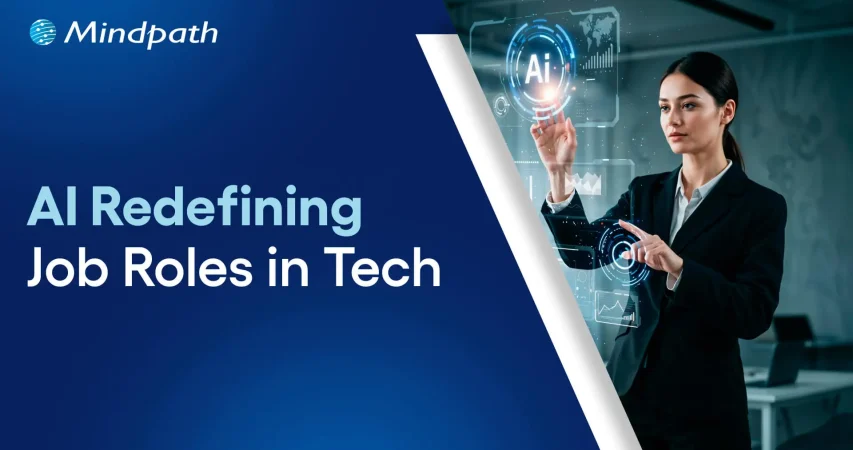
Future of Work: How AI is Redefining Job Roles in Tech

Join our Newsletter!

Featured Posts

Support Is One Click Away

Home

Future of Work: How AI is Redefining Job Roles in Tech

AI Redefining Job Roles in Tech

Future of Work: How AI is Redefining Job Roles in Tech

Artificial intelligence is rapidly transforming how the tech world operates, bringing a wave of changes that are reshaping the ways in which professionals work and innovate. The influence of AI redefining job roles in tech can be seen across every corner of the tech industry, where automation and human creativity are coming together to drive smarter, faster, and more efficient ways of building the future. This isn’t about replacing talent; it’s about enabling talent to reach new heights of access and productivity.

Organizations are changing rapidly, and traditional job roles are being redefined. Developers have become strategists, data analysts have become decision-makers, and engineers are collaborating more closely with advanced intelligent systems, leveraging AI in decision-making to drive smarter business outcomes. The pace of change will accelerate, and those who can adapt will lead the next generation of digital expansion. Let’s dive in and examine the impact of AI on the future of work and how it is changing the technology landscape like never before.

As AI transforms the tech workforce, businesses have more ways than ever to scale and innovate. Want to know how? Explore our AI development services to elevate productivity and stay competitive.

The Growing Influence of AI in Today’s Tech Industry

Artificial Intelligence is evolving into a transformational force in the contemporary technology sector. It will alter the ways businesses design products, optimize resource allocation for applications, and provide digital experiences. Companies are utilizing AI to not only automate tasks but also to make informed decisions and create new innovation opportunities. With the rise of AI in business strategy, organizations are now integrating intelligent systems to strengthen planning, improve efficiency, and gain a competitive edge. AI’s influence is extending into every dimension of technology.

A report published by McKinsey stated that the adoption of AI in IT functions increased from 27% to 36% in six months. The report also showed that 71% of organizations that use AI employ generative AI for at least one business function. Additionally, 38% of companies that use AI anticipate their overall workforce to remain the same over the next three years, while IT and product development teams are expected to see growth. This demonstrates the benefits of AI not just in operational efficiency but also in creating new skill-based jobs and redefining job roles in the tech sector, helping humans work more intelligently and strategically.

Must Read: Is Your Business Ready for AI?

How is AI Changing Job Roles?

The impact of artificial intelligence on employment is changing how people do their jobs and how organizations staff their teams. It’s creating new types of opportunities, and it is changing the types of skills that matter the most in today’s tech world. Here are the differences AI is making in job roles across the industry.

1. New Opportunities in AI-Driven Careers

As artificial intelligence expands, the emergence of new specialized careers in technology is beginning to take shape. People are now working as AI trainers, data scientists, and ethics officers, among other roles. These new job roles will be open for a workforce to be smarter and more resourceful going forward.

2. Smarter Work with Automation

AI is taking over repetitive work like data entry, research, and customer support. That frees up professionals to spend more time in the day on creativity, innovation, and decision-making. The trend of AI redefining job roles in tech captures the reshaping of work toward strategic and value-added work.

3. Shifting Skills and Smarter Roles

As AI tools are getting integrated into daily operations, workers are now the ones who supervise, analyze, and enhance the results provided by AI. They are acquiring skills in data interpretation, problem-solving, and collaboration. Their changing duties, thus, emphasize the impact of technology on the restructuring of the old job models.

4. Boosting Productivity Across Teams

AI tools increase both accuracy and speed with tasks like analysis of data and performance management of systems. Teams are now able to work more successfully and with higher levels of accuracy and speed. AI redefining job roles in tech is making the workplace more task efficient and performance focused, a sign of AI transforming the future of work.

5. Growing Value of Human Skills

With AI, handling most of the technical and monotonous tasks, the qualities of creativeness and emotional intelligence have become very important. Essentially, traits such as empathy, communication, and leadership have become the main factors in one’s professional development. These proficiencies are what make it possible for people to be leaders of innovation; thus, they are‌ indispensable.

6. A Changing Job Market Landscape

Artificial ‍intelligence is changing the way companies hire employees and how the workforce is managed. With the help of AI, recruiters can find the right candidates in less time and then focus on valuable interaction with the candidates. The AI redefining job roles in tech trend is an indication that the two, people and technology, are evolving hand in hand to build up the future workforce that will be more ‌‍ ‍‌powerful.

Wondering how your business can actually implement these AI capabilities without overwhelming your team? Explore our detailed guide on AI consulting services explains how expert support can simplify adoption and accelerate results.

AI Job Roles in Tech

The increase of AI job opportunities in technology is changing how workers build careers and how innovation will occur. AI continues to expand and is also creating jobs that integrate technology, creativity, and human thinking.

1. Building Smarter Systems

Artificial intelligence (AI) engineers develop smart systems that enable businesses to become more efficient and intelligent in their processes. They build responsive solutions using machine learning and automation that will evolve and get better with time.

2. Turning Data into Decisions

Researchers and analysts work on research and analyze information gathered through AI tools. They provide companies with better decisions by leading them from complex data to business insights. Their work is essential across sectors, from finance to AI for customer services, where data-driven insights improve customer interactions.

3. Training the Machines

AI teachers and trainers help create guidelines for learning for AI systems. Their work guarantees that every algorithm works perfectly and aids actual applications.

4. Designing Better Algorithms

Algorithm engineers develop and improve algorithms that power features such as recommendations and predictions. They partner with software engineers and data scientists to implement efficient and precise models.

5. Leading AI Product Development

AI product managers handle the end-to-end development of AI solutions. They ensure those solutions support user needs, can scale across an organization’s technology stack, and support business objectives, demonstrating how AI is redefining job roles in tech and advancing growth across fields. Their contributions help drive advancements in multiple industries, including AI in e-commerce, where product managers shape smarter and more personalized shopping experiences.

Want to see how AI is reshaping not just tech jobs but also the way websites are built? Our blog on AI in Web Development breaks down how intelligent automation is transforming the entire development workflow.

Ready to Embrace the Future of AI in Tech?

Artificial intelligence has a vital role in changing the way we work, learn, and develop in the technology space. The trend of AI redefining job roles in technology shows how human creativity and machine intelligence can work together to build a smarter future. The individuals who adapt and retrain today will confidently participate in tomorrow’s digital transformation.

At Mindpath, we develop cutting-edge AI development solutions that help businesses grow faster and work smarter. Our skilled team focuses on developing intelligent systems that automate processes, apply data analysis, and improve decision-making. We help our clients leverage AI technology, allowing them to remain competitive in an ever-evolving technology-based world while achieving digital success that will last for a long time.
Related Post

Explore top projects built with ReactJS, from personal websites to SaaS apps. Learn why ReactJS is ideal for scalable, high-performance web solutions.
Discover how AI can revolutionize your business with predictive analytics, machine learning, and conversational AI for smarter decisions and improved efficiency.

Related Post

generative AI for customer service

In the technology-driven era, the customer service landscape has undergone a transformational change.  A key technology that has been serving as a catalyst is generative AI. The rising popularity of generative AI for customer service is evident, as about 65 % of leaders in customer service intend to leverage the technology along with conversational AI to boost customer satisfaction (Source: IBM). 

The emergence of Gen AI has been nothing short of transformational for businesses. One of the main areas that has witnessed a remarkable change because of Gen AI is customer service. The novel technology has undoubtedly broadened the boundaries of customer support. Business entities across diverse industries can focus on enhancing customer experience with AI, especially generative AI. Let’s explore how modern businesses can capitalize on Generative AI in customer service.

If you are looking to leverage the user experience with the use of Gen AI. Contact us to unlock the full potential of Gen AI in enhancing your customer support and delivering personalized services.

An Insight into Generative AI

Before answering the question – How generative AI is improving customer service, it is crucial to have clarity on Gen AI. Generative AI refers to the specific branch of Artificial Intelligence that is capable of creating new content in the form of text, audio, video, and image formats. The output of Generative AI mainly depends on the type of data that it has been trained on.

In recent years, Generative AI has undoubtedly been considered a major breakthrough in the AI landscape. It has not only expanded the boundaries of Artificial Intelligence but also redefined how individuals and businesses interact with AI technology. The functionality of generative AI is not restricted to generating new content. It can also generate chat responses, create deepfakes, and personalize interactions.

Wondering how artists and creators are adapting to AI? Discover how Generative AI is changing the creative industry, and see how automation and imagination now work together.

Role of Generative AI in Customer Service

Customer service is the specific domain where companies offer support and assistance to their customers. The assistance could be offered prior to, during, or after the purchase of their offering. Regardless of the timing of such service, the role of customer service is indispensable since it can have a major influence on the overall experience and satisfaction of customers. At present, the customer service arena has undergone revolutionary change thanks to the adoption of Gen AI by businesses.

Generative AI for customer service has been a boon in the business world. It has certainly equipped businesses to automate their customer service function. As a result, the overall efficiency of business entities to promptly respond to the queries and concerns of their customers has increased significantly. Today, the role of GenAI customer service is of high strategic importance for businesses. By leveraging the core capabilities of Generative AI, businesses are able to redefine how they deliver support to their customers.

Curious about how generative AI is applied in real-world scenarios? Explore Generative AI Use Cases to discover how businesses leverage AI for content, design and innovation.

Key Benefits of Generative AI-based Customer Service

The strategic deployment of Generative AI technology in a customer service setting can give rise to a host of benefits for businesses.  In order to take advantage of the novel technology in an optimum manner, it is a must for businesses to understand its potential at an in-depth level. Some of the major benefits that can arise for businesses by integrating generative AI in customer service include:

1. Prompt Response

By integrating Gen AI-powered customer service, businesses are able to promptly respond to the concerns or queries of their customers. Customers do not have to wait for long hours to get support from businesses. Gen AI undoubtedly empowers businesses to respond to their customers instantly. Moreover, thanks to the use of Gen AI in customer support, businesses are able to offer 24/7 assistance to their customers. This automatically increases the overall convenience of customers and strengthens their association with businesses.  

2. Personalization of Interactions

One of the chief benefits of gen AI in customer support is that it facilitates personalization. As a result, business entities can tailor the interaction to meet the exact needs of their customers. Generative AI technology is basically capable of accessing customer data and past interactions, thereby personalizing the conversations. The integration of Generative AI for chatbots has been revolutionary since it has taken personalization to the next level. Thus, in the competitive business environment, businesses are able to have meaningful conversations as well as interactions with their customers.  

3. Better Productivity of Customer Service Agents

One of the benefits of AI in support teams revolves around the higher productivity of agents. Thanks to the automation of conversations with customers, the workload of customer service agents has significantly reduced. Therefore, they are able to focus on complex interactions and deliver value to customers. Moreover, the possibility of customer service agents suffering from burnout and fatigue can also be significantly reduced.

Must Read: Generative AI Trends 

4. Downside of Gen AI in Customer Service

Although Generative AI technology has been disrupting customer service like no other technology, it has also given rise to a few concerns. In order to get a holistic insight into the potential of Gen AI, it is crucial to take into consideration its shortcomings. By having a comprehensive insight into these next-gen customer service solutions, businesses can leverage the novel technology in an optimal manner.

5. Hallucinations 

One of the major shortcomings revolves around hallucinations. There may be a number of occasions when Gen AI may generate inaccurate or counterfeit responses that may seem plausible. However, due to their inaccuracy, the risk of misinformation may arise. Furthermore, customers may be on the receiving end because of this particular flaw. In sensitive industries such as healthcare or finance, it may act as a major hindrance for both businesses and customers.

6. Absence of domain knowledge

Another downside that businesses need to take into consideration is the lack of domain knowledge. Unless and until companies fine-tune Gen AI prior to its implementation, there may arise knowledge-related gaps. Due to such gaps, Gen AI may not be able to address complex queries that may be asked by customers. As a result, the results may not be relevant and useful for customers.  

7. High reliance on automation

The excessive reliance on automation has the potential to affect the personalization component of the interaction. When customers may expect to get empathetic and emotionally sensitive responses, generative AI may not be the ideal customer service solution to meet their needs. As a result, the issue relating to emotional disconnect may arise, diminishing customer satisfaction.  

It is imperative for businesses to take into account the positives as well as the negatives of Gen AI. It can certainly create an opportunity for businesses to capitalize on the core capabilities of Gen AI and redefine how they deliver customer service. As a result, they can strategically leverage Gen AI to strengthen their association with their target audience.

Trying to keep up with rapid AI advancements? Read Generative AI Revolution to learn how this transformation is redefining business and creativity.

Looking to Redefine Your Customer Experience with AI?

The customer service realm has undergone a dynamic change in recent years due to the adoption of Generative AI by businesses. Even though Gen AI is still in its nascent stage, it holds immense promise, especially in the customer service setting. It is essential to bear in mind the associated benefits as well as drawbacks of the generative AI technology.

The novel technology has given rise to a plethora of opportunities for firms to redefine how they interact and engage with their customers while extending customer support to them. In order to leverage Generative AI, you can choose Mindpath as your success partner. The novel digital solutions offered by the company can help businesses take advantage of Gen AI capabilities and enhance their customer service. Thus, businesses across diverse industries and sectors can strategically deploy Gen AI to reshape their customer interactions.

Frequently Asked Questions

1. How does generative AI handle complex or sensitive customer queries?

Generative AI can manage many queries effectively, but complex or sensitive issues often require human involvement. It works best when combined with human oversight, where AI handles routine interactions and escalates critical or nuanced cases to trained support professionals for accurate resolution.

2. What type of data is required to make generative AI effective in customer service?

Generative AI relies on high-quality, structured, and relevant data such as past customer interactions, FAQs, and product information. Well-prepared data ensures accurate responses, better personalization, and improved reliability, making it essential for delivering consistent and meaningful customer support experiences.

3. How can businesses maintain trust while using generative AI in customer interactions?

Trust can be maintained by ensuring transparency, accuracy, and clear communication. Informing users when they are interacting with AI, regularly monitoring responses, and providing easy access to human support helps build confidence and ensures a reliable customer experience.

4. What measures can reduce errors or hallucinations in generative AI responses?

Regular model monitoring, fine-tuning with domain-specific data, and implementing validation layers can significantly reduce errors. Combining AI outputs with predefined rules or human review ensures more accurate and dependable responses, especially in scenarios where precision is critical.

5. How does generative AI scale customer support operations effectively?

Generative AI can handle a large number of simultaneous interactions without delays, making it highly scalable. It allows businesses to manage increasing customer demands efficiently while maintaining response speed and consistency, without the need to proportionally increase support staff.

Discover how Generative AI is revolutionizing customer service with automation, efficiency, enhancing customer experience and more.
full stack nodejs

Companies are now seeking scalable and robust applications, which can meet both years of functional performance and user expectations. That’s when full-stack Node.js development comes into play, uniting the power of frontend and backend within a single environment. It allows developers to build faster and smarter while creating applications to remain adaptable as the business continues to grow.

In this way, constructing end-to-end solutions is more fluid and intelligent. With cohesive databases, APIs, and user interfaces integrating and interfacing, developers can automate some of the hassle proactively. Understanding full-stack Node.js ultimately gives developers an advantage to think forward as technology grows and gives organizations tangible opportunities to grow with applications that perform and scale easily. So, let’s dive in to know how this expertise truly makes a difference.

Want to build an advanced application without compromising performance? At Mindpath, our full-stack development services will help you provide the best solutions, handling both front-end and back-end with efficiency.

Understanding the Fundamentals of Full-Stack Development

Full-stack development means developing on the front end and back end of a web application. The front end refers to all the things that the user responds to and interacts with, such as buttons, layouts, designs, etc. The back end refers to all of the things that run in the background, like databases, servers, etc., and all the logic that makes it run smoothly, working together.

A full-stack developer has the capability to deal with both sides. They are capable of building UX and the technology that serves the app. This gives them agile skills that allow them to build comprehensive applications entirely from front to back.

Understanding the Basics of Node.js

Node.js is a platform that allows you to run JavaScript code in a JavaScript runtime outside of the browser. It is built on Google’s V8 engine, which is extremely fast and built to be efficient. Node.js allows developers to write server-side applications using the same exact language as for the front end, making development and management easier and smoother.

An advantage of Node.js is that it operates asynchronously, which allows tasks to not have to wait for one another to complete, meaning that applications can handle multiple requests at once. Because of this, the use of full-stack Node.js is quickly becoming a good choice when building scalable, real-time, and modern applications.

The success of using Node.js in full-stack development depends on hiring the best developer. Discover the key Factors to Consider while Hiring Node.js Developers.

Why is Node.js Important for Full-Stack Development?

Utilizing Node.js full-stack technology is an impressive approach to developing a complete web application. Here are reasons that Node.js is a valuable technology option in the full-stack.

Importance of Node.js for Full-Stack Development

1. High Performance Delivery

Node.js utilizes a non-blocking I/O hardware model that can handle hundreds or even thousands of requests simultaneously, providing faster response times and greater user-specific.

2. Cross-Platform Power

With the Node.js full stack, developers can write mobile and desktop apps to run on Windows, macOS, Linux, and more. By relying on a single JavaScript code base, developers can save time and effort writing for multiple platforms.

3. Microservice Architecture Made Easy

Full-stack Node allows users to break one larger application down to multiple smaller independent services using infrastructure that is easier to work with. This approach lets developers build faster, stay flexible, and rely on proven solutions.

4. Scalable Solution

Full-stack Node.js is used by major players like Walmart, Uber, and Trello to handle millions of users. It helps to lower load time significantly, and it ensures your applications will scale seamlessly, as your demands increase.

5. Real-Time Advantage

When it comes to applications that leverage chat, live streaming, food delivery, or payments, Node.js full-stack is the way to go. It seamlessly provides real-time updates to keep the user engaged and connected.

Also Read: Full-stack Development for Web Projects

Key Steps to Use Node.js in Full-Stack Development

A full-stack Node.js developer is involved in both the front end and the back end of web application development and will work to build complete web applications. Below is a synopsis of the primary steps to utilize Node.js in full-stack development that is easy and productive.

Key Steps to Use nodejs in full stack development

1. Set Up the Development Environment

To begin your application-building experience, you will need to install Node.js and npm (Node Package Manager). These tools will allow you to execute JavaScript beyond the browser, and they will also help manage libraries with ease. Verify the setup by checking versions with simple commands in your terminal.

2. Initialize the Project

Make a new folder for your app, and use ‘npm init’ to create a ‘package.json’ file. A package.json file holds important information, such as your project name, dependencies, and scripts. It will serve as the basis for managing everything in your project.

3. Build the Server with Express.js

Install Express.js so you’ll be able to set up the backend server and handle all of the different routes. Express.js makes handling requests, responses and APIs supposedly easy. This step will ensure the backend runs appropriately with the frontend.

Must Read: Full-stack development trends

4. Connect to a Database

Based on your needs for this project, select a database like MongoDB or PostgreSQL. This should be paired with a Node.js library like Mongoose or Sequelize, which will allow you to connect to and perform both read and write operations on your data. At this point, you will have the ability for your application to persist and retrieve your data.

5. Design the Front-End

Build the front-end using a library such as React, Angular, or Vue. You can link the front-end through RESTful APIs or GraphQL to your Node.js back end. At this point, players will finish the bridge for a Full-stack Node.js application.

6. Manage Authentication and Security

Use libraries like Passport.js or JWT to add secure login and registration. Secure necessary paths so that any authorized user can get to those routes. You should always consider security in any Full-stack Node.js application.

7. Test and Deploy the Application

Create unit and integration tests to ensure that your application does what you intended. Deploy the application to cloud hosting solutions like Google Cloud, AWS, or Heroku. To utilize your Full-stack Node.js application’s performance tool on different scales, you should monitor its performance!

Looking to integrate AI in your Node.js projects? Explore our Ultimate Guide to Node.js Libraries for AI Integration to discover the most effective libraries for building smart, scalable, and future-ready applications.

Ready to Unlock the Power of Full-Stack Node.js?

Full-stack Node.js has proved to be a smart choice for building scalable, high-performing, and real-time applications. It unites front-end and back-end seamlessly, helping developers create complete solutions with speed and flexibility. With its ability to handle microservices, cross-platform apps, and real-time updates, it has become an essential technology for modern web development.

At Mindpath, we provide expert full-stack development services designed to match your business goals. Our skilled Node.js developers bring deep technical knowledge and practical experience to build secure, scalable, and user-friendly applications. If you are looking to transform your digital ideas into reality, hiring a Node.js expert from our team ensures growth and lasting impact.

Master full-stack development with Node.js! Its scalability, performance, and seamless frontend-backend integration.
ai in retail industry

Undoubtedly, the global retail landscape is going through a massive transformation. A major architect of this transformation is Artificial Intelligence, or AI. Today’s customers demand convenience, immediacy, as well as personalization. They expect companies to anticipate their needs. Well, AI in retail industry helps brands to achieve that. 

If you want to create a seamless shopping experience and boost customer engagement, retail AI would be an excellent option. Today, we are moving beyond simple automation to a new phase of creative and predictive intelligence. So, this blog explores how generative AI in retail and other AI tools are enhancing customer engagement. Besides, we will discuss some AI in retail examples to get a better idea about this.  

Looking to go beyond generic AI tools to create truly personalized retail experiences? Our AI development services help retailers build custom solutions that boost customer engagement and drive smarter growth.

AI in Retail Industry- A Short Brief

Artificial intelligence in retail store means the use of natural language processing, machine learning, generative AI, and computer vision to enhance or automate decision-making. These technologies also play a crucial role in streamlining operations and personalizing customer journeys. 

Offering predictive recommendations and data-driven insights, AI in retail industry boosts customer satisfaction and revenue. As per a recent survey, the use of AI in the retail sector can increase customer experience by 59 percent (Source: World Tea News). 

Besides, generative AI creates massive economic potential for retailers. It is projected to offer between USD 240 billion to USD 390 billion in economic value (Source: McKinsey).

Whether it is a recommendation engine suggesting useful products or a retail AI chatbot helping shoppers, AI can be embedded in all aspects of the customer journey. 

Must Read: AI in E-commerce

Generative AI in Retail- A Game-Changer for Customer Engagement

Generative AI for retail is now pushing boundaries by offering personalized and dynamic content at scale. Well, here is how it plays a crucial role in creating customer engagement strategies. 

1. Hyper-Personalized Product Recommendation

AI in retail industry effectively analyzes customers’ purchase history, preferences, and behaviour. It can provide customized product recommendations based on the gathered data. In addition, such recommendations can appear in applications, emails, or websites, which enhances the conversion rates. 

Customer satisfaction, shopping experience, and loyalty can be improved by offering the customers relevant products at the right time. 

2. Smart Virtual Assistants and Chatbots

Retailers are able to provide 24/7 customer support using generative AI chatbots. Bots can easily handle multiple queries without any issues. Furthermore, they can guide purchases. 

Over time, these intelligent bots can learn from customer interactions, improving personalization and accuracy. Besides, you will be able to reduce the cost of customer support when using a chatbot.

Want to offer instant and personalized support to your online shoppers? Explore conversational AI chatbots to learn how they improve customer engagement and boost conversions.

3. Demand Forecasting 

AI-driven demand forecasting involves using ML and data and analytics trends for predicting the demand of products in the future. Retailers can optimize inventory, improve logistics and reduce waste by analyzing market data, sales, and customers.

These models may be trained to respond to changes in the market, assisting retailers in better planning than the rest. So, they can react swiftly to the changes.

4. Dynamic SMS and Email Campaigns

Advanced AI tools for retail industry can create personalized SMS and email campaigns. For this, they consider various elements like behavioral data, seasonal trends, and customer segments. Speaking about some useful AI-powered tools you can use are OptiGenie, HubSpot, Canva, and AdCreative.ai.

These messages or emails are relevant and engaging, leading to higher click-throughs, open rates, and conversions. Furthermore, retailers can also automate outreach using these tools. 

5. Visual Search and Styling

Thanks to generative AI, customers can now find their desired products quickly. They just need to upload an image of the product, and the search engine will then display similar products instantly. 

Besides, these tools also offer styling suggestions based on the customer’s input. It is this visual search that can enhance product discovery and interaction while minimizing friction. It is used by retailers to offer a shopping experience that is immersive and intuitive. 

Planning to personalize every customer interaction at scale? Discover generative AI for customer service to learn how it delivers tailored responses and smarter assistance.

6. Custom Rewards and Loyalty Programs

AI assists retailers to design custom loyalty and reward programs by analyzing the frequency and preferences of purchases. Special offers, targeted incentives, and personalized rewards generate increased brand loyalty and purchase repetitions. 

The use of AI in retail industry ensures that all customers feel appreciated, establishing stronger customer relationships.

7. Sentiment Analysis

The use of AI in retail industry promotes sentiment analysis to monitor the emotions of the customers. These tools analyze social media, reviews, feedback, etc, to understand customers. With the right data, retailers will be able to respond to all negative sentiments positively. 

In addition, the insights are also used in the development of marketing plans and brand communication, which is in line with customer expectations.

Artificial Intelligence is no longer a futuristic concept. It is changing customer interaction by hyper-personalizing automated customer support, visual search, etc.  

Wondering how to connect customer data with long term planning? Check out AI in business strategy and discover how it improves forecasting, personalization, and operational efficiency.

Key AI Use Cases in Retail

Now, we shall find out the key AI use cases in retail industry that have contributed to the smooth transformation of the retail sector.

Use Cases Description
Inventory Optimization AI helps retailers stock the right products using predictive analytics. This helps avoid stockouts and overstock issues. 
Customer Segmentation AI can categorize customers based on their demographics, preferences, and behaviour for targeted marketing. 
Fraud Prevention AI tools regularly monitor transactions for suspicious activities, protecting customers and retailers. 
Price Optimization Retail AI tools adjust pricing based on competition, demand, and customer behaviour. 
Virtual Try-Ons AI allows shoppers to try products digitally, lowering return rates and enhancing customer engagement. 
Route Planning AI-assisted route planning helps retailers eliminate service disruption and manage changing conditions. 

A Few Real-World Examples of Generative AI in Retail

The influence of AI in retail industry revolves around the behavior of the customers. Some of the established retailers are using AI to offer superior experiences. The following are some real-world AI in retail examples that can be considered to have a clear picture.

1. Amazon Go Stores

These stores use computer vision, deep learning, and sensors and help customers purchase their preferred products. The AI tools monitor purchases and automatically charge the customer’s account. 

2. Shopify

Shopify Magic is a new product offered by Shopify that understands your retail store and creates content automatically. 

3. Sephora

It supports AI-based virtual try-ons for beauty products, increasing sales and improving customer confidence in the product. 

4. Walmart

They have implemented AI for predictive analytics as well as inventory management.

5. Zara

It applies predictive modeling systems that are supported by AI to analyze fashion trends. These models track social media platforms, sales data, etc to know what the customers truly desire. The company is also able to streamline supply chains with the help of AI. 

6. The North Face

They use IBM’s Watson to offer customers a conversational shopping assistant. 

Looking to anticipate market shifts before your competitors do? Discover Generative AI trends to learn how predictive insights shape smarter retail strategies.

Technologies and Tools Powering AI in Retail

AI in retail industry is driven by a robust ecosystem of tools and technologies. Both facilitate operational efficiency, and smarter decision-making. Read on to know a few major innovations that are supporting the retail sector.

1. Big Data & Predictive Analytics

Evaluate large datasets to predict customer behavior, trends, as well as inventory requirements. 

2. Data Management Tools

Help in organizing and retrieving both unstructured and structured data to support decision-making and personalization. 

3. Salesforce Einstein

Offers features such as automated workflows, predictive analytics, and powerful generative AI tools.

4. NLP

Natural Language Processing helps understand as well as respond to customer queries, feedback, and reviews. It powers chatbots as well as allows personalized communication.

5. Computer Vision

This technology helps with shelf monitoring, smart mirrors, and visual search by processing video data and images in the retail stores.

6. IoT or Internet of Things

IoT involves devices that are connected and used to detect foot traffic and monitor inventory.

These technologies assist retailers in ensuring that customers remain the focal point in the interaction process, enabling them to stay competitive in this changing market. 

Want to make faster and more accurate business choices in retail? Discover AI in decision making to learn how data driven insights improve customer engagement and operational efficiency.

AI and Retail- What Comes Next?

Due to the ongoing development of AI technology, the future of AI in retail industry promises a more personalized shopping experience. Retailers worldwide will implement AI more often for operational efficiency, customer service, and personalization, thus eliminating the lines between digital and physical commerce.

In the future, we can expect:

1. Application of Emotion AI

AI will be in a position to understand customer emotions and assist retailers in enhancing customer satisfaction.

2. Hyper-Personalization

Generative AI in retail will offer context-aware and real-time experiences across multiple channels. 

3. Sustainability Insights

AI will assist retailers in tracking and lowering their environmental impact. 

4. Virtual Shopping Assistants

AI-powered virtual shopping assistants will offer real-time and personalized shopping support. 

5. Blockchain Integration

Retail and e-commerce sectors will become more transparent and secure with the help of blockchain and AI.

Retailers who leverage AI will successfully meet customer expectations. Result? Increased customer engagement, loyalty, and growth.  

Curious why businesses are rapidly adopting intelligent technologies? Check out the benefits of AI and discover how it improves decision making and competitive advantage in retail and e commerce.

Ready to Transform Your Retail Business with AI?

Artificial intelligence is revolutionizing retail by enhancing customer engagement, personalizing shopping experiences, and improving operational efficiency. Retailers leveraging AI gain a competitive edge, optimize processes, and deliver smarter, data-driven experiences that delight customers and drive growth.

At Mindpath, we provide tailored AI development services for the retail sector. Our experts design custom AI solutions that streamline operations, enable predictive analytics, and boost customer engagement. Partner with us to harness AI strategically and create innovative, scalable retail experiences that drive measurable results.