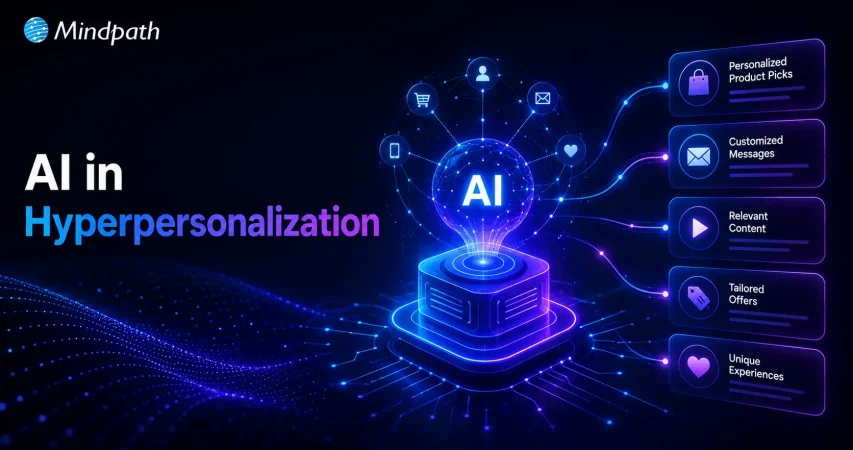
AI in Hyperpersonalization: A New Era of Tailored Customer Solutions

Join our Newsletter!

Featured Posts

Support Is One Click Away

Home

AI in Hyperpersonalization: A New Era of Tailored Customer Solutions

AI in Hyperpersonalization

AI in Hyperpersonalization: A New Era of Tailored Customer Solutions

Have you ever noticed how some brands seem to know exactly what you need, sometimes before you do? Imagine opening a shopping app and seeing recommendations that feel almost handpicked just for you. This level of personalization is no coincidence—it’s powered by AI and is known as hyperpersonalization. But how exactly does AI make this happen? And what does it mean for the future of customer experiences? Let’s dive into how AI is redefining what it means to truly know your customer.  

What is Hyperpersonalization?

Hyper-personalization leverages Artificial Intelligence and real-time data to provide highly personalized experiences, showcasing items and information that are specific to each customer’s tastes. By analyzing individual purchasing behaviors, prior purchases, and browsing habits, AI allows companies to give suggestions that are tailored to each customer’s distinct interests and preferences. 

This high degree of personalization enables organizations to go beyond generic ideas, resulting in a more seamless and engaging client experience. It’s an effective strategy that improves convenience and strengthens brand loyalty by making each customer feel understood and cherished. Hyper-personalization allows marketers to constantly offer relevant, customized information that engages with each client on a personal level. 

The Role of AI in Hyperpersonalization

1. Smarter Product Recommendations

AI’s ability to comprehend user preferences and behaviors is crucial in revolutionizing the way product suggestions are generated. AI can forecast what you will be interested in next based on data such as previous purchases, browsing history, and even time spent on certain things. This goes beyond mere ideas; it tailors each recommendation to your own preferences and needs. 

For example, if you’ve been looking for shoes, AI can recommend a pair that matches your style or even forecast the type of shoes you’d like based on recent searches or seasonal patterns. These recommendations sometimes appear to be “reading your mind,” displaying goods you never considered, but once you see them, they feel like a great fit. This degree of personalization improves the whole buying experience. You spend less time looking for what you want because the AI finds it for you, making each interaction seem more relevant and easier. With hyperpersonalization, AI guarantees that the goods you view are constantly relevant to your tastes, improving your entire shopping experience. 

2. Friendlier Chatbots

AI-powered chatbots have gone a long way towards providing more lifelike, human-like conversations. Instead of robotic, one-size-fits-all replies, these chatbots can now tailor their tone, vocabulary, and behavior to the context of the interaction and the user’s specific demands. They employ powerful AI algorithms to comprehend not just what you’re saying, but also the emotions and meaning behind it. 

These AI chatbots can also personalize replies by recalling prior encounters, recognizing your preferences, and offering relevant solutions. Whether you need help with a product, troubleshooting, or completing a purchase, the chatbot customizes its replies to your individual needs, exactly like a real agent would. AI chatbots boost customer service by making conversations feel more personal and human, resulting in a more engaging and fulfilling experience for customers, allowing businesses to provide 24/7 help without losing quality or empathy.    

3. Better Campaign Strategies

AI-powered solutions have transformed the way businesses approach marketing campaigns, allowing them to analyze massive volumes of data and forecast campaign outcomes more accurately. These technologies look at customer behavior, market trends, and previous campaign performance to spot patterns that might not be visible. Understanding these trends allows AI to assist businesses fine-tune their strategy, ensuring they are targeting the appropriate audience with the right message at the right time. 

Furthermore, AI can enhance processes by automating repetitive operations like segmenting audiences, providing personalized content, and managing digital marketing. This automation minimizes human work and improves marketing teams’ efficiency, allowing them to focus on higher-level strategy and creativity.  AI analyzing data in real time makes marketing campaigns more fluid and responsive. Brands can swiftly alter campaigns based on performance analytics, increasing their ability to remain relevant and adapt to changing client requirements. This increased efficiency not only enhances campaign efficiency, but also enables a more personalized marketing strategy, offering bespoke content and experiences that engage with specific customers. 

4. Tailored Marketing Materials

AI allows organizations to go beyond basic marketing messages by providing highly personalized content that addresses individual tastes and behaviors. AI can generate marketing materials that are specifically tailored to you by analyzing data such as your previous purchases, browsing habits, social media activity, and even real-time elements such as location or current trends. 

Furthermore, AI can adapt the tone, structure, and timing of the material to the individual’s preferences. It can provide a product recommendation at the ideal time, such as when you’re planning a trip or getting ready for a vacation, ensuring that the offer feels timely and relevant. By combining various data points and external variables, AI enables companies to generate targeted, relevant marketing that improves the customer experience and drives stronger connections with their audience.  

Also Read: Top 10 Benefits of Artificial Intelligence in 2024 

AI Development Services at Mindpath

Mindpath specializes in AI development services that help organizations grow and prosper by leveraging smart technologies. Our AI solutions are intended to increase efficiency, improve customer experiences, and make more informed business decisions. We develop specialized AI systems that can analyze vast volumes of data, forecast future trends, and automate repetitive operations, allowing your processes to run quicker and more accurately.  Our AI services may be customized to meet your specific company needs, from creating pleasant chatbots to providing personalized product suggestions. Whether you want to optimize operations or engage customers with intelligent, automated solutions, Mindpath has the AI technologies you need. Our team collaborates closely with you to guarantee that the AI technology we build helps you succeed and stay ahead. 

Final Thoughts!

AI is truly transforming the way businesses connect with their customers, creating a future where experiences are not only personalized but also highly intuitive. Through smarter product recommendations, friendlier chatbots, optimized campaign strategies, and tailored marketing materials, AI is helping brands build stronger, more meaningful relationships with their audiences. At Mindpath, we are dedicated to bringing these advancements to life with our custom AI development services, ensuring that your business stays ahead of the curve and delivers exceptional, personalized experiences. By harnessing the power of AI, you can enhance customer engagement, streamline operations, and create more impactful marketing strategies that drive long-term success. 

Ready to elevate your customer experiences with AI?

Partner with Mindpath today to explore our custom AI development solutions and stay ahead in your industry!

Related Post

Explore how Agentic AI empowers machines with decision-making abilities, enhancing efficiency, customer service, and operational effectiveness.

Related Post

Important to Consider When Hiring a Canadian ReactJS Developer
Hiring a ReactJS developer in Canada requires evaluating both technical expertise and problem-solving abilities. The ideal candidate should have a strong JavaScript foundation, in-depth React knowledge, experience with state management, and proficiency in front-end technologies. Additionally, expertise in version control, API integration, and performance optimization plays a crucial role in developing efficient applications. To ensure a successful hire, it’s essential to assess their ability to write clean, maintainable code and collaborate effectively. Below are four key factors to consider when hiring a ReactJS developer.

1. Strong JavaScript and React Fundamentals

A skilled ReactJS developer must have a deep understanding of JavaScript (ES6+), JSX, props, state, and component lifecycle methods. Proficiency in higher-order functions, closures, and asynchronous programming is crucial for building scalable applications. Additionally, a strong grasp of React hooks, context API, and functional components ensures efficient state management and UI rendering. This foundation allows developers to write optimized, reusable components and implement modern front-end development best practices, leading to faster and more maintainable web applications.

2. Proficiency in State Management and API Integration

Managing application state efficiently is crucial for complex React projects. Developers should be proficient in Redux, Context API, or other state management libraries to handle global state effectively. Experience in fetching, handling, and updating data from external APIs using Axios or Fetch API is equally important. Understanding RESTful APIs, GraphQL, and authentication mechanisms enhances their ability to build dynamic applications. These skills ensure smooth data handling and seamless communication between the frontend and backend, improving user experience and application performance.

3. Expertise in Frontend Technologies and Testing

A ReactJS developer should have a strong command of HTML, CSS, and responsive design principles to build user-friendly interfaces. Familiarity with CSS preprocessors like Sass or Less helps maintain scalable stylesheets. Additionally, experience with unit testing frameworks like Jest and React Testing Library ensures code reliability. Writing testable components minimizes bugs and enhances maintainability. Ensuring proficiency in these areas helps create visually appealing, robust applications that work seamlessly across different devices and browsers.

4. Version Control, Performance Optimization, and Tools

Version control is essential for collaborative development. A proficient ReactJS developer should have expertise in Git for managing code changes and maintaining project history. Knowledge of React performance optimization techniques like lazy loading, memoization, and efficient rendering improves application speed. Familiarity with React Router for navigation, Webpack for bundling, and accessibility best practices enhances overall development quality. These skills ensure that applications remain fast, scalable, and easy to maintain while following industry standards.

Looking for skilled ReactJS developers in Canada? Mindpath, connects you with top professionals to build high-performance web applications. Our experts specialize in React development, state management, API integration, performance optimization, and modern front-end technologies. Whether you need a dedicated team or individual talent, we have the right solution for your project. Partner with Mindpath today and hire expert ReactJS developers for your next big project!

Get in Touch Now!

Discover the key factors influencing software development costs and how to optimize your budget. Learn how Mindpath can help.
Web Development Costs
Ever puzzled over why web development costs vary so much? What exactly drives the price tag of a new website? Are you aware of the key factors that influence these costs and how they affect your budget? In this blog we are going to explore what affects web development costs, unravel the various factors that influence pricing, and provide you with the insights necessary to make strategic financial decisions for your project.  Web development is the process of building and designing websites to ensure that they appear attractive, are easy to use, and perform smoothly. The duties of a web developer extend beyond creating visually appealing websites; they also include optimizing a site’s functionality, such as speed and capacity to accommodate large numbers of users simultaneously. It implies that they work on everything from the style and design to the underlying coding that powers the website. Understanding the whole cost of web development is important for multiple reasons. It helps you create a precise budget, allowing you to know how much you can spend and prevent unexpected spending. Knowing the expenses may help you make intelligent choices about the features and functions to add, ensuring you get the most for your money. Since web development is a continuous process, it also enables you to prepare for upcoming upgrades or enhancements. By understanding the expenses and factors that impact them, you can collaborate more effectively with developers, manage your project more efficiently, and ensure the success of your website.  So, let us dig in deep to know about the factors influencing the cost of web development in detail! 

Factors Influencing Web Developer Hiring Costs

Web Development services at Mindpath

1. Complexity of Project

The complexity of your project significantly influences the cost of hiring web developers. Simple websites, such as personal blogs or small commercial sites, are typically less expensive to build. They require simple functionality and a simplistic design, making them quicker and easier to construct. More complicated projects, such as online stores with various features or specialised web apps, require a higher budget. These projects need complex coding, special design work, and maybe the integration of numerous technologies, all of which add time and effort to developers’ workloads. Understanding the complexity of your project allows you to better manage your budget and guarantee you have the right degree of expertise for your needs. 

2. Level of Experience

The cost of hiring a web developer is heavily influenced by their level of expertise. Junior developers, who are new to the profession, typically charge cheaper fees because they are still building expertise. Senior developers, on the other hand, charge more fees due to their years of expertise and specialized talents. Their skill typically allows them to manage more complicated jobs and provide higher-quality results. So, if you want complex features or a high degree of skill, expect to pay extra for a senior developer. 

3. Type of Model

The cost of web development is also influenced by whether you hire freelancers, in-house teams, or outsourcing companies. Hiring freelancers is often less expensive than taking on a whole in-house staff. Freelancers provide flexibility and reduced prices because they operate independently and have no additional overhead expenditure. Outsourcing, in which you contract with outside companies or teams, can still be less expensive than recruiting an in-house team, but typically more expensive than freelancers. Outsourcing allows companies to have access to specialized talents and resources without the long-term commitment required for in-house recruiting. Each choice has its own economic consequences, so knowing them can help you choose the most cost-effective solution for your project. 

4. Location

Developers in North America and Western Europe typically demand greater fees because of the higher expense of living and market standards in these locations. In contrast, developers in Eastern Europe or Asia frequently offer lower prices due to reduced living costs and differing market conditions. By evaluating the location, you may strike a balance between quality and affordability that fits your budget while still satisfying your project’s requirements. 

Ready to elevate your online presence?

Mindpath delivers exceptional web development tailored to your needs. 

How Much Does Web Development Costs?

Web development prices can range from $1,000 to $145,000, based on project scope, website complexity, and business size. Businesses often spend $1,001 to $10,000 per year on continuous maintenance. Agencies often charge between $1,000 and $5,000 per year for full services, whereas freelancers may charge between $1 and $500 per year to specialize in individual tasks. The overall cost might also represent the specific requirements of each firm, such as interactive features or enormous content. Investing in web development is typically regarded as beneficial, with 82% of organizations reporting satisfaction with their return on investment. 

Web Development Services at Mindpath

Factors Influencing Web Developer Hiring Costs

At Mindpath, we provide Web Development services to assist you establish a strong online presence. We design websites that look amazing on any device and are simple for your visitors to browse. Whether you require a basic website or a complicated web application, we ensure that your site runs smoothly and accurately portrays your brand. Here are some of our services: 

1. Responsive Website Design

We create websites that adapt to any screen size, ensuring they look great and work well on both phones and computers. 

2. Frontend and Backend Development

Our team maintains both the sections of your website that people interact with (frontend) and the underlying mechanisms that allow it to function (backend), resulting in a comprehensive and successful online solution.

3. Content Management Systems (CMS)

We install user-friendly systems that allow you to add, update, and manage your website’s content without difficulty.

4. E-commerce Solutions

We create customized online shopfronts that make it easy for you to exhibit and sell your items or services, giving your consumers a pleasant shopping experience. 

Wrapping Up!

Understanding web development expenses might be difficult, but it is critical for making intelligent choices and managing your budget properly. By considering project complexity, developer experience, recruiting methodology, and location, you can better understand what drives the pricing and how to maximize your investment.  

At Mindpath, we provide high-quality web development services that are personalized to your specific requirements, guaranteeing a seamless and effective online presence. Whether you need a flexible website design or a solid e-commerce solution, our skilled team is here to help you realize your vision while getting the most out of your investment.  

Looking for top-tier web development services?

At Mindpath, we craft stunning, functional websites that align with your goals. 

application security best practices

In this modern tech world, keeping your app safe and secure isn’t just a minor task anymore, but rather it has become a business priority. Whether you have built a mobile app or a web platform, the users trust you with their personal information every time they log in or make any transaction. Isn’t it true? This is the reason for which you should follow application security best practices because it can help you in protecting your app from hackers, data leaks and even costly breaches.

Strong security starts when you understand the correct strategy, starting from secure coding to regular updates and data protection. Do you want to know what is the best practice for application security for your web and mobile apps? Don’t worry, we will cover essential techniques for securing your applications in this blog, which can help you in staying one step ahead of threats and building trustworthy digital experience.

According to MarketsandMarkets Analysis, The mobile apps and web analytics market is expected to grow from 9.4 billion in 2022 to USD 20.2 billion by 2027, at a CAGR of 16.4%.

What is Application Security?

Application security refers to the practice of protecting your apps from threats that could steal all the data and even harm the system. It involves adding security features during the development stage and continuing to protect your app even after it is launched. This can ensure that both your app as well as the information it handles, are safe from hackers and other risks.

This protection can include hardware tools, software settings and regular security settings. For instance, a powerful router that obscures a device’s IP address provides hardware protections, while an application firewall embedded in the software frames actions. Security protocols, such as routine testing and upgrades, help to ensure risks are identified and rectified quickly so that the app continues to secure itself for years to come.

What are the 3 Pillars of Application Security?

To build a strong foundation for protecting any app, it’s important to focus on the core elements of security. These three pillars work together to keep applications safe and trustworthy.

1. Process:

This pillar includes the policies, procedures, and workflows that help manage and secure applications. These processes are designed to reduce risk and protect the app throughout its entire lifecycle.

2. Technology

Technology covers the tools and security controls used to keep applications safe. While new solutions keep emerging, it’s important to focus on the core security needs that protect the application effectively.

3. People

People are often the most overlooked part of application security, even though they play a key role. This pillar focuses on managing human risk, which includes the behaviors and actions of employees, contractors, and partners who have access to the system.

Web Application Security Best Practices

In today’s digital world, keeping your application and security strong is more important than ever. A single loophole can lead to serious trouble. That’s why it’s essential to follow a smart plan to protect your app from threats. Here are some best practices you can follow:

1. Spot and Understand the Weak Points in Your App

After setting up your app security plan, it’s time to check for weak spots. You are likely to find many issues, but not all are serious. Focus on the most dangerous ones first. Use a custom threat model or OWASP risk scores to help you sort and fix them smartly

2. Use Quick Fixes Like Virtual Patching and WAF

Waiting months to fix app issues is risky. Virtual patching and a Web Application Firewall (WAF) can protect your app right away. They block attacks, even before a complete fix is ready. Also, limit app features and keep watching traffic to catch problems early and stay safe.

3. Start with Fixing the Most Important Issues

Fixing every issue at once can feel overwhelming. Focus first on the critical and high risks that could hurt your business or brand the most. Once those are handled, move on to the lower-risk ones. This smart step-by-step plan helps save time and protects what matters most.

4. Group Your Apps by Risk Level

When you have many apps, it helps to sort them by priority. Put them in buckets like critical, serious, and normal based on how sensitive the data is. Fix the most important ones first. Retire unused apps, and keep your list updated to stay organized and reduce risk.

5. Build a Clear Map of Your App Security

When apps grow fast, it’s easy to lose track. Start by making a full list of all your apps, their purpose, and update status. Add details like how they’re used and update security steps. This clear picture helps you fix issues quickly and build stronger web application security.

6. Monitor Your Application Every time

Virtual patching through a WAF helps you fix issues faster and keeps your app under watch. It shows which attacks are blocked and where they come from. This ongoing monitoring builds useful security insights and also helps stop app-layer DDoS attacks before they cause trouble.

Also Read – Top Mobile App Development Trends in 2025

Mobile Application Security Best Practices

Mobile apps are a big part of our daily lives and keeping them secure is a must. Whether you’re building an app or managing one, these simple practices can help you protect your users and data from unwanted threats.

1. Be Careful with Third-Party Libraries

Third-party libraries can save time but might bring security risks if not handled right. Always keep them updated and patched. Take time to check their safety before using them to avoid accidentally opening doors for hackers.

2. Make Login Stronger with Better Authentication

Use strong login methods to keep your app safe. Combine passwords with extra checks like one-time codes or fingerprint scans. Multi-factor authentication (MFA) makes sure only the right users can get in by asking for two or more ways to prove who they are.

3. Monitor and React to Threats Instantly

Use tools that keep an eye on your app and spot threats right away. When something suspicious happens, act quickly to protect your app. Having a clear plan for responding helps your team fix issues fast and keeps your app secure, following the best mobile security practices.

4. Set Clear Access Controls

Control what users can see and do in your app to keep data safe. By limiting access, you prevent unauthorized people from reaching sensitive information. This simple step is key to strong mobile app security and helps protect your app and users effectively.

5. Keep Your App Secure with Regular Updates

Regularly update your app and fix any security issues quickly. Patching helps close gaps that hackers could exploit. Setting up a routine for updates ensures your app stays protected and reduces the chance of breaches, keeping both your app and users safe.

6. Protect Your App with Tamper Detection

Use tamper detection to spot if your app’s code has been changed. Tools like checksums or digital signatures check the app’s integrity. If something is off, the app can stop running, alert your team, or even erase sensitive data to keep everything secure.

Are You Protecting Your App in the Right Way?

Application security best practices matter for everyone, not just tech teams. They help build trust, prevent data leaks, and keep users safe. Simple actions like checking your code, controlling access, and updating often can make a big difference. Staying secure today means staying ahead of threats.

At Mindpath, building secure digital experiences is our priority. Our web and mobile application development services follow proven application security best practices to ensure safety, performance, and reliability at every step. Partner with us to deliver robust and secure solutions you can trust.