React vs Vue: Which JavaScript Framework is Best for Frontend Development?

Join our Newsletter!

Featured Posts

Support Is One Click Away

Home

React vs Vue: Which JavaScript Framework is Best for Frontend Development?

React vs Vue

React vs Vue: Which JavaScript Framework is Best for Frontend Development?

The software development industry keeps evolving incredibly with new technologies and innovations, breaking down traditional precedents. At the same time, software applications have become more complicated as businesses seek better ways to come up with successful products. The React vs Vue debate plays a major role in determining the difference between success and failure for your new software solutions. You might have many questions about the need to focus specifically on these two frontend development tools. Let’s dive in to get answers to all your questions.

With more frontend development technologies coming to the forefront, it is difficult to make the right choice for your project. React and Vue are the most preferred JavaScript technologies for web development. Both of them have become the strongest competitors among frontend development frameworks for their unique features. Let us learn the differences between React.js and Vue.js to choose the ideal pick according to your requirements.

Struggling to choose the right frontend framework for building fast and interactive web applications? Mindpath offers expert ReactJS development services to help you create scalable, high-performance solutions that align with your growth goals.

Understanding the Fundamentals of React and Vue

If you take a look at the top apps you use in everyday lives, most of them have either React.js or Vue.js in their tech stack. Choosing one of the ideal frameworks for software development can pose significant challenges. You must know what each of them has to offer for frontend development before making a decision. The following sections will provide insights on the fundamental details of React and Vue that can help you compare them.

Quick Overview of React

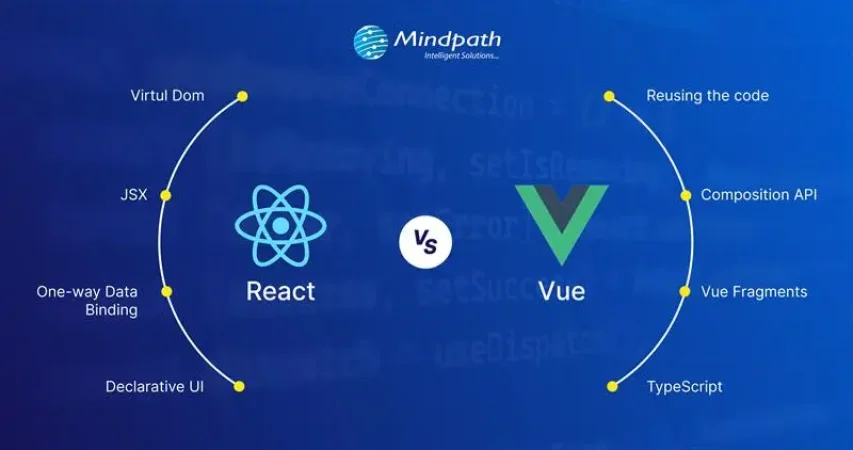
React.js is a well-known javascript framework for frontend development that delivers promising edge in creating interactive user interfaces (UI). Remarkable features of this tool include its origin which – it was created by Facebook in 2011 for internal purposes. Although most of us frequently refer to React as a framework, it’s an open-source javascript library for frontend development. One of the notable aspects in the Vue vs React debate is the use of JSX in React.js syntax. The role of JSX (JavaScript Syntax Extension) is very important in writing HTML elements in JavaScript code without making use of JavaScript functions.

React is among popular, dynamic, and versatile JavaScript frontend libraries used for developing frontend applications. It is most preferably used to create scalable applications with dynamic user interfaces and cross-platform capabilities. React developer tools also provide the support to identify performance issues and ensure a faster debugging process. Another striking feature of React is the flexibility to develop single-page applications and server-side apps as well as mobile apps.

Quick Overview of Vue

While React is a JavaScript library, Vue is an open-source JavaScript framework for frontend development. Vue.js grabbed headlines upon its arrival in 2014 for the shorter and simpler learning curve. As a matter of fact, the React vs Vue vs Angular comparison reflects on the fact that the design of Vue draws inspiration from Angular. The creator of Vue, a former Google engineer, picked the best components of Angular and the same approach as React.js to create a versatile framework.

Developers choose Vue for its easy-to-use interface and efficiency in developing web apps with a component-based model. The framework also includes a large library that empowers developers to create apps with better performance. Many developers prefer Vue over React for its simpler approach to coding with a less complex structure and plain syntax. On top of it, the collection of plugins available with Vue ensures efficient incorporation of additional functionalities in the app.

Looking to build a high-performance frontend that scales with your business and delivers real ROI? Learn from our ReactJS for App Development guide to understand how React empowers business owners to make smarter, future-ready technology decisions.

Let’s have a look at the React vs Vue comparison with Google Trends:
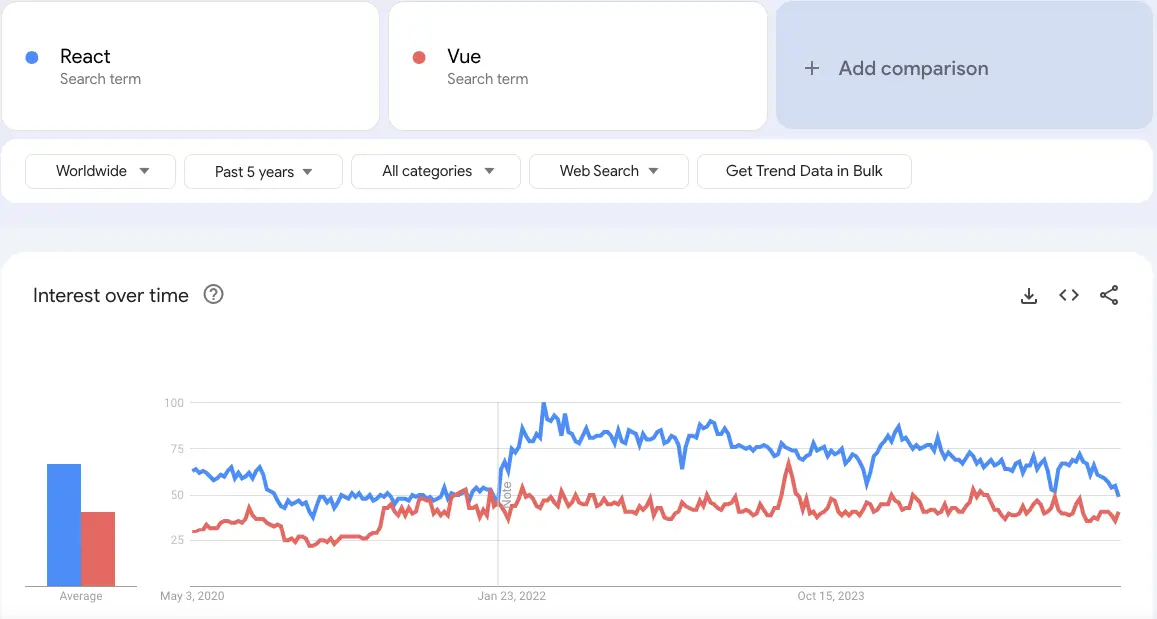
react vs vue google trends

Unraveling the Differences between React and Vue

While React is a JavaScript library, Vue is an open-source JavaScript framework for frontend development. Vue.js grabbed headlines upon its arrival in 2014 for the shorter and simpler learning curve. As a matter of fact, the React vs Vue vs Angular comparison reflects on the fact that the design of Vue draws inspiration from Angular. The creator of Vue, a former Google engineer, picked the best components of Angular and the same approach as React.js to create a versatile framework.

Developers choose Vue for its easy-to-use interface and efficiency in developing web apps with a component-based model. The framework also includes a large library that empowers developers to create apps with better performance. Many developers prefer Vue over React for its simpler approach to coding with a less complex structure and plain syntax. On top of it, the collection of plugins available with Vue ensures efficient incorporation of additional functionalities in the app.

1. App Size and Performance

The size of app in each framework speaks a lot about the ReactJS performance they can offer in the development process. You can use the Vue vs React performance benchmark to discover how Vue.js is the better pick to create small and faster apps. Vue allows you to compress the code so that it can consume significantly less space. As a matter of fact, applications created in Vue are almost 10% to 30% smaller than React-based applications.

The smaller app size enables faster coding as you will need limited inputs, thereby providing the assurance of better performance. Vue also stands as a formidable contender in terms of performance with its efficient default library. The testing library of Vue.js makes applications run quickly and more efficiently. On the other hand, React requires you to download additional libraries to introduce new features that increase app size and reduce performance.

2. Scalability

Another noticeable factor in the comparison between React.js and Vue.js is scalability as businesses seek ways to expand their apps with new functionalities. Which JavaScript frontend framework can come to your rescue when your app attracts more customers? React and Vue have efficient scalability solutions, albeit for different categories of apps. While React is the best pick to create large and complex apps, Vue is suitable for faster and simpler apps.

However, Vue and React both works on the same infrastructure and relies on a unidirectional data flow. In addition, Vue also offers support for two-way reactive data binding that allows simpler data management. The reactivity system of Vue ensures that you can track changes and introduce updates in the DOM. While React has a larger developer ecosystem and more templates and tools, Vue provides the guarantee of better scalability.

Where does React fail when it comes to scalability? You can find smart components in React.js that feature state management library functions. On the other hand, the dumb components help in executing simple functions and presenting things to the virtual DOM.

Must Read: ReactJS Web Development Guide

3. Operational Performance

The next important point of the difference between React and Vue will focus on their performance in different operations. Vue has been the favourite of companies as it offers exceptional performance in less complex and smaller projects. According to recent tests conducted on both frameworks, the operational performance depends on type of tasks where you can apply them. The tests focused on important metrics such as memory usage, rendering time and row creation speed for operations like clearing large tables or introducing updates.

React.js leverages a virtual DOM to ensure efficient management of UI updates and showcases impressive performance in all benchmarks. The operational performance of React is significantly higher in scenarios that require dynamic updates and content rendering. On the other side of the debate, Vue.js also leverages a virtual DOM alongside offering a reactive data-binding system. Vue has consistently shown competitive performance at par with React in different test scenarios.

4. Syntax and Learning Curve

You should also review the React js vs Vue js debate from the perspective of their syntax. React uses the JSX syntax while Vue uses the template syntax for developing user interfaces. Vue uses HTML templates by default albeit with the option to write code in JSX. On the other hand, React relies solely on JSX for the syntax. The isolation of HTML, JS and CSS in Vue ensures that beginners can also create web application frontends with ease. Developers with limited experience in JavaScript or the ones who have been using HTML/CSS will love working with Vue.

React presents a steeper learning curve as developers need in-depth understanding of JavaScript to work with the framework. Even if JSX offers more power and flexibility, beginners will find it more complex for frontend development.

5. Official Documentation

The documentation for React and Vue also play a crucial role in the React vs Vue comparison. Official documentation of any framework or library provides guidance on their components and the best ways to use them. Tools with clear and comprehensive documentation can also attract businesses which need clear directions for usage and troubleshooting. Vue has always maintained well-organized documentation that serves as its formidable strength. The decision to choose from React or Vue becomes simpler with the assurance of the simpler learning process and troubleshooting in Vue. On top of it, the latest improvements in official Vue documentation provide more comprehensive resources to help developers.

React is far behind Vue in terms of documentation because it focused only on basic concepts and advanced uses. The updated version of React documentation promises some changes such as better accessibility, clear explanations and real-world examples. With time, React will also have documentation that will help developers learn about its functionalities and best practices.

Wondering what separates a good ReactJS project from a truly successful one? Read the essential ReactJS Developer Skills for successful web projects to make smarter hiring and development decisions.

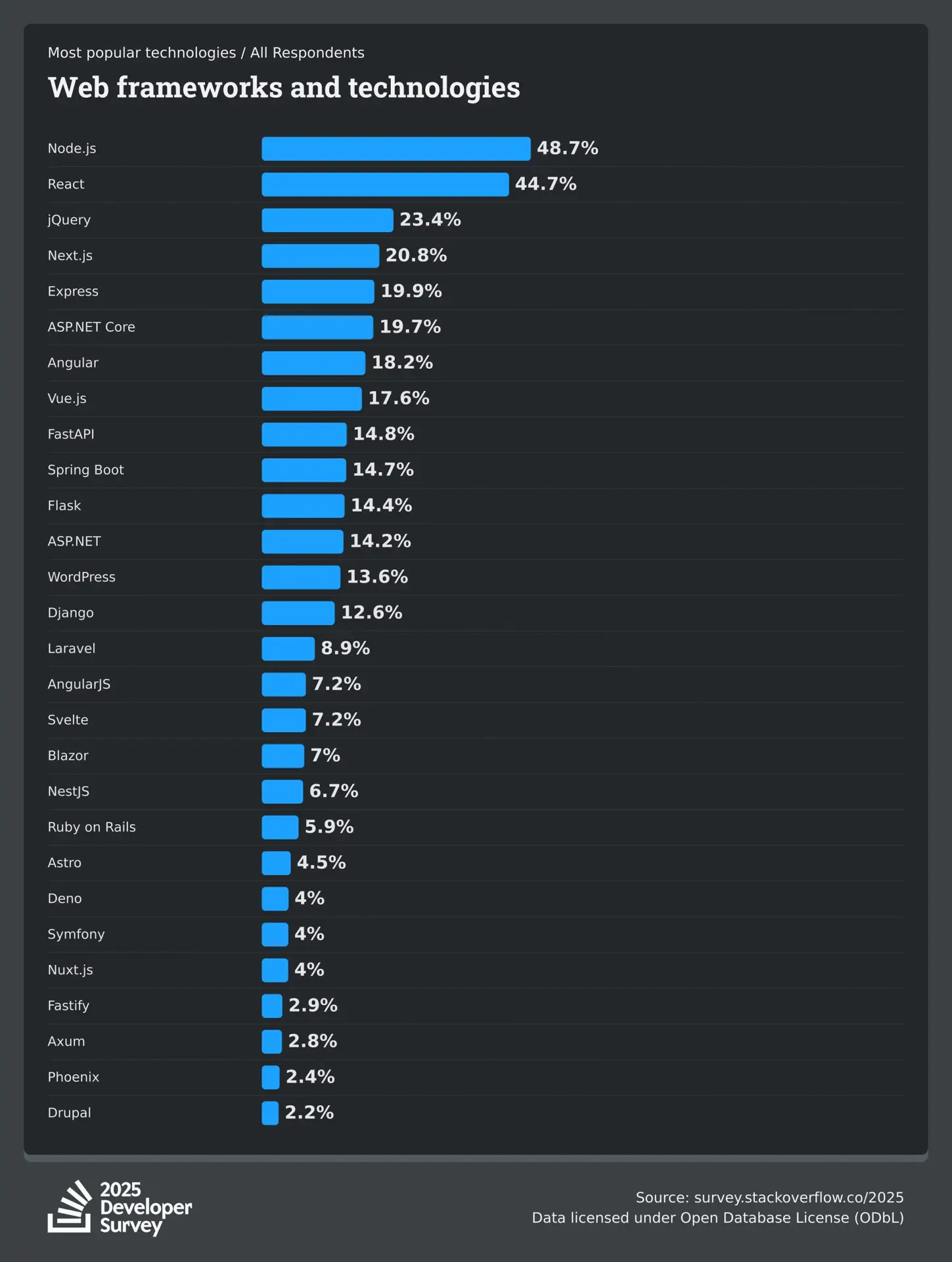
2024 Developer Survey by Stack Overflow

The 2024 Developer Survey by Stack Overflow, recorded the responses of over 65,000 developers about the technologies, coding, and tools they are interested to learn and use, and experience at work. Here’s the outcome of 38,132 (58.3%) responses received by professional developers on the popularity of web frameworks and technologies.
2024 developer survey stackoverflow

ReactJS vs VueJS: Which is Better for Your Project?

The differences between React and Vue mentioned above depict that each one of them has some distinguishing pulses and minuses. It is important to use the example of a React-based application and the example of a Vue-based application at the same time to understand their adoption in the real world. Some of the noteworthy companies that use React.js are instagram, Netflix, and Uber.

On the other side of the spectrum, industry giants like GitLab, Zoom, Upwork use Vue.js. Therefore, the choice of a frontend development framework depends completely on your needs. Still confused about choosing the right framework for your next project? No worries, Mindpath offers ReactJS development services and is ready to help you make the right decision. Take the first step now to choose the right framework for your dream project.


Related Post

Discover the ultimate guide to hiring Node.js developers in London. Learn about the skills, benefits, and cost factors involved in finding the right talent for your project.
Discover essential factors for hiring legal software developers and see how Mindpath’s custom solutions like websites and chatbots can transform your practice.
Discover the power of Conversational AI! Learn its benefits, features, and how Mindpath can help transform your customer interactions.

Related Post

Node.js libraries 

In the modern application development landscape, having speed, flexibility, and smart tools is paramount to success. This is why Node.js libraries are so valuable to both developers and businesses, in that they are all about making a complex task easy, reducing development time, and inspiring innovation. In fact, you can think of libraries as the building blocks of development that enable you to focus on truly valuable features rather than repeatable boilerplate code.

Now, the issue isn’t even finding libraries but just figuring out which is the right one to choose. Each year, new alternatives come out, which provide interesting features and improved performance. So, which libraries really made a difference in 2026? Looking at the top 25 libraries below gives you a good glimpse into what aspects of development are affecting Node.js. Let’s walk through the best options to help you shape your projects for speed, ease of use, and reliability.

Choosing right NodeJS libraries is just the beginning of a successful project. Mindpath’s Node.js development services help you implement latest libraries and best practices effectively for seamless development.

What is a Node.js Library?

Many developers are curious and often wonder: Is Node.js a library? The answer is no. Node.js is a runtime environment that allows JavaScript to run outside of a browser. It is the groundwork to build fast, scalable applications, but it is not a library itself. It can be used with libraries, and it has the possibility to run countless libraries.

When we refer to Node.js libraries, we will consider them as tools explicitly designed to run in the Node.js environment. These libraries are reusable chunks of code that help you with repetitive or simple tasks, such as handling a database, authentication, or file processing. They give developers the freedom to add features without having to rewrite functions. Libraries also do not dictate the structure of a project like frameworks might; they allow developers to develop more intelligently and rapidly.

Must Read: Advantages of NodeJS 

Top 25 Libraries in Node.js

Choosing a Node library can drastically improve the speed and efficiency of your application build. These libraries can provide you with a pre-packaged solution to a common challenge, so you don’t need to write the code from scratch. Let’s take a look at the top 25 libraries that Node.js developers are using in 2026.

1. Async.js

Async.js is one of the most valuable Node.js libraries that enhances asynchronous code without complication. It inhibits render-blocking JavaScript, allowing webpages to load faster and make more fluid transitions. JavaScript content loads asynchronously alongside other page elements, resulting in better overall performance and user experience.

2. Request

Request is a widely used library for making HTTP calls in Node.js apps, and it is super easy and reliable to connect with external entities such as APIs or websites through the HTTP protocol and later retrieve data from them. There are so many libraries for Node.js, but developers often choose Request for tasks like authentication and establishing communication between apps.

3. Express

Express is one of the most popular libraries in Node.js for building fast and scalable web applications. It is important because it is designed to be minimal. This means that it is flexible enough for developers to add features as they like and not worry about excessive complexity. Express is one of the most downloaded NPM packages because it’s popular for building APIs and server-side applications.

4. Socket.io

Socket.io is a reliable library to help developers create real-time applications quickly. It allows for advanced two-way communication between servers and clients, making it ideal for chat apps, live feeds, or real-time updates of any kind. Counted as one of the most popular Node packages used today, the benefits of Socket.io include speed, reliability, and platform compatibility.

5. Jest

Jest is an open-source testing framework for React, Vue, and Angular projects. It is made up of a test runner, mocking library, and assertion library, all in one. Jest is trusted amongst the best Node.js libraries and minimizes velocity, allowing developers to ensure quality with a quick and safe test process.

Is your application quality strong enough to avoid costly bugs after launch? Learn how the right NodeJS development company ensures reliable testing and long-term stability.

6. CORS

CORS is part of the Express Libraries that enables cross-origin requests for Node.js applications. It ultimately allows the server to enable which domains can access it as a resource. It is one of the essential libraries and would enable developers to build a secure and modern web application.

7. UglifyJS2

UglifyJS2 is by far one of the best libraries for minifying and compressing JavaScript files with Node.js. It will minimize the file size, take up space on computer systems, and improve the ability for your pages to load quickly. Many developers utilize this option to improve performance for their web applications.

8. Ethers.js

Ethers.js is a fairly small library that can be used to build Ethereum-based apps. It has a clean API for wallets, smart contracts, and transactions. Developers like to use it because of its security, its flexibility, and its strong community support for Ethereum.

9. Mongoose

Mongoose is an Object Data Modeling library that allows developers to connect MongoDB to Node.js with ease. It provides schemas, validations, and hooks that allow developers to organize and manage data more conveniently. This library allows for a more organized and easier workflow when working with databases.

10. Multer

Multer is a Node.js middleware for handling file uploads. It is specifically for multipart forms, which handle file uploads gracefully. It is a very fast and lightweight middleware for managing files uploaded by the user.

Do heavy file uploads slow down your app and impact user experience? Explore how hiring skilled NodeJS developers helps optimize performance at scale.

11. Gulp

Gulp is a task runner used for automating repetitive tasks in a development process. Its job includes file minifications, compiling CSS, and optimizing a workflow. Gulp is one of the popular Node.js libraries that allows teams to save time and be more effective.

12. PM2

The PM2 is a process manager built to run Node.js applications in production, and has the ability to restart apps if necessary, monitor performance, and handle scaling. PM2 keeps serious applications running without any downtime.

13. Passport

Passport is a flexible authentication middleware that works smoothly with Express applications. It is easy to add new login methods as it can be extended by many plugins. Developers like it for its modularity, simplicity, and power to secure their apps.

14. Browserify

Browserify brings Node.js modules into the browser. It bundles dependencies for convenience when writing a client. It structures and organizes front-end projects.

15. Parser

In Node.js, parser middleware allows a developer to use something with a request body. Developers create parsers to take data from forms or JSON files. Parsers give developers a fast and clean way to interact with data.

Want to leverage your application data to build smarter, AI-driven features? Explore the top Node.js libraries for AI integrations to unlock business intelligence.

16. Nodemailer

Nodemailer sends emails using Node.js. Teams often use it for alerts, notifications, and transactions. It is simple to set up and very reliable.

17. Sequelize

Sequelize is an Object-Relational Mapping tool for Node.js and databases. It works with MySQL, PostgreSQL, SQLite, and more. It simplifies how developers work with data through its query and relation methods.

18. JSHint

JSHint is a linter for JavaScript code that looks for errors, syntax issues, and bad practices. It saves time by catching issues early.

19. Axios

Axios is a client based on promises to make HTTP requests. Works in Node.js and the browser. Among other libraries for Node.js, experts consider it safe and note that it supports modern clients.

20. Morgan

Morgan is middleware for Express applications dedicated to logging. It logs requests, responses, and errors. It can help you monitor your app and even debug.

Can you track performance issues before they impact your customers? Learn the key factors to consider when hiring NodeJS developers who build reliable, well-monitored applications.

21. Dotenv

Dotenv is a module that can manage your environment variables in your project. It helps keep sensitive information like passwords private. It’s safe, small, and very simple to use.

22. Faker

Faker generates fake data to test with. It’s quick to create names, emails, and addresses. Node.js libraries, such as Faker, help you build mock datasets quickly.

23. Puppeteer

Puppeteer is a powerful tool that automates Chrome and helps with tasks like frontend testing and performance checking. It makes website crawling and UI testing much faster and easier for developers.

24. Lodash

Lodash is a utility library that offers many functions to simplify common programming tasks. It helps developers keep their code clean, short, and easy to manage.

25. Winston

Winston is a logging library that helps manage and store logs in one place. It supports multiple formats and storage options, making application monitoring more reliable.

Can your business afford downtime caused by unseen application errors? Discover how expert NodeJS developers build high-performance apps with proactive logging and monitoring.

Ready to Choose the Right Node.js Libraries?

Exploring the top Node.js libraries in 2026 shows how much they improve speed, reliability, and ease of development. These tools help developers focus on features that matter most without wasting time on repetitive work. From testing and logging to database management and performance optimization, each library adds value and creates smoother workflows for modern applications.

At Mindpath, we offer expert Node.js development services that help businesses build scalable, secure, and efficient applications. Our skilled developers use proven Node.js libraries to design solutions tailored to your goals. With deep technical expertise and a focus on quality, we deliver results that save time and enhance performance. Let us help you bring your project to life.

Top Tips for Hiring Skilled ReactJS Developers in California
Hiring the proper ReactJS developer in California is essential to developing a high-quality, scalable application. In today’s competitive technology industry, it is important to properly examine prospects. Several aspects impact the success of your project, including technical knowledge and communication abilities. Taking these important factors into account will assist you in finding a developer who fulfils your company requirements and assures seamless development.

1. Competitive Salary

California is home to some of the most prominent technology organizations, making it a very competitive employment market for ReactJS developers. To recruit and retain top people, competitive compensation is required. Developers with extensive experience in ReactJS, state management libraries like Redux, and current frameworks sometimes command higher wages owing to demand. Salaries vary according to experience, location in California, and the intricacy of the work. Junior developers may have lower wage expectations, but mid-level and senior developers with demonstrated skill expect higher pay. Keeping up with industry wage trends ensures that your offer remains competitive. In addition to competitive base pay, performance-based incentives, bonuses, and stock options can help make your employment offer stand out. Providing a well-structured remuneration package will enhance your chances of securing skilled ReactJS developers who can contribute effectively to your project’s success.

2. Benefits Package

A solid benefits package is essential for recruiting and retaining ReactJS employees in California, in addition to a competitive wage. With the growing cost of living, developers prioritize advantages such as complete health insurance, dental and vision care, and mental health services. These bonuses improve work satisfaction and general well-being. Retirement programs, such as employer-matched 401(k) contributions, enhance the long-term value of your offer. Paid time off, parental leave, and wellness initiatives all help to promote a healthy work-life balance, making your organization more desirable to developers looking for stability. Other incentives, such as learning and development opportunities, conference sponsorships, and home office stipends, might help your employment offer stand out. Offering remote work permits, commuting advantages, or gym memberships boosts employee happiness. A well-rounded benefits package doesn’t just attract top ReactJS developers but also helps with long-term retention, ensuring your project has the stability and expertise needed for success.

3. Remote Work Flexibility

The need for flexibility has increased, and many experienced ReactJS developers in California choose remote work arrangements. Being open to employing remote developers inside the state helps you to tap into a larger talent pool without being constrained to a single area, such as San Francisco or Los Angeles. Employers and developers benefit from the flexibility that remote work provides. It helps businesses save money on office space while allowing developers to work in a pleasant, distraction-free environment. Offering hybrid or entirely remote positions might attract highly skilled individuals who might be unwilling to relocate. Invest in communication technologies like Slack and Zoom, as well as project management systems like Jira and Trello, to guarantee remote collaboration is efficient. Setting clear expectations for deliverables, meetings, and deadlines can assist in sustaining productivity. By embracing remote work flexibility, you can hire top ReactJS talent across California, improving the chances of securing developers with the right skills and expertise for your project.

Finding the right ReactJS developer requires competitive salaries, strong benefits, and flexible work options. At Mindpath, we connect you with top ReactJS talent in California, ensuring the perfect fit for your project.

Get expert developers who deliver high-performance, scalable applications. contact Mindpath today! to build your ReactJS team with confidence!

Discover the ultimate guide to hiring Node.js developers in London. Learn about the skills, benefits, and cost factors involved in finding the right talent for your project.
mobile app development trends

Every year, new technologies reshape the way we use our mobile phones, and 2026 is no exception. If you are willing to create an app or just curious about the future of mobile technology, then staying updated with the latest mobile app development trends will be considered as a smart choice. These trends are not buzzwords but instead play a role in shaping the way individuals utilize apps, how they are developed by developers and how companies can expand through mobile platforms.

The mobile app world is changing at a quick pace, and 2026 will bring to us some of its most game-changing innovations. From smart AI features to faster and safer user experiences, mobile applications are becoming more effective and helpful in our day-to-day lives. This blog will walk you through the top 10 trends in mobile app development in 2026. 

Want to turn your mobile app idea into a powerful digital solution, but unsure where to start or whom to trust? Mindpath offers expert mobile app development services, building scalable applications tailored to your business needs.

Before learning about the trends, we must have a quick look at the market value of mobile app development: 

Interpreting the Mobile App Development Market Value

According to a study by Allied Market Research, the worldwide mobile app development industry was valued at $195.7 billion in 2023 and is likely to grow to $606.1 billion by 2032. This growth, with a CAGR of 13.1% between 2024 and 2032, is primarily because an increasing number of people are using smartphones and wish to have apps according to their individual requirements.

mobile app development google trends
Mobile App Development Google Trends

New technologies are helping to make apps smarter and more useful. More people shopping on phones and working remotely after the pandemic has also made mobile apps more popular around the world. Let’s see what are the latest trends for mobile app development in 2026.

Curious about the latest tools shaping modern mobile app development and how they impact performance and scalability? Read our blog on Mobile App Development Tools to explore the frameworks, platforms, and technologies developers rely on to build powerful apps.

Latest Mobile App Development Trends in 2026

The future of mobile app development is looking brighter than ever, with groundbreaking trends that are set to reshape the way we interact with technology. As we move forward, these emerging trends will drive innovation as well as set new standards for app performance and user experience. Let us take a look at it:  

1. Artificial Intelligence (AI)

Artificial intelligence (AI) in mobile app development is revolutionizing in 2026. With advancements such as Apple’s Core ML 3, developers are now able to more easily incorporate AI into their apps. AI will make apps smarter, enhancing performance and user experience, and will be a driving force in defining the future of mobile applications.  

2. Augmented Reality (AR) and Virtual Reality (VR)

Augmented Reality (AR) and Virtual Reality (VR) will be big trends in mobile app development in 2026. AR is becoming more practical and useful across different industries, while VR is enhancing gaming experiences on mobile devices. Both technologies are helping create more interactive and engaging apps. As these trends grow, we’ll see AR and VR shaping the way users interact with apps in exciting new ways. Based on research by Statista, revenue in the AR & VR market worldwide is projected to reach US$46.6bn in 2026, with an annual growth rate (CAGR 2026-2029) of 7.42%, leading to a projected market volume of US$62.0bn by 2029. 

3. Predictive Analytics

Predictive analytics is transforming how mobile apps work. By using AI and data analysis, apps can now predict what users want or need, offering personalized experiences. In 2026, this technology is widely used to improve app interfaces and user interactions. Apps will offer content and suggestions based on each user’s actions, making them feel more intuitive and relevant. 

4. Cloud Computing Integration

In 2026, cloud computing will become a key trend in mobile app development. It allows apps to store data and perform tasks on the cloud, rather than relying on the user’s device. This will not only improve app performance but also make development more efficient and cost-effective. As cloud technology continues to grow, it will play a major role in shaping mobile app functionality. According to Precedence Research, the global cloud computing market was valued at USD 753.11 billion in 2024 and is projected to grow to approximately USD 5,150.92 billion by 2034, with a CAGR of 21.20% between 2026 and 2034. 

Also Read: Cloud Computing Trends

cloud computing market

5. Chatbots

In 2026, chatbots will see widespread adoption in mobile apps, enhancing customer service and user interactions. Driven by AI, they will provide more natural, human-like responses, improving efficiency and responsiveness. This integration will streamline support processes and elevate the overall app experience, making it faster and more intuitive for users. 

Also Read: Benefits of Chatbots

6. 5G Technology

The rollout of 5G in 2026 will enhance app performance by providing faster speeds and lower latency. This will enable apps to support more advanced features and deliver smoother user experiences. With improved network efficiency, users can expect faster data processing and better overall functionality. The faster connectivity will also open doors for new, innovative app capabilities. 

7. Internet of Things (IoT)

The Internet of Things (IoT) is transforming how we interact with everyday devices, offering more convenience and automation. From controlling home appliances to managing security systems, IoT is becoming integral to modern living. As more devices become interconnected, the potential for smarter homes, workplaces, and healthcare solutions will continue to grow, creating a more seamless and efficient experience for users. 

8. Low-code /No-code Development

Low-code/no-code development is revolutionizing how apps are created by simplifying the process and allowing users with little to no coding experience to build apps. This approach speeds up development significantly, making it easier to create and modify apps quickly. By empowering business stakeholders and non-developers to participate in the process, it ensures the final product better meets user needs and business goals. Based on Statista statistics, the global low-code platform market is expected to reach around 65 billion U.S. dollars by 2027, reflecting its rapidly growing demand. 

9. Mobile App Security

Mobile app security is crucial as more businesses use apps to handle sensitive customer data. Vulnerabilities in apps can expose users to cyberattacks, leading to financial loss, fines, and a damaged reputation. To protect apps, developers must integrate strong security measures such as encryption, multi-factor authentication, and secure coding practices. Regular updates and testing are also essential to maintaining robust security. 

10. Apps for Foldable Devices

Foldable devices are making a strong comeback, with popular models like the Samsung Galaxy Z Fold 5, Huawei Mate X5, and Motorola Razr 40 leading the way. These devices allow users to adjust the screen size, providing both portability and an expanded experience. As their popularity grows, the demand for specialized mobile apps will rise, requiring optimized interfaces that adapt seamlessly as screens fold and unfold. 

Ready to discover how modern mobile apps are built? Explore the latest Mobile App Development Technologies that power innovative and user-friendly applications.

Embrace the Future of Mobile Apps with the Latest Technology and Trends

The future of mobile technology is full of exciting changes. The top trends in mobile development for 2026 show us how fast the industry is moving. From smarter AI to apps for foldable devices, each trend brings new ways to build better user experiences. Staying updated with these trends in mobile development is important for creating apps that are fast, secure, and user-friendly. 

At Mindpath, we specialize in using the latest technology for mobile app development. Our team follows the latest trends in mobile development to deliver apps that are modern, efficient, and built for the future. If you’re looking for a mobile app development company your search ends here. We at Mindpath have a team of professionals with expertise in creating AI-powered apps, apps built for 5G, or solutions optimized for foldable devices, we’re here to turn your idea into a reliable mobile solution.