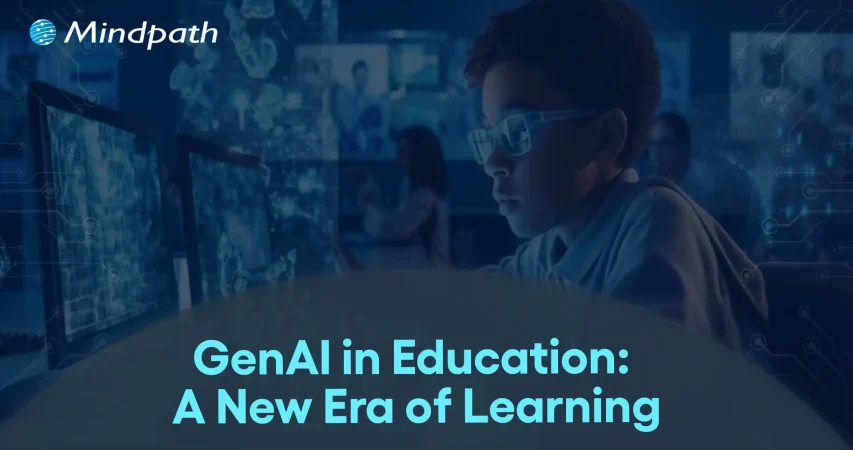
Generative AI in Education – Reshaping the Future of Learning 

Join our Newsletter!

Featured Posts

Support Is One Click Away

Home

Generative AI in Education – Reshaping the Future of Learning 

generative ai in education

Generative AI in Education – Reshaping the Future of Learning 

The rapid growth of artificial intelligence and its impact across different sectors have made everyone rethink the potential of AI. As artificial intelligence becomes a monumental force of transformation in education, policymakers and educators must reevaluate their perspectives on AI. With the rising demand to incorporate generative AI in education, it is important to understand how generative AI creates opportunities for students and educators.

At the same time, you must also discover the challenges that may prevent long-term growth of AI in the education sector. Let us find out whether generative AI has the potential to redefine learning with insights on its advantages and real-world examples.

Ready to transform your education platform with AI? Discover how Mindpath empowers institutions with intelligent, outcome-driven AI-powered solutions.

Unraveling the Significance of Generative AI for Education

Generative AI encompasses any type of AI model that can generate original content, such as text, audio and images. As compared to traditional AI, generative AI relies on simulation of human creativity to generate completely new and contextually relevant output for different user instructions. The ‘human-like’ abilities in generative AI make it one of the major forces of transformation for the education sector. With the arrival of LLMs like the GPTs by OpenAI, the pace of transformation of the education industry has increased.

The growing number of generative AI in education research paper publications also showcases a rising interest in the potential of gen AI to revolutionize education. If you take a closer look at the numbers from different surveys, you will notice how AI has become an integral part of classrooms. For instance, a study by the RAND Corporation in 2023 revealed that only 18% of teachers used AI tools regularly. Another survey in 2024 by Study.com showcased that almost 84% of educators actively used AI in their classrooms.

One of the leading players in AI, Anthropic, released their Education Report on the basis of half a million anonymous student conversations on Claude LLM in the US. The report revealed that students in science and quantitative course like computer science relied more on generative AI for learning. The report also highlighted that almost 47% of student interactions with Claude focused on direct output creation and direct problem solution. According to a corresponding student survey, around 84% of students reported using AI to save time, while 78% of students claimed that it offered better understanding.

Want to discover how you can create engaging educational content quickly without compromising on quality? Check out the best Generative AI tools for content creation to streamline your workflow and boost productivity.

Use Cases of Generative AI for Education

The adoption of generative AI in education sector depends significantly on the effectiveness of generative AI in making education more accessible and efficient. As evident from the Education Report by Anthropic, generative AI helps students save time, learn better, and find direct solutions to problems in their learning journey. The following sections will show you why generative AI is a big thing in the education sector right now.

1. Personalization of Learning at Scale

The first use case of generative AI in the domain of education deals with personalization of learning experiences at scale. Generative AI has the capability to deliver personalized learning experiences at scale while adapting to individual learning styles and needs. Until now, the scale of a classroom created difficulties for educators to offer personalized learning experiences.

The role of gen AI in education sector is not only about assisting students but also giving each student what they need to achieve success. Generative AI tools can evaluate the performance data of students and identify their strengths and limitations alongside finding out their learning modalities. Subsequently, Gen AI can use the analysis to create customized learning resources according to the comprehension level of each student.

Generative AI can help with the shift from one-size-fits-all assessments towards dynamic quizzes and assignments. AI tools can review the test results of students and recommend suggestions to improve performance in weak areas. The assurance of instant feedback on the work of learners and problem-solving approaches can make the learning experience of students more productive.

Want to see how AI chatbots can support personalized learning experiences? Explore our guide on chatbot in education to understand how they enhance individualized learning.

2. Assistance for Educators

Most of the discussions about implementing generative AI in the field of education revolve around benefits for learners. You must also know about the implications of generative AI for educators to understand its range of applications. Educators spend more time on administrative tasks which increase the burden on them. Generative AI can work as a powerful assistant for educators and help with automation of many repetitive tasks.

Educators can use generative AI tools for automated grading of multiple-choice tests and provide nuanced feedback for written assignments. In addition, generative AI can also help educators generate engaging content like simulations, gamified learning modules and virtual labs to create more effective and engaging learning experiences.

Generative AI also helps in evaluation of educational data to recognize trends and gaps that can be used for designing the curriculum. The use of gen AI ensures comprehensive coverage of concepts alongside alignment with popular educational standards. On top of it, Gen AI tools for education can also help educators in drafting lesson plans, assignments and worksheets. Generative AI not only alleviates the burden on educators but also gives them more time to focus on learners.

3. Improving the Accessibility of Education

Another notable addition among the opportunities associated with adoption of generative AI in the education industry is the assurance of improved accessibility. Generative AI can make education accessible beyond the traditional boundaries. For instance, generative AI tools can offer real-time transcription of lecture videos or facilitate text-to-speech translation. With these features, learners with hearing impairments or reading difficulties can enjoy significant advantages.

The answers to “how can AI be used in education?” also focus on making learning easier for students. Generative AI can provide summaries for complex research papers or academic articles, thereby making long form content easier to understand.

Looking to understand how institutions are using AI tools to support students more effectively? Learn more about educational chatbot solutions and how they enhance the overall learning experience.

Limitations for Generative AI in the Field of Education

The adoption of generative AI in the world of education might bring multiple opportunities for improvement. At the same time, you cannot ignore the concerns arising from some limitations of generative AI. One of the biggest concerns associated with use of gen AI in education revolves around plagiarism and academic integrity. How will educators find out whether students have not used AI for plagiarizing the work of other students or experts?

The pros and cons of generative AI in education also emphasize how relying too much on AI can create problems. For example, depending on AI can hinder the development of research and critical thinking skills in learners. Another formidable challenge for the full-fledged adoption of AI in education is the lack of awareness. Educators need comprehensive training to use the best capabilities of generative AI with special attention to ethical guidelines.

Curious about what’s shaping the future of digital learning and modern classrooms? Discover the latest emerging trends in education technology to stay ahead of the curve.

Final Thoughts

The review of the pros and cons of adopting generative AI in the domain of education reveals a balanced perspective. The most distinguishable trait of generative AI which makes it useful for education is the ability to generate new content. The common highlight in all generative AI in education examples is the creation of new content. Generative AI can create lessons, learning plans, quizzes and other learning materials according to user instructions.

At Mindpath, we offer Artificial Intelligence development services for the Edtech world, tailored as per your requirements. Our GenAI powered solutions are built to help educational institutions to get the benefits of generative AI to enhance efficiency, engagement, and bring benefits to the learners. Partner with Mindpath to develop customized AI solutions that will help you take your EdTech vision further.
Related Post

Discover the key factors influencing software development costs and how to optimize your budget. Learn how Mindpath can help.

Related Post

outsourcing web development

In the present world, maintaining a strong online presence has become a necessity for any business. That’s where outsourcing web development can help you. As a matter of fact, this can be your most strategic growth accelerator. It is currently being used by organizations of both large and small scale to get access to global talent and unlock innovation, which keeps them on the competitive edge.

If you want to update your current website or introduce a new one, outsourcing can help you facilitate smooth management of this process, giving you time to work on other crucial issues. This post will help you know what outsourcing web development truly means and explore the 10 amazing benefits of the same.

Struggling to keep up with rising development costs, talent shortages, and faster digital demands in 2026? Mindpath’s web development services help you outsource with confidence, delivering scalable solutions that accelerate business growth.

Web Development Outsourcing- A Short Brief

In simple words, outsourcing web development is a practice of hiring an external team of professionals to handle a development project. Instead of investing in creating an in-house team, some businesses prefer to opt for outsourced web development services. The major factors that have caused this are minimized costs, shorter project durations, and the availability of specialized skills.

This will enable the businesses to concentrate on the major operations without the need to worry about web development and maintenance. It has become a norm amongst companies. Over 76 percent of the enterprises outsource their IT functions (Source: Deloitte). This is useful for startups and enterprises. 

Should You Outsource Web Development?

Still not sure if you should outsource web development? Here are some questions that can help you make a decision: 

1. Do you require any specialized skills not available in-house? 

2. Is scalability important to your business growth?

3. Do you want to speed up time-to-market and lower costs? 

If your answer is yes, you can prefer to outsource web development projects. This will offer you a perfect combination of expertise, innovation, as well as efficiency. If you are looking for some more reasons, check out the selections below, where we have covered some impressive benefits of outsourcing web development. 

Want to build a tailored digital solution that perfectly aligns with your business goals and user needs? Check out our guide on custom web development services to discover how personalized solutions can give you a competitive edge.

10 Key Advantages of Outsourcing Your Web Development

Outsourcing web development is not just about reducing costs; it’s also about working smarter without compromising quality. Read on to know the major advantages of outsourcing web development and the reasons why several businesses are drawn towards it. 

1. Access to Global and Top Talent

Outsourcing opens the door to highly experienced and skilled UX/UI designers, programmers, creative experts, project managers, and more. You are not limited by location anymore. The outsourced companies use advanced technologies such as blockchain and AI, and have skilled experts in frontend and backend development.

Based on your budget and requirements, you can outsource projects to regions well known for their tech expertise, such as Poland, Europe, or the United States. It allows you to leverage top-tier talent at competitive hourly rates.  

2. Reduced Development Cost

The most obvious advantage of outsourcing is lower web development costs. When you hire an in-house team, you will have to deal with multiple expenses. For instance, salaries, office space, software, benefits, employee training, and more.

You don’t have to worry about full-time salaries when you outsource. You only have to pay for the services you need. Besides, most outsource web development companies follow a flexible pricing structure. That can help startups and SMEs scale quickly. 

3. Fast Development Time

An experienced outsourced development team can start working on your project instantly. They have access to all web development tools and web development technologies to complete the task on time. 

Besides, they always follow streamlined workflows and agile methodologies to ensure faster prototyping and deployment. This gives you a chance to launch your website or web app faster to stay ahead of your competitors. 

4. Scale Up or Down Conveniently

The fact is, your web development needs are not constant. When you need to launch a new product, you may need a large team. And for maintenance, a few developers will be enough. Outsourcing lets you adjust your team as per your needs. 

Furthermore, scaling will be more predictable. You can plan ahead, understanding your requirements and adjusting team skills and size quickly. This is useful for seasonal companies and startups moving through a rapid growth stage. 

5. Access to The Latest Tech

Everyone is aware that technology is dynamic. It may not be easy to keep abreast with new security measures, web development trends, web development frameworks and web programming languages. However, outsourcing companies usually invest in the state-of-the-art tools and platforms.

They also assure you of working with best practices and current security features in developing your web apps. With chatbots, AI, and other high-level cybersecurity solutions, they transform your site into a masterpiece.

Curious how AI is transforming the way modern websites are built and optimized for better performance? Discover our in-depth guide on AI in web development to learn how it can enhance efficiency, personalization, and scalability.

6. Risk Mitigation

Creating a website comes with various risks, including security issues, non-compliance, and unexpected costs. These factors can easily derail your project. If you don’t want to deal with all these risks, partnering with an outsourcing company would be an ideal option. 

Trusted web development outsourcing companies practice the best security, compliance, and coding standards. In addition, their special QA teams constantly ensure your new website complies with the accessibility guidelines and performance. In addition, their SLAs or service-level agreements can be of benefit to you.

7. 24/7 Technical Support and Maintenance

A website needs to be updated as well as optimized regularly after it is developed. The majority of businesses fail to maintain their websites through their in-house team. Outsourcing provides continuous maintenance and technical support.

They keep an eye on your website, fixing things and making sure your site is equipped with the most recent laments to run without any hassle.

8. Reduced Burn Rate

You may find developing an in-house team appealing. However, it comes with major overhead. For instance, recruitment expenses, equipment leases, back-office operations, team onboarding, and more. 

For early-stage businesses or startups without consistent revenue, these expenses can inflate the burn rate. Well, outsourcing web development provides you with a leaner alternative. Pay only when you opt for their services, and you can stay financially agile. 

9. More Time for Core Operations

Web development is a process that should be carefully monitored, and it needs much of your attention. That means when done in-house, you may not get enough time for core business operations. 

By handing over the task to an external team, you can dedicate your time to other crucial things, such as sales, marketing, customer acquisition, strategic partnerships, etc. As a result, when your web app is fully developed, you will be in a good position to execute a successful launch. 

10. Enhanced Transparency and Project Management

Reputed outsourcing companies utilize modern project tracking tools, agile methodologies, and focus on transparent communication. They ensure you get regular updates and reports about your project. 

Furthermore, they ensure a smooth collaboration between you, designers, developers, and the project manager. With such facilities, you can ensure your web development aligns with the company’s vision. 

Looking to improve collaboration and speed up your web development process with a more flexible approach? Explore our detailed guide on agile methodology in web development to discover how it helps deliver faster and more efficient results.

Common Web Development Services to Outsource

You can assign the entire project or specific parts to your outsourced web development company. Here are some of the common services that are usually outsourced:

1. UI/UX Design

To develop interesting and user-friendly interfaces.

2. Web Consulting

Assists in idea validation and making web development easy.

3. Tailored Web Development

This includes both backend and frontend coding.

Must Read: Frontend Development Trends

4. E-Commerce Development

Creating a superior online store. 

5. API Development and Integration

To create custom APIs for enhanced user experience and functionality.

6. Database Management

To design as well as manage databases in a secure manner. 

To achieve desired outcomes, outsourcing web development to an experienced and reliable company is important. 

Planning to build a successful digital product but unsure about the right steps and timeline to follow? Discover our complete web development roadmap to understand each phase and make smarter outsourcing decisions.

Ready to Kick Start Your Business Growth by Outsourcing Web Development?

Outsourcing web development is more than a cost-saving strategy. It allows businesses to access global talent, adopt the latest technologies, scale efficiently, and focus on core operations. Smart outsourcing ensures faster project delivery, improved quality, and long-term business growth.

At Mindpath, we offer end-to-end web development services tailored to your unique needs. From UI/UX design and web apps to maintenance and support, our expert team ensures seamless execution, timely delivery, and innovative solutions that help your business scale confidently and achieve measurable results.

ai solutions for small businesses

Some business owners still think artificial intelligence, or AI, is only for big tech companies. Maybe it is true. But it has also become a crucial element for startups and small businesses. In fact, AI solutions for small businesses are helping them work faster, efficiently and smarter.

With this, you can easily use AI for customer service, simplify operations and scale faster. This blog will decode the AI solutions for business and answer the important question of how it can be used in startups. Besides, you will also get to know how to get started with this. 

Want to use AI more effectively but don’t know how to implement it affordably? Mindpath’s AI development services build practical, budget-friendly AI solutions that fit your business goals and accelerate your growth.

What are AI Solutions for Small Businesses?

Artificial intelligence may sound complex, but for startups and small businesses, it is surprisingly very practical. AI solutions for small businesses are truly a game-changer. These tools combine language processing and machine learning to help in business operations.  These tools can greatly streamline your workflows, improve communication with customers and offer detailed reports. Most importantly, they automate various tasks. Different from massive enterprise systems, AI tools for small businesses are generally affordable, accessible, and scalable. That’s why more small business owners are using AI tools to attain more with fewer resources. As per a study by Entrepreneur.com, nearly 68 per cent of small businesses have deployed AI to manage their daily business operations. 

Curious about the technology behind modern AI solutions? Explore top AI Models to understand which models power today’s most effective business applications.

Benefits of AI Solutions for Small Businesses and Startups

Small businesses generally experience a shortage of resources, such as insufficient personnel and a limited budget. The introduction of AI became an excellent solution. Read on to understand the benefits it offers. 

1. Increased productivity

AI tools reduce manual errors and streamline workflows. Besides, the support for smarter task management. This, in turn, helps a team to focus on other important tasks. 

2. Enhanced Engagement

With the help of responsive support, personalised marketing and smarter chatbots, you can create meaningful interactions. It will lead to higher satisfaction and increased loyalty. 

3. Task Automation

You can easily automate various repetitive tasks such as scheduling, invoicing, data entry and more. Your team can invest more time in customer relationships and strategy. 

4. Improved Decision Making

AI in decision-making helps provide you with predictive analytics and detailed insights. Based on these reports, you can come up with informed decisions with maximum clarity. 

By using modern AI solutions, small businesses can operate like a large business. And handling complex tasks would be easier for them. 

Wondering how AI can impact small business growth? Read detailed benefits of AI to discover how AI improves efficiency, productivity, and decision-making.

Best AI Solutions Small Businesses Can Use

No matter whether you have an e-commerce store or a small boutique, if you are using the right AI solutions or tools, you can scale faster. Let us guide you with this by suggesting some of the best tools you can opt for. 

1. ChatGPT

We are all well aware of this tool. It helps businesses generate content and automate customer service. You can deploy it to draft tailored emails and write blogs. Furthermore, it can be trained to answer common FAQs. By lowering workload and enhancing communication, this tool can help your team to offer consistent and quick support. 

Curious how tools like ChatGPT work? Discover our Large Language Models (LLMs) blog to learn how LLMs help automate content, communication, and workflows.

2. Microsoft 365 Copilot

It is designed to add the functionalities of generative AI into various Office applications. The tool supports MS Outlook, Word, Teams, etc. Using this, startups can efficiently automate various tasks, including data analysis, content generation and email drafting. When used with Excel, it can detect business trends by analysing data. This saves time and increases productivity. 

3. HubSpot AI

It is designed to help businesses streamline their marketing operations. For example, it can automate customer segmentation, email campaigns, and lead scoring. Furthermore, the tool can analyse the behaviour of customers and generate tailored content. On the other hand, its marketing and CRM platform can help small businesses simplify outreach and scale easily. 

4. Shopify Sidekick

Shopify Sidekick is a powerful AI assistant that can automate customer queries and store management. Besides, it can help in analytics reporting. By deploying this for your online store, you can answer common customer questions and detect popular products. 

5. Grammarly and Superhuman Go

Grammarly is a popular AI writing assistant that works well in checking style, clarity and grammar across documents, blogs, emails and more. Superhuman Go, a part of Grammarly, can suggest replies, summarise reports or threads and speed up email writing. Using these tools, small businesses can write professional business proposals, emails as well as marketing copy. 

Looking to go beyond writing assistance and create content? Explore generative AI tools for content creation to see how small businesses use AI to generate high-quality content.

6. Canva Magic Studio

This AI-powered solution can generate various marketing content based on your inputs. It helps in creating social media posts, videos, graphics and more. You can also use it to create logos, promotional flyers, invitations, etc. It’s simple to use, and you can create stunning graphics without the help of professional designers. 

7. Bookkeeping.ai

Managing invoicing and bookkeeping is a complex and time-consuming task. What if you can automate these tasks? Well, this is possible through Bookkeeping.ai. The tools can reconcile various accounts, categorise transactions and create detailed reports. With this tool, you can lower the risk of errors and avoid financial losses. Without hiring a dedicated accountant, you can make financial management easier for your small business. 

8. Zendesk AI

You all know that customer experience is vital for every business. If you are looking for an ideal AI solution for this, give Zendesk AI a try. It offers customer chatbots, automated ticketing and human-like responses. Apart from this, it can categorize as well as prioritize support tickets, detect trends and offer data-driven recommendations. All these things will lead to increased customer satisfaction. 

9. Tableau Pulse

Data-driven decision-making has become a new standard for every business. Small businesses can use Tableau Pulse to visualize key trends, and project demand. Besides, it helps interpret complex marketing and financial data. Your marketing team can use it to analyze multiple KPIs, driving growth and engagement. Tableau Pulse has simplified business intelligence for non-technical users. 

10. Buffer

Buffer has made social media management simple and efficient. It allows businesses to post on different social media platforms from a single dashboard. Buffer comes equipped with a built-in AI assistant that can produce engaging content and help your team brainstorm new ideas. It is an excellent option for lean teams that want to ensure a consistent online presence. 

Curious about the different forms of artificial intelligence behind such tools? Read types of AI to understand ANI, AGI, and ASI and how each powers modern business applications.

11. Lumen 5

AI solutions for small businesses like Lumen 5 have significantly reduced the obstacle to video creation. Video is an effective way to reach target customer, and small businesses can use it to promote their brands using engaging videos. It comes with a text-to-video tool, and you can generate a video from your scripts or blog posts. Besides, it has a huge media library as well as voiceover options. Within a few minutes, you can create a short professional video for your brand. 

With the right AI tools for small businesses, you will be able to automate, scale, and optimize workflows. In fact, these tools are your secret weapon for managing tasks smarter.

The Future of AI Solutions for Small Businesses

It can be said that AI solutions for small businesses are getting more accessible and powerful. The more advanced models are unlocking new opportunities for startups and businesses. With time, pre-trained models will become common in different industries. What’s more? Edge AI will facilitate offline functionalities. 

Experts have also predicted that chatbots and voice assistants will behave more naturally. That means users will enjoy human-like interactions. We may also see massive integration of artificial intelligence with low-code platforms. Small businesses that adopt AI solutions early will surely enjoy a competitive edge in innovation, as well as efficiency. 

Want to improve real-time customer interactions? Explore conversational AI to learn how AI-powered chat and voice assistants help businesses deliver faster and more personalised conversations.

AI Solutions- Supporting Small Businesses to Expand

AI solutions for small businesses and startups are truly reshaping how they compete, operate and grow. On the other hand, AI solutions startups are supporting innovation by offering intelligent and scalable tools that can help these businesses achieve their desired goals. 

Are you thinking about deploying these modern tools to support your business operations? Well, you have made an excellent decision. But to leverage the full power of AI tools, you need to choose a trusted partner like Mindpath. We are here to assist businesses in choosing the right tools. With our tailored AI development services, you can easily unlock new levels of efficiency and impact.  

Generative AI in Finance

Have you ever wondered how technology is reshaping the world of finance? Imagine a future where financial decisions are driven by advanced algorithms, predictive insights, and automated solutions. What if you could tap into tools that not only enhance efficiency but also transform how businesses operate? In this blog, we’ll explore the fascinating world of generative AI and its incredible use cases in the finance sector. So, let’s dig in!  

What is Generative AI?

Generative artificial intelligence (generative AI) is a form of AI capable of producing new content and ideas, such as conversations, stories, images, videos, and music. AI technologies aim to replicate human intelligence in nontraditional computer tasks such as image identification, natural language processing (NLP), and translation. Generative AI represents the next phase in artificial intelligence. You can teach it to understand human language, programming languages, art, chemistry, biology, or any other complicated topic. It leverages previously trained data to tackle new issues. For example, it can acquire English vocabulary and compose a poem using the words it processes. Your organization can utilize generative AI for a variety of applications, including chatbots, media production, and product development and design. 

Generative AI is transforming the banking industry by utilizing cutting-edge technology to rapidly analyze massive volumes of data. It enables banks and financial organizations to provide personalized solutions for consumers, such as individualized investment strategies. This system can also detect fraud by identifying unique patterns in transactions, which protects our money. Businesses can employ generative AI to make more informed choices, save time, and improve customer service. 

Use Cases of Generative AI in Finance

1. Automating Accounting Tasks

Generative AI is making a significant impact on finance and accounting by assisting with daily activities. It can automatically gather and enter data, verify and match amounts in records, and organize various financial activities. Businesses can reduce manual effort and calculation errors by implementing automation. This implies that bookkeeping becomes faster and more precise, resulting in improved financial management overall. Companies that use generative AI can utilize less time on repetitive chores and instead focus on crucial decisions. 

2. Creating Financial Reports Easily

Generative AI makes it considerably easier to prepare financial reports by combining information from several sources and organizing it in an understandable manner. It can gather data from a variety of systems, including accounting software, sales databases, and market analysis tools, and compile it into a single complete report. This eliminates the need for firms to spend hours manually gathering and organizing data. 

This technology enables businesses to swiftly provide reliable reports for stakeholders, banks, regulators, and investors. Generative AI not only saves time, but it also decreases the possibility of mistakes that can happen when performing tasks manually. This guarantees that the information is trustworthy and provided in an organized, understandable style. 

3. Using Chatbots for Customer Help

Generative AI-powered chatbots and virtual assistants are transforming how organizations deliver customer service by providing personalized assistance tailored to each client’s individual demands. These chatbots can swiftly answer questions, give information, and walk users through procedures, making it simpler for consumers to receive the help they require. 

The primary function of chatbots in financial institutions is to enhance the user experience. They enable simple and effective interactions between the bank or financial provider and the consumer. For example, if a client has a concern about their account balance or needs assistance with a transaction, the chatbot may give immediate responses, eliminating the need for users to wait for a human representative. 

4. Assessing Credit Risk

Credit risk analysis is one area where generative AI is having a substantial influence. These clever algorithms can look at a variety of criteria, including a person’s credit history, financial documents, and key economic indices. By digesting this data, generative AI helps banks and financial institutions better determine borrowers’ creditworthiness. 

AI insights enable creditors to make better educated loan approval choices, establish acceptable interest rates, and calculate appropriate credit limits. For example, if a person has a good credit history and a steady income, the AI may propose that their loan application be approved at a reduced interest rate. In contrast, if the research identifies possible risk factors, it may advise greater prudence, such as increased interest rates or reduced loan limits. 

5. Spotting Fraud and Protecting Data

Fraud detection is one of generative AI’s most effective applications in finance and banking. These powerful algorithms can identify patterns of fraudulent activity in financial transactions, therefore reducing cybersecurity risks and improving overall data security. Suppose a transaction appears unexpected or does not reflect a customer’s regular spending patterns. AI can highlight it for additional research, allowing banks to respond rapidly to possible fraud. 

In addition to detecting fraud, generative AI is crucial for securing sensitive data. It employs powerful encryption techniques to protect financial information and continually analyses financial transactions for any suspicious activity. This implies that financial institutions can better secure their clients’ data and keep them safe from identity theft and other cyber threats. 

6. Personalized Financial Advice

Generative AI is changing the way individuals receive financial advice by providing personalized analysis and suggestions based on user data and behavior. By analyzing current data, such as spending patterns and financial objectives, AI can deliver insights tailored to everyone’s requirements. 

 For example, if a person wants to invest but has limited expertise, the AI can recommend the best investment possibilities depending on their risk tolerance and financial goals. Similarly, if a user wants to save for a certain purpose, the AI can suggest budgeting ways to assist them achieve that objective more effectively. This tailored approach not only improves customer happiness but also enables people to become more knowledgeable about their money. By receiving relevant advice on investments, savings, budgeting, and financial planning, customers can make better decisions that lead to improved financial health.  

Also Read: Generative AI for Business: Unlocking the Key to Unstoppable Success

Generative AI Services at Mindpath

At Mindpath, we provide a variety of generative AI services to help organizations’ succeed. Our team uses cutting-edge AI technology to provide personalized solutions that address your individual requirements. We can help you automate activities, provide meaningful reports, and improve customer service.  Our Artificial Intelligence services can assist businesses in streamlining processes, enhancing decision-making, and creating better client experiences. We recognize that each firm is unique, therefore we collaborate closely with you to understand your objectives and obstacles. Our goal is to create bespoke solutions that drive success and enable you to stay ahead in a competitive market. At Mindpath, we are dedicated to using generative AI to create new possibilities and drive development for your company. 

Final Thought!

In the rapidly evolving world of finance, generative AI is opening doors to efficiency, security, and personalized services that were previously out of reach. From automating complex tasks to providing targeted financial advice, the potential applications are transforming the industry in ways that benefit both businesses and customers. At Mindpath, we’re excited to support organizations as they harness these innovations. With our generative AI solutions, financial institutions can not only enhance their operations and service quality but also drive growth and innovation in a competitive landscape. Embracing generative AI with a trusted partner like Mindpath paves the way for a future where finance is smarter, more secure, and entirely customer focused. 

Ready to elevate your financial solutions with generative AI?

Partner with Mindpath to drive innovation, efficiency, and security.

Explore how generative AI is transforming finance with innovations in automation, fraud detection, and more for enhanced security.