At some point, every growing AI initiative runs into the same question: should we keep using an API or build something of our own? The LLM vs API decision is rarely as simple as comparing model capabilities. Cost, data control, latency, customization, and the demands of the application can all change the answer.
Key Takeaways
- 01
Choose between an LLM and API based on business requirements, cost, control, and performance. - 02
Custom LLMs make sense when standard APIs cannot meet critical business requirements. - 03
Self-hosted models offer greater control over data, infrastructure, latency, and model behavior. - 04
Custom LLM development requires investment in data, compute, engineering, deployment, and ongoing maintenance. - 05
Evaluate total ownership costs before replacing an API with a custom or self-hosted LLM.
Building a custom LLM can sound like the logical next step when an API starts falling short, but it can also introduce significant engineering and operational overhead. In many cases, RAG, fine-tuning, or a self-hosted model can address the real limitation without training a model from scratch. In this blog, we’ll look at when each approach makes sense, what it really costs, and how to choose based on business value.
Mindpath’s custom LLM development services help businesses design, customize, deploy, and optimize models around their specific data, workflows, performance goals, and infrastructure requirements.
What is a Custom LLM?
A custom LLM is a language model adapted or developed for a specific business requirement instead of relying entirely on a general-purpose model. Customization can involve fine-tuning an existing open-weight model, training it on specialized datasets, or building a model architecture for highly specific workloads. The goal is to make the model more effective for particular tasks, terminology, workflows, or operational constraints.
The key point is that custom LLM development does not always mean training a foundation model from scratch. A company may customize an existing model when that delivers the required performance with less investment.
Common benefits of custom LLM and considerations include:
1. Domain specialization
Handles industry-specific language, terminology, and workflows more consistently.
2. Greater control
Organizations can have greater control over model behavior, deployment, and infrastructure.
3. Data governance
Self-hosted deployments can provide stronger control over sensitive data and processing environments.
4. Predictable performance
A specialized model can be optimized for defined business tasks and response patterns.
5. Infrastructure demands
Self-hosting requires suitable compute, deployment architecture, monitoring, and MLOps capabilities.
6. Ongoing maintenance
Model evaluation, updates, security, and performance monitoring remain the organization’s responsibility.
What is an Off-the-Shelf API?
An off-the-shelf API provides businesses with access to a pre-trained LLM through a provider-managed interface. Instead of developing, training, and operating the underlying model, the application sends prompts or structured requests to the provider and receives generated responses. This makes it possible to add language capabilities to an application without taking responsibility for the model’s underlying infrastructure, training pipeline, or serving environment.
Key benefits and considerations include:
1. Faster deployment
Teams can integrate established models without building model infrastructure.
2. Lower initial investment
Training and infrastructure requirements are largely handled by the provider.
3. Managed scalability
Providers manage the computing resources needed to serve changing demand.
4. Model access
Businesses can use increasingly capable models without developing them internally.
5. Usage-based costs
Expenses generally increase with model usage, context size, and request volume.
6. Limited control
Businesses have less control over the underlying model, infrastructure, updates, and provider policies.
Mindpath’s custom LLM development services help businesses design, customize, deploy, and optimize models around their specific data, workflows, performance goals, and infrastructure requirements.
Explore Custom AI Development →
LLM vs API: How Do the Tradeoffs Compare?
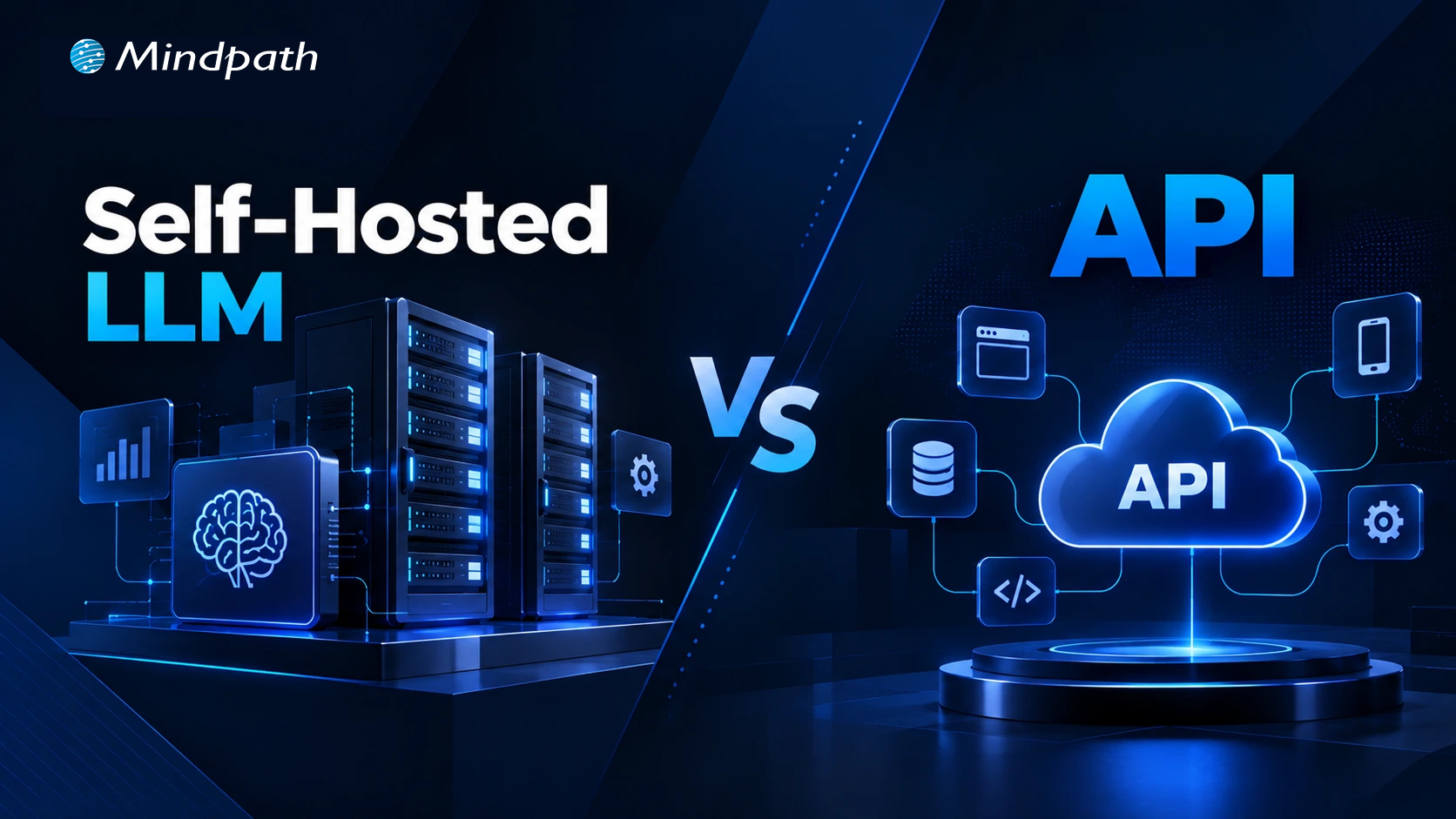
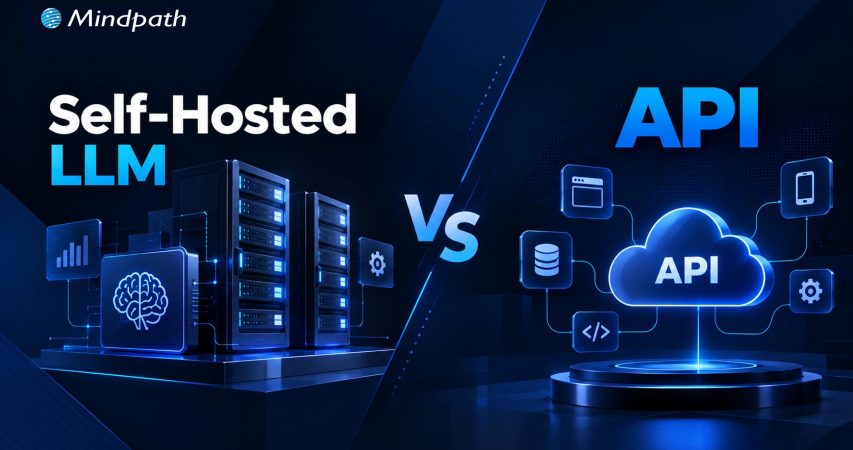
The custom LLM vs API decision becomes clearer when you look beyond model quality. An API gives a team quick access to a capable model without requiring it to manage GPUs, deployment, scaling, or model operations. A self-hosted approach offers greater control, but that control comes with infrastructure, engineering, security, and maintenance responsibilities.
The right choice therefore depends on what the business is trying to optimize. A hosted API may be the practical option when speed and simplicity matter, while a self-hosted model can become attractive when data control, predictable workloads, latency, or specialized performance are more important.
| Decision Factor | Off-the-Shelf LLM API | Self-Hosted / Custom LLM |
|---|---|---|
| Time to Market | Fast integration using existing models | Longer setup, testing, and deployment |
| Upfront Investment | Lower initial investment | Higher engineering and infrastructure costs |
| Model Control | Limited control over underlying model | Greater control over model and deployment |
| Customization | Prompting, RAG, tools, and provider options | Fine-tuning, model selection, and deeper customization |
| Data Control | Governed by provider architecture and policies | Greater control over data location and processing |
| Infrastructure | Provider manages compute and serving | Organization manages compute and serving |
| Scalability | Provider handles infrastructure scaling | Team must plan and manage capacity |
| Latency | Depends on provider, network, and model | Greater ability to optimize serving and placement |
| Cost at Scale | Usage costs can rise with volume | Higher fixed costs, with potential advantages at predictable scale |
| Maintenance | Lower operational responsibility | Requires ongoing MLOps, monitoring, updates, and security |
| Vendor Dependency | Higher dependency on provider pricing and availability | Greater architectural independence |
| Best Fit | Fast-moving, general-purpose AI applications | Specialized, sensitive, high-volume, or highly controlled workloads |
For organizations comparing self-hosted LLM vs API options, the biggest consideration is often not which model produces better response in isolation. It is which architecture delivers the required performance while keeping the total cost and operational complexity under control.
When Should a Company Build a Custom LLM?
The right time to consider custom LLM development is when an API creates a measurable limitation that simpler approaches cannot solve. The local LLM vs API decision should be driven by business requirements, data control, performance, and long-term economics.
1. Specialized Domain Performance
General models consistently struggle with highly specialized terminology, workflows, or task-specific requirements.
2. Strict Data Control
Sensitive information must remain within a controlled infrastructure rather than being processed through an external provider.
3. Predictable High Volume
Large, consistent workloads make API usage costs difficult to justify over the long term.
4. Latency Requirements
Applications require faster and more predictable inference than a third-party API can reliably provide.
5. Deep Customization
Prompting, RAG, or standard fine-tuning cannot deliver the required level of model behavior or task performance.
6. Infrastructure Ownership
The business needs greater control over deployment, model versions, inference infrastructure, and operational policies.
7. Provider Dependency
Long-term reliance on external pricing, model changes, rate limits, or availability creates unacceptable business risk.
8. Strategic Model Ownership
AI is becoming a core product capability where controlling the underlying model can create meaningful technical or commercial advantage.
How Much Does Custom LLM Development Cost?
The cost of custom LLM development depends heavily on the model approach, data requirements, infrastructure, and level of customization involved. In LLM vs API comparison, businesses should evaluate total cost of ownership rather than comparing API fees with development costs alone.
Key cost factors include:
1. Model Development
Fine-tuning or deeper model customization requires specialized ML engineering and evaluation.
2. Data Preparation
Cleaning, structuring, labeling, and validating domain-specific datasets can become a significant part of the investment.
3. Compute Infrastructure
Training and inference require GPUs, storage, networking, and supporting infrastructure.
4. Engineering Expertise
ML engineers, data engineers, MLOps specialists, and application developers may all contribute to the project.
5. Deployment Model
Self-hosted environments require ongoing infrastructure, monitoring, security, and optimization.
| Development Approach | Typical Cost Range | What Drives the Cost | Best Fit |
|---|---|---|---|
| API Integration | $15K–$80K | Integration, prompts, testing, application development | Fast AI launches and general-purpose applications |
| RAG Development | $50K–$150K | Data pipelines, retrieval, evaluation, security | Business knowledge and document-heavy applications |
| Fine-Tuned LLM | $100K–$300K+ | Data preparation, training, evaluation, engineering | Specialized tasks and domain-specific behavior |
| Self-Hosted Open Model | $150K–$750K+ | Model customization, GPUs, deployment, MLOps | High-volume or data-sensitive workloads |
| Custom-Trained LLM | $500K–$1.5M+ | Training data, compute, ML engineering, infrastructure | Strategic use cases requiring deep model ownership |
When Should You Hire Custom LLM Developers?
Building a custom LLM requires expertise across model engineering, data pipelines, infrastructure, evaluation, and deployment. Businesses should consider it when the technical complexity and operational responsibility go beyond what their existing AI team can efficiently manage.
1. Specialized Model Expertise
Bring in experienced developers when model selection, fine-tuning, evaluation, or optimization requires deeper ML expertise.
2. Complex Data Pipelines
External expertise can help when large, fragmented, or sensitive datasets need to be prepared for training or fine-tuning.
3. Production Deployment
Custom models need reliable serving, monitoring, scaling, security, and MLOps practices beyond initial development.
4. Performance Optimization
Experienced teams can optimize inference speed, memory usage, model quality, and infrastructure costs for production workloads.
5. Limited Internal Expertise
Hiring specialists can accelerate development when building an in-house AI team would take significantly longer or require substantial recruitment costs.
Is a Custom LLM the Right Investment for Your Business?
The LLM vs API decision should come down to business value, not the appeal of owning a model. APIs, RAG, fine-tuning, self-hosting, and custom models each have a place. The right approach is the one that solves your performance, cost, security, and scalability requirements without adding unnecessary complexity.
At Mindpath, we provide custom LLM development services covering model customization, data engineering, deployment, evaluation, and optimization. As a custom LLM development company, we help businesses build practical AI systems aligned with their technical requirements, workflows, and long-term goals.