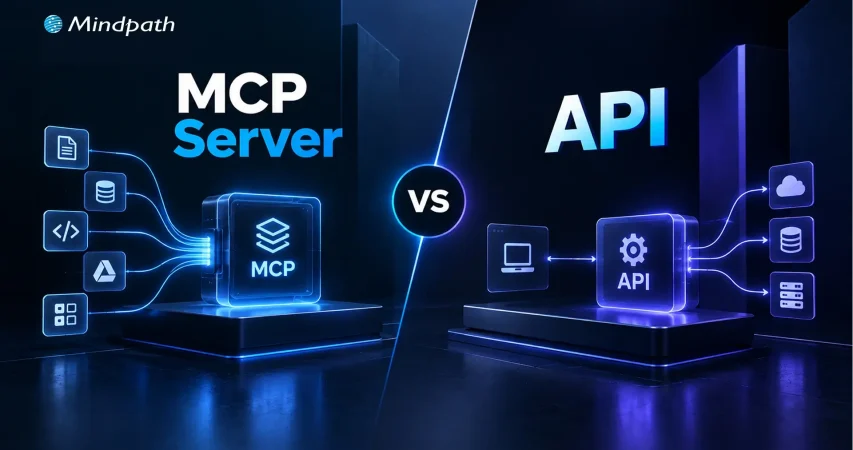
As AI agents move beyond answering questions to using tools, accessing data, and triggering actions, MCP vs API has become an important architecture discussion. An MCP server and traditional APIs can both connect AI systems with external capabilities, but they approach AI integrations from different layers and serve different interaction models.
Key Takeaways
- 01
APIs provide structured access to specific services, data, and application functions. - 02
MCP gives AI applications a standardized way to discover and use tools. - 03
MCP and APIs serve different roles and can work together within the same architecture. - 04
APIs suit predictable workflows, while MCP supports more dynamic agent-driven interactions. - 05
Choosing between MCP and API depends on system requirements, workflows, and existing architecture.
The distinction matters when designing systems that need reliable access to business applications, databases, and third-party services. Understanding where APIs fit, where MCP adds value, and how the two can work together helps teams build cleaner and more adaptable agent architectures. In this blog, we will compare MCP and APIs and explain where each approach fits best.
Ready to build AI systems that connect smoothly with your existing tools and services? Mindpath offers AI Integration Services to help businesses connect AI with their existing technology stack.
What is an API?
An API, or Application Programming Interface, is a defined way for one software system to communicate with another. It exposes specific operations or data through endpoints that an application can call using structured requests. The API handles the underlying business logic and returns a predictable response, allowing developers to connect services without accessing their internal implementation.
APIs are widely used across modern software architectures, including AI applications. An AI system can use an API to retrieve customer records, query a database, process payments, or trigger an action in another application. The developer typically determines which endpoint to call, what parameters to send, and how the returned data should be handled.
Key features of APIs:
1. Defined Endpoints
Expose specific operations or resources through structured interfaces.
2. Request-response Model
Process an application request and return a structured result.
3. Authentication
Control access using methods such as API keys, OAuth, or tokens.
4. Predictable Interactions
Follow documented rules for parameters, methods, and responses.
5. System Integration
Connect applications, services, databases, and third-party platforms.
6. Developer-controlled Workflows
Let developers determine when and how each API operation is used.
What Is an MCP Server?
An MCP server is a system that exposes tools, resources, and other capabilities to an AI application through the Model Context Protocol. Instead of requiring an AI application to handle every integration through separate, custom logic, an MCP server provides a standardized way to make external capabilities available to an MCP client.
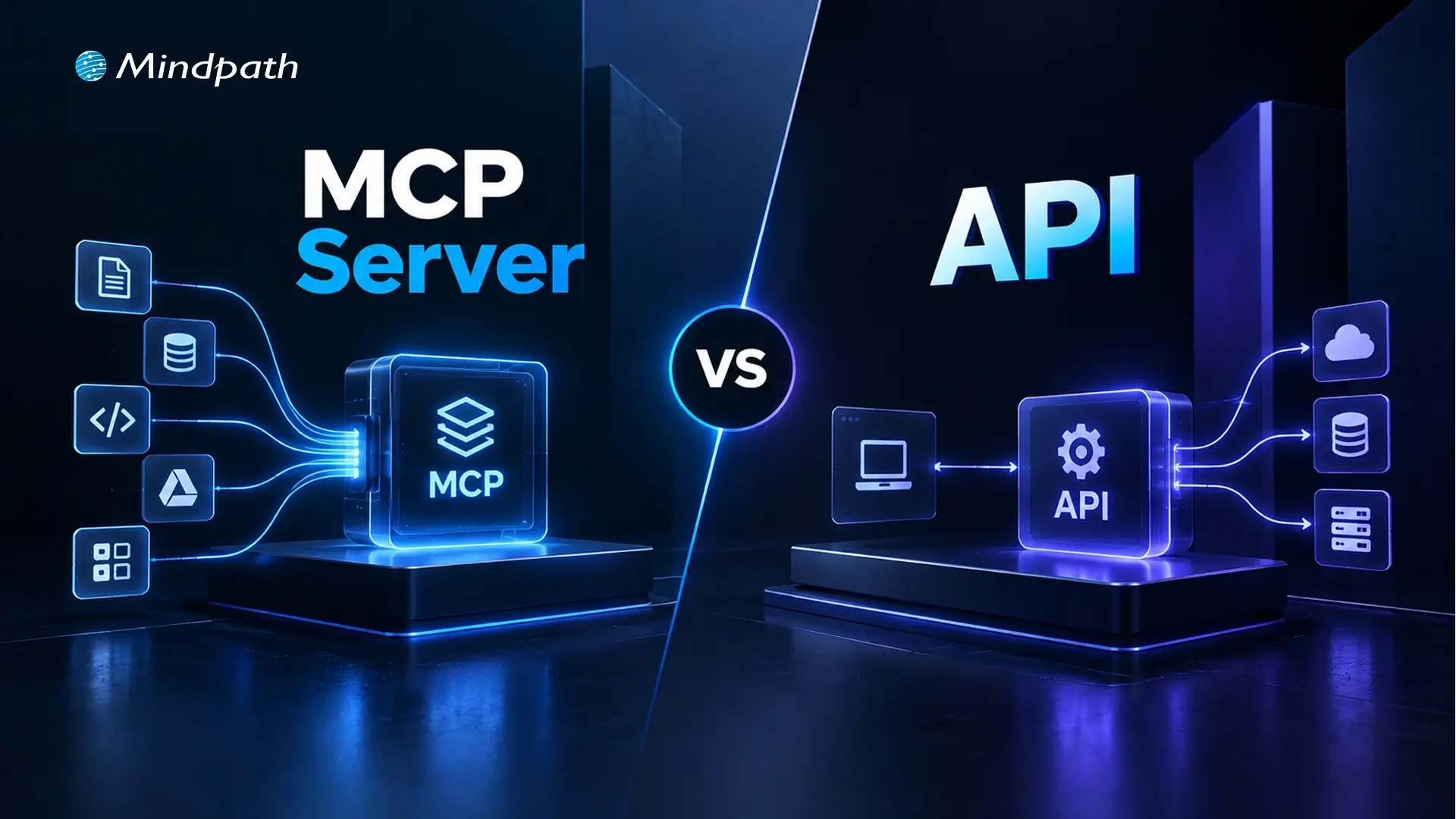
In the MCP vs API discussion, the key difference is the interaction model. An API typically gives a developer a defined endpoint to call, while an MCP server presents capabilities in a format designed for AI applications to discover and use within an agent workflow. This can help AI agents work with business systems, files, databases, and external services through a consistent interface.
Key features of MCP servers:
1. Tool Access
Expose specific actions that an AI application can invoke when needed.
2. Resource Access
Provide structured access to relevant data and external information.
3. Capability Discovery
Allow the client to understand which tools and resources are available.
4. Standardized Communication
Use a common protocol for communication between MCP clients and servers.
5. Controlled Access
Define which capabilities and data an AI application can access.
6. Agent-oriented Integration
Support AI workflows where the model needs to interact with external tools and information.
MCP vs API: What Is the Difference?
MCP and APIs can both connect software with external capabilities, but they are designed around different interaction patterns. An API gives an application a defined interface for requesting data or triggering specific operations. MCP provides a standardized way for AI applications to discover and interact with tools and resources.
The difference becomes clearer when an AI system needs to move beyond a fixed set of developer-defined calls. An AI API can efficiently support predictable operations, while MCP can help an AI application identify available capabilities and use them as part of an agent-driven workflow.
1. Purpose
APIs expose application functionality, while MCP structures access to tools and resources for AI applications.
2. Primary Consumer
APIs are commonly consumed by applications and developers, while MCP is designed around AI clients and agents.
3. Discovery
APIs generally depend on documentation and predefined integration logic; MCP supports standardized capability discovery.
4. Interaction
APIs typically follow explicit requests and responses, while MCP supports AI-driven tool and resource interactions.
5. Workflow Control
API workflows are usually defined by application logic, while MCP can support dynamic tool selection within agent workflows.
6. Integration Approach
APIs can connect systems directly, while MCP can provide an agent-facing layer over existing services.
| Comparison Area | API | MCP |
|---|---|---|
| Primary Role | Connects applications with specific services or functions | Connects AI applications with tools, resources, and capabilities |
| Core Interface | Endpoints, methods, parameters, and responses | Tools, resources, prompts, and protocol-defined interactions |
| Typical Consumer | Developers and software applications | AI applications, assistants, and agents |
| Capability Discovery | Usually handled through API documentation or application logic | Capabilities can be exposed and discovered through the protocol |
| Interaction Pattern | Application sends a predefined request | AI application can select and invoke an available capability |
| Workflow Control | Primarily defined by application code | Can support dynamic, agent-driven workflows |
| Data & Actions | Exposes specific data or operations | Makes selected data and actions available to AI applications |
| Integration Layer | Often serves as the direct service integration layer | Can act as an AI-facing layer over existing services and APIs |
| Best Fit | Predictable application workflows and system integrations | Agentic workflows requiring access to multiple tools or resources |
| Relationship | Can function independently or underneath other systems | Can work alongside APIs rather than replacing them |
How Do MCP and APIs Work Differently in AI Integrations?
The difference between MCP vs APIs becomes clearer when looking at how an AI system actually interacts with external capabilities. With a traditional API, the application usually knows the endpoint, required parameters, authentication method, and expected response before the workflow begins. The developer defines this logic and controls when the API is called.
With MCP, the interaction can be structured around capabilities available to the AI application. An MCP client connects to an MCP server, which exposes relevant tools and resources. The AI application can then use those capabilities as part of an agent workflow, while the underlying implementation remains behind the server interface.
A Typical API Workflow
1. Identify the Service
The developer selects the required API and reviews its documentation.
2. Define the Request
Application logic specifies the endpoint, parameters, and authentication.
3. Send the Request
The application calls the API when the workflow reaches the relevant step.
4. Process the Response
The returned data is handled according to predefined application logic.
5. Continue the Workflow
The application determines the next operation based on the response.
A Typical MCP Workflow
1. Connect the Client
The AI application establishes a connection with the MCP server.
2. Expose Capabilities
The server makes relevant tools and resources available to the client.
3. Understand Available Tools
The AI application can identify capabilities exposed through the server.
4. Invoke a Capability
The agent can use an appropriate tool as part of its task.
5. Use the Result
The returned information can inform subsequent steps in the AI workflow.
Which Approach Fits Your System Best?
APIs provide structured access to specific services, data, and operations, while MCP provides a standardized way for AI applications to discover and use tools and resources. Understanding this difference helps teams choose an approach that matches their architecture, workflow requirements, and intended system behavior.
Choosing between MCP and API can shape how effectively your AI system interacts with existing capabilities. Mindpath AI development services help businesses evaluate these architectures and build practical AI solutions around their technical requirements, existing systems, and long-term development goals.