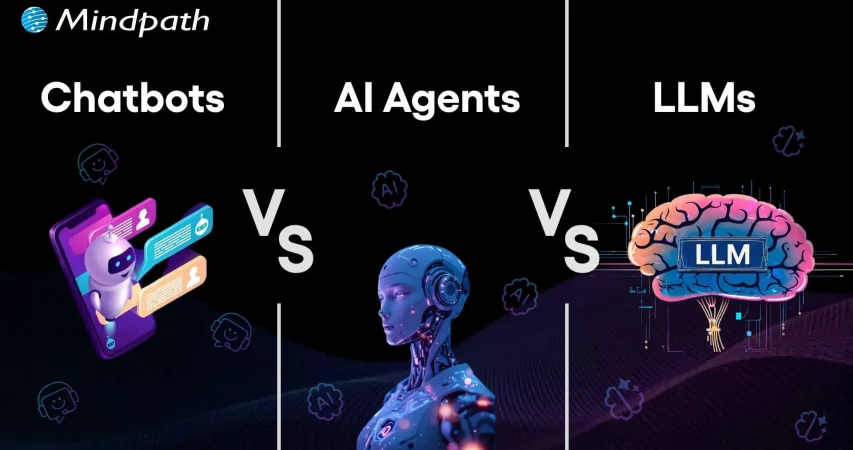
Chatbots vs AI Agents vs LLMs – Choose the Best One for Your Business?  

Join our Newsletter!

Featured Posts

Support Is One Click Away

Home

Chatbots vs AI Agents vs LLMs – Choose the Best One for Your Business?  

chatbots vs AI agents vs LLMs  

Chatbots vs AI Agents vs LLMs – Choose the Best One for Your Business?  

AI is transforming business communication, behavior, and decision making. However, the process of selecting the appropriate intelligence layer is still bewildering, right? When teams compare chatbots vs AI agents vs LLMs, the choice impacts speed, cost, and growth. So, how do you align technology and actual business objectives? We must overcome the indecisiveness and begin to think clearly, practically and strategically.

Expectations are growing at a rapid rate as the debate on automation commences. Customers desire fast responses, smarter behaviors, and repeat experiences. In the meantime, leaders desire control, magnitude, and value that is measurable. This tension renders this decision to be critical. But what are some of the ways these technologies would fit various business requirements nowadays? In this blog, we will guide you to make the correct choice for your business with confidence. So, continue reading further!

Ready to use the right AI technology to streamline and scale your business? Mindpath offers customised AI development services to build chatbots, AI agents, and LLM-powered solutions.

Choosing the Best: Chatbots vs AI Agents vs LLMs

In today’s industry, chatbots, AI agents, and LLMs play key roles in improving business operations. Each brings unique capabilities, but the right choice depends on your specific business needs. Let’s dive deeper into each technology to understand how it can best serve your goals.

What is a Chatbot?

A chatbot is a computer application that converses with the user via text or voice. It solves queries, provides information and directs the users in real time. Companies implement chatbots on websites and applications to assist customers, save time, and enhance the speed of the responses.

Chatbots cope with direct and simple conversations that are easy to explain in the context of chatbots vs AI agents vs LLMs debate. They respond according to set patterns or trained responses. This renders them dependable when it comes to FAQs, bookings, and simple support matters.

How Does a Chatbot Work?

Chatbots operate through reading the input of users and comparing it with the trained data or rules. They apply AI, machine learning and NLP to comprehend intent. Then, they choose the most appropriate response, according to some patterns, logic, or previous interactions.

There are two main chatbot types for chatbot for business use. Declarative chatbots act according to the established rules and respond to the frequently asked questions. Predictive chatbots are based on advanced AI and learning. They are dynamic, personalized, and predictive in terms of user needs.

What are the Key Benefits of a Chatbot?

Chatbots are more effective in addressing specific tasks. This is why they are highlighted in comparisons such as Chatbots vs AI agents vs LLMs. Some of its notable advantages include the following.

1. Offer 24/7 services immediately that enhance customer satisfaction.

2. Provide quick and reliable customer experiences channelwide.

3. Drive growth and sales with personal and timely contacts.

4. Gather customer information to enhance knowledge and business practices.

5. Minimize the expense of dealing with the large volume of queries via chatbots and AI agents.

Curious which chatbot capabilities deliver real value compared to AI agents and LLMs? Discover AI chatbot examples to check out practical use cases that support smarter decisions.

What is an AI Agent?

An AI agent refers to a system that performs work without human intervention through the use of tools and workflow. It is able to make decisions and resolve problems. AI agents respond to environments and take actions, which means that there is no need to have human guidance on daily operations.

As we always compare Chatbots vs AI agents vs LLMs, AI agents are more effective in complex and multi-step tasks than simple chatbots. They apply NLP in LLMs, automate processes, and offer intelligent support to all enterprise software and IT systems.

How Does an AI Agent Work?

The AI agents operate based on a defined role, type of communication and personality. They obey orders and apply tools to accomplish tasks that are effective. The agents evolve with time, learn to be more accurate, make better decisions and cope with complex situations.

A clear persona makes sure that there is a consistent behavior as the agent develops. Memories store short term, long term, episodic, and shared information to aid in learning. Tools enable access to data, manipulation or control of systems. LLMs play the role of the brain where they can make intelligent use of understanding, reasoning and language production.

What are the Key Benefits of an AI Agent?

The AI agents provide more intelligent automation and work on more advanced tasks than simple interactions. They have advanced business capabilities in comparison with Chatbots vs AI agents vs LLMs. Some of the most outstanding advantages are as follows.

1. Increase productivity through an AI agent for business to automate your tasks.

2. Better accuracy through identification of mistakes and production of quality output.

3. Work 24/7, accomplish tasks and help teams at any time.

4. Cut the expenses through automation of workflows and manual inefficiencies when we comparison chatbots vs AI agents.

5. Use data to offer information and make superior decisions.

Looking to decide whether AI agents are the right fit for your business operations? Check out the role of AI agents to learn how they handle complex tasks autonomously.

What is an LLM?

Large language model (LLM) is a computer program that is capable of comprehending and producing text based on deep learning algorithms. It learns on large amounts of data to identify patterns in language and comprehend human language.

LLM forms the backbone of chatbots and AI agents in the debate of Chatbots vs AI agents vs LLMs discussion. They interpret speech, invent answers and facilitate thinking. Fine-tuning LLM provides an accurate performance of tasks. These include answering questions or summarizing content or translating the text effectively.

How Do LLMs Work?

LLMs learn language by training on massive text datasets. They apply Transformer neural networks, which apply self-attention to learn context, patterns and relationships. This enables them to produce human text, respond to questions, summarize, and do other language tasks.

In LLMs for business, these models automate the process of creating content, customer support and data analysis. They forecast words in a text one by one, identify more complex patterns and give correct answers. They also enable companies to save time, enhance communication, and make smarter decisions effectively.

What are the Key Benefits of LLMs?

LLMs have advanced language interpretation and generation that redefine the way businesses interact with data and clients. They are more flexible and intelligent than any other model in comparisons such as Chatbots vs AI agents vs LLMs. Some of the notable advantages include the following.

1. Automation of language and data processes to enhance productivity and minimize the effort.

2. Scale operations in a graceful way to handle the large and increasing quantities of data.

3. Provide low-latency and fast responses to improve Chatbots and LLMs based interactions.

4. Multiple languages should be supported to allow worldwide communication and expanded presence.

5. Create insights that can make informed choices in the comparison of AI agents vs LLMs.

Want to see how LLM capabilities will expand beyond text generation? Learn about the future of LLMs to discover trends redefining intelligent systems.

Chatbots vs AI Agent vs LLMs: Key Differences

Before settling on the appropriate intelligence model to use, businesses should have clarity. This section describes the difference between the chatbots and the AI agent and the LLMs:

1. Functional Scope

Chatbots are based on guided responses and structured conversations. They are able to deal with direct user queries in their day-to-day operations.

AI Agents accomplish objectives based on actions and decisions. They work outside of a discussion and control workflows on their own.

LLMs are language understanding and language generating machines. They justify contents, analysis and arguments between systems.

2. Intelligence Depth

In Chatbots vs. AI Agent vs. LLMs, chatbots are based on predetermined logic. They are competent in foreseeable and monotonous situations.

AI agents are based on reasoning and awareness. They modify behaviors depending on the objectives and results.

The LLLs have high language intelligence. They decode intent, tone as well as context.

3. Level of Autonomy

Chatbots are responsive and wait until the users prompt them. They are unable to start and take charge of things individually.

AI agents are very independent and only act on the goals that have been specified. Their planning and implementation are not guided constantly.

The operation of LLMs needs prompts or integrations. They never take action independently.

Also Read: LLaMA LLM

4. System Complexity

Chatbots have minimal architecture and processes. This makes deployment and maintenance simple.

AI agents entail multi-step systems containing memory and equipment. They control cross-platform complex processes.

LLMs are based on the use of advanced neural networks. They are complex enough to do in-depth processing of language.

5. Cost and Growth Readiness

Chatbots provide cost-effective scaling when it comes to simple support requirements. A lot of teams implement them rapidly.

AI agents are more expensive to invest in but are easily scalable to automation. They are appropriate to be used in the enterprise settings.

The LLMs are ecologically friendly as they are scaled using cloud APIs. The overall cost depends on the volume of usage.

6. Architectural Dependency

Chatbots tend to incorporate LLMs to have conversations. The connection is evident in Chatbots vs LLMs discourses.

AI agents use LLMs as their reasoning engine. They incorporate action and planning layers.

LLMs provide the foundation across systems. This role helps explain the differences in Chatbots vs AI agents vs LLMs clearly.

Planning to deploy AI solutions that focus on instant communication and support? Discover conversational AI chatbot to check out how they fit modern business needs.

Let us understand more clearly through the difference table:

Feature  Chatbots  AI Agents  LLMs 
Interaction Communicates with users through text or voice Interacts with users and systems to complete tasks Understands and generates language for multiple applications
Task Scope Handles simple and repetitive tasks Manages complex multi-step workflows independently Performs advanced content, analysis, and language tasks
Decision-Making Follows predefined rules and scripts Makes autonomous decisions based on goals and context Supports reasoning when integrated into systems or prompts
Learning Learns slowly through updates and rules Improves from past interactions and feedback Learns from large datasets and adapts to patterns automatically
Integration Works alone or with basic systems Integrates with tools, software, and workflows Powers other systems and integrates into chatbots or AI agents
Efficiency Provides quick responses for simple queries Saves time through task automation Processes large amounts of language data rapidly
Suitability Ideal for basic customer support and FAQs Best for enterprise automation and multi-step tasks Suitable for advanced language intelligence and analysis
Scalability Scales easily for repeated interactions Handles growing workflows and processes Scales via cloud APIs for large data and tasks

Ready to Choose the Right AI for Your Business?

The decision on Chatbots vs AI agents vs LLMs influences the manner in which your business operates and develops. All the options address various problems and suit various objectives. Chatbots are good at one-dimensional conversations. AI agents are independent in handling complex tasks. LLMs drive language comprehension on a system-wide basis. Understanding needs will result in more intelligent decisions. The comparison assists teams in making clear and confident decisions.

At Mindpath, our AI development services assists companies to convert AI concepts into practical solutions. Our professionals create chatbots, AI agents, and LLM based systems that will suit your objectives. We are concerned with speed, precision and a value that is measurable. Mindpath Teams develop scalable AI solutions using the framework that enable growth, better decisions, and customer experiences in industries.

 FAQS

1. What are the major differences between Chatbots, AI Agents and LLMs?

When we make a comparison of chatbots vs AI agents vs LLMs, each has a different business purpose. Chatbots are directed towards basic conversations and user guidance. The AI agents are involved in their tasks and decision-making, whereas the LLMs comprehend and create language within systems.

2. Can chatbots work without LLMS?

Yes, chatbots and LLMs do not always work together. Business chatbot can be executed with the help of predefined rules or scripts. LLMs do not make simple tasks mandatory, and they enhance the quality of conversation.

3. Between chatbots and AI agents, which is more advanced?

The AI agents prove better in the chatbots vs AI agents debate. They are future-oriented and execute multifaceted and multi-process work. Chatbots are primarily the ones that answer questions and are programmed to act according to certain patterns.

4. Do AI agents need LLMs to function?

LLMs for business improve an AI agent and LLMs combination. Even in the absence of LLM, AI agents can operate with the help of tools and rules. LLMs enhance the agents by making them smarter, improving their reasoning, understanding and natural language output.

5. When should a business choose AI agent, chatbot, and LLMs?

Chatbots and AI agents can be used to support or automate the work. Chatbots and LLMs perform better when the natural language understanding is serious. The appropriate decision is based on the complexity of the task and business objectives.

Related Post

Related Post

Hire NodeJS Developers in Canada
Hiring a Node.js developer in Canada requires assessing both technical and soft skills while ensuring they fit within the local business environment. A strong candidate must be proficient in Node.js, JavaScript, and frameworks like Express.js while also demonstrating problem-solving abilities and adaptability. Additionally, understanding Canadian regulations such as PIPEDA is essential for compliance. Ensuring a cultural fit within your team can improve collaboration and efficiency. Below are four key considerations to help you hire the best Node.js developer for your business in Canada.

1. Strong Technical Expertise

A skilled Node.js developer should have a deep understanding of asynchronous programming, event-driven architecture, and error handling. Proficiency in JavaScript fundamentals, including object-oriented programming and closures, is essential. Experience with Express.js, NestJS, or Koa is valuable for building efficient applications. Database management using MongoDB, PostgreSQL, or MySQL ensures proper data handling. Familiarity with RESTful API development is crucial for smooth application interactions. Candidates with expertise in microservices architecture and serverless computing can help build scalable and high-performance applications for your business. 

2. Essential Soft Skills

Beyond technical expertise, soft skills play a crucial role in a developer’s success. A Node.js developer must have excellent communication skills to collaborate effectively with teams. Their ability to explain complex concepts clearly ensures smoother teamwork. Problem-solving skills are essential for debugging and optimizing applications efficiently. Adaptability helps developers stay updated with new technologies. Additionally, strong teamwork and collaboration skills ensure they work well within a team. Assessing these qualities through behavioral interviews can help you find a candidate who fits your company’s culture and work environment. 

3. Project-Specific Requirements

Every Node.js project has unique requirements, so hiring developers with relevant experience is essential. If your application needs to handle high traffic or large datasets, ensure candidates understand scalability concepts like load balancing and caching. Security is another key factor—look for experience in data encryption, authentication, and cyber threat protection. Familiarity with DevOps tools and CI/CD pipelines can streamline deployment and monitoring. Hiring a developer who has worked on similar industry projects ensures they understand challenges and can deliver optimized solutions for your business. 

4. Understanding of Canadian Business Practices

Hiring a Node.js developer in Canada requires awareness of local regulations and workplace culture. Ensure your candidate understands Canadian privacy laws like PIPEDA if handling user data. Compliance with these laws is essential for protecting user information and avoiding legal issues. Additionally, consider cultural fit—a developer should be able to adapt to Canadian work environments, follow industry best practices, and align with your company’s values. Time zone compatibility and remote work experience are also factors when hiring internationally. These considerations ensure a smooth hiring process and long-term success. 

Looking to hire top Node.js developers in Canada? Mindpath provides expert developers skilled in building scalable, secure, and high-performance applications. Our team understands Canadian regulations, modern frameworks, and best practices to ensure project success. Whether you need custom development, API integration, or full-stack solutions, we have the right talent for you.  

Partner with Mindpath today and take your Node.js development to the next level!  

Read out next blog:  What Skills to Look for while hiring a NodeJS Developer in Canada? 

Hire skilled Node.js developers in Canada with expertise in scalability, security, and compliance. Find the right talent with Mindpath!
CI/CD Pipelines

Continuous Integration and Continuous Deployment (CI/CD) pipelines have revolutionized modern DevOps best practices. In fact, they are the backbone of DevOps in recent years. CI/CD pipelines allow teams to release high-quality software faster and more reliably. This is possible because a CI/CD pipeline can automate the key stages of the software development lifecycle.

CI/CD Pipelines have empowered software teams and developers like never before. You need to have an in-depth understanding of what is CI/CD in DevOps, as it has been acting as a game-changer. In the business context, a CI/CD Pipeline allows faster product releases and creates value by reducing costs and streamlining the overall development process. It is time to explore what is CI/CD pipeline at a deeper level.

Want to reduce deployment delays and boost business efficiency? Mindpath’s DevOps Consultation and Implementation services streamline DevOps processes to deliver smooth and scalable software delivery.

An Insight into CI/CD Pipeline

CI,CD pipeline full form is continuous integration and continuous deployment. A CI/CD pipeline refers to a series of steps that software developers need to follow so that they can deliver a new version of a software solution. CI/CD pipelines can also be defined as the practice that focuses on improving software delivery throughout the software development lifecycle. It has been transforming the software development process through automation.

CI/CD pipeline introduces automation throughout diverse stages such as development, testing, production, and monitoring.  Teams are in a position to develop top-quality software in a fast and secure manner. The automated testing process allows the identification of dependencies and other issues at an early stage, thereby saving valuable time later. 

Ready to maximize the impact of your CI/CD workflows? Explore the benefits of DevOps to understand how it boosts performance, reduces errors, and accelerates releases.

Mechanism of CI/CD Pipeline

Now that you know CI,CD pipeline full form, and its meaning, it is time to explore its underlying mechanism. The insight can definitely help you understand how a CI/CD pipeline works. To understand how it works, you need to bear in mind that there exist three interrelated methods, including Continuous Integration, Continuous Delivery, and Continuous Deployment.

1. Continuous Integration

Continuous Integration refers to the process of fusing changes to code into a shared repository several times a day. An automated system is responsible for building the app and running tests every time the developer works on the code. CI fundamentally encompasses automated unit tests and static code analysis.

The fundamental goal at this stage is to discover issues relating to integration. In the absence of continuous integration, bugs may surface after multiple changes have been made at the time of a major release. This makes it challenging to find as well as fix them. Continuous Integration minimizes the specific threat by performing tests of every minute change in an isolated manner. 

2. Continuous Delivery

Continuous delivery lays emphasis on the automation of the process that takes place after the code passes the CI stage. CD prepares each change for release so that the deployment can be done smoothly to production at a given time. In the case of a CD pipeline, after the verification of the build, it is moved through the staging environment as well as the pre-production environment in an automatic manner.

It is essential to bear in mind that continuous delivery does not involve the deployment of code to production in an automatic way. The codebase is kept in a deployment-ready state so that software development teams will be able to release as per their need or convenience. CD enables organizations to release software more regularly. 

3. Continuous Deployment

Continuous deployment is responsible for automatically releasing code changes to end-users after passing a series of predefined tests. These predefined tests could be integration tests that test code in a copycat environment and help to ensure code integrity.

This automated process of releasing software code changes directly to the production environment after they have passed all the necessary automated tests eliminates the need for manual intervention. It enables teams to deliver updates and new features to users quickly. It also helps to fix bugs fast. Basically, it accelerates the feedback loop with customers and minimizes the risk relating to large and infrequent releases.   

Looking to understand how CI/CD pipelines are becoming smarter and more efficient? Check out the role of AI in DevOps to learn how automation and intelligence are transforming pipeline performance and reliability.

Key Benefits of CI/CD Pipeline

Now that you know what is CI/CD pipeline it is time to look at some of its key benefits. CI/CD pipeline benefits allow software teams to develop software in an agile manner while ensuring quality. Some of the top benefits include:

1. Faster Time to Market

One of the main benefits of CI/CD pipelines is that teams are able to deliver new features and fix bugs for users faster as well as more often. In fact, this is how major tech giants have been making incremental improvements in their products and creating value for their target market audience. 

With the help of CI/CD tools in DevOps businesses are able to quickly respond to user feedback and develop quality software apps. A typical CI/CD pipeline example automates the build, test, and deployment of a web application, thereby ensuring that the software is introduced in the market in a timely manner. 

2. High-Quality Codes

While releasing software, the role of proper testing is of paramount importance. Now that you know what is CI/CD in DevOps, you can say that high priority is given to testing. A central part of any CI/CD pipeline involves a series of automated tests that are run on every build. 

Automated tests ensure that teams can perform tests in a continuous manner, and the quality of software solutions can be maintained. The automated nature of tests plays a key role in enhancing the quality of code that is generated. 

3. Shorter Feedback Loops

While talking about the CI/CD pipeline example, a thing that is non-negotiable is rapid feedback. Getting feedback early ensures that teams can save sufficient time as well as effort while developing software applications. Teams are able to give frequent updates, which helps in receiving immediate feedback from the users. It thus helps to bring about appropriate changes and increase user satisfaction. 

4. Less Downtime

Even with automated testing, there is a possibility that bugs may sometimes sneak their way through production. A key benefit of using CI/CD tools in DevOps and making regular updates is that it makes it easier to locate the cause of an issue. As the commits are smaller, teams and developers can roll back the change without having to remove necessary elements. This certainly simplifies how issues are fixed and reduces the overall downtime. 

5. Better Communication and Collaboration

One of the main benefits of CI/CD pipelines revolves around improved communication and collaboration among team members. This practice enables members to function in a cohesive manner and make changes to the code. They can also respond to the queries and comments of one another in a transparent manner. The ongoing feedback loop makes sure that there is no communication gap among the team members. The rise in effectiveness in team collaboration is reflected in the ultimate software solution. 

Wondering how CI/CD pipelines are evolving in modern DevOps practices? Discover the latest DevOps trends to learn which tools, methodologies, and innovations are driving smarter and more reliable pipelines.

Final Words

In the prevailing software development arena, the concept of CI/CD pipeline has emerged as a breath of fresh air. It has shown the power that automation can bring while developing software solutions. Some of the key benefits of CI/CD pipelines that you should be aware of include high-quality code, faster time to market, and many more. The explanation of the underlying mechanism of the CI/CD pipeline is there so that you can understand how the process works. 

Mindpath’s top-grade DevOps solutions can certainly assist modern business organizations to leverage CI/CD pipelines to the fullest. Our experts will ensure that, through continuous integration and continuous delivery, your business can develop excellent software applications that can improve user satisfaction. 

Discover how CI/CD pipelines streamline software development, boost quality, and reduce costs with automated processes.
AGI vs ASI 

AI is advancing quickly, and the installation of the debate around AGI vs. ASI is picking up steam in tech circles. These phrases might seem similar but have very different meanings for the technology and the future. While we discuss this landscape, it is good to think about how this evolution will affect industries, decision-making, and everyday life. The difference between intelligent systems and possibly superintelligent systems is interesting, as there are many factors and questions that will stimulate conversation among the expert community.

To comprehend the differences between AGI and ASI, it is necessary to examine their features and possible influence. AGI will try and mimic human-like building understanding across tasks, and ASI expands into areas beyond ourselves, with conjectures that we may not be able to comprehend. By tracking the advancement of these systems, we may be able to better prepare ourselves for potential opportunities and challenges. In this blog, we will explore AGI vs. ASI in greater detail and what separates them.

Want to implement this rise of AGI and ASI into your business operations? At Mindpath, our AI Development Services empower you to integrate this next-generation intelligence into real-world applications today.

What is AGI AI?

AGI stands for artificial general intelligence. The goal of AGI artificial intelligence is to develop systems that are able to think and learn like a human being. As it stands, current artificial intelligence only operates within a defined boundary, while AGI will have the ability to undertake new tasks or challenges that have not been specifically programmed. AGI research needs to increase intelligence beyond narrow application and focus on understanding, reasoning, and problem solving over a wide variety of situations.

Regarding AGI vs. ASI, AGI describes the point in time at which a machine has human-like cognitive properties. It can learn on its own, improve its own skills, and perform tasks that were never taught to perform specifically. This level of advanced intelligence is the step researchers see as important toward more advanced systems. AGI also helps understand what the future of intelligence will look like within the technical framework.

Want to know which AI breakthroughs are driving the gap between AGI and ASI? Explore the most recent developments in generative AI trends and their impact on advanced intelligence.

Key Benefits of AGI Artificial Intelligence in Business

Artificial general intelligence is changing the way enterprises deal with problems and prospect the future. Its ability to learn and adjust like a human being is paving the way for the options that change the companies’ concept of getting bigger and ‍‌innovating.

1. Better Decisions

AGI studies large amounts of data to identify patterns and trends that generate wiser decisions. It also offers predictive analytics, which enables businesses to plan in terms of strategy, demonstrating one of the differences between AGI vs. ASI capabilities.

2. Boosted Innovation

AGI also allows for new products, services, and business models that never existed before. It can also spark the creative process for businesses to remain competitive.

3. Enhanced Customer Care

AGI tailors their interaction based on anticipated customers’ behavior and preferences. AGI is also able to offer customer care in real time, which leads to improved retention and satisfaction.

4. Increased Efficiency

AGI is capable of taking over monotonous tasks, granting employees more time for strategic activities. It facilitates workflows and improves productivity overall.

5. Reduced Costs

AGI streamlines processes and lowers required labor, minimizing operational costs. It performs tasks correctly, thus decreasing errors that lead to wasteful expenditures.

Struggling to implement AI effectively despite understanding the differences between AGI and ASI? Discover practical insights on overcoming these challenges of AI adoption.

What is ASI AI?

ASI stands for artificial superintelligence. ASI artificial intelligence signifies a phase in which machines excel human intellect in all areas. ASI doesn’t simply copy human-like thinking, as is the case with AGI, but ASI can process complex abstractions and resolve problems beyond a human level of operations. The ability to reason, learn, and adapt will happen much faster than any human could.

In the conversation of AGI vs. ASI, ASI is unique and purely hypothetical in that people are generally not aware of it yet, but it could very well usher in a mega-change. It proposes an ideal of self-aware systems that understand and interpret behavior in ways that humans cannot. Researchers are working on ASI to prepare for what technology, society, and decision-making look like in the future when intelligence is not limited to humans.

Key Benefits of ASI Artificial Intelligence in Business

ASI AI stands for a new tier of intelligence, one that reveals the outer limits of what machines might be able to accomplish. Its capability is changing how enterprises reflect on technology, strategy, and the future.

1. Advanced Problem-Solving

ASI has the ability to analyze a massive quantity of data at extraordinary levels of speed to solve problems that are impossible for humans. Companies interested in AGI vs. ASI can leverage this ability to develop new opportunities and discover new markets.

2. Hyper-Personalized Service

ASI can analyze customer data in order to gain insights into their individual preferences and behaviors and offer highly personalized experiences. ASI can offer personalized marketing, recommendations, and customer service that predict customer needs before they express them.

Must Read: Generative AI for Business

3. Predictive Insights

ASI is capable of making market predictions, predictions about consumer behavior, and disruptions with a high degree of accuracy. By having this ability, organizations can make better decisions and reduce risk.

4. Operational Efficiency

ASI can oversee complex processes and streamline industries with almost no human supervision. It can improve workflows, minimize inefficiencies, and reduce operating costs significantly.

5. Enhanced Cybersecurity

ASI can identify and mitigate cyber threats in real-time, keeping ahead of possible attacks. It enhances security for critical infrastructures and proprietary business information.

Wondering how AGI and ASI compare to other stages in the AI evolution journey? Discover the various types of Artificial Intelligence and how they shape modern innovation.

ASI vs. AGI: A Comparison Table

The table below highlights the key differences between ASI and AGI, showing how their capabilities and potential impacts vary.

Feature AGI ASI
Intelligence Level Human-level cognitive abilities across tasks. Surpasses human intelligence in all domains.
Learning Ability Learns and adapts like humans across multiple areas. Learns exponentially and self-improves beyond human understanding.
Problem-Solving Can handle complex tasks humans can manage. Solves problems beyond human capacity, including abstract and novel challenges.
Existence Currently under research, possible in the future. Hypothetical, not yet achieved.
Decision-Making Makes informed, human-like decisions. Makes near-perfect predictions and strategic choices using vast data.
Impact Supports humans, automates tasks, and improves productivity. Can transform industries, create technologies, and potentially surpass human control.
Examples Personal assistants, research AI. Hypothetical global optimization or fully autonomous research systems.

Are You Ready to Unlock the Future of AI?

Artificial intelligence is evolving rapidly, and understanding AGI vs ASI helps businesses prepare for future opportunities and challenges. Both systems offer unique capabilities, from human-like decision-making to superintelligent problem-solving. Staying informed allows organizations to leverage these technologies responsibly and strategically, ensuring they remain competitive and innovative as AI continues to reshape industries and daily operations.

At Mindpath, we offer expert AI development services to help businesses implement advanced AGI and ASI solutions. Our team builds scalable, intelligent systems tailored to your goals, from automating workflows to creating predictive and personalized experiences. Partnering with Mindpath ensures your organization can stay ahead in innovation, efficiency, and growth while navigating the evolving AI landscape with confidence.