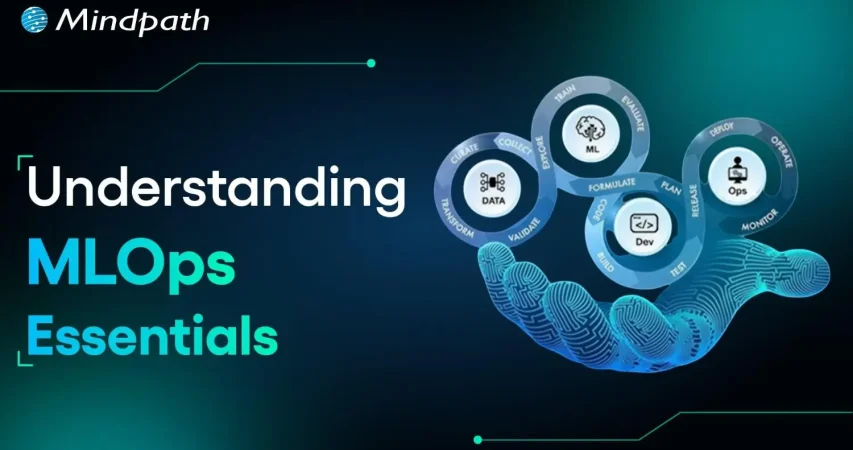
MLOps Essentials: Strategies for Automating Model Deployment

Join our Newsletter!

Featured Posts

Support Is One Click Away

Home

MLOps Essentials: Strategies for Automating Model Deployment

MLOps essentials

MLOps Essentials: Strategies for Automating Model Deployment

The global artificial intelligence market size is expected to reach USD 2480.05 billion by 2034. Yet many organisations fail to translate such huge investments in favour of their business values. Many generative AI projects are going to lose their efficiency recently due to challenges like poor data quality.

Further, inadequate risk controls have been increasing the costs. So, the major issue lies in filling the gap between predictive models and implementing them into your business workflows. This is where the relevance of MLOps essentials comes into the picture. MLOps have the capacity to align the life cycle of machine learning while incorporating continuous monitoring.

Looking to integrate AI into your existing systems without disrupting operations? At Mindpath, we offer AI development services that ensure smooth implementation and measurable results.

What is MLOps?

If we simply define what is MLOps, then it generally stands for Machine Learning Operations. Moreover, it’s a set of technologies and practices that bring software engineering principles into the world of machine learning. Additionally, it streamlines the way you test, deploy and maintain the models for clarity and efficient results.

Unlike traditional ML development, where models were often operated in a single system, MLOps treats the complete lifecycle of ML as a software product lifecycle. This means you can be assured of better collaboration, reproducibility, scalability and automation.

  • MLOps can help your team take ML models from experimentation to production level safely and quickly.
  • It manages the models reliably over time and collaborates across engineering, data science and operations teams.

How MLOps Essentials Overpowers the Traditional DevOps while Solving Leading ML Challenges?

MLOps and DevOps take complete responsibility for automating processes while encouraging collaboration between teams. But MLOps is capable of tackling unique challenges of machine learning that DevOps can’t necessarily address.

  • In traditional software systems, once you deploy your app, it is mandatory to work within a stable environment with minimal challenges.
  • However, ML models heavily depend on data and need continuous updates and validation when new data enters.
  • DevOps prioritises managing the software code and the infrastructure. On the other hand, MLOps essentials include handling the lifecycle of models that can degrade over time.
  • This involves addressing many major issues like data drift, model degradation, and model performance. All of these risks need periodic retraining and real-time assessment.

Planning AI initiatives but unsure where to start? Explore the complete AI roadmap guide to understand how to structure, prioritize, and scale your AI initiatives effectively.

What are Some Core Components of an MLOps Architecture?

The MLOps architecture can differ as per your organisational requirements. Some of the major components are here in this section for a complete reference.

1. Data Layer

This involves storage, data ingestion, preprocessing and versioning. As your models completely depend on data, tracking and handling their quality is necessary.

2. Development Environment

This is where the data scientists create and train models using their notebooks or integrated development environments. So, your experiments must be reproducible. This means the data, code and the environment settings are versioned.

3. Model Registry

This works as the main repository where the trained models are stored along with the metadata like deployment status. This feature can ensure you of data governance.

4. Monitoring

Once you complete the deployment process, your models must offer you accurate predictions. Moreover, precise and continuous assessment can offer you better performance while predicting potential defects. So, your model can also be relevant in the real-world usage.

5. Data Regulations

The regulatory efforts have been broadening due to major AI usage. So, your organization must prioritize relevant rules. Following the relevant practices can help your model serve trustworthiness.

Facing challenges in optimizing large models for scalable deployment? Learn how Low-Rank Adaptation streamlines fine-tuning with minimal resource overhead. 

List of Top MLOps Tools You Should Adopt in 2026

Let us further highlight some of the best MLOps tools for your model development and monitoring. All these tools have the ability to simplify and streamline the ecosystem of your machine learning.

1. LangChain

It is a versatile and effective framework developers use to initiate apps powered by language models. It leverages several components that enable you to build, deploy and monitor context-rich applications. The following framework consists of some major components like libraries, templates, LangServe and LangSmith.

2. Qdrant

This is one of the best MLOps tools in 2026 that is taking the market by storm. It is an open-source search engine that offers a production-ready service with a viable API. Moreover, it allows you to store, manage and search the vector embeddings. As it is written by Rust, it remains extremely quick and efficient even you work with it under high load.

3. MLFlow

MLFlow is an open-source tool that enables you to handle the core parts of the ML lifecycle. Developers majorly use it for experiment tracking. However, you can also utilise it for deployment, reproducibility, and model registry.

4. Prefect

When talking about MLOps essentials, this tool leads the competitive edge. This is a modern data stack, people use for coordinating and monitoring the workflows across multiple applications. It is a light-weight and open-source tool created for an end-to-end MLOps pipeline.

Must Read: Low Code Developement 

What are Some Benefits of MLOps Service?

The MLOps market size is going to extend to USD 25.93 billion by 2034. So, the adoption of MLOps has been increasing efficiently while fueling model deployment and automating monitoring. Businesses now understand that adopting MLOps can bring them a series of benefits, as given below.

1. Better ROI

As per the reports from Deloitte, organisations using MLOps technology claim an average ROI of 28% with better returns. This remains consistent with the growing demand of the market trends, where AI and ML are going to drive business value.

2. Increases Efficiency

Around 94% of companies initiate time-consuming and repetitive tasks. So, MLOps service can automate such processes while boosting your job satisfaction level. Further, this allows your team to prioritise strategic activities while improving your operational efficiency.

3. Faster Delivery

MLOps essentials allow you to lessen the deployment times by automating your CI/CD pipelines. This enables your business to adapt quickly as per the market changes and use AI-driven insights without any delays.

4. Serves Cost-Effective Results

Automating the manual tasks through MLOps architecture, you can minimise the chances of human error and high operational charges. Additionally, it allows your business to simplify the workflows while allocating the resources in a better way.

Want to make your model deployment process more environmentally responsible? Explore how energy-efficient computing drives sustainable innovation.

How to Implement MLOps Seamlessly?

You need to value a structured approach when it comes to MLOps implementation. Here, you can go through some major steps that serve efficiency.

1. Get Your Data Prepared.

Before anything else, you need to prioritise the quality of your data. Start by gathering, cleaning and organising data to make them ready for action.

2. Create Your ML Model

Now that you have the best shape for your data, it’s time for you to leverage a model. So, prefer your features, algorithms and fine-tune the hyperparameters to gather the best results.

3. Deploy Your Model

Deployment is all about leveraging your model in the real world for a service or business application.

4. Assess the Performance

ML models might differ in their performance when the conditions change. So, you need to continuously monitor its accuracy.

5. Retrain for the best Results

Retraining your model time to time can help you get accurate and relevant data that can fulfil your current customers ‘requirements.

Curious about which AI models can accelerate your machine learning workflows? Learn more about the top AI models and how they fit into effective MLOps practices.

Conclusion

Whether you are looking to automate the process or to enhance your model’s governance, MLOps essentials remain the major aspect to stay competitive in the current scenario. Further, MLOps can improve your time to market. However, you need to prefer the right approach and mindset to leverage the best of MLOps.

If you are looking for expert support that can optimise your MLOps strategy and implementation, Mindpath can be your perfect pick. This company can help your machine learning management turn into production-rich success.
FAQs

1. What is MLOps in simple terms?

MLOps is the convenient practice of applying software engineering principles to your machine learning workflows.

2. How can an MLOps pipeline uplift my model deployment?

An MLOps pipeline can streamline the steps of data validation, testing and deployment. This approach reduces manual errors while speeding up your delivery.

3. What are some common MLOps tools in the recent scenario?

Some of the efficient MLOps tools include Qdrant, LangChain and MLFlow. These tools are capable of making your models work precisely.

4. Why you should monitor consistently in MLOps?

Monitoring ensures your model is continuously performing as per the real-world data. It detects issues like degraded accuracy and data quality problems.

5. Is MLOps only reliable for large-scale organisations?

While large businesses benefit effectively, small and medium businesses can also adopt MLOps practices to upgrade their needs.

Related Post

Master full-stack development with Node.js! Its scalability, performance, and seamless frontend-backend integration.

Related Post

DevOps challenges

DevOps has played a crucial role in transforming conventional approaches to software development. Businesses utilize DevOps to ensure faster software delivery with improved quality and better collaboration between development and operations teams. However, the discussions about DevOps challenges don’t come into the limelight, with most of the emphasis being on the benefits of DevOps.

Most of the teams working with the DevOps approach experience many struggles and roadblocks, which can be frustrating at times. Awareness of the prominent challenges for DevOps and their solutions can help a business owner find the best strategic approach for DevOps implementation. This post will help you discover some of the prominent challenges in DevOps and their potential solutions.

Don’t know how to tackle the challenges in the DevOps process? Our experts will provide practical strategies that help you move forward and streamline your operations. Contact us to get personalized support to achieve successful DevOps implementation.

Why does DevOps Face Challenges?

The most common answers to “What is DevOps?” paint it as a combination of software development and IT operations. However, you need to dive a little deeper to understand what DevOps actually entails. DevOps is not about introducing a new department in the organization or bringing a specific set of tools for better results. As a matter of fact, DevOps is a paradigm shift that requires businesses to change how they think about collaboration and communication.

You can notice that success in DevOps initiatives is more about the cultural and philosophical shift rather than the technical aspects. Even with the undeniable benefits of DevOps attracting the eyes of business owners, there is no way to ignore the challenges. Many organizations fail in DevOps implementation due to their inability to recognize the challenges that are not purely technical.

Exploring the Most Prominent DevOps Challenges

The utility of DevOps is clearly evident in the different advantages like faster time to market, easier recovery from incidents, reduced deployment failures, and enhanced efficiency. However, a lack of awareness of the challenges with DevOps can lead businesses to waste resources and end up with substandard results. The following sections will help you learn about the most critical challenges for DevOps implementation.

1. Cultural Resistance and Fragmentation

The most prominent challenge for DevOps is the cultural shift that comes with it. The traditional approach to software development involved development and operations teams working in silos. Both teams had different goals, mindsets, and metrics for the same project, thereby leading to conflict. For instance, developers focus on faster delivery and innovation, while the operations team emphasizes stability above everything.

The fundamental difference between the two teams can create problems in the adoption of the DevOps methodology for new projects. One of the notable problems that arises from differences between the development and operations teams is the ‘us vs. them’ mentality. In addition, professionals in both teams accustomed to traditional workflows will showcase resistance to new tools and practices. Furthermore, the lack of active involvement of leadership also creates difficulties for the cultural shift required in DevOps.

2. Complexity of Tools and Integration Process

Any business that wants to embrace DevOps can capitalize on a wide range of tools for every phase of the software development lifecycle. You can find DevOps tools for almost everything, including CI/CD, security, version control, and monitoring. The assurance of access to so many tools offers the flexibility to choose any tool according to your needs. At the same time, it also creates challenges for DevOps projects as choosing the right tools can be a considerably daunting task. Some businesses end up adopting a lot of tools that don’t align with each other, thereby leading to inefficiencies.

Businesses have to face difficulties in achieving seamless integration between different DevOps tools. On top of it, DevOps teams must learn about a wide range of tools, which calls for investing a lot of time in training. The challenges due to the complexity of tools also focus on the inconsistencies in development, testing and production environments that lead to deployment failures.

Looking to optimize your CI/CD pipeline with smarter automation and streamlined processes? Visit our blog on DevOps Best Practices to discover the strategies high-performing teams use to achieve consistent, stable releases.

3. Lack of Attention to Security

The next prominent challenge for businesses in the adoption of DevOps is the lack of attention to security. Since DevOps aims at ensuring faster software delivery, most of the focus of DevOps solutions is on speed. However, businesses forget about security until the final stages of the software development cycle. Pushing security to the later stages of development as an afterthought is responsible for many challenges in DevOps. One of the most critical outcomes of ignoring security till the last stage of development focuses on compliance issues. Without integrating security practices from the beginning, any DevOps initiative is likely to face regulatory penalties.

The delayed attention to security results in the discovery of bugs and errors in the final stages of development. As a result, businesses have to spend more resources and time fixing such errors. The possibilities of bugs passing undetected through different stages of development can lead to the creation of insecure code. The problems arising from insecure code, such as data loss and breaches, can damage the reputation of an organization.

4. Rigidity of Legacy Systems

Most of the organizations embracing DevOps work with legacy systems and applications in their infrastructure. The adoption of DevOps for businesses with legacy systems is a daunting task, as the old systems were not designed for agile paradigms. You can think of monolithic architectures that involve large and tightly coupled applications, which create difficulties in frequent modification, testing, and deployment.

The automation-first principle in DevOps is not applicable in legacy processes that rely heavily on manual configuration and deployment. Businesses have to go through nightmares to discover the complex dependencies in legacy systems during transformation efforts. At the same time, businesses must also remember that older systems have more security vulnerabilities, making it difficult to integrate them into a DevOps pipeline.

Planning to integrate security into your DevOps workflow? Explore our blog on DevSecOps to learn how automated security checks and continuous monitoring strengthen every stage of development.

Discovering the Ideal Solutions to DevOps Challenges

The insights on challenges for DevOps reveal that adopting a unified approach to development and IT operations is not easy. However, businesses can overcome these challenges by following a holistic approach to address the limitations of people, processes, and technology. The following sections offer an overview of some of the proven solutions to the challenges of DevOps implementation.

1. Culture of Collaborating and Sharing Responsibility

The foremost addition among the biggest DevOps trends points to efforts to break down silos and establish cross-functional teams. DevOps initiatives require shared goals around desired business objectives rather than focusing on KPIs of individual departments. Business owners must foster open communication and transparency between teams to create new paths for collaboration and knowledge sharing. Most important of all, leaders must showcase active participation in the projects and communicate with team members. When all team members share the same goals and responsibilities, the chances of cultural resistance and conflicts are reduced by a huge margin.

2. Adoption of Standardized Combination of Tools

The large assortment of tools for DevOps is obviously one of the most complex challenges for business owners. However, the solution suggests that adopting a standard set of tools with a thoughtful approach can prevent confusion. For instance, businesses must identify the critical areas for automation while choosing DevOps services and select tools that perform the best in the concerned areas. Most important of all, businesses must choose tools that facilitate easier integration with existing systems. Platforms such as Azure DevOps or GitLab can be the best picks for DevOps with their integrated version control, project management, and CI/CD capabilities.

3. Security from Early Stages

Another proven solution to a formidable DevOps challenge is the adoption of security as a shared responsibility in all stages of the development cycle. Integration of security practices and tools in the early stages of development can involve scanning the source code during development and testing applications to identify vulnerabilities in the running state. DevOps teams should also use techniques like software composition analysis to recognize and resolve open-source vulnerabilities. The other proven solutions to embrace security in the early stages include automated security checks for CI/CD pipelines and security training.

Looking to combine fast DevOps practices with automated security checks? Check out our blog on DevOps vs DevSecOps to understand how DevSecOps adds proactive, automated safeguards to every stage of your pipeline.

Want to Simplify DevOps and Achieve Faster Time to Market?

The overview of the notable DevOps challenges and the solutions recommended for them showcases that embracing DevOps is not easy. On the other hand, a holistic and strategic approach to fighting against the challenges can help businesses embrace DevOps easily. The right DevOps strategy will not only ensure faster time to market but also achieve new benchmarks of competitive advantage.

We at Mindpath have been serving our clients with end-to-end IT solutions, including DevOps services tailored to their needs and vision. Our experts have the experience required to understand the client’s vision and offer relevant solutions. Talk to our DevOps consultants and discover the ideal way to make the most of DevOps benefits now.

Frequently Asked Questions

1. Why do some DevOps implementations fail despite having the right tools?

Failure often happens when organizations focus only on tools and ignore cultural alignment. Without proper collaboration, shared goals, and leadership support, even the best tools cannot deliver results. DevOps success depends equally on mindset, communication, and well-defined processes.

2. How can organizations measure the success of their DevOps adoption?

Success can be measured through key indicators such as deployment frequency, lead time for changes, system reliability, and recovery time after failures. These metrics help assess efficiency, stability, and the overall impact of DevOps practices on business performance.

3. What role does leadership play in overcoming DevOps challenges?

Leadership plays a critical role in driving cultural change and setting clear goals. Strong leadership ensures team alignment, encourages collaboration, and supports continuous improvement. Without active involvement from leadership, DevOps initiatives may struggle to gain momentum and direction.

4. How can teams manage the transition from legacy systems to a DevOps environment?

The transition should be gradual, starting with identifying critical systems and modernizing them step by step. Breaking monolithic systems into smaller components, automating processes, and testing continuously helps reduce risks and ensures a smoother shift to DevOps practices.

5. Why is continuous learning important in a DevOps environment?

DevOps involves evolving tools, practices, and technologies. Continuous learning helps teams stay updated, adapt to changes, and improve their workflows. It also enables better problem-solving and ensures that teams can effectively handle new challenges as they arise.

Discover key DevOps challenges and effective solutions to streamline development and operations, and boost deployment efficiency.
Headless CMS

The digital landscape always adopts unique approaches that engage audiences widely. So, accordingly, businesses are striving to offer exceptional online experiences to be prominent in the digital world. To achieve this, a systematic content-management system can play a critical role. However, traditional CMS systems might limit your performance while restricting your content delivery over multiple channels. 

This is where a headless CMS can be a desirable option to rely upon. As per the statistics, the estimated market of headless CMS software is going to touch USD 7,113.6 million by 2035. This is efficiently transforming the way businesses manage and distribute their content. 

Looking for a website that attracts more customers and grows your business? At Mindpath, we offer professional web development services to build fast, secure, and high-converting websites for your business.

What is a Headless CMS, and How Does It Work?

A headless CMS is known to be a content management system that generally decouples the backend from the front-end. Talking about the traditional CMS platforms, they were able to analyze how content is displayed. But a headless CMS allows developers to prefer their desired front-end technology, making the process more adaptable and versatile. 

A headless CMS uses APIs to deliver content and ace its way for making your customers’ experience more user-centric. Now, you are well aware of what is a headless CMS. Further, let us learn about its working capabilities. 

  • Through a headless CMS architecture, content developers can work within the backend, where they can seamlessly add, modify, or organize content as per their requirements. 
  • The backend is considered to be a repository or a database. So, instead of creating HTML pages, the headless CMS offers content through APIs. This allows your developers to fetch it and display it over multiple platforms. 
  • Accordingly, front-end developers can use JavaScript frameworks like Angular, React, or Vue.js to present the content in a more appealing way. This ensures your brand values have been implemented properly into the content.

Want to understand how digital transformation is changing the way businesses manage content and technology? Explore our blog on digital transformation trends to discover the key innovations driving modern digital experiences.

How a Headless Content Management System Can Be Beneficial for Your Business?

A headless content management system comes with a series of benefits that can escalate the versatility of your business in the digital landscape. 

1. Efficient Omnichannel Service

A headless content management system allows your team to channelize content seamlessly through different channels. No matter if you prefer IoT devices, a website, or a mobile app, your content will remain consistent. This is how your users will love the interactive experience while fueling your brand values. 

2. Enhanced Flexibility

Your business doesn’t have to work with pre-defined layouts, as a headless CMS will always help you perform uniquely. You can easily understand the power of your front-end technologies while allowing you to leverage your creativity and custom efforts. 

No matter if you want a personalized website or a mobile app with a unique interface, a headless CMS platform can offer you flexibility while bringing life to your vision. 

Must Read: Top Mobile App Development Technologies

3. Offers Scalability and Keeps Your Business Future-Proof

Headless CMS offers scalability to your designs. With your business growth, you might discover new channels and technologies. So, a headless CMS makes it easier for integration. The decoupled architecture ensures your content can be efficiently distributed without disturbing your active work structure. 

So, no matter if you want to diversify your product line or want to reach new markets, headless CMS can completely support your growth. 

4. Better Market Delivery

With the backend and front-end separated in a headless CMS platform, it ensures your workflow is not disturbed. This allows your business to initiate rapid content updates, respond swiftly, and launch detailed campaigns faster as per the market demands. 

This valuable approach offers you a great significance in the competitive edge. With better turnaround times, your business can gather better opportunities while reacting to changing trends. 

5. Easy Customization

Businesses can easily personalize their content with the help of headless CMS options. This can be done to satisfy your users’ preferences and behavior. By delivering data-rich insights, you can easily target your audience segments for better reach. Further, this step can enhance your customer engagement while escalating their satisfaction rate. 

For your information, personalization always breeds loyalty, and a headless CMS always equips you with tools that tailor content as per individual user requirements. Moreover, it creates memorable experiences that give rise to long-term customer relationships. 

Wondering how modern technologies and strategies are reshaping the way businesses operate? Read our detailed blog on digital transformation for business to understand how it drives growth and innovation.

Where You Should Utilize a Headless CMS?

A headless CMS can be your ultimate solution for a series of scenarios, as given below. Discover where the headless CMS options can be your viable preference. 

1. Custom Front-end Development

If you require a unique and custom front-end experience, a headless CMS can allow your front-end developers to effectively discover their creativity. So, your user experience and designs are not limited to any pre-built templates. It allows you to generate a unique digital experience that can make your customers happy. 

2. Multi-platform Requirements

If you want your content delivery to be seamless through multiple platforms, a headless CMS architecture can be your suitable pick. It simplifies content distribution while keeping your user experience valuable over different channels. 

3. Content-first Integrations

There are many organizations that desire content marketing. So, a headless CMS can easily align your content creation with its delivery. Apart from this, it accesses your markets to acknowledge engagement while your development team can handle the technical aspects. 

Thinking about how emerging AI technologies can enhance your digital ecosystem alongside Headless CMS? Read about the most impactful AI trends shaping the future of technology.

4. E-commerce Applications

Headless CMS can be a suitable choice for your e-commerce platforms, where you need to endlessly update your content and products. Moreover, it allows you to initiate swift updates in your pricing, product listing, and promotional content. 

5. IoT Applications

Headless CMS can easily manage and offer content to a variety of connected devices in IoT applications. It includes healthcare devices, smart applications, and even manufacturing equipment. Further, headless CMS architecture ensures real-time updates and proper content distribution to these devices. 

6. Personal Web Application

Organizations that create custom web apps or websites with unique approaches and functionality requirements can adopt the values of Headless CMS. You can use APIs to access and display content as per your requirements, offering you greater flexibility in layout and designs. 

Struggling to understand how modern businesses build scalable digital systems to support flexible content architectures? Read our guide on custom software development to see how businesses build future-ready platforms.

How to Implement Headless CMS with Best Practices?

Integrating a headless CMS is not random, as you need to adopt a better plan. 

1. Assess Your Requirements

In the initial phase, start by identifying your content delivery needs. This might include the type of content and the number of platforms you want to target.

2. Opt for the Right CMS

Prefer a headless CMS that fulfills your business motive. You can consider elements like ease of use, scalability, content modeling ease, etc. 

3. Data Migration

In the next step, you need to think about migrating your existing content to the headless CMS platform. This includes transferring all the content from your existing CMS platform to the new one. 

4. Content Modeling

Next, you need to think about content modeling that can match your business’s unique requirements. 

5. API Integration

There are many headless CMS platforms that offer APIs to access and further retrieve the content. So, you can develop APIs for your front-end apps. 

Curious about how AI models can be trained to generate more relevant and contextual content for modern CMS platforms? Learn how OpenAI fine-tuning API works and how it can enhance your content strategy.

Conclusion

The digital landscape is changing in a blink. So, brands that can offer consistent and engaging content through multiple channels are more likely to survive in the market. So, a headless CMS platform can make your modern development teams unique by offering them the flexibility they desire. 

No matter if you want to extend your digital presence or just want to elevate your engagement rate, a headless CMS can provide you with a good foundation to be successful. Here, Mindpath can be your ultimate partner. This company can help you with the best CMS implementation while keeping you ahead with your unique innovations and dedicated content. 

Discover the benefits of headless CMS for faster content delivery, personalized experiences, and seamless integration.
mobile app development company

Digital transformation for businesses is changing how they engage with customers, and mobile apps have become a major aspect of that process. Choosing the right mobile app development company can transform a simple idea to a robust, user-friendly app. There are many companies to choose from, and it is important to look beyond claims and find a partner that can truly deliver on what is important to you and your vision.

A company’s methodologies, creativity, and grasp of objectives, vision, and goals can have a profound impact on your app’s ultimate success. Observing how a company adapts, engages with clients, and innovates can provide you with an even clearer sense of their capabilities. Taking time to evaluate these aspects will lead to smarter decision-making. This blog will serve as a step-by-step guide to distinguishing and selecting a mobile app development agency that is right for you.

Curious to know how mobile app development enhances your digital presence among the users? Explore Mindpath mobile app development services to see how our experts can bring your imagination to reality.

Understanding Mobile App Development

Mobile app development refers to the act of developing software applications for mobile devices such as smartphones and tablets. Today, users spend more time on mobile apps compared to desktop websites, averaging nearly four hours each day. Apps are used for many common tasks, from checking the weather to sending payments. They add a layer of modern life which is now impossible to fully separate oneself from.

One of the main reasons for the huge revenues is the widespread use of mobile apps, with annual global expenditures totaling billions of dollars. Moreover, the companies can use the latest mobile app development tools to create applications. This will not only delight their customers but also make their businesses run more smoothly while saving their precious time. Additionally, numerous enterprises consider it crucial for them to avail themselves of the services of trustworthy mobile app development firms. If they want to keep the edge in the market and develop the right solutions for their users’ needs.

Want to build a mobile app tailored exactly to your business goals and user needs? Check out custom mobile app development services to learn how personalized solutions drive better results.

Steps to Choose the Right Mobile App Development Company

The decision of finding the best mobile app development company is the key to converting your idea into a successful application. If you pick a company that comprehends your objectives, has good communication and gives you reliable solutions, then you are ensured a perfect development process and a stable app as the final outcome.

1. Check Industry Experience

Ensure the mobile app development company is familiar with your business area and its problems. Examine their previous works to establish whether they have accomplished solutions close to your application’s idea. Usually, the experience of the professionals in your field leads them to present you with innovative solutions and new ideas. Eventually, a bespoke mobile app development organization with a decorated history of success can uplift the utility and the relativity of your app.

2. Assess Technical Skills

First, you should analyze the level of the team’s technical expertise, which includes programming languages and frameworks. Try to find out the ways they have structured the app for development, testing, and troubleshooting. Technically strong teams will keep themselves updated with the latest mobile app development trends if they want to provide top-quality apps. Moreover, you will know if the company meets your expectations when discussing technical issues.

3. Review Design Capabilities

Take a look at their design portfolio to grasp their artistic point of view. Get access to apps that they have developed to verify the interface and the user experience. Find out if the team is able to tailor the designs to your market and potential customers. Collaborating with a custom mobile app development company gives you the guarantee that your app will have a nice design and be easy to use.

Planning to build a mobile app that stands out with smart and data-driven capabilities? Discover benefit of AI in mobile app development to check out how businesses use AI for competitive advantage.

4. Look at Client Feedback

Try looking through feedback and written recommendations of people who have previously worked with the team to get an idea of how well the team members communicate and work together. Communication is the key to knowing how the company is going to be aware of the deadlines and the way they are going to be responsible. Through this action, you will be double-checking whether the mobile application development company is able to meet your requirements before you decide to go ahead with them.

5. Consider Budget Clearly

Map out project scope, characteristics, and branding necessities to get a rough idea of the expenses. Have a chat about your budget with the team so that there are no unexpected situations arising later. Know the different working arrangements, such as fixed-price or time-and-material and select the one most suited to your needs. Being open about costs related to app development is one of the ways that trust between the two parties can be formed.

Want to choose a mobile app development company that uses the latest and most reliable tech stack? Check out top mobile app development technologies to learn what powers high-performing apps.

6. Evaluate Communication Style

A project is more likely to be successful with good and effective communication. It’s a great opportunity to get to know the team behind your project and find out how they monitor your project with progress updates and how they implement feedback. Their style is important to you, and you have to feel comfortable. A mobile app development company that has good communication skills can avoid most of the setbacks and misinterpretations.

7. Decide Team Location

Consider the benefits of onshore versus offshore teams for collaboration and costs. Onshore teams allow real-time communication, while offshore teams may offer cost advantages. Balance of convenience, talent, and budget when making your choice. A mobile app development company in USA may suit businesses looking for closer collaboration and time zone alignment.

Ready to safeguard user data and prevent common mobile app vulnerabilities? Discover application security best practices to check out proven protection strategies.

8. Verify Legal and Security Standards

Inquire about security steps, encryption, and data compliance policies. Make sure that the rights of intellectual property as well as user data are secured. Look at precedents for projects for legal and security standard conformity. A dependable Mobile app development company protects your app and keeps the confidence of the users.

9. Check Scalability and Flexibility

Your app and the team behind it can both change and evolve over time, so the team needs to be equally flexible. You should find out if they are able to not just increase the resources but also change the features according to your needs. An app that can stretch its features will be able to stay relevant in a dynamic market. Working with a custom mobile app development company is an excellent means to ensure the lifespan of your application.

10. Explore Post-Launch Support

An application has to be maintained after the launch. It is a must to have a support package which will include the response time, and they can keep the app updated for you. The team has to be composed of qualified people who will be able to cope with future demands. The assistance of a robust mobile app development company after the release of the application will keep your app stable and successful in the long run.

Want to understand why businesses invest heavily in mobile apps today? Check out benefits of mobile app development to learn how apps drive growth and customer engagement.

Ready to Build a Successful Mobile App?

One of the most important factors in the mobile app success is finding the appropriate mobile app development company to work with you. A trusted partner who leads to a hassle-free mobile-app creation and brings you a thriving future is within your reach by methodically assessing the proficiency, capabilities, design and support. Your business benefits from a wise decision made now that will allow you to advance and maintain your edge over the digital realm.

We at Mindpath provide complete mobile app development services tailored to the requirements of your business. Our skilled team creates apps those are safe, capable of scaling, and centred around user interaction, which are the main factors that increase customer loyalty and productivity. Through our commitment to innovation and excellence, we assist you in designing mobile solutions that go beyond competitive markets and produce actual business outcomes.