Front End vs Back End vs Full Stack Developer: What are the Differences?

Join our Newsletter!

Featured Posts

Support Is One Click Away

Home

Front End vs Back End vs Full Stack Developer: What are the Differences?

front end vs back end vs full stack

Front End vs Back End vs Full Stack Developer: What are the Differences?

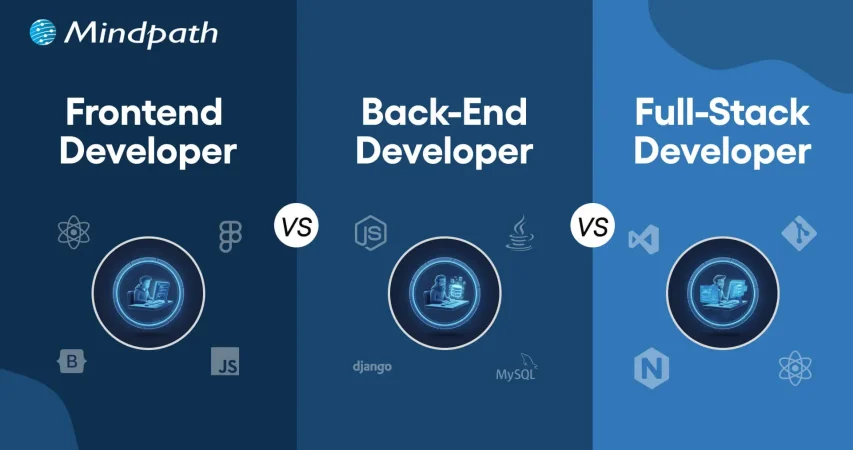
Web development is one of the formidable tools that have helped businesses stay strong in the era of digital transformation. It has also attracted attention towards the frontend vs backend vs full stack comparison, since the three distinct components have a distinct role in web development. If you have to begin your next web project anytime soon, then it is important to learn the significance of these terms.

Businesses have been tapping into the digital revolution with the help of websites and web applications to establish their digital presence. However, business owners must know whether they should pick full-stack developers or a combination of frontend and backend developers. Let us compare frontend development, backend development, and full-stack development to find the best choice for your next web project.

Not sure about what to choose, frontend, backend, or full-stack developer for your next project? At Mindpath, our web developmet services give you the best of both expertise that speeds up your development process and provides seamless end-to-end solutions.

Unraveling the Components of Web Development

The general impression about web development is that it focuses on building websites or web applications. As you dive deeper into web development, you will find the backend and frontend divisions quite clearly. Where does full-stack development enter the picture? You can find a perfect answer to the question with brief overviews of the two crucial components in web development.

Fundamentals of Frontend Development

The term ‘frontend’ gives out the meaning of frontend development. It stands for the part of web applications that is visible to users. Frontend developers have to create different aspects of the user interface, including text font, colors, menu styles, and buttons. Most of the frontend vs backend vs full stack development comparisons paint frontend development as the process of creating the aesthetics of web applications. On the other hand, the comparisons miss the fact that frontend developers also create the user experience.

Frontend developers take on different tasks such as developing intuitive user interfaces, optimizing for performance, and ensuring accessibility on different devices. The other crucial tasks involved in frontend development include testing the frontend for errors and ease of navigation, and optimizing the user experience. Working as a frontend developer means that you will have to use languages like JavaScript, HTML, and CSS. On top of it, developers should know how to use frameworks like React and Angular to improve performance and responsiveness.   

Fundamentals of Backend Development

The backend of a web application represents the components that run the application from behind the scenes. Most of the answers to “What is a backend developer?” reveal that they focus on the server, databases, and APIs. Backend developers have to ensure that all these components work in unison with each other efficiently and provide the desired functionalities. The responsibility of backend developers starts with understanding the main objectives of the website or web application and creating the relevant architecture.

Backend developers will have to ensure that there are ideal systems in place for data storage with the assurance of easier scalability. The biggest task of a backend developer is to create and optimize the server-side logic for efficient performance across different devices. Another crucial task that separates the front and back ends of a web application is API management for seamless functionality on diverse platforms. As a backend developer, you should also focus on creating the website architecture with flexibility for adding upgrades in the future. 

The extensive list of responsibilities of backend developers also includes the implementation of algorithms, backend security, and integrating payment systems. To achieve all these responsibilities, a backend developer must be an expert in one of the server-side programming languages, like PHP, Python, and Java. Backend developers also use frameworks like Django to expedite the development process. The skills required for backend developers also include tools like SQL and Oracle.

Why Do You Need Full Stack Development?

The overview of frontend development and backend development reveals their significance in the web development lifecycle. However, the front-end, back-end, and full-stack relationship becomes clearly evident when you combine the two crucial processes of web development. A full-stack developer can do the work of frontend and backend developers with little to no support from other professionals. The primary responsibilities of full-stack developers revolve around the user experience, servers, data modeling, databases, and hosting. 

Full-stack developers write code for the frontend and backend of web applications while collaborating with design teams and stakeholders. In addition, they also optimize the code with consistent testing and debugging. You can notice the full-stack vs frontend vs back-end development differences in the other responsibilities of full-stack developers. For instance, a full-stack developer not only implements servers and databases on the backend but also designs the user interactions on the frontend of the application.   

The tasks in full-stack development indicate that developers will need better technical proficiency than frontend or backend developers. Apart from fluency in frontend and backend programming languages, full-stack developers must also have strong soft skills.

There are unique advantages that full-stack development brings beyond its technical skills. Explore the benefits of full-stack development, which empowers businesses to accelerate innovation.

Diving Deeper into the Frontend vs Backend vs Full Stack Debate

Business owners who want to create web projects must be worried about the decision between choosing full-stack developers or backend and frontend developers. You can use the frontend vs full stack vs back-end developer comparison to determine the staffing requirements for your next web project. 

1. Focus Areas

Creating an effective web application or website requires attention to different areas of the application. The best way to differentiate frontend development and backend development from full-stack development requires the identification of the areas they focus on. Frontend development focuses on the graphical user interface and user experience, while backend development focuses on the server-side operations and data management. 

Full-stack development involves combining the focus areas of front and back ends of an application to deliver the required functionalities. The focus area of a full-stack developer is the complete application development lifecycle.

2. Objectives

The next important point of difference between frontend development and backend development focuses on the goals. Frontend developers work to deliver a positive user experience with a website or web application that looks good. The goals of frontend development also revolve around creating an appealing aesthetic for the web application while ensuring responsiveness and accessibility. 

The frontend vs backend vs full stack comparison also sheds light on how backend developers aim to create a high-performance and efficient app. Backend development relies on leveraging logic to achieve different functionalities alongside addressing user experience issues.    

3. Responsibilities

You can get a better impression of the differences between full-stack, frontend, and backend developers by learning about their responsibilities. The primary responsibility of a frontend developer involves implementing visual designs and layouts for a web application. Frontend development responsibilities also include creating a responsive design and interactive elements for the user interface. As a frontend developer, you will also have the responsibility of ensuring cross-browser compatibility for the application.

The responsibilities of a backend developer revolve around database management, API development, and backend security. Backend development also focuses heavily on creating, implementing, and maintaining the server architecture. The back-end vs full-stack vs frontend comparison will draw attention to the ways in which full-stack developers take on a broader set of responsibilities. Some of the notable responsibilities of full-stack developers include end-to-end development, system integration, and server and website architecture design. On top of it, full-stack developers must also take complete ownership of the project. 

4. Technical Skills

Another effective approach for comparing frontend and backend developers with full-stack developers is the technical proficiency required for the jobs. The full-stack vs back-end vs frontend debate in web development becomes quite simple in terms of the technical proficiency required in each area. Frontend development involves the use of technologies like HTML, JavaScript, and CSS. The other notable tools used in frontend development include frameworks like React, Vue, and Angular. 

Backend developers rely on programming languages like Python, PHP, and Java to write server-side logic. On the other hand, they also utilize frameworks like Django to leverage tools for faster and efficient development. Full-stack developers use a combination of all backend and frontend technologies, depending on the project requirements.

Here is an overview of the differences between full-stack, front-end, and backend developers.

Criteria Frontend Backend Full Stack
Focus Areas Frontend development focuses on the user interface and experience. Backend development revolves largely around server-side operations and database management. Full-stack development focuses on the complete application development lifecycle.
Objectives Frontend developers aim to make the application look good and easy to interact with. Backend developers aim to ensure that the web application works as intended by the client. Full-stack developers focus on building a complete web app with the frontend and backend elements.
Responsibilities Frontend developers take the responsibility of creating interactive elements and implementing visual designs with better responsiveness. Backend developers have to take care of server architecture, database management, API development, and backend security. Full-stack developers are responsible for designing the complete architecture, end-to-end development, and system integration.
Technical Skills Frontend developers know how to work with HTML, CSS, JavaScript, and frameworks like React and Angular. Backend developers know how to use programming languages like Python, Java, and PHP for server-side coding and other backend frameworks. Full-stack developers must have a strong command of backend and frontend technologies.

Want to know if full-stack development is becoming essential for modern web projects? Explore on how it helps businesses integrate systems efficiently and drive growth in our blog: Is full-stack development the future of web projects?

Final Thoughts

The insights on the differences between backend, frontend, and full-stack development reveal how full-stack offers a better choice. Why should you choose two different developers when one full-stack developer can do their jobs? However, the frontend vs backend vs full stack development comparison shows that frontend and backend developers also have unique strengths. Therefore, you need to consult with experts before you prepare a strategy for your next web project.

We at Mindpath have been offering expert web development services and delivering to one client after another with continuously growing customer satisfaction. You can come to us with any idea for web applications, and we can promise to create robust and appealing solutions that can attract your target audience. We have a team of experienced full-stack developers, frontend developers, and backend developers who have worked on multiple projects. Reach out to our consultants and make the most of our expertise in web development now. 
Related Post

Discover how hiring remote developers can drive startup success by tapping into global talent, enhancing productivity, and reducing costs.

Related Post

ReactJS

Are you ready to unlock the full potential of your business? Imagine combining the power of ReactJS with other cutting-edge technologies to boost your growth and enhance your digital presence. In this blog, we will explore how integrating ReactJS with other tools can transform your business operations, improve user experiences, and drive long-term success.  

In today’s fast-paced digital environment, businesses must use the correct technologies to remain competitive and provide the greatest customer service. Integrating ReactJS into your applications is an essential step towards doing this. Businesses can utilize ReactJS when combined with other technologies to develop quicker, more responsive websites and apps that are easier to maintain and grow. This connection improves performance, enriches user experiences, and enables organizations to remain adaptable in an ever-changing market. 

Curious to see how this synergy can work for you? Let’s dive in and discover the possibilities! 

Integrating ReactJS with Other Technologies

1. ReactJS with Python

Combining ReactJS and Python provides a robust platform for developing full-stack apps. ReactJS is well-known for its dynamic and interactive user interfaces, but Python excels at sophisticated server-side activities and data processes. Businesses that use Python for backend operations can power ReactJS apps more effectively, particularly when dealing with massive quantities of data or real-time processing. 

One of the primary benefits of combining ReactJS with Python is the speed with which data can be handled. Python is perfect for applications that must manage complicated data, such as single-page apps that require speedy and precise data retrieval. Many well-known firms have profited from this combo. Spotify, for example, employs ReactJS for its front end and Python for data processing on the back end. Similarly, Instagram uses ReactJS and Python to manage millions of user interactions while ensuring seamless performance.  

2. ReactJS with Node

By combining ReactJS and Node.js, developers can construct full-stack JavaScript apps that use the same language on both the client and server sides. This integration simplifies and speeds up the development process by requiring developers to focus on only one language throughout the stack. One of the primary advantages of mixing ReactJS and Node.js is the ability to create real-time apps. Node.js is recognized for its event-driven architecture, which makes it ideal for real-time data handling. When combined with ReactJS’ interactive, dynamic user interfaces, it provides users with a smooth and responsive experience. 

Major organizations such as LinkedIn and Uber use this mix for their platforms. LinkedIn employs ReactJS and Node.js to provide a quick, real-time user experience, whereas Uber depends on ReactJS for the front end and Node.js to manage real-time location updates and ride requests, providing smooth communication and a unified experience for users. 

3. ReactJS with Express

Combining ReactJS with Express provides a solid basis for building full-stack JavaScript apps, easing both front-end and back-end development. This combination increases the development workflow and overall efficiency by managing dynamic user interfaces on the client side with ReactJS and server side with Express. 

One distinguishing aspect of ReactJS and Express is their ability to efficiently manage asynchronous tasks. Both technologies are excellent at managing asynchronous data queries, making them suitable for creating dynamic, data-driven single-page applications (SPAs). This leads to a quicker, smoother user experience with continuous updates and interactions, eliminating the need for frequent page reloads. 

When combined, ReactJS and Express offer a powerful solution for building fast, scalable, and efficient web applications, where both the front-end and back-end work in perfect harmony to deliver an optimal user experience. 

4. ReactJS with Next.js

Combining ReactJS and Next.js provides significant advantages for developing modern online apps that are quick, scalable, and SEO friendly. Next.js allows React developers to construct server-rendered apps that not only reduce load speeds but also improve search engine optimization (SEO), guaranteeing that your website ranks higher and performs better. 

One of the primary benefits of combining Next.js and ReactJS is Server-Side Rendering (SSR). SSR enables React apps to be pre-rendered on the server before being delivered to clients, resulting in quicker load times and improved SEO performance. Next.js now supports Static Site Generation (SSG), which allows you to create static pages ahead of time. This strategy is appropriate for dynamic websites that need to be fast and optimized while still giving an outstanding user experience.  

5. ReactJS with React Native

Integrating ReactJS with React Native provides significant benefits for creating online and mobile applications in a single environment. This combination enables developers to construct cross-platform mobile apps with near-native performance while using the same codebase as for web app development. 

One significant advantage of utilizing ReactJS with React Native is the ability to reuse code between web and mobile platforms. This not only speeds up the development process but also assures consistency, saving time and effort in creating distinct apps for different platforms. React Native also offers a near-native mobile experience, with smooth and responsive performance on iOS and Android devices. 

6. ReactJS with Redux

Combining ReactJS and Redux provides an effective approach for handling complicated states in large-scale applications. Redux is an effective approach to manage the state of your project, making it easy to trace changes and assure consistency throughout the application. 

One of the primary advantages of integrating Redux with ReactJS is centralized state control. Redux lets you maintain the application’s state in one location, ensuring that updates are consistent throughout the program. This is especially useful for big web applications where handling states across numerous components can be onerous. Redux facilitates the predictable flow of data, making it easier to manage even the most complicated ReactJS applications. Another advantage is the ease of testing and debugging. Since Redux acts as a single source of truth for the application state, it becomes much easier to trace errors and identify problems, streamlining the debugging process and improving the reliability of your app.  

7. ReactJS with Java

Combining ReactJS and Java is a potent combination for developing enterprise-grade online apps, where the power of Java on the backend meets the flexibility of ReactJS on the frontend. This connectivity enables developers to build dynamic, scalable systems capable of handling complicated needs. 

One of the primary advantages of combining ReactJS with Java is having to have a robust backend powered by Java while utilizing ReactJS for a flexible and dynamic frontend. Java’s strong nature guarantees that the program scales effectively, while ReactJS allows for building responsive, user-friendly interfaces with seamless interactions. 

Furthermore, integrating ReactJS and Java provides cross-platform compatibility, allowing online apps to execute effortlessly across several platforms. This allows firms to reach a larger audience while maintaining fast performance and consistent functionality across devices. 

Also Read: 5 Key Benefits of React JS Development Services in 2024

Integrate ReactJS with Technologies at Mindpath

At Mindpath, we specialize in integrating ReactJS with various technologies to build powerful, scalable, and efficient web applications. By combining ReactJS with other tools and frameworks, we can deliver smooth, interactive user interfaces alongside strong, reliable backends.  Whether it’s ReactJS paired with Node.js for faster development, Express for efficient state management, or Python for handling complex data operations, we ensure that your application performs seamlessly across all platforms. Our expertise in integrating ReactJS with technologies like Redux, Next.js, and more allows us to create real-time, SEO-friendly, and mobile-optimized applications. 

Wrapping Note!

Integrating ReactJS with other advanced technologies is a game-changer for businesses aiming to enhance their digital presence, streamline operations, and deliver superior user experiences. By combining ReactJS with tools like Python, Node.js, Express, and Redux, businesses can create dynamic, fast, and scalable web applications that meet the demands of today’s competitive market. Whether you’re building complex data-driven platforms or developing mobile apps with seamless user experiences, ReactJS offers the flexibility and power to take your projects to the next level. At Mindpath, we are committed to harnessing the potential of ReactJS and other cutting-edge technologies to help your business thrive. Let us help you unlock new possibilities and achieve long-term success by integrating the best tools for your digital transformation journey. 

Ready to take your business to the next level?

Partner with Mindpath for seamless ReactJS integrations and cutting-edge technology solutions.

Discover how integrating ReactJS with cutting-edge technologies can boost business growth, enhance user experiences, and streamline web app development.
Benefits of containerization

In the technology-driven world, containerization technology has emerged as a highly promising innovation. In a short period, it has been recognized as a reliable tool that can be used for streamlining DevOps workflows.

According to IBM’s recent report, the global container market is likely to reach USD 3123.42 million in the year 2031. It shows that more organizations are shifting towards containerization to leverage its benefits for modern development. Let’s explore the containerization meaning in detail and look at its key benefits!

Are you ready to take full advantage of containerization for your projects? Contact us, and our experts will guide you on how to implement it effectively in your business, which will boost the overall performance.

What is Containerization?

Containerization refers to a novel software deployment process. It bundles the code of an application with all the libraries and files that are needed to run in any environment. Conventionally, developers could run applications by installing the versions that matched the operating system of their machine.

However, by utilizing containerization tools, developers can create a container or just one software package that is capable of running on diverse kinds of operating systems and devices. A common containerization example involves Netflix since it relies on containers for scaling thousands of microservers for powering its platform.

Curious how containerization impacts your development budget? Check out software development costs to see how to save while going modern.

Why is Containerization Needed?

In the present times, many believe that containerization holds the promise to modernize legacy systems. This is possible since it can help create new and scalable cloud-native software applications. Containerization functions by acting as a kind of OS virtualization, where you can easily run apps in isolated user spaces.

In the modern software development context, containers serve as executable software packages. They bundle the application code with all the necessary configuration files, libraries, and other dependencies that are required for it to run. Containerization is needed since it fragments operating systems into smaller sections that can be used by developers in an efficient way. It is believed to be one of the most revolutionary developments in the software development space.

Also Read: Types of Software Development

Top Benefits of Containerization

The benefits of containers are of high value for software developers. If you are into software development, it is a must for you to not only familiarise yourself with containerization but also learn about its benefits. Some of the chief containerization advantages are:

1. High Portability

One of the main benefits of containerization is related to high portability. A container is capable of bundling dependencies. Thus, by leveraging the innovative technology, software developers can take their software application almost anywhere without having to rebuild it to suit a new environment. The abstraction that is offered by containerization makes sure that the container works in a similar manner, no matter where it is deployed.

2. High Efficiency

One of the key advantages of containerization you need to be aware of revolves around its efficiency. In fact, it is considered to be one of the most efficient forms of virtualisation that exists in the modern development context. Containers are able to boost the efficiency level in two ways. These ways are the use of all the resources and the minimization of the workload. Isolated containers are able to perform their specific operations without any kind of interference or disruption from other containers.

3. Better Agility

At present, containerization serves as a valuable tool that can be used for streamlining DevOps workflows. Software developers can gain value from the advantages of containers and solve a plethora of DevOps challenges. For instance, when developers need to carry out a task, they can create a container to handle it in a prompt and efficient way. It thus empowers software developers to promptly respond to diverse problems that arise in their path.

4. Improved Scalability

One of the top containerization benefits is related to the scalability dimension. Containers act as extremely lightweight software components that can run in an efficient manner. As a result, software developers are able to effortlessly add multiple containers for diverse apps on one machine. The container cluster is able to utilize computing resources from one shared operating system.

Worried about security slowing down your development process? Learn about DevSecOps and discover how integrating security into DevOps ensures faster, safer software delivery.

5. Greater security

Containerization supports a greater level of security in the software development context. The isolated nature of containers automatically minimizes the level of security risks. Thus, the ability of malicious actors to compromise the security aspects is reduced to a significant extent. Moreover, software developers also have the option to leverage security scanning tools for the purpose of scanning container images and locating known vulnerabilities.

6. Faster delivery of software solutions

Typically, software development teams take a fairly long time to move from the conceptualization stage to implementation. By capitalizing on containerization, it is possible to shorten the gap between these phases. This is because Continuous Integration (CI) acts as a natural extension of containerization. It shortens the software development process and makes it more efficient by automating diverse processes relating to testing as well as creating new code.

7. High degree of flexibility

One of the main advantages of containerization is that it allows software developers to develop apps in a versatile manner. This is because they can flexibly operate their code in diverse environments. Irrespective of the demands of the deployment process, containerization can make sure that all your needs are effectively met in the modern development context.

8. Improved fault tolerance

Many modern software development teams leverage the containerization approach so that they can utilize containers for creating fault-tolerant apps. In fact, developers have the option to utilize a diverse range of containers for running microservers on the cloud. As containerized microservers are capable of operating in an isolated manner, a single faulty container does not have an adverse impact on other containers. As a result, the overall resilience improved in the modern app development space.

Worried about keeping your applications reliable under pressure? Explore the top DevOps trends for 2026 to learn how modern practices improve resilience and fault tolerance.

Things to Know Before Using Containerization

It is true that containerization gives rise to a host of benefits for modern software development. However, the technology has certain points that you need to be aware of so that you can optimally leverage the novel technology. Some of the main cons of containerization include:

1. Orchestration

When it comes to virtualization, developers have the option to utilize just one orchestrator. However, if you choose the containerization approach, you have to select from diverse orchestration tools. Some of the common tools that you may consider include Mesos, Swarm, or Kubernetes.

2. Monitoring

When it comes to containerization, it is a must to continuously monitor containers for performance as well as security. Without proper monitoring, concerns relating to security and performance may arise. However, the good news is that several monitoring tools are available that you can utilize for monitoring purposes.

3. Data Storage

In the case of virtualization, the data storage aspect is pretty simple and straightforward. However, that is not the case when it comes to containerization since it involves a high degree of complexity. In the case of persistent container data, developers need to move it to the host system or a location with a persistent file system from the application container. Moreover, the design of containers may lead to data loss since the data present inside may disappear after the container shuts down, if you have not stored the data elsewhere.

Want to ensure your team has the right skills to make the most of containerization? Discover the key qualities of a good software engineer who can implement modern development practices effectively.

Final Words

In the modern software application development realm. The role of containerization is indispensable. The novel approach has been acting as a transformative force and empowering software developers. Some of the main benefits of containerization include high portability, better efficiency, improved agility, better scalability, and greater security.

Businesses can capitalize on the containerization process by partnering with Mindpath. The experts will ensure that your app development process can become efficient, scalable, and secure by leveraging the containerization approach optimally.

Discover how containerization benefits modern development with easy management, scalability, efficiency, and security. Boost your apps today!

Are you looking for skilled NodeJS developers in California to build a fast and scalable web application? Do you need experts who can turn your ideas into reality with efficient backend solutions? Whether you’re launching a startup or upgrading an existing system, hiring the right NodeJS developers can make all the difference.

Finding the appropriate NodeJS developers in California is essential for organizations that want to create high-performance, scalable apps. With the growing need for real-time and data-intensive solutions, hiring competent NodeJS developers guarantees smooth backend operations, faster development, and better user experiences. Whether you’re building a powerful web application, an API, or a microservices architecture, having the proper team is essential. California, being a tech hotspot, has access to top NodeJS developers that can assist bring your concept to reality.

Let’s explore how you can find the best talent for your project!

Steps to Hire NodeJS Developers in California

1. Define Your Requirements

Before you begin the hiring process, carefully define your requirements for a Node.js developer. Determine the technological requirements, such as knowledge of JavaScript, Node.js frameworks (Express, Nest.js), databases (MongoDB, PostgreSQL), and cloud services (AWS, Azure). Depending on the intricacy of your project, you might need a junior, mid-level, or senior developer. Also, specify the sort of employment: full-time, contract, or freelance. Setting a budget is also important, as developer prices in California vary depending on experience and competence. A well-documented criteria list guarantees that you attract qualified individuals who meet your company’s demands.

2. Create A Detailed Job Listing

Once you’ve determined your needs, the following step is to write a thorough job description and promote it on appropriate sites. Include important tasks, necessary skills, preferable experience, and information about your organization. Posting on job boards like LinkedIn, Indeed, and Glassdoor, as well as specialized tech recruiting sites like Toptal, Upwork, or Stack Overflow Jobs, boosts your chances of obtaining top talent. If you want to find local talent in California, check into networking events, tech meetings, and development groups. A well-written job posting attracts talented Node.js developers while screening out unqualified applications.

3. Shortlist And Screen Candidates

After receiving submissions, thoroughly analyze resumes and portfolios to narrow down the most potential applicants. Look out for relevant Node.js programming experience, past projects, and industry-specific knowledge. Conduct a first screening via phone or video conversations to evaluate their communication skills, problem-solving strategy, and cultural fit. Examine credentials or other technical skills, such as DevOps understanding, API development, or performance optimization, as needed. Effective screening helps limit the pool of applicants to those that genuinely meet your project demands.

4. Conduct Technical Assessments

To employ a professional Node.js developer, a comprehensive technical examination is required. Begin with coding challenges on sites such as HackerRank, Codility, and LeetCode to assess problem-solving abilities, algorithmic thinking, and code efficiency. Assess their knowledge of asynchronous programming, RESTful APIs, error handling, and database management—all of which are required for Node.js development. In addition to standardized assessments, a live coding session or take-home project can help students analyze their approach to real-world challenges. This might entail creating a basic API, optimizing a database query, or addressing performance concerns. Reviewing their code quality, logic, and debugging abilities can help you establish their level of experience. In addition, evaluate their capacity to work with frameworks such as Express.js and technologies such as Docker or AWS, if applicable. A well-structured technical examination guarantees that you employ a qualified and efficient Node.js developer who can contribute effectively to your project’s success.

5. Conduct An Interview And Finalize The Hire

The final stage in recruiting a Node.js developer is to conduct organized interviews to assess both technical and soft abilities. Begin by addressing their prior projects, familiarity with Node.js frameworks, and problem-solving techniques. Enquire about real-world problems such as managing high-traffic apps, improving API performance, and adopting security best practices. This helps to examine their practical knowledge and ability to operate under pressure. In addition to technical capabilities, assess their communication, cooperation, and adaptability—all of which are required for smooth collaboration. Examine how they manage comments, contribute to debates, and fit within your company’s culture. A candidate that knows agile development, CI/CD pipelines, and cloud technologies can provide significant value. Once you’ve discovered the right developer, negotiate a wage, finalize contract conditions, and talk about job objectives. Ensure a smooth onboarding process by providing project details, necessary tools, and clear communication channels. A well-structured hiring process guarantees the right Node.js talent for your team.

Looking for skilled Node.js developers in California to build high-performance applications? At At Mindpath , we connect you with experienced Node.js experts who can deliver scalable, secure, and efficient solutions tailored to your business needs. Whether you’re developing a web app, API, or enterprise platform, our developers have the expertise to bring your vision to life.

Ready to hire the best Node.js talent in California? Contact Mindpath today and let’s build something great together!

Discover the ultimate guide to hiring Node.js developers in London. Learn about the skills, benefits, and cost factors involved in finding the right talent for your project.