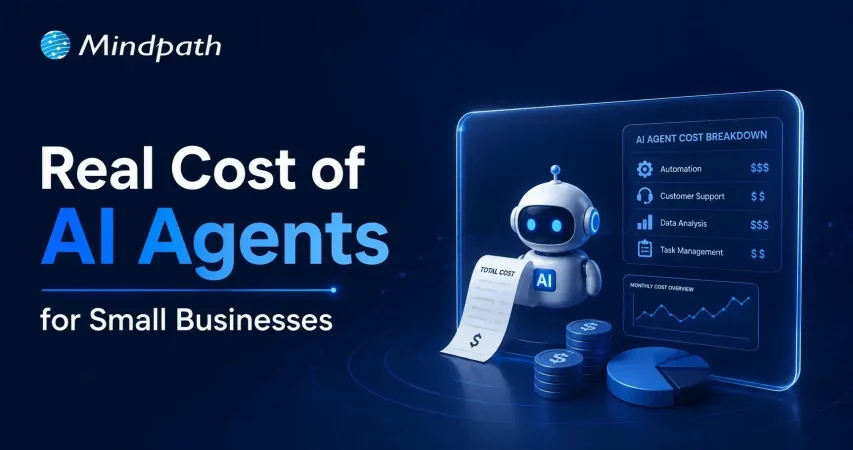
The Real Cost of AI Agents for Small Businesses: A Transparent Breakdown 

Home

The Real Cost of AI Agents for Small Businesses: A Transparent Breakdown 

The Real Cost of AI Agents for Small Businesses: A Transparent Breakdown 

Join our Newsletter!

Cost to build an AI Agent

Small businesses today are watching AI agents handle customer queries, automate workflows, and close sales round the clock. Exciting? Absolutely. But many business owners jump in without truly understanding the cost to build an AI agent. That gap between excitement and reality often leads to budget overruns. So, let’s talk numbers, trade-offs, and what actually goes into building one.

Key Takeaways

  • 01
    The cost to build an AI agent ranges from $3,000 to $50,000 upfront.
  • 02
    Complexity, integration, and data readiness are the biggest cost drivers.
  • 03
    Hidden costs like token bloat and API fees catch most small businesses off guard.
  • 04
    Starting with one narrow task keeps your budget controlled and ROI measurable.
  • 05
    Consistent maintenance and prompt tuning protect your long-term agent investment.

Furthermore, the pricing rarely tells the full story. Vendors show you the entry plan; they rarely show you integration fees, maintenance costs, or what happens when your agent scales. Every layer adds up quietly. In this blog, we break down every real cost involved so you can plan smarter, spend better, and build an AI agent that actually works for your business. So, let us read further and know more!

Looking for a cost-effective way to implement AI? Our AI development services help businesses build scalable AI solutions with measurable ROI.

What Factors Influence the Cost to Build an AI Agent?

Building an AI agent is never one flat price. Implementing an AI agent cost shifts dramatically based on what you need, how complex your workflows are, and which technology stack your team chooses. Several moving parts quietly push the budget up or down. Understanding these factors upfront saves you from nasty surprises later. Let’s break down exactly what drives the cost.

1. Scope and Complexity

Rule-based chatbots follow fixed scripts and cost far less to build. True agentic AI that reasons, plans, and adapts autonomously demands significantly more development effort and budget.

2. Integrations and Tooling

Every external system your agent connects to, such as your CRM, ERP, or payment gateway, adds development time. Giving the agent capabilities like web browsing or database querying also requires rigorous security testing.

3. Data Readiness and Preparation

Unstructured or siloed data needs heavy cleanup before your agent can use it effectively. Setting up vector databases and memory architecture to support long-term recall adds another layer to your AI automation cost.

4. Technology Stack

Your choice between proprietary LLMs, open-source models, and no-code builders directly shapes both upfront and recurring costs. Custom frameworks like LangChain offer more control but require significantly more development time.

5. Security and Compliance

Regulated industries like healthcare and finance carry strict compliance requirements including HIPAA and GDPR. Penetration testing, security audits, and data privacy measures push the AI automation cost noticeably higher.

6. Maintenance and Continuous Training

Launching your agent is only the starting point. Production environments demand ongoing prompt tuning, knowledge updates, and performance monitoring throughout the agent’s entire lifecycle.

What Is the Actual Cost to Build an AI Agent for Small Businesses?

The AI customer service agent cost for small businesses ranges from $3,000 to $50,000 upfront. Monthly maintenance and token fees add $50 to $1,000 more.

1. Cost Breakdown by Agent Type

Costs vary widely depending on complexity and autonomy level. Here is what each tier typically costs small businesses today.

2. Off-the-Shelf Configured Agents: $3,000 – $10,000+

No coding is needed here. You pay for prompt setup, branding, and basic routing configuration.

3. Basic Custom Agents (MVP): $10,000 – $25,000

These agents handle customer support, lead qualification, and simple automation. They connect to your website or one external API.

4. Mid-Level and Internal Agents: $25,000 – $50,000+

These require multi-step planning and deep CRM integration. Human-in-the-loop oversight adds complexity and cost.

5. Ongoing Operational Costs

Building the agent covers only the starting investment. Monthly operational costs keep it running and improving.

6. API and Token Usage: $20 – $500+ Per Month

Usage costs depend on query volume and your chosen LLM. OpenAI, Anthropic, and Gemini all price differently.

7. Cloud Hosting: $50 – $300 Per Month

This covers serverless functions and knowledge base storage. Costs scale as your agent handles more traffic.

8. Maintenance: 15% – 30% of Build Cost Annually

Regular updates, bug fixes, and prompt refinements are essential. Strong ROI of AI agent development depends heavily on consistent maintenance investment.

Hidden Costs of AI Agents Nobody Talks About

1. Agentic Token Bloat

Reasoning loops silently stack up your LLM API charges.

2. AI Drift Maintenance

Changing business rules add 15-20% to annual build costs.

3. System Integration and API Fees

Custom API connections cost $25,000 to $75,000 additionally.

4. Debugging and Monitoring

Silent agent failures waste valuable developer time and money.

How Can Small Businesses Reduce the Cost to Build an AI Agent?

Building an AI agent does not have to drain your budget. Smart planning and the right approach can significantly cut costs without compromising on quality or performance.

1. Leverage No-Code Agent Builders

Skip expensive developer fees with visual drag-and-drop platforms. Non-technical staff can build and integrate agents independently and affordably.

2. Mix Models and Use Open-Source

Avoid paying GPT-4 prices for every routine task. Smaller open-source models like Llama 3 cut token costs significantly.

3. Start With a Single Narrow Task

Target one high-volume process like scheduling or email replies. This keeps your initial AI agent ROI for small businesses measurable and clear.

4. Run in Parallel First

Test your agent alongside existing workflows for four to six weeks. This catches errors before full deployment and protects your investment.

5. Optimize Your Prompt Engineering

Well-structured prompts use fewer tokens and reduce unnecessary back-and-forth. This directly lowers how much does an AI agent cost per month operationally.

Is the Cost to Build an AI Agent Worth It for Your Small Business?

For most small businesses, the answer is yes. The cost to build an AI agent pays back quickly through saved labor, faster response times, and scalable automation. Start small, measure results, and expand only where it genuinely moves your bottom line.

At Mindpath, we provide AI development services tailored specifically for small business budgets and goals. We help you skip the guesswork, avoid hidden costs, and build agents that actually deliver results. Let us help you make the right investment from day one. Contact us today for a free consultation, and discover how the right AI solution can help your business save time, reduce costs, and grow with confidence.
Frequently Asked Questions

Q1. What is a realistic budget to start with when thinking about the cost to build an AI agent?

Starting small is always the smarter move. A basic MVP agent typically costs between $10,000 and $25,000. For tighter budgets, no-code platforms bring that figure down to $3,000. Start narrow, prove value, then scale gradually.

Q2. Can a small business actually afford an AI agent in 2026?

Absolutely, and more businesses are doing it successfully. The key is matching the agent’s complexity to your actual needs. Overspending on features you do not need is the biggest mistake small businesses make early on.

Q3. How long does it take to build and deploy an AI agent?

A basic configured agent can go live within two to four weeks. Custom-built agents with CRM integrations and multi-step workflows typically take two to four months. Planning your data readiness beforehand cuts deployment time significantly.

Q4. Does the cost to build an AI agent include ongoing maintenance?

Rarely upfront. Most vendors quote the build cost only. Maintenance, prompt tuning, and API updates add 15% to 30% of the build cost annually. Always ask for a full lifecycle cost estimate before signing any agreement.

Q5. What is the biggest mistake businesses make when budgeting for an AI agent?

Underestimating hidden costs. Token usage, API integration fees, cloud hosting, and drift maintenance all add up quietly. Many businesses budget only for the build and get caught off guard by operational expenses within the first three months.

Related Post

applications of AI in education

The traditional classroom is rapidly evolving into digital learning spaces, where technologies like AI play a major role in transforming education. Artificial intelligence is changing how educators teach and how students learn in schools, colleges and universities. On top of it, the applications of AI in education have also revolutionized the conventional approaches for managing educational institutions.

Artificial intelligence will not only serve as an invaluable partner for students and educators but also change the traditional perspectives on education. AI can provide opportunities for personalized learning alongside enhancing administrative efficiency. Let us discover some of the top use cases of AI in education with real-world examples.

Planning to use AI to make learning more personalized and efficient? At Mindpath, our AI development services can help you design and deploy smart tools tailored to your educational needs.

Significance of AI for Education

The importance of education for the progress of our society can never be undermined in any circumstance. However, the formidable challenges faced by the education industry create roadblocks for growth. The prominent challenges that call for adoption of artificial intelligence in education include rising administrative burden, shortage of teachers and decline in student performance. Artificial intelligence offers innovative solutions to these problems and serves promising benefits to the education industry.

The uses of artificial intelligence for education can revolutionize the industry while empowering learners and educators. For instance, AI can improve learning outcomes for each student through comprehensive analysis of their strengths, weaknesses and learning styles. AI can help in creating adaptive learning systems that ensure real-time modification of learning resources with the right difficulty level.

AI is also important for education from the perspective of teachers as artificial intelligence can enable automation of administrative tasks such as grading, lesson planning and attendance tracking. The uses of AI in education also focus on the capabilities of AI to analyze large volumes of student data. As a result, AI can enable effective decision making and draw valid conclusions about student performance.

Want to understand the broader education trends driving digital transformation and AI integration? Discover the top emerging trends in education and technology. 

Unraveling the Notable Use Cases of AI for Education

The blend of artificial intelligence and education can indicate the beginning of a new phase for the industry. You can notice different use cases of AI in hospitality, finance or transportation establishing new benchmarks in various areas. Similarly, you can also expect AI to create a revolutionary impact in the education sector. The following use cases of AI along with some real-world examples can help you understand how AI will transform education.

1. Personalized Learning

One of the foremost additions among the use cases of AI in the domain of education focuses on personalized learning. As a matter of fact, it is the most common use of AI in education all over the world. Artificial intelligence can help educators in delivering customized lessons and learning resources to students. On the other hand, students can enjoy the benefits of adaptive learning where educational content adapts to their needs while fostering better understanding and retention of content.

The most prominent example of AI use cases in personalized learning is Knewton. The platform uses AI for personalizing education alongside helping students learn at their own pace and addressing individual learning gaps. Knewton has successfully delivered almost 15 billion personalized recommendations for learners in more than 300 institutions.

2. Intelligent Tutoring Systems

The next notable application of artificial intelligence in the education industry points at intelligent tutoring systems. The primary functionality of these tutoring systems revolves around offering real-time guidance, practice exercises and feedback. Most of the intelligent tutoring systems showcase the convergence between AI and education in innovative ways. Intelligent tutoring systems work by simulating the behavior of a human tutor, offering step-by-step lessons and tracking the performance of learners.

One of the notable examples of intelligent tutoring systems is MATHia by Carnegie Learning. It is an intelligent tutoring system that teaches mathematics to middle and high school students. With the power of AI, the intelligent tutoring platform adapts to different learning paths and offers real-time feedback alongside adjusting lessons to the skill level of learners.

3. Breaking the Language Barrier

If you want to know about the broader implications of artificial intelligence for education, then you must know how AI breaks language barriers. Among the multiple examples of AI used in education, you will find platforms like Duolingo changing global education. You don’t have to struggle for months to learn a new language when you have AI to personalize the learning process.

AI systems can measure your proficiency, learning pace and pronunciation in a specific language. Based on the data obtained for every learner, AI systems can recommend customized lessons, grammar explanation and vocabulary practice. The facility of immediate feedback on grammar and pronunciation can help learners correct their mistakes immediately and learn faster.

4. Automation of the Admission Process

Generative AI systems can use natural language processing to extract accurate insights from application data in seconds. The systems can automate the decision-making processes for admission of new students based on academic performance and past data. The automated admission process is one of the prominent artificial intelligence applications in education as it can help educational institutions find the top talent. AI plays a major role in removing human biases from the admission process thereby ensuring an impartial screening procedure.

The best example of using AI to improve admission processes is Hampshire College, which achieved a 61% increase in enrollment. The college used generative AI tools to predict admission trends and optimized recruitment methods based on meaningful insights. Educational institutions can build more trust with an efficient and transparent admissions process that reduces administrative burden alongside elevating the standards of student selection.

Struggling to understand the real impact of AI in educational decisions? Explore this detailed guide on AI decision-making use cases to see practical examples and insights.

5. Managing Scholarships and Financial Aid

Educational institutions can also rely on artificial intelligence to ensure effective management and distribution of financial aid and scholarships. AI can help in achieving systemic equity and efficiency in the management of financial aid and scholarships. AI systems can ensure faster assessment of financial aid applications with special attention to factors like income level, family history, demographic information, and academic performance.

Machine learning algorithms can ensure significant reduction in human bias and processing time. The automated analysis of scholarship applications through AI systems offers a data-driven approach to the verification process. AI can also handle other tasks, such as discovering qualifying students by comparing their profiles with available funds. Accurate forecasts for financial aid requirements also provide the ideal foundation for proactive budget management.

6. Education Supply Chain Optimization

Most of the discussions about using AI in schools focus on the advantages of personalized learning and reducing administrative burden on educators. On the other hand, you must also know how artificial intelligence has been transforming supply chain management for educational institutions. Generative AI tools can help in automation of the procurement process and streamlining supply chain management.

Proactive AI systems can place orders in advance by forecasting future demand for resources such as textbooks, digital tools and lab equipment. The predictive capabilities of generative AI allow it to ensure accurate adjustments in supply levels. AI systems can also leverage real-time tracking to detect supply chain bottlenecks. The University of Michigan is one of the notable examples of educational institutions embracing AI to improve supply chain management.

Wondering which AI breakthroughs are driving change in education today? Read about emerging generative AI trends and how they are being applied across industries.

7. Smarter Feedback and Assessment

The traditional approaches for assessment might consume more time of educators and students experience delays in receiving feedback. Artificial intelligence can create possibilities for faster and smarter assessment. One of the notable additions among examples of using AI for smarter feedback is Cognii. The virtual learning assistant of Cognii offers real-time feedback for open-ended answers alongside ensuring 96% accuracy in grading essays.

Tools like Cognii utilize natural language processing and machine learning for assessment of grammar, syntax, concept hierarchy and semantics. As a result, teachers don’t have to worry about effectiveness of student performance assessment in different academic tasks. Educators can use the additional time to provide more qualitative feedback to students and address systemic issues to address weaknesses.

8. Enhancing Accessibility of Education

You cannot think of the advantages and disadvantages of AI in education without learning about the impact of AI on accessibility of education. Artificial intelligence can serve as a valuable tool for driving different assistive technologies that can help students. For instance, AI systems can convert written text into voice notes for visually impaired learners. Similarly, AI can also ensure transcription of lecture videos into text thereby helping learners with hearing difficulties.

Microsoft Live is one of the top examples of using AI to remove accessibility barriers in education. It can help with real-time translation of classroom instructions and lectures in the native languages of learners on their devices. As a result, non-native speakers will not face troubles during learning thereby ensuring an inclusive learning environment.

Curious how AI-powered tools are making classrooms more interactive and personalized? Read our in-depth guide on Chatbots in Education to see real-world use cases.

Ready to Transform Education with AI-Driven Innovation?

Artificial intelligence is reshaping education by enabling personalized learning, improving accessibility, and automating administrative tasks. From smarter assessments to adaptive systems, AI empowers educators and students alike, creating efficient, engaging, and data-driven learning experiences that support long-term academic success.

At Mindpath, we offer AI development services designed for the education sector. Our experts build intelligent, scalable solutions that enhance learning experiences, streamline operations, and improve outcomes. Partner with us to implement customized AI tools that drive innovation and deliver measurable educational impact.

AI tools for devops

Artificial Intelligence has certainly surfaced as a transformative force in the DevOps realm. In the current times, DevOps teams and professionals have the opportunity to leverage top Artificial Intelligence tools in order to streamline the software development process while promoting resource optimisation. 61% entities have reported that the adoption of AI in DevOps has significantly boosted their delivery ability.

Both novice and experienced DevOps professionals need to familiarise themselves with the strategic role of AI for the DevOps approach. The insight is crucial to capitalise on the capabilities of AI and strengthen how the DevOps approach is adopted while developing software solutions. Let’s identify some of the major AI tools that are revolutionising DevOps at the moment.

Want to adopt AI in DevOps with full potential? Mindpath’s AI Development Services provide full assistance on how you can select and implement the right tool according to your specific requirements.

Best AI Tools for DevOps Teams

Artificial Intelligence has been gaining high prominence in the DevOps arena. Within a short span of time, diverse AI tools have emerged that have simplified the work of DevOps teams. These tools have immense potential to redefine the DevOps approach.

It is imperative to identify the AI tools for DevOps so that you can simplify diverse processes relating to automation, security, code development and many more. Some of the top AI tools for DevOps professionals include:

1. GitHub Copilot

GitHub Copilot is undoubtedly one of the most popular AI tools for DevOps experts that exists today. It can be used as an extremely useful tool that is powered by Artificial Intelligence, which simplifies coding. It is capable of making suggestions to coders. Moreover, it can also assist coders by providing valuable assistance in entire functions. As a result, by leveraging the specific tool in the DevOps landscape, it is possible for developers to write code in an efficient manner. Furthermore, by leveraging the specific tool, the possibility of making errors is substantially reduced. GitHub Copilot represents a significant step toward the future of AI in software development and DevOps workflows.

2. AWS Codeguru

The popularity of Amazon Codeguru has been skyrocketing in recent times. It serves as a perfect tool that DevOps professionals can use for the purpose of automating code analysis. A highlight of this particular artificial intelligence for DevOps is that it is capable of making intelligent recommendations relating to code reviews. Coders and software developers can also rely on the specific tool to gain insightful suggestions relating to the performance of applications. With the help of this top-grade AI tool, DevOps teams can locate issues and improve the quality of their code, and fully leverage the benefits of AI in their development workflows.

3. Datadog

Datadog is a popular AI-driven platform that simplifies the processes for development teams. It is certainly among the top DevOps for business tools that can be used for diverse purposes such as monitoring, security, and performance. This tool offers rich insights to DevOps teams in terms of the behaviour of the software application and the overall health of the infrastructure. It certainly serves as a holistic tool that can offer observability power in an end-to-end manner to DevOps teams. You can definitely capitalise on this tool to achieve goals relating to real-time observability, unified monitoring, and troubleshooting.

4. Splunk

Splunk has gained a solid reputation in the DevOps scene of the current times. It acts as a robust data analytics and monitoring platform that can be used by DevOps teams. By choosing the specific AI-based tool, you can get complete visibility across the full software development lifecycle. In case you have limited familiarity with the particular tool, you can consider partnering with top providers of DevOps services. DevOps teams can leverage Splunk for diverse purposes, including monitoring of performance, event and log monitoring.

5. Sysdig

Sysdig serves as one of the most comprehensive DevOps platforms available for software developers at present. It has been specifically designed for diverse purposes such as monitoring and security in containerised environments. A chief highlight of the tool is that it integrates operations along with top security and offers unified control and visibility to teams. Thus, throughout the software development lifecycle, DevOps professionals can have a solid insight into the process. Moreover, you can rest assured about compliance and monitoring aspects by utilising the tool.

Trying to keep up with the rapidly evolving DevOps landscape as we move into 2026? Explore the latest DevOps trends shaping modern development, automation, and AI-driven workflows.

6. Dynatrace

In the contemporary DevOps landscape, the Dynatrace tool has been playing a cardinal role. It acts as an ideal observability platform that can be leveraged by DevOps teams while developing top-notch software applications. You can take advantage of this app to simplify processes relating to monitoring, collaboration, and automation. Furthermore, Dynatrace offers a broad range of tools that can create value for you relating to resilience engineering, release validation, and automated remediation of problems. The powerful capabilities of the AI tool can empower your DevOps team while developing novel software solutions.

7. Ansible

Ansible is a popular open source automation tool that streamlines DevOps practices for professionals. This tool is primarily used for the purpose of streamlining as well as automating a broad range of IT tasks and processes. It significantly contributes to the DevOps process by focusing on areas such as configuration management, deployment of applications, and the provisioning of infrastructure. Moreover, DevOps teams can leverage the AI-based tool to perform orchestration. This is because Ansible facilitates the orchestration of complex workflows and supports the coordination of multiple tasks.

8. Harness

In the current DevOps realm, Harness has emerged as a holistic software delivery platform., By using the specific tool, your DevOps team can automate the full software development process. Therefore, starting from continuous integration and continuous delivery, you can automate ongoing tracking of errors. Harness has been recognised as one of the most useful tools for DevOps professionals. With the help of the AI tool, your DevOps team can certainly accelerate the software development process and minimize the possibilities of errors and mistakes.

9. Argo CD

In recent times, Argo CD has surfaced as a popular AI tool that can be used by DevOps professionals. It is basically a declarative continuous delivery tool. By using the tool, it is possible for DevOps teams to automate the management as well as the deployment of software apps within Kubernetes clusters. The fact that it is open source in nature enables DevOps teams to use it in a highly versatile and flexible manner. The specific tool offers a broad range of features to users, such as single sign-on integration, multi-cluster management, and many more.

10. Snyk

While adopting the DevOps approach to develop software solutions, one cannot ignore the security aspect. This is when the Snyk tool comes into the picture. Snyk is a developer-first platform that incorporates security elements into the software development process. You can utilize this specific AI tool in your DevOps process for scanning vulnerabilities in code, containers and open-source dependencies. This tool is well-suited for diverse DevOps teams since it perfectly integrates with various elements, such as developer workflow, as well as cloud platforms. You can leverage the tool since it offers actionable insights that can enhance the overall quality of your software solution.

Looking to overcome DevOps hurdles such as security risks, and scalability issues? Discover DevOps challenges and solutions that help organizations overcome these issues and improve operational efficiency.

Benefits of AI Tools in DevOps

The use of AI tools in DevOps processes can give rise to a host of benefits for DevOps teams. Some of the major benefits that you must be aware of include:

1. Better reliability

DevOps teams can leverage AI capabilities to create highly reliable software solutions. This is mainly possible by making use of the predictive analysis function of AI technology.

2. Faster Software creation process

Software development can be quite time-consuming. However, by leveraging AI tools, it is possible to automate diverse processes. It can ultimately speed up the software development process for teams.

3. Proactive resolution of issues

Issues can act as major bottlenecks while developing software applications. With the help of the right AI tools, it is possible for DevOps teams to proactively deal with issues. Therefore, the overall quality of the software solution can also improve.

4. Improved collaboration

By using AI tools or generative AI tools for DevOps, it is possible for professionals to enhance collaboration. Collaboration can certainly open up new and better opportunities that can strengthen the overall process relating to the development of software solutions.

Want to learn how DevOps can transform your business and accelerate your development processes? Discover the benefits of DevOps for a deeper understanding of its impact and value.

Final Words

In the dynamic DevOps arena, the use of artificial intelligence tools is considered to be a necessity. DevOps teams need to be aware of the top tools so that they can strategically use them while creating software solutions. The selection of the right kinds of tools can certainly streamline the software development processes for you. Some of the top tools that you must be aware of include GitHub Copilot, AWS Codeguru, Datadog, Splunk, Sysdig, etc.

We at Mindpath help businesses to make the most of the top AI tools for DevOps with our AI Development Services. Our professionals ensure that the perfect AI tools are chosen that are in line with your DevOps processes. Moreover, you can see how intelligent DevOps can strengthen the quality of your software solutions.

Support Is One Click Away

Featured Posts

Related Post

Discover the key factors influencing software development costs and how to optimize your budget. Learn how Mindpath can help.
Explore how digital transformation reshapes businesses, boosts efficiency, enhances customer experiences, and drives sustainable growth for success.