Home

AI for Procurement: 10 Use Cases from Sourcing to Spend Analysis

AI for Procurement: 10 Use Cases from Sourcing to Spend Analysis

Join our Newsletter!

AI for procurement

Traditional procurement often involves fragmented supplier data, lengthy approval cycles, manual paperwork, and limited spending visibility. These inefficiencies can increase operational costs and slow business decisions. AI for procurement is changing how organizations manage these activities by bringing automation, predictive insights, and intelligent data analysis into everyday procurement operations.

Key Takeaway

  • 01
    AI helps procurement teams automate repetitive tasks and make faster purchasing decisions.
  • 02
    Intelligent supplier discovery and bid comparison improve sourcing efficiency and supplier selection.
  • 03
    AI-powered contract analysis helps identify compliance issues and important contractual terms.
  • 04
    Spend analysis AI reveals spending patterns, unusual expenses, and potential cost-saving opportunities.
  • 05
    Predictive analytics helps businesses manage supplier risks and anticipate supply chain disruptions.

As supply chains become increasingly complex, businesses need faster ways to evaluate suppliers, control spending, and manage procurement risks. AI helps procurement teams make informed decisions while reducing repetitive work and improving operational efficiency. In this blog, we’ll explore what AI for procurement means, its key benefits, and 10 practical use cases across the procurement lifecycle.

Ready to Make Procurement Smarter?

Mindpath offers AI consulting services to help businesses develop AI-powered solutions tailored to their operational needs.

What Is AI for Procurement?

AI for procurement refers to the use of artificial intelligence to automate purchasing activities, analyze supplier data, and support procurement decisions. It combines technologies such as machine learning, natural language processing, predictive analytics, and generative AI to help teams manage procurement tasks more efficiently.

Key applications include:

  • Machine learning: Identifies spending patterns, evaluates supplier performance, and predicts potential supply chain risks.
  • Natural language processing: Extracts key details from contracts, supplier documents, invoices, and purchase requests.
  • Predictive analytics: Forecasts demand, estimates price fluctuations, and identifies potential procurement disruptions.
  • Generative AI: Summarizes contracts, answers procurement queries, and assists with supplier communications.
  • Intelligent automation: Processes purchase orders, validates invoices, and reduces repetitive administrative work.

Unlike traditional rule-based automation, AI can identify patterns across large datasets and support decisions that require contextual analysis. When integrated with existing procurement and ERP systems, it helps connect sourcing, purchasing, contract management, and spend analysis within a more informed workflow.

Key Benefits of AI in Procurement

AI helps procurement teams improve efficiency, control spending, and make informed purchasing decisions. By reducing manual work and analyzing procurement data, businesses can gain better control over their purchasing operations.

1. Better cost control

Identify unnecessary expenses, compare supplier pricing, and uncover opportunities to reduce purchasing costs.

2. Faster sourcing decisions

Use AI in sourcing to identify suitable suppliers, evaluate bids, and compare supplier capabilities more efficiently.

3. Reduced manual workload

Automate repetitive activities such as purchase order processing, invoice matching, and document verification.

4. Improved supplier management

Evaluate supplier performance, monitor delivery reliability, and identify potential risks before they affect operations.

5. Greater spending visibility

Apply spend analysis AI to categorize expenses, identify spending patterns, and highlight potential savings opportunities.

6. Stronger compliance

Monitor purchasing activities, check contract requirements, and flag transactions that may violate procurement policies.

7. Proactive risk management

Analyze supplier data and market conditions to anticipate disruptions and support timely decisions.

10 Practical Use Cases of AI in Procurement

AI is changing how businesses manage procurement activities, from identifying suppliers to monitoring spending and managing supply chain risks. The following use cases show how organizations can apply AI to improve efficiency, accuracy, and purchasing decisions.

1. Intelligent Supplier Discovery

Finding reliable suppliers requires evaluating multiple factors, including pricing, product quality, certifications, and delivery capabilities. AI analyzes supplier databases, market information, and historical records to identify potential vendors that match business requirements.

  • Supplier identification: Find suitable suppliers based on purchasing requirements and capabilities.
  • Market analysis: Compare supplier pricing, availability, and market trends.
  • Capability assessment: Evaluate certifications, delivery history, and supplier performance.

2. Automated Bid Comparison

Comparing multiple supplier quotations manually can delay sourcing decisions, especially when proposals contain different pricing structures and contract terms. AI extracts relevant details and presents them in a consistent format, helping procurement teams evaluate bids more efficiently.

  • Price comparison: Identify differences in product costs, discounts, and additional charges.
  • Term evaluation: Compare delivery schedules, payment conditions, and contract requirements.
  • Bid assessment: Highlight pricing inconsistencies and missing information across supplier proposals.

3. Predictive Supplier Risk Assessment

Supplier-related risks can affect production schedules, product availability, and procurement costs. AI evaluates financial records, delivery performance, market developments, and external risk indicators to identify potential problems before they disrupt business operations.

  • Financial monitoring: Identify signs of supplier financial instability.
  • Delivery tracking: Detect recurring delays and inconsistent fulfillment patterns.
  • Risk alerts: Flag potential disruptions based on changing market and supplier conditions.

4. AI-Powered Contract Analysis

Procurement contracts often contain lengthy clauses, compliance requirements, renewal conditions, and pricing agreements. AI for procurement helps teams review these documents by extracting important information, summarizing terms, and identifying clauses that require further attention.

  • Clause extraction: Identify payment terms, renewal dates, penalties, and obligations.
  • Compliance checks: Flag clauses that may conflict with internal procurement policies.
  • Contract summaries: Generate concise summaries to support faster reviews and approvals.

5. Automated Purchase Order Processing

Creating and processing purchase orders involves repetitive data entry, verification, and approval activities. AI automates several steps by extracting information from purchase requests, checking order details, and identifying missing or inconsistent information.

  • Data extraction: Capture product details, quantities, prices, and supplier information.
  • Order validation: Check purchase requests against predefined procurement rules.
  • Approval support: Route purchase orders to the appropriate personnel for authorization.

6. Intelligent Invoice Matching and Reconciliation

Matching invoices with purchase orders and delivery records can consume significant time, particularly when businesses process large transaction volumes. AI compares these records, identifies discrepancies, and helps finance teams resolve payment-related issues.

  • Invoice matching: Compare invoice details with purchase orders and delivery records.
  • Discrepancy detection: Flag differences in quantities, pricing, and payment amounts.
  • Duplicate identification: Detect repeated invoices before payments are processed.

7. AI-Powered Spend Analysis

Understanding where procurement budgets go is essential for controlling expenses and identifying savings opportunities. Spend analysis AI examines purchasing transactions, categorizes expenses, and identifies patterns that may remain difficult to detect through manual reporting.

  • Spend categorization: Group transactions by supplier, department, category, or business unit.
  • Anomaly detection: Identify unusual spending patterns and unexpected cost increases.
  • Savings identification: Highlight duplicate purchases, excessive spending, and opportunities for supplier consolidation.
  • Spending forecasts: Analyze historical purchasing data to estimate future expenditure.

8. Automated Vendor Onboarding

Bringing new suppliers into a procurement system requires collecting documents, verifying business details, and checking compliance requirements. AI simplifies this process by extracting information, validating submitted records, and identifying incomplete applications.

  • Document verification: Extract details from tax records, certifications, and registration documents.
  • Information validation: Identify missing or inconsistent supplier information.
  • Compliance screening: Flag records requiring additional checks before supplier approval.

9. Supply Chain Disruption Prediction

Unexpected supply chain disruptions can affect inventory availability, delivery schedules, and business continuity. AI analyzes internal and external data to identify early warning signals and help procurement teams prepare alternative sourcing plans.

  • Market monitoring: Track commodity prices, geopolitical developments, and market changes.
  • Disruption forecasting: Identify potential delays using supplier and logistics data.
  • Alternative sourcing: Help teams evaluate backup suppliers and procurement options.

10. Supplier Performance and Sustainability Monitoring

Supplier evaluation needs to continue after onboarding to ensure consistent quality, reliable deliveries, and responsible business practices. AI monitors supplier performance data and sustainability indicators to support ongoing evaluations.

  • Performance tracking: Monitor delivery timelines, product quality, and order fulfillment.
  • ESG monitoring: Evaluate available environmental, social, and governance information.
  • Supplier scoring: Compare vendors using performance metrics and predefined business criteria.
  • Continuous alerts: Identify declining performance and potential compliance concerns.

How to Choose the Right AI Procurement Tools?

Selecting the right technology is important for getting measurable value from procurement automation. Businesses should evaluate their existing processes, data requirements, and operational goals before investing in AI procurement tools.

Consider these factors when evaluating available options:

1. Integration capabilities

Check compatibility with existing ERP, accounting, inventory, and supplier management systems.

2. Automation features

Look for capabilities such as invoice processing, contract analysis, supplier evaluation, and purchase order automation.

3. Data security

Evaluate encryption, access controls, data privacy policies, and compliance requirements.

4. Analytics and reporting

Choose tools that provide spending insights, supplier performance reports, and predictive analytics.

5. Scalability

Ensure the platform can handle growing transaction volumes, additional suppliers, and changing procurement requirements.

6. Ease of adoption

Consider user-friendly interfaces, employee training requirements, and the level of technical support available.

7. Customization

Check whether workflows, approval rules, and reporting features can be adapted to business requirements.

The right selection should address specific procurement challenges while fitting existing workflows and supporting future business growth.

Ready to Transform Your Procurement Operations with AI?

AI for procurement helps businesses improve sourcing, strengthen supplier relationships, automate routine tasks, and gain better spending visibility. From supplier discovery to spend analysis, these applications support faster decisions, better cost control, and more efficient procurement operations across the business.

At Mindpath, we help businesses develop AI-powered solutions through AI consulting, custom AI development, and intelligent automation services. Our team builds tailored solutions that align with procurement workflows, improve operational efficiency, and support long-term business goals.
Ready to Make Procurement Smarter?

Automate procurement workflows and improve purchasing decisions with AI-powered solutions.

Frequently Asked Questions

It provides insights into supplier performance, purchasing patterns, market conditions, and spending trends, helping procurement leaders make informed decisions.
Yes. AI compares supplier quotations, analyzes historical pricing, and highlights contract terms that procurement teams can use during negotiations.
Standardize supplier records, remove duplicate entries, correct inconsistent transaction details, and integrate reliable data sources before implementation.
No. AI handles repetitive analysis and administrative tasks, while procurement professionals oversee negotiations, approvals, supplier relationships, and strategic decisions.
Start with repetitive, data-intensive activities such as invoice matching, purchase order processing, supplier document verification, and spend categorization.

Support Is One Click Away

Featured Posts

Related Post

legacy modernization

Technology is a high-paced thing, and companies are under pressure to keep up with it. Legacy Modernization has come to be a serious agenda among companies that currently use the old systems to conduct their daily operations. You may find that the performance is slowing down, maintenance costs are increasing, and security threats are increasing yearly. All these problems cause tension amongst teams and restrict innovation. Then, what actually happens when the old systems are retarding progress? And how do companies get back in control without derailing the fundamental processes?

Meanwhile, leaders desire systems that can enable development, flexibility, and more intelligent decision-making. Their goals are to enhance performance besides safeguarding the vital data and business logic. Such an equilibrium needs a good technical direction and strategy. Thus, it is critical to comprehend the acceptable strategy to achieve success in the long term. This blog will discuss all the major points of legacy modernization step by step.

Ready to move beyond outdated systems that slow down your business? Mindpath offers legacy modernization services to help you upgrade and transform legacy applications into scalable and future-ready solutions.

What is Legacy Modernization?

Legacy modernization is the strategic process of updating, re-architecting, or replacing outdated software systems to align with modern technology capabilities, security standards, and business objectives. It improves performance, security, and scalability while preserving core business logic. Businesses rely on it to remain competitive, reduce technical debt, and drive growth transforming aging systems into scalable, agile, and cost-effective solutions without disrupting day-to-day operations.

However, legacy system modernization goes beyond technical upgrades. Companies need to reconsider procedures, user experience and long term objectives. They enhance efficiency, mitigate risk and facilitate innovativeness with strategic change. An effective modernization strategy puts technology into business performance and establishes a platform to achieve the long-term digital development.

Why is Legacy Modernization Important?

Outdated systems slow progress and increase risk. The modernization of legacy applications helps businesses improve performance, security, and flexibility. Here are some of its key benefits:

1. Legacy modernization reduces high maintenance and infrastructure costs. It also reduces the reliance on the old systems and costly specialists support.

2. It enhances the rate of speed and general dependability of the system. Teams are also able to update at a higher pace and handle changes with ease.

3. It enhances security because it eliminates the risks associated with outdated software. Organizations remain updated on new compliance standards and regulations as well.

4. It improves agility and promotes inter-team innovation. Companies are able to introduce new functionality in a shorter time and react to the needs of the market.

5. Contemporary systems can easily manage increasing traffic and information. They are also compatible with cloud computing and other sophisticated analytics solutions.

6. It improves user experience by making the user interfaces and performance cleaner. There is a greater work efficiency and confidence among the employees when using the system.

Curious about the best way to transition from legacy systems to modern platforms? Check out our legacy modernization roadmap blog to uncover proven steps and strategies.

How to Modernize Legacy Applications?

Organizations must take a clear and strategic approach to legacy modernization to avoid disruption and control risk. A structured plan helps teams upgrade systems efficiently while supporting business goals and future growth.

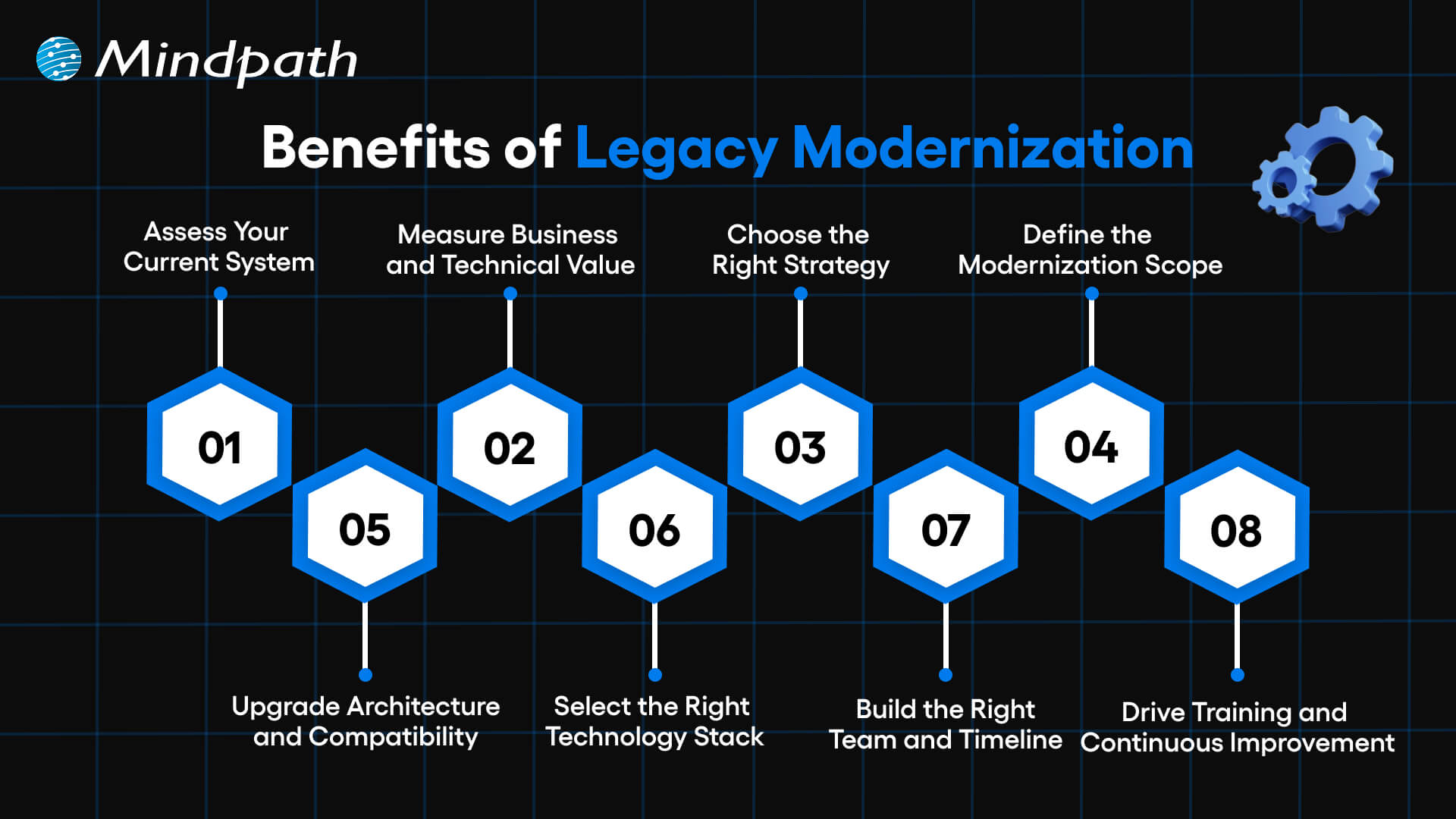
benefits of legacy modernization

1. Assess Your Current System

Evaluate your applications both business and IT. Determine deficiencies in performance, security and scalability. This step builds a strong base for legacy modernization decisions.

2. Measure Business and Technical Value

Assess business fit, agility, cost, complexity and risk. Know the amount of value each system brings in the present day. Clear insights strengthen your legacy app modernization strategy.

3. Choose the Right Strategy

Select a legacy modernization approach that aligns with business goals. Compare such options as rehost, refactor, rebuild or replace. Take the course of action that brings more quickly and reduces the risk.

4. Define the Modernization Scope

Target key points that lead to business performance. Eliminate the old and unwanted functions that complicate things. A clear scope helps teams modernize legacy applications with confidence.

5. Upgrade Architecture and Compatibility

Use scalable architecture when needed e.g. microservices. Enhance dynamism and streamline administration of the system. Enhance seamless integration with other tools/ platforms.

6. Select the Right Technology Stack

Select technologies that will be able to accommodate existing needs and expand in the future. Never act on your judgment without consulting experts. Good testing will guarantee effectiveness, protection and dependability.

7. Build the Right Team and Timeline

Create a cross functional team with established responsibilities and ownership. Develop and maintain documentation. Set realistic milestones to guide legacy modernization progress.

8. Drive Training and Continuous Improvement

Train the staff on effective use of the new system. Onboarding is encouraged by means of structured support. Continuous updates keep legacy modernization relevant and sustainable.

Want to align your legacy systems with your long-term business goals? Explore the legacy modernization strategy for business growth to build a result-driven transformation plan.

Key Challenges in Legacy Modernization

There are some valid advantages of legacy modernization, but it also possesses actual challenges. During the transition, organizations have to be ready to overcome technical, financial, and operational challenges.

1. Complex Legacy Code

Systems are difficult to comprehend and expand due to old-fashioned code and lack of documentation. Such complexity slows the development and raises its maintenance costs.

2. Integration Barriers

The old systems also fail to make connections with cloud providers and new APIs. Architecture reengineering will require teams to be mindful of downtime and the gaps in security.

3. Security and Compliance Gaps

The existing security and regulations are not met in aging systems. It is necessary that Legacy Modernization involves proactive protocols, encryption, and compliance control updates.

4. High Costs and Limited Resources

Modernization demands investment in equipment, education, and infrastructures. Lack of a proper roadmap will increase costs and strain internal resources.

5. User Resistance to Change

Employees tend to be at ease with the well-known systems. Good communication, training will enable teams to adjust to Legacy Modernization programs.

6. Performance and Scalability Limits

Old applications are unsuitable to meet the increasing data and user requirements. Legacy Modernization enhances speed, stability, as well as long term scalability.

7. Knowledge and Skill Gaps

It may be challenging to locate professionals with knowledge of old technologies. Lack of experience will put risks and time delays at a higher level and make the project more complex.

8. Data Migration Risks

Migration of mass volumes of old data can result in loss, corruption or compatibility problems. There has to be audits, backups and testing of data to ensure data integrity in Legacy Modernization.

Planning to integrate AI into your legacy infrastructure for better decision-making? Learn about AI-driven legacy system modernization to transform your systems intelligently.

8 Legacy Modernization Strategies for Modern Businesses

Companies must have a strategy in place when modernizing old systems. The right legacy modernization strategies assist in decreasing risk and faster business worth.

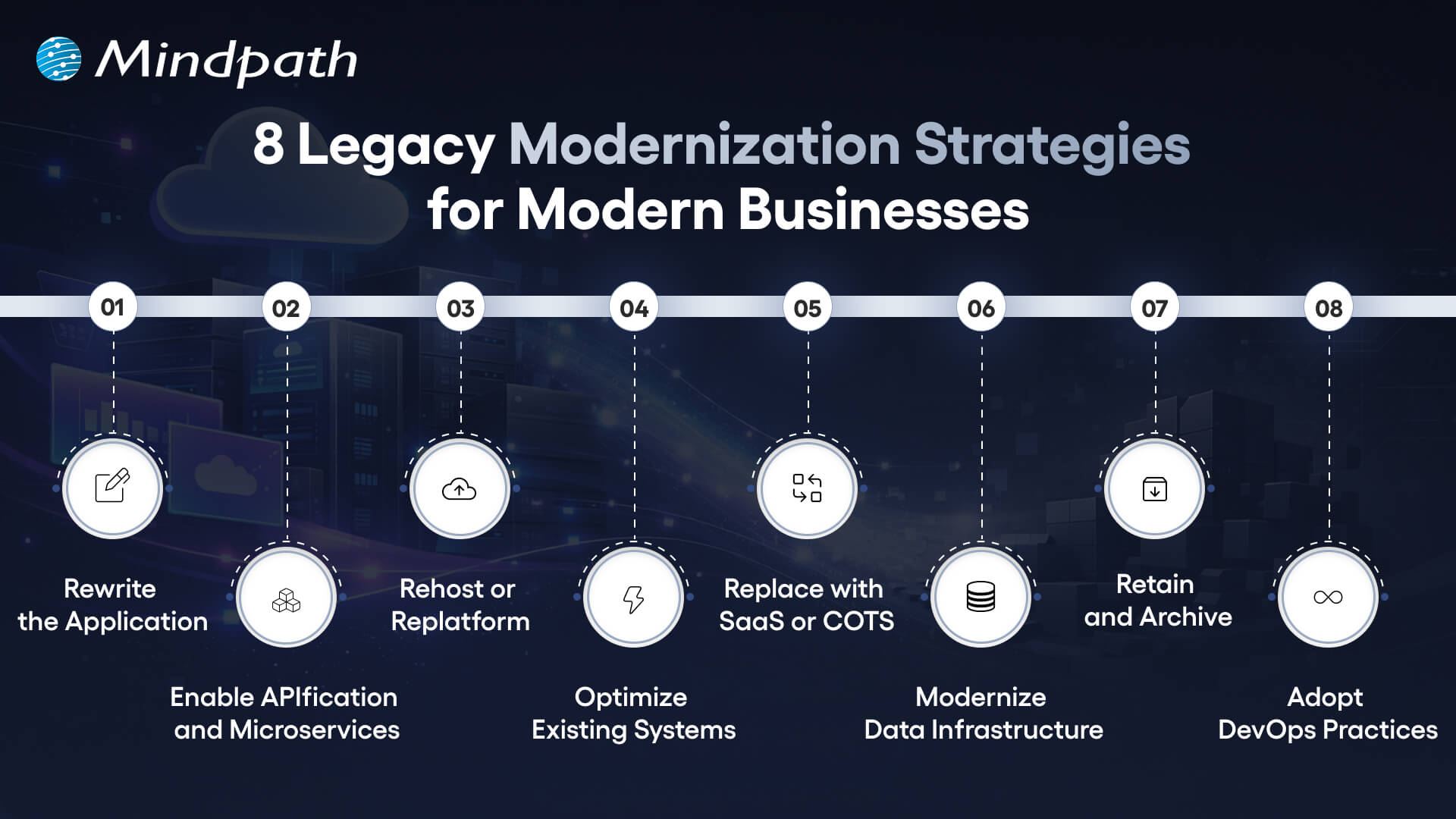
8 legacy modernization strategies for modern businesses

1. Rewrite the Application

Rewrite the old systems using new languages. This strategy will modernize the application and enhance quicker updates. It also reduces the long term maintenance.

2. Enable APIfication and Microservices

Divide monolithic systems into small services. APIs can be used to better integrate them. Innovation is accelerated through this model.

3. Rehost or Replat form

Migration to the cloud with minimal code modification. It is a move that minimizes infrastructure expenses within a very short time. The teams enhance scalability without causing much disturbance.

4. Optimize Existing Systems

Check the workloads as well as code performance gaps. Minimize the usage of infrastructure and operations expenditures. Utilize savings to finance additional upgrades.

5. Replace with SaaS or COTS

Use pre-made platforms that will satisfy business requirements. Accomplish security and compliance. Implement solutions in a shorter time and with reduced risk.

6. Modernize Data Infrastructure

Move the old databases to scaled systems. Enhance the speed, analytics, and flexibility. This step should be aligned to Legacy Modernization.

7. Retain and Archive

Retain those systems that retain the necessary value. Audits of applications that are rarely used in the archive. Unnecessary changes and risks should be avoided.

8. Adopt DevOps Practices

Implement continuous integration and testing. Publishing is faster and teamwork becomes better. Enhance the performance and stability of the systems.

Planning to enhance your modernization efforts with better automation and continuous delivery? Discover DevOps best practices to build a more agile and scalable transformation process.

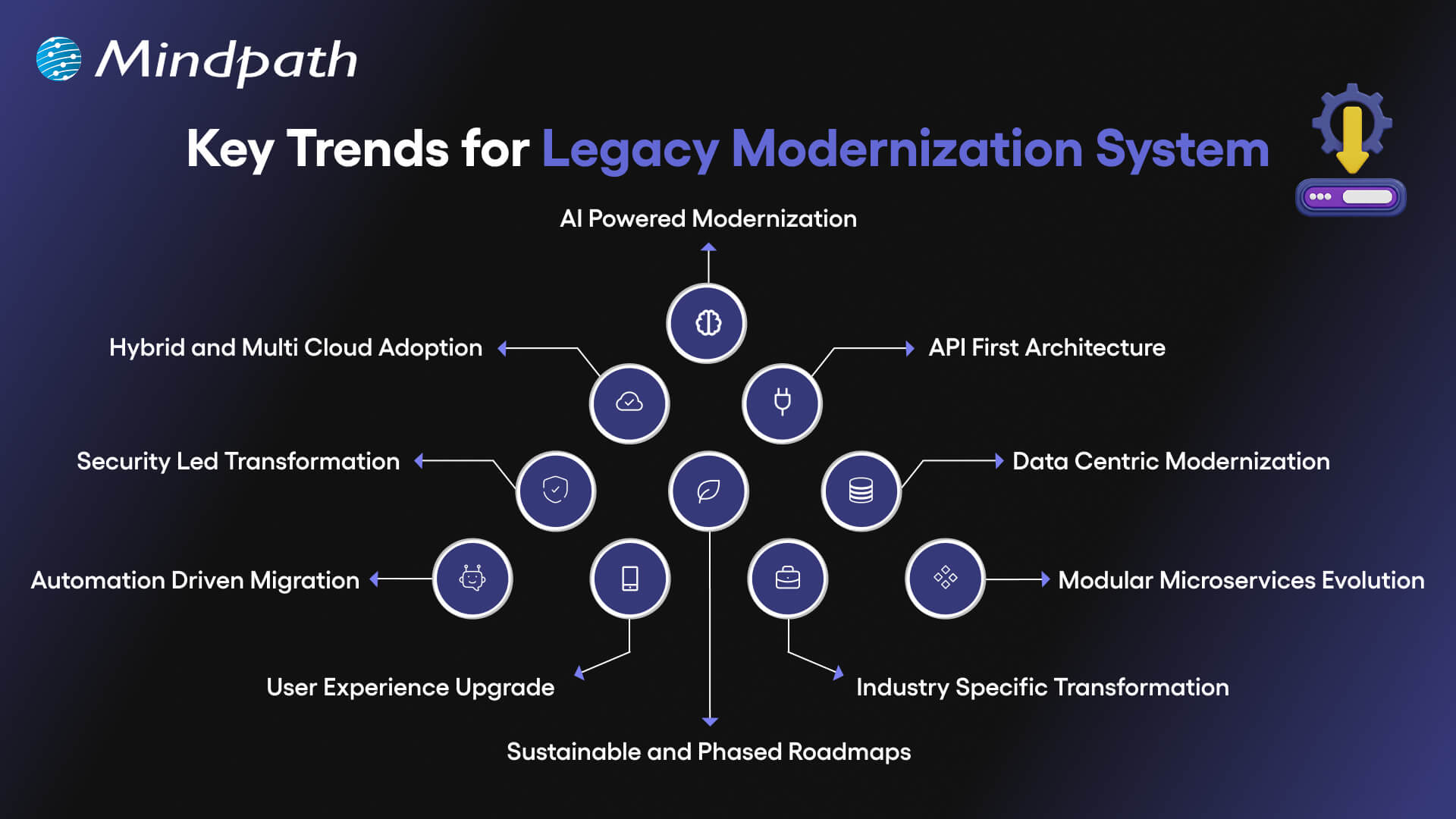
Key Trends for Legacy Modernization System

Organizations are still redefining their technology environment to remain competitive. The modernization trends point to the new directions that lead to faster, smarter and more scalable transformation.

key trends for legacy modernization system

1. AI Powered Modernization

Code refactoring, re-architecture and system analysis are now assisted by AI. According to legacy modernization trends, many enterprises spend lots of money in AI. It enhances preciseness, less threat, and accelerates change.

2. Hybrid and Multi Cloud Adoption

Organizations have stopped relying on one cloud provider. They operate hybrid and multi cloud environments to be flexible and resilient. Container platforms assist systems to operate efficiently in environments.

3. API First Architecture

Enterprises substitute monolithic models with modular API based models. The APIs enhance integrations, scalability, and expedited feature upgrade. The change holds its ground in the contemporary legacy modernization patterns.

4. Security Led Transformation

The presence of stringent rules encourages companies to advance the old security checks. Zero trust models, encryption, and enhanced access management are implemented in teams. Every modernization roadmap is currently being influenced by security.

5. Data Centric Modernization

Isolated data warehouses are sent to unified lake house platforms by businesses. This measure enhances real-time understanding and information controls. Powerful data strategy is a key to successful legacy software modernization.

Curious about how AI can reduce costs and improve system capabilities? Check out the benefits of AI to transform your business operations.

6. Automation Driven Migration

Code scanning, risk detection, and recommendation are processes performed by AI-based tools. Jurisdictional testing and documentation lowers the manual work involved. These applications reduce migration time.

7. Modular Microservices Evolution

Businesses upgrade microservices using containers and orchestration technology. AI assists in tracking and optimization of working loads. This will enhance system stability and scalability.

8. User Experience Upgrade

The future UX concentrates on customization, usability, and functionality. Component based design models substitute strict legacy interfaces. These enhancements are in line with wider patterns of legacy modernization.

9. Industry Specific Transformation

Banks, healthcare providers, and manufacturers need individual solutions. Modern systems are now able to comply with strict industry rules. A strong legacy modernization framework supports niche requirements effectively.

10. Sustainable and Phased Roadmaps

Companies are ready to upgrade slowly than to rewrite everything. Planned phase will guarantee the sustainability of long term and reduce disruption. This approach makes modernization anticipative and expandable.

Want to make your legacy modernization efforts more environmentally responsible? Explore sustainable technology to build eco-friendly and future-ready systems.

Examples of Legacy Systems

Several organizations are still using the old systems to execute important activities. These are the legacy systems that are still in use and support day-to-day processes in spite of low adaptability and scalability.

1. Cloud Enablement in Financial Services

To enhance scaling and reporting, a fintech company has transferred the core systems to the cloud. This legacy modernization decreased manual labor and increased reliability.

2. Clinical Platform Enhancement

A microservices-based upgrade of an oncology system to speed up its performance. The transformations enhanced integration and helped to make medical decisions faster.

3. High-Performance Trading Systems

Microservices and automated deployments were embraced in a trading platform. This legacy modernization enabled speed and increased volume of transactions.

4. Digital Leasing Transformation

One leasing system upgraded its infrastructure to initiate operations more quickly. The upgrade made the operations less complex and efficient.

5. Smart Assessment Innovation

One of the education platforms presented AI-based grading tools. The educators used to save some time and received more rapid performance feedback.

6. Scalable K-12 Learning Infrastructure

One school system optimized its cloud environment to its maximum. The upgrade also enhanced the uptime and made the learning process stable.

Wondering how to connect legacy modernization with broader business goals? Explore about digital transformation for business to align technology with strategic growth.

Ready to Future Proof Your Business?

Legacy systems limit growth, increase risk, and slow innovation. Organizations that invest in legacy modernization improve performance, security, and scalability while reducing long term costs. A clear strategy helps teams modernize in phases and avoid disruption. With the right approach, businesses build flexible systems that support innovation, improve user experience, and create lasting competitive advantage in a fast changing digital market.

Mindpath stands as a trusted legacy modernization service provider delivering practical and scalable solutions. Our team assesses existing systems, defines a clear roadmap, and executes modernization with minimal disruption. We focus on performance, security, and cloud readiness to create measurable business value. With proven expertise and strong technology partnerships, Mindpath helps enterprises modernize confidently and achieve sustainable digital growth.

AI in Education
Have you ever wondered about how AI is revolutionizing education? How can AI make lessons more personalized for each student? What can be the benefits of implementing AI in education? If you are intrigued by these questions, you have arrived at the right place. In this blog, we are going to explore the key benefits as well as the use cases of AI in education.   The education system has changed from the traditional classroom setup. We are no longer limited to a physical room full of books and a blackboard to learn. Nowadays, education is easily accessible and flexible, with personalization at the tip of our fingers as AI is changing the education sector by offering tailored, adaptive learning experiences. It is making learning inclusive, supporting teachers in their tasks, and personalizing learning for everyone. This technology is going to turn conventional models of education and offer more personalized support to students in accordance with their needs, learning styles, and abilities.   Let us dive deep to explore the key benefits as well as the use cases of Artificial Intelligence in education! 

Benefits of AI in Education

1. Customized Learning

The greatest advantage of AI in education is that it offers personalized learning. With AI, learning becomes much more likely to be tailored to each student’s needs. If one student is weak in reading, AI can provide extra support by way of practice and activities. At the same time, another student who excels in reading can be given more challenging materials to engage their interest. This way, each student is presented with material that suits their levels best, making their work more effective and enjoyable. 

2. Expanded Accessibility and Inclusion

AI is overcoming distance and physical limitations in education. Students in remote places or with physical constraints may now access high-quality educational resources using AI-powered solutions such as virtual instructors, interactive course materials, and language translation services. This technology contributes to a more inclusive educational environment in which all students, regardless of location, have equal opportunities to learn and develop. 

3. Adaptive Assessments and Feedback

AI improves evaluations by employing exams, assignments, and even analyzing pupils’ facial expressions or posture to measure their development. This enables rapid feedback, indicating exactly where a learner requires further assistance and giving resources that will help them understand. This strategy not only improves academic achievement, but it also promotes students’ general well-being and trust regarding their learning journey. 

4. Streamlined Administrative Tasks

AI is excellent at both creating personalized teaching and performing administrative work. It can handle student information, organize lessons, and grade multiple-choice tests. This automation allows teachers to devote more time to what is most important: crafting interesting classes, developing strong connections with students, and providing useful feedback. 

5. Enhanced Student Engagement

AI is altering student engagement by offering fascinating new ways to study. Gamification, interactive simulations, and personalized learning plans provide students with dynamic educational experiences. Tools such as interactive classrooms and immersive platforms make learning more fun, allowing students to engage with one another and enthusiastically explore new topics. 

Use-cases of AI in Education

1. Advanced Tutoring Systems

Tutoring programs driven by AI provide pupils individualized support. As students work in classes, AI examines their responses, identifies areas where they may be suffering, and provides personalized explanations to make things simpler. This manner, the learning tempo is tailored to each student’s needs. These systems improve students’ understanding of difficult topics by providing rapid support and a learning style that is tailored to each learner. The continual contact with AI improves learning outcomes and raises students’ confidence and performance. 

2. Automated Grading and Evaluation

Grading is made easier by artificial intelligence, which evaluates student work rapidly and uniformly. This minimizes instructors’ burden, allowing them to focus on providing personalized help. By detecting patterns in pupil performance, AI can identify individuals who require further support and direct focused assistance. Additionally, AI delivers quick feedback, which improves the learning process. Automated grading and assessment improve teaching quality, assure fair assessments, and foster interaction among students and teachers. 

3. AI-Powered Chatbots and Assistants

AI-powered chatbots and virtual assistants play an important role in improving students’ educational experiences. They offer immediate assistance by walking students through assignments, answering problems, and providing comments. These resources are available 24 hours a day, seven days a week, and satisfy the demands of students at any time. Their personalized guidance promotes autonomous learning and helps students actively participate in their studies, hence enhancing academic progress and achievement. 

4. Educational Entertainment and Gamification

Edutainment and gamification make learning more enjoyable and engaging by incorporating artificial intelligence. By developing instructional games and simulations, AI transforms standard teachings into interactive experiences. Including game aspects such as prizes and competitiveness keeps students interested and engaged in their study. These gamified technologies not only capture students’ interest, but they also help them grasp and recall complicated concepts better. AI-driven edutainment and gamification mix education and entertainment to create a dynamic learning environment with thrilling gaming and interactive challenges. 

5. Interactive and Educational Games

Artificial intelligence improves interactive and educational games by providing interesting learning experiences. These games integrate AI algorithms, natural language processing, and machine learning to create interesting tales, react to player activities, and provide personalized insights. This technique encourages students to become more interested, creative, and deliberate in their learning. AI-powered learning systems use challenges, simulations, and virtual worlds to encourage active learning, improve problem-solving abilities, and foster collaboration among students. 

6. Smart Curriculum Planning

AI helps with creating curriculum by analyzing educational data to identify patterns or weaknesses in student learning. It can propose curriculum modifications and revisions based on current research and new standards of learning. AI may also assist in matching curricula with specific goals for learning, keeping the information relevant and up to date. This enhances curriculum design efficiency, allowing educators to make informed decisions and make better use of resources, ultimately improving educational quality and relevance. 

Mindpath’s AI Development Services for Education

AI development services at Mindpath are changing the face of learning in educational institutions with advanced technology. We utilize sophisticated algorithms and machine learning techniques in providing smart solutions for enhancing learning and process streamlining in education.  Our Predictive Analytics service examines educational data to forecast trends, identify learning gaps, and provide actionable insights, helping educators and institutions make better decisions. We apply machine learning to enable personalized, dynamic learning processes attuned to the needs of each student, increasing engagement and performance.  We have data-driven insights that provide detailed analysis and support for curriculum planning, progress monitoring of students, and optimal structuring of teaching strategies. Our automation solutions will make administrative tasks related to grading and scheduling easier, freeing educators to teach and engage with students more. 

Wrapping-Up

AI is revolutionizing the learning process with in-depth, personalized, and truly innovative experiences. From personalized lesson plans and adaptive feedback—reducing administrative burden—to interactive educational games, AI finds ways to make the learning process more efficient and accessible. These developments do not clearly indicate how students will learn better but arm educators with more focused support and lively classrooms. 

Mindpath is on the cutting edge of this revolution in education. Our AI development services enable powerful new levels of personalization in learning, the automation of administrative tasks, and insight-driven solutions. We empower institutions of education to make use of AI for better learning outcomes, teaching strategies, and, in fact, the educational environment. 

Curious how AI can revolutionize your classroom?

Explore Mindpath’s cutting-edge AI solutions and transform your educational experience today.

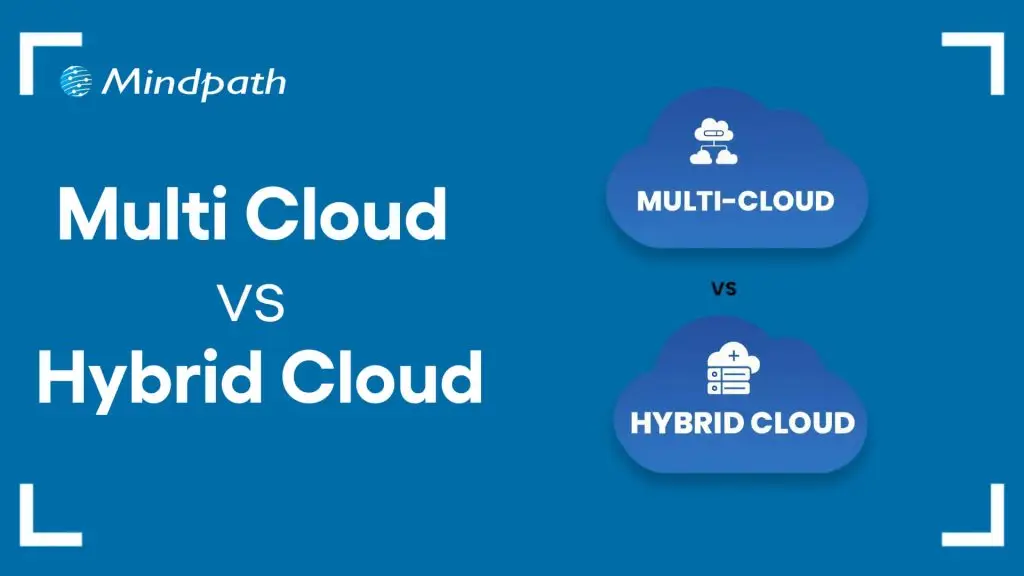
Multi Cloud vs Hybrid Cloud

Deciding between multi-cloud vs. hybrid cloud strategies is becoming an important choice for organizations that want to remain agile and scalable. Every organization needs to find a way to balance flexibility, security, and performance, and this holds true with cloud architecture as well. The more complex challenge is determining which model can optimize operations while allowing the teams in the organization to innovate unhindered. As technology progresses to new heights, a strong cloud architecture can be a differentiating element within an organization’s growth.

It is essential to be certain of how both cloud models serve your business objectives and technical goals to make the better decision. It is not just an issue about infrastructure, but positioning your organization for the future and digital resilience. Understanding their differences helps organizations make confident and data-driven decisions in a world where technology changes rapidly. In this blog, we will explain some of the fundamental principles of multi-cloud and hybrid cloud so that the decision on which is best for you will be less difficult.

Want to determine which cloud strategy will be ideal for your organization? Contact us to get DevOps Consultation & Implementation services and make smart business decisions that lead to future growth.

Understanding the Fundamentals of Hybrid Cloud and Multi-Cloud

A hybrid cloud is an IT architecture that combines on-premises infrastructure or private cloud environments with public cloud services such as AWS, Google Cloud, or Microsoft Azure. Organisations can house sensitive data in a private cloud to protect it, while still utilizing the on-demand, scalable, and cost-effective computing of the public cloud. Hybrid clouds offer enhanced control, resource utilisation, and performance. This approach allows organisations to efficiently manage workloads across both environments, keeping critical data secure while scaling non-sensitive operations through the public cloud.

A multi-cloud strategy is the intentional use of two or more public cloud providers, such as AWS, Microsoft Azure, and Google Cloud, to distribute workloads and achieve specific corporate objectives. In the multi-cloud vs. hybrid cloud debate, companies will tend to prefer multi-cloud solutions for flexibility, avoiding being locked into a single vendor platform, and minimizing operational risks such as downtime or loss of data. Each application in a multi-cloud environment can run on a public cloud platform or private cloud platform based on relative performance or cost needs.

Wondering how application architecture impacts multi-cloud and hybrid cloud success? Explore cloud-native development to learn how cloud-native apps improve scalability and flexibility.

Advantages of Hybrid Cloud

A hybrid cloud gives companies the right combination of flexibility and control, helping companies manage data securely and securely provide scalability and efficiency for operations.

1. Strong Security and Data Control

Hybrid cloud allows companies to maintain improved control of sensitive data and mission-critical systems. Companies can use private servers to store private information and public clouds for everyday tasks, allowing for a balance between security and freedom.

2. Smarter Cost Management

Businesses can reduce their costs by maintaining constant workloads on private systems, while variable workloads can move to the public cloud. This model allows for a pay-as-you-go system that reduces risk of overspending and improves cost optimization.

3. Faster Performance and Low Latency

Hybrid cloud enhances performance by positioning time-sensitive jobs, such as analytics or IoT applications, nearer to the end user. The configuration call for helps to reduce latency and increase response times for the users.

4. Reliable Disaster Recovery

Businesses are able to store crucial data in the public cloud while ensuring that a main version is also preserved on their premises and if there is a systems failure, they can quickly restore and resume business as usual with minor interruptions.

5. Greater Scalability on Demand

Organizations can easily scale their capacity up or down via the public cloud when they find themselves in busy periods or running promotional activities that bring in high traffic. After the busy period ends, they can scale down their capacity, so they aren’t wasting money and resources.

6. Better Compliance and Data Governance

Hybrid cloud helps companies follow data protection rules by keeping customer data on local servers. At the same time, they are still able to carry out non-sensitive work in a public cloud, thus making an informed decision on multi-cloud vs hybrid cloud.

7. Boosted Innovation and Flexibility

Teams can experiment with fresh tools and services in the public cloud without interfering with core systems. This illustrates that the difference between multi-cloud vs hybrid cloud can drive business innovation and flexibility within the digital age.

Is your cloud strategy aligned with long-term digital growth goals? Discover digital transformation for businesses to understand how the right cloud approach accelerates innovation.

Examples of Hybrid Cloud

These are some real-world hybrid cloud examples and how organizations use this approach to improve business flexibility, security, and efficiency.

1. Digital Transformation

A hybrid cloud modernizes IT systems with a remote workforce and protects data in a secure environment.

2. Disaster Recovery

Hybrid clouds help your business continue operating normally by recovering data at a fast speed in the event of outages.

3. Development and Testing

Developers develop and test apps in their public clouds, then port to private clouds.

4. Cloud Bursting

During peak traffic, additional workloads move from private clouds to public clouds without impacting performance.

5. Edge Computing

Delivers and processes data near the user, resulting in faster and lower latency experiences.

6. AI & Machine Learning

A hybrid cloud supports AI workloads with the best scalability and the security of their data.

Looking for ways to optimize costs and scale applications seamlessly in complex cloud setups? Discover serverless architecture in cloud computing to explore how serverless solutions support modern cloud architectures.

Advantages of Multi-Cloud

The following are the main benefits of a multi-cloud strategy that will help to improve business performance and facilitate better operations.

1. Business Continuity Edge

In comparing multi-cloud vs. hybrid cloud, one advantage of multi-cloud is that it allows operations to continue even if one of the providers has an outage. By spreading workloads across a combination of platforms, businesses provide continued performance and reliability.

2. Flexible Cost Management

In the hybrid cloud vs. multi-cloud comparison, another of the advantages of multi-cloud is improved cost control. This allows companies to choose the cheapest cloud provider for each workload and optimize resources effectively.

3. Customized Security Approach

Multi-cloud allows organizations to engage with providers that best suit their compliance and security requirements. This helps to ensure improved data security and better alignment with regulatory standards.

4. Independent Provider Choice

Using a multi-cloud strategy, organizations will have less reliance on one vendor. They will have the flexibility to move workloads, negotiate terms, and meet changing demand in the market.

5. Optimized Technology Access

Each cloud provider has a service that they do best, e.g., AI, analytics, or integration. Multi-cloud allows organizations to select the cream of the crop and combine them together to get the best performance and innovation.

6. Enhanced Global Reach

Multi-cloud allows applications to be deployed across multiple locations to minimize latency and enhance speed. This is especially useful for global companies that need to provide consistent, reliable speeds globally.

7. Ongoing Innovation Power

By utilizing countless ecosystems in the cloud, firms are able to engage with new, emerging technologies that give them flexibility and even a competitive advantage regarding innovation and continued growth.

Curious about where cloud adoption is heading next? Explore cloud computing trends to discover emerging technologies shaping multi-cloud and hybrid strategies.

Examples of Multi-Cloud

Here are real-world examples of multi-cloud that demonstrate how businesses use multiple providers to enhance their performance, flexibility, and reliability.

1. Specialized Services

A business may use Google Cloud for analytics and AWS or Azure for AI tools to get the best of each platform.

2. Disaster Recovery & Continuity

A financial firm can rely on OCI for core apps and IBM Cloud as a backup to ensure uninterrupted operations.

3. Cost & Performance Balance

A retailer may host its e-commerce site on one cloud and run analytics on another to save costs and improve speed.

4. Diverse SaaS Usage

An organization can follow a multi-cloud approach by using Salesforce for CRM and Workday for HR management.

5. Compliance & Data Security

A healthcare provider may store patient data in a private cloud while using a public cloud for general operations.

Looking to build healthcare software that meets strict compliance and data security standards? Explore our blog on healthcare software to discover how secure cloud-based solutions protect sensitive patient data.

Multi-Cloud vs. Hybrid Cloud: A Comparison Table

Below is a brief comparison table showcasing the primary differences between hybrid cloud and multi-cloud, so you can gauge which model may work better for your business requirements.

Aspect Hybrid Cloud Multi Cloud
Definition Combines private and public clouds to work as one integrated environment. Uses multiple public cloud providers for different workloads.
Primary Goal Balance security with scalability by keeping sensitive data on private clouds. Maximize flexibility and performance by choosing the best services from each provider.
Architecture Integrates on-premise infrastructure with one or more cloud services. Operates across multiple independent cloud platforms without tight integration.
Data Management Data moves between private and public clouds based on need. Data is distributed across several cloud platforms for specific tasks.
Security Control Offers stronger control and compliance for sensitive workloads. Security depends on each provider’s standards and your management strategy.
Cost Efficiency Reduces cost by keeping predictable workloads in private environments. Optimizes cost by comparing pricing and using best-fit providers.
Use Case Ideal for regulated industries needing data privacy and scalability. Perfect for businesses aiming for high availability and vendor flexibility.
Example A bank using private cloud for transactions and public cloud for analytics. A retailer using AWS for e-commerce, Google Cloud for data, and Azure for AI.

Ready to Choose the Right Cloud Strategy for Your Business?

Deciding between multi-cloud vs. hybrid cloud depends on your organization’s needs for flexibility, performance, and security. Both approaches empower businesses to innovate and scale effectively. Understanding their core differences helps you design a cloud strategy that aligns with your goals and builds a strong foundation for long-term digital success.

At Mindpath, we deliver expert cloud computing services to help businesses design secure and scalable environments. Our team builds tailored multi-cloud vs. hybrid cloud solutions that enhance performance, reduce costs, and boost efficiency. Partner with us to create a future-ready infrastructure that keeps your business innovative, adaptable, and competitive in a fast-changing digital world.

Learn the key differences between multi-cloud and hybrid cloud strategies and discover how Mindpath’s cloud services can help.