Home

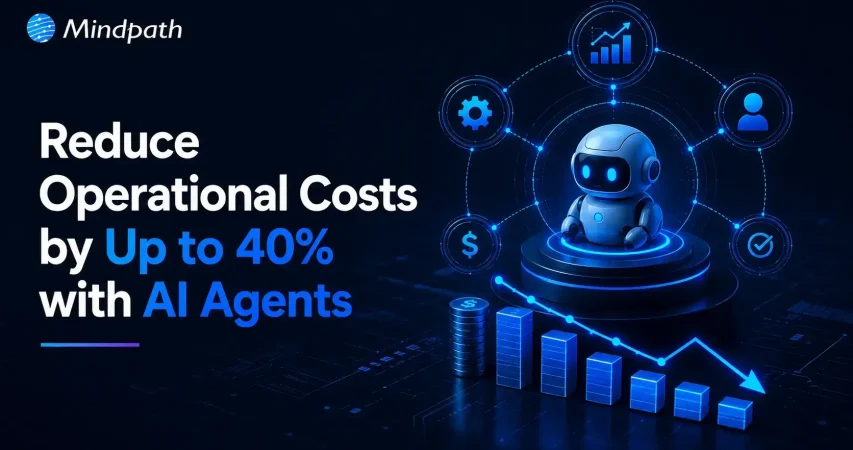
How AI Agents Can Reduce Operational Costs by Up to 40%

How AI Agents Can Reduce Operational Costs by Up to 40%

Join our Newsletter!

AI Agent for Cost Reduction

Rising operational expenses are pushing companies of every size to rethink how they run their day-to-day processes. More organizations are now turning to AI agents for cost reduction, using intelligent automation to cut down manual effort, reduce errors, and get more done with the resources they already have.

Key Takeaways

  • 01
    AI agents make intelligent, context-aware decisions, making them more effective than traditional rule-based automation.
  • 02
    Businesses reduce operational costs through lower labor hours, fewer errors, and continuous AI-driven productivity.
  • 03
    AI agents automate end-to-end business processes across customer support, finance, HR, IT, and supply chain operations.
  • 04
    Continuous learning enables AI agents to identify new opportunities for long-term business cost optimization.
  • 05
    Starting with high-cost business processes helps organizations achieve faster ROI from AI agent implementation.

From customer support to supply chain management, these digital workers are quietly reshaping how businesses spend and save. In this blog, we are going to explore how AI agents are helping companies reduce costs, improve efficiency, and stay competitive in 2026.

Are rising operational costs slowing your business growth? At Mindpath, we help organizations build intelligent AI agents that automate business processes, reduce operational expenses, and improve long-term efficiency with customized AI development solutions.

Why Businesses are Adopting AI Agents for Cost Reduction in 2026?

AI agents are software programs built to perform tasks on their own, make decisions, and interact with systems or people without constant supervision. Unlike traditional automation tools that follow rigid, preset rules, AI agents can understand context, learn from data, and adjust their actions as conditions change.

In 2026, businesses are no longer treating AI agents as experimental tools. They are being deployed across finance, HR, IT support, sales, and operations to handle repetitive, time consuming work. This shift is a major driver of AI for operational efficiency, freeing up teams to focus on strategic work while agents manage the routine execution. As adoption grows, companies are realizing that the savings go well beyond simple task automation. They extend into smarter decision-making, faster turnaround times, and leaner day to day operations.

What makes this moment different from earlier waves of automation is how accessible it has become. Cloud infrastructure, affordable computing power, and more capable AI models have made it possible for mid-sized and even small businesses to deploy agents that were once out of reach for anyone but large enterprises. As a result, most leadership teams have stopped asking whether they should use AI agents and started asking which processes to automate first.

How AI Agents Improve Business Efficiency and Reduce Costs?

Efficiency sits at the heart of nearly every cost saving strategy, and this is exactly where AI agents make the biggest difference. Using AI agents for business efficiency allows companies to remove bottlenecks and cut down the time spent on manual, repetitive work.

Here is how they help:

1. Faster Task Completion

AI agents can process requests, generate reports, and complete workflows in minutes instead of hours, which directly cuts down on labor hours spent on routine work.

2. Fewer Human Errors

Automated agents follow the same logic every time, so the risk of costly mistakes drops and there is less rework to pay for down the line.

3. Round the Clock Availability

Unlike human teams, AI agents can keep working through the night without overtime pay, so productivity does not have to pause when the office closes.

4. Better Use of People

When agents handle the routine work, employees get more time for the tasks that actually need human judgment, and that raises overall output without hiring more staff.

5. Room to Grow

AI agents can take on a heavier workload without a matching jump in cost, which makes it easier for a business to scale without its budget scaling right along with it.

These improvements add up over time. A single automated workflow might only save a few hours a week on its own, but once agents are working across several departments, the combined effect on productivity and cost becomes significant enough to shape overall business strategy.
AI Agents for Process Automation Across Business Functions

Process automation is one of the clearest places where businesses see a return on their AI investment. Deploying AI agents for process automation lets companies streamline entire workflows instead of just automating one task here and there.

Some of the most useful applications include:

1. Customer Support

AI agents can answer common questions, route tickets, and follow up with customers instantly, which means fewer support staff are needed to keep response times fast.

2. Finance and Invoicing

Agents can process invoices, catch discrepancies, and manage approvals on their own, cutting down manual accounting hours and reducing payment delays.

3. HR and Onboarding

From answering employee questions to handling paperwork, agents make HR workflows simpler and take a real chunk out of the administrative load.

4. IT Support and Monitoring

AI agents can spot issues, send alerts, and resolve common problems before a person ever has to step in, which keeps downtime and support costs down.

5. Supply Chain Coordination

Agents can track inventory, forecast demand, and trigger reorders automatically, helping businesses avoid both wasted stock and costly shortages.

What these examples have in common is that AI agents rarely replace just one step in a process. They tend to connect several steps into one coordinated flow, and that is what allows businesses to save money at the level of the whole process rather than one task at a time.

AI Cost Optimization: Smarter Ways to Reduce Business Costs with AI Agents

Beyond automation, AI cost optimization is about using data and intelligence to make smarter financial decisions across the business. AI agents for cost reduction really prove their worth here, moving from simply executing tasks to actively helping manage costs.

A few ways AI agents support cost optimization:

1. Predictive Spend Analysis

Agents can study historical data to forecast expenses and flag anything unusual early, helping teams catch budget problems before they grow.

2. Vendor and Contract Management

AI agents can review contracts, compare vendor pricing, and point out better deals, which puts businesses in a stronger position when negotiating.

3. Energy and Infrastructure Monitoring

In IT heavy environments, agents can fine-tune server usage and cloud resource allocation, which cuts unnecessary infrastructure spending directly.

4. Less Manual Reporting

Agents can build real-time financial dashboards without anyone entering data by hand, which saves reporting time and speeds up decisions.

5. Ongoing Improvement

AI agents learn from the operations they run and often surface new efficiency gains over time, so the savings tend to compound rather than stay flat.

Understanding how to reduce business costs with AI agents really comes down to identifying which repetitive, data heavy, or decision-driven processes can be handed over to intelligent systems and doing that in a structured way rather than all at once. Businesses that start with a clear audit of their biggest cost centers tend to see faster, more lasting results than those that automate without much of a plan.

Ready to Cut Costs with AI Agents?

The evidence is hard to ignore. Businesses that adopt intelligent automation are seeing real reductions in operational spending, faster workflows, and fewer costly mistakes. AI agents for cost reduction are not a futuristic idea anymore. They are a practical strategy that companies across industries are already using to stay lean and competitive in 2026.

Looking to reduce operational costs while improving business efficiency? At Mindpath, we design and develop custom AI agent solutions that automate workflows, optimize operations, and deliver measurable cost savings tailored to your business goals.

At Mindpath, we help businesses design and implement AI agent solutions built around their specific operational challenges. Whether that means automating customer support, streamlining finance workflows, or optimizing IT infrastructure, our team works closely with you to find the right opportunities and build agents that deliver real, measurable savings. If you are ready to see what AI agents can do for your business, Mindpath is here to help you get started.

Frequently Asked Questions (FAQs)

AI agents are intelligent systems that can make decisions and adjust to changing conditions, unlike rule-based automation that just follows fixed steps. Because they understand context and learn over time, they handle complex business tasks more effectively.
Depending on the industry and use case, businesses have reported cost reductions of up to 40 percent after adopting AI agents. Most of the savings come from reduced labor hours, fewer errors, and faster process completion.
Customer support, finance, HR, IT, and supply chain management tend to see the biggest impact. These areas involve repetitive, data heavy tasks that AI agents can handle quickly and accurately.
Costs vary, but many AI agent solutions are built to scale and can start small. Over time, the operational savings usually outweigh the initial investment, which makes this accessible for growing businesses too.
Mindpath works with businesses to identify high impact processes, design custom AI agent solutions, and integrate them smoothly into existing systems. The goal is always measurable efficiency and cost savings suited to each business.

Support Is One Click Away

Featured Posts

Related Post

conversational AI use cases

Businesses are becoming keen on smarter ways to engage their customers and streamline their overall operations. This is where conversational AI has stepped in as a foremost option. As per the reports of McKinsey, around 78% of companies have integrated conversational AI into at least one of their major operational areas. Further, most of them are achieving steady returns and better efficiency. According to the recent reports, around 80% of organizations are planning to adopt AI-integrated solutions for customer service improvement.

So, starting from intelligent virtual assistants to automated customer support, conversational AI use cases have been rapidly growing across industries. But what exactly makes this technology so superior in the recent age? Let’s find out the reason in this blog along with its major use cases.

Looking to leverage AI to automate processes, enhance decision-making, and drive business growth? At Mindpath, we offer AI development services that help businesses build intelligent, scalable solutions tailored to their unique needs.

Conversational AI

What are Conversational AI Solutions?

Conversational AI is a major subset of artificial intelligence that enables natural and human-like interactions between humans and computers through technologies like AI agents and virtual assistants. Unlike rigid, rule-based programs, it uses natural language processing (NLP), machine learning (ML), and large language models (LLMs) to understand context, retain dialogue history, and respond to both text and voice inputs conversationally.

Further, it mimics natural human-like conversations. Conversational AI solutions have made a significant impact in multiple industries while easing customer servicing efforts.

How Does Conversational AI Work for Multiple Industries?

If you have ever thought, “How does conversational AI work?”, it adopts the relevance of multiple technologies as listed here.

  • Natural Language majorly helps AI to understand your language and the intent of your customers.
  • Machine learning enables you to assess the past interactions of the customers while improving them for the betterment.
  • Speech recognition can convert your voice into text through voice-based assistants.
  • Context management ensures the conversations are error-free and maintains human-like emotions.

Top Conversational AI Use Cases that Are Benefiting Industries

You will be going through some of the most relevant conversational AI examples and applications in this section. Additionally, these use cases have been leveling up the operations and engagement.

1. E-commerce

When we think of e-commerce trends, conversational AI chatbots can be very prominent. Additionally, it improves customer satisfaction by helping them with the purchase.

  • AI chatbots offer personalized product recommendations based on your user behavior & assist them with order tracking.
  • Further, it helps with recovering the carts by helping customers in real-time.
  • By offering real-time assistance during checkout, it can boost conversions.

2. Customer Support Automation

This is one of the most adopted conversational AI applications. Businesses use AI-powered chatbots to manage high-volume customer queries quickly and conveniently. Moreover, these chatbots can instantly answer your queries while eliminating common issues.

  • It sends complicated tasks to human agents where it needs more factual assessment.
  • This feature decreases response time while supporting you throughout the journey.

3. Lead Generation

Conversational AI can easily automate the lead generation process.

  • AI bots can catch the attention of users through interactive conversations. Further, it gathers necessary data for future usage.
  • It assesses responses and can identify high-quality leads and prioritize them for the sales team.
  • This ensures that your business can focus its efforts on prospects with higher conversion potential. Further, it can save your time and overall sales efficiency.

4. Healthcare Assistance

Conversational AI is broadening engagement while making medical assistance accessible to many patients at a time. This is one of the incredible benefits of conversational AI for business.

  • AI systems can help you with appointment scheduling & symptom assessments.
  • Offer mental health support through guided conversations.
  • Such tools can ease the stress of healthcare practitioners & can offer needed assistance to patients.
  • Moreover, they ensure continuous assessment & follow-ups. This way, your healthcare delivery will be much more efficient & result-oriented.

5. Banking and Financial Services

Financial organizations are using conversational AI to offer secure, fast, and efficient customer interactions.

  • AI chatbots can handle tasks like checking account balances and offering transaction updates. Moreover, it can make you aware of fraudsters in real-time.
  • These features can satisfy your customers while making you follow strict regulations.
  • By automating your routine banking efforts, you can minimize the operational charges while making the digital experience error-free.

6. Human Resource

HR departments are mainly using conversational AI to streamline recruitment and employee engagement processes. Further, AI chatbots can screen candidates while scheduling their interviews at their convenience.

  • The tools can help your team with HR related questions, such as onboarding steps and leave policies.
  • This can also ease the burden of administrative workload while improving the hiring process.
  • It also keeps the discussion between the candidates and the employees clear.

7. IT and Helpdesk Automation

Conversational AI is mainly used in IT support to automate repetitive and time-consuming tasks.

  • AI bots can easily erase technical glitches and can guide your users through complete solutions. Further, it can help with password resetting and instant support.

Want to see how evolving AI trends are enhancing the capabilities of conversational AI? Discover the top AI trends that are driving innovation and growth.

Real-World Adoptions of Conversational AI

Here are some top conversational AI examples across multiple industries throughout the world.

Real-world Examples of Conversational AI
Amazon Alexa It can answer your queries, play music and manage smart home devices.
Apple Siri It is only available on iOS devices and employs voice interactions to send messages or schedule reminders.
Google Assistant It can promptly follow your voice to execute tasks like sending text messages.
Cortana It is Microsoft’s personal productivity assistant that executes a series of functions.
Samsung’s Bixby Bixby can perform multiple functions like fetching location-specific weather updates, sending messages and much more.

Conversational AI Industry Trends

The conversational AI industry is evolving rapidly, shifting through valuable advancements. Some of the major trends have been given here.

  • Conversational AI is acquiring more power by adopting generative AI tools.
  • Virtual assistants have been growing in number. Around 69% of companies claimed that these assistants have helped them improve their customer service.
  • Multilingual conversations have also been drawing the attention of customers from any cultural background.

Bottom Line

Conversational AI has given rise to a new era of possibilities across major industries. Its integration into the sectors has majorly changed how businesses engage with customers and streamline their internal operations. Conversational AI solutions are helping businesses operate more efficiently with advanced inclusions.

If you also want to unlock such opportunities, Mindpath stands out as a prominent choice. With our AI development services, companies can seamlessly implement conversational AI into their workflows while staying ahead in the digital world.

Conversational AI

Frequently Asked Questions

Image showing a person working on a laptop.

Want to know about the potential conversational AI use cases? You have reached the right place; let’s dive deep and understand the top use cases of conversational AI.

The advancement of the human race seen in recent times is mindboggling. At the spearhead of the pioneering force of development are the advances in technology made by man. With the rapid pace of development, humans realize the need to create artificial intelligence at par with human intelligence.

Especially after the massive disruption caused by the pandemic, we search for artificial intelligence applications capable enough to take up a significant chunk of manually completed tasks. The pandemic and subsequent social distancing have made us trust machines to complete specific tasks that can be hazardous to our health. Artificial intelligence is an important factor in machines replacing manual labor at most places.

With the rise in artificial intelligence applications, the AI-human relationship is evolving to make it more interactive and fruitful. One core technology that lies at making the use of AI more satisfying for humans is conversational AI. Conversational AI is a set of technologies that help a computer register, process and understand human language. Conversational AI renders a more human touch to AI applications by giving human-AI interactions a more conversational flow.

In this way, conversational AI makes it convenient for people to use complex machines. Conversational AI increases machines’ efficiency by helping them understand the user’s needs in a better way.

Understanding Conversational AI Use Cases

Conversational AI is one of the most promising sectors of Artificial intelligence, with its market share growing from $4.2 billion in 2019 to $15.7 billion by 2024. It is only natural for conversational AI use cases to increase in the next few years. As the accessibility of computers and intelligent devices increases, conversational AI use cases also improve. Conversational AI is used in both the commercial and domestic sectors today. Here are the few conversational AI use cases that highlight the revolution that conversational AI truly is.

IT and Data Security Services

One of the primary conversational AI use cases is found in the IT sector and data security. IT companies are using chatbots as the primary interface of customer support services. The chatbots help customers in accessing support services at any time. These chatbots are programmed to address the fundamental issues faced by a customer and offer troubleshooting solutions. If the customer’s type of concern is of higher complexity, it gets forwarded to the IT support executive. Having a chatbot in the IT services helps filter out the customer requests according to the complexity and priority of the concerns.

–  Using a chatbot in the customer support chain helps resolve issues, increase the staff’s productivity, and better incident management.

–  The chatbots also provide more data security to the customers as they are not exposed to a third party.

–  Chatbots are used in the IT service support sector, troubleshooting, and customer information sector.

Sales Management

Conversational AI platforms like chatbots and virtual assistants are used to handle the different processes involved in sales. In this way, chatbots and virtual assistants help in improving the sales management of an organization. Chatbots can be integrated into warehouse systems, databases, and CRM systems to simplify and streamline. Large-scale manufacturing companies use virtual assistants to schedule despatch of product shipments. Chatbots also help in maintaining sales databases. Chatbots can also assist lead management. Moreover, chatbots help in checking the lead status and fill in the lead details for sales executives.

Marketing and Promotions

Use cases for AI in conversational marketing are in every industry if appropriately observed. Every successful company takes its marketing strategy seriously. Companies are now using technology to support their marketing goals. One of these technologies is conversational AI. Companies are using different online platforms like websites and social media for marketing. The chatbots integrated into these platforms are excellent examples of conversational AI use cases. Chatbots help in gathering customer insights and potential leads from online platforms. Demographics and data insights lay the foundation of the marketing strategy for companies. Conversational AI applications provide crucial data to the marketing teams so that they can create efficient strategies.

Chatbots interact with potential customers to gather good leads. For highly interested potential customers, chatbots help in scheduling demos and meetings. Chatbots observe a visitor’s website activity to recommend products that can be relevant to them. There are many more ways in which conversational AI supports marketing activity and customer acquisition.

Internal Virtual Assistant

Apart from helping a company interact with its customers, a chatbot can also help an organization establish channels of internal communication. This helps in improving the coordination between the different teams of an organization. Internal virtual assistants and intranet chatbots can help set up meetings with the staff, sending out reminders to everyone involved, and improving internal communication in general.

Employees can do small tasks like applying for leaves, approving leaves, and staying informed on internal updates with intranet chatbots’ help. Chatbots can also help in the organization of documents and making them accessible to employees when needed. This decreases the hassle of working and allows an employee to become self-reliant in the workflow.

Furthermore, chatbots can keep the employees in the loop for recent developments, perform simple tasks for them and improve the company’s workflow in general.

Retail Industry Operations

In 2020, the retail industry was in for a revamp to embrace the new normal. As retail became tech-empowered, it also served as a strong example of conversational AI use cases.  The use of chatbots and other conversational AI forms act as virtual shopping assistants for people who want to shop from home. Even inside a store, chatbots help the customers in exploring the inventory for their chosen product. Intelligent chatbots help customers find suitable product recommendations according to their preferences and needs. In e-commerce websites, chatbots help in adding products to the cart and checking out with them. Even in offline stores, conversational AI helps customers make payments and checkout without human interactions.

Bottom Line

Conversational AI plays a vital role in carrying out operations in almost all sectors. The above-mentioned are a few of the use cases of Conversational AI in today’s era. If a user wants to learn more about conversational AI under a conversational AI tutorial, he/she cannot forego the use cases of conversational AI in different fields. With the adoption of conversational AI chatbots for your business, you can take your business to the next level of growth.

Want to know more about conversational AI? Reach our experts at eBotify and they will explain to you the concepts of conversational AI and chatbots.

Want to know about the potential conversational AI use cases? You have reached the right place;
Web development trends

The landscape of web development is evolving faster than ever. What was an innovation just a few years ago is now obsolete. Developers and businesses should stay ahead of the curve to remain relevant and competitive. From decentralized technology to AI-powered automation, the latest web development trends are redefining how web apps and websites are developed and optimized. 

These trends do not just revolve around making technical upgrades. They involve strategic shifts that influence digital growth and user experience. By embracing these advancements early, you can enjoy a decisive edge in this competitive digital world. Following a well-structured web development roadmap can help you prioritize the right technologies, tools, and methodologies for maximum impact.

In this blog, we will talk about some major trends in web development processes, methodologies, and tools that are constantly transforming this landscape. 

Using these trends in your business requires expert guidance. At Mindpath, we offer web development services where our guidance will provide you with the direction you need to stay ahead of the competition.

Why Web Development Trends Matter?

Web development is now entering a transformative era, significantly driven by user-centric designs and technological innovations. In the future, we can expect to see faster, personalized, and smarter websites.

Besides, the demand for Progressive Web Apps will increase as these apps provide users with an app-like experience without downloading an app. What’s more? With machine learning and IoT widely integrated into websites, the web will evolve into a more responsive, intelligent, and interactive ecosystem. 

Let’s further explore the top web development trends that are shaping the next generation of digital experience.  

Top Web Development Trends to Watch in 2026

As we move deeper into 2026, here are some trends that are reshaping how web applications and websites are built and deployed. These innovations enhance scalability, performance and align with increasing demand for transparency, security and personalization.

1. Code Will Become Optional: AI-Assisted Development

In 2026, AI-powered web development tools will streamline multiple tasks, from code creation to UX enhancement. Platforms such as OpenAI Codex, GitHub Copilot, Tabnine, and more help developers by suggesting improvements, writing boilerplate code, debugging, and more. 

Besides, web application development trends in 2026 include predictive analytics, AI-assisted personalization, intelligent chatbots, etc. Such intelligent capabilities have become integral to modern web development projects with source code, reducing development time and enhancing user engagement. 

2. The Rise of Jamstack Architecture

Jamstack (which combines JavaScript, APIs, and Markup) has become one of the most popular web development technologies. This modern architecture decouples the front-end from the back-end. It leads to improved security, better scalability, as well as faster load times. For marketing pages, e-commerce sites, and content-heavy platforms, Jamstack would be an excellent choice 

3. Blockchain Technology

Blockchain is here to facilitate continuous flows of records and transactions, called blocks. This technology is cryptographically secure and records every transaction in a tamper-proof and transparent manner.  

Web developers can use this to create high-performance, decentralized applications that eliminate centralized control and intermediaries. 

4. Progressive Web Apps

By combining the features and functionalities of native mobile apps and websites, PWAs are changing the web development process. These apps offer an app-like experience while being cost-effective and accessible. 

A report indicates that the global PWA market is projected to grow from USD 1.9 billion in 2014 to USD 9.7 billion by the end of 2034 (Source: Emergen Research). This clearly shows the rising adoption of PWAs by businesses.

5. Machine Learning in Browsers

Thanks to the latest web development technologies like TensorFlow.js and WebAssembly, web developers can easily run various machine learning models in browsers. This facilitates voice recognition, real-time personalization, predictive UX, and more. It is now possible to create privacy-conscious and faster applications that can adapt to user behaviour. 

Are your web apps providing the best possible experience for users? Discover UI/UX design trends in web application development to learn how modern design trends can enhance usability and engagement.

6. Micro-Frontends

It breaks down the complete UI into manageable, smaller components. This modular approach significantly enhances scalability and facilitates parallel development. This can be an excellent solution for large-scale development projects. 

7. No-Code and Low-Code Platforms

Low-code development is getting popular among developers. Platforms such as Bubble, OutSystems, and Webflow let non-technical users create functional websites with minimal coding. It reduces costs and accelerates prototyping. Low-code or no-code development is one of the impactful dev trends in 2026 for small businesses and startups.  

8. Single Page Applications

These web apps are created as a single page, and they can dynamically update content in real-time. SPAs help reduce costs, and businesses can use cloud technology to attain scalability. Some examples of popular SPAs are Google Maps, Facebook, Airbnb, Twitter, and Netflix. 

9. WebRTC Advancements

WebRTC is a major technical advancement in the field of web app development. It is an open-source technology and uses HTML and JavaScript APIs to add communication features to browsers. There is no need to use any external software or plugins.

With the help of RTCPeerConnection, RTCDataChannel, and MediaStream, it enables peer-to-peer data, video, and audio sharing. 

10. Edge Computing

It refers to the processing of data closer to the source instead of depending on centralized data centers. It reduces latency, improves privacy and performance while helping businesses to keep costs low. 

Edge computing is becoming significantly crucial for business, and it is estimated that by 2028, it will reach USD 378 billion (Source: IDC Research). 

Choosing the right technologies is crucial for building a high-performing web app. Explore the tech stack for your web app success to discover the best tools and frameworks for your project.

11. Motion UI Frameworks

These frameworks help bring a static interface to life by integrating optimized transitions and animations. For example, Animate.css offers ready-to-use animations that are compatible with multiple browsers. It is a great option for sliders and home pages. 

You can implement animations that are not just visually appealing but also serve functional purposes, such as highlighting vital information, guiding visitors through a certain process, etc. 

12. Adaptive and Responsive Design

Web development trends in 2026 also include the wide use of adaptive designs. With wearables and foldable devices entering the mainstream, adaptive design is now evolving. Developers are prioritizing gesture optimization, context-centric layouts, and device-specific breakpoints. 

This shift is central to modern web development trends, ensuring a consistent user interface across screens and devices. 

13. Server-Driven UI

It enables servers to identify the behaviour and structure of the front-end for dynamic content rendering and quick updates. It transmits JSON-based instructions to the frontend and controls the UI layouts.

This development approach allows faster deployment, seamless CMS integration, personalization, and cross-platform consistency. It is a strategic shift in today’s web development trends.

14. Data-Driven UX and Real-Time Analytics

Developers are now integrating session recording, heatmaps, real-time user behaviour tracking, and more for design decisions. This approach reduces guesswork and assumptions while enhancing user satisfaction. 

Product metrics, email analytics, Google Analytics, and social media analytics are some commonly used analytics tools to get important quantitative data. This approach aligns with new web development trends and can also boost conversion rates. 

15. AI-Assisted SEO Optimization

With search engines, SEO is also evolving. AI tools are now helping with content scoring, meta tag generation, keyword clustering, and improving internal linking. 

For developers and content strategists, it means better alignment with user needs and faster optimization cycles. 

Looking to build a website that drives engagement and conversions? Explore web design and development services to discover how professional design and development make an impact.

Best Programming Languages for Modern Web Development

Staying updated with the Latest Web Development Languages is also important to create future-proof and scalable web applications. Here are some key languages that cater to frontend as well as backend needs.

1. JavaScript

The backbone of front-end development, and it helps create interactive and dynamic user interfaces. 

2. TypeScript

An ideal option for large-scale projects due to its error reduction and maintainability. 

3. Go

Also called Golang, it is popular for its concurrency and speed. It is widely used for websites requiring high performance. 

4. PHP

A dominating language for server-side scripting. Frameworks such as Laravel are modernizing PHP development.

5. Rust

Well-known for performance and memory safety, Rust works well for secure backend systems and web assembly projects. 

Want a web application built to match your workflow perfectly? Discover our custom web development services to learn how we create bespoke digital experiences.

Emerging Software Development Trends in 2026

In 2026, the application development trends cover CI/CD automation, AI coding, and more. Here are some major dev trends you should consider. 

1. Micro Frontends

Dividing user interfaces into independently-deployed, smaller parts with an aim to achieve flexibility, collaboration, and scalability. 

2. AI-Assisted Coding

Smart testing tools and code generation tools powered by AI are simplifying workflows. 

3. CI/CD Pipelines

Automated testing ensures that web applications and websites are updated on time and faster. 

4. Sustainable Development

Coding architectures and practices that meet global accessibility standards and reduce energy consumption are getting popular in dev trends. 

5. 5G Integration

Developers can leverage 5G technology to optimize CDNs or Content Delivery Networks and create high-performing websites. 

It can be said that the future of web development holds more such exciting innovations. 

Integrating CI/CD into your development cycle can boost productivity. Explore CI/CD Pipelines to discover tools and techniques for seamless automation.

It’s Time to Embrace the Trends

The 2026 web development trends clearly signal a shift toward adaptability, speed, and intelligence. Businesses optimizing their landing pages or creating new websites from scratch, these new technologies in web development can offer strategic opportunities to enhance the digital experience.  

If you are searching for an expert who can guide you through this evolving landscape, Mindpath would be the best option for you. We offer comprehensive web development solutions designed to take your digital experience to a whole new level. Our experts keep themselves updated with the current web development trends so that you can enjoy the desired results. Let us develop a perfect website integrated with advanced features and capabilities, and stand out in this competitive market.  

Frequently Asked Questions