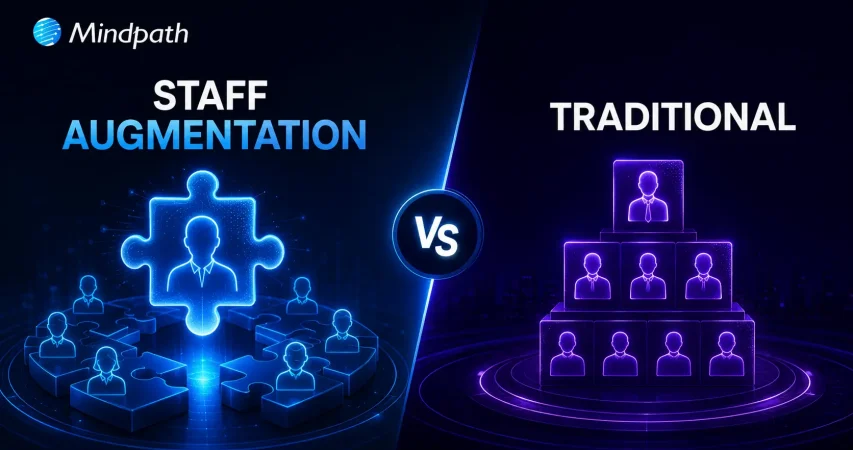
Benefits of IT Staff Augmentation vs. Traditional Hiring 

Join our Newsletter!

Featured Posts

Support Is One Click Away

Home

Benefits of IT Staff Augmentation vs. Traditional Hiring 

Benefits of IT Staff Augmentation vs. Traditional Hiring 

Benefits of IT Staff Augmentation vs. Traditional Hiring 

IT staff augmentation offers a flexible, scalable, and cost-effective alternative to traditional hiring models. It enables businesses to quickly access specialized talent, adapt to changing project needs, and optimize resource allocation without long-term commitments. This approach enhances operational efficiency, speeds up hiring processes, and supports strategic growth in dynamic markets.

Are you struggling to find the right talent for your IT projects or facing challenges with traditional hiring processes? Traditional hiring could take months, but what if there was a faster, more flexible solution? Now, with IT staff augmentation, you may satisfy your project goals fast and effectively without the long-term commitment and expense associated with traditional employment. This blog will explore the key benefits of IT staff augmentation compared to traditional hiring models, helping you make an informed decision for your business. 

Staying competitive in today’s changing business world frequently requires the capacity to expand quickly and adapt. Businesses must make crucial choices about how best to find and retain talent to satisfy the needs of IT projects. IT staff augmentation boosts your current workforce with additional workers that have specialized skills or knowledge. In contrast to traditional hiring, which usually entails long-term employment contracts, staff augmentation provides the freedom to scale resources up or down in accordance with project demands. 

Let us dig deep and explore the primary benefits that IT staff augmentation services offer compared to traditional hiring models. Understanding these benefits allows firms to make educated decisions in line with their strategic goals and operational requirements. Additionally, recognizing the power of remote development teams can further enhance flexibility, access to global talent, and cost-efficiency, enabling businesses to scale their projects effectively. 

What are the traditional hiring models?   

Traditional hiring models cover a range of techniques used by businesses to onboard new staff members. Here’s a short breakdown: 

  • Direct Hiring: This is the most popular approach used by businesses to hire people directly for full- or part-time jobs. It includes posting job positions, evaluating applications, setting up interviews, and choosing job applicants.


  • Temporary Hiring: Businesses employ people to do certain tasks or for a set amount of time. Temporary hires are made by the company itself or through employment agencies to cover short-term positions like project-based labour or seasonal labour.


  • Contractual Hiring: Contractual hiring is employing individuals or businesses under a formal contract to do certain activities or projects. Contractors may labour for a certain amount of time until the project is finished, and they are normally compensated for their services in accordance with the conditions specified in the contract.


  • Freelancers or Independent Contractors: Businesses employ independent contractors or freelancers on a project-by-project basis. They work for themselves and supply specialized knowledge or services on demand, frequently from a distance. They are not employees.


Drawbacks of traditional hiring models    

Despite being frequently employed, traditional employment strategies include several drawbacks that businesses need to consider:  

  • Time and Resource Inefficiency: It might take a while and a lot of resources to advertise job positions, evaluate applications, hold interviews, and decide who gets hired. This inefficiency frequently leads to protracted spells of unemployment, which affects output and pushes back project deadlines.


  • Cost Implications: Conventional hiring includes indirect costs like pay, benefits, and overhead related to permanent workers in addition to direct expenditures like advertising, onboarding charges, and recruiting agency fees (if applicable). Budgetary constraints may be strained by these costs, especially if turnover rates are significant or if highly skilled personnel require premium pay.


  • Rigidity in Staffing: In traditional models, once employed, workers usually commit to long-term jobs that might not match project-specific requirements or changing corporate demands. This lack of adaptability may cause resources to be overextended during peak hours or underutilized during off-peak hours, which would reduce overall operating efficiency.


  • Skills and Expertise Gaps: Access to the knowledge or abilities required for specialized projects or cutting-edge technology could not always be ensured by traditional recruiting practices. Talent with specialized skills may be difficult for organizations to find and keep, which might impede innovation and competitiveness in quickly changing sectors. 

Overview of IT Staff Augmentation    

Businesses use IT staff augmentation services, a dynamic outsourcing approach, to improve internal skills and meet project objectives. This strategy entails hiring outside experts, frequently through direct contracts or staffing firms, to assist and enhance current internal teams. Staff augmentation, which provides temporary or project-based solutions, enables flexibility in workforce management in contrast to traditional recruiting, which involves bringing on board individuals for permanent employment. The first step in the process of augmenting IT professionals is to determine exactly what knowledge and abilities are required to carry out a specific project or cover a void in the organization. Then, using a range of channels, such as independent contractors, freelancers, and specialized recruiting agencies, companies look for people or teams with the necessary training and expertise.  

Key Benefits of IT Staff Augmentation  

  •  Flexibility and Scalability   

Two important benefits of hiring more IT professionals are flexibility and scalability, which enable companies to modify their workforce in response to shifting demands and market dynamics. Through the on-demand availability of specialized skills and knowledge, IT staff augmentation provides organizations with flexibility in response to a wide range of project needs. For a new campaign, for example, a marketing agency may add digital advertising professionals to its team to ensure they have the requisite knowledge without having to commit to long-term hiring. This flexibility improves the way projects are carried out by utilizing outside resources just how projects are carried out by utilizing outside resources to when they are specifically needed. Scalability in IT staff augmentation allows companies to efficiently allocate resources. Compared to keeping a set, full-time staff, organizations may control expenses more effectively by expanding to match expanded project scope or by shrinking following project completion. Because it may be expanded geographically or into new markets, its scalability also helps strategic objectives by offering flexible workforce options that are customized to local needs. 

  • Cost-Effectiveness   

Cost-effectiveness gives companies effective ways to manage project budgets and acquire specialized talents. In contrast to traditional recruiting, which entails high upfront expenditures such as onboarding and recruitment fees, staff augmentation lowers these costs. Since agencies find and screen candidates, businesses may save money on hiring expenses. Additionally, firms save money on long-term costs like benefits, office space, and equipment because augmented workers are not full-time employees. Because of this flexibility, businesses may minimize expenses during downtime by allocating staff in accordance with project phases. 

  • Access to Specialized Talent   

access to specialized talent enables companies to swiftly and effectively obtain knowledge that might not be present internally. Through agencies or direct contracts, companies may hire outside experts and access a wide range of specialized talents and industry-specific information. This strategy works especially well for projects needing specialized technical skills or temporary requirements that don’t warrant hiring people on a long-term basis. Businesses may improve project outcomes, innovate successfully, and tackle difficult problems with specialized knowledge by utilizing the experience and skill of augmented workers. IT staff augmentation guarantees operational excellence and competitiveness in quickly changing sectors by giving businesses access to specialized expertise when and when it’s needed. 

  • Faster Hiring Process   

One clear benefit of contracting IT staff augmentation over traditional recruitment techniques is that it allows firms to integrate qualified individuals more quickly. Employing agencies with pre-screened applicants or directly engaging with appropriate contractors can help companies find contractors more rapidly. This expedited procedure shortens the time it takes to fill roles, jumpstarts projects, and improves flexibility in meeting market needs. IT staff augmentation helps companies to achieve project deadlines, deploy workers quickly, and keep up operational momentum without sacrificing quality or knowledge. It does this by reducing administrative delays and expediting onboarding procedures. 

Choosing Between IT Staff Augmentation and Traditional Hiring   

Criteria IT Staff Augmentation Traditional Hiring 
Flexibility High – Can scale up/down as needed Low – Fixed, long-term commitments 
Cost Cost-effective, reduced overhead Higher costs, including benefits and office space 
Time to Hire Fast – Quick onboarding with pre-vetted candidates Slow – Lengthy recruitment and onboarding process 
Access to Talent Access to specialized, global talent quickly Limited to available local talent 
Project Adaptability Easily adapt to changing project needs Rigid, less adaptable to project changes 
Commitment Short-term or project-based Long-term employment contracts 

Conclusion 

Lastly, IT staff augmentation provides a new answer for firms facing the problems of old employment strategies. It gives businesses unmatched scale, flexibility, and access to specialized personnel, enabling them to successfully and economically satisfy project requirements. Businesses may boost agility, optimize resource allocation, and sustain competitiveness in volatile market settings by utilizing on-demand external knowledge.  

Whether you’re expanding for a new project or looking for specialized expertise, Mindpath provides flexible hiring solutions without the long-term obligations of traditional recruitment. With Mindpath, you can streamline your processes and provide better outcomes. Get in touch with us right now to talk about your IT staffing needs and see how our solutions may benefit your company. 

Get in touch! 

Related Post

Discover top tech trends transforming the travel industry, from AI to IoT, and learn how Mindpath can help your business stay ahead.
Discover how AI governance platforms ensure responsible, and transparent AI development and learn how Mindpath’s AI services can help.

Related Post

hire node js developers

In this new age of technology, speed and performance are more important than ever. If you are creating an enterprise chat application, an e-commerce site or a custom dashboard, the right technology and right people behind it can be a game-changer. It’s the time to think smart, if you are aiming to stay ahead in the competitive market. Well, choosing to hire Node.js developer can help you build fast, scalable and reliable web applications that can match your business goals perfectly. 

Node.js is relied on by some of the world’s largest brands due to its event-based architecture and non-blocking I/O model. Node.js enables developers to support numerous connections at the same time, leading to extremely efficient backend systems. When you recruit Node.js developers, you’re hiring professionals with experience in optimizing performance while maintaining minimal development expenses. In this blog, we will look at the primary reasons why you should hire Node.js developers to be a great business decision for your growth and success. 

Looking to turn your ideas into high-performance web applications? Mindpath offers expert Node.js development services that are intended to transform your ideas into applications. 

Overview of Node.js

Node.js is an open-source platform that allows developers to execute JavaScript on the server, rather than just in the browser. It’s built upon Google’s V8 engine, which is very fast, so it can execute tasks efficiently. Node.js allows developers to utilize the same language to code the front and back ends of a website, which means that building stuff is easier and quicker.

What is so special about Node.js is how efficiently it can deal with lots of users simultaneously without lagging. This is perfect for real-time applications such as chats platforms or live streaming. It’s also simple to scale up your business, so even if your users increase, Node.js can keep up with it. And there are thousands of pre-built tools available through npm that make it easier for developers to create better apps without having to build them from scratch. 

With the increased demand for Node.js, hiring Node.js developers has also become essential.

Let’s find out what benefits Node.js developers can offer:  

Why Hire Node.js Developers?

Node.js is becoming a top choice for businesses that need swift and responsive web solutions and seasoned developers can unlock its full potential to create glitch-free, real-time applications. These are the reasons to hire Node.js programmers for your next project: 

1. Build Apps that Grow With your Business

One big reason to bring in Node.js developers is their skill in building apps that grow with your business. As more people use your app, it needs to handle lots of users at the same time without slowing down. Node.js developers know how to make that happen. They use smart ways to manage traffic and keep everything running smoothly. Whether you’re starting small or expecting fast growth, they build your app ready for the future. If your app needs to respond quickly, handle real-time updates, or manage lots of users, these developers can handle that expertly. 

2. Affordable Development with Great Results

Using tools that don’t cost extra helps keep your project budget friendly. Developers skilled in Node.js know how to make the most of this free technology to build reliable and fast apps. Their experience means they can deliver quality work without unnecessary expenses. This balance of cost and performance makes a big difference for businesses looking to grow without overspending. With their help, you get a well-built application that won’t drain your resources but still meets your needs perfectly. 

3. Creating Interactive and Real-Time Experiences

When you want apps like chat, games, or teamwork tools that work instantly, developers with Node.js skills are the right choice. They understand how to build systems that don’t slow down, even when many users are active at once. Their work makes sure your app can handle lots of requests without waiting around, so everything feels fast and smooth. This means users can enjoy real-time updates and seamless interactions. Having these developers means your app will stay quick and responsive, giving your users a great experience every time they use it. 

Also Read: Advantages of NodeJS

4. Expertise in NPM

A good Node.js development company can offer you node.js developers who are experts in using NPM (Node Package Manager), the built-in tool that helps add new features quickly. Instead of building everything from scratch, these developers can easily find and use ready-made packages to speed up the process. This means your app can get new functions faster and updates happen smoothly. Their experience with NPM helps save time and effort, so your project moves ahead without delays. Hiring them means your app gets built efficiently while still being flexible for future changes.  

5. Offer Full Stack Development

With Node.js development, you get developers who can build both the front-end and the back end of your web app. They use the same language, JavaScript, for everything, which makes the process faster and more organized. These developers know how to create what users see and also set up the systems that keep your app working in the background. This means you don’t need two separate teams. It saves time, avoids confusion, and helps your app run smoothly from start to end. It’s a simple and smart way to get full-stack development done right. 

6. Perfect Fit for Microservices Architecture

Node.js developers are great at building apps using microservices Architecture. These are small parts of an app that can work on their own but also connect with other parts when needed. This makes the whole app easier to build, change, and grow. If one part needs an update, they can fix just that part without touching everything else. It keeps things flexible and clean. With Node.js developers, your app becomes easier to manage and ready to scale as your business grows. It’s a smart way to handle complex web apps without making things messy. 

7. Easy Accessibility

Node.js developers are easy to find because Node.js is based on JavaScript, a language most developers already know. This means that they don’t need much training to get started on your project. They can jump in quickly and begin working without long delays. This makes the whole process faster and smoother for you. Whether you’re starting something new or growing an existing app, having developers who already understand the tools saves time and effort. It’s a simple and smart choice when you want things done efficiently and without hassle. 

Looking to build fast and scalable NodeJS applications? Read our blog on hiring expert NodeJS Developers for High-Performance Apps to see how experienced developers can deliver robust, high-performing solutions for your business.

Ready to Build Powerful Applications with Node.js Developers?

Choosing to hire Node.js developers is one of the smartest choices for creating fast, real-time, and scalable web apps. These developers bring the right mix of front-end and back-end skills to keep your application running smoothly while handling more users as you grow. Their ability to work with modern tools and create user-friendly, high-performing apps makes them the right fit for businesses of all sizes. 

At Mindpath, our Node.js development services are designed to turn complex ideas into smooth, high-performing applications. Our developers are skilled in using the latest tools like NPM, real-time capabilities, and scalable systems to support your business needs. We bring both technical skill and practical experience to deliver solutions that are efficient, reliable, and easy to manage. 

Hire Node.js developers at Mindpath to give your business a strong edge in the digital space. Our team works closely with you to understand your goals, then builds powerful web solutions that meet them. Whether you’re starting small or planning big, we’ve got the skills to grow with you. 

Discover the transformative power of conversational AI chatbots. From cost savings to increased sales, learn how chatbots can drive growth.
LLaMA LLM

Are you hearing a lot about the LLaMA LLM lately and wondering what it is and why it’s special? If so, you’re not alone. Buzz regarding this powerful open large language model (LLM) continues to build and spread from technology forums to developer circles and the larger AI community. It’s fundamentally reshaping how many people think about AI tools and putting the spotlight on open-source innovation that has never been seen before.

The emergence of open-source LLMs fundamentally reshapes how AI is developed, shared, and scaled. Until now, the primary focus in the industry has been on the deployment and governance of closed prompts within a closed model. Large language models with open-source options, like LLaMA, are a welcome addition that now allows access for researchers, developers, and even startups, with fewer restrictions to experiment, customize, and build. It will not only provide greater access to advanced AI but also create a larger momentum for innovation across many sectors. In this blog, we’ll explore what sets LLaMA apart and how it’s driving this change. 

Looking to harness the power of LLMs and AI for your business but don’t know where to start? Mindpath offers AI Development Services to help you build, customize, and deploy intelligent solutions that drive real results.

Before diving further, let us have an idea about open LLMs: 

Understanding Open LLMs

Open-source large language models (LLMs) are incredible power AI models that can be deployed, changed, and shared for free by anyone. Where closed or paid models like OpenAI’s GPT are restricted to only those who pay to access the models, open-source LLMs are built on being open and transparent, meaning that developers and researchers can inspect, make improvements and train on their own data. These models are often contributed as a collaborative effort by communities or organizations who believe in promoting open innovation making it possible for others to learn and create new things with AI. 

There are many benefits to using open-source LLMs. They can save researchers a lot of money, because there’s no licensing fee and they can be adapted in very precise ways to what the researcher wants. Developers can also rely on strong open-source communities from which they can freely draw robust sets of tools, tutorials, and updates. This community effort often supports not only researchers’ progress but also helps more people get involved in shaping the future of these technologies. 

Curious about the different kinds of AI and how they impact businesses? Learn about the types of AI to understand where LLMs like LLaMA fit in the broader artificial intelligence landscape.

Among these Open-source LLMs, the most popular one is LLaMA LLM. Let’s dive into that! 

large-language-models-market

What is LLaMA LLM?

LLaMA is a large language model developed by Meta that can understand and generate human-like text. It learns from a huge amount of data and uses a special design, or architecture, to figure out patterns in language. This helps it give smart and relevant answers, whether it’s writing something, translating, or answering questions. 

What makes LLaMA stand out is its strong performance and the way it is available for the tech community. Many people ask, is LLaMA open source? While it’s not fully open like some models, Meta has made it available to researchers and developers, making it easier for them to explore, test, and build new AI tools using LLaMA. 

Must Read: Low-Rank Adaption (LoRA)

Why is LLaMa LLM So Popular?

LLaMA AI has quickly gained popularity in the AI community, and it’s easy to see why. Its performance, accessibility, and flexibility make it a strong choice for developers, researchers, and businesses alike. Here are some key reasons behind its rising popularity: 

1. Scalability and Efficiency

LLaMA is scalable, which means it can run on different kinds of hardware — from powerful GPUs to everyday computers. This makes it easier for researchers and developers who may not have access to expensive systems. By making advanced AI tools more reachable, LLaMA helps more people experiment and innovate. That’s why many developers now use LLaMA in app development without needing a huge setup or high costs. 

2. Adaptability

LLaMA can be trained for specific uses, which makes it really flexible. Whether it’s a chatbot for customer service or a tool that creates content, it’s possible to fine-tune LLaMA to fit different industries and goals. This adaptability means it can work well in many real-world situations. It’s not just a one-size-fits-all model, rather it adjusts to what you need it to do. 

3. State-of-the-Art Performance

LLaMA has shown top performance in different language tasks like translation, classification, and more. These results come from how well the model is designed and trained. Meta’s AI team used smart methods and architecture to make sure LLaMA performs at a high level. Because of this, it stands out as one of the most powerful tools in the language model space today. 

4. Open-Source Initiative

Meta has taken steps to make LLaMA more open and available to the research community. By releasing the models and sharing detailed documentation, they’ve made it easier for others to use, study, and build on LLaMA. As a leading example of an open source LLM, LLaMA is helping more people explore and contribute to the future of AI in a truly collaborative way.  

Want to customize large language models to fit your specific business needs? Learn how OpenAI’s Fine-Tuning API enables developers to fine-tune AI models for more accurate and specialized applications.

Real–World Applications of LLaMA

LlaMA LLM is being used in many real-life projects today. Its open nature makes it easier for developers to build and improve solutions, and it’s often seen as a strong example of how open models can drive real innovation. Here are a few practical ways people are using LLaMA today:

1. Faster Content Creation for Marketing Teams

A digital marketing agency can use LLaMA to write content like blog posts, social media captions, or newsletters. This helps them save time and focus more on creative ideas and strategies. Since LLaMA can quickly generate useful content, the team can keep up with deadlines without stress. It’s a great LLaMA open source LLM example that shows how AI can help marketing teams work faster and smarter. 

2. Smarter Chatbots for Customer Support

A business can use a chatbot powered by LLaMA to answer customer questions. The bot gives fast, helpful replies to common queries, so human support agents can handle more complex problems. Over time, the chatbot can learn from interactions and get even better. This helps improve customer satisfaction. You can even build one yourself by following a simple LLaMA open source LLM tutorial, which makes it easier for teams to create smart support tools. 

3. Breaking Language Barriers with AI

An international company can use LLaMA to translate emails, documents, or messages into different languages. This helps their teams communicate better across regions. LLaMA can provide quick and accurate translations, making global teamwork easier. With an open-source model like this, it’s possible to build tools that support real-time communication without high costs or complex setups. 

4. Understanding Customers Through Sentiment Analysis

A brand tracking tool can use LLaMA to understand how customers feel by reading reviews or social media posts. The tool can spot trends, positive feedback, or complaints. This helps companies make better decisions to improve their products or reputation. Because LLaMA is flexible and open, teams can customize it to track the right kind of feedback for their needs. 

Want to see AI in action, improving business outcomes? Explore AI chatbot examples to understand how LLM-powered chatbots are driving real-world results.

Curious about Using LLaMA for Your Business?

LLaMA LLM is changing the way people use and develop AI by making powerful language models more open and accessible. Its flexibility, strong performance, and the support of an open community allow researchers, developers, and businesses to build smarter, faster, and more customized AI solutions. As an open-source LLM example, LLaMA is helping drive innovation across many industries, breaking barriers and making advanced AI tools available to more people than ever before. 

If you want to harness the power of LLaMA in your own projects, Mindpath AI Development services can help. We specialize in building tailored AI tools using open-source models like LLaMA to meet your unique business needs. Whether you want to improve customer support, create content, or analyze data smarter, our team can guide you through every step to bring your AI vision to life efficiently and effectively. 

Openai fine tuning api tutorial

In current times of generative AI, prompt engineering is not sufficient to address the requirements of advanced applications. There is a need among content strategists, developers and product teams to have models that can be used to analyze domain-specific language and provide a uniform output. And that is where OpenAI’s fine-tuning tutorial comes in to guide developers through the complicated process of training various models. From healthcare to legal tech, fine-tuning has enabled customization of pre-trained models, opening new opportunities in AI-powered solutions. This blog will allow you to know more via a simple OpenAI fine-tuning API tutorial, as well as some OpenAI fine-tuning examples. We will also talk about why it is crucial for developers. 

Ready to use customised AI models that align precisely with your business data, goals, and customer expectations? Mindpath’s AI development services provide end-to-end solutions from design to deployment.

OpenAI’s Fine-Tuning – What is It All About?

Let’s begin this OpenAI fine-tuning API tutorial by understanding the basics, i.e, what OpenAI fine-tuning is. 

OpenAI models such as ChatGPT are trained on huge web-scale datasets. These are designed to perform across different domains. However, when it comes to handling specialized use cases, for example, technical support, expert reasoning, or legal context analysis, these models need more targeted control. OpenAI fine-tuning API for developers has made it possible. It enables developers to train base models using task-specific datasets. This, in turn, assists models in acquiring new skills and behavior, based on the needs of the business. Regardless of whether you are building a personalized chatbot, advanced summarization systems, or scaling content generation, fine-tuning provides you with accuracy, performance, and control.

Must Read: Low-Rank Adaptation (LoRA) 

Importance of OpenAI Fine-tuning for Developers

The OpenAI fine-tuning API tutorial focuses on the crucial nature of AI model fine-tuning. Fine-tuning ChatGPT is an essential strategy for developers aiming to create custom AI solutions. By customizing models, they make those models offer more consistent and smarter outputs. The following are a few points that explain why fine-tuning is a necessity for every developer.

1. Better Relevance and Accuracy

For all domain-specific queries, fine-tuned models will perform better compared to generic models. They will offer more contextually relevant and accurate responses.

2. Reduced Cost and Latency

Fine-tuned OpenAI models are more efficient. How? Well, they can attain better results with fewer prompts, lowering token usage. Besides, it leads to a faster response time. 

3. Consistent Communication Style and Tone

Wouldn’t it be great if your AI model could speak just like your brand? You can make that a possibility with fine-tuning. You will be able to train the model with specific style, vocabulary and voice such that the outputs match the brand identity.

4. Enhanced Format Handling

If your application demands outputs in a specific reporting format or JSON structure, fine-tuning ensures the model follows those requirements. 

5. Robust Safety and Control

By training your AI models on domain-safe and curated data, you can reinforce desired behaviour. This, in turn, will significantly reduce the risk of harmful or off-brand responses. 

6. Unlocking New Opportunities

Fine-tuning OpenAI models can be used for multiple applications. Developers can train models to manage tasks, prioritizing expertise and specific interaction styles. 

Curious about the concepts that make AI models like OpenAI’s so powerful? Explore the attention mechanism explained, which shows how attention transforms the way models understand and generate data.

OpenAI Models Developers Can Fine-Tune for Custom Tasks

As described in this OpenAI fine-tuning API tutorial, the fine-tuning API allows developers to fine-tune various advanced models, increasing their capabilities. Now, let’s have a look at the OpenAI models that can be fine-tuned for specialized applications. 

1. GPT-3.5

Undoubtedly, GPT 3.5 is a top choice among developers. Some major reasons behind this popularity are cost-effectiveness and low latency. Fine-tuning this model allows developers to reduce the complexity and increase consistency. Product recommendation guides, FAQ bots and customer service automation are some of the common uses of GPT 3.5.

2. GPT-4o

This is OpenAI’s flagship multimodal model. It can process images, audio, videos, and text. This model offers users advanced customization features without losing speed and efficiency. It can be optimized by the developers for domain-specific tasks that demand enhanced textual as well as visual comprehension. Financial document analysis and advanced customer support bots are some common OpenAI fine-tuning examples centered on GPT-4o.

3. GPT- 4.1

This OpenAI model is created to handle multi-step tasks, structured problem-solving and extensive reasoning. It is a perfect option for complicated processes. Fine-tuning this model allows developers to introduce the tools capable of adhering to the domain-specific formats, which makes them a great choice in case of technical planning or automating research.

4. O-Series Models

O-series models are based on GPT-4o and are optimized for efficiency and performance. You can use these models for tasks where GPT-4o’s functionality may be excessive. These models can be fine-tuned to be cost-effective and scaled to a large extent without reducing their accuracy. They come in handy with several industry-specific applications in sectors like SaaS, legal tech, and healthcare.

Wondering how large language models work behind the scenes? Explore the Large Language Model (LLM) detailed guide to discover the foundations of AI that make fine-tuning possible.

Tips to Use Open-AI Fine-Tuning API Effectively

The OpenAI fine-tuning API tutorial can provide useful information on the optimization methods of AI models. These practices can improve mode reliability if utilized in the right manner. Here are some best practices to consider for effective fine-tuning.

1. Data Quality

It’s obvious! The AI models will not be capable of providing precise results without clear, well-constructed, and relevant datasets.

2. Right Model

As mentioned above, only a few OpenAI models can be fine-tuned. For instance, GPT-3.5 or GPT-4o.

3. Tune Hyperparameters

Experiment with batch sizes, training cycles, and learning rates. This will help you find the right configuration. 

4. Evaluate Regularly

Properly monitor progress, identify overfitting, and optimize the training approach. 

By focusing on all these factors, developers can fine-tune OpenAI models with confidence. This is the foundation for fine-tuning ChatGPT or other models for tailored applications that can offer precise results.  

Want to know how fine-tuned AI models can improve business decisions? Explore AI in decision-making to discover how intelligence-driven insights optimize strategy and operations.

When to Fine-Tune vs When to Use Prompt Engineering?

This is a common question that most developers would ask when learning OpenAI fine-tuning API concepts. After all, choosing between prompt engineering and fine-tuning is a vital decision for every developer creating AI-powered tools. Let’s break it down. 

Begin With Prompt Engineering

Well, for most use cases, prompt engineering can be an ideal option. A well-developed system prompt, combined with clear instructions and examples, can enable a generic AI model to perform efficiently. In fact, they can attain around 80 to 90 percent task accuracy. Moreover, prompt engineering is cost-effective, fast, and there is no need to maintain a custom model for it. It is also ideal for low-volume tasks and prototyping.

Scenarios Where Fine-Tuning Actually Makes Sense

Based on this OpenAI fine-tuning API tutorial, we can state that in cases where you need to be more consistent and in control, fine-tuning makes a great choice. You can consider it when:

  • You want a consistent style and tone format in communications.
  • You wish to decrease the cost of the API.
  • The existing model offers irrelevant output that can be resolved through curated examples. 
  • You want to enhance the AI model’s ability to accurately process complex instructions. 

Fine-tuning is a major investment. It requires time for accurate data preparation and training costs. However, the long-term results are really impressive. Wondering how? Well, when you learn fine-tuning API methods, you can easily unlock the ability to boost the model’s efficiency, reliability, as well as performance.

Looking to understand where AI is headed next? Discover generative AI trends to explore emerging applications and practical use cases of intelligent systems.

Custom AI: The Future We Will Witness Soon

OpenAI’s fine-tuning API clearly shows a significant leap in making modern AI models bespoke and adaptable. It offers developers who want to go beyond what general AI does the means to add specific domain experience, brand voice, and intelligence to the models. This OpenAI fine-tuning API tutorial proves that it will unlock the next generation of custom AI models.

If you want to join the trend and enhance your business’s functionality with custom AI solutions, you can always count on Mindpath. We provide AI development services that help organizations develop as well as fine-tune their AI foundation models. Our team helps you align AI models with your workflows and domain-specific data. Partner with us today and build a custom AI solution to support your business growth.