Application Security Best Practices for Web and Mobile Apps

Join our Newsletter!

Featured Posts

Support Is One Click Away

Home

Application Security Best Practices for Web and Mobile Apps

application security best practices

Application Security Best Practices for Web and Mobile Apps

In this modern tech world, keeping your app safe and secure isn’t just a minor task anymore, but rather it has become a business priority. Whether you have built a mobile app or a web platform, the users trust you with their personal information every time they log in or make any transaction. Isn’t it true? This is the reason for which you should follow application security best practices because it can help you in protecting your app from hackers, data leaks and even costly breaches.

Strong security starts when you understand the correct strategy, starting from secure coding to regular updates and data protection. Do you want to know what is the best practice for application security for your web and mobile apps? Don’t worry, we will cover essential techniques for securing your applications in this blog, which can help you in staying one step ahead of threats and building trustworthy digital experience.

According to MarketsandMarkets Analysis, The mobile apps and web analytics market is expected to grow from 9.4 billion in 2022 to USD 20.2 billion by 2027, at a CAGR of 16.4%.

What is Application Security?

Application security refers to the practice of protecting your apps from threats that could steal all the data and even harm the system. It involves adding security features during the development stage and continuing to protect your app even after it is launched. This can ensure that both your app as well as the information it handles, are safe from hackers and other risks.

This protection can include hardware tools, software settings and regular security settings. For instance, a powerful router that obscures a device’s IP address provides hardware protections, while an application firewall embedded in the software frames actions. Security protocols, such as routine testing and upgrades, help to ensure risks are identified and rectified quickly so that the app continues to secure itself for years to come.

Want to transform your ideas into seamless applications?  Our Web and Mobile Application Development Services offer end-to-end development to create scalable and high performing apps which are designed accoridng to the business needs.

What are the 3 Pillars of Application Security?

To build a strong foundation for protecting any app, it’s important to focus on the core elements of security. These three pillars work together to keep applications safe and trustworthy.

1. Process:

This pillar includes the policies, procedures, and workflows that help manage and secure applications. These processes are designed to reduce risk and protect the app throughout its entire lifecycle.

2. Technology

Technology covers the tools and security controls used to keep applications safe. While new solutions keep emerging, it’s important to focus on the core security needs that protect the application effectively.

3. People

People are often the most overlooked part of application security, even though they play a key role. This pillar focuses on managing human risk, which includes the behaviors and actions of employees, contractors, and partners who have access to the system.

Also Read: Custom Web Development Services

Web Application Security Best Practices

In today’s digital world, keeping your application and security strong is more important than ever. A single loophole can lead to serious trouble. That’s why it’s essential to follow a smart plan to protect your app from threats. Here are some best practices you can follow:

Web application security Best Practices

1. Spot and Understand the Weak Points in Your App

After setting up your app security plan, it’s time to check for weak spots. You are likely to find many issues, but not all are serious. Focus on the most dangerous ones first. Use a custom threat model or OWASP risk scores to help you sort and fix them smartly

2. Use Quick Fixes Like Virtual Patching and WAF

Waiting months to fix app issues is risky. Virtual patching and a Web Application Firewall (WAF) can protect your app right away. They block attacks, even before a complete fix is ready. Also, limit app features and keep watching traffic to catch problems early and stay safe.

3. Start with Fixing the Most Important Issues

Fixing every issue at once can feel overwhelming. Focus first on the critical and high risks that could hurt your business or brand the most. Once those are handled, move on to the lower-risk ones. This smart step-by-step plan helps save time and protects what matters most.

4. Group Your Apps by Risk Level

When you have many apps, it helps to sort them by priority. Put them in buckets like critical, serious, and normal based on how sensitive the data is. Fix the most important ones first. Retire unused apps, and keep your list updated to stay organized and reduce risk.

5. Build a Clear Map of Your App Security

When apps grow fast, it’s easy to lose track. Start by making a full list of all your apps, their purpose, and update status. Add details like how they’re used and update security steps. This clear picture helps you fix issues quickly and build stronger web application security.

6. Monitor Your Application Every Time

Virtual patching through a WAF helps you fix issues faster and keeps your app under watch. It shows which attacks are blocked and where they come from. This ongoing monitoring builds useful security insights and also helps stop app-layer DDoS attacks before they cause trouble.

Curious about the next step in mobile innovation? Explore Progressive Web Apps (PWA): The Future of Mobile-First Development to see how PWAs combine the best of web and mobile apps for faster, engaging experiences.

Mobile Application Security Best Practices

Mobile apps are a big part of our daily lives and keeping them secure is a must. Whether you’re building an app or managing one, these simple practices can help you protect your users and data from unwanted threats.
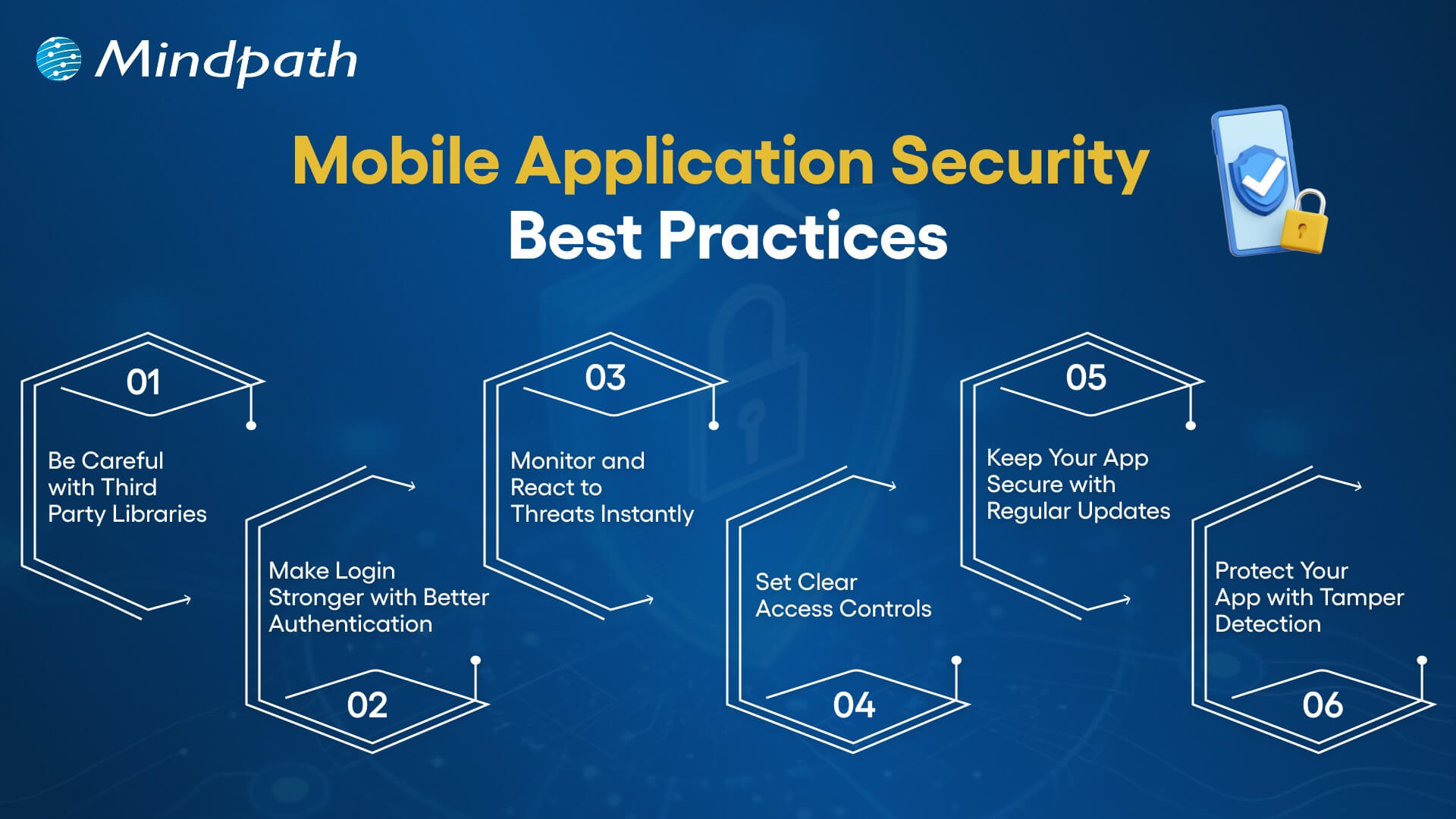
mobile application security best practices

1. Be Careful with Third-Party Libraries

Third-party libraries can save time but might bring security risks if not handled right. Always keep them updated and patched. Take time to check their safety before using them to avoid accidentally opening doors for hackers.

2. Make Login Stronger with Better Authentication

Use strong login methods to keep your app safe. Combine passwords with extra checks like one-time codes or fingerprint scans. Multi-factor authentication (MFA) makes sure only the right users can get in by asking for two or more ways to prove who they are.

3. Monitor and React to Threats Instantly

Use tools that keep an eye on your app and spot threats right away. When something suspicious happens, act quickly to protect your app. Having a clear plan for responding helps your team fix issues fast and keeps your app secure, following the best mobile security practices.

Also Read – Top Mobile App Development Trends in 2025

4. Set Clear Access Controls

Control what users can see and do in your app to keep data safe. By limiting access, you prevent unauthorized people from reaching sensitive information. This simple step is key to strong mobile app security and helps protect your app and users effectively.

5. Keep Your App Secure with Regular Updates

Regularly update your app and fix any security issues quickly. Patching helps close gaps that hackers could exploit. Setting up a routine for updates ensures your app stays protected and reduces the chance of breaches, keeping both your app and users safe.

6. Protect Your App with Tamper Detection

Use tamper detection to spot if your app’s code has been changed. Tools like checksums or digital signatures check the app’s integrity. If something is off, the app can stop running, alert your team, or even erase sensitive data to keep everything secure.

Wondering how a mobile app can boost your business? Explore the Benefits of Mobile App Development to discover how apps improve engagement, sales, and customer loyalty.

Are You Protecting Your App in the Right Way?

Application security best practices matter for everyone, not just tech teams. They help build trust, prevent data leaks, and keep users safe. Simple actions like checking your code, controlling access, and updating often can make a big difference. Staying secure today means staying ahead of threats.

At Mindpath, building secure digital experiences is our priority. Our web and mobile application development services follow proven application security best practices to ensure safety, performance, and reliability at every step. Partner with us to deliver robust and secure solutions you can trust.

Frequently Asked Questions

1. Why are application security best practices important for both web and mobile apps?

Application security best practices help protect user data, prevent unauthorized access, and reduce the risk of cyberattacks. Since both web and mobile apps handle sensitive information, following these practices ensures safer user experiences and helps maintain trust over time.

2. When should application security best practices be applied during development?

Security should be considered from the very beginning of the development process, not added later. Building security into design, coding, testing, and deployment stages helps prevent vulnerabilities early and reduces the chances of costly fixes after launch.

3. What are common mistakes that can weaken application security?

Common mistakes include ignoring regular updates, using outdated libraries, weak authentication methods, and poor access control. These gaps can make applications vulnerable to attacks, which is why consistent monitoring and timely fixes are essential for maintaining strong security.

4. How often should applications be tested for security issues?

Applications should be tested regularly, especially after updates or new feature releases. Continuous testing, including vulnerability scans and security audits, helps identify risks early and ensures the app remains protected against evolving threats over time.

5. Can small businesses also follow strong application security practices?

Yes, even small businesses can implement effective security measures. Simple steps like using secure coding practices, enabling strong authentication, and keeping systems updated can significantly reduce risks without requiring large resources or complex infrastructure.

Related Post

Related Post

React Component Architecture

React component architecture is a way of designing apps that divides the user interface into separate, reusable elements known as components. Each component is responsible for its own data and display, making the app more organized, versatile, and manageable. This method enables developers to create large applications by integrating basic building components, resulting in improved speed, faster updates, and seamless scalability as the program evolves. Since each component functions separately, modifications to one area of the program do not affect the overall system, allowing for faster and more efficient development.  

How React Component Architecture Helps in Scalability

1. Hierarchical Structure

React’s component architecture facilitates application scaling by organizing components in a hierarchical manner. Smaller components are nested within bigger ones, much like building blocks, to aid in the management of complicated programs. This structure adheres to the UI layout, making it evident how various elements of the program link. As the program expands, new features can be introduced without disrupting current components. Since each component operates separately, upgrades and maintenance are simplified. This modular strategy increases code reusability, lowers mistakes, and assures that even big programs stay well-organized and expandable over time.  

2. Incremental Updates

React’s component architecture promotes scalability by promptly handling updates. Instead of refreshing the full page, React employs a virtual DOM to identify just the parts that require updating. This implies that the UI refreshes rapidly and without disrupting other components, resulting in improved speed. For big and dynamic apps, this strategy avoids unneeded re-renders, allowing the program to operate smoothly even as it develops. By updating just the necessary items, React provides quicker load times, a better user experience, and less resource utilization. This makes it easier to grow apps while maintaining responsiveness and efficiency.  

3. Isolation of Logic

React’s component architecture separates application components, making them easier to maintain and grow. The UI and business logic are handled separately, allowing developers to construct and reuse components without having to deal with complicated state management. This separation guarantees that each component is dedicated to a single purpose, decreasing mistakes and boosting maintainability. When scaling a program, new features can be introduced without disrupting the rest of the system. React’s logic isolation allows teams to work on multiple portions of the app at the same time, making development faster, more organized, and simpler to scale as the project expands.  

4. Independent Units

React’s component architecture enables applications to scale effectively by making each component independent. Every component handles its own state and presentation, so updates or modifications to one element of the program will not affect the others. This modular framework allows you to add new features, repair bugs, and update certain components without impacting the overall system. Because components are self-contained, teams can work on different areas of the program at the same time, which speeds up development. This independence also enhances code reuse and maintainability, ensuring that the program remains organized and manageable as it expands.  

At Mindpath, elevate your app’s performance and scalability with our expert React development services.

Ready to build something amazing? Contact us today!  

Next Up: Learn about State Management in React and its role in scalable applications. 

Explore how to structure React components for maintainability, efficiency, and scalability in large-scale applications.
Generative AI Use Cases in Diverse Industries

“Necessity is the mother of invention.” We have all encountered this phrase in our science textbooks or while reading about most scientific innovations. Be it the invention of the cell phone, the internet, or the World Wide Web, each of these has brought a paradigm shift in the world of technology.  

While technology is rapidly expanding its horizon, Artificial Intelligence remains the buzzword that every business can’t stop gushing about. Generative AI, a subfield of artificial intelligence, has gained massive momentum post the launch of ChatGPT by OpenAI in 2022. Since then, generative AI use cases have found their way in some of the major industries, including healthcare, banking & finance, gaming, and supply chain, to name a few, marking the beginning of the Gen AI revolution.

But what is Generative AI? Is it only limited to text or image generation, or can it help in other fields as well? In this blog, we will be answering some of the burning questions around Generative AI and generative AI use cases across industries.  

Want to implement cutting-edge GenAI solutions in your company? Mindpath offers end-to-end AI Development Services for deploying generative AI applications efficiently.

Introduction to Generative AI 

Let’s start with the basics: what is Generative AI? A magic lamp that fulfils all your wishes; well, almost! Generative AI uses a pool of data that includes text, images, code, etc., amongst other data types.  

With the help of machine learning models and neural networks, this large sum of data gets analyzed, patterns are discovered, and output is delivered. Generative AI, as it says, is not limited to analyzing the data, but creates new information such as content, images, videos, and even code.  

Also Read: Top GenAI Trends 

Here are some of the key components of Generative AI:  

key components of Generative AI

  1. Data: Raw data such as documents, eBooks, ledgers, images, videos, codes and a lot more that Generative AI uses to learn.  
  2. Neural Network Models: They work just like a human brain; they help AI models to make sense of all the raw data we have put in the model.  
  3. Training and Model Parameters: There are some parameters that help AI models fine-tune the information, cut the noise and generate accurate output.  
  4. Input: When you ask a Gen AI model to create a cover letter for a job, create a report based on Excel data, generate a Ghibli image to roll with the current trends, that’s categorized as an “input”.  
  5. Output: Whatever results a Gen AI model, such as ChatGPT, MidJourney, Bart, delivers for your query is the output.  

Generative AI is gaining momentum, with a global market valued at USD 37.89 billion in 2025 which is projected to reach USD 1,005.07 billion by 2034 at a CAGR of 44.20%. (Source: Precedence Research)

Generative AI Use Cases Across Industries 

While Gen AI is growing, curating a business-first roadmap for its adoption is important for those seeking to leverage it to its fullest advantage.  Now that we have explored what Generative AI is, let’s move on to some prominent generative AI use cases in different industries, proving that it’s more versatile than we know!  

1. Healthcare 

According to a recent survey by Deloitte Center for Health Solutions, 75% of leading healthcare companies across the globe are either currently experimenting with generative AI or planning to scale Gen AI in the near future.  

In what area, you may wonder? Generative AI healthcare is being used to maintain patient records, drug discovery, interpreting and analyzing medical images such as X-rays, CT scans, MRIS, to mention a few.  

Scientist are using generative AI for modelling molecular structures that can help not just in creating new drug compounds but also in predicting their effectiveness.  

92% of healthcare leaders see a promising future of generative AI in improving efficiency as well as speeding the decision-making in critical scenarios.  

2. Banking  

Next up is the banking and finance industry. Generative AI in banking is fueling the fintech revolution in more ways than one. Generative AI is currently being leveraged for detecting fraud, assessing the credit score or credit risk based on the creditworthiness of an individual or an entity, customer support, automating routine tasks and compliance checks, creating investment strategies, among others.  

A recent report by KPMG revealed that around 76% of banking executives in the United States are planning to implement Gen AI for fraud detection and prevention, while 62% want to leverage it to improve their customer service, followed by 68% of professionals that believe Gen AI can be best used for regulatory compliance.  

3. Gaming  

One of the most exciting areas for generative AI applications could be gaming. According to Statista, over one-third of game developers across the globe are already using Gen AI tools in their studios. PCG, which stands for Procedural Content Generation, is the largest segment of the gaming industry where almost 30% gen AI is being used currently. PCG helps game developers create larger than life game world, environment and universe that intrigues the players and gives them a more immersive experience.  

Other than PCG, some other significant generative AI use cases in gaming include developing characters, detecting bugs, generating real-time content like new levels and challenges, and detecting any kind of irregularities or security breaches or threats.  

Wondering how AI can help your business to reach the exceptional level of growth? Read our blog to learn about the importance of generative AI for business.

4. Supply Chain 

When it comes to adopting Gen AI, the supply chain industry is no stranger to it. In fact, McKinsey’s survey revealed that a third of global businesses are effectively using generative AI in business areas, including operation processes automation (66%), production planning and scheduling (47%), quality control and inspection (44%), and inventory management (43%).  

Gen AI can support the supply chain industry with better demand forecasting, optimizing day-to-day operations, assessing and controlling supplier risks,  quality control, fraud detection, and much more!  

 5. Other Industries 

Apart from the above-mentioned industries, use cases of generative AI are prevalent in other industries such as sales and marketing, insurance, legal and compliance, human resources, product development, and many more.  

While many still utilize gen AI for content, image and code generation, the applications are certainly above and beyond. However, leveraging gen AI comes with its own set of challenges. Being AI-ready is in demand for every industry and business seeking to adapt and leverage AI to its advantage. There’s no one-size-fits-all guidebook or roadmap for AI adoption; rather, each business and industry needs to understand its niche and create a roadmap that generates true value.  

Wondering how generative AI is influencing content creation and design strategies? Check out our blog generative AI changing creative industries  to see how AI-driven creativity is shaping the future of industries.

Ready to Embrace Innovation with Generative AI?

Generative AI is expanding its horizon, and businesses have started to realize its true potential. While Gen AI continues to grow, it’s critical to assess all of its aspects that involve data security, lack of information, and overdependence.  

Businesses looking to adapt AI must look beyond the hype and create a strategy that works for them. At Mindpath, we help businesses create solutions that are based on their real pain points rather than creating just another software. When you talk to us, we attempt to understand your operations and what may work to make them more efficient.  

Our customer-first approach helps us identify gaps and curate a solution that works for you. Thus, if you’ve been wanting to adopt AI, the right time is now! Let’s discuss how our AI development services can help you make the best of up-and-coming technologies and get your business future-ready!  

Frequently Asked Questions

1. Why are generative AI use cases expanding so quickly across industries?

Generative AI use cases are expanding because businesses need faster innovation, better decision-making, and automation at scale. The technology can process vast datasets and generate meaningful outputs, helping industries respond quickly to market changes while improving efficiency, accuracy, and customer experience.

2. How can companies identify the right generative AI use cases for their industry?

Businesses should start by analyzing operational challenges, repetitive workflows, and data-heavy processes. The most effective generative AI use cases solve real business problems rather than following trends. A clear roadmap, measurable goals, and strong data infrastructure help ensure successful adoption.

3. Is generative AI suitable for regulated industries?

Yes, but with caution. Regulated industries like healthcare and finance must ensure data privacy, compliance, and transparency. Proper governance frameworks, human oversight, and secure infrastructure are essential to safely implement AI solutions without violating regulatory standards.

4. What skills are required to implement generative AI in an organization?

Organizations need a mix of AI engineers, data scientists, domain experts, and cybersecurity professionals. Beyond technical roles, leadership must understand strategy and change management. Training employees to collaborate with AI tools is equally important for long-term success.

5. What risks should businesses consider before scaling generative AI solutions?

Key risks include data bias, security vulnerabilities, inaccurate outputs, and overdependence on automation. Businesses should validate AI-generated results, maintain human supervision, and establish ethical guidelines. A balanced approach ensures innovation without compromising reliability or trust.

Custom mobile application development

Businesses today, in a fast-moving digital world, are always trying to innovate so they can stay ahead. Custom mobile application development helps drive the change in how companies interact with their customers and improve internal operations. Try to imagine having a solution that is just for your business and will improve efficiency, engagement, and accelerate growth. Developing an app with a solution for the goals of your business has become a strategic need for any business wanting to be an industry leader.

As technology develops, the demand for personalized digital experiences grows, and the expectations of customers rise. If organizations want to provide authentic value, they can no longer select a generic approach. With custom mobile application development services, organizations gain the ability to adjust quickly, have deep functionality, and create seamless experiences that genuinely resonate. In this blog, we will discuss how those applications form the basis of digital transformation and change the way businesses are operating in a connected world.

Unlock new ways of connecting with users that help your business reach greater heights with Mindpath’s mobile app development services, which provide solutions according to the individual business demands.

Overview of Custom Mobile Application Development

Custom mobile app development means developing customized mobile applications that align with the company’s unique goals and workflow. A custom mobile app development company constructs your app from the ground up, giving you total control of features, design, and experience, while they supply the solutions to maximize efficiency and growth.

The process enables organizations to provide seamless integration of the app with their current systems with full confidence in security and scalability. Throughout the process, from planning and designing to developing and supporting, every phase of the app is managed to achieve business requirements and provide a smooth, entertaining experience for users.

How Does Custom Mobile Application Development Drive Digital Transformation?

Custom mobile app development is changing the way businesses think about tech and growth. It allows organizations to embrace newer solutions to replace their technologies that serve the company’s individual goals and strategies in this digital age.

Driving Digital Transformation with Custom Mobile Application Development

1. Boosting Customer Experience

By using custom mobile application development, a company can have an app that is unique and offers a different experience for the users. These applications are the most convenient way for the customers to interact with the company, get a response, and receive the service. If a business adopts a user-centric design, it is only a matter of time before they will see their customers being more loyal and having a stronger bond with them.

2. Improving Workflow Efficiency

Personalized applications simplify core business operations through the automation of monotonous tasks and the minimization of errors. As a result, the company productivity is elevated and operational expenses are lowered. Enterprises thus become winners of facilitated work processes and a better structured system.

3. Supporting Smart Decision-Making

Custom app development enables real-time data collection and analysis. Companies have the ability to monitor consumer behavior, industry trends, and their own performance in an easy way. Such a data-driven strategy is a great source of power for decision-makers, as it enables them to take correct and prompt decisions.

Want to understand which tools and frameworks power successful mobile apps and accelerate digital transformation? Explore our detailed guide on mobile app development technologies to discover the platforms and tech stacks driving innovation.

4. Encouraging Innovation and Agility

By using tailored solutions, businesses have the possibility to create exclusive features that tackle issues directly. Such freedom from constraints promotes creativity and makes it possible for the company to adjust to the changes in the market swiftly. In other words, companies have the opportunity to be ahead of their competitors in the sense that they can try out new things and make their moves faster.

5. Gaining a Competitive Edge

Custom applications are a great way for companies to be different from the rest of the businesses by giving them exclusive features and a better user experience. Such differentiation leads to a powerful market presence. A good app is the company’s strongest weapon in the battle for customers against competitors.

6. Preparing for Growth

Custom mobile application development is a wise decision when considering business growth because it guarantees that the app will be scalable. It is very easy to add new features or make a service available to more users. The company can grow with no problem of performance or user experience being compromised.

Must Read: AI in Mobile Apps

7. Securing Data and Compliance

Custom apps may have the most sophisticated security features that are specifically tailored to meet the needs of different industries. Such features not only secure sensitive information but also help in maintaining compliance with the set regulations. Companies can go about their operations without any worries that their data is secure.

8. Integrating Seamlessly with Systems

Custom apps built using the right mobile app development tools can be linked to existing corporate software and platforms without any problems. As a result, this leads to the creation of a single digital ecosystem that spans across different tools. Information exchange between various systems becomes very easy. Hence, the mistake rate is reduced, and the speed of work is increased.

9. Supporting Remote Teams

With the help of mobile application development platforms, employees get access to tools and information from anywhere. This provision of remote access is a great boost to collaboration, which can now happen across different locations. It also allows work arrangements to be flexible. Teams are thus not being unproductive as they are not bound to a single office.

10. Creating New Business Opportunities

The creation of custom apps may result in a business gaining revenue streams through subscription fees, in-app purchases, or new digital models. Companies can now dig into newer ways of monetizing their services. By means of website and mobile app development, the business can ensure that these opportunities are indeed going in line with their overall strategy.

Looking to future-proof your mobile app strategy? Discover the latest insights in our blog on mobile app development trends to see how emerging technologies are redefining digital experiences.

Want to Drive Growth with Custom Mobile Apps?

Custom mobile application development is a powerful tool for businesses looking to innovate and stay competitive. Tailored apps improve efficiency, enhance customer experience, and provide data-driven insights that guide smarter decisions. By adopting custom solutions, organizations can drive growth, strengthen their market presence, and create seamless digital experiences that truly align with their goals.

At Mindpath, we offer professional custom mobile application development services to help businesses achieve these results. Our team builds scalable, secure, and feature-rich mobile applications that integrate smoothly with existing systems. We focus on delivering solutions that match your business needs and foster innovation. We provide a superior user experience across all platforms.