AI and Cloud Computing: Top Benefits and Best Practices

Join our Newsletter!

Featured Posts

Support Is One Click Away

Home

AI and Cloud Computing: Top Benefits and Best Practices

AI and Cloud Computing

AI and Cloud Computing: Top Benefits and Best Practices

The modern-day digital development depends on the intelligence, scalability, and flexibility advancing concurrently. This transformation is driven by AI and cloud computing, which help companies to make more efficient decisions by analyzing data faster. Executives see visible improvements in operations, products and customer experience. Consequently, the subject of conversation is not just trends but actually implementation. Teams want to have systems that learn, adapt and spur growth with minimum friction or delays.

With the increased adoption, there are heightened expectations in every industry. Decision makers want to have clarity, control and enduring value. They have to strike a balance between innovation and stability and cost consciousness. Additionally, it depends on choosing the correct strategy at the initial stage to succeed. Strategy is crucial and so is the technology. So, in this blog, we shall analyze the major advantages and the best practices of AI and cloud computing.

Keep reading further to learn more about this strategic synergy!

Want to optimize your business operations and scale effortlessly with the cloud? Mindpath offers cloud-managed services to provide secure, efficient, and fully managed cloud solutions.

Understanding the Core Fundamentals of AI and Cloud Computing

Artificial Intelligence (AI) facilitates machines to carry out tasks that would otherwise be carried out by human intelligence. It studies based on data, reasoning, identifies patterns, and comprehends language. Some of these major fields are machine learning, deep learning and natural language processing. AI helps companies to increase their efficiency, create smarter tools, and discover insights. Artificial intelligence and cloud computing tend to collaborate in order to improve outcomes.

Cloud computing involves computing resources, which include servers, storage as well as software offered via the Internet. It allows businesses to scale fast, pay as per their usage and access services anytime. The basic models include IaaS, PaaS and SaaS. This adaptability reduces the cost, accelerates the development, and supports the contemporary applications.

AI applications run effectively and successfully on cloud computing. AI and cloud computing go hand in hand to develop smarter and quicker systems. Cloud provides scalable storage and high-performance computing of AI models. AI will introduce intelligent cloud services via analytics, automation and optimization of resources. They all facilitate chatbots, predictive insights, and data analysis. The companies can operate cloud-based AI to take advantage of more advanced AI tools without substantial initial expenses and data analysis. Companies can access advanced AI tools on cloud platforms without huge upfront costs.

Looking to streamline cloud operations with intelligent solutions? Explore AI tools for DevOpss to see how automation and analytics optimize development and deployment workflows.

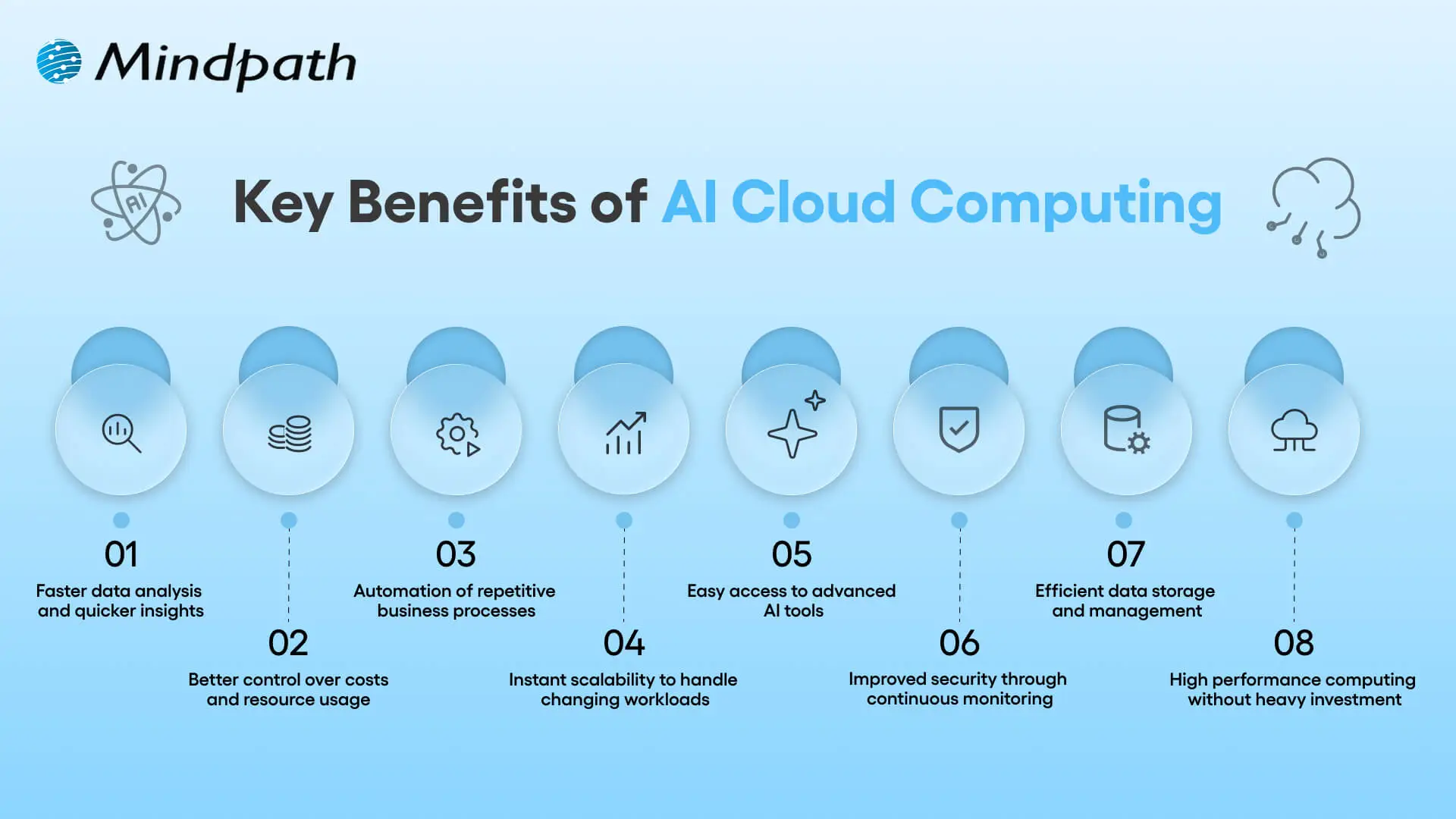
Key Benefits of AI Cloud Computing

AI and cloud computing are transforming the world of business and technologies. They open up fresh opportunities of development, productivity, and better decision making. Organizations look into how to make use of this combination. These are the best advantages that companies can embrace to remain competitive.
1. Faster Data Insights

AI and cloud computing have excellent assistance in analyzing large data sets within a short period of time. Businesses bridge the data sources at ease and identify patterns that can make better decisions. This pace facilitates planning and minimizes guesswork in the operations.

2. Smarter Cost Control

AI and cloud computing minimize excessive expenditure on computers and their support. Businesses purchase resources as they consume and spend as demand increases. This strategy maintains flexible and predictable budgets.

3. Intelligent Automation

AI and cloud is used to automate repetitive workflow processes. Systems acquire knowledge and enhance processes through time. Teams are more strategic oriented as operations proceed normally.

4. Flexible Scaling Power

With AI and cloud computing, scaling up and down of resources is done on demand. Businesses either expand or contract without hesitation. This scalability helps in the development and unexpected increase in workload.

Must Read: Cloud Computing Trends

5. Easy Access to AI Tools

Cloud services provide ready-to-use AI services to business needs. Teams combine analytics, language processing, and vision tools within a short period of time. In combination, cloud computing and artificial intelligence eliminate technical restrictions.

6. Stronger Security Oversight

Cloud systems that operate based on AI keep a constant watch on activity. They identify threats at an early stage and react quicker to threats. This enhances security without retarding processes.

7. Better Data Management

Cloud services are an easy way of organizing, storing and retrieving data. AI assists in the automation of information classification and management. Companies have smarter data to analyze and report.

8. High Performance Computing

Artificial intelligence workloads require resources with high computing capabilities to operate. The cloud platforms offer on-demand GPUs and fast processors. Businesses deal with complicated activities that are not heavily capitalized.

Planning to deploy AI solutions at scale in the cloud? Explore cloud security tools to see how modern technologies secure AI pipelines and cloud infrastructure.

Best Practices for Implementing AI in Cloud Computing

AI and cloud computing need a more explicit and deliberate way of developing real value. Before adopting systems, teams need to plan, set goals and prepare systems. Technology is as important as strategy. These best practices demonstrate the way to apply AI in cloud computing in an effective and responsible manner.
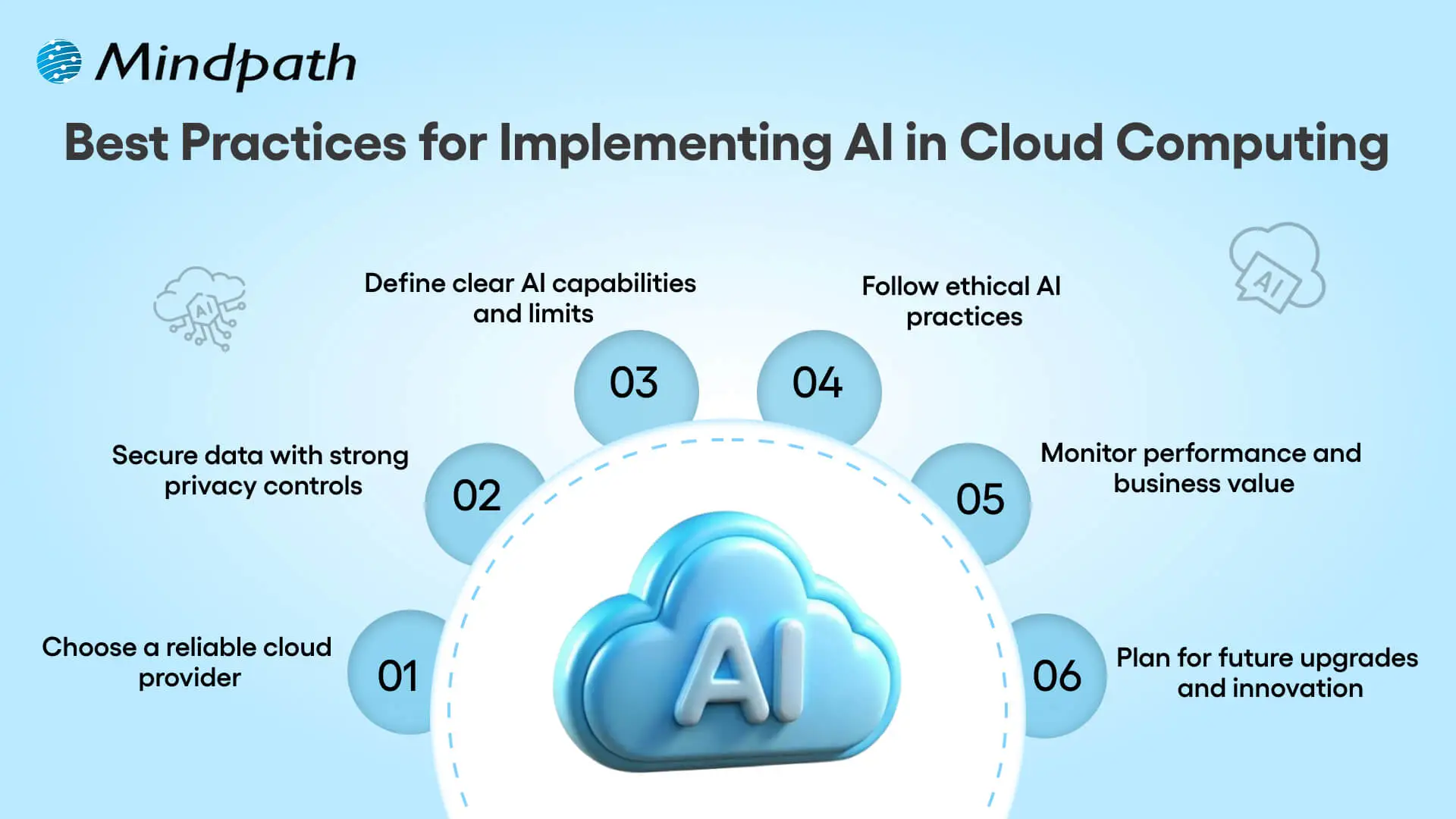
1. Select a Trusted Cloud Provider

Select a provider with the track record of working with AI and cloud services. Assess its standards of reliability, scalability, and compliance. Powerful partner will facilitate safe expansion and stable long-term operations.

2. Prioritize Data Privacy and Security

Encrypt and implement control access to sensitive information. Review security policies on a regular basis in order to minimize risks. High level of security instills trust in cloud systems and AI.

3. Define Clear AI Capabilities and Limits

Know what AI is capable of providing under the circumstances of the quality of the data. Track models regularly in order to identify bias or performance problems. Good expectations can make teams use AI in a responsible and effective way.

Also Read: Cloud Computing Attacks

4. Establish Ethical AI Practices

Instruct employees on how to use AI fairly, transparently, and accountably. Ethical consciousness results in an improved decision-making process within teams. Conscientious operations enhance the confidence of cloud-based AI.

5. Monitor Performance and Business Impact

Monitor behavior and business performance of the track systems. Assess value through measurement of efficiency, accuracy and cost. Consistent reviews help to maintain AI and cloud investments in accordance with the objectives.

6. Prepare for Future Innovation

Anticipate changing regulations and elements of technology. Architecture Software Build scalable systems, which welcome upgrades and additional features. A visionary roadmap would guarantee success in the long term with AI and cloud computing.

Wondering how AI applications can scale efficiently in the cloud? Check out serverless architecture in cloud computing to learn how server-free designs enable faster, cost-effective, and scalable deployments.

Ready to Turn AI and Cloud Computing into Real Business Value?

Artificial intelligence and cloud computing are transforming the nature of modern business development, competition, and innovation. They allow making smarter decisions, executing them faster, and operating flexibly together. It takes proper planning, excellent data, and responsible usage in order to be successful. By linking technology to the objectives of the firms, companies mitigate risk and create value in the long term. The approach will assist teams to develop systems which are adaptable, scalable and perform well.

Mindpath AI cloud services assist companies to embrace AI clearly and confidently. Our professionals develop safe and scalable solutions which are practical to the business requirements. We put an emphasis on performance, ethics, and quantifiable results. Mindpath provides organizations with a dependable service in terms of planning, deployment, and optimization. Our strategy will make AI and cloud computing produce useful outcomes and not complications.

Related Post

Explore common myths about AI, uncover the truths behind them, and learn how Mindpath’s AI development services can transform your business.
Discover the top 7 tools for managing remote development teams, boosting collaboration, communication, and productivity.

Related Post

Hiring remote software developer

If you are in search of good remote software developers in New York, you might be aware of the challenges behind it. Due to the competitive landscape, it is hard to find an expert who can communicate well and integrate effortlessly into your team without any friction. So, companies in New York are essentially hiring remote software developers to scale faster and to access specialized skills while reducing operational costs. As the software development market size is going to touch 1.04 trillion by 2030, businesses are looking forward to unveiling something unique to lead the graph. 

In this blog, you can go through the expert-backed tips and the best practices to confidently assess the remote hiring process in New York. With the professional assets by your side, you can be assured of long-term business growth. 

Planning to turn your software idea into a powerful business solution? Mindpath offers custom software development services in New York tailored to your unique requirements.

Why Hiring a Remote Software Developer in New York Is So Essential

Talking about New York, it is a global tech hub. But competition for top talent is expensive and intense at the same time. So, you can hire a remote software developer to encourage your business and to remain competitive without compromising on skills or speed. 

There are some key elements present in New York that drive the demand for hiring remote software developers. This includes high local salaries that allow companies to prioritize remote options. Further, global talent pools also leverage niche expertise that suits the companies’ requirements. 

As a result, hiring a software engineer for remote roles has become a strategic decision rather than a temporary solution. 

Must Read: Remote Work Tools for Developers

Challenges of Hiring a Remote Software Engineer in New York

Hiring remote developers in New York can help you leverage the excellence of incredible talent. However, it has certain complications. 

1. Cultural and Communication Barriers

Considering people from different countries and backgrounds can strengthen your team, but it comes with some friction. What feels like significant and effective feedback to one developer might be blunt for another one. So, you must be clear about your expectations and communicate everything with clarity to ensure smoothness. 

There are some teams that even include short sessions to make new employees understand the basic rules of the company. 

2. Time Zone Disturbance

Coordinating across time zones might sound easier, but it is much more complex than expected. So, creating certain overlapping hours for real-time meetings majorly depends on async tools to keep things moving. So, it is necessary for remote software engineer jobs to understand the essential time zone and communicate with the right people. 

3. Onboarding and Training Difficulties

It is not possible for you to onboard remotely. However, your company should prioritize an intentional structure. You just can’t depend on casual conversations to bridge the gaps. You must stick to a documented process combined with scheduled check-ins. This ensures your new remote software engineer is feeling less isolated. 

Looking to reduce hiring costs while maintaining quality? Learn about the key benefits of hiring remote developers and how they help companies stay competitive.

What Skills Should You Look for in a Remote Software Engineer?

When you are assessing a software developer for remote roles, verifying only technical readiness is not enough. Remote working requires a proper balance of hard and soft skills to ensure productivity. 

Major Technical Skills

  • The developer should be proficient in leading programming languages. 
  • They should have proper experience in handling cloud platforms and APIs.
  • The experts possess coding best practices to make your company lead with innovations. 
  • They should be familiar with modern and advanced frameworks. 

Important Soft Skills

  • Talking about the soft skills, the remote software developer jobs include proper communication abilities. 
  • They should maintain self-discipline and timelines to complete a project on time. 
  • The experts should have a problem-solving mindset that can encourage innovations. 
  • Most importantly, they should have experience working independently without continuous supervision. 

These qualities are essential for success in remote software engineer jobs, especially when your team is operating in different time zones. 

Looking to hire the right remote developers for your projects? Check out most popular web programming languages to understand which technologies top developers use and how they impact project success.

Steps to Hire the Best Remote Software Developers in Town

If you are looking forward to hiring a remote software developer for the competitive network of New York, you must break the chain of the traditional hiring process and follow a structured approach as given below.

1. Define Your Project Requirements

Before you pile up your desk with multiple resumes, take a pause and clarify what you are actually looking for. Think of these one-off features that need to be completed within a month, or a long-term role. It is also essential to understand if you are looking for a single developer or a team for your remote Dev jobs

Being specific about your requirements can prevent you from interviewing candidates who are not meeting your expectations.

2. Be Specific About Your Job Descriptions

A good job description can define what expectations you are setting. As a series of companies in New York might be structuring their job description, you need to be unique. Outline the daily responsibilities and the skills that are non-negotiable. Further, it is efficient to list down the tools that the remote software developer should be acquainted with. 

For example, if your development criteria rely heavily on React and Node, just be open about it. It can save you and the application from future frustrations.

3. Source Your Candidates

Where you are sourcing your candidates speaks a lot about the kind of developer you will find. Freelance marketplaces can bring you a lot of choices quickly, but the quality might be missing. On the other hand, talent networks generally examine their candidates, but the price can be on the upper side. So, most of the companies rely on outsourcing agencies as everything fits perfectly with them as per the requirements. 

However, the decision completely depends on your priorities and needs. So, assess properly.

Want to combine remote hiring with global expertise? Check out offshore software development to understand how offshore teams support faster, flexible software delivery.

4. Go Through the Applications and Portfolios

A portfolio of the remote software developer can represent what they have built in the past and how it has influenced the business’s profile. Look, if their work has some resemblance to your project scopes and complexities. This is one of the most important steps you need to look for when hiring a remote software developer in New York.

5. Verify Technical Skills

Pair-programming sessions, coding challenges, and small paid projects can unveil if a candidate’s skills align with their claims. So, you can assess their technical knowledge through some quick and easy tests. But, do not overdo it, as it can hamper their confidence while making your company lose a true talent.

6. Evaluate Cultural Fit

Technical ability is just half the picture. You want someone who can communicate properly and can take feedback positively. This is very important for remote teams where communication is more essential than ever.

7. Onboard Efficiently

Hiring a remote software developer with a signed contract is not enough. It also depends on how you involve them in your team. Offer them the tools and make them acquainted with the documentation. Make clear introductions and make them feel like part of the team. 

Looking for experienced ReactJS developers to support remote projects in New York? Discover how to hire ReactJS developers in New York and build a high-performing development team.

Why Experience is Important When Hiring Remote Developers?

Not all developers thrive in remote settings. For better adaptability, you should hire a remote software developer with prior experience. 

  • Experienced remote professionals require less supervision.
  • They can communicate proactively while eliminating all the gaps.
  • They understand async workflows and offer consistent results without failing. 

Final Words

The demand for a remote software developer in New York is continuously growing due to agility and innovation. So, understanding the right techniques to hire remote developers can allow the New York companies to adopt world-class expertise without any geographical limits. However, your success depends on your expectations and a strong focus on collaboration and compliance. 

So, if your organization is aiming to build a remote development team, it is essential to partner with a technology company that understands engineering and delivery at the same time. This is where Mindpath comes into the picture. Mindpath offers custom software developments services which provide support your business by offering complete technology solutions while making your digital platforms scalable. Collaborate with skilled software developers here who can make your outcomes align with the business demands. 

Learn how to hire remote software developers in New York with expert tips on defining needs, skills, and onboarding for project success.
Generative AI in Human Resources

Imagine a world where hiring the perfect candidate feels effortless, employee engagement is at an all-time high, and HR processes run like a well-oiled machine. Sounds like a dream, right? What if I told you that Generative AI could be the key to making this vision a reality? Have you ever wondered how technology could enhance talent acquisition, streamline onboarding, or even foster a more inclusive workplace? In this blog, we’ll explore the transformative role of Generative AI in HR. So, let’s dive in! 

What is Generative AI?

Generative artificial intelligence (generative AI) is a form of AI capable of producing new content and ideas, such as conversations, stories, images, videos, and music. AI technologies aim to replicate human intelligence in nontraditional computer tasks such as image identification, natural language processing (NLP), and translation. Generative AI represents the next phase in artificial intelligence. You can teach it to understand human language, programming languages, art, chemistry, biology, or any other complicated topic. It leverages previously trained data to tackle new issues. For example, it can acquire English vocabulary and compose a poem using the words it processes. Your organization can utilize generative AI for a variety of applications, including chatbots, media production, and product development and design.  Generative AI is important in HR because it alters old procedures and improves decision-making. HR personnel can focus on strategic efforts that encourage development by automating tedious duties like resume screening. Furthermore, Generative AI does data analysis to find insights that enhance employee engagement and talent acquisition. Integrating Generative AI in HR facilitates operations and creates a more responsive workforce, which boosts overall performance as firms look for efficiency and creativity. 

Role of Generative AI in HR

1. Smarter Recruiting

Generative AI can greatly simplify the employment and recruitment process. For instance, employment posts can be made visually appealing and with clarity using ChatGPT. In order to focus and improve the effectiveness of interviews, they can also create unique screening questions according to the position. 

AI can be used by HR departments and recruiters to save time and effort while writing various email correspondence throughout the employment process, such as outreach emails and rejection letters. 

Certain platforms now allow you to look for candidates by posing straightforward queries as an alternative to laborious search techniques. To identify the greatest fit for your vacant roles, these AI technologies may also compare the profiles of candidates with job descriptions. 

2. Streamlined Onboarding

AI chatbots can act as virtual assistants during the onboarding process, providing new hires with real-time help. The process runs more smoothly since they can respond to enquiries regarding corporate regulations, perks, salary, and how to obtain time off swiftly. These chatbots also offer assistance with utilizing the company’s systems, finding vital assets, and finishing required documentation. This not only makes the onboarding process better, but it also makes new recruits feel more at ease and established into their jobs faster. By simplifying duties, AI helps HR professionals to focus more on personal connection and assistance 

3. Training Transformation

The training and development of employees can be substantially enhanced by combining generative AI with HR. AI, for example, can evaluate a worker’s abilities, output, and career objectives to provide tailored learning programs that best suit their requirements. Additionally, AI-based training solutions are emerging. These technologies replicate the advantages of in-person coaching by giving advise, responding to queries, and providing real-time feedback. 

By automatically updating content to match industry standards, AI can maintain training materials current and guarantee that staff members are constantly learning the most recent knowledge. AI is also capable of producing realistic training simulations that adjust to the decisions made by staff members, giving them experience making decisions in actual situations. Employee confidence is increased, and practical skills are developed via this experiential learning. 

4. Enhancing Engagement

HR managers can utilize generative AI to create thoughtful survey questions for employee engagement. These questionnaires can provide insightful information on how to raise productivity, enhance workplace happiness, and resolve any issues inside the company. 

The previously discussed AI chatbots can also help to keep current employees engaged by routinely responding to enquiries about corporate perks, policies, and other important details. This enables workers to easily obtain what they want through self-service, freeing up HR personnel to concentrate on more crucial in-person contacts that enhance the working environment as a whole. 

5. Data-Driven HR Insights

Generative AI can help HR departments in analyzing enormous volumes of data and identifying relevant trends. It can also convert complicated information into simple visualizations, making data insights more understandable and appealing. 

For example, AI can analyze compensation data to identify trends or unexpected patterns, such as gaps in pay or attendance, which can indicate concerns such as employee unhappiness or management issues. AI can even construct scripts for deeper data analysis, allowing HR teams to explore more sophisticated insights and take quick action to address possible issues. 

6. Faster Task Automation

Generative AI can speed up numerous mundane operations for HR workers, such as arranging interviews, going through applicants, and creating reports. This enhanced efficiency enables HR teams to focus on higher-impact tasks such as strengthening business culture, implementing talent initiatives, and generating personalized employee development plans. 

By automating repeated operations, AI decreases the chance of human mistake while simultaneously ensuring process consistency. This not only increases HR efficiency, but it also enhances accuracy and decision-making. As a result, HR departments become increasingly important to the company’s performance, influencing its development and long-term strategy. 

7. Improving Internal Communications

Generative AI can assist in the development of internal communications that are suited to the needs of both the organization and its personnel. It can swiftly create material with the appropriate tone and voice to reflect the company’s ideals, as well as personalize messaging to better connect with each employee. AI ensures that messages within the organization are consistent, engaging, and accessible to everybody. 

AI can also personalize communications depending on an employee’s function, hobbies, geography, or career stage. Whether you’re communicating with recruits or current workers, generative AI ensures that your messages are smart, targeted, and successful at all levels. 

Generative AI Solutions at Mindpath

At Mindpath, we provide Artificial Intelligence solutions that make HR activities easier and faster. Our AI products assist HR teams in streamlining their operations by automating chores such as generating job posts, screening candidates, and drafting emails. We also utilize AI to analyze massive quantities of HR data, identifying patterns in employee performance, attendance, and pay.  HR teams can apply generative AI to develop personalized training materials, deliver targeted messages to staff, and improve internal communications. Our products allow HR professionals to devote more time to vital tasks such as employee development, talent management, and workplace culture improvement. Mindpath enables HR teams to work smarter and contribute more to company development. 

Wrapping Up!

Generative AI is revolutionizing the future of human resources by making procedures more efficient, personalized, and data driven. From smarter recruiting to increased employee engagement, AI enables HR professionals to focus on what is most important to people. As technology advances, adding AI into HR procedures will save time and effort while also creating a more inclusive, responsive, and effective workplace. At Mindpath, we help HR teams realize the full potential of generative AI, resulting in increased growth and innovation in your organization. The future of human resources is here, and it is powered by AI. 

Ready to transform your HR processes with Generative AI?

Partner with Mindpath to streamline recruitment, boost engagement, and drive business growth.

Explore how Generative AI in Human Resources is revolutionizing recruitment, making HR processes smarter and more efficient.
Hire NodeJS Developers in London
The cost of hiring Node.js developers in London varies according to expertise, project complexity, and firm size. Junior developers often charge £30-£70 per hour, but experienced developers charge between £70 and £150 per hour. It’s critical to assess your project’s requirements and budget appropriately. The following are significant factors that determine these expenses.

1. Experience Level

The experience of a Node.js developer significantly impacts the hourly rate. Junior developers with limited experience in Node.js typically charge lower rates, between £30 – £70 per hour. They can handle basic tasks but may need more guidance. In contrast, senior developers with extensive experience in complex Node.js projects and advanced skills may charge £70 – £150 per hour. Their expertise includes managing large-scale applications, leading teams, and solving intricate technical challenges, justifying their higher rates.

2. Project Complexity

The complexity of the project plays a crucial role in determining developer rates. Projects requiring expertise in advanced Node.js frameworks (such as NestJS or Express) or specialized areas like cloud integration and real-time services will demand developers with advanced skills. Such projects often require a deeper understanding of architecture and scalability, leading to higher rates. Developers with specialized knowledge will charge more to reflect the increased technical demands and the project’s overall complexity.

3. Company Size and Location

The size of the company and its location can also influence Node.js developer rates. Larger companies located in central London typically offer higher hourly rates, ranging from £70 to £150. These companies often have more significant resources, larger budgets, and complex projects. In contrast, smaller startups or businesses based in suburban areas may offer lower rates, typically between £30 to £70, as they often work with tighter budgets and smaller-scale projects. However, location does not always guarantee lower rates, as other factors such as the project type can still affect pricing.

At Mindpath. we offer expert Node.js developers with the right experience to meet your project’s needs, whether you’re looking for junior talent or senior developers with specialized skills. Our developers are proficient in advanced frameworks, real-time solutions, and complex cloud integrations, ensuring your project is in capable hands.

Start building your team with Mindpath today!

Discover the cost to hire Node.js developers in London: £30-£70/hour for juniors and £70-£150/hour for experienced, depending on expertise and project complexity.